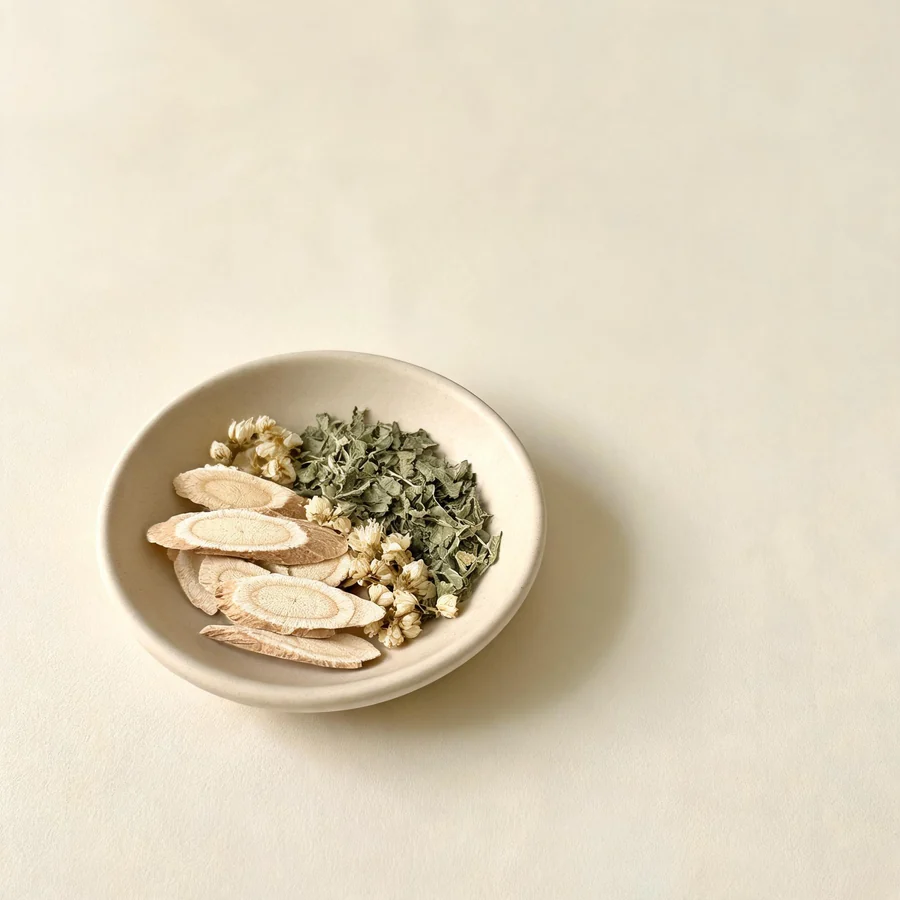
Understanding Burning hot skin to the touch
The tradition describes the skin as a mirror of the internal organs and of defensive Qi. Heat reaching the surface feels hot to the touch regardless of its source.
Wind-Heat gives sudden onset after wind or a cold, with skin that feels hot but may be accompanied by chills, sore throat and thirst. Toxic-Heat gives painful hot red eruptions such as boils or abscesses with high thirst, restlessness and dark scanty urine.
Heat in the Blood gives bright red rashes with skin that feels warm or burning, especially at night, with a flushed face and restlessness. Damp-Heat gives burning with weeping or oozing skin, a heavy body and a greasy taste.
Empty-Heat from Yin deficiency is the most easily missed pattern: the skin feels warm or burning especially at night, with night sweats, dry mouth and five-palm heat, but there is no red inflamed rash. The treatment is nourishing, not cooling. Liver Qi stagnation transforming into heat gives burning that flares with anger, with rib-side distension and irritability.
The skin is read as a mirror of the internal organs and of defensive Qi. When it feels hot to the touch, heat has risen to the surface, and the task is to find where it came from. The Lungs are said to govern the skin and to manage how the pores open and close, so an outside invader usually involves them first, but the Liver, the Spleen and the Kidneys can each generate heat of their own that radiates outward. Because the same symptom has so many origins, there is no single cooling answer, and the practitioner relies on the tongue, the pulse and the history of the flare.
The patterns differ in texture and timing as much as in cause. Wind-Heat arrives suddenly and fights at the surface. Toxic-Heat gathers into painful swellings and consumes fluids. Heat in the Blood makes the skin bright red and the blood agitated. Damp-Heat leaves the skin wet and the body heavy. Empty-Heat from Yin deficiency burns quietly at night with little to see. Heat from Liver Qi stagnation flares only when emotion peaks. Whether the skin is moist or dry, and whether the burning is worse by day or by night, is often the fastest way to tell them apart.
Conventional view
From a Western perspective, skin that feels hot to the touch is often a sign of local inflammation, infection or increased blood flow, with common causes including sunburn, allergic reactions, insect bites, cellulitis, abscesses, or systemic conditions such as fever and autoimmune flares. Diagnosis involves a physical exam checking redness, swelling and skin temperature, sometimes supported by blood tests or cultures.
Treatment depends on the cause: antibiotics for bacterial infection, antihistamines for allergy, topical corticosteroids or oral NSAIDs for inflammation, cooling gels and pain relievers for sunburn or mild irritation, and where no clear trigger is found, symptom relief with antipyretics for fever or emollients for dry irritated skin.
These approaches calm an acute flare but often do not address why the Heat keeps returning; when tests are normal and the burning comes and goes, or is tied to stress, diet or hormonal cycles, conventional medicine has few tools to break the pattern. TCM traces the Heat to its root, whether lingering Dampness, an overactive Liver or a deficiency of cooling Yin, and aims to restore balance.
Selected PubMed records
Real PubMed records for the conventional discussion above, selected by condition name and title relevance. They are references, not a claim that any treatment is proven for this condition.
- Scalp dysesthesia: a neuropathic phenomenon.. Journal of the European Academy of Dermatology and Venereology : JEADV, 2022. PMID: 35122352.
- A Systematic Review of the Efficacy of Microfocused Ultrasound for Facial Skin Tightening.. International journal of environmental research and public health, 2023. PMID: 36674277.
How it connects
Three clusters recur. Abscess and acne belong to the same Toxic-Heat or Damp-Heat root, so a boil and a field of inflamed papules can be one process, and clearing the heat usually settles both the burning and the lesions. Night sweats with flushed cheeks belong to Yin deficiency, the same empty heat that wakes the person and reddens the cheekbones. A bitter taste belongs to Liver fire rising, which heats the skin where the Liver channel runs, most visibly on the face and chest, and is typically stirred by the same stress.
How it is assessed
The practitioner takes the temperature and looks for rash, sweating and triggers.
What a practitioner looks for
- Rash: red inflamed skin suggests excess heat; hot skin without rash suggests Empty-Heat.
- Timing: heat worse at night with sweats suggests Yin deficiency.
- Triggers: wind and cold suggest Wind-Heat; anger suggests Liver Qi stagnation transforming into heat.
- Red flags: fever with red streaks, confusion or rapid heart rate.
The practitioner begins with the quality of the heat and its timing. A sudden widespread flush after a change in weather suggests an external invasion, while a slow smouldering heat that builds towards evening suggests an internal deficiency. Where the burning sits matters too, since heat along the Liver channel favours the face, chest and flanks, while an eating pattern that produces dampness tends to show in the folds and on the lower body.
The excess patterns are then separated. Wind-Heat gives a red tongue tip with a thin yellow coat and a floating rapid pulse. Toxic-Heat gives a red tongue with thorn-like papillae and a dry yellow coat, with a rapid forceful pulse and marked thirst. Heat in the Blood gives a deep red tongue with little coat and a rapid pulse, with bright red blotches but less swelling than a toxic lesion. Damp-Heat gives a yellow greasy coat, a swollen tooth-marked tongue and a slippery rapid pulse, with oozing skin.
The two quieter patterns complete the picture. Empty-Heat from Yin deficiency gives a thin red peeled tongue, a fine rapid pulse that weakens on deep pressure, night sweats, dry mouth and heat in the palms, soles and chest. Liver Qi stagnation turning into heat gives redder tongue sides, a wiry rapid pulse and burning that appears with irritability, rib-side distension and a bitter taste. A mixed picture is judged by which element is driving the current flare.
TCM patterns in Burning hot skin to the touch
Burning skin is one symptom and six different fires, and giving the wrong cooling herb can make the picture worse. The first distinction is between heat that came from outside and heat generated within. Wind-Heat arrives quickly, often after a windy day or a cold, with a sore throat, mild chills and a floating rapid pulse. Everything else is internal, and the next question is what the heat is doing. If it has gathered into a painful red swelling, a boil or an abscess, it is Toxic-Heat and needs strong resolving herbs. If it has entered the Blood, the rash is bright red and the face is flushed. If dampness has trapped it, the skin weeps and the body feels heavy. Two quieter patterns look similar and are easily missed: Empty-Heat from Yin deficiency burns at night without much redness, and Liver Qi stagnation burns when anger or frustration peaks.
| Pattern | Key signs | The itch | Tongue | Main formula |
|---|---|---|---|---|
| Wind-Heat | Skin feels hot to touch with mild chills; Sore red throat with thirst | Not specified | Body: Red at the tip and edgesCoat: Thin yellow or white turning yellow | Not specified |
| Toxic-Heat | Painful hot red boils, abscesses or carbuncles | Not specified | Body: Red, often with raised red pointsCoat: Yellow, dry, sometimes thick | Not specified |
| Heat in the Blood | Bright red skin rashes; Skin warm or burning especially at night | Not specified | Body: Deep red, often with red points or pricklesCoat: Thin, yellow and dry | Not specified |
| Damp-Heat | Skin burning with weeping or oozing | Not specified | Body: Red, often swollen with teeth marksCoat: Yellow, greasy and thick, usually in the middle and at the root | Not specified |
| Empty-Heat caused by Yin Deficiency | Skin warm or burning especially at night; Dry mouth and throat worse in the evening | Not specified | Body: Red, thin and dry, often crackedCoat: Little or none; the tongue may look peeled | Not specified |
| Liver Qi Stagnation that transforms into Heat | Skin burning that flares with anger or frustration; Distending or burning pain along the ribs | Not specified | Body: Red, with the sides redder than the centreCoat: Yellow | Not specified |
Wind-Heat
Sudden hot skin after wind or cold, with sore throat and chills.
Wind-Heat arrives from outside and passes in through the nose and the skin, settling in the superficial layers. Defensive Qi meets it there, and the struggle itself generates heat, so the skin feels hot and looks red, with an itch or a mild urticarial rash. Because the surface is unsettled the person may also feel a slight chill and a sore throat, and the thirst is for cold drinks.
The tongue tip and edges are red under a thin yellow coat, or one shifting from white to yellow, and the pulse floats and runs rapid. Wind, stuffy rooms, fried and spicy food and lost sleep aggravate it, while a cool aired room, rest, cold drinks, light clothing and staying out of drafts help. Xiao Feng San is the formula named, using Bo He, Niu Bang Zi and Chan Tui, and the points are Hegu (LI-4), Quchi (LI-11) and Fengchi (GB-20).
Signs
- Sudden onset after wind or a cold
- Skin feels hot to touch with mild chills
- Sore red throat with thirst
- Mild fever
Diet and lifestyle for this pattern: Stay in a cool, aired room but out of draughts, drink plenty of water and cooling teas such as chrysanthemum or mint, and eat light food such as congee and steamed vegetables. Avoid spicy, greasy and fried food that generates internal Heat.
Toxic-Heat
Painful hot red eruptions with high thirst and restlessness.
Toxic-Heat is heat and toxin gathered deep and surging outward. It is often triggered by an infection, or by an internal imbalance that let heat build unchecked, and it produces angry red swellings, boils or abscesses that are painful and burning under the hand. It also consumes fluids, so thirst is intense, the urine dark and scanty, and the person is restless and cannot settle to sleep.
The tongue is red with raised prickly papillae and a dry yellow coat, and the pulse is rapid and forceful, full or overflowing. Spicy fried food, alcohol, coffee, hot rooms and overwork aggravate it, while cold compresses, a cool aired room, cold drinks and rest help. Wu Wei Xiao Du Yin and Huang Lian Jie Du Tang are the formulas named, drawing on Jin Yin Hua, Lian Qiao, Pu Gong Ying and Zi Hua Di Ding, and the points are Dazhui (DU-14), Quchi (LI-11), Hegu (LI-4) and Xuehai (SP-10).
Signs
- Painful hot red boils, abscesses or carbuncles
- Thirst for cold drinks
- Restlessness or difficulty sleeping
- Dark scanty urine
Diet and lifestyle for this pattern: Eat cooling, light food such as cucumber, watermelon and mung bean soup, and avoid spicy, greasy and fried food, alcohol and coffee. Drink plenty of water at room or cool temperature, keep the skin clean and avoid scratching, and rest rather than overexerting.
Heat in the Blood
Bright red rash with burning skin and a flushed face.
This is an interior excess pattern in which heat has reached the blood level and made the blood agitated, so it moves too quickly and rises to the surface. The skin then feels hot and looks bright red, with blotches or a flushed face. The heat also dries fluids, so there is thirst and dryness, and the burning intensifies at night when Yin should be settling the Yang. Swelling is usually less than in Toxic-Heat because the heat sits within the vessels rather than in one lump.
The tongue is red with red spots or prickles under a thin yellow dry coat, and the pulse is rapid, often wiry and forceful. Spicy fried food, alcohol, coffee, stress and hot stuffy rooms aggravate it, while a cool aired room, cold drinks, cooling food and rest help. The formula named for this pattern is a blood-cooling one, chosen where heat has entered the Blood with a tendency to bleed as well as skin heat, and the herbs carrying that action here are Bai Mao Gen and Zi Cao. The points are Xuehai (SP-10), Quchi (LI-11) and Dazhui (DU-14).
Signs
- Bright red skin rashes
- Skin warm or burning especially at night
- Flushed red face
- Thirst with restlessness
Diet and lifestyle for this pattern: Focus on cooling, blood-nourishing food such as cucumber, watermelon, mung beans and leafy greens, and avoid spicy, greasy and fried food as well as alcohol and coffee that add Heat. Keep the mind calm and avoid overstimulating environments, especially in the evening.
Damp-Heat
Burning skin that weeps or oozes, with a heavy body.
Dampness and Heat join forces and settle in the skin. Dampness is heavy and sticky, so it produces weeping, oozing and vesicles along with a sluggish heavy feeling in the body, while Heat brings the redness, the swelling and the burning. Together they obstruct the pores and channels, so the normal dispersing and cooling work of the skin is hampered and the surface stays hot, damp and uncomfortable.
The tongue is red under a yellow greasy coat and may be swollen with teeth marks, and the pulse is soggy and rapid or slippery and rapid. Humid weather, greasy fried sweet food, dairy, alcohol, coffee and a sedentary life aggravate it, while a cool dry room, light bland meals, bitter food and gentle exercise help. Bi Xie Shen Shi Tang is the formula named, with Bi Xie, Huang Bo and Yi Yi Ren, and the points are Yinlingquan (SP-9), Quchi (LI-11) and Sanyinjiao (SP-6).
Signs
- Skin burning with weeping or oozing
- Heavy sluggish body
- Sticky greasy taste
- Loose sticky stools
Diet and lifestyle for this pattern: Cut out greasy, fried, sweet and dairy-rich food as well as alcohol, which all generate Dampness and Heat. Favour light, plain, cooling food such as barley, mung beans, cucumber and bitter melon, keep living spaces dry and aired, and walk or practise yoga gently to move Qi and drain Dampness.
Empty-Heat caused by Yin Deficiency
Burning skin at night with sweats and no red rash.
Yin is the cooling and moistening half of the body. When it is depleted, Yang is left in relative excess and produces a false heat that rises to the surface. This heat is quieter than a true excess fire: the skin feels warm or burning, especially in the evening and at night, but there is little redness or swelling. It comes with night sweats, a dry mouth and throat that worsen in the evening, heat in the palms, soles and chest, flushed cheekbones and disturbed sleep.
The tongue is red, thin and dry with cracks and little or no coat, and the pulse is fine and rapid, weak on deep pressure. Spicy food, alcohol, coffee, overwork, late nights and hot rooms aggravate it, while a cool dark bedroom, rest, cooling moistening food and calming activity help. Zhi Bai Di Huang Wan is the formula named, with Zhi Mu and Huang Bo, and the points are Taixi (KI-3), Sanyinjiao (SP-6) and Zhaohai (KI-6).
Signs
- Skin warm or burning especially at night
- Night sweats
- Dry mouth and throat worse in the evening
- Heat in palms, soles and chest
Diet and lifestyle for this pattern: Eat cooling, moistening food such as pear, apple, tofu, black sesame and goji berries, and avoid spicy, fried or overly stimulating food as well as alcohol and coffee, which consume Yin. Rest, avoid late nights, and keep the bedroom cool and dark to support deep sleep and reduce night sweats.
Liver Qi Stagnation that transforms into Heat
Burning that flares with anger, with rib-side distension.
The Liver keeps Qi moving smoothly. Sustained frustration, anger or stress blocks that movement, and trapped Qi generates heat. The heat rises along the Liver channel to the face, chest and flanks, so the skin burns there in the moments when emotion peaks, with rib-side distension, a bitter taste, red face and eyes, and irritability that arrives quickly.
The tongue is red with redder sides under a yellow coat, and the pulse is wiry and fast. Stress, anger, spicy fried food, alcohol, coffee and hot rooms aggravate it, while calming activity, cold drinks, cooling food and gentle exercise help. Dan Zhi Xiao Yao San is the formula named, with Chai Hu, Zhi Zi and Mu Dan Pi, and the points are Taichong (LR-3), Xingjian (LR-2) and Qimen (LR-14).
Signs
- Skin burning that flares with anger or frustration
- Distending or burning pain along the ribs
- Irritability and explosive anger
- Bitter taste with a red face
Diet and lifestyle for this pattern: Avoid spicy, greasy and fried food and alcohol that add Heat. Manage stress with gentle daily movement such as walking or yoga, and eat cooling food such as cucumber, celery and chrysanthemum tea.
Treatment approach
How the tradition treats burning hot skin to the touch, with the herbs, formulas and points used for it.
Principles
- Clear heat and dispel Wind where the onset is sudden and external.
- Resolve toxicity where there are painful red eruptions.
- Cool the Blood where the rash is bright red and burning.
- Nourish Yin where the burning comes from deficiency, and address stress where heat flares with emotion.
- The branch is always to cool the skin, but the root decides how. Release the surface for Wind-Heat, resolve toxin strongly for Toxic-Heat, cool the Blood when it is agitated, drain dampness alongside the cooling when the skin weeps, nourish Yin when the heat is empty, and course the Liver when emotion is the trigger. The formulas follow that logic, from Xiao Feng San and Wu Wei Xiao Du Yin through Huang Lian Jie Du Tang and Bi Xie Shen Shi Tang to Zhi Bai Di Huang Wan and Dan Zhi Xiao Yao San. Internal herbs are often paired with washes or compresses, since the skin responds to direct cooling as well.
Herbs used
Formulas
- Xiao Feng San
- Wu Wei Xiao Du Yin
- Huang Lian Jie Du Tang
- Bi Xie Shen Shi Tang
- Zhi Bai Di Huang Wan
- Dan Zhi Xiao Yao San
Acupoints
- LI-4 (Hegu)
- LI-11 (Quchi)
- GB-20 (Fengchi)
- DU-14 (Dazhui)
- SP-10 (Xuehai)
- SP-9 (Yinlingquan)
- SP-6 (Sanyinjiao)
- KI-3 (Taixi)
- KI-6 (Zhaohai)
- LR-3 (Taichong)
- LR-2 (Xingjian)
- LR-14 (Qimen)
What to expect
- Acute excess patterns are described as settling within days to two weeks.
- Empty-Heat improves slowly as Yin is nourished.
- Fever with red streaks or confusion requires urgent medical care.
- Acute excess heat usually responds inside a few days, with full clearing in one to two weeks. Damp-Heat and Heat in the Blood need two to four weeks because dampness is slow to leave and blood heat takes time to settle. Yin deficiency and Liver stagnation need four to eight weeks and often longer, and relapses are common if late nights, alcohol or sustained stress return. Flares that shorten and cool with each course are the useful sign that progress is real.
Safety and when to get help
Seek medical help urgently for
- High fever with chills and rapid heart rate.
- Spreading red streaks from an area of hot red skin.
- Burning skin with blistering, peeling or severe pain.
For anything severe, sudden or spreading quickly, read when a skin problem needs urgent care.
Cautions
- Do not apply ice directly to hot inflamed skin.
- Persistent unexplained skin heat needs medical assessment.
- Do not stop prescribed treatment for skin or systemic disease.
Using this alongside conventional care
- TCM is described as complementary to conventional care: antipyretics, antibiotics and prescribed treatment continue alongside herbs.
- Herbs sit alongside antibiotics, antihistamines and anti-inflammatory drugs without known serious conflict, but the combination should be declared to both practitioners. The clearest caution is anticoagulation, since several cooling and Blood-cooling herbs have mild blood-thinning effects, so warfarin and similar drugs need supervision. Topical washes can follow prescribed creams if the timing is spaced out. Never stop a prescribed medicine in order to see what the herbs do alone, and fever with spreading red streaks, confusion or breathlessness needs emergency care.
Diet and lifestyle
- Favour water-rich cooling food such as cucumber, watermelon and pear, and avoid alcohol, coffee and spicy food.
- Cooling from the inside means avoiding what adds heat while supporting fluids. The classical literature favours water-rich food, naming cucumber, watermelon, pear and leafy greens, and bitter food such as bitter melon and dandelion greens, with room-temperature or cool water and chrysanthemum or mint tea. Spicy, fried and greasy food, alcohol, coffee and heating meats such as lamb and venison are best left out while the skin is hot. Smaller, simpler meals also help, since they prevent the dampness and heat that heavy food creates.
If you're pregnant
In pregnancy Yang energy can become excessive, making Heat patterns more common, but many heat-clearing herbs, especially bitter-cold ones such as Huang Lian, Huang Qin and Da Huang, are contraindicated because they can stimulate uterine contractions or harm the fetus. For Wind-Heat, mild herbs such as Bo He and Niu Bang Zi are generally safe, though Xiao Feng San is used with caution.
Points such as LI-4 and SP-6 are avoided, and a qualified practitioner must be consulted for any treatment.
If you're breastfeeding
Bitter-cold herbs such as Huang Lian and Huang Bo can pass into milk and cause diarrhoea or digestive weakness in the infant. For Toxic-Heat, milder alternatives such as Jin Yin Hua and Lian Qiao are safer, and for Yin deficiency heat, since Zhi Bo Di Huang Wan contains Huang Bo, acupuncture or topical washes are better options.
Topical herbal compresses act locally without systemic absorption, making them an excellent choice during breastfeeding.
If treating a child
Children's skin is delicate and easily invaded by external Wind-Heat or Damp-Heat from dietary irregularity, and burning skin often appears with acute rashes, chickenpox or impetigo. Diagnosis relies on observing the skin, tongue and behaviour rather than verbal reports.
Doses are reduced to a quarter to a half of the adult dose and formulas must be mild, while paediatric tuina and gentle acupuncture are well tolerated.
If treating an elderly patient
In older people chronic burning skin often arises from Yin deficiency or Blood dryness rather than excess Heat, and bitter-cold herbs can damage an already weakened Spleen and Stomach, so they are used sparingly and at lower doses. Formulas such as Zhi Bo Di Huang Wan may suit but should be balanced with Spleen-supporting herbs.
Acupuncture is safer for frail patients, focusing on Yin-nourishing points such as KI-3 and SP-6.
Urgent-sign guidance is based on standard sources: NHS anaphylaxis, NHS cellulitis, NHS Stevens-Johnson syndrome, NHS melanoma.
Evidence
Evidence status
Compiled for this page from the classical and modern literature; not a systematic review, so treat it as a pointer to sources rather than clinical guidance.
Research on burning skin as a standalone symptom is scarce; studies instead address conditions where burning is a feature, such as acne, eczema and urticaria. Randomised trials of acupuncture and of formulas including Xiao Feng San and Wu Wei Xiao Du Yin report reductions in inflammation, redness and heat sensation, but the overall quality is moderate to low, with many Chinese trials lacking blinding or placebo.
The direct evidence is thin because burning is rarely studied as a symptom in its own right. Trials instead address acne, eczema and urticaria, where burning is prominent. Randomised work on Xiao Feng San and on Wu Wei Xiao Du Yin reports less inflammation, redness and heat sensation, and systematic reviews call for stronger designs. Most trials are Chinese, few are blinded or placebo-controlled, so the reasonable position is that herbs may help and that response should be judged on the skin rather than assumed.
Studies often cited
Randomised trials report significant reductions in skin inflammation, redness and the sensation of heat. Randomised controlled trials, mostly Chinese (as recorded in the source)
Studied in the same conditions where burning is prominent, with moderate to low overall evidence quality. Clinical trials and systematic reviews (as recorded in the source)
In 120 patients with inflammatory acne and burning, the herbal group had a 60% reduction in inflamed lesions and burning after eight weeks against 30% with placebo, with no serious adverse events. Wang Y, Li J, Zhang H, et al. Chinese Journal of Integrated Traditional and Western Medicine. 2018;38(5):567-572.
Across 15 trials the formula reduced itching and burning scores more than antihistamines alone, with a favourable safety profile, in wind-heat and damp-heat type urticaria. Zhang L, Chen X, Liu Y, et al. Journal of Ethnopharmacology. 2020;250:112478.
A protocol for a forthcoming review of the formula's anti-inflammatory and heat-clearing effects on infected wounds, with outcomes covering healing time, redness, heat and adverse events. Li X, Zhao M, Huang R, et al. Evidence-Based Complementary and Alternative Medicine. 2022;2022:9832167.
Classical record
When wind-heat invades the skin, the body feels hot, the skin appears red, and the pulse is floating and rapid.
- Zhu Bing Yuan Hou Lun (Treatise on the Causes and Symptoms of Diseases), section on wind-heat skin disorders. The Chinese original is not reproduced here: it could not be recovered reliably from the source record, and is not guessed.
Common questions
Why does my skin feel hot without a rash?
That is described as Empty-Heat from Yin deficiency, which is treated by nourishing rather than cooling.
Is hot skin a fever?
Not necessarily. The classical literature distinguishes systemic fever from local heat patterns; a fever with red streaks or confusion needs urgent care.
Can herbs cool the skin?
The tradition describes clearing heat and cooling the Blood for excess patterns, and nourishing Yin for deficiency.
When should I worry?
High fever with chills, spreading red streaks, or blistering and peeling skin.
Why does the burning come and go?
Burning that switches on and off usually points to an internal pattern rather than an outside invader. Liver Qi stagnation flares with stress and frustration, while Yin deficiency heat surfaces in the evening and at night. Treating the root aims to break the cycle so the sensation stops returning on its own, and noting what preceded each flare makes the pattern much easier to identify.
How fast can herbs cool the skin?
For acute heat the classical literature suggests a change within a day or two, as with a mild wind-heat rash. Deeper pictures take longer: dampness and blood heat usually need a few weeks, and Yin deficiency or Liver stagnation commonly four to eight weeks of daily herbs with weekly acupuncture. Your practitioner can give a more precise estimate once the pattern is clear.
Does acupuncture help burning skin?
It is used for exactly this. Points are selected to clear heat out of the channels involved and to support the organ system underneath, whether that is the Lung, the Liver or the Kidney, and many people feel coolness or relaxation during the session. Repeated treatment is what maintains a cooler baseline, and it works best alongside internal herbs.
Can the heat return after treatment?
It can, and the classical literature is careful about this. The aim is to correct the imbalance so the symptom does not return, and recurrence is uncommon after a full course when the dietary and lifestyle advice is followed. If the original drivers, such as chronic stress, late nights or a heating diet, continue unchanged, the pattern usually re-emerges and needs treating again.