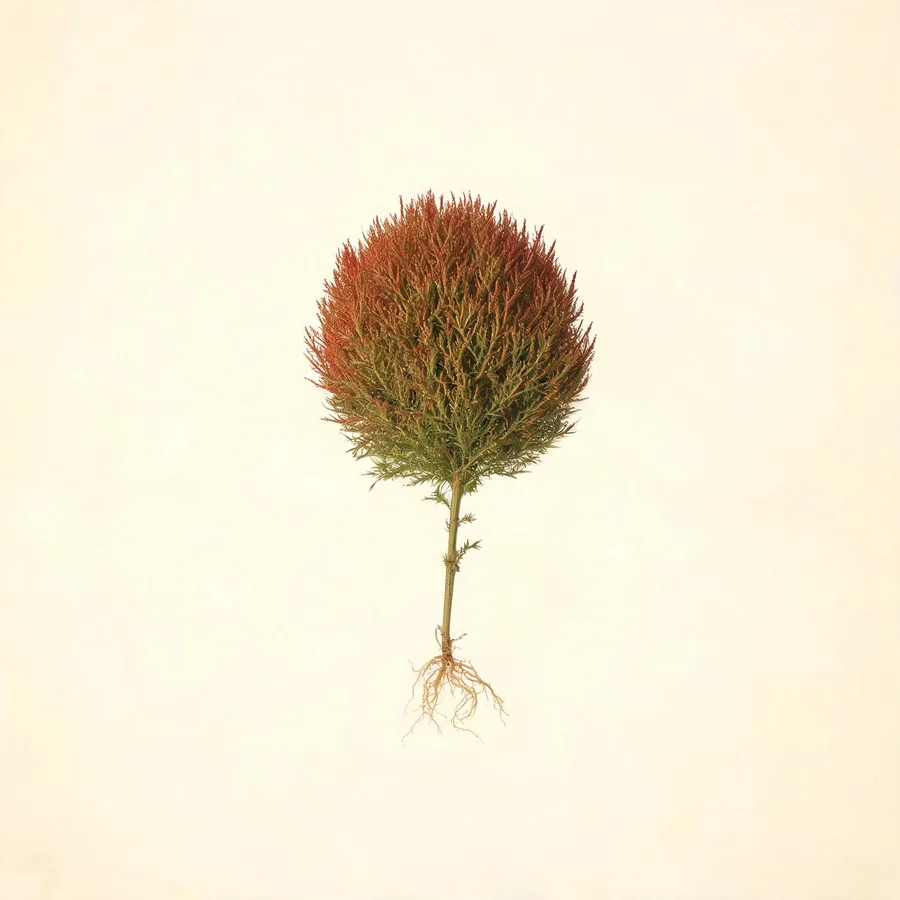
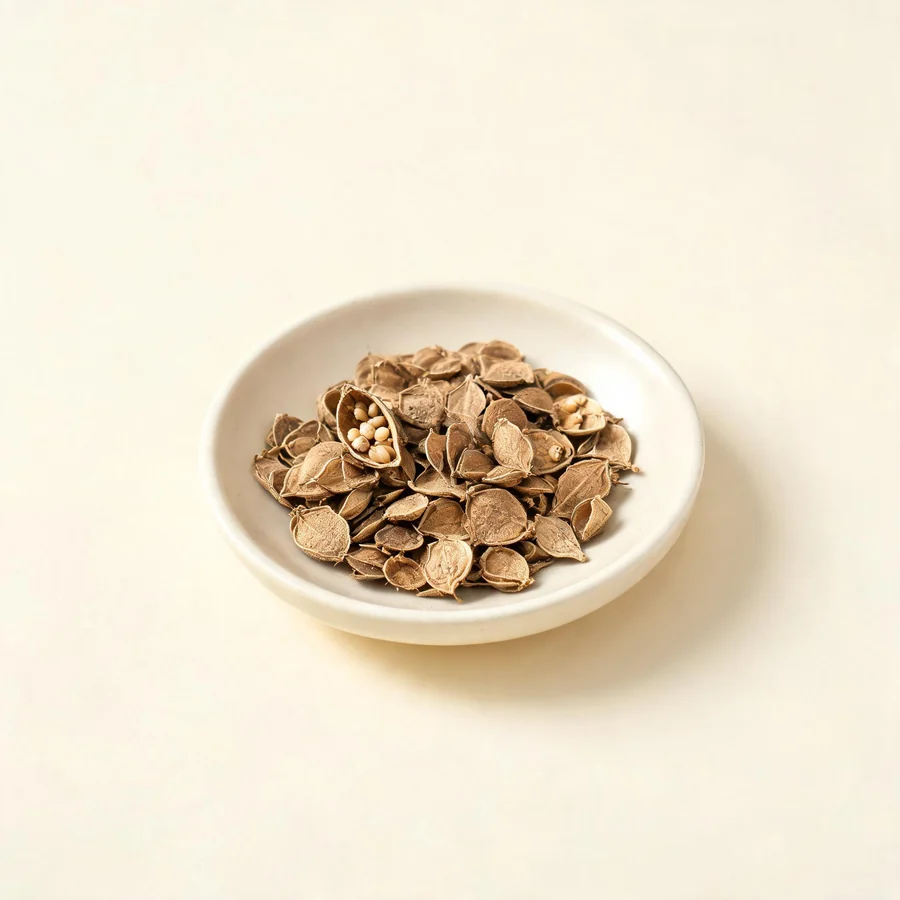
Skin profile
Where this herb sits in skin practice: the pattern it corrects, the skin signs it suits, and what it should not be used for.
Di Fu Zi is the gentle itch herb that also drains: it is chosen for wet, itchy skin when the digestion should not be overloaded, and for the combination of an itchy rash with hot, scanty urination.
Skin signs that suggest it
- Itchy, weeping or slightly swollen skin with a greasy coating on the tongue (damp-heat with Wind)
- Itch that moves from one place to another, or hives that appear and fade
- Itchy skin together with hot, scanty or burning urination
- Damp itchy skin in the groin or genital area with a thick discharge
- A red tongue with a yellow greasy coating, and a slippery pulse
When it is not the right herb
Not for skin that is dry, thin and cold with no itch and no dampness, and not for someone with weak cold digestion who already has loose stools and a poor appetite. It is also not for excessive urination without damp-heat, since its draining action would then work against the body rather than with it.
What it does for skin
Skin-relevant actions only. Each one describes a mechanism in TCM terms and what it looks like on the skin.
Clears Heat and drains Dampness
The fruit is cold and bitter, and it is used where Heat and Dampness have collected in the skin or the lower body. Itchy weeping patches, a greasy tongue coating, thick discharge and hot scanty urine are all read as the same pattern, and the herb addresses them together because it drains the dampness rather than only cooling the surface.
Dispels Wind and stops itch
Itch that moves, comes and goes, or appears in a new place each day belongs to Wind in this framework. Di Fu Zi is mildly acrid, which is the quality said to disperse Wind, and it belongs among the standard herbs for itch. It is gentler than Ku Shen or Bai Xian Pi, which is why it is often the herb chosen for a child or for a long-standing low-grade itch.
Promotes urination and drains dampness downward
Through its Kidney and Bladder entry the fruit increases urine flow, so the dampness held in the skin has an exit below. That matters in skin practice because the same dampness that produces a discharge or a weeping eruption is reduced when it is drained below, and it explains the traditional place of the herb in formulas for itchy skin with urinary burning. It is a mild diuretic, not a treatment for infection on its own.
Settles damp itch in the genital skin
The fruit is used in washes for scrotal and vulval itch, jock itch and the damp itchy skin of the groin, usually with Ku Shen and She Chuang Zi. Its mildness suits skin that is already irritated, and its cold nature makes it the better choice when the area is red and hot rather than pale and cold.
Skin conditions it is used for
Mapped to the condition pages on this site. The pattern column shows what the skin is doing when this herb is the right choice.
| Condition | Pattern | Why it suits | Typical setting |
|---|---|---|---|
| Eczema | Damp-heat with Wind, weeping and itchy | A weeping, itchy eczema flare is the damp-heat picture, and Di Fu Zi is the mild option within it: it dries the ooze, disperses the Wind that drives the itch, and drains some of the dampness through the urine. It is used when the flare is not severe enough to need the stronger bitter-cold herbs, and in washes where the skin is too irritated for a concentrated decoction. | Modified Xiao Feng San with Di Fu Zi added, or a Di Fu Zi and Bai Xian Pi wash |
| Itchy skin | Wind-damp-heat with itch that moves | Itch without a fixed lesion, or itch that shifts around the body, is read as Wind on a base of Dampness and Heat. Di Fu Zi contributes the wind-dispersing and itch-stopping part while its draining action reduces the dampness underneath, and it is mild enough for a longer course than the more bitter herbs allow. | Di Fu Zi with Bai Xian Pi and Ku Shen, internally or as a wash |
| Urticaria | Wind and Heat over a Damp base | Hives are a Wind pattern by definition: raised wheals that arrive suddenly and move. Di Fu Zi is combined with Fang Feng, Jing Jie and Chan Tui to release the surface, and with cooling herbs when the wheals are red and hot. Laboratory work on the fruit describes suppression of allergic responses, but that is not the same as proof of benefit in hives. | Di Fu Zi with Fang Feng, Jing Jie and Chan Tui in a modified Xiao Feng San |
| Contact dermatitis | Local damp-heat and Wind after contact with an irritant | A contact reaction that is itchy, red and weeping is treated as Heat, Dampness and Wind confined to the area that met the substance, and a cooled wash is the natural route. Di Fu Zi is mild enough for inflamed skin and is often combined with Bai Xian Pi. Removing the trigger is the first step, and a severe or spreading reaction needs medical care. | Di Fu Zi and Bai Xian Pi as a cooled wash |
| Itchy genitalia | Damp-heat in the lower burner with urinary burning | This is the pattern where both halves of the herb's action are wanted at once: genital itch with dampness, and hot, scanty or burning urination. Di Fu Zi drains the damp-heat through the bladder while it settles the surface itch, and it is combined with Ku Shen for the skin and Tong Cao for the water passages. Persistent symptoms need assessment for infection. | Di Fu Zi with Ku Shen and Tong Cao, internally and as a wash |
| Vulvar eczema | Damp-heat below with discharge and itch | Vulval eczema that is itchy, damp and red, with a thick discharge, fits the lower-burner damp-heat picture, and the fruit is used internally and as a dilute wash. Its coldness suits the heat, and its mildness suits skin that is already sore. Any bleeding, ulceration or change in the skin needs assessment before a wash is used. | Di Fu Zi with Ku Shen and She Chuang Zi as a wash |
Combinations for skin
Herbs it is paired with when the skin, not an internal organ, is the target.
| Partner | Ratio | Why the pair is used |
|---|---|---|
| Bai Xian Pi | 9 to 15 g Di Fu Zi with 6 to 10 g Bai Xian Pi | Bai Xian Pi clears heat and toxin from the skin while Di Fu Zi drains dampness through the bladder, so the pair covers both the surface and the drainage route. It is a standard combination for eczema, widespread itchy weeping rashes and damp-heat eruptions, taken internally or used as a wash. |
| Ku Shen | 9 to 15 g Di Fu Zi with 4.5 to 9 g Ku Shen | Ku Shen is the more bitter and colder of the two, aimed at heat and toxin, while Di Fu Zi offers a second exit through the bladder and is gentler on the digestion. The pair suits genital itch with a yellow discharge, an itchy damp rash, and burning on passing urine, where one herb alone would address only half the picture. |
| She Chuang Zi | 15 g each in a wash | One herb is cold and the other warm, and both dry Dampness, quiet Wind and settle itch, so the mixture works whether the case runs hot or cold. Di Fu Zi adds a mild draining action through the urine. It is the standard wash for genital itch, groin eczema and scrotal eczema. |
| Tong Cao | 9 to 15 g Di Fu Zi with 3 to 6 g Tong Cao | The fruit clears heat from the Bladder and increases urine flow, while Tong Cao opens the water passages of the Triple Burner. Together they relieve hot, painful or scanty urination, which is the internal half of the picture when a skin eruption is accompanied by urinary symptoms. |
Topical use
Di Fu Zi is used externally as a cooled wash for itchy, weeping and inflamed skin, and its mildness makes it one of the safer herbs for a wash that covers a larger area. It is decocted, strained and applied to eczema, hives, contact reactions and genital itch, often with Ku Shen, Bai Xian Pi or She Chuang Zi, and it can also be added to a shallow bath. Because the fruit is not a strong irritant, it is a reasonable first wash for a child or for skin that has reacted to a stronger preparation.
| Preparation | How and when it is used |
|---|---|
| Cooled decoction wash | Simmer 15 to 30 g of the fruit in about 700 ml of water for 15 to 20 minutes, strain, and cool to skin temperature. Bathe or compress the area for 10 minutes once or twice daily, pat dry, and make a fresh batch each time. |
| Bath for widespread itch | A weaker decoction can be added to a shallow lukewarm bath for generalised itch or hives. Keep the bath short, avoid hot water, and stop if the skin stings or becomes redder. |
| Dilute wash for children | Use about half the adult concentration, applied with a soft cloth rather than by soaking, for childhood eczema or nappy-area itch. Stop if the skin becomes irritated, and have a persistent rash in a young child assessed. |
Patch test and cautions
Patch test on a small area of normal skin for 24 hours before the first full wash. Do not apply to broken, ulcerated or infected skin without supervision, keep the liquid away from the eyes, and stop at once if burning, stinging or spreading redness develops. A wash is not a substitute for medical care when a rash is spreading, blistering or accompanied by fever.
Safety for skin use
What to check before recommending or using it, including the cautions that matter most for skin patients.
Do not use, or use with caution
- Spleen and Stomach deficiency-cold, with loose stools, a poor appetite and abdominal discomfort. The bitter cold nature can worsen all three, and the dose is reduced or the herb omitted where digestion is borderline.
- No damp-heat present. Its cold draining action can draw on fluids and warmth that are not in excess, and it is not a herb for dry skin with no itch or moisture.
- Excessive urination without damp-heat. Because the fruit promotes urine flow, using it in that picture works against the body rather than with it.
- Known allergy to the fruit. Hives or swelling of the lips have been reported rarely after an oral decoction, and the herb is stopped if they appear.
Pregnancy and breastfeeding
Use only with practitioner supervision, at a reduced dose, and only where damp-heat is clear. The classical record includes it in formulas for foetal heat and for painful urination in pregnancy, but the cold draining quality might in principle draw on fluids or unsettle a pregnancy, and there are no modern safety data. A dilute external wash over a small area is regarded as lower risk, and during breastfeeding there are no studies of transfer into milk, so a short course at the standard dose, with guidance, is the cautious position, with the infant watched for loose stools.
Interactions
- Diuretics such as thiazides or loop diuretics. The mild diuretic action of the fruit could add to theirs, so watch for fluid loss or an electrolyte imbalance.
- Insulin and oral hypoglycaemic medicines. Preclinical work reports blood sugar lowering in some fractions of the fruit, so glucose should be monitored if it is used alongside these drugs.
- Immunosuppressant drugs. Laboratory extracts have altered immune responses in animal models, so a theoretical interaction is possible and should be discussed with the prescribing team.
- Sang Piao Xiao. The classical literature records a mutual aversion between the two, so they might blunt one another's action without being toxic together; the combination needs thought rather than being forbidden.
Allergy and patch testing
Rare allergic reactions, including hives and swelling of the lips, have been reported after an oral decoction, and contact irritation is possible with a strong wash. Patch test before a first wash, keep washes dilute, and stop at once if a rash, swelling or breathlessness develops; the last two need urgent medical attention.
General safety references
General references for herbal hepatotoxicity and herb-drug interactions; they are not specific to this herb.
- Review article: Herbal hepatotoxicity - an update on traditional Chinese medicine preparations. Alimentary Pharmacology & Therapeutics, 2014. PMID: 24844799.
- Interactions between herbal medicines and prescribed drugs: an updated systematic review. Drugs, 2009. PMID: 19719333.
- Warfarin and food, herbal or dietary supplement interactions: a systematic review. British Journal of Clinical Pharmacology, 2021. PMID: 32478963.
Evidence
The classical record is quoted with its source. The modern note states the level of evidence plainly.
Classical record
It treats Bladder heat and promotes urination. It supplements the centre and benefits essence-Qi. Long-term use sharpens the ears and eyes, lightens the body and delays ageing.
Shen Nong Ben Cao Jing (Divine Husbandman's Classic of Materia Medica) - The oldest record gives the urinary action; the skin uses came later, out of the same draining of damp-heat.
Di Fu Zi is bitter, cold and drains heat. Its only real use is clearing and guiding out Damp-Heat and promoting urination. The Shen Nong Ben Cao Jing says it supplements the centre and benefits essence-Qi, and the Bie Lu says it strengthens Yin, but these mean that once Damp-Heat is removed the Yin-essence naturally settles; one must not take the words literally and mistake it for a tonifying substance.
Ben Cao Zheng Yi (Correct Meaning of Materia Medica) - The passage warns against taking those old tonic-sounding phrases literally, which matters when the fruit is chosen for skin rather than for deficiency.
It dispels wind and dries dampness, and benefits the skin.
Classical materia medica - The skin benefit named here is the action skin practice relies on most, and it is consistent with the older urinary record.
Modern evidence
Evidence status
- Laboratory and animal studies of Kochia scoparia extracts report anti-allergic and antipruritic effects, suppression of delayed-type hypersensitivity, and antibacterial activity of water extracts against common urinary pathogens. These are preclinical findings.
- Clinical trial evidence for Di Fu Zi in skin disease is limited, mostly small, and usually part of a multi-herb wash or formula. No firm conclusion about efficacy in eczema or urticaria can be drawn from the published literature.
- Toxicological work puts the oral water-extract LD50 in mice at roughly 7.15 g per kg, which is a wide margin, with overdose described as bringing nausea, stomach ache, chills, tiredness and loose stools.
PubMed records
Selected real PubMed records for this herb's species or its constituents, chosen by species name and title relevance. They are references for the non-TCM discussion above, not proof that the herb treats any skin condition.
- Anti-inflammatory activity of Kochia scoparia fruit on contact dermatitis in mice.. Molecular medicine reports, 2016. PMID: 26707133 (skin-related record).
- Kochiae Fructus, the Fruit of Common Potherb Kochia scoparia (L.) Schrad: A Review on Phytochemistry, Pharmacology, Toxicology, Quality Control, and Pharmacokinetics.. Evidence-based complementary and alternative medicine : eCAM, 2021. PMID: 33603816 (safety record).
Dose and forms
Skin-practice dosing and the preparations that suit skin complaints.
| Form | Dose and notes |
|---|---|
| Decoction (internal) | 9 to 15 g of dried fruit daily in a formula. As much as 30 g is described in severe damp-heat, under supervision, and a smaller dose is used when Spleen weakness is borderline. |
| External wash | 15 to 30 g decocted in water and used cooled on the area that itches, for eczema, generalised itch and genital complaints. The liquid is not swallowed by this route and should be made fresh for each use. |
| Digestive limit | An excess can bring nausea, stomach ache, chills, tiredness and loose stools. If these appear, the dose is reduced and Spleen-supporting herbs are added rather than the course being pushed on. |
The dose itself is unremarkable; what needs care is the indication. There is a wide safety margin in animal work, and the practical limit is digestive tolerance rather than toxicity. The stir-fried fruit, Chao Di Fu Zi, is chosen when the Spleen is somewhat weak but the drying and itch-stopping actions are still wanted, because stir-frying to a slight scorch moderates the cold nature while preserving the core action.
Citations and further reading
Only real sources are listed: the classical materia medica passages quoted above, and the source works behind the botanical and safety statements.
- Shen Nong Ben Cao Jing (Divine Husbandman's Classic of Materia Medica), attributed compilation of the Han period - classical entry quoted above.
- Ben Cao Zheng Yi (Correct Meaning of Materia Medica), late Qing period - classical entry quoted above.
- Di Fu Zi monograph: Pharmacopoeia of the People's Republic of China - source for the accepted botanical source, part used and quality requirements.
- Modern evidence statement: based on laboratory and toxicological literature on Kochia scoparia, summarised as a statement about the level of evidence rather than as a cited finding. No clinical trial is presented as proof of effect.
- Botanical description and identification: botanical literature on Kochia scoparia, Amaranthaceae.
Educational reference for qualified practitioners. This page is not medical advice, and skin conditions should be diagnosed by a clinician before treatment.