Understanding Contact dermatitis
The classical literature frames contact dermatitis as an invasion of external pathogens, usually Damp-Heat or toxic Heat, that penetrates where the defensive Qi is weak or the constitution intolerant.
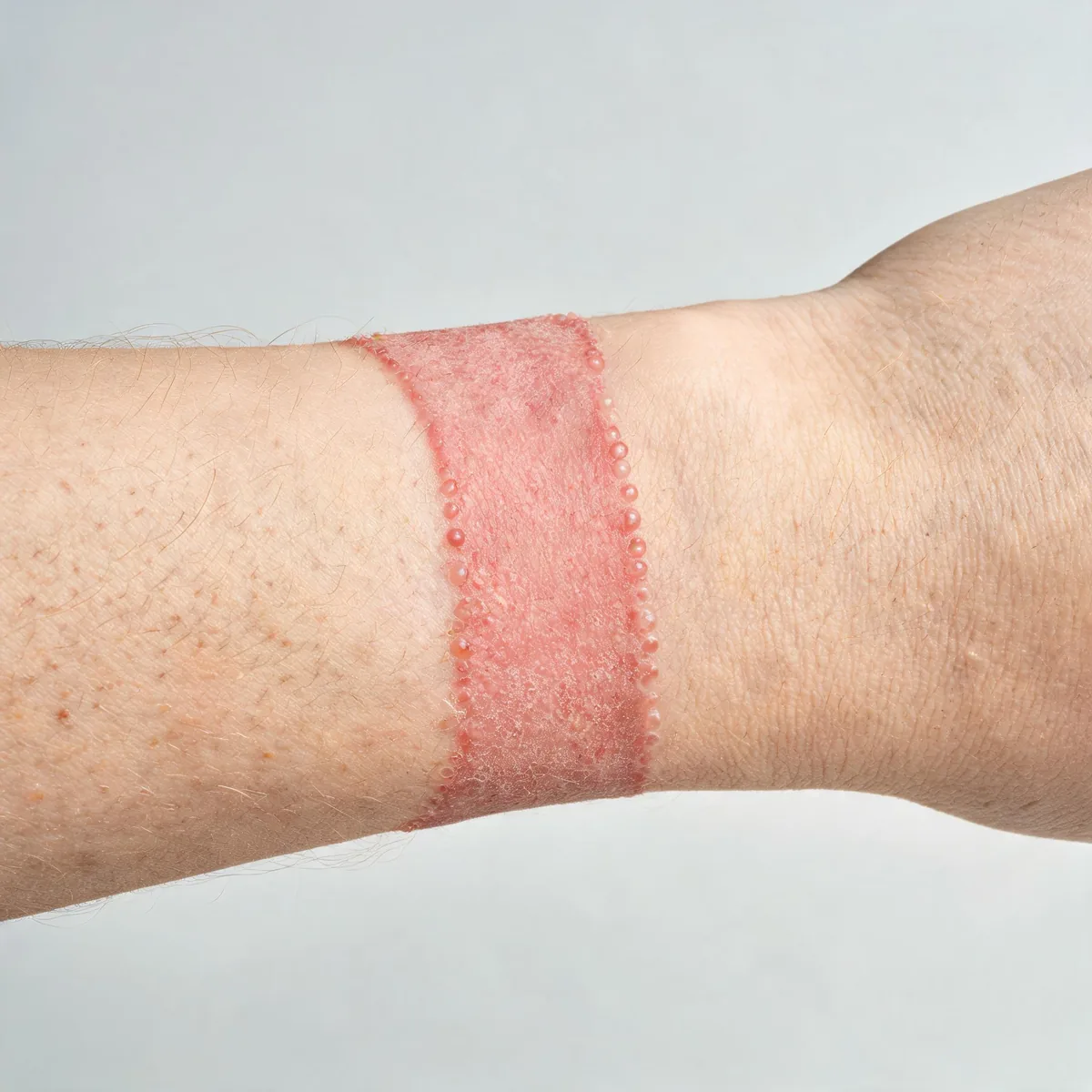
The acute reaction is read as the body trying to expel the pathogen: redness, swelling, vesicles and weeping at the site of contact, appearing quickly. Bright red, swollen, weeping skin with burning points to Damp-Heat.
If the reaction becomes chronic, the picture shifts. Dry, flaky, thickened skin with itch that worsens at night is read as Blood deficiency with external wind; a duller, oozing, lingering rash with bloating and loose stools is read as Spleen deficiency with dampness.
Because the trigger is external, avoidance is part of treatment in both frameworks, and the classical literature treats identification of the contactant as the first practical step.
The skin is the outer boundary of the body, the surface where defensive Qi meets whatever the world puts against it. When that boundary is intact, contact with an irritant passes without consequence. When the constitution is intolerant, or the defensive Qi is thin, the same contact becomes an invasion, and the body answers with redness, swelling and oozing as it tries to push the pathogen outward again. The classical literature frames the rash as a surface reaction with an internal root, which is why removing the trigger helps and yet does not by itself change the tendency to react.
The acute picture is Damp-Heat. Dampness shows in the weeping, the swelling and the heaviness felt in the head and body, while Heat shows in the colour, the burning and the speed of the flare, and the tongue runs red under a thick yellow greasy coat with a rapid slippery pulse. Repeated flares drain the Blood. The skin then turns dry, flaky and thick, the itch moves about and is worst at night, the tongue turns pale with only a thin coating while the pulse becomes thin and wiry, which is Blood Deficiency with External Wind. Where digestion has always been weak, or the patient is a child, the deeper picture is Spleen Deficiency with Dampness: dull lingering papules, bloating, loose stools, a pale puffy tongue and a soft slow pulse.
Conventional view
Contact dermatitis is an inflammatory skin reaction to direct contact with an irritant or allergen, typically a red itchy rash that may blister, weep or become dry and cracked. Diagnosis is usually from appearance, location and a history of exposure to a trigger such as nickel, poison ivy or harsh chemicals, with patch testing to identify allergens in persistent cases.
Standard treatment identifies and avoids the trigger and uses topical corticosteroids to reduce inflammation and itch, with oral corticosteroids or antihistamines for severe or widespread cases, and emollients and barrier creams to protect and repair the skin barrier.
Topical steroids calm acute inflammation but do not address the underlying susceptibility that makes some people react more severely or frequently, long-term use can thin the skin, and symptoms often return when treatment stops. Conventional care also treats all contact dermatitis as one condition, without separating the hot weeping acute type from the dry chronic type, a distinction central to TCM.
Selected PubMed records
Real PubMed records for the conventional discussion above, selected by condition name and title relevance. They are references, not a claim that any treatment is proven for this condition.
- Allergic Contact Dermatitis.. The Medical clinics of North America, 2020. PMID: 31757238.
- Irritant Contact Dermatitis - a Review.. Current dermatology reports, 2022. PMID: 35433115.
How it connects
In an allergic constitution, contact dermatitis rarely appears alone: the same disharmony that makes skin react to an irritant often makes the airways react to pollen or dust. The shared root is typically Lung and Spleen deficiency with accumulated Dampness and latent Heat; when defensive Qi is weak and the skin barrier is compromised, external pathogens invade, showing as a rash in one person and nasal congestion or wheezing in another. Allergic rhinitis, asthma and contact dermatitis co-occurring are then expressions of one constitutional pattern, so treating the core imbalance tends to improve all three together. The cluster changes the plan. Where allergic rhinitis or asthma runs alongside the rash, the classical literature treats the shared root of Lung and Spleen deficiency with accumulated dampness and latent heat rather than chasing each diagnosis separately. Atopic dermatitis sits closest of all, since the two conditions can look alike on the skin and both respond to the same Blood-nourishing, Wind-settling approach once the chronic phase is reached. Strengthening the Spleen and settling the surface can then help breathing and skin together.
How it is assessed
Diagnosis is anchored by timing and location: what touched the skin, and how quickly the rash appeared.
What a practitioner looks for
- Timing: a rash appearing within hours to days of contact with a new substance points to an acute external cause.
- Appearance: bright red, swollen and weeping points to Damp-Heat; dry and thickened points to a chronic picture.
- Distribution: the shape and site often map onto the object or substance involved.
- Constitutional signs: digestion, thirst, bowels and energy decide whether a deficiency pattern sits underneath.
The consultation starts at the surface. The practitioner notes where the rash sits, whether its shape matches the object that touched the skin, how moist it is, and how long after contact it appeared. A rash confined to the wrist under a watch strap and appearing within hours reads differently from a patch that began on the hands and has since spread. Questions follow about itch at night, bowel habit, appetite, thirst and energy, because those answers decide whether a deficiency sits underneath the reaction.
Tongue and pulse settle the pattern. A red tongue with a thick yellow greasy coat and a rapid slippery pulse supports Damp-Heat. A pale thin tongue with a thin coat and a fine wiry pulse supports Blood Deficiency with External Wind, especially when the skin is leathery and the itch is night-time. A pale puffy tongue with a white coat and a soft or slow pulse supports Spleen Deficiency with Dampness. Mixed pictures are common, and the practitioner then judges which element is driving the current flare and which is background susceptibility.
TCM patterns in Contact dermatitis
Contact dermatitis is not one pattern. The same red itchy rash can arise because an irritant has driven Damp-Heat into the skin, because repeated inflammation has left the Blood too thin to nourish the surface, or because a weak Spleen keeps producing internal dampness that seeps outward. What separates them is not how the rash looks on the first day but how it behaves over weeks: an acute weepy flare that arrived hours after contact tells a different story from a dry thickened patch that has been scratched for months. Tongue and pulse decide the rest. A red tongue with a thick yellow greasy coat and a rapid slippery pulse belongs to Damp-Heat, while a pale thin tongue with a thin coat and a fine wiry pulse belongs to Blood Deficiency with External Wind. A pale puffy tongue with a soft slow pulse points to the Spleen.
| Pattern | Key signs | The itch | Tongue | Main formula |
|---|---|---|---|---|
| Damp-Heat | Bright red swollen skin with weeping vesicles; Rash appears quickly after contact | Intense burning and itching | Body: Red, often swollen with teeth marksCoat: Yellow, greasy and thick, usually in the middle and at the root | Long Dan Xie Gan Tang |
| Blood Deficiency with External Wind | Dry flaky or thickened skin; Brittle nails and dry hair | Itch worse at night | Body: Pale and thin, sometimes slightly dryCoat: Thin, white and a little dry | Dang Gui Yin Zi |
| Spleen Deficiency with Dampness | Dull lingering oozing papules | Not specified | Body: Pale and swollen, often with teeth marks along the edgesCoat: White, greasy and moist, thick in the middle | Shen Ling Bai Zhu San |
Damp-Heat
The acute picture: bright red, swollen, weeping skin that appears quickly after contact.
An intolerant constitution lets an external irritant act as a toxin once it meets the skin, and Dampness with Heat lodges in the surface channels. Dampness supplies the weeping, the swelling and the heavy feeling in the head and limbs, while Heat supplies the colour, the burning and the speed with which the rash appears. Because both block the same channels the lesion oozes and burns at once, and scratching adds friction heat that makes the whole picture worse.
The tongue is red under a thick yellow greasy coat that does not scrape off easily, sometimes swollen with teeth marks, and the pulse is slippery and rapid. Heat, humidity, alcohol, fried food and re-exposure all drive it, while cool compresses, cool washing water, light cooling food and rest ease it. Long Dan Xie Gan Tang is the formula named here, drawing on Long Dan Cao, Huang Qin, Ku Shen and Bai Xian Pi, and the points chosen are Quchi (LI-11), Hegu (LI-4), Sanyinjiao (SP-6) and Xuehai (SP-10).
Signs
- Bright red swollen skin with weeping vesicles
- Intense burning and itching
- Rash appears quickly after contact
- Heaviness in body and head
- Thirst with little desire to drink
Diet and lifestyle for this pattern: Avoid spicy, greasy, fried and sugary food, which generate Dampness and Heat that feed the rash. Eat cooling, Dampness-draining food such as mung beans, cucumber, watermelon and lightly cooked leafy greens, wash the skin with cool rather than hot water, and identify and strictly avoid the substance that triggered it.
Blood Deficiency with External Wind
The chronic dry picture: flaky thickened skin with night-time itch.
Months of inflammation, or one severe reaction after another, consume the Blood that keeps skin supple. Without that nourishment the surface turns dry, scaly and fragile, and dryness invites Wind, which in this tradition explains an itch that moves from place to place and flares at night. The skin is no longer red and weeping but thick, cracked and lined, because it cannot repair itself quickly enough between flares.
The tongue is pale and thin with a thin white coat that is slightly dry, and the pulse is fine and wiry and keeps a floating quality near the surface. Dry windy weather, stress, lost sleep, hot showers and harsh soap all aggravate it, while humid air, daily moisturising, rest and warm nourishing meals help. Dang Gui Yin Zi is the formula named, with Dang Gui, Shu Di Huang and Fang Feng, sometimes supported by Xiao Feng San, and the points are Xuehai (SP-10), Sanyinjiao (SP-6), Hegu (LI-4) and Quchi (LI-11).
Signs
- Dry flaky or thickened skin
- Itch worse at night
- Pale or sallow complexion
- Aversion to wind and drafts
- Brittle nails and dry hair
Diet and lifestyle for this pattern: Moisturise daily with a gentle fragrance-free cream and avoid hot showers and harsh soap that strip the skin's oils. Eat blood-building food such as dark leafy greens, beetroot, red meat, bone broth and black sesame, cut back on spicy, fried and drying food and alcohol, protect the skin from wind and sudden temperature change, and protect sleep so Blood can regenerate.
Spleen Deficiency with Dampness
The lingering oozing picture with a digestive signature.
A constitutionally weak Spleen cannot transform and transport fluids, so dampness accumulates inside the body and eventually overflows to the skin as dull papules and vesicles that ooze rather than burn. Because the origin is digestive, the rash almost never travels alone: loose stools, bloating after eating, a poor appetite and heaviness in the limbs belong to the same picture, and the skin signs settle when the digestion does.
The tongue is pale, swollen and tooth-marked with a white greasy moist coat, and the pulse is soggy and slow, possibly slippery. Cold raw food, dairy, greasy food, humid weather and overwork all aggravate it, while warm cooked meals, rest, a dry warm environment and gentle walking help. Shen Ling Bai Zhu San is the formula named, built on Bai Zhu, Fu Ling and Yi Yi Ren, and the points are Zusanli (ST-36), Sanyinjiao (SP-6) and Fenglong (ST-40).
Signs
- Loose stools or diarrhoea
- Abdominal bloating after eating
- Poor appetite and fatigue
- Heaviness of body and limbs
- Dull lingering oozing papules
Diet and lifestyle for this pattern: Eat warm cooked food such as soups and congees, and avoid raw, cold and greasy food that burdens the Spleen. Keep the skin clean and dry without harsh soap, and gentle daily movement helps Qi flow and supports digestion.
Treatment approach
How the tradition treats contact dermatitis, with the herbs, formulas and points used for it.
Principles
- Remove the contactant first; no formula substitutes for ending the exposure.
- Clear heat and drain dampness in the acute weeping phase.
- Nourish Blood and settle Wind once the skin has become dry and thickened.
- Support the Spleen where the pattern is lingering and oozing, since dampness is described as the persistent element.
- Every prescription works on two levels at once. The branch is the visible reaction, so the immediate job is to clear Heat, drain Dampness and quieten the itch. The root is why this person reacted at all, and that decides the formula: Long Dan Xie Gan Tang when bitter cold draining is needed for an acute weepy flare, Dang Gui Yin Zi when the Blood must be rebuilt and Wind settled, Shen Ling Bai Zhu San when the Spleen must be strengthened so that dampness stops forming. In practice the two aims are combined in one prescription and the balance shifts as the rash changes.
Herbs used
Formulas
Acupoints
What to expect
- Acute contact rashes are described as improving within one to two weeks once exposure stops and the pattern is treated.
- Chronic thickened skin takes longer, with visible change over weeks.
- Re-exposure is expected to bring the rash back.
- Progress rarely follows a straight line. A good week is often followed by a short return of itching after a hot shower, a new soap or a stressful stretch, and those fluctuations are easier to read when exposures are written down. Once the skin has settled, many people need a maintenance formula, an occasional short course, or simply a review before the seasons change.
Safety and when to get help
Seek medical help urgently for
- Difficulty breathing or swelling of the lips, tongue or throat - possible anaphylaxis.
- Widespread blistering or peeling skin.
- Fever, chills or pus draining from the rash - signs of secondary bacterial infection.
For anything severe, sudden or spreading quickly, read when a skin problem needs urgent care.
Cautions
- Do not apply strong topical herbs to broken or widespread skin without advice.
- Patch-test any topical preparation on a small area first.
- Identify and remove the trigger; treatment will fail if exposure continues.
Using this alongside conventional care
- TCM is described as complementary to conventional care: prescribed topical treatment can continue while herbs and acupuncture are added, and emergency symptoms need emergency care rather than a clinic appointment.
- Two cautions matter most. Steroid creams should be tapered rather than stopped abruptly, because withdrawal can provoke a rebound flare that is then wrongly blamed on the herbs. Cooling and drying herbs can also unsettle a sensitive stomach, and some interact with anticoagulants or immunosuppressants, so the full medication list belongs in the consultation. Topical washes are usually the safest thing to add while an oral formula is being adjusted. Spreading redness, fever or pus needs medical review rather than a stronger wash.
Diet and lifestyle
- Dietary advice is secondary here because the cause is external, but where the pattern is Damp-Heat the same guidance applies: reduce greasy, fried, spicy and sweet food and alcohol.
- The general rule is to eat in a way that creates neither Heat nor Dampness: plain warm meals, plenty of water, and little fried, sweet or heavily spiced food, with alcohol left out while the skin is active. For an acute weeping Damp-Heat rash the classical literature adds cooling, drying foods such as mung beans, cucumber and lightly cooked greens. For dry chronic skin the emphasis moves to building Blood, with dark greens, beetroot, bone broth and a moderate amount of red meat. Where the Spleen is the root, warm soups and congees replace raw salads and iced drinks.
If you're pregnant
Treatment in pregnancy must protect both mother and fetus. Bitter-cold herbs that drain Damp-Heat, such as Long Dan Cao and Huang Qin, are used cautiously because their strong downward-moving, cooling nature can disturb the pregnancy, and formulas such as Long Dan Xie Gan Tang are generally avoided.
Gentle external washes with herbs such as Ku Shen or Huang Bai are preferred, applied topically with minimal systemic absorption, and Hegu (LI-4) and Sanyinjiao (SP-6) should not be needled. The Blood deficiency pattern is relatively safer to treat with nourishing herbs such as small amounts of Dang Gui, though a qualified practitioner must monitor the formula closely.
If you're breastfeeding
Breastfeeding mothers need treatment that will not pass harmful substances into the milk. Bitter-cold Damp-Heat herbs such as Huang Lian can cause diarrhoea in the nursing infant and should be avoided, and topical washes and compresses are the safest first line because they act locally.
If internal herbs are necessary, mild formulas such as Xiao Feng San may be considered under professional guidance, balancing Wind-dispelling with Blood-nourishing herbs that are less likely to affect milk supply, and the practitioner should always be told that the mother is nursing.
If treating a child
Contact dermatitis in children often presents as an acute weepy rash, but the underlying pattern is frequently Spleen deficiency with Dampness, especially where there is a history of digestive weakness, loose stools or poor appetite. The Spleen's failure to transform fluids leaves internal Dampness that overflows to the skin when an irritant triggers it.
Treatment therefore strengthens the Spleen with gentle formulas such as Shen Ling Bai Zhu San at a quarter to a half of the adult dose by age, and topical washes with mild herbs such as Huang Bai or Ma Chi Xian are traditionally used, with limited trial evidence. Children's skin is delicate, so harsh drying herbs are avoided.
If treating an elderly patient
In older patients contact dermatitis tends to become chronic and dry, fitting Blood deficiency with External Wind: the skin is thin, dry and poorly nourished, with intense itching that worsens at night.
Treatment must be gentle, at about two-thirds of the adult dose, with formulas such as Dang Gui Yin Zi preferred and bitter-cold Damp-Heat herbs used sparingly because they can damage an already weakened Spleen and Stomach. Acupuncture is a safe adjunct that avoids drug interactions with the many medicines older patients take, and progress may be slower but the skin can become more resilient with consistent care.
Urgent-sign guidance is based on standard sources: NHS anaphylaxis, NHS cellulitis, NHS Stevens-Johnson syndrome, NHS melanoma.
Evidence
Evidence status
Compiled for this page from the classical and modern literature; not a systematic review, so treat it as a pointer to sources rather than clinical guidance.
Evidence is emerging, mostly small trials and case series. Topical herbal washes containing Ku Shen and Huang Bai have been studied in acute contact dermatitis with reported reductions in erythema, oozing and itch, but samples are small, blinding is often absent and follow-up is short. Acupuncture has been examined for allergic skin conditions more broadly with some evidence for reducing itch intensity.
One further trial deserves mention. In 2018 a randomised trial set a topical Chinese herbal preparation against hydrocortisone cream in allergic contact dermatitis and reported comparable improvement with fewer adverse effects. Two limits keep this modest: it is a single small trial, and most of the stronger dermatology evidence concerns atopic dermatitis and has been carried across on the basis of shared inflammation rather than direct testing. The fair reading is that herbs and washes may reduce symptoms alongside strict trigger avoidance, not that they replace it.
Studies often cited
Reduced erythema, oozing and itching in acute contact dermatitis in small trials. Small clinical trials and case series (as recorded in the source)
Some evidence for reduced itch intensity in allergic skin disease; studies specific to contact dermatitis are limited. Clinical studies (as recorded in the source)
In allergic contact dermatitis the herbal compound performed comparably to hydrocortisone cream, with fewer side effects reported. Randomised controlled trial, 2018 (as recorded in the source record)
PubMed records for the TCM evidence
Real PubMed records for the TCM clinical evidence discussed above, selected by condition name and title relevance. They are references, not proof of benefit.
- Dermatoses caused by cultural practices: Therapeutic cultural practices.. Journal of the American Academy of Dermatology, 2018. PMID: 29908818.
- Immunopathogenesis and immunoregulatory mechanisms in allergic contact dermatitis.. Frontiers in immunology, 2026. PMID: 42212145.
Classical record
When toxic heat invades externally and accumulates in the skin, the treatment should clear heat, cool the blood and resolve toxicity.
- Wai Ke Zheng Zong (Orthodox Manual of External Medicine), section on toxic heat rashes. The Chinese original is not reproduced here: it could not be recovered reliably from the source record, and is not guessed.
Lacquer sore arises in people whose constitution rejects lacquer; on contact they are poisoned, and itching, redness, swelling and blistering appear on the face and body.
Zhu Bing Yuan Hou Lun, chapter on lacquer sores - Zhu Bing Yuan Hou Lun (Treatise on the Causes and Symptoms of Diseases), chapter on lacquer sores, recorded from the reference. The Chinese original is not reproduced here because it could not be recovered reliably from the source record, and is not guessed.
Common questions
Can TCM help acute contact dermatitis?
The tradition describes herbs and acupuncture as useful for the acute Damp-Heat picture, provided the contactant is removed. Severe reactions, blistering or breathing difficulty need emergency care.
How long does the rash take to settle with herbs?
Acute rashes are described as improving within one to two weeks once exposure stops; chronic thickened skin takes longer.
Can I use TCM alongside steroid creams?
Yes. The tradition describes prescribed topical treatment as compatible with herbs and acupuncture, with no abrupt changes to prescribed therapy.
Will it come back?
If the skin is exposed to the same substance again, the reaction is expected to return, which is why identifying the trigger is the first step.
What should I avoid eating during a flare?
While the rash is active, cut back on fried, sweet and heavily spiced food and leave out alcohol, all of which the classical literature links to more Heat and Dampness. For a weeping, burning rash favour cooling foods such as mung beans, cucumber and lightly cooked greens. Once the skin has turned dry and thickened the emphasis shifts to Blood-building foods including dark greens, beetroot and a moderate amount of lean meat. Caffeine is worth reducing too, since it aggravates itching in some people.
Does acupuncture really reduce itching?
It can, and it is often the quickest relief in clinic. Needling moves stagnant Qi and Blood and quietens the sensation of itch, and points such as Quchi (LI-11) and Xuehai (SP-10) are selected for their cooling action. Relief may be immediate after a session, but lasting change needs repeated treatment alongside herbs and trigger avoidance.
Is long-term use of Chinese herbs safe for the skin?
Prescribed by a qualified practitioner they are generally well tolerated. Bitter cooling herbs can unsettle the digestion when the stomach is empty, so they are usually taken with or after food, and a rare person reacts to a herb itself, in which case the formula is changed. A long course should be reviewed rather than repeated automatically, and any new symptom belongs in the consultation.
Can treatment stop the reactions coming back?
The aim is to raise the threshold rather than to guarantee immunity. Strengthening the Spleen, rebuilding Blood or clearing dampness that has lingered for months makes the skin less reactive, and many people find that a substance which once caused a severe rash now causes a mild one or none. Re-exposure can still provoke a flare, so avoiding a known trigger stays part of the plan.