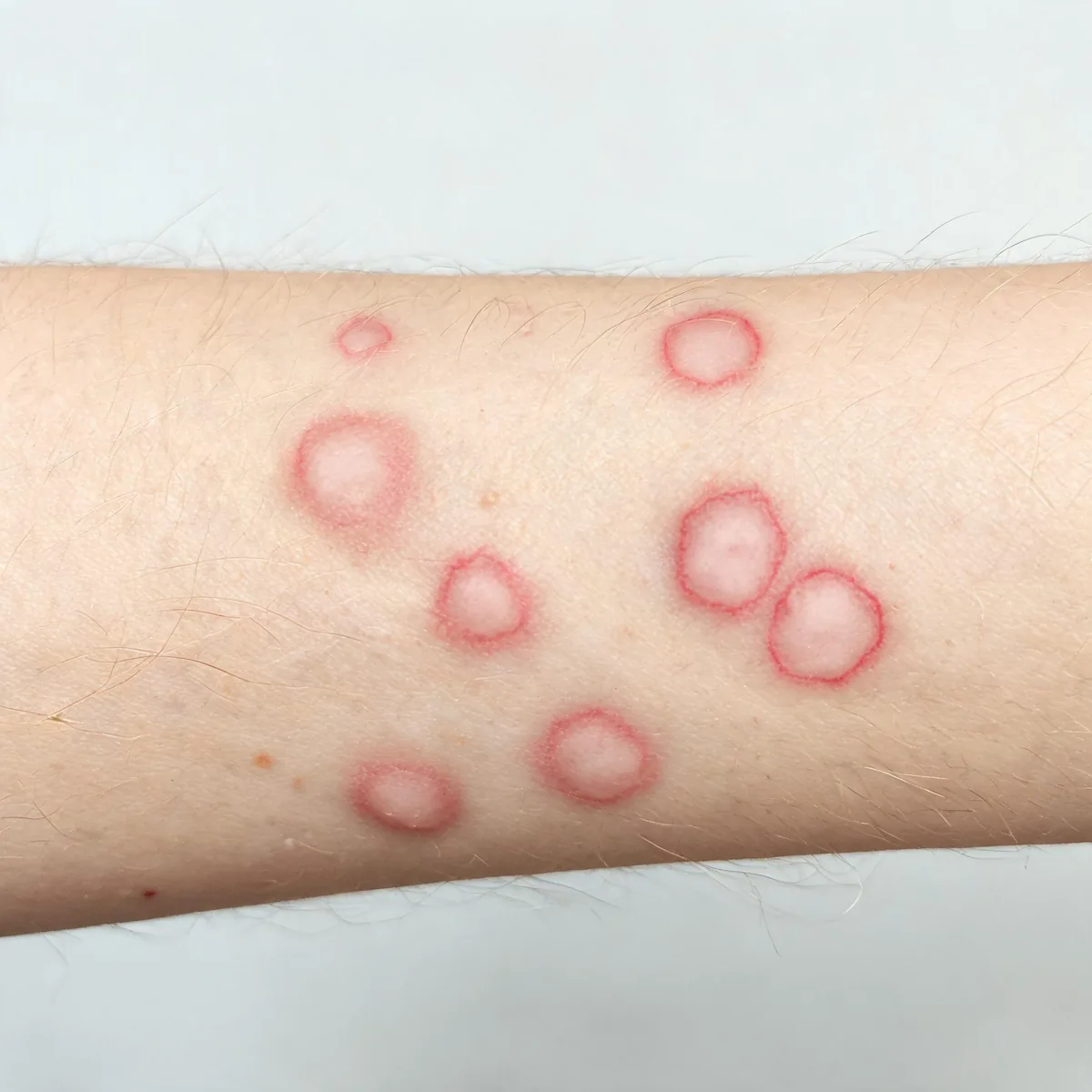
Understanding Urticaria
The classical literature explains hives as a conflict between the bodys defensive Qi and an invading pathogen, most often Wind. Because Wind moves, the wheals shift location; because it strikes suddenly, the outbreak is abrupt.
Wind-Heat is the common acute picture: red raised wheals with a burning quality, worse in warmth and eased by coolness, often with a sore throat or thirst. Wind-Cold is its mirror: pale wheals triggered by cold exposure and drafts, with chills and no thirst.
Where the reaction is accompanied by digestive signs, the picture is Damp-Heat in the Stomach and Spleen: bright red wheals with bloating, a sticky taste and loose stools. In the deficiency picture the wheals are pale, appear with fatigue, and the person reports dizziness and poor appetite.
Toxic-Heat is the severe picture: high fever, wheals that merge into large burning plaques, intense thirst and restlessness. The classical literature treats that as a medical matter first, which is why the safety section carries the airway warnings.
The wheals are read as a struggle between Defensive Qi and an invading pathogen, most often Wind, which is why the rash appears suddenly, moves about and fades just as quickly. Wind disrupts the opening and closing of the pores, trapping Qi and fluids under the skin into raised wheals, and it rarely acts alone: combined with Heat it gives red burning hives worse in warmth, and combined with Cold it gives pale less itchy wheals that flare in cold weather.
The digestion is central as well. Rich, greasy or spicy food overloads the Spleen and Stomach, generates Dampness and Heat, and that turbidity steams upward to erupt as bright angry hives with bloating or loose stools. In chronic cases the picture shifts from invasion to weakness: when Qi and Blood are deficient the protective barrier is too thin to resist even mild triggers, so pale hives recur with fatigue or stress, which is why treatment looks past the rash to the imbalance underneath.
Conventional view
Urticaria, commonly called hives, is a skin condition of raised red or skin-coloured wheals that appear suddenly and itch intensely, ranging from a few millimetres to several centimetres and sometimes joining into larger plaques. Histamine and other chemicals released from mast cells in the skin drive the reaction, often triggered by allergens, infections, stress or physical stimuli such as cold or pressure, and diagnosis is usually based on the appearance and history, with allergy testing for persistent cases.
First-line treatment is a non-sedating antihistamine to block the histamine response and relieve itching. If that is not enough, doctors may add H2 blockers, short courses of oral corticosteroids, or in chronic cases prescription treatments such as omalizumab or immunosuppressants, and identifying and avoiding triggers is part of management.
Antihistamines and corticosteroids suppress the itch and swelling of acute hives effectively but do not explain why the outbreaks keep happening, long-term use can bring drowsiness, weight gain or weakened immunity, and many people find the hives return once treatment stops. The conventional approach also treats all hives as one overactive histamine response, without separating the hot red food-triggered kind from the pale cold-sensitive fatigue-linked kind that TCM treats as different conditions.
Selected PubMed records
Real PubMed records for the conventional discussion above, selected by condition name and title relevance. They are references, not a claim that any treatment is proven for this condition.
- The international EAACI/GA²LEN/EuroGuiDerm/APAAACI guideline for the definition, classification, diagnosis, and management of urticaria.. Allergy, 2022. PMID: 34536239.
- The International Guideline for the Definition, Classification, Diagnosis and Management of Urticaria.. Allergy, 2026. PMID: 41649409.
- Comparative efficacy and safety of biologics and systemic immunomodulatory treatments for chronic urticaria: Systematic review and network meta-analysis.. The Journal of allergy and clinical immunology, 2025. PMID: 40663028.
How it connects
Hives also cluster with other allergic and stress-related conditions. When Protective Qi deficiency or Blood deficiency with External Wind is the root, the Lungs' defensive function is compromised, so allergic rhinitis and asthma frequently flare alongside the wheals, and atopic dermatitis shares the same terrain. Anxiety and insomnia are close companions to chronic itching, because the same Wind and Heat that drive the hives disturb the Shen and the itch keeps the mind alert at night, so calming the spirit is often part of settling the skin. In chronic urticaria the patterns commonly blend. Long-standing Blood deficiency weakens Protective Qi, so a person may have dry skin and night itching and also catch colds easily, and Damp-Heat from the diet can sit alongside Qi deficiency so the wheals are red and hot while the person still feels tired. The strongest trigger and the quality of the wheals point to the primary pattern: red hot food-related hives suggest Damp-Heat, pale fatigue-related hives suggest deficiency, evening worsening suggests Yin or Blood deficiency, and flares after meals hint at digestive Heat.
How it is assessed
The practitioner asks about the colour and temperature of the wheals, their timing, and what triggers them.
What a practitioner looks for
- Colour and heat: red and hot points to Wind-Heat or Toxic-Heat; pale points to Wind-Cold or deficiency.
- Timing and movement: wheals that appear and vanish quickly, changing place, are the Wind signature.
- Triggers: warmth, cold, pressure, food, alcohol, stress and medication are all asked about.
- Constitutional signs: fatigue, digestion, appetite, thirst, and whether the pattern is acute or long-standing.
The practitioner begins with the colour, temperature and timing of the wheals, the triggers and any accompanying symptoms, then confirms the pattern on the tongue and pulse. Bright red burning wheals that flare in warmth or after hot food point to Wind-Heat, with a red tongue, thin yellow coat and a floating rapid pulse, a very common picture in sudden acute outbreaks.
Pale or light red wheals that worsen in cold air or after cold drinks, sometimes with chills, point to Wind-Cold, with a pale tongue, thin white coat and a floating tight pulse, the body reacting to cold that traps Wind in the skin. Bright red wheals with abdominal pain, diarrhoea or constipation point to Damp-Heat in the Stomach and Spleen, with a yellow greasy coat and a slippery rapid pulse, often after a heavy rich meal.
Chronic pale or skin-coloured hives with fatigue, dizziness and a pale complexion point to Qi and Blood deficiency, with a pale tongue, thin coat and a thin weak pulse; the body lacks the strength to defend itself, and mild stress or a breeze can set off an outbreak. Bright red burning wheals that merge into large plaques with fever and chills signal Toxic-Heat, with a red tongue, yellow or dry coat and a flooding rapid pulse, and need prompt care.
TCM patterns in Urticaria
Urticaria is treated by pattern, because the same itchy wheals can arise from a sudden Wind invasion, from Heat or Cold trapped in the skin, from Damp-Heat generated in the digestion, from Toxic-Heat in a severe attack, or from Qi and Blood deficiency that leaves the surface undefended. Wind-Heat gives bright red burning wheals that worsen with warmth; Wind-Cold gives pale wheals that worsen with cold; Damp-Heat in the Stomach and Spleen gives hives with digestive upset; Qi and Blood deficiency gives pale recurrent wheals with fatigue; Toxic-Heat gives fiery merged plaques with fever. These patterns overlap and change over time, especially when an acute attack becomes chronic, which is why the tongue and pulse decide the treatment. The self-check above is a way into that differentiation, not a diagnosis.
Wind-Heat
The common acute picture: red, burning wheals that move and worsen with warmth.
Wind-Heat invades the surface when the pores are open, and because Heat accelerates it the wheals come on suddenly and move from place to place, red, raised and intensely itchy. Heat makes them burn and worsen in warmth, after hot food or in stuffy rooms, and the person may feel feverish and thirsty.
The tongue is red with a thin yellow coat and the pulse is floating and rapid. Heat, spicy food, alcohol, hot environments and stress aggravate it, while cool air, cooling food such as mung beans and cucumber, and rest help. Treatment dispels Wind and clears Heat, with Xiao Feng San as the standard formula and herbs such as Jing Jie, Fang Feng, Jin Yin Hua and Lian Qiao.
Signs
- Red raised wheals with burning
- Wheals appear and disappear quickly
- Worse in warmth, eased by coolness
- Sore throat, mild fever, thirst
Diet and lifestyle for this pattern: Avoid spicy, greasy and fried food as well as alcohol, which add Heat to the body. Drink cooling teas such as chrysanthemum, mint or dandelion, keep the environment cool, wear light breathable clothing, and a gentle rinse with cool water can soothe acute itching.
Wind-Cold
Pale wheals triggered by cold and drafts, with chills and no thirst.
Wind-Cold settles when the body is exposed to cold or drafts, and the Cold constricts the channels so the wheals are pale or light red, less burning and often more tolerable than Wind-Heat. They appear after cold wind, cold drinks or sudden temperature change, sometimes with chills and a dislike of cold.
The tongue is pale with a thin white coat and the pulse is floating and tight. Cold weather, drafts, iced drinks and cold raw food aggravate it, while warmth, warm cooked food, ginger tea and covering the skin help. Treatment releases the exterior and disperses Cold, with Gui Zhi Tang as the standard formula and herbs such as Ma Huang, Gui Zhi and Sheng Jiang used with care.
Signs
- Pale or light-red wheals
- Worse with cold exposure
- Chills without sweating
- Headache and body aches
- No thirst, or preference for warm drinks
Diet and lifestyle for this pattern: Dress warmly and avoid draughts. Sip warm ginger tea to help release the exterior, and avoid cold drinks, raw food and swimming in cold water, which can trap Cold in the body.
Damp-Heat in Stomach and Spleen
Hives with a digestive signature: bright red wheals, bloating and a sticky taste.
A digestion overloaded by rich, greasy or spicy food produces Damp-Heat that steams upward and erupts through the skin. The hives are bright red and angry with a sticky sensation, and they come with the middle burner signs of bloating, abdominal discomfort, a sticky taste and loose or irregular stools.
The tongue is red with a yellow greasy coat and the pulse is slippery and rapid. Greasy fried food, sugar, alcohol, late meals and humid weather aggravate it, while light warm meals, bitter greens, barley and regular mealtimes help. Treatment clears Heat and drains Dampness, with Long Dan Xie Gan Tang or Huo Xiang Zheng Qi San as standard formulas and herbs such as Huang Lian, Huang Qin, Cang Zhu and Yi Yi Ren.
Signs
- Bright red wheals
- Abdominal bloating or pain
- Sticky or loose stools
- Bitter or sticky taste
- Thirst with little desire to drink
Diet and lifestyle for this pattern: Eat light, easy meals. Steer clear of greasy, fried or very spicy food, and avoid alcohol completely during a flare-up. Cooling food such as mung beans, cucumber and celery helps, gentle daily walking supports digestion and clears Dampness, and do not overeat, stopping at about seventy percent full.
Qi and Blood Deficiency
The chronic, fatigue-linked picture: pale wheals that appear when the person is tired.
When Qi and Blood are low the skin is undernourished and the outer defence is porous, so Wind slips in with little provocation. The wheals are pale or skin-coloured, recur again and again, and flare with tiredness, stress or a mild breeze, alongside fatigue, dizziness, palpitations and a sallow complexion.
The tongue is pale and thin with a thin coat and the pulse is thin and weak. Overwork, skipped meals, poor nutrition, stress and wind exposure aggravate it, while rest, warm cooked meals, gentle movement and a draft-free environment help. Treatment tonifies Qi and Blood and stabilises the exterior, with Ba Zhen Tang or Yu Ping Feng San as standard formulas and herbs such as Huang Qi, Dang Gui, Bai Zhu and Fang Feng.
Signs
- Pale or skin-coloured wheals
- Worse at night and after fatigue
- Dizziness and light-headedness
- Persistent fatigue
- Poor appetite
Diet and lifestyle for this pattern: Build reserves with warm, nourishing food: bone broth, congee, dark leafy greens, red dates and small portions of good quality protein. Avoid raw, cold and greasy food that taxes the Spleen, prioritise regular meals and adequate sleep, and keep movement gentle such as walking or qigong so Qi circulates without depletion.
Toxic-Heat
The severe acute picture: high fever with wheals that merge into burning plaques.
In a severe acute attack Heat gathers into toxicity, and the wheals become bright red, burning and merged into large plaques with marked swelling, high fever and chills. The skin feels hot to touch, the itch is intense and the whole picture is more than a simple surface invasion.
The tongue is red with a yellow or dry coat and the pulse is flooding and rapid. Heat, infection, strong sun and rich spicy food aggravate it, while rest, fluids, cooling food and urgent medical assessment help. Treatment clears Heat, resolves toxicity and cools the Blood, with Qing Wen Bai Du San as the standard formula and herbs such as Shi Gao, Zhi Mu, Jin Yin Hua and Lian Qiao; spreading hives with fever need urgent medical review.
Signs
- High fever and chills
- Wheals merging into large burning plaques
- Intense thirst for cold drinks
- Restlessness and irritability
- Constipation with dark scanty urine
Diet and lifestyle for this pattern: Avoid all heating and stimulating food: alcohol, coffee, spicy dishes, fried and greasy items, lamb and shellfish. Embrace cooling, hydrating food such as cucumber, watermelon, mung bean soup and plenty of room-temperature water, rest in a cool quiet space and avoid overheating, and a lukewarm shower can calm burning skin without shocking it.
Treatment approach
How the tradition treats urticaria, with the herbs, formulas and points used for it.
Principles
- Settle Wind first: the acute picture is treated by dispelling Wind, and whether it is heat or cold changes the method.
- Drain Damp-Heat when there is a digestive signature.
- Build Qi and Blood in the chronic, fatigue-linked pattern, where the wheals are pale rather than red.
- Remove the trigger where it can be identified; the classical literature treats avoidance as part of treatment.
- Treatment always works on two fronts at once: it calms the Wind that drives the immediate itching and wheals, and it corrects the imbalance that let Wind invade. Excess patterns are cleared, deficiency patterns are nourished so that the body's own defence can keep Wind out, mixed pictures are addressed by combining or alternating formulas, and the formula is adjusted as the tongue and pulse change.
Herbs used
Formulas
- Yin Qiao San
- Xiao Feng San
- Gui Zhi Ma Huang Ge Ban Tang
- Jing Fang Bai Du San
- Fang Feng Tong Sheng San
- Ba Zhen Tang
- Yu Ping Feng San
- Huang Lian Jie Du Tang
Acupoints
- LI-11 (Quchi)
- LI-4 (Hegu)
- SP-10 (Xuehai)
- GB-20 (Fengchi)
- DU-14 (Dazhui)
- ST-36 (Zusanli)
- ST-25 (Tianshu)
- ST-40 (Fenglong)
- SP-6 (Sanyinjiao)
- qihai-ren-6
- BL-40 (Weizhong)
What to expect
- Acute Wind-Heat or Wind-Cold hives are described as improving within days once the pattern is treated.
- Chronic urticaria is expected to need weeks to months, with the deficiency pattern taking longest.
- Recurrence is described as likely if the trigger remains.
- In the first week or two the hives usually become less intense, smaller, less red and less frequent, and itching often eases noticeably after acupuncture. The goal then shifts from calming the skin to preventing new outbreaks, so that triggers which once caused a severe reaction produce only a mild fleeting rash or none at all, and the total course runs from about six weeks for a straightforward excess pattern to four to six months for a deep deficiency.
Safety and when to get help
Seek medical help urgently for
- Swelling of the lips, tongue or throat - this can progress rapidly to a blocked airway.
- Difficulty breathing or wheezing.
- Dizziness, fainting or a sudden drop in blood pressure - signs of anaphylaxis.
For anything severe, sudden or spreading quickly, read when a skin problem needs urgent care.
Cautions
- Do not delay emergency treatment to take herbs.
- Antihistamines and prescribed treatment should not be stopped abruptly.
- Chronic urticaria requires medical review to exclude other causes.
Using this alongside conventional care
- TCM is described as complementary to conventional care: antihistamines can continue while herbs and acupuncture are added. Any change to prescribed treatment should be discussed with the prescriber, and emergency symptoms need emergency care.
- TCM can be used alongside conventional care. Keep taking prescribed antihistamines while the herbal formula is built up, tell the practitioner about corticosteroids or omalizumab so the treatment plan and any taper are coordinated, and do not stop conventional medicines suddenly. Report drowsiness, new swelling of the lips or throat, wheezing or difficulty breathing immediately, because those need urgent medical attention rather than a clinic appointment.
Diet and lifestyle
- The advice depends on the pattern: avoid hot, spicy and alcohol for Wind-Heat and Toxic-Heat; avoid cold and raw food for Wind-Cold; reduce greasy, sweet and dairy food for Damp-Heat. Keeping a food and trigger diary is named as the practical tool.
- Whatever the pattern, avoid food that generates Heat and Dampness: fried and greasy dishes, excessive sugar, alcohol and very spicy food. Cold raw food and iced drinks weaken the Spleen and worsen Dampness, so favour warm cooked soups, stews, congees and steamed vegetables, and for deficiency patterns add blood-nourishing and Qi-building food such as dark leafy greens, bone broth and small portions of well-cooked red meat, liver, black sesame and goji berries. When the hives are red and hot, cooling food such as mung beans, cucumber and chrysanthemum tea may help, and a simple food diary often reveals personal triggers.
If you're pregnant
Pregnancy can trigger or worsen urticaria because the growing baby draws on the mother's Blood and Qi, leaving the skin's protective Wei Qi more vulnerable to Wind. The Qi and Blood deficiency pattern becomes more common, with pale intermittent wheals and fatigue, and Damp-Heat may flare if morning sickness or changed eating overloads the digestion.
Herbal treatment in pregnancy needs caution: formulas that strongly move Blood or contain potent herbs such as Ma Huang are avoided, while gentler options such as Ba Zhen Tang or modified Yu Ping Feng San are used only under professional guidance. Acupuncture is generally safe, focusing on points such as Zusanli ST-36 and Qihai REN-6 to support Qi and Blood, and any formula should be prescribed by a practitioner experienced in pregnancy care.
If you're breastfeeding
During breastfeeding the priority is to avoid herbs that could pass into milk and cause infant diarrhoea or colic. Bitter-cold herbs such as Huang Lian, used for severe Heat patterns, need extreme caution or milder alternatives such as Yi Yi Ren, and aromatic herbs such as Bo He may reduce milk supply and are best minimised.
Acupuncture is an excellent option because it poses no risk to the baby: Quchi LI-11 and Hegu LI-4 suit Wind-Heat patterns, while Zusanli ST-36 and Sanyinjiao SP-6 help rebuild the mother's reserves in deficiency patterns and calm the skin at the same time.
If treating a child
In children urticaria is often acute and linked to food triggers or a recent infection, with Wind-Heat and Damp-Heat in the Stomach the most common patterns. Because children's digestion is immature, a dietary indiscretion easily generates Damp-Heat that erupts on the skin.
Herbal doses are adjusted by weight and age, typically one-third to half the adult dose for school-age children, and gentle choices such as Xiao Feng San in reduced dose or simple teas of Jin Yin Hua and Bo He can work well. Paediatric acupuncture uses fewer needles and shorter retention, with points such as Quchi LI-11 and Zusanli ST-36 well tolerated; a practitioner experienced with children should guide treatment.
If treating an elderly patient
In older adults urticaria tends to become chronic and is dominated by Qi and Blood deficiency, with pale, less dramatic but persistent wheals that flare with fatigue or stress. Age-related decline in Spleen and Kidney function weakens the Wei Qi, so even mild triggers invite Wind in.
Treatment is gentler and slower, with doses around two-thirds of the adult amount to avoid burdening a constitution that may already be taking several medicines. Formulas such as Ba Zhen Tang with Yu Ping Feng San nourish Blood and stabilise the exterior without harshness, and acupuncture is well tolerated, given more often in shorter sessions with points such as Sanyinjiao SP-6 and Xuehai SP-10 to build Blood and calm Wind.
Urgent-sign guidance is based on standard sources: NHS anaphylaxis, NHS cellulitis, NHS Stevens-Johnson syndrome, NHS melanoma.
Evidence
Evidence status
Compiled for this page from the classical and modern literature; not a systematic review, so treat it as a pointer to sources rather than clinical guidance.
The evidence is moderate for chronic urticaria. A pilot randomised trial of a formula based on Xiao Feng San reported greater reduction in urticaria activity than placebo over 12 weeks with no serious adverse events, and a meta-analysis of a modified Xiao Feng San formula reported higher response rates and less recurrence than antihistamines alone. Samples are small and the trials are few, so this supports rather than replaces standard antihistamine treatment.
Studies often cited
In a randomised double-blind placebo-controlled pilot trial, the herbal group showed significantly greater reduction in urticaria activity scores than placebo after 12 weeks, with no serious adverse events. The formula targeted Wind-Heat and Damp-Heat patterns. Chan HHL, et al. Frontiers in Pharmacology. 2018. doi:10.3389/fphar.2018.01474
A systematic review and meta-analysis found that the modified formula improved total effective rate and reduced recurrence compared with antihistamines alone, with a favourable safety profile. Zhang Y, et al. Chinese Medicine. 2022. doi:10.1186/s13020-022-00642-3
PubMed records for the TCM evidence
Real PubMed records for the TCM clinical evidence discussed above, selected by condition name and title relevance. They are references, not proof of benefit.
- The International Guideline for the Definition, Classification, Diagnosis and Management of Urticaria.. Allergy, 2026. PMID: 41649409.
- Efficacy of Acupuncture for Chronic Spontaneous Urticaria : A Randomized Controlled Trial.. Annals of internal medicine, 2023. PMID: 37956431.
Classical record
When Wind-Heat lodges in the skin, it gives rise to urticaria, with red colour and itching.
- Wai Ke Zheng Zong (Orthodox Manual of External Medicine), section on wind rash.
瘾疹者,由邪气客于皮肤,复逢风寒相折,则起风瘙瘾疹。
Urticaria occurs when pathogenic Qi lodges in the skin, and then encounters Wind-Cold, which triggers the eruption of itchy wind wheals.
Zhu Bing Yuan Hou Lun (Treatise on the Causes and Symptoms of Diseases), Volume 2, Wind Diseases - Classical citation; the translation is our own.
Common questions
Can acupuncture really stop hives?
The tradition describes acupuncture as calming the immune response and settling Wind during an acute outbreak, chosen by pattern. Evidence is limited; this page records the traditional selection rather than a proven effect.
How long do Chinese herbs take to work on hives?
The classical literature suggests acute Wind patterns can improve within days, while chronic urticaria takes weeks to months, longer where there is deficiency.
Can I keep taking antihistamines?
Yes. The tradition describes antihistamines and TCM as compatible, with the caveat that prescribed treatment should not be stopped abruptly and emergency symptoms need emergency care.
Why do my hives move around?
Moving, evanescent wheals are the defining feature of the Wind pattern in this framework, which is why treatment is directed at settling Wind.
Can I take Chinese herbs alongside my antihistamines?
Yes, many people do, and the two approaches can work well together. Keep taking the antihistamine while the herbal formula is built up, take the doses apart from each other by an hour or two, and tell both the prescribing doctor and the TCM practitioner what you are taking, because the plan to reduce the antihistamine should be coordinated and gradual. Never stop conventional medicine suddenly on your own.
Do I need to avoid wind and cold if I have chronic urticaria?
If your wheals are pale and flare after cold air, drafts or cold drinks, then yes: this is the Wind-Cold picture, and protecting the skin from cold wind, keeping the neck, hands and feet warm, and choosing warm cooked food over iced drinks can reduce the number of outbreaks. People whose hives are red and worse with heat need the opposite, cooling and shade rather than extra warmth.