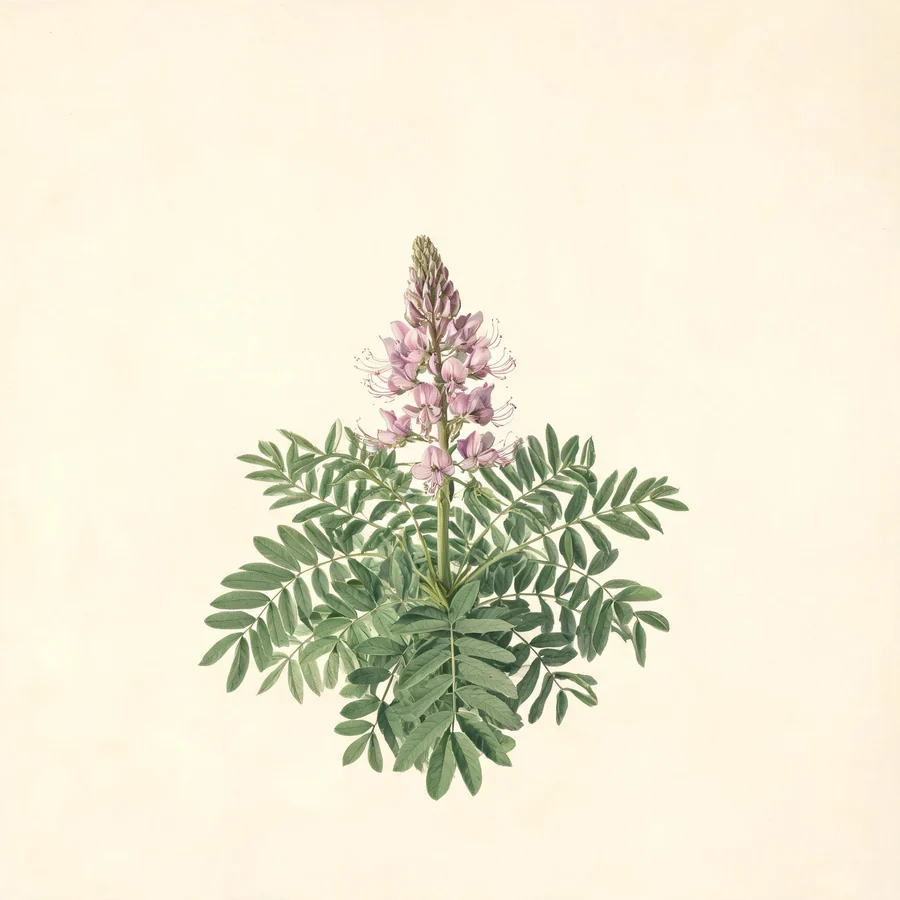
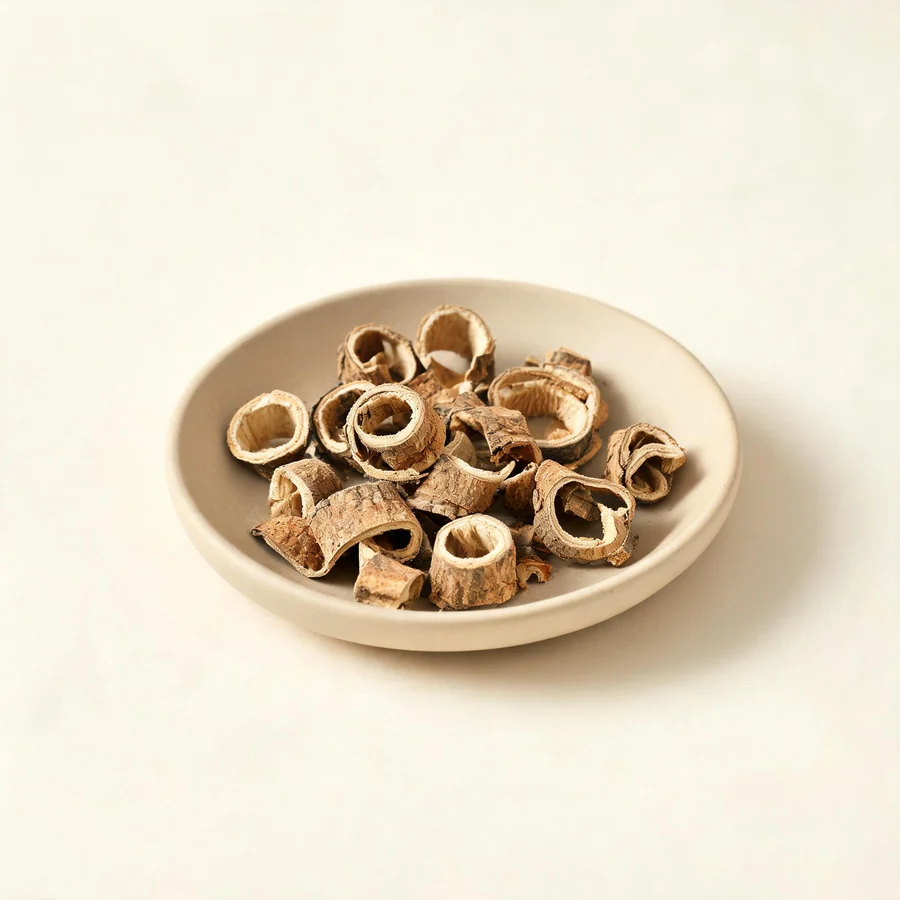
Skin profile
Where this herb sits in skin practice: the pattern it corrects, the skin signs it suits, and what it should not be used for.
Bai Xian Pi is the itch herb that moves: it is chosen for rashes that wander, for wheals that come and go, and for damp-heat that discharges yellow fluid. The liver signal is the reason its courses are short, not a reason to avoid a herb that otherwise suits the surface well.
Skin signs that suggest it
- Intensely itchy, red patches that weep a yellow discharge and crust over
- Wheals or a rash that moves from place to place, with heat and irritation (Wind and Heat)
- Damp, itchy skin in the groin, scrotum or vulva with a thick discharge
- Itch with little to see between the scratched lines, worse in warmth and at night
- A red tongue carrying a greasy yellow coat, and a slippery pulse
When it is not the right herb
Not for cold, dry, thin skin without redness or ooze, and not for a person with weak cold digestion, loose stools and a pale tongue. Existing liver disease, or liver enzymes that are already raised, rules the bark out altogether rather than calling for a smaller dose.
What it does for skin
Skin-relevant actions only. Each one describes a mechanism in TCM terms and what it looks like on the skin.
Clears Heat and dries Dampness
The bark is bitter and cold, and it is used where Heat and Dampness have combined in the skin to produce redness, swelling and a discharge. Weeping eczema, an oozing patch behind the ear, macerated skin in a fold and a scalp that crusts yellow all fit this description. The drying action reduces the wet surface while the cold clears the inflammation that produces it.
Dispels Wind and stops itch
In this framework itch belongs to Wind, especially when it moves, comes and goes, or appears in a new place each day. Bai Xian Pi is described as reaching the skin and expelling that Wind while it clears the Heat underneath, which is why it is regarded as one of the most important dermatological herbs. It is used for hives, for itchy rashes with heat signs, and for the itch of scabies and tinea, both internally and in washes.
Clears Heat and resolves toxin
Where a lesion has become infected, with pus, a red-hot edge or an ulcerated surface, the bark is added to toxin-resolving formulas. Its role is smaller than that of the dedicated fire-purging herbs, but it is useful when infection sits on top of a damp-heat rash and when a sore is both itchy and purulent. Spreading redness with fever needs medical assessment rather than a herb.
Drains damp-heat from the lower body
Through its Spleen, Stomach and Bladder entry the bark reaches the groin and the genital skin, where it is used for itchy scrotal eczema, vulval itch with a thick yellow discharge, and the damp itchy skin of the inner thigh. The same descending action was applied classically to damp-heat jaundice; in a skin edition that history matters only because it explains why the herb suits damp-heat that keeps returning below.
Skin conditions it is used for
Mapped to the condition pages on this site. The pattern column shows what the skin is doing when this herb is the right choice.
| Condition | Pattern | Why it suits | Typical setting |
|---|---|---|---|
| Eczema | Wind-damp-heat with itch and a yellow discharge | An eczema flare with a yellow discharge, crusting and itch that moves about is read as Wind sitting on Heat and Dampness. Bai Xian Pi addresses all three, and it is used in a formula for the internal picture as well as in a cooled wash for the surface, which is why it appears in wash recipes as often as in decoctions. Very dry, lichenified eczema with no discharge is not the picture it suits. | Modified Xiao Feng San with Bai Xian Pi added, or a Bai Xian Pi and Ku Shen wash |
| Itchy skin | Wind and damp-heat with itch as the main complaint | When the dominant symptom is itch and the skin between scratched areas looks almost normal, the tradition treats it as Wind carrying Heat and Dampness through the surface. Bai Xian Pi is chosen because it expels the Wind and clears the damp-heat underneath, so the itch is addressed at its source rather than numbed. It is commonly combined with Ku Shen and Di Fu Zi, internally or in a wash. | Bai Xian Pi with Ku Shen and Di Fu Zi, internally or as a wash |
| Urticaria | Wind-heat wheals that appear and move | Hives are the textbook Wind presentation: raised wheals that come up suddenly and shift around the body. Bai Xian Pi is paired with Fang Feng and Jing Jie to release the surface, and with cooling herbs for the red, hot quality of the wheals. Its place is in acute and recurrent urticaria with heat signs; a wheal with swelling of the lips or throat is a medical emergency and not a case for herbs. | Modified Xiao Feng San with Bai Xian Pi and Fang Feng |
| Contact dermatitis | Local Heat and toxin where an irritant has touched the skin | A contact reaction is confined to the area that met the substance, and it is read as Heat and toxin held in the skin, often with Dampness if it weeps. Bai Xian Pi is used both internally and as a cooled wash to clear the local heat and settle the itch. Removing the trigger comes first, and a severe or spreading reaction, or one with blistering over a large area, needs medical care. | Bai Xian Pi and Ku Shen as a cooled wash, with cooling herbs internally |
| Scabies | Damp-heat with a parasitic surface component | The bark has been used against scabies for as long as it has been used for eczema, usually in a wash, and it is read as clearing the damp-heat that the burrows inflame while killing the parasite. It relieves itch and dries the secondary eruption but does not replace the specific scabies treatment, which must also cover close contacts and the bedding. | Bai Xian Pi and She Chuang Zi wash, alongside conventional scabies treatment |
| Itchy genitalia | Damp-heat in the lower burner with a thick yellow discharge | Thick yellow discharge, swelling and itch in the genital skin are the lower-body expression of damp-heat, and the bark reaches that area through its Spleen, Stomach and Bladder entry. It is given internally with Ku Shen and Huang Bai and used as a dilute wash for the surface itch. Persistent discharge, bleeding or a visible change in the skin needs assessment. | Bai Xian Pi with Ku Shen, Di Fu Zi and Huang Bai |
Combinations for skin
Herbs it is paired with when the skin, not an internal organ, is the target.
| Partner | Ratio | Why the pair is used |
|---|---|---|
| Ku Shen | 6 to 10 g each in decoction, or 15 g each in a wash | A well-tried external combination for itch with damp-heat. Ku Shen supplies the deeper drying and the parasite-killing action while Bai Xian Pi adds the wind-dispersing element that explains why the itch moves. They are used together in washes for eczema, scabies and genital itch, and the same two herbs are often taken internally in the same formula. |
| Di Fu Zi | 9 to 15 g Di Fu Zi with 6 to 10 g Bai Xian Pi | Bai Xian Pi clears heat and toxin from the skin while Di Fu Zi drains dampness downward through the urine and has its own itch-stopping action. The pair covers the surface and the drainage route at once, and it suits itchy damp-heat eruptions that will not settle, especially where urinary burning accompanies the rash. |
| Fang Feng | 6 to 10 g each | Fang Feng releases Wind at the surface and Bai Xian Pi clears the Heat beneath, so between them the Wind, Heat and Dampness behind an itch are all addressed. The Wind element is why a rash wanders to fresh places, which cooling alone cannot explain. It is used where hives or itchy rashes that wander also show heat signs. |
| Jing Jie | 6 to 10 g each | Jing Jie is a light, warming herb that lifts Wind away from the skin, so it makes up for the coldness that Bai Xian Pi brings, and encourages the rash to come out. The two are often seen together in skin formulas built around itch, and the warm herb makes the combination usable in mixed cold-heat pictures. |
| Cang Zhu | 6 to 10 g each | Both are bitter and drying herbs aimed at Dampness, but Cang Zhu works on how the Spleen transports fluids, while Bai Xian Pi acts on the skin itself. Between them the source of the Dampness is reduced as well as the places where it shows, which suits eczema or an itchy rash that oozes, with a greasy coat on the tongue and heaviness in the limbs. |
Topical use
The bark is used externally as a cooled wash or compress for itchy, weeping and inflamed skin, and it is one of the herbs most often found in traditional wash formulas. It is boiled, strained and applied, alone or with other cooling herbs, and the wash can run alongside an internal course. Topical use keeps a herb with a liver question away from the liver, which is one reason washes are favoured for limited areas.
| Preparation | How and when it is used |
|---|---|
| Cooled decoction compress | Simmer 15 to 30 g of root bark in about 700 ml of water for 20 minutes, strain, and cool to skin temperature. Apply with clean gauze for 10 to 15 minutes once or twice daily to itchy, red or weeping patches, and discard the liquid after use. |
| Wash or bath for widespread itch | A weaker decoction can be added to a shallow bath for generalised itch, or used as a hand and foot soak. Keep the concentration low, keep the water lukewarm rather than hot, and stop if the skin stings or tightens. |
| Combined wash with Ku Shen | The bark is commonly decocted with an equal part of Ku Shen for a wash used on eczema, scabies and genital itch. Make up a fresh batch for each use, do not share the container, and patch test the mixture before applying it to a large area. |
Patch test and cautions
Patch test for 24 hours on normal skin before the first full use. Do not apply to broken, ulcerated or infected skin without supervision, keep the wash away from the eyes and mouth, and stop at once if burning, stinging or spreading redness develops. Because the bark carries a liver signal, keep topical courses short as well, and do not use it over large areas of damaged skin where absorption may be greater.
Safety for skin use
What to check before recommending or using it, including the cautions that matter most for skin patients.
Do not use, or use with caution
- Spleen and Stomach deficiency-cold: loose stools, a poor appetite, a cold abdomen and a pale tongue. A bitter cold bark can worsen all of these, and the classical commentaries warn against it where the lower body is cold and deficient.
- Skin that is cold, dry and thin rather than red and weeping. Without Heat and Dampness to clear, the bark dries the skin further and may aggravate the itch it was meant to settle.
- Existing liver disease, or liver enzymes that are already raised. This rules the bark out rather than calling for a lower dose.
- Unexplained tiredness, sickness, dark urine, pale stools, or a yellow tinge in the whites of the eyes while taking it. These are signals to stop at once and have liver function tested, because the reported injury can appear at an ordinary dose.
Pregnancy and breastfeeding
Avoid internally unless a practitioner supervises closely. In animal tissue, dictamnine has been observed to make uterine muscle contract, and skimmianine adds to that effect, so in theory a pregnancy could be put at risk by the bark. No case has been documented, but the pharmacological signal and its cold nature mean that most practitioners will not use it in pregnancy. A small topical area is usually regarded as lower risk, though it should still be discussed, and breastfeeding mothers are advised to keep to short courses only for a clear damp-heat picture, watching the infant for loose stools or unusual sleepiness.
Interactions
- Other drugs that load the liver, for instance high-dose paracetamol, methotrexate, a statin or an azole antifungal. Since the unpredictable liver injury is the chief safety concern here, adding the bark to a liver-loaded regimen increases avoidable risk; if the combination cannot be avoided, liver tests are sensible.
- Immunosuppressant drugs. Immune effects for the bark have been seen in laboratory work, so its interaction with these medicines is uncertain rather than established, and it should be discussed with the prescribing team.
- Antihypertensives and stimulant drugs. In animals skimmianine behaves in a sympathomimetic, ephedrine-like way, so blood pressure is worth watching when the bark is used with these medicines.
- Nothing in the way of an interaction has turned up in a clinical trial, so these cautions are reasoned from the constituents and should be read as precautionary rather than proven.
Allergy and patch testing
Contact dermatitis to herb washes is well recognised, and the aromatic bark can irritate sensitive skin. Patch test first, keep compresses to a limited area, and stop at once if the skin becomes more irritated rather than calmer. A rash, swelling or breathlessness after an internal dose needs urgent medical attention.
General safety references
General references for herbal hepatotoxicity and herb-drug interactions; they are not specific to this herb.
- Review article: Herbal hepatotoxicity - an update on traditional Chinese medicine preparations. Alimentary Pharmacology & Therapeutics, 2014. PMID: 24844799.
- Interactions between herbal medicines and prescribed drugs: an updated systematic review. Drugs, 2009. PMID: 19719333.
- Warfarin and food, herbal or dietary supplement interactions: a systematic review. British Journal of Clinical Pharmacology, 2021. PMID: 32478963.
Evidence
The classical record is quoted with its source. The modern note states the level of evidence plainly.
Classical record
白鲜皮,气寒善行,味苦性燥,为诸黄风痹要药,世医止施之疮科,浅矣。
Its Qi is cold and moves freely, its taste is bitter and its nature drying, and it is a key herb for the various kinds of jaundice and for Wind impediment; that physicians of his own day used it only for sores was, in his view, a shallow reading.
Ben Cao Gang Mu (Compendium of Materia Medica), Li Shizhen - Li Shizhen's objection is a useful corrective. The bark is now known chiefly as a skin herb, while for him it was a liver and joint medicine too, and one drying action underlies all of those uses.
白鲜乃苦寒胜湿之药,又能通行经隧脉络……气味甚烈,故能彻上彻下,通利关节,胜湿除热,无微不至也。
A bitter, cold herb that overcomes Dampness and also opens the channels and collaterals; its smell and taste are so strong that it reaches from top to bottom, frees the joints, and clears Dampness and Heat wherever they lie.
Ben Cao Zheng Yi (Correct Meaning of the Materia Medica) - That reading, that the bark reaches everywhere, explains how one herb can serve the skin, the joints and the liver at once, and it accounts for the small dose.
It clears heat and dries dampness, and is used for itching and skin sores.
Classical materia medica - The link to skin disease runs right through the record of this bark, and it is the action the modern use rests on.
Modern evidence
Evidence status
- Pharmacovigilance reports describe idiosyncratic liver injury associated with the bark, and animal work identifies dictamnine, obacunone, fraxinellone and limonin as potential hepatotoxic constituents. The damage does not track the dose in any predictable way and may involve the immune system, so an ordinary dose does not guarantee safety.
- Clinical trial evidence for Bai Xian Pi in skin disease is limited, mostly small, and generally embedded in multi-herb formula studies rather than in trials of the bark alone. No firm conclusion about efficacy in eczema or urticaria can be drawn from it.
- In 2008 a patent haemorrhoid medicine that contained the bark was taken off the market following reports of liver injury, and that event sits behind much of the later interest in its safety rather than its efficacy.
PubMed records
Selected real PubMed records for this herb's species or its constituents, chosen by species name and title relevance. They are references for the non-TCM discussion above, not proof that the herb treats any skin condition.
- Dictamnine inhibited keratinocyte hyperproliferation and alleviated psoriasis-like dermatitis via blocking HIF1A-mediated ferroptotic pathway.. Journal of ethnopharmacology, 2026. PMID: 40945883 (skin-related record).
- Exploring the Mechanism of Hepatotoxicity Induced by Dictamnus dasycarpus Based on Network Pharmacology, Molecular Docking and Experimental Pharmacology.. Molecules (Basel, Switzerland), 2023. PMID: 37446707 (safety record).
Dose and forms
Skin-practice dosing and the preparations that suit skin complaints.
| Form | Dose and notes |
|---|---|
| Decoction (internal) | 5 to 10 g of dried root bark daily, in a formula. Older sources sometimes reach 15 g where damp-heat skin disease is severe, but the liver signal argues against pushing the dose to chase a stubborn rash. |
| External wash | 15 to 30 g decocted in water, strained and cooled, then applied to the skin or poured into a shallow bath for widespread itch. Often the decoction is made with She Chuang Zi and Ku Shen, and it can be used alongside an internal course of the same herbs. |
| Course length | Short courses, with review at two weeks. Liver function should be tested if treatment goes past that point, and the herb is stopped at once if fatigue, nausea, dark urine or jaundice appear. |
The ceiling is kept low for a reason unrelated to the classical non-toxic label. The liver reports are unpredictable in whom they affect, so an ordinary dose is no guarantee of safety and a bigger one gives no extra protection; courses are therefore short and the dose is not raised when the rash is stubborn. Loose stools are the usual warning that the cold bitter bark has overstepped what the digestion will take, and they call for reducing it rather than adding another herb.
Citations and further reading
Only real sources are listed: the classical materia medica passages quoted above, and the source works behind the botanical and safety statements.
- Ben Cao Gang Mu (Compendium of Materia Medica), Li Shizhen, Ming dynasty - classical entry quoted above.
- Ben Cao Zheng Yi (Correct Meaning of Materia Medica), late Qing period - classical entry quoted above.
- Bai Xian Pi monograph: Pharmacopoeia of the People's Republic of China - source for the accepted botanical source, part used and quality requirements.
- Modern evidence statement: based on pharmacovigilance reports and laboratory work on Dictamnus dasycarpus constituents, summarised as a statement about the level of evidence rather than as a cited finding. No clinical trial is presented as proof of effect.
- Botanical description and identification: botanical literature on Dictamnus dasycarpus, Rutaceae.
Educational reference for qualified practitioners. This page is not medical advice, and skin conditions should be diagnosed by a clinician before treatment.