Understanding Athlete's foot
The tradition describes athlete foot as a local manifestation of internal dampness and heat, often rooted in a weak Spleen.
The Spleen transforms and transports fluids. When it is weakened by diet, stress or fatigue, dampness accumulates and naturally sinks downward, settling in the feet. Heat combined with that dampness produces the macerated, itchy, oozing picture.
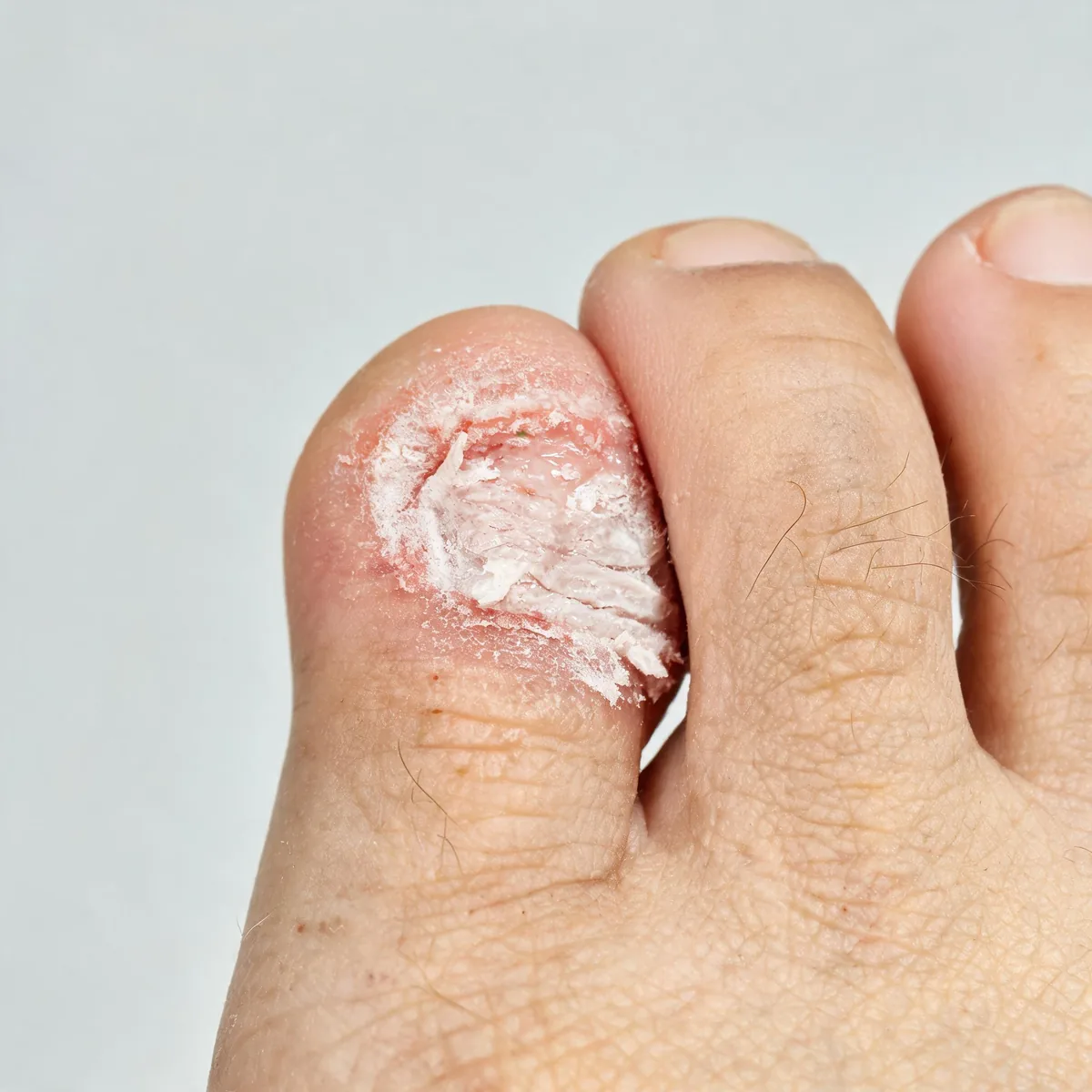
The common pattern is Damp-Heat in the Lower Burner: white sodden skin between the toes, vesicles, clear or yellowish oozing, intense itch worse in warm damp conditions, and foul-smelling feet.
A dry variant is also described. Where the skin is dry, flaky and thickened with painful fissures, the pattern is Blood deficiency with external wind, and the treatment direction reverses from drying to nourishing. A third picture, heat and Blood stagnation, gives stabbing or burning pain with dark red or purplish swollen skin.
Athlete's foot is read as a local expression of internal Dampness and Heat, with the Spleen at the root. The Spleen transforms and transports fluids, and when poor diet, stress or fatigue weakens it, Dampness collects and naturally sinks to the feet; damp floors, sweaty shoes and humid weather can add external Dampness and combine with the internal picture to trigger a flare.
The acute wet form is Damp-Heat in the Lower Burner, with white macerated skin between the toes, intense itch and oozing vesicles. When the problem lingers for months, the persistent Damp-Heat consumes Blood and fluids and the picture turns to Blood Deficiency with External Wind, with dry scaly thickened soles and night itch. A less common but more severe form is Heat and Blood Stagnation in the Lower Burner, where the skin is dark red or purplish, hot, tight and painfully stabbing rather than merely itchy.
Conventional view
Athlete's foot, or tinea pedis, is a common fungal infection of the skin of the feet, most often caused by dermatophytes. It usually starts between the toes with itching, scaling, redness and sometimes blisters or painful cracking, and the fungi thrive in warm moist environments such as sweaty shoes, locker rooms and humid weather. Diagnosis is usually visual, sometimes confirmed by skin scraping or culture, and the infection can spread to the toenails or elsewhere, often recurring.
Standard treatment relies on topical antifungal creams, sprays or powders with ingredients such as clotrimazole, miconazole or terbinafine, and more severe or resistant cases may need oral antifungals. Keeping the feet clean and dry, changing socks often and wearing breathable footwear support treatment and reduce recurrence.
Antifungal medicine kills the fungus but does not explain why some people get recurrent infections while others do not. The underlying susceptibility, often linked to excessive sweating, a compromised skin barrier or internal imbalance, remains unchanged, recurrence rates are high, and long-term topical steroids used for itch can thin the skin and worsen the problem.
Selected PubMed records
Real PubMed records for the conventional discussion above, selected by condition name and title relevance. They are references, not a claim that any treatment is proven for this condition.
- Tinea pedis: an updated review.. Drugs in context, 2023. PMID: 37415917.
- Diagnosis and Management of Tinea Infections.. American family physician, 2025. PMID: 41118183.
How it connects
Athlete's foot is rarely an isolated problem. Damp-Heat gravitates to the lowest part of the body and easily spreads to the groin, so tinea cruris, body odour, greasy skin and fungal infections elsewhere often appear together. When the picture becomes chronic and shifts toward Blood deficiency with Wind, the same lack of nourishment shows in dry scaly patches on the shins, elbows or scalp, and in brittle nails and hair. Where Heat and Blood stagnation dominate, the local inflammation can progress to secondary bacterial infection with spreading redness, pain and fever. Elements of more than one pattern commonly coexist, especially in long-standing cases: weeping between the toes points to Damp-Heat while dry cracked heels point to Blood Deficiency, because chronic Dampness damages fluids and leaves a mixed picture. If the skin is mainly wet and intensely itchy, Damp-Heat is active; if dryness and scaling dominate, Blood Deficiency with Wind is driving it; if pain and redness are prominent, Heat and Blood Stagnation needs attention. Spreading redness, fever or severe pain need urgent medical review for secondary bacterial infection.
How it is assessed
The practitioner looks at moisture, skin condition and odour, and asks about diet and footwear.
What a practitioner looks for
- Moisture: macerated white skin between the toes and oozing suggests Damp-Heat.
- Dryness: flaky thickened soles with fissures suggest Blood deficiency with wind.
- Pain: stabbing or burning pain with purplish swelling suggests heat with Blood stagnation.
- Contributing factors: occlusive footwear, sweating, diet and humidity are all part of the assessment.
The practitioner examines the skin between the toes and on the soles and asks when the itch or pain is worst, how long it has lasted, and whether thirst, fatigue or other signs accompany it. White macerated sodden skin with weeping and tiny blisters, intense itch, a red tongue with a greasy yellow coat and a slippery rapid pulse point to Damp-Heat in the Lower Burner, the common acute picture.
Dry scaly thickened or cracked soles with night itch, a pale tongue with little coat and a thin pulse point to Blood Deficiency with External Wind, where prolonged Damp-Heat has used up Blood and fluids and left the skin undernourished. Marked redness, swelling, erosion and stabbing pain rather than itch, with a dark red or purplish tongue and a wiry or choppy pulse, point to Heat and Blood Stagnation in the Lower Burner, where Heat has damaged the vessels and blood has stagnated locally.
The practitioner also notes whether both feet are affected, whether the nails are involved, and whether the person is otherwise healthy, since recurrent infections can reflect a weakened Spleen and a broader damp constitution that needs addressing alongside the local skin.
TCM patterns in Athlete's foot
Athlete's foot is treated by pattern, because the same itchy feet can come from different internal states. Damp-Heat in the Lower Burner is the common acute form, with macerated white skin between the toes, oozing and intense itch in warm damp conditions. Blood Deficiency with External Wind is the chronic dry form, with scaly thickened soles, cracks and night itch after months of recurring infection. Heat and Blood Stagnation in the Lower Burner is the severe form, with dark red or purplish hot swollen skin and stabbing pain. Many people carry a mixture, especially after a long history, so the tongue and pulse decide which pattern dominates and the emphasis of treatment shifts as the skin changes from wet to dry.
| Pattern | Key signs | The itch | Tongue | Main formula |
|---|---|---|---|---|
| Damp-Heat in the Lower Burner | Macerated whitish sodden skin between toes; Vesicles with clear or yellowish oozing | Intense itch worse in warmth and damp | Body: Red, slightly swollen, with a coating thickest at the rootCoat: Yellow and greasy | Not specified |
| Blood Deficiency with External Wind | Dry flaky or thickened skin on the soles | Itch worse at night | Body: Pale and thin, sometimes slightly dryCoat: Thin, white and a little dry | Not specified |
| Heat and Blood Stagnation in the Lower Burner | Intense stabbing or burning foot pain; Dark red or purplish swollen skin | Not specified | Body: Reddish-purple with stasis spots and distended sublingual veinsCoat: Dry and yellow | Not specified |
Damp-Heat in the Lower Burner
The common moist picture: sodden peeling skin between the toes with itch and odour.
When Dampness and Heat accumulate they sink downward and settle in the feet, saturating the skin between the toes until it is waterlogged, white and macerated, while the Heat drives redness, intense itch and small oozing blisters. Hot humid weather and sweaty footwear trap more heat and moisture and feed the fungal overgrowth.
The tongue is red with a yellow greasy coat thickest at the root, and the pulse is slippery and rapid, possibly soggy at the rear position. Rich spicy and greasy food, synthetic shoes, damp socks and walking barefoot in wet places aggravate it, while keeping the feet dry and cool, breathable cotton socks and a light diet help. Treatment clears Heat and drains Dampness, with Si Miao San as the standard formula and herbs such as Ku Shen, Huang Bai, Cang Zhu and Yi Yi Ren.
Signs
- Macerated whitish sodden skin between toes
- Vesicles with clear or yellowish oozing
- Intense itch worse in warmth and damp
- Heaviness in the legs
- Foul-smelling feet
Diet and lifestyle for this pattern: Dry the feet thoroughly, especially between the toes, and wear cotton socks and shoes that let air through. Skip greasy, fried, spicy and sugary food as well as dairy, which fuel Damp-Heat, and add barley, mung beans and cucumber, which are light and cooling.
Blood Deficiency with External Wind
The dry fissured picture: thickened soles with painful cracks.
When the infection lingers, persistent Damp-Heat gradually consumes Blood and fluids, so the skin can no longer be nourished and moistened. It becomes dry, scaly, thickened and prone to painful cracks, and the dryness creates a void that external Wind enters, stirring the shifting night itch.
The tongue is pale and thin with a thin white slightly dry coat, and the pulse is fine and wiry at the left middle position. Dry windy weather, overwork, stress, alcohol and spicy food and harsh soaps aggravate it, while moisturising, warm not hot soaks, blood-nourishing food and sleep help. Treatment nourishes Blood, moistens dryness and dispels Wind, with Dang Gui Yin Zi as the standard formula and herbs such as Dang Gui, Bai Shao, He Shou Wu and Fang Feng.
Signs
- Dry flaky or thickened skin on the soles
- Fissures that may bleed
- Itch worse at night
- Pale or dull complexion
- Aversion to wind and drafts
Diet and lifestyle for this pattern: Eat blood-nourishing food such as dark leafy greens, beetroot, black sesame and a little liver or red meat, while avoiding food that is very spicy, fried or drying. Keep the feet clean but moisturised with coconut or sesame oil to prevent cracking, and protect them from cold draughts.
Heat and Blood Stagnation in the Lower Burner
The painful picture: burning stabbing pain with dark swollen skin.
When Damp-Heat persists and intensifies, the Heat scorches the Blood so that it congeals and stagnates. The skin turns dark red or purplish and feels hot and tight, the pain becomes stabbing rather than itching, and the toes may look dusky or bruised because circulation is blocked.
The tongue is reddish-purple with stasis spots, distended sublingual veins and a dry yellow coat, and the pulse is deep, choppy and often rapid. Prolonged standing, stress and anger, spicy greasy food and tight shoes aggravate it, while cooling soaks, gentle movement and elevating the feet help. Treatment cools and invigorates the Blood and clears Heat, with Si Miao Yong An Tang as the standard formula and herbs such as Jin Yin Hua, Dang Gui, Chi Shao and Hong Hua.
Signs
- Intense stabbing or burning foot pain
- Dark red or purplish swollen skin
- Erosion or oozing with dark discharge
- Worse with pressure and at night
- Restlessness or agitation
Diet and lifestyle for this pattern: Cut back on spicy, greasy and heating food that adds fuel. A lukewarm foot soak with honeysuckle or dandelion can cool and clear the area, gentle walking keeps Blood moving without long periods on your feet, and dry breathable footwear matters as much as diet here.
Treatment approach
How the tradition treats athlete's foot, with the herbs, formulas and points used for it.
Principles
- Drain dampness and clear heat while the skin is moist and itchy, addressing the Spleen as the source.
- Nourish Blood and moisten the skin where it is dry and fissured, rather than drying it further.
- Move Blood and clear heat where the foot is painful, swollen and discoloured.
- Keep the feet dry and rotate footwear, which both frameworks treat as essential.
- Treatment works on two levels at once: clearing the local Dampness and Heat from the skin with soaks, washes and powders, and correcting the internal imbalance that let the infection take hold. Acute wet patterns are drained and cooled, chronic dry patterns are nourished and moistened, painful stagnant patterns are cooled and moved, and diet and lifestyle that support the Spleen are the foundation that keeps the condition from returning.
Herbs used
Formulas
Acupoints
- SP-9 (Yinlingquan)
- ST-40 (Fenglong)
- LI-4 (Hegu)
- LR-3 (Taichong)
- SP-6 (Sanyinjiao)
- SP-10 (Xuehai)
- ST-36 (Zusanli)
- LI-11 (Quchi)
What to expect
- Itching and maceration are described as improving within one to two weeks of treatment and foot care.
- Dry fissured patterns take longer to soften.
- Recurrence is common unless footwear and dampness are addressed.
- Most people notice less itching and oozing within the first week of herbal foot soaks and internal herbs, and acupuncture once or twice a week helps drain Dampness and strengthen the Spleen, often improving energy and digestion as well. The skin itself can take a few weeks to heal, and chronic dry cracked feet may need a couple of months, with treatment continued for at least a few months to consolidate the result and reduce recurrence.
Safety and when to get help
Seek medical help urgently for
- Redness and swelling spreading up the leg, which may be bacterial cellulitis.
- Fever with chills.
- Pus, foul-smelling discharge or a foot that is hot and very painful, especially in someone with diabetes.
For anything severe, sudden or spreading quickly, read when a skin problem needs urgent care.
Cautions
- People with diabetes need foot problems reviewed promptly.
- Do not apply strong topical preparations to broken skin between the toes.
- Toenail involvement needs medical assessment.
Using this alongside conventional care
- TCM is described as complementary to conventional care: antifungal creams or oral treatment can continue alongside herbs, and spreading infection needs medical care.
- Herbal soaks and internal formulas can be used alongside topical antifungals: apply the cream after the soak and let the skin dry thoroughly. Tell both the practitioner and the doctor about all treatments, especially oral antifungals, because some heat-clearing and damp-draining herbs can affect liver function and need monitoring, and never stop a prescribed medicine without medical advice.
Diet and lifestyle
- To reduce dampness, avoid sugar, dairy, greasy or fried food, and excess raw or cold food, all of which are said to burden the Spleen.
- Because Dampness is the root of most athlete's foot patterns, avoid sugar, dairy, greasy and fried food, and excessive raw or cold food, all of which burden the Spleen. Favour lightly cooked vegetables, whole grains such as barley and millet, and damp-draining legumes such as adzuki beans, drink warm water or barley tea, and limit alcohol and spicy food during an acute flare.
If you're pregnant
During pregnancy the body's natural tendency towards Dampness and Heat can make Damp-Heat type athlete's foot more pronounced. Internal formulas such as Si Miao San and Dang Gui Yin Zi are used with great caution or avoided, because their blood-moving and bitter-cold properties could affect the pregnancy, and topical treatment is the preferred approach.
Herbal foot soaks with mild pregnancy-safe herbs such as Ku Shen, Di Fu Zi and Bai Xian Pi can relieve itching and dry Dampness without systemic absorption, though a practitioner experienced in pregnancy care should be consulted before any preparation, even an external one.
If you're breastfeeding
The main concern during breastfeeding is that bitter-cold herbs taken internally, such as Huang Bai in Si Miao San, may pass into breast milk and cause digestive upset or diarrhoea in the infant, so internal formulas are generally avoided.
Topical washes and creams are safe because they act locally with negligible systemic absorption, and foot hygiene with moisture-wicking socks helps. If internal treatment is needed for a severe or stubborn case, a practitioner can adjust the formula towards gentler, milk-compatible herbs.
If treating a child
Children, especially active ones, are prone to athlete's foot through sweaty feet and shared environments such as swimming pools. The most common pattern is Damp-Heat with macerated, itchy toe webs.
Treatment centres on external washes with gentle herbs such as Ku Shen and She Chuang Zi, since children's skin is sensitive and may not tolerate strong drying agents. Internal formulas are rarely needed, but if used must be dosed at one-third to a half of the adult amount by weight, and teaching the child to dry the feet thoroughly and wear breathable footwear is essential because their Spleen Qi is still developing and more susceptible to Dampness.
If treating an elderly patient
In older adults athlete's foot often shifts towards Blood deficiency with Wind, with dry, cracked, thickened skin that itches intensely at night. Because the underlying deficiency makes overly drying or cooling treatment counterproductive, care shifts to nourishing Blood and moistening dryness with soaks containing Dang Gui and Bai Shao and with emollient ointments.
Acupuncture points such as Sanyinjiao (SP-6) and Xuehai (SP-10) can help build Blood. Many older patients take multiple medicines, so internal formulas need careful interaction review, and slower skin regeneration means a longer, gentler timeline yields the best results.
Urgent-sign guidance is based on standard sources: NHS anaphylaxis, NHS cellulitis, NHS Stevens-Johnson syndrome, NHS melanoma.
Evidence
Evidence status
Compiled for this page from the classical and modern literature; not a systematic review, so treat it as a pointer to sources rather than clinical guidance.
Evidence is growing and mostly from China. Randomised trials report herbal foot baths and topical preparations performing comparably to conventional antifungal creams, sometimes with lower recurrence. A 2020 meta-analysis of external TCM treatments found significantly better clinical cure rates for tinea pedis than placebo or standard antifungals with few adverse events, but small samples and weak blinding limit confidence.
Most evidence comes from Chinese trials of herbal foot baths and topical preparations, which several randomised studies found comparable to conventional antifungal creams with lower recurrence, and a 2020 meta-analysis of external TCM treatments reported significantly better clinical cure rates for tinea pedis than placebo or Western antifungals with few adverse events. Small samples and limited blinding weaken the evidence, and combination therapy with standard antifungals shows promise for faster relief and longer disease-free intervals. Herbs such as Ku Shen and Huang Bai are thought to act both directly against the fungus and by regulating local skin immunity, and larger international trials are still needed.
Studies often cited
Randomised trials report similar effectiveness to conventional antifungal creams, with lower recurrence rates in some studies. Randomised controlled trials (as recorded in the source)
External TCM treatments significantly improved clinical cure rates for tinea pedis compared with placebo or Western antifungals, with few adverse events. 2020 meta-analysis (as recorded in the source)
Classical record
Foot dampness is due to damp-heat pouring downward or contracting damp toxin, causing maceration between the toes, itching and oozing.
- Golden Mirror of Medicine (Yi Zong Jin Jian), section on foot dampness. The Chinese original is not reproduced because the source record could not be relied on for the characters.
脚湿气,由湿热下注,或感染湿毒,致足丫湿烂,瘙痒流水。
Foot dampness is caused by Damp-Heat pouring downward or by contracting damp toxin, producing maceration between the toes, itching and oozing.
Yi Zong Jin Jian (Golden Mirror of Medicine), Foot Dampness - Classical citation; the translation is our own.
Common questions
Can herbs clear athlete foot?
The tradition describes treating the damp heat internally and the skin locally, with improvement over one to two weeks. Antifungal treatment can continue alongside.
Why does it keep returning?
The framework explains recurrence as dampness sinking to the feet again, usually because diet, footwear and humidity have not changed.
Should I use drying powders?
Drying suits the moist pattern but can worsen the dry fissured one, which is why the classical literature distinguishes them.
When is it serious?
Spreading redness up the leg, fever, or a hot very painful foot needs medical assessment, particularly with diabetes.
Is athlete's foot a sign of a deeper health problem in TCM?
Often it is. Recurrent athlete's foot can signal an underlying weakness in the Spleen, the organ system that manages fluids, so when the Spleen is sluggish Dampness accumulates and sinks to the feet. Addressing that root with diet, herbs and acupuncture can improve the feet along with energy, digestion and general wellbeing, not merely the current outbreak.
Will athlete's foot come back after TCM treatment?
TCM aims to reduce the chance of recurrence by treating the internal imbalance that makes the feet susceptible, and while no treatment can promise the infection never returns, many people find their outbreaks become less frequent and less severe, and some break the cycle altogether. Keeping feet dry and following a dampness-reducing diet supports the long-term result.
What can I do at home to support TCM treatment for athlete's foot?
Keep the feet clean and dry, especially between the toes, wear breathable cotton socks and change them when damp, and avoid walking barefoot in public wet areas. Cut back on sugar, dairy, greasy food and excess raw or cold food, favour lightly cooked vegetables, barley tea and adzuki beans, and dry the feet thoroughly after washing and after each soak.