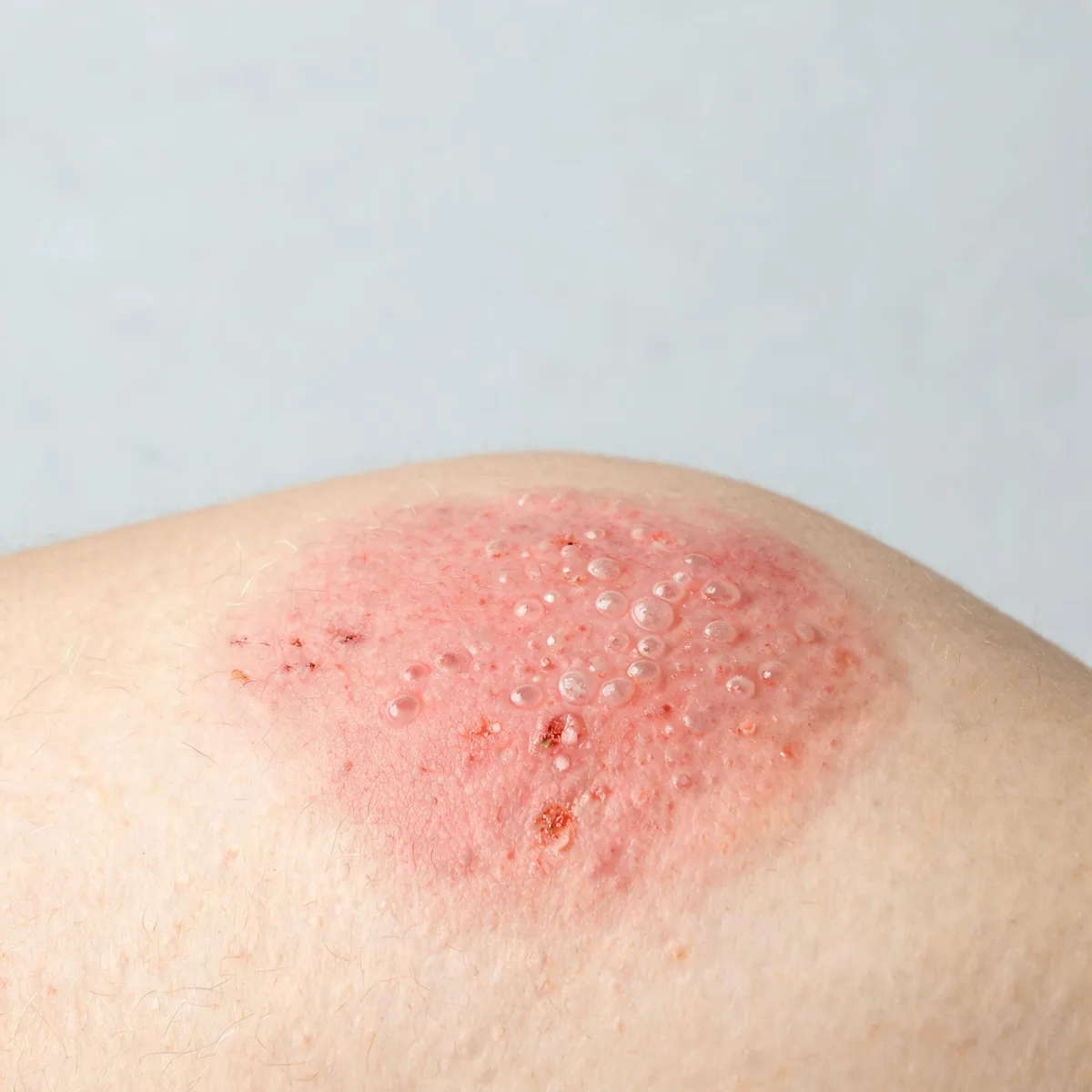
Understanding Itchy vesicular rashes
The tradition describes itchy vesicular rashes as a sign of internal disharmony, with the Lungs governing the pores, the Spleen managing fluids and the Liver circulating Qi and Blood.
Liver and Gallbladder damp heat gives a red blistering oozing rash with yellow discharge, burning intense itch, a bitter taste, irritability and dark scanty urine. Wind-Heat gives a similar blistering oozing rash with yellow discharge plus a feeling of heat, thirst and possible mild fever or sore throat - the acute surface pattern.
Spleen deficiency with dampness gives dull oozing lesions with little redness and milder itch, with poor appetite, bloating and loose stools. Blood deficiency with external wind gives dry flaky rough skin with scaling and fissures, burning itch worse at night and a pale complexion. Yin and Blood deficiency adds dry mouth with a desire to sip water and night sweats.
Three organs carry most of the explanation. The Lungs open and close the pores and govern the surface, the Spleen turns food into Qi and manages fluids, and the Liver keeps Qi and Blood moving smoothly. Let any of them lose its balance and Dampness, Heat or Wind gather inside until they spill out onto the skin, which is where the rash and the itch come from.
Where the Lungs are the weak point, an exterior pathogen such as Wind-Heat has an easy entry, and the rash arrives suddenly, itches hard and moves about. Where the Spleen is the weak point, dampness accumulates quietly and the skin stays dull and oozing, never quite clearing. Where Blood and Yin are the weak point, the surface is simply undernourished, so it dries, thickens and cracks. Reading skin, tongue and pulse together is what tells the practitioner which of these is running the show.
Conventional view
Atopic dermatitis, the commonest form of eczema, is a long-running inflammatory condition of the skin. Dryness and severe itch lead the symptom list, along with red scaly patches and, during flares, blisters that ooze clear fluid. It usually begins in childhood and then comes and goes for years. Genetics, a leaky skin barrier, an over-reactive immune system and environmental irritants are all thought to contribute, and no single cause has been pinned down. A doctor makes the diagnosis from the look and distribution of the rash and from the history; tests are seldom required unless infection is suspected.
Treatment is layered. Emollients are applied daily to repair the barrier, topical corticosteroids or calcineurin inhibitors settle a flare, and oral antihistamines help with itch. When disease is moderate or severe, dermatologists turn to systemic immunosuppressants, biologic injections or phototherapy. The realistic goal is control of symptoms with fewer flares, because a cure is not yet available.
The limits are real. Topical steroids work during a flare but can thin the skin with prolonged use and often give only temporary relief, with the eczema returning once they stop. Systemic drugs carry risks such as increased infection, kidney strain or nausea. The conventional approach also treats the skin in isolation, without addressing the digestive, stress-related or internal-heat factors that many people notice driving their flares, which is where a pattern-based treatment adds something.
Selected PubMed records
Real PubMed records for the conventional discussion above, selected by condition name and title relevance. They are references, not a claim that any treatment is proven for this condition.
- The terminology of skin disorders. Primary Care, 2000. PMID: 10815043.
How it connects
Itchy vesicular rashes rarely travel alone. Allergic rhinitis and asthma commonly appear alongside, the classic atopic grouping, and in TCM terms all three can rest on a constitutional weakness of the Spleen and Lungs that leaves the body open to Dampness, Heat and Wind. That same dampness, spilling onto the skin, can congest the sinuses or the airways, so strengthening the Spleen and draining Dampness may ease all three together. Loose stools and persistent tiredness cluster in as well, especially where Spleen Deficiency with Dampness is the pattern, because the gut and the skin answer to the same organ.
How it is assessed
The practitioner assesses the blister fluid, the redness and the accompanying signs.
What a practitioner looks for
- Fluid: yellow discharge with intense burning suggests damp heat.
- Redness: bright red with heat suggests Wind-Heat; dull with little redness suggests Spleen deficiency.
- Dryness: scaling and fissures suggest Blood or Yin deficiency.
- Red flags: honey-coloured crusts, spreading redness, fever or widespread blistering.
The first question is what the skin is doing. An acute, weepy, red eruption with heat in it points to Damp-Heat or to Wind-Heat that has invaded from outside, while chronic dry thickened skin points towards Blood or Yin deficiency. Bright red skin with blisters and yellow oozing, together with a red tongue under a thick yellow greasy coat, indicates Liver and Gallbladder Damp-Heat; these flares come on fast and are often accompanied by heaviness, thirst, dark urine and a slippery rapid pulse.
A sudden crop of red papules with fierce itching that heat makes worse, a red tongue with a thin yellow coat and a floating pulse suggests Wind-Heat, which often follows exposure to wind or an allergen and can settle as quickly as it came. Where the rash lingers, looks dull and weeps only a little, and the person is off their food, bloated, loose in the bowel and tired, Spleen Deficiency with Dampness becomes the working diagnosis, with a pale swollen tongue, a white greasy coat and a soft slow pulse. Chronic dry, thick, pigmented skin that itches at night is Blood Deficiency with External Wind, with a pale tongue and a fine pulse. A deeper dryness, flaky and burning, with a dry mouth and constipation, means Yin as well as Blood has run low, which is common in older people and after long illness.
TCM patterns in Itchy vesicular rashes
Five patterns account for most vesicular rashes, and how much the skin weeps separates them more reliably than any other sign. Liver and Gallbladder Damp-Heat is the wettest and most inflamed: red, blistering, oozing skin with yellow discharge, a bitter taste, irritability and a wiry slippery rapid pulse. Spleen Deficiency with Dampness is the dull version, with lesions that ooze a little and barely redden, a poor appetite, bloating and loose stools and a milder itch. Blood Deficiency with External Wind turns the picture dry, with scaling, fissures and an itch that is intense at night and comes and goes with drafts. Wind-Heat is the acute surface pattern, arriving suddenly as red itchy papules and tiny vesicles with a floating rapid pulse, often after heat, wind or stress. Yin and Blood Deficiency is the deepest dryness, with cracks, burning, night sweats and five-centre heat.
| Pattern | Key signs | The itch | Tongue | Main formula |
|---|---|---|---|---|
| Liver and Gallbladder Damp-Heat | Red blistering oozing rash with yellow discharge | Burning and intense itching | Body: Red, with redder sidesCoat: Thick, yellow and greasy | Not specified |
| Spleen Deficiency with Dampness | Dull oozing skin lesions with little redness | Less intense itching than acute eczema | Body: Pale and swollen, often with teeth marks along the edgesCoat: White, greasy and moist, thick in the middle | Not specified |
| Blood Deficiency with External Wind | Dry flaky rough skin with scaling and fissures; Pale complexion with dull nails and dry hair | Burning and intense itching | Body: Pale and thin, sometimes slightly dryCoat: Thin, white and a little dry | Not specified |
| Wind-Heat | Red blistering oozing rash with yellow discharge | Burning and intense itching | Body: Red at the tip and edgesCoat: Thin yellow or white turning yellow | Not specified |
| Yin and Blood Deficiency | Dry flaky rough skin with scaling and fissures; Dry mouth and throat with desire to sip water | Burning and intense itching | Body: Pale to pale-red, thin, dry and crackedCoat: Scanty or peeled | Not specified |
Liver and Gallbladder Damp-Heat
Red blistering rash with yellow discharge and a bitter taste.
When Dampness and Heat overwhelm the Liver and Gallbladder, the body tries to discharge the excess through the skin surface. Hot, sticky fluid is pushed outward, and the result is the acute picture: swollen red skin, blisters that weep, and a burning itch. The Heat also disturbs the Liver's job of keeping Qi moving smoothly, which is why irritability and frustration tend to flare at the same time as the rash.
The tongue body is red with redder sides beneath a thick yellow greasy coat, and the pulse is wiry, slippery and rapid. Anger, spicy greasy fried food, alcohol, humid weather and scratching all make it worse, while a cool dry room, bland light meals and cool compresses ease it. Long Dan Xie Gan Tang is the formula, draining Damp-Heat downward through the urine, with Taichong (LR-3), Yanglingquan (GB-34), Yinlingquan (SP-9) and Quchi (LI-11) as the points.
Signs
- Red blistering oozing rash with yellow discharge
- Burning and intense itching
- Bitter taste with irritability
- Dark scanty urine
Diet and lifestyle for this pattern: Avoid alcohol, coffee, spicy food and greasy fried dishes, which all add fuel to the Damp-Heat fire. Fill your plate with cooling, water-rich vegetables such as cucumber, celery and mung bean sprouts, sip chrysanthemum tea to cool the Liver gently, keep the skin clean and dry using lukewarm rather than hot water, wear loose breathable cotton, and try not to scratch, which breaks the skin and invites more Heat.
Spleen Deficiency with Dampness
Dull oozing lesions with little redness and loose stools.
A weak Spleen does not transform food and fluids properly, and what is left over turns into Dampness, a heavy, turbid substance. Because the Spleen governs the skin, that Dampness can seep outward and form dull, oozing vesicles that itch. Weak Qi also means the skin is poorly nourished and repairs slowly, so the rash sits in a lingering subacute or chronic phase.
The tongue appears pale, swollen and indented by teeth, coated white and greasy, and moist, and the pulse is soggy and slow, sometimes slippery. Cold raw greasy food, humid weather, fatigue and worry aggravate it, while warm cooked meals, a dry comfortable environment, gentle movement that brings on a light sweat and adequate rest help. Shen Ling Bai Zhu San is the main formula and Wei Ling Tang is used where fluids and Qi both need moving, with Zusanli (ST-36), Sanyinjiao (SP-6), Yinlingquan (SP-9) and Pishu (BL-20) as the points.
Signs
- Dull oozing skin lesions with little redness
- Less intense itching than acute eczema
- Poor appetite with bloating
- Loose unformed stools
Diet and lifestyle for this pattern: Eat warm, cooked, easy food such as soups, congee and steamed vegetables, and avoid cold, raw and greasy food as well as dairy and sugar, which create Dampness. Gentle daily walking or stretching helps the Spleen move Qi and clear Dampness, and avoid overwork, since fatigue weakens the Spleen directly.
Blood Deficiency with External Wind
Dry flaky skin with fissures and burning itch.
Skin starved of Blood turns dry, rough and liable to crack. That weakness lets external Wind settle into the surface, which stirs up intense itching and a rash that can appear and fade suddenly. Habitual scratching then adds small blisters and thickened, scaly patches, which is why chronic cases look so much coarser than they began.
The tongue is pale and thin with a thin white, slightly dry coat, and the pulse is fine and wiry, sometimes floating at the surface. Wind and drafts, dry air, fatigue, spicy drying food, night-time and heavy sweating all provoke it, while moisturising, rest, warm cooked meals and shelter from the wind relieve it. Dang Gui Yin Zi nourishes Blood, moistens dryness and dispels Wind, carried by Dang Gui and Fang Feng, and the points are Xuehai (SP-10), Zusanli (ST-36), Quchi (LI-11) and Fengchi (GB-20).
Signs
- Dry flaky rough skin with scaling and fissures
- Burning and intense itching
- Pale complexion with dull nails and dry hair
- Aversion to wind and drafts
Diet and lifestyle for this pattern: Eat warm, nourishing food that builds Blood, such as bone broth, dark leafy greens, red meat and black sesame. Avoid raw, cold and spicy food that can damage the Spleen or dry the skin, moisturise well with gentle fragrance-free cream after bathing, protect the skin from wind and dry air, and keep exercise gentle without heavy sweating.
Wind-Heat
Red blistering rash with heat and possible mild fever.
Here the pathogen comes from outside, landing on the skin and the Lungs at the same time. Wind carries Heat to the surface, where the two contend with the body's defensive Qi, and red itchy papules with tiny vesicles appear. Since the pathogen has not gone deeper than the surface, the eruption arrives abruptly and flares whenever heat, wind or stress is added.
The tongue tip and edges are red with a thin yellow coat, and the pulse is floating and rapid. Hot weather, hot showers, spicy greasy food, alcohol, stress, drafts and friction all stir it, while a cool dry room, cool compresses, light bland meals, a gentle sweat and acupuncture settle it. Xiao Feng San disperses Wind, clears Heat and drains Dampness, with Jing Jie, Fang Feng and Chan Tui, and the points are Quchi (LI-11), Hegu (LI-4) and Xuehai (SP-10).
Signs
- Red blistering oozing rash with yellow discharge
- Burning and intense itching
- Feeling of heat with thirst
- Possible mild fever or sore throat
Diet and lifestyle for this pattern: Avoid spicy, greasy and deep-fried food as well as alcohol, which can generate internal Heat. Wear loose breathable cotton and keep the skin cool, let gentle exercise such as walking or yoga release the exterior without overheating, and peppermint or chrysanthemum tea can soothe the skin from within.
Yin and Blood Deficiency
Dry fissured skin with night sweats and dry mouth.
Yin and Blood supply the cooling moisture that keeps skin supple. When both run low the surface cannot hold water, so it turns dry, thin and cracked, and the low-grade heat of Yin deficiency rises towards the skin, producing an itch that is worst at night, when Yin should be cooling and settling the body.
The tongue is pale to pale-red, thin and dry with cracks and a scanty or peeled coat, and the pulse is fine and rapid. Spicy greasy fried food, hot baths and saunas, fatigue, dry air and late nights all deplete it further, while a cool dry environment, hydrating foods such as pear juice, sleep and moisturising the skin help. Dang Gui Di Huang Yin nourishes Yin and Blood and moistens the dryness, with Dang Gui, Shu Di Huang and Bai Shao, and the points are Taixi (KI-3), Sanyinjiao (SP-6), Xuehai (SP-10) and Ganshu (BL-18).
Signs
- Dry flaky rough skin with scaling and fissures
- Burning and intense itching
- Dry mouth and throat with desire to sip water
- Night sweats
Diet and lifestyle for this pattern: Eat moistening, cooling food such as pear, black sesame, spinach and bone broth, and avoid spicy, fried or drying food. Keep skin hydrated with gentle fragrance-free cream, use lukewarm rather than hot water, and choose gentle exercise such as tai chi or restorative yoga that supports Yin without overheating.
Treatment approach
How the tradition treats itchy vesicular rashes, with the herbs, formulas and points used for it.
Principles
- Clear heat and drain dampness where blisters weep and burn.
- Dispel Wind-Heat where the onset is acute with fever.
- Support the Spleen where oozing is dull and digestion is weak.
- Nourish Blood and Yin where the skin is dry and fissured.
- Every pattern is approached on two fronts at once: the pathogen that is actively producing the rash is cleared, and the substance that was too weak to prevent it is rebuilt. During an acute flare the balance tips towards clearing, with herbs and points chosen to drain Dampness, cool Heat and disperse Wind; as the skin settles, the emphasis moves to rebuilding the Spleen, Liver or Kidneys so the surface recovers its resilience. Internal formulas do the main work, external washes, soaks and ointments soothe the skin directly, and points are chosen both for the local itch and for the organ pattern behind it. Since patterns shift, with a Spleen-deficient person suddenly flaring with Damp-Heat, the prescription is reviewed at each visit.
Herbs used
Formulas
- Long Dan Xie Gan Tang
- Shen Ling Bai Zhu San
- Wei Ling Tang
- Dang Gui Yin Zi
- Xiao Feng San
- Dang Gui Di Huang Yin
Acupoints
- LR-3 (Taichong)
- GB-34 (Yanglingquan)
- LI-11 (Quchi)
- SP-9 (Yinlingquan)
- ST-36 (Zusanli)
- SP-6 (Sanyinjiao)
- BL-20 (Pishu)
- SP-10 (Xuehai)
- GB-20 (Fengchi)
- LI-4 (Hegu)
- KI-3 (Taixi)
- BL-18 (Ganshu)
What to expect
- Acute wet patterns are described as settling within one to two weeks.
- Dry deficiency patterns take longer.
- Bacterial infection changes the picture and needs medical treatment.
- Improvement usually arrives in stages: itch intensity and the number of new patches fall first, over two to four weeks, and the texture and appearance of the skin follow more slowly. Chronic eczema commonly needs three to six months of consistent treatment for a stable result, and the aim is a calmer baseline that holds rather than a single clear spell.
Safety and when to get help
Seek medical help urgently for
- Increased redness, warmth, swelling, pus or honey-coloured crusts with fever.
- Widespread blistering or skin peeling.
- Rapidly spreading redness from the rash.
For anything severe, sudden or spreading quickly, read when a skin problem needs urgent care.
Cautions
- Do not burst blisters.
- Keep the skin cool and avoid occlusion.
- Persistent or recurrent rashes need medical diagnosis.
Using this alongside conventional care
- TCM is described as complementary to conventional care: prescribed topical treatment continues alongside herbs.
- Herbal medicine and acupuncture can sit alongside conventional eczema care, and over time may reduce how much topical steroid or antihistamine is needed. Prescribed medicines should never be stopped suddenly without medical advice, and each clinician should know what the other is doing. Tell the dermatologist which herbs are being taken, and tell the TCM practitioner about immunosuppressants, biologics or blood thinners, since herbs that move Blood, Dang Gui among them, can interact with anticoagulants and the formula will be adjusted accordingly.
Diet and lifestyle
- Avoid spicy, greasy and fried food, alcohol and excess sugar.
- Whatever the pattern, the same broad rules help. Cut back on peppers, alcohol, deep-fried and greasy food, sweets and dairy, and favour cooling, easily digested meals such as rice congee, cooked greens, pear, cucumber and mung beans. Where the skin is chronically dry, add moderate amounts of Blood-nourishing food such as bone broth, black sesame and spinach. A food diary is worth keeping, because individual sensitivities vary and are easy to miss.
If you're pregnant
Pregnancy draws Qi and Blood towards the fetus, so a Blood Deficiency pattern can deepen and chronic dry eczema can become more prominent, while the physiological heat of pregnancy can also drive an acute Damp-Heat flare. Treatment has to stay gentle: herbs that move Blood strongly, Dang Gui and Chuan Xiong among them, are avoided in high doses, and bitter-cold herbs such as Long Dan Cao are limited.
For Damp-Heat, Huang Qin is used cautiously and Fu Ling is preferred. Acupuncture is generally safe, though points such as Hegu (LI-4) and Sanyinjiao (SP-6) and anything on the lower abdomen are avoided. Topical herbal washes are a low-risk option that can be used throughout.
If you're breastfeeding
Ku Shen and Long Dan Cao are bitter and cold, and can enter breast milk, where they may loosen the stool or upset the infant's digestion. When a Damp-Heat pattern has to be treated, milder damp-draining herbs such as Yi Yi Ren and Fu Ling are used and courses are kept short. A Blood-nourishing formula such as Dang Gui Yin Zi is generally safe here and can even support postpartum recovery.
Acupuncture carries no risk to a nursing infant, and it can be the first choice for itching and inflammation during this period.
If treating a child
Most childhood eczema comes from Spleen Deficiency with Dampness or from an acute Wind-Heat invasion. A young Spleen is immature, so dampness builds easily and overflows onto the skin. A flare of red papules and vesicles responds well to Xiao Feng San, given at a third to a half of the adult dose according to age and weight, while chronic dull oozing eczema suits Shen Ling Bai Zhu San, which strengthens the Spleen and dries dampness gently.
Diagnosis leans on observation, since young patients cannot always describe what they feel. A tongue that is pale, swollen and indented by teeth suggests a weak Spleen, while a red tip with a thin yellow coat points to Wind-Heat. Many children tolerate needles poorly, so acupressure, paediatric tuina or gentle moxibustion at Zusanli (ST-36) and Pishu (BL-20) are good alternatives. Dietary change, especially avoiding cold, raw and greasy food, matters more in children than in adults.
If treating an elderly patient
By old age eczema is almost always chronic and rooted in Yin and Blood Deficiency, with skin that is itchy, dry and thin, often deeply cracked and barely weeping at all. Kidney essence declines naturally with age, so treatment nourishes deeply instead of clearing pathogens aggressively, and Dang Gui Di Huang Yin or Dang Gui Yin Zi suits this without draining vital Qi.
Doses are reduced to around two thirds of the standard adult amount and timelines are longer, with gradual change over weeks, not days. Multiple medicines are a genuine concern, so herb-drug interactions need reviewing, particularly with blood thinners and diabetes medication. Acupuncture is well tolerated and can ease itch, with Xuehai (SP-10) and Sanyinjiao (SP-6) giving gentle Blood nourishment and settling Wind.
Urgent-sign guidance is based on standard sources: NHS anaphylaxis, NHS cellulitis, NHS Stevens-Johnson syndrome, NHS melanoma.
Evidence
Evidence status
Compiled for this page from the classical and modern literature; not a systematic review, so treat it as a pointer to sources rather than clinical guidance.
The evidence here comes from atopic eczema, which is the closest studied equivalent, and it is moderate for acupuncture and low to moderate for herbs. Reviews report reduced itch and eczema severity with acupuncture, and the Cochrane review found some evidence that certain herbal preparations reduce severity and steroid use while rating overall quality low. A small randomised trial of Xiao Feng San in children reported better severity scores and less steroid use than placebo.
The evidence is cautious but real. A 2012 systematic review of six randomised trials found acupuncture better than conventional medication for itch intensity and overall severity, while noting a high risk of bias in the included studies. The 2013 Cochrane review examined herbal medicine for atopic eczema and concluded that some preparations may reduce severity and corticosteroid use, though it rated the overall quality low because of small samples and weak methods. Xiao Feng San has been tested in a placebo-controlled trial of 85 children, which reported greater improvement and less steroid use over twelve weeks with no serious adverse events. Larger, better blinded trials are still needed.
Studies often cited
A systematic review of six randomised trials found that acupuncture significantly reduced itch intensity and improved eczema severity compared with conventional medication, while calling for larger and more rigorous trials. Lee MS, Choi TY, Kim JI, et al. Acupuncture in Medicine. 2012;30(4):298-303. doi:10.1136/acupmed-2012-010150
The review found some evidence that certain herbal preparations may reduce eczema severity and corticosteroid use, but rated overall evidence quality as low because of small study sizes and methodological limitations. Gu S, Yang AW, Xue CC, et al. Cochrane Database of Systematic Reviews. 2013, Issue 9. Art. No.: CD008642. doi:10.1002/14651858.CD008642.pub2
In a randomised double-blind placebo-controlled trial of 85 children, the herbal group showed greater improvement in severity scores and reduced topical corticosteroid use after 12 weeks, with no serious adverse events. Hon KL, Leung TF, Ng PC, et al. British Journal of Dermatology. 2007;157(2):357-363. doi:10.1111/j.1365-2133.2007.08036.x
Classical record
Eczema is formed when internal damp-heat brews within and external wind invades; wind, dampness and heat struggle together, soaking into the skin and causing the condition.
- Wai Ke Zheng Zong (Orthodox Manual of External Medicine).
湿疮者,由风湿热邪客于肌肤,与血气相搏,故生疮,痒痛,汁出。
Damp sores arise when wind, dampness and heat lodge in the skin and flesh and clash with the Blood and Qi, so sores form that itch, hurt and discharge fluid.
Zhu Bing Yuan Hou Lun on damp sores - Classical citation: Zhu Bing Yuan Hou Lun (Treatise on Causes and Symptoms of Diseases), chapter on damp sores.
Common questions
What causes vesicular rashes?
The classical literature reads them as dampness and heat; conventional medicine looks for eczema, contact allergy, fungus or viral causes.
Should I pop the blisters?
No. The roof protects the skin and reduces infection risk.
Can herbs dry them up?
The tradition describes clearing damp heat, with improvement over one to two weeks for acute cases.
When is it urgent?
Honey-coloured crusts with fever, spreading redness, or widespread blistering.