Understanding Foul body odour
The classical literature traces foul body odour to the internal environment: accumulated dampness and heat steaming outward through the skin. The Liver and Gallbladder channels run through the armpits, which is why underarm odour is read as Liver and Gallbladder damp heat.
Liver and Gallbladder damp heat gives a pungent odour with yellow-tinged sweat, a bitter taste, rib-side distension, irritability and dark scanty urine. That is the classic underarm picture.
Toxic-Heat stagnation adds local redness, swelling and heat in the armpit with tenderness and a stronger than usual odour. The classical literature treats that as inflammation rather than simple damp heat.
Spleen deficiency with dampness gives a musty persistent odour with sticky heavy sweat, bloating, loose stools and fatigue. That is a deficiency picture and the smell is different: musty rather than sharp. Liver Qi stagnation transforming into heat gives odour with irritability, a bitter taste, rib-side distension and a throbbing headache. Disharmony between Heart and Kidneys gives night sweats with a faint sour smell, palpitations, vivid dreams and low back soreness.
Conventional view
In Western medicine, body odour is what happens when skin bacteria break down sweat, especially the thicker, protein-rich secretion of the apocrine glands found in the armpits and groin. It is a normal process rather than a disease, though it can become socially distressing when strong or persistent. Assessment is rarely complicated: the smell and its location usually settle the question, and it seldom signals serious illness, although a sudden change can occasionally reflect a metabolic disorder.
Management starts with washing and with antiperspirants, which block sweat ducts with aluminium salts, and deodorants, which mask the smell or kill the bacteria. More severe cases may be offered stronger topical agents, Botox injections to paralyse the sweat glands temporarily, or surgery such as sweat gland removal or sympathectomy. All of these work locally, on sweat or on bacteria.
The gap is that they do not explain why two people in the same conditions can smell so differently. Antiperspirants can irritate the skin, aluminium exposure is a common worry, and Botox and surgery are invasive and costly, with a risk of compensatory sweating elsewhere. Most importantly, the same antiperspirant is offered for a smell that appears with stress, one that follows a heavy diet and one that arrives as sour night sweats, although in Chinese medicine those have different roots.
Selected PubMed records
Real PubMed records for the conventional discussion above, selected by condition name and title relevance. They are references, not a claim that any treatment is proven for this condition.
- Bromhidrosis treatment modalities: A literature review.. Journal of the American Academy of Dermatology, 2023. PMID: 33482257.
- Deodorants and antiperspirants: New trends in their active agents and testing methods.. International journal of cosmetic science, 2023. PMID: 36896776.
How it is assessed
The practitioner notes the odour, the sweat and the constitutional picture.
What a practitioner looks for
- Odour character: pungent suggests Liver and Gallbladder damp heat; musty suggests Spleen deficiency; sour with night sweats suggests Heart and Kidney disharmony.
- Sweat: yellow-tinged sweat supports damp heat; sticky heavy sweat supports Spleen deficiency.
- Local signs: armpit redness and tenderness suggest Toxic-Heat stagnation.
- Red flags: sudden severe change in odour needs medical review.
The first question is about the smell itself, because its character says more than its strength. Pungent sweat that stains clothing yellow, with a bitter taste, rib-side distension and irritability, points to Liver and Gallbladder damp-heat, with red sides to the tongue, a greasy yellow coat and a pulse that is wiry, slippery and rapid. Where the armpit skin is red, swollen and tender and the odour is sharper still, the picture has thickened into Toxic-Heat.
A musty smell that lingers without sharpening is a different matter. With sticky sweat, bloating after meals, loose stools, fatigue and a pale swollen tongue under a white greasy coat, it suggests Spleen deficiency with dampness. An odour that flares with anger and stress, with a bitter taste, a throbbing headache and red eyes, suggests Liver Qi stagnation turning into heat, while a faint sour note in night sweats, with palpitations and sore lower back, suggests that Heart and Kidneys have fallen out of step.
TCM patterns in Foul body odour
Five patterns are described for foul body odour, each separated by the character of the smell. Liver and Gallbladder Damp-Heat is the classic underarm picture: pungent, yellow-tinged sweat with a bitter taste, rib-side distension and irritability. Toxic-Heat Stagnation is a deeper and sharper version of the same process, with redness, swelling and tenderness there. Spleen Deficiency with Dampness is a deficiency rather than an excess, so the smell is musty instead of sharp, the sweat is sticky, and there is bloating, loose stool and fatigue. A fourth pattern is driven by emotion: stagnant Liver Qi that has heated up, flaring with anger and stress alongside a throbbing headache and red eyes. Disharmony between Heart and Kidneys is the quietest, with a faint sour note in night sweats, palpitations and lower back soreness. Three are cleared and drained, one is strengthened, one nourished.
| Pattern | Key signs | The itch | Tongue | Main formula |
|---|---|---|---|---|
| Liver and Gallbladder Damp-Heat | Distension or pain under the ribs | Not specified | Body: Red, with redder sidesCoat: Thick, yellow and greasy | Not specified |
| Toxic-Heat Stagnation | Localised redness swelling and heat in the armpit; Skin hot irritated or tender to touch | Not specified | Body: Deep red or crimson with raised red pointsCoat: Thick, dry and yellow | Not specified |
| Spleen Deficiency with Dampness | Not specified | Not specified | Body: Pale and swollen, often with teeth marks along the edgesCoat: White, greasy and moist, thick in the middle | Not specified |
| Liver Qi Stagnation that transforms into Heat | Rib-side distension or pain; Red eyes | Not specified | Body: Red, with the sides redder than the centreCoat: Yellow | Not specified |
| Disharmony between Heart and Kidneys | Not specified | Not specified | Body: Red and thin with a redder tip, possibly a midline crackCoat: Little or none | Not specified |
Liver and Gallbladder Damp-Heat
Pungent underarm odour with yellow sweat and a bitter taste.
The Liver and Gallbladder channels pass through the armpits, and the smell begins there because damp-heat has collected along those pathways. Heat alone would be sharp but dry, and dampness alone would be musty but cool; together they steam the moisture upward and outward, so the sweat comes out yellow-tinged and pungent, and once it sits on the skin and in clothing the smell strengthens. The same congestion disturbs the free flow of Qi, which is why the taste in the mouth is bitter, the rib-side feels distended and the mood is irritable.
The tongue is red with redder sides and a thick yellow greasy coat, and the pulse is wiry, slippery and rapid. Fried, spicy and greasy food, alcohol, coffee, humid weather, long hours of sitting and anger all make it worse, while a cool dry environment, light bland meals, gentle exercise and stress reduction help. Long Dan Xie Gan Tang is the formula, with Long Dan Cao as the chief herb draining damp-heat from the channel and Huang Qin drying it, and the points are LR-3 (Taichong), LR-2 (Xingjian) and SP-9 (Yinlingquan).
Signs
- Pungent odour with yellow-tinged sweat
- Bitter taste in the mouth
- Distension or pain under the ribs
- Irritability with dark scanty urine
Diet and lifestyle for this pattern: Avoid greasy, fried and spicy food as well as alcohol and coffee, which add Heat and Dampness. Eat cooling, Dampness-resolving food such as mung beans, Job's tears, cucumber and bitter greens, wear loose breathable fabric, and shower after sweating to keep the armpits dry and clean.
Toxic-Heat Stagnation
Armpit redness, swelling and heat with a stronger pungent odour.
When damp-heat is left to sit for months or years, it thickens into something sharper. Toxic-Heat is the same fire concentrated: it collects in the armpit, where the skin becomes red, swollen and tender to the touch, and the sweat turns more pungent than the ordinary damp-heat smell. The sensation is of local heat and irritation, and the person often feels hot generally and thirsty for cold drinks.
The tongue is deep red or crimson, often showing prickly papillae under a thick, dry yellow coat; the pulse runs fast and forceful, sometimes overflowing. Spicy and greasy food, alcohol, coffee, hot humid weather and anger feed it, while cooling compresses, cold drinks and rest calm it. Pu Ji Xiao Du Yin works by resolving toxin, cooling the Blood and clearing heat, and the points are LI-11 (Quchi), LI-4 (Hegu) and DU-14 (Dazhui).
Signs
- Localised redness swelling and heat in the armpit
- Skin hot irritated or tender to touch
- Pungent foul odour stronger than usual
- Thirst with restlessness
Diet and lifestyle for this pattern: Avoid spicy, greasy and deep-fried food as well as alcohol, which all add fuel to the toxic fire. Eat plenty of cooling, detoxifying food such as cucumber, watermelon, mung beans and bitter greens, keep the armpits clean and dry, wear loose breathable cotton, and a gentle cool-water rinse during the day can soothe the skin.
Spleen Deficiency with Dampness
Musty persistent odour with sticky sweat and loose stools.
This pattern is a weakness rather than an excess. The Spleen transforms and transports fluids, and when it is tired the fluids are not moved on but gather as dampness inside the body. That dampness is heavy and turbid, and it seeps outward through the skin, particularly in the armpits where the glands are dense. The smell is musty and persistent rather than sharp, and it clings to clothing. Because the root is deficiency, the person is tired, bloated after eating and their stools are loose.
The tongue is pale and swollen with teeth marks and a white greasy, moist coat, and the pulse is soggy and slow, soft and without force. Greasy, sweet and dairy-rich food, cold raw food and iced drinks, damp weather, sitting still and worry all weaken the Spleen further, while warm dry weather, light bland food, gentle movement and not overeating help. Ling Gui Zhu Gan Tang warms and transforms dampness and strengthens the Spleen, with Bai Zhu and Fu Ling doing the central work, and the points are REN-12 (Zhongwan), ST-36 (Zusanli), BL-20 (Pishu) and SP-9 (Yinlingquan).
Signs
- Musty persistent body odour, not sharp
- Sticky heavy-feeling sweat
- Abdominal bloating after eating
- Loose stools with fatigue and heaviness
Diet and lifestyle for this pattern: Warm, light, cooked food is the best ally here: congee, steamed vegetables and small amounts of ginger. Avoid dairy, sugar, greasy fried food and iced drinks, which all create more Dampness, and gentle daily movement such as walking or yoga helps the Spleen move Qi and dry out internal moisture.
Liver Qi Stagnation that transforms into Heat
Odour with irritability, rib-side distension and headache.
Emotion is the trigger here. When frustration and stress are held in, Liver Qi stops moving freely, and Qi that cannot move slowly heats up, the way a blocked engine runs hot. The heat rises and changes the sweat, giving it a sharper, more acrid quality that becomes obvious when anger flares. Stagnation and heat recruit whatever dampness is already present, which is why the smell can be both sharp and heavy. The bitter taste, the throbbing headache, the red eyes and the rib-side tension are all signs of a Liver under pressure.
The tongue is red, especially at the sides, with a yellow dry coat, and the pulse is wiry and runs fast. Anger, prolonged stress, greasy and spicy food, alcohol and coffee all intensify it, while bitter greens such as dandelion, chrysanthemum tea, gentle exercise and deliberate relaxation relieve it. Dan Zhi Xiao Yao San soothes the Liver, clears the stagnant heat and harmonises the Spleen, with Zhi Zi and Mu Dan Pi clearing the fire and Chai Hu moving the Qi, and the points are LR-3 (Taichong), LR-2 (Xingjian) and LR-14 (Qimen).
Signs
- Irritability and angry outbursts
- Bitter taste in the mouth
- Rib-side distension or pain
- Throbbing or distending headache
- Red eyes
Diet and lifestyle for this pattern: Cool the fire with chrysanthemum tea, celery and mung beans, and avoid spicy, greasy food and alcohol that add fuel. A daily walk or gentle stretching keeps Liver Qi moving, and a short meditation can stop anger from simmering into odour.
Disharmony between Heart and Kidneys
Night sweats with a faint sour smell and palpitations.
The Heart and the Kidneys normally hold each other in balance: Kidney Yin cools and moistens, Heart Fire warms and moves. When Yin is depleted the axis tips, empty heat rises and disturbs the mind, and fluids are pushed out at night when they should be held in. The sweat of this pattern is faint and sour rather than strong, and it appears mainly at night or after a poor night's sleep. The company it keeps is that of a depleted interior: palpitations, vivid dreams, restlessness, heat that gathers in the chest, palms and soles, a dry mouth and throat, and soreness in the lower back and knees.
The tongue is thin and red with a redder tip, hardly any coat and sometimes a midline crack, and the pulse is fine and rapid, weaker towards the back and a little floating at the front left. Worry, overwork, late nights and spicy food burn more Yin, while an early and consistent bedtime, a cool quiet room and light moistening food let it recover. Gui Pi Tang tonifies the Heart and Spleen to settle the spirit, and Liu Wei Di Huang Wan nourishes Kidney Yin, with the points HT-7 (Shenmen), KI-3 (Taixi), HT-3 (Shaohai) and SP-6 (Sanyinjiao).
Signs
- Night sweats with a faint sour smell
- Mental restlessness and irritability
- Palpitations and vivid dreams
- Sore weak lower back and knees
Diet and lifestyle for this pattern: Favour cooling, moistening food such as pear, cucumber, tofu and millet, and avoid spicy, fried or overly heating food that consumes Yin. Go to bed early and protect sleep, since late nights deplete Kidney Yin quickly, and keep exercise gentle so fluids circulate without overheating.
Treatment approach
How the tradition treats foul body odour, with the herbs, formulas and points used for it.
Principles
- Drain dampness and clear heat, which is the shared direction in most patterns.
- Support the Spleen where the odour is musty and the digestion is weak.
- Address emotion where Liver Qi stagnation is driving the heat.
- Investigate a sudden dramatic change in odour medically.
- Two things are happening at once in treatment, and keeping them separate is useful. Locally, the sweat and the skin need cooling and drying so the smell is reduced while deeper work takes hold. Internally, the organ system producing the damp-heat has to be corrected: the Liver and Gallbladder may need draining, the Spleen may need strengthening, or a constrained Liver may need calming. The second is slower and more important, because it decides whether the odour returns.
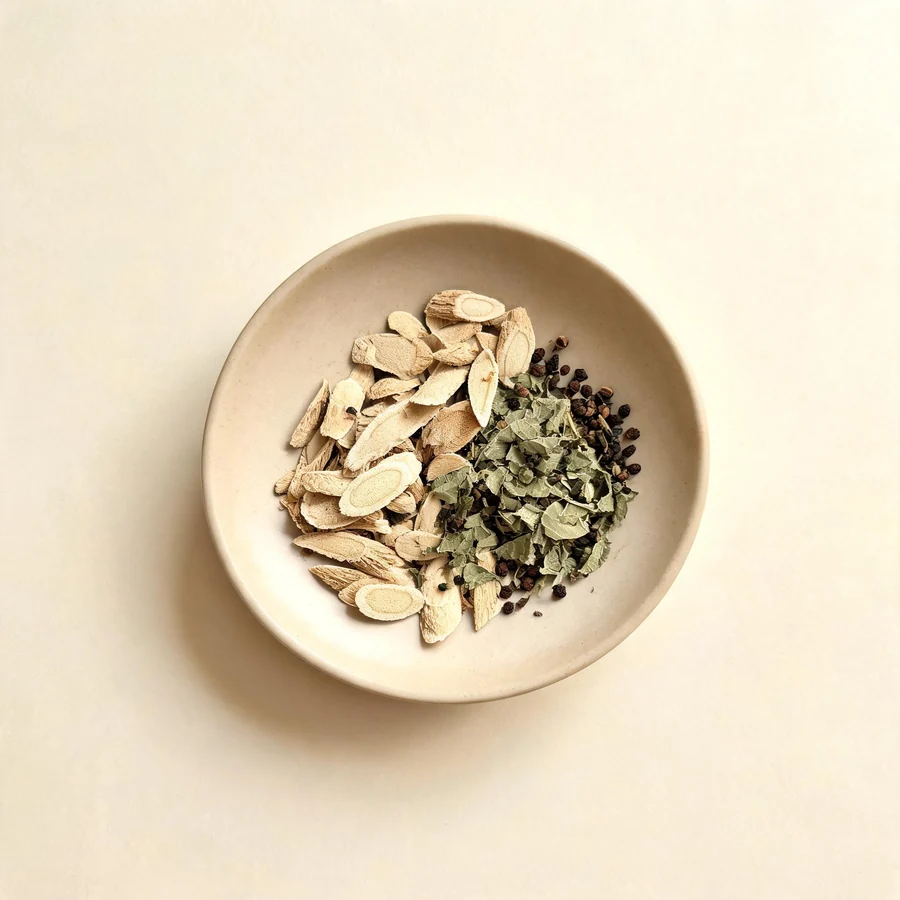
Herbs used
Formulas
- Long Dan Xie Gan Tang
- Pu Ji Xiao Du Yin
- Ling Gui Zhu Gan Tang
- Dan Zhi Xiao Yao San
- Gui Pi Tang
- Liu Wei Di Huang Wan
Acupoints
- LR-3 (Taichong)
- LR-2 (Xingjian)
- SP-9 (Yinlingquan)
- LI-11 (Quchi)
- LI-4 (Hegu)
- DU-14 (Dazhui)
- zhongwan-ren-12
- ST-36 (Zusanli)
- BL-20 (Pishu)
- LR-14 (Qimen)
- HT-7 (Shenmen)
- KI-3 (Taixi)
- HT-3 (Shaohai)
- SP-6 (Sanyinjiao)
What to expect
- The tradition describes improvement over weeks with treatment and dietary change.
- Recurrence follows diet, stress and humid weather if the pattern is not maintained.
- A sudden severe change in odour needs medical assessment rather than herbal treatment.
- The first change is usually local: the sweat feels less sticky and the smell less intense within a week or two of starting treatment. What follows is slower and matters more, because it reflects the internal pattern shifting rather than the surface being masked, and most people notice a steadier change over three to six weeks, along with better digestion, sleep and mood as the underlying pattern eases. Maintaining that result depends on diet and stress management continuing after the herbs stop.
Safety and when to get help
Seek medical help urgently for
- Sudden severe change in body odour that appears overnight.
- Armpit redness and swelling with fever.
- Odour with unexplained weight loss, fever or night sweats.
For anything severe, sudden or spreading quickly, read when a skin problem needs urgent care.
Cautions
- Do not use strong antiperspirants on inflamed skin.
- Persistent night sweats need medical review.
- Sudden metabolic-smelling changes, for example a fruity smell, need urgent care.
Using this alongside conventional care
- TCM is described as complementary to conventional care: hygiene and prescribed topical treatment continue alongside herbs.
- Herbal treatment and conventional measures are not in competition here. Antiperspirants, deodorants, stronger topical agents, Botox and surgical options can all continue, and no serious interaction is known between the herbs used for this complaint and over-the-counter products. The point to raise is medication: diuretics, blood pressure drugs and anything that alters sweating may interact with herbs that drain dampness, some of which have a mild diuretic effect of their own, so both practitioners should know the full list. If a prescribed antiperspirant is in use, apply herbal washes between applications rather than at the same time.
Diet and lifestyle
- Favour cooling easily digested food and reduce spicy, greasy and fried food, alcohol and caffeine.
- The principle is to reduce what feeds dampness and heat rather than to find a single forbidden food. That means plenty of cooling, easily digested food such as mung beans and barley, cucumber, celery and leafy greens, with bitter vegetables and chrysanthemum tea, and less alcohol, coffee, fried food, spicy food and sugar. Pattern adds detail: Liver and Gallbladder damp-heat does better on light meals with no alcohol, Spleen deficiency needs warm cooked food, regular meals and no iced drinks, Liver Qi stagnation eases with bitter greens and stress reduction, and the Heart and Kidney pattern needs moistening food and an early bedtime.
If you're pregnant
In pregnancy Qi and Blood gather to nourish the fetus, which can stir up damp-heat that was already there or leave a relative lack of Yin with heat rising, and the odour may become more noticeable simply because sweating increases. The problem is treatment. Bitter-cold herbs, Huang Qin and Long Dan Cao among them, are used with great caution or avoided, and the classical formula Long Dan Xie Gan Tang is not usually given because it drains strongly downward and may affect the pregnancy.
Safer options are dietary, cutting greasy, spicy and sweet food, and external application of powders that cool without being toxic, such as pearl powder, or a mild herbal wash. If internal treatment is needed, a gentler formula built on Yi Yi Ren, Fu Ling and aromatic herbs such as Huo Xiang can be used under close professional guidance, and acupuncture on points such as SP-9 (Yinlingquan) and ST-36 (Zusanli) avoids strong internal medication while steering clear of forbidden points.
If you're breastfeeding
Herbs that are bitter and cold, used to clear damp-heat, may pass into milk and cause diarrhoea or digestive upset in a nursing infant; Huang Lian and Huang Qin are the strongest of them, and Long Dan Cao belongs in the same group, so Long Dan Xie Gan Tang and formulas like it are generally avoided while feeding. Draining herbs that are gentler and less cold, among them Yi Yi Ren, Fu Ling and Bai Bian Dou, suit the Spleen deficiency picture without that risk, and external treatment is still used in practice, although trial evidence is limited.
A powder of calcined alum (Ku Fan) or talcum, dusted on the armpits, absorbs moisture and cuts the smell without entering the bloodstream. Diet is the other lever: less dairy, sugar and fried food can reduce dampness and smell with no risk to the baby.
If treating a child
Odour before puberty is uncommon, and it usually means a Spleen that is constitutionally weak with dampness collecting, or a diet heavy in greasy and sweet food that has generated damp-heat. The smell is musty more often than pungent, the tongue may be pale and puffy under a greasy coat, and the pulse feels weak. Because children are described as having a Spleen that is often insufficient, treatment strengthens the Spleen and transforms dampness rather than clearing heat aggressively.
Doses are a third to a half of the adult dose. Shen Ling Bai Zhu San with aromatic additions such as Huo Xiang and Pei Lan is often suitable, bitter-cold herbs are avoided because they can damage a developing Spleen and Stomach, and mild non-irritating powders are safe externally. Removing junk food and sugary drinks is the cornerstone, and acupressure or paediatric tui na on ST-36 (Zusanli) and BL-20 (Pishu) replaces needles.
If treating an elderly patient
In older patients the odour more often comes from deficiency than from excess. The commonest roots are a Spleen and Kidney Yang that no longer warms and moves fluids, so dampness gathers inside, or a Kidney Yin that has run low so that empty heat rises. The smell is usually less intense than in the damp-heat patterns but more persistent, and it sits alongside fatigue and cold limbs in the Yang picture or night sweats in the Yin picture. The tongue separates the two: pale and swollen with teeth marks in Yang deficiency, red and peeled in Yin deficiency.
That changes the direction of treatment. Draining dampness hard would weaken a patient who is already deficient, so the approach is to warm and tonify where Yang is low, or nourish Yin and clear empty heat where Yin is low, and to expect progress to be gradual. External applications and dietary change remain supporting measures, and the aim is a steady lessening of odour alongside better energy, warmer limbs and more settled sleep.
Urgent-sign guidance is based on standard sources: NHS anaphylaxis, NHS cellulitis, NHS Stevens-Johnson syndrome, NHS melanoma.
Evidence
Evidence status
Compiled for this page from the classical and modern literature; not a systematic review, so treat it as a pointer to sources rather than clinical guidance.
There is no clinical trial literature specific to this complaint; the evidence basis is classical and clinical experience rather than controlled study. The traditional texts treat it as damp-heat stagnating in the skin with sweat unable to discharge, and describe topical as well as internal treatment. Any page describing it should be read as a summary of that tradition, not as evidence of efficacy.
Classical record
Fox odour arises when damp-heat stagnates in the interstices of the skin, sweat cannot be discharged, and the stench is unbearable. Treatment should clear heat and dry dampness, with external application of Mi Tuo Seng powder.
- Wai Ke Zheng Zong (Orthodox Manual of External Medicine).
Common questions
Why does my sweat smell so strong?
The classical literature reads it as dampness and heat steaming outward, with the Liver and Gallbladder channels implicated in underarm odour.
Can herbs change body odour?
The tradition describes draining damp heat and supporting the Spleen, with improvement over weeks.
When should a change in odour worry me?
A sudden dramatic change can reflect metabolic or infectious illness and needs medical review.
Is it just about hygiene?
No. Hygiene manages the surface; the classical literature treats the internal damp-heat pattern behind it.