Skin profile
Where this herb sits in skin practice: the pattern it corrects, the skin signs it suits, and what it should not be used for.
Mang Xiao is a salt for hot, hard, tense swellings outside and for heat-bound stool inside. The dressing softens and cools; the purge is short and watched, because the risk is the water and salt it takes with it.
Skin signs that suggest it
- A hot, red, tense, sharply bordered swelling that has not yet come to a head
- A painful, shiny red plaque with a dry stool and a coated tongue alongside
- Engorged, painful haemorrhoids with heat, swelling and a bearing-down feeling
- Hard, dry stool with a full abdomen, dry mouth and a thick yellow coating in someone with a hot skin lesion
- A boil with surrounding hardness and throbbing pain rather than a fluctuant centre
When it is not the right herb
Not for cold, pale, deficient skin with no heat, and not for an abscess that is already fluctuant, which needs drainage rather than a poultice. Not on broken, ulcerated or deeply infected skin, and not near the eyes, mouth or other mucous membranes. Not internally in cold-deficient digestion, in dehydration or electrolyte disturbance, or in pregnancy. It is not a daily laxative and it is not for dry constipation that comes from deficiency.
What it does for skin
Skin-relevant actions only. Each one describes a mechanism in TCM terms and what it looks like on the skin.
Softens hardness and reduces a hot swelling
The salty, cold dressing is applied to a swelling that is tense and hard rather than discharging. Water is drawn out of the tissue, the surface softens and the pain eases, which is the traditional meaning of softening hardness. It is used while a boil or an early abscess is still hard, and stopped once the centre softens, because a collection needs drainage rather than another poultice. The dressing is damp, not dripping, and the skin underneath is checked at each change.
Cools a hot, red surface
A cooled solution of the salt takes heat from the skin directly, and the relief on a burning red plaque or an inflamed fold is immediate and temporary. It is used as a compress for minutes at a time on intact skin, and it is an adjunct rather than a treatment: erysipelas and spreading cellulitis need antibiotics, and a salt compress must not delay them. The solution is made fresh, used cool and discarded.
Drains heat downward when taken internally
By mouth the salt keeps water in the bowel and produces a strong, watery purge, which in the tradition clears heat that has bound with stool in the Yang Ming. In skin practice it is chosen when a hot lesion, a flushed face and a dry bound stool appear together, so that the heat has a route out. It is dissolved into the strained decoction at the end rather than boiled, and the course is one or two doses, not a habit.
Eases engorged tissue in the perianal area
A warm sitz bath of the salt is used for painful, swollen haemorrhoids, where the osmotic pull and the warmth reduce the engorgement and the stinging. It is a comfort measure alongside treatment of the underlying cause, and it is used on intact skin for about ten minutes at a time. Persistent bleeding, a new lump or severe pain calls for examination, not another bath.
Skin conditions it is used for
Mapped to the condition pages on this site. The pattern column shows what the skin is doing when this herb is the right choice.
| Condition | Pattern | Why it suits | Typical setting |
|---|---|---|---|
| Boils | Heat toxin gathering before pus has formed | A hard, hot, tender boil that has not yet pointed is the classic external indication: the salt dressing draws water from the inflamed tissue, softens the induration and reduces the throbbing. It is used while the lesion is hard and stopped when it becomes fluctuant, because at that point drainage is the treatment. A boil on the face, a boil with spreading redness or fever, or one that is not settling needs medical care. | A cooled Mang Xiao compress, with Huang Lian Jie Du Tang internally where heat toxin is marked |
| Skin Abscess | Heat and dampness collecting into a hard mass | Before a collection liquefies, an abscess is a hard, painful swelling, and a salt dressing is a traditional way to reduce the tension around it. It never replaces drainage, and it is not applied to broken skin or to a wound that is already discharging. The internal formula addresses the heat and the stagnation, and the whole approach belongs alongside proper medical assessment of the collection. | A Mang Xiao dressing, with Xian Fang Huo Ming Yin internally and drainage where needed |
| Erysipelas | Fire toxin with a bright, tense, spreading plaque | Erysipelas is a bright red, raised, sharply bordered plaque that spreads quickly and burns, and it needs prompt antibiotics. A cooled salt compress is used only as an adjunct to soothe the surface while that treatment starts, and it must not delay medical care. The cold, salty nature is read as countering the fire and softening the tension of the plaque, but the infection itself is not cleared by a dressing. | A cooled Mang Xiao compress alongside antibiotics, with Pu Ji Xiao Du Yin where a practitioner prescribes it |
| Anal Irritation | Damp-heat with engorged, painful haemorrhoids | Itch, moisture and a bearing-down ache around the anus from engorged haemorrhoids are read as damp-heat sinking downward. A salt sitz bath reduces the swelling and the stinging, and it is used for short periods on intact skin. Bleeding, a new lump or pain that is severe or persistent needs examination, because haemorrhoids are not the only cause of those symptoms. | A Mang Xiao sitz bath, with Ku Shen and Huang Bai in the bath where damp-heat is clear |
Combinations for skin
Herbs it is paired with when the skin, not an internal organ, is the target.
| Partner | Ratio | Why the pair is used |
|---|---|---|
| Da Huang | 6 to 12 g Mang Xiao with 3 to 9 g Da Huang | The classic purgative pair, and the strongest in the tradition. Da Huang pushes the accumulation out while the salt softens hard, dry stool and holds water in the bowel, so the two treat the full picture of distension, fullness, dryness and solidity. The salt is dissolved in the strained decoction after the root has been boiled, and the pair is stopped as soon as the stool passes. |
| Gan Cao | 9 to 12 g Mang Xiao with 6 g Gan Cao | Licorice tempers the salt. Together with Da Huang it forms Tiao Wei Cheng Qi Tang, which the tradition calls the gentle purge: the salt softens and clears as before, but the licorice slows and blunts it, so the formula suits heat constipation with dryness and hardness where gross distension is absent. More salt than licorice is what keeps softening as the dominant action. |
| Zhi Shi | 6 g Zhi Shi with 6 to 9 g Mang Xiao | Zhi Shi moves the Qi of the Large Intestine downward and relieves the fullness that accompanies a bound bowel, while the salt softens what is hard. The pair is used when the abdomen is distended and the stool will not move, and it is combined with Da Huang in the Cheng Qi formulas. It is a purge for a robust person with a clear excess pattern, not for a frail or depleted one. |
| Huang Bai | 15 g Huang Bai with 30 g Mang Xiao in a sitz bath | Huang Bai is bitter and cold and drains damp-heat from the lower body, and the salt adds an osmotic pull that reduces swelling. The combination is used as a bath for inflamed haemorrhoids or a hot, moist perianal area, and it is kept to short immersions on intact skin. It is a comfort measure, and persistent bleeding or pain still needs examination. |
Formulas where it leads
- Da Cheng Qi Tang (大承气汤) - The major purging formula of Da Huang, Mang Xiao, Zhi Shi and Hou Po, for the full Yang Ming picture of distension, fullness, dryness and solidity with fever and delirium. The rhubarb supplies the push, the salt the softening, and the Qi-moving herbs the descent. It is a formula for a clear excess pattern, given briefly and under supervision, and it is not a remedy for ordinary constipation.
- Tiao Wei Cheng Qi Tang (调胃承气汤) - The mildest of the Cheng Qi formulas, with Mang Xiao, Da Huang and Gan Cao. The licorice softens the purge, which suits heat constipation with dryness and hardness where the gross distension of the major formula is missing. It is chosen when a purge is needed in someone who is not robust, and it remains a short-course treatment.
Topical use
Mang Xiao is used on the skin as a cooled solution, a damp dressing or a sitz bath for hot, tense, swollen areas. The salt is dissolved in warm water, allowed to cool and applied on gauze or used as a soak, and the skin is checked at each change. It is for intact skin: broken, ulcerated or deeply infected areas, and the skin around the eyes and mouth, are not treated with it.
| Preparation | How and when it is used |
|---|---|
| Cooled compress | Dissolve 30 to 60 g of the salt in 500 ml of warm water and let it cool. Soak clean gauze, wring it so that it is damp rather than dripping, and lay it on the swelling for 10 to 15 minutes, two or three times a day. Make it fresh each time and stop if the skin stings or becomes more red. |
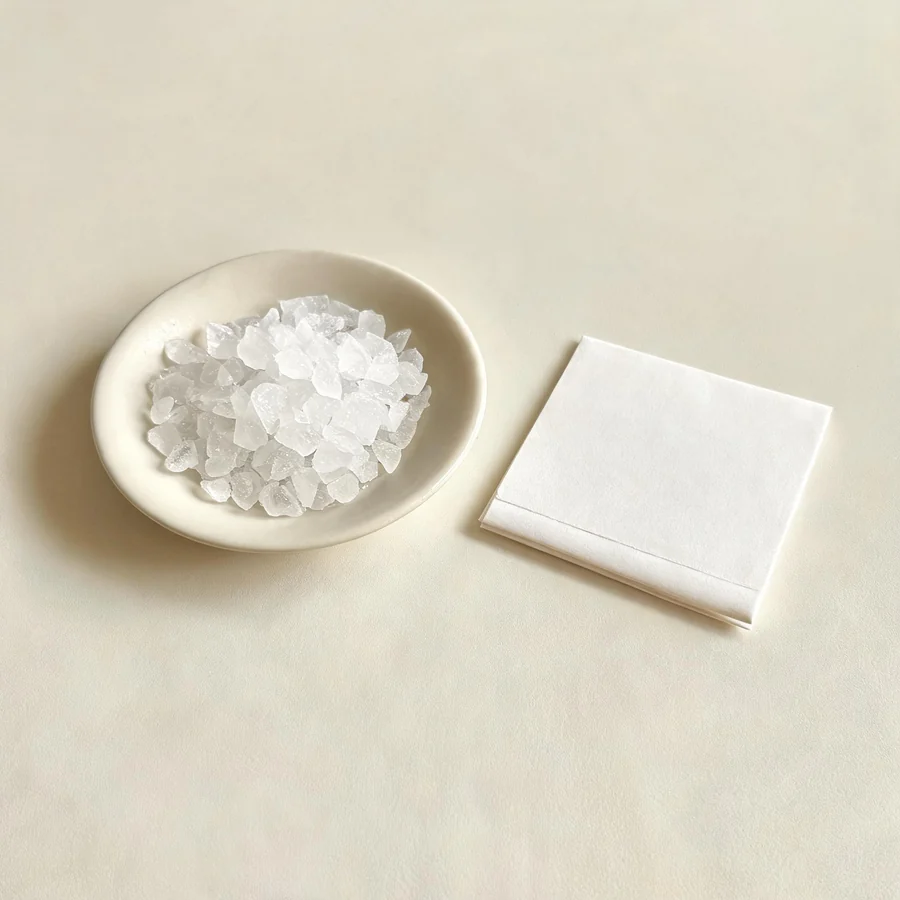
| Damp dressing sachet | Wrap 30 to 50 g of the crystals in a double layer of gauze, dampen the parcel with water and lay it over a hard, hot swelling for 15 to 20 minutes. Check the skin underneath afterwards, and do not strap it on tightly or leave it on overnight. |
| Sitz bath | Dissolve 30 g in 2 litres of warm water in a clean basin and sit for about 10 minutes, once or twice a day. Use intact skin only, pat dry afterwards, and do not share the basin or the towel. |
Patch test and cautions
Keep the solution away from the eyes, mouth and other mucous membranes, and do not use it on broken, blistered or ulcerated skin. Stop at once if the skin stings, burns or becomes more red. A spreading red infection, a fluctuant abscess or a fever needs medical care, and a salt dressing must never delay that assessment. Do not use it on infants, and do not cover a dressing with plastic.
Safety for skin use
What to check before recommending or using it, including the cautions that matter most for skin patients.
Do not use, or use with caution
- Pregnancy. Classical texts forbid the salt outright, reasoning that a forceful downward purge may provoke the womb. It is not given by mouth at all, and external use is discussed with a clinician.
- Bowel obstruction, perforation or an acute abdomen, with severe pain, vomiting or a silent abdomen. The salt draws water into a bowel unable to move it and may make an obstruction worse.
- Cold-deficient digestion: loose stools, poor appetite and a cold, aching abdomen. A cold salt purge sets the digestion back badly.
- Constipation without heat binding, from Qi or Blood deficiency or from cold. A cold salt purge produces little stool and worsens the underlying weakness.
- Dehydration, electrolyte disturbance, impaired kidney function and frailty. A purge takes fluid that such people have none to spare.
- Prolonged or habitual use, and use on broken or ulcerated skin.
Pregnancy and breastfeeding
Contraindicated. Classical works forbid the salt in pregnancy without qualification, since a forceful osmotic purge drives the intestine hard and may set off contractions; the Shen Nong Ben Cao Jing states that miscarriage can follow, and later books repeat the ban. The Shang Han Lun tradition still permits a purgative where illness threatens life, holding that treating the true cause does the pregnancy no harm, but that is an expert call in a crisis. Putting the salt on the abdomen or breasts during pregnancy is not a way around the caution without advice. It can enter milk and loosen a baby's stool, so use while nursing needs a reduced dose, a brief course, with the infant watched.
Interactions
- Every other oral medicine. A salt that draws water into the bowel also speeds everything along it, so less of a tablet is absorbed; the medicine goes first and the salt follows one to two hours later. Digoxin, warfarin, anti-epileptics, lithium and the oral contraceptive are the drugs most affected.
- Diuretics, ACE inhibitors, ARBs and NSAIDs. With a purge added, any of these can tip a person into dehydration and a rising creatinine, especially when older and in hot weather.
- Digoxin. A strong purge lowers potassium and magnesium, which makes the heart more sensitive to digoxin, so nobody on that drug should treat their own constipation with this salt.
- Antihypertensives and certain antibiotics. The shift of fluid may lower blood pressure unpredictably, and the sulphate reduces how much tetracycline or fluoroquinolone is absorbed.
Allergy and patch testing
A true allergy to sodium sulphate is rare. A salt solution can irritate or dry intact skin, and patch testing is sensible before a compress is used on a large area. Stop if the skin stings, reddens or peels, and keep the solution away from the eyes.
General safety references
General references for herbal hepatotoxicity and herb-drug interactions; they are not specific to this herb.
- Review article: Herbal hepatotoxicity - an update on traditional Chinese medicine preparations. Alimentary Pharmacology & Therapeutics, 2014. PMID: 24844799.
- Interactions between herbal medicines and prescribed drugs: an updated systematic review. Drugs, 2009. PMID: 19719333.
- Warfarin and food, herbal or dietary supplement interactions: a systematic review. British Journal of Clinical Pharmacology, 2021. PMID: 32478963.
Evidence
The classical record is quoted with its source. The modern note states the level of evidence plainly.
Classical record
芒硝,味咸软坚,故能通燥结;性寒降下,故能去火热。
The salty flavour softens hardness, and that is why it can open a binding caused by dryness. Its nature is cold and it moves downward, and that is why it can remove fire and heat. Flavour and temperature are not decoration in this system: they are the statement of what a substance does, and the two halves of this sentence are the whole of the salt's action.
Yao Pin Hua Yi - A compact statement of the reasoning behind both the internal purge and the external use on a hot, hard swelling.
咸味下泄为阴...气坚者以咸软之,热盛者以寒消之,故张仲景大陷胸汤、大承气汤、调胃承气汤皆用芒硝以软坚去实热。结不至坚者,不可用也。
The salty flavour drains downward and belongs to Yin. What is firm is softened by salt, and what is excessive in heat is dissolved by cold, which is why Zhang Zhongjing used this salt in the three great purging formulas to soften hardness and remove excess heat. Where the binding has not become hard, it should not be used.
Cheng Wu-Ji's commentary on the Shang Han Lun - The closing line is the safeguard: a binding that has not hardened is no reason for the salt. This line is the classical ground for cautioning against a drastic purge in ordinary constipation.
主百病,除寒热邪气,逐六府积聚,结固留癖,能化七十二种石。
It is used for a hundred illnesses. It removes cold and heat as pathogenic influences, drives out accumulations in the six bowels, dissolves hardened masses and long standing fixed obstructions, and is said to transform seventy two kinds of stone.
Ben Cao Gang Mu (Compendium of Materia Medica), entry for Pu Xiao - It concerns the crude mineral and reads as much as alchemy as medicine; the line worth keeping clinically is the one about masses that have hardened and obstructions long fixed.
Modern evidence
Evidence status
- Sodium sulphate works as an osmotic laxative; its documented hazard is loss of water and electrolytes, not poisoning. Laxative pharmacology and bowel-preparation practice describe this well.
- Dermatological evidence for hypertonic salt compresses is limited. The practice rests on the physical draw of water across a membrane and on traditional use, and no controlled trial of the salt in skin infection was identified.
- External use does not replace antibiotics or drainage. The safety literature is about dehydration, low potassium and low sodium, which matter most in older, frail or diuretic-taking patients.
PubMed records
Selected real PubMed records for this herb's species or its constituents, chosen by species name and title relevance. They are references for the non-TCM discussion above, not proof that the herb treats any skin condition.
- Sodium Tetradecyl Sulfate.. , 2006. PMID: 37094053 (general record).
Dose and forms
Skin-practice dosing and the preparations that suit skin complaints.
| Form | Dose and notes |
|---|---|
| Internal decoction | 6 to 12 g dissolved in the strained decoction once it has cooled a little, not boiled with the herbs. The lower end gives a gentler moistening action, and the upper end suits stool that is hard, dry and clearly heat-bound; the course is one or two doses. |
| External compress | 30 to 60 g dissolved in 500 ml of water for a cooled compress, or 30 g in 2 litres for a sitz bath. There is no fixed weight for external use, and the solution is made fresh and discarded. |
| Course length | One or two doses for the purge, and a few days at most for compresses. Prolonged use damages Spleen Yang and depletes fluids. |
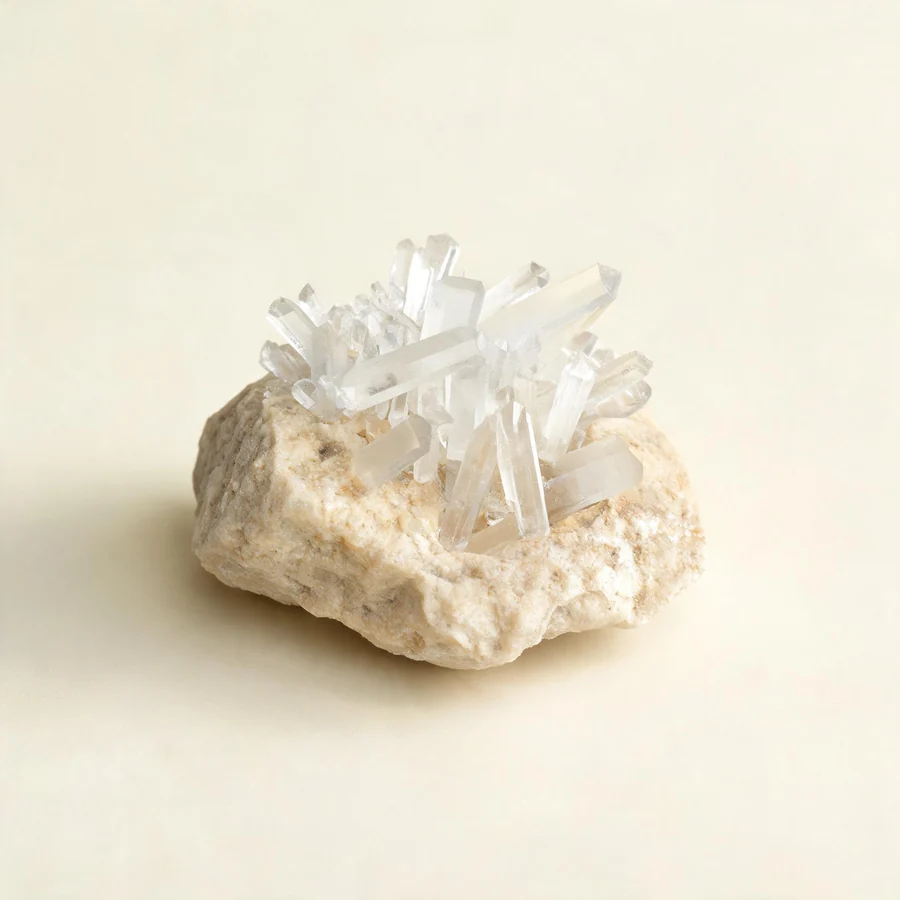
Route and fluid are the two things to get right. The salt is dissolved at the end rather than boiled, because boiling with the herbs reduces its strength, and it is taken with enough fluid to replace what it draws into the bowel. The refined crystal is the standard grade; the cruder Pu Xiao is stronger and less predictable and is restricted to external use in modern practice. Store it sealed below 30 degrees Celsius, because in a warm dry cupboard it loses its water of crystallisation and its strength.
Citations and further reading
Only real sources are listed: the classical materia medica passages quoted above, and the source works behind the botanical and safety statements.
- Yao Pin Hua Yi, on the salty flavour and cold nature of the salt - classical entry quoted above.
- Cheng Wu-Ji's commentary on the Shang Han Lun - classical entry quoted above.
- Ben Cao Gang Mu (Compendium of Materia Medica), Li Shizhen, 1578, entry for Pu Xiao - classical entry quoted above.
- Mang Xiao monograph: Pharmacopoeia of the People's Republic of China - source for the refined mineral identity and the storage requirement.
- Modern safety statement: based on laxative pharmacology and electrolyte literature, summarised as a statement about the level of evidence rather than as a cited finding.
- Mineralogy: literature on mirabilite, hydrated sodium sulphate, its crystallisation and its weathering to thenardite.
Educational reference for qualified practitioners. This page is not medical advice, and skin conditions should be diagnosed by a clinician before treatment.