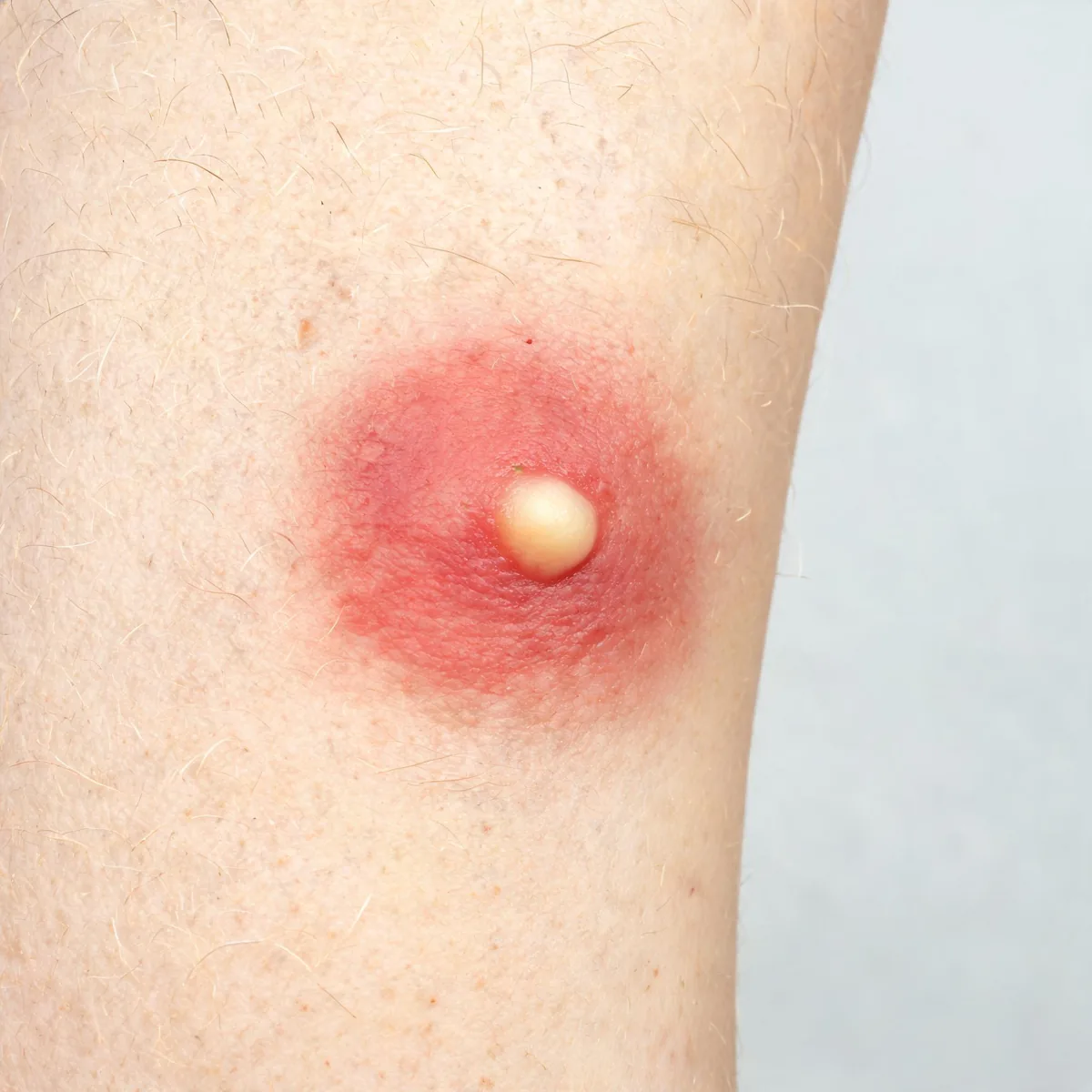
Understanding Skin abscess
The tradition describes an abscess as a local fight between the body protective Qi and an invading pathogen, where heat and dampness accumulate and eventually form pus.
Toxic-Heat stagnation gives the classic acute abscess: bright red, hot and throbbing, swelling rapidly with pus, high fever, intense thirst and restlessness. The classical literature reads this as the most active picture.
Blood stagnation with heat gives a hard dark-purple lump with fixed stabbing pain that is slow to form pus, with dark skin around it. Damp-Heat gives a boggy swelling that may ooze clear or yellow fluid, with heaviness and a greasy taste.
The classical literature is clear that an abscess has a natural endpoint: either it resolves, or it points and drains. That is why drainage is part of care, and why squeezing or lancing at home is not advised.
The word abscess covers a process rather than a single lesion. Qi and blood gather at one site, the tissue is held under pressure, and heat builds until the flesh breaks down and a cavity fills. Whether that cavity is tight and fiery, hard and dark, or soft and weeping is the practical question, because the answer decides whether the formula cools, moves or drains.
Three organs usually form the background. The Lung governs the skin, so heat held there can surface as inflammation. The Spleen manages fluids, and a diet of rich or sweet food leaves it unable to transform them, so dampness builds up and then meets heat. The Liver keeps Qi moving, and sustained frustration or stress can turn that stagnation into fire. A person may therefore develop the same-looking abscess for quite different reasons.
Conventional view
In Western medicine a skin abscess is a walled-off collection of pus in the skin or deeper tissue, usually caused by bacteria entering through a small break, a hair follicle or a scratch. The area becomes red, warm, swollen and tender, and a fluctuant centre may develop. Diagnosis is mostly clinical, with ultrasound used when a deep collection is suspected and culture taken when the organism matters.
Treatment is drainage. A small abscess may be incised and allowed to drain under local anaesthetic, with antibiotics added when there is spreading cellulitis, fever, a facial location or a weakened immune system. Warm compresses, elevation and pain relief support recovery, and a review appointment checks that the cavity is closing.
What this does not address is why the same person forms abscesses again. Circulation, immune function, blood sugar and the general terrain sit outside the scope of a drainage procedure and a course of antibiotics, and a scarred or repeatedly infected area may need further surgery. The pattern approach is aimed at that gap, not at replacing drainage or antibiotics.
Selected PubMed records
Real PubMed records for the conventional discussion above, selected by condition name and title relevance. They are references, not a claim that any treatment is proven for this condition.
How it connects
The patterns overlap because they describe movement through time. Toxic-Heat and Blood Stagnation frequently appear together, and dampness can layer over either, which is why a single abscess may show a bright red rim, a dark hard centre and a weeping edge at once. Noticing which feature dominates, and what eases it, is more informative than tallying signs: cooling that helps points to heat, a hard lump that resists cooling suggests stasis, and a discharge that worsens in humid weather suggests dampness. Because a deep or spreading infection can become serious, a large, rapidly growing or feverish abscess needs medical assessment rather than pattern work.
How it is assessed
The practitioner assesses the stage of the abscess and the systemic response.
What a practitioner looks for
- Stage: hot, red and throbbing suggests active heat; a hard dark lump suggests stagnation; boggy oozing suggests damp heat.
- Systemic signs: high fever, chills and feeling unwell require urgent care.
- Site: facial abscesses, especially near the nose or eye, are dangerous and need urgent medical assessment.
- Spreading: red streaks or expanding redness indicates lymphangitis or cellulitis.
Examination begins at the lesion. Colour, temperature, how firm or fluctuant it feels, and whether the skin over it is dusky or bright all go into the reading, together with the character of the pain: a throb that keeps time with the pulse differs from a fixed stab that worsens at night. The practitioner also notes how far the redness extends and whether the centre is pointing.
Then come the general questions. Fever, thirst, appetite, stool, energy and sleep show whether the reaction is strong and hot or muted and depleted. A red tongue with a yellow coat and a rapid, slippery pulse supports Toxic-Heat, a purple tongue with a choppy pulse supports stasis, and a greasy coat with a slippery pulse supports dampness. Because an abscess can progress quickly, the examination is also a safety check, and a large, spreading or facial lesion is referred on.
TCM patterns in Skin abscess
Three patterns are described for skin abscess, and they read best as stages of one process rather than as separate diseases. Toxic-Heat Stagnation is the early, active phase: the skin is bright red, hot and throbbing, the swelling comes up quickly, with fever, thirst and thick yellow pus once it forms. Blood Stagnation with Heat is what happens when that heat meets sluggish circulation; the lump becomes hard and dark, the pain turns into a fixed stab that is worse at night, and the collection is slow to point. Damp-Heat is the boggy, oozing version, heavy rather than sharp, often on the lower body or in a fold, with a greasy tongue coating and a discharge that keeps coming. In practice the boundaries blur: an untreated hot abscess can turn stagnant and a stagnant one can begin to weep. Deciding which is dominant tells the practitioner whether to clear fire, move blood or dry dampness.
| Pattern | Key signs | The itch | Tongue | Main formula |
|---|---|---|---|---|
| Toxic-Heat Stagnation | Bright red hot throbbing abscess; Rapid swelling with pus formation | Not specified | Body: Deep red or crimson with raised red pointsCoat: Thick, dry and yellow | Not specified |
| Blood Stagnation with Heat | Fixed stabbing pain at the site; Pain worse at night and with pressure | Not specified | Body: Reddish-purple, with stasis spots and dark sublingual veinsCoat: Thin, dry and yellow | Not specified |
| Damp-Heat | Boggy swollen abscess that may ooze clear or yellow fluid | Not specified | Body: Red, often swollen with teeth marksCoat: Yellow, greasy and thick, usually in the middle and at the root | Not specified |
Toxic-Heat Stagnation
The acute abscess: bright red, hot, throbbing with fever.
This is the classic hot abscess. Heat from outside, or heat built up inside by rich, spicy food and alcohol, congests the Qi and blood in one spot, and the congestion itself generates more heat. The tissue is held under pressure, the centre softens as the flesh breaks down, and the result is a tense, angry swelling that hurts well before it discharges.
The tongue is deep red with raised papillae and a thick dry yellow coat, and the pulse is rapid, forceful and often overflowing. There is fever, thirst for cold drinks, restlessness, and sometimes dark urine or constipation, and squeezing makes everything worse. Xian Fang Huo Ming Yin is the primary formula named here, with Wu Wei Xiao Du Yin added when the fire needs a sharper edge, and Jin Yin Hua, Pu Gong Ying and Lian Qiao carrying the clearing. Hegu (LI-4), Quchi (LI-11), Dazhui (DU-14) and Xuehai (SP-10) are the points used.
Signs
- Bright red hot throbbing abscess
- Rapid swelling with pus formation
- High fever with a feeling of intense heat
- Intense thirst for cold drinks
- Restlessness
Diet and lifestyle for this pattern: Avoid spicy, greasy and fried food as well as alcohol and coffee, which all generate internal Heat. Eat cooling, detoxifying food such as cucumber, bitter gourd, watermelon and mung bean soup, keep the abscess clean and never squeeze it, and rest and stay hydrated to support the body's fight against the toxin.
Blood Stagnation with Heat
A hard dark lump slow to form pus, with fixed pain.
When heat settles into tissue whose circulation is already poor, the two reinforce each other. The heat inflames, the stagnant blood holds that inflammation in one place, and the lump turns hard, dark and deeply tender instead of red and diffuse. This often follows an abscess that was never fully resolved, or arrives with prolonged stress and overheating.
The tongue is reddish-purple, sometimes with stasis spots and distended veins beneath it, and the pulse is choppy and rapid, often wiry on the left guan. Pain is fixed, stabbing and worse at night and under pressure, and the skin over the lump looks dusky. Xue Fu Zhu Yu Tang is the formula named for this pattern, with Dan Shen, Chi Shao and Tao Ren breaking up the knot and Jin Yin Hua preventing further heat, while Xuehai (SP-10), Geshu (BL-17), Hegu (LI-4) and Quchi (LI-11) are the points.
Signs
- Fixed stabbing pain at the site
- Pain worse at night and with pressure
- Hard dark-purple lump slow to form pus
- Dark purplish skin around the abscess
Diet and lifestyle for this pattern: Eat cooling, blood-moving food such as hawthorn, black fungus, mung beans and chrysanthemum tea, and avoid spicy, greasy and deep-fried food as well as alcohol, which fuel Heat and stasis. Gentle daily walking keeps blood flowing while tight clothing and prolonged pressure on the area do not, and keep the abscess clean and cool without squeezing.
Damp-Heat
A boggy swelling that may ooze, with a heavy body.
Dampness arrives from the weather and the surroundings, or is made internally when a diet of greasy, sweet and spicy food overloads the Spleen. Combined with heat it becomes a turbid, sticky pathogen that settles where moisture collects, such as the lower body, a skin fold, or an area with poor circulation. The swelling is puffy and boggy, it comes to a head slowly, and it may weep rather than drain.
A red tongue carrying a thick yellow greasy coat that resists scraping, together with a slippery, rapid or soggy pulse, confirms the picture, alongside heaviness in the body and head, a muzzy taste, a poor appetite and loose sticky stools. Humid weather, sweet drinks and inactivity all aggravate it. Long Dan Xie Gan Tang is the formula named here, with Jin Yin Hua, Yi Yi Ren and Huang Lian clearing heat and draining the damp, and Quchi (LI-11), Yinlingquan (SP-9), Sanyinjiao (SP-6) and Zusanli (ST-36) chosen as points.
Signs
- Boggy swollen abscess that may ooze clear or yellow fluid
- Heaviness in body and head
- Sticky or greasy sensation in the mouth
- Poor appetite with loose sticky stools
Diet and lifestyle for this pattern: Avoid greasy, sweet and spicy food as well as alcohol, which all generate Dampness and Heat. Eat light, plain food such as barley, mung beans, cucumber and lightly cooked vegetables, keep the skin clean and dry in breathable fabrics, avoid damp humid environments, and keep moving gently so the Spleen transforms Dampness.
Treatment approach
How the tradition treats skin abscess, with the herbs, formulas and points used for it.
Principles
- Get medical drainage and antibiotics where indicated: that is the treatment for an abscess.
- Clear heat and resolve toxicity as an adjunct while the abscess is active.
- Move Blood and resolve stasis where the lump is hard and slow to point.
- Drain dampness where the swelling is boggy and oozing.
- Two refinements follow from the pattern. Where the lump is hard and slow to point, the formula adds blood-moving herbs rather than simply increasing the cooling ones, and where the discharge is boggy and constant, bitter drying herbs are paired with gentle draining so that the dampness has an exit. Points follow the same logic, clearing heat at LI-4 and LI-11, moving blood at SP-10 and BL-17, and draining dampness at SP-9 and ST-36.
Herbs used
Formulas
Acupoints
- LI-4 (Hegu)
- LI-11 (Quchi)
- DU-14 (Dazhui)
- SP-10 (Xuehai)
- BL-17 (Geshu)
- SP-9 (Yinlingquan)
- SP-6 (Sanyinjiao)
- ST-36 (Zusanli)
What to expect
- Drained abscesses usually settle within one to two weeks with medical care.
- Undrained abscesses can enlarge or spread.
- Recurrence suggests an underlying pattern or a persistent focus needing review.
- Timelines depend on the pattern. An acute Toxic-Heat abscess often settles within three to seven days of treatment, a hard stagnant lump may need two to four weeks to soften, and a boggy damp one can take four to eight weeks, with recurrent cases needing two to four months of constitutional work. Progress is judged by less pain, a smaller margin of redness and a discharge that becomes thinner, not by the lump vanishing overnight.
Safety and when to get help
Seek medical help urgently for
- Rapidly spreading redness or red streaks radiating from the abscess.
- High fever, chills or feeling very unwell.
- An abscess on the face, especially near the nose or eye, or one that is large and extremely painful.
For anything severe, sudden or spreading quickly, read when a skin problem needs urgent care.
Cautions
- Do not squeeze, cut or lance an abscess at home.
- Diabetes and immune suppression make abscesses more serious.
- Deep or recurrent abscesses need medical and possibly surgical review.
Using this alongside conventional care
- This page is complementary only: incision and drainage plus antibiotics where indicated are the treatment, and herbs are used alongside.
- Herbal treatment sits alongside incision and drainage and antibiotics, and there is no need to choose between them. Jin Yin Hua and Lian Qiao both carry antimicrobial activity and are not expected to interfere with antibiotics, though blood-moving herbs, Tao Ren, Dan Shen and Chi Shao among them, can add to anticoagulant and antiplatelet drugs, so both prescribers should know the full list. A course of antibiotics should be finished as prescribed even when the abscess looks better, and any planned procedure should be mentioned so that herbs can be paused if needed.
Diet and lifestyle
- Shift toward cooling light easily digestible food, and avoid spicy, greasy and sugary food and alcohol.
- The general principle is to remove what feeds heat and dampness and to add what cools and moves. Spicy, deep-fried and greasy food, alcohol, coffee, sugary drinks and heavy red meat belong in the first group, as does dairy for someone prone to dampness. Cooling, light foods such as mung bean soup, cucumber, bitter gourd, watermelon, pearl barley and leafy greens belong in the second, and a stagnant lump benefits from blood-moving foods such as hawthorn and black fungus. The lesion should never be squeezed, and loose breathable clothing keeps pressure off it.
If you're pregnant
Heat-clearing and blood-moving herbs need care in pregnancy. Xian Fang Huo Ming Yin contains Ru Xiang and Mo Yao, which move blood and may be unsuitable, and while Wu Wei Xiao Du Yin is comparatively gentler it still holds bitter-cold herbs that are best used in modest doses. Sanyinjiao (SP-6) and Hegu (LI-4) are points traditionally avoided in pregnancy, since both can encourage contractions. Topical poultices, with gentle heat-clearing herbs and close supervision, are preferred, alongside support for the body's Qi so that the pathogen does not go deeper.
If you're breastfeeding
Huang Lian and Huang Qin are bitter and cold, and they can reach breast milk and cause loose stools in a baby, so milder heat-clearing herbs, Jin Yin Hua in particular, are preferred, with acupuncture as an adjunct. Cooling topical washes treat the lesion with negligible absorption. If a severe infection does need stronger internal treatment, a mother may be advised to express and discard milk for that period, though careful formula choice makes this rarely necessary.
If treating a child
Abscesses are common in children and often follow a diet with too much greasy or sweet food, giving a Damp-Heat or Toxic-Heat picture. Doses are usually a third to a half of an adult amount, and because a child's skin is delicate, anything applied to it must be gentle rather than drying. The Spleen is easily unsettled at this age, so a formula that drains dampness without injuring it, Shen Ling Bai Zhu San for example, may be given alongside heat-clearing herbs to reduce recurrence. Acupressure at Zusanli (ST-36) and Quchi (LI-11) can take the place of needling.
If treating an elderly patient
In older patients a deficiency of Qi and Blood often sits behind repeated abscesses, so the acute heat is less pronounced and healing is slower. Treatment pairs heat-clearing with tonification, and Blood Stagnation with Heat often coexists because circulation is poor. Doses are gentler and interactions matter more, since many older patients take several medicines. Acupuncture is a safe adjunct, particularly Geshu (BL-17) and Xuehai (SP-10) to move blood and clear heat.
Urgent-sign guidance is based on standard sources: NHS anaphylaxis, NHS cellulitis, NHS Stevens-Johnson syndrome, NHS melanoma.
Evidence
Evidence status
Compiled for this page from the classical and modern literature; not a systematic review, so treat it as a pointer to sources rather than clinical guidance.
The evidence is limited to a case series and traditional reasoning. A case series of a classic formula reported rapid resolution of skin abscesses and avoidance of antibiotics in most cases, and the classical texts describe abscess formation as nutritive Qi rebelling into the flesh. Abscesses can be serious and may need drainage or antibiotics, so herbal treatment belongs alongside medical assessment, not instead of it.
Beyond that case series, most of the published work on herbal treatment for skin infection comes from Chinese-language journals and consists of small observational reports rather than controlled trials. Sample sizes are modest, blinding is rare and outcomes are often described rather than measured, so the results are encouraging but not conclusive. Comparisons against standard antibiotic care, and studies with follow-up long enough to record recurrence, are still needed.
Studies often cited
A case series reported rapid resolution of symptoms and avoidance of antibiotics in most cases treated with Xian Fang Huo Ming Yin, describing the formula as clearing Toxic-Heat and promoting pus drainage. The case series reported on Xian Fang Huo Ming Yin for skin abscesses and described rapid resolution of symptoms and avoidance of antibiotics in most cases, with the formula clearing Toxic-Heat and supporting drainage. A novel effective treatment for skin abscess using traditional Chinese herbal medicine: a case series. Retrieved from https://pmc.ncbi.nlm.nih.gov/articles/PMC12874562
Classical record
When nutritive Qi does not flow smoothly and rebels against the flesh and interstices, it gives rise to abscess and swelling.
- Su Wen (Yellow Emperor's Inner Classic, Basic Questions), Chapter 3.
When the pulse is floating and rapid there should be fever, yet if there is instead chilliness and a painful spot, an abscess is about to form there.
- Classical diagnostic passage on abscess formation, as recorded in the classical literature source.
寒邪客于经络之中则血泣,血泣则不通,不通则卫气归之,不得复反,故痈肿。寒气化为热,热胜则腐肉,肉腐则为脓。
When cold lodges in the channels and collaterals the blood congeals; congealed blood does not flow, and where it does not flow the defensive Qi gathers and cannot return, so an abscess and swelling form. The cold turns to heat, heat in excess putrefies the flesh, and putrefied flesh becomes pus.
Ling Shu, Chapter 81: Yong Ju - Classical citation: source, chapter 81 of the Ling Shu.
Common questions
Can an abscess be treated with herbs alone?
No. An abscess usually needs drainage, and spreading infection needs antibiotics. Herbs can support the pattern around that.
Should I drain it myself?
No. Home lancing risks spreading infection and damaging tissue.
Why is a facial abscess more serious?
Because infection near the nose and eye can spread through venous channels to the brain, which is dangerous.
When should I go to hospital?
Spreading redness or streaks, high fever or chills, or a large painful abscess on the face.
Is acupuncture safe directly on or near an abscess?
Points are usually chosen at a distance from the infection, on the limbs and back, so that heat and toxin are cleared systemically, and needling straight into an abscess is avoided because it can spread the infection. A practitioner may use bleeding on nearby points with sterile single-use lancets, and a topical herbal poultice is a safer way to treat the lesion itself.
How long can an abscess take to clear with herbal treatment?
An acute red, hot abscess often improves within three to seven days, a hard dark one involving blood stasis may take two to four weeks, and a boggy damp one can take four to eight weeks because dampness clears slowly. Recurrent abscesses usually call for several months of constitutional work to correct the pattern behind them.