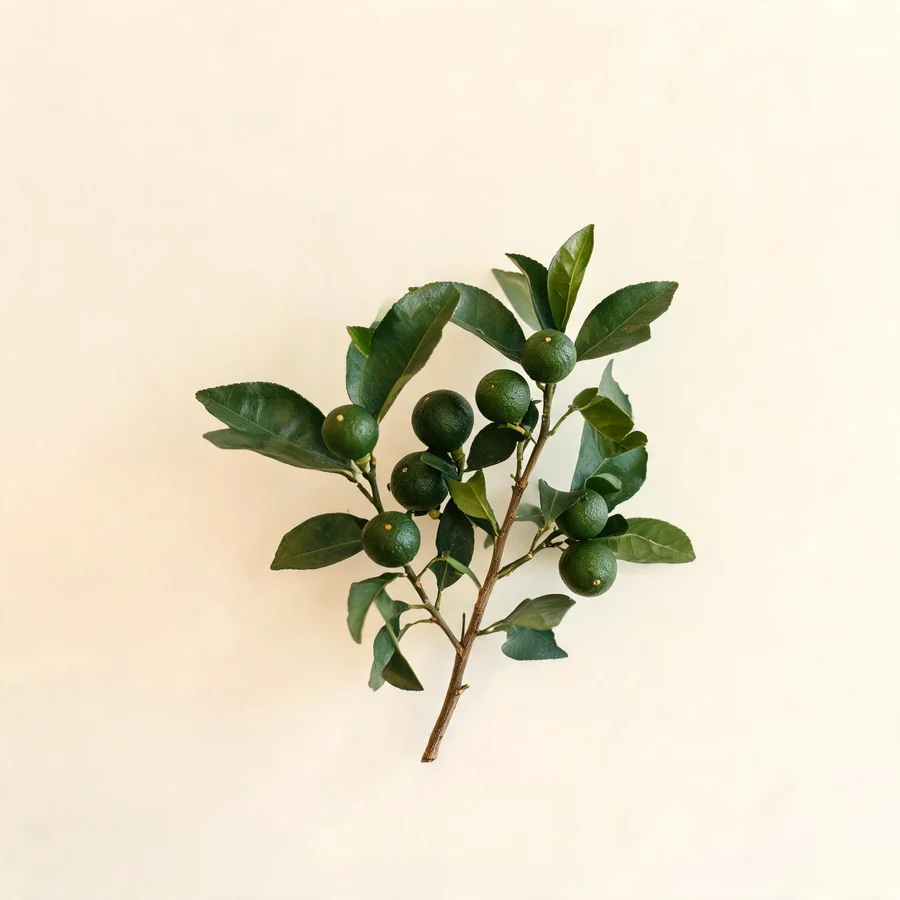
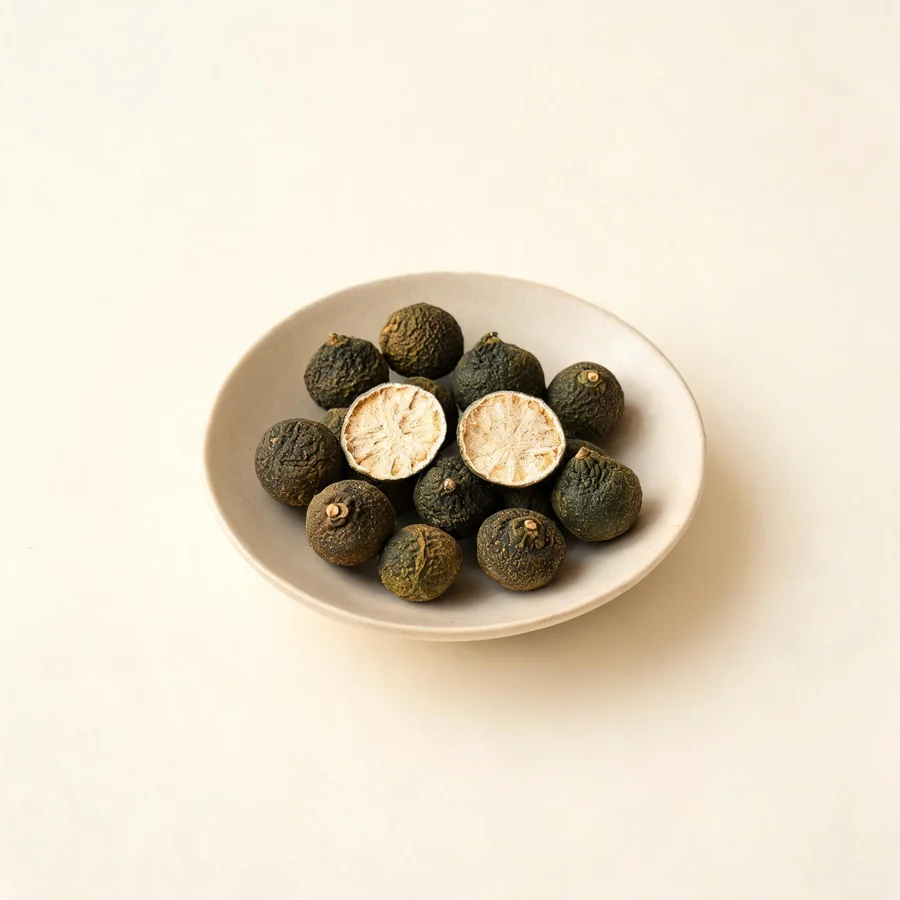
Skin profile
Where this herb sits in skin practice: the pattern it corrects, the skin signs it suits, and what it should not be used for.
Zhi Shi is a supporting herb in skin practice: it disperses the wind that itches, moves the stagnation behind a congested flare, and softens the small phlegm nodules that form where Qi has stopped. It is confined to excess patterns, short courses and supervised use.
Skin signs that suggest it
- Itch that resembles insect bites or scattered beans, moving from place to place with no fixed lesion (wind in the skin)
- Wheals or a red rash that flares after a heavy or greasy meal, with a tight upper abdomen and a thick coating on the tongue
- Firm, pea-sized nodules or small cysts under the skin that refill after being emptied, with little inflammation (phlegm nodules)
- Greasy skin and scalp with a yellow coating on the tongue, worse when the bowels are sluggish
- Belching, a stuffed feeling after eating and a full, tender epigastrium alongside the skin flare
When it is not the right herb
Not for skin that is dry, thin, pale and depleted, where there is nothing full to break, and not for the restless itch of blood deficiency in an exhausted, light-sleeping person. The fruit is not given in pregnancy, and it is not a daily digestive for a weak Spleen, because breaking Qi that is already thin leaves the person more tired and looser in the stool. Where wheals or itch are cold-provoked and pale, a warming approach is needed rather than a cooling, dispersing fruit.
What it does for skin
Skin-relevant actions only. Each one describes a mechanism in TCM terms and what it looks like on the skin.
Disperses Wind and quiets surface itch
The oldest notice of the fruit describes wind held in the skin that itches as though small beans were scattered through it, and that reading still guides its use. The itch it suits is restless and moving rather than fixed to one plaque, often with no visible lesion beyond scratch marks, and it tends to worsen when the person is overheated or has eaten heavily. The fruit is paired with wind-releasing herbs so that the surface reaction is dispersed while the stagnation underneath is moved, and it is often given alongside an external cooling wash for the surface.
Breaks Qi and clears the congestion behind a flare
Flares that follow stagnation show a pattern: a tight abdomen, belching, a thick coating and a sluggish bowel, with the eruption worsening whenever digestion is poor. Breaking that congestion and restoring the downward movement of the intestines lowers the internal pressure that the tradition holds responsible for pushing heat and dampness out into the skin. This is a supporting role rather than a leading one, it is given for days rather than months, and it is stopped as soon as the belly softens and the stool moves freely.
Scatters phlegm nodules under the skin
The third classical action of the fruit is to transform phlegm and disperse nodules, which in skin practice means firm, discrete lumps: small cysts, fatty nodules, or the deep indurated lesions of acne that feel like a pea beneath the surface. The reasoning is that phlegm congeals where Qi has stopped moving, so the herb that moves Qi most forcefully also loosens what has set. It is given with phlegm-transforming and blood-moving partners, and any nodule that is new, growing or fixed needs medical assessment rather than a herbal trial.
Drains damp-heat that shows as grease and oil
Where skin and scalp are oily, the scale is yellow and greasy and the tongue carries a thick coating, the picture is damp-heat with stagnation. The fruit is slightly cool and bitter, so it dries and clears at the same time as it moves, and it works best inside a formula with stronger drying herbs such as Huang Qin and Ku Shen. Its own drying power is modest, which is why it is never the main herb for a wet, weeping surface.
Skin conditions it is used for
Mapped to the condition pages on this site. The pattern column shows what the skin is doing when this herb is the right choice.
| Condition | Pattern | Why it suits | Typical setting |
|---|---|---|---|
| Itchy skin | Wind stirring in the skin on a background of Qi stagnation | Itch that wanders, leaves scratch marks rather than a fixed plaque and settles when the digestion settles is read as wind roused by stagnant Qi. The fruit's classical skin indication is exactly this picture, an itch like scattered beans, and its downward dispersing action is held to remove the congestion that keeps the wind stirring. It is a supporting herb, given with wind-releasing partners, and it is not used for the dry itch of blood deficiency. | Modified Xiao Feng San with Zhi Shi and Fang Feng |
| Urticaria | Wind-heat with food stagnation in the middle | Wheals that rise after a rich meal, in a person with a tight abdomen, belching and a thick coating, are read as wind-heat sitting on top of food stagnation. Moving the stagnation removes the internal trigger while the wind-releasing herbs address the surface, and the fruit's cool nature keeps it from adding heat. Pale wheals provoked by cold are a different pattern and do not call for this fruit. | Modified Ping Wei San with Zhi Shi, Fang Feng and Huang Qin |
| Acne | Damp-heat and phlegm congestion with sluggish bowels | Oily skin, inflamed papules and deep indurated lesions in a person with a coated tongue and irregular bowels are read as damp-heat with phlegm congestion. The fruit moves the Qi that the phlegm has obstructed and helps the deeper lesions to soften, while stronger cooling and drying herbs handle the inflammation. It suits the congested, sluggish presentation rather than the dry, flushed one. | Modified Qing Shang Fang with Zhi Shi, Zhe Bei Mu and Huang Qin |
| Sebaceous cysts | Phlegm congealed where Qi has stopped | A smooth, firm swelling that refills after being emptied, with normal skin colour and little tenderness, fits the classical description of a phlegm nodule. The tradition treats such lumps by moving Qi and transforming phlegm rather than by cutting, and the fruit supplies the movement. It is a slow, adjunctive role: a cyst that is inflamed, rapidly enlarging or discharging needs medical assessment rather than herbs. | Modified Er Chen Tang with Zhi Shi, Zhe Bei Mu and Mu Li |
| Subcutaneous lipomas and nodules | Phlegm and Qi congealing into a soft fixed lump | Soft, movable lumps that have developed slowly are read as phlegm and Qi that have congealed together under the skin. The fruit is used to keep that material moving while dispersing and drying herbs loosen it, on the reasoning that a nodule will not resolve while the Qi beneath it stays knotted. Response is measured in months, and a lump that changes character needs investigation before any herbal treatment is continued. | Xiao Luo Wan style formula with Zhi Shi and Xia Ku Cao |
| Seborrhoeic dermatitis | Damp-heat with grease on a stagnant middle | A red base with thick yellow greasy scale along the hairline and brows, together with a coated tongue and a heavy feeling after eating, is read as damp-heat fed by stagnation. The fruit dries and moves, so the grease and the congestion are addressed together, and its slightly cool nature suits the redness. It is a modest helper here rather than the main drying agent, which remains Huang Qin. | Huang Qin and Zhi Zi with Fang Feng, within a damp-heat formula |
Combinations for skin
Herbs it is paired with when the skin, not an internal organ, is the target.
| Partner | Ratio | Why the pair is used |
|---|---|---|
| Fang Feng | 6 to 10 g each | Fang Feng releases wind at the surface while Zhi Shi moves the Qi that the wind has stirred. The pair is the classical answer to itch that travels, and it is used where the skin shows scratch marks and a changing pattern rather than one fixed plaque. The releasing herb keeps the treatment at the surface, and the fruit keeps the middle from re-supplying the congestion that started the itch. |
| Bai Zhu | 1 : 2 Zhi Shi to Bai Zhu, as in Zhi Zhu Wan | The classical paradox: the breaking fruit set against a Spleen tonic, with the tonic leading at twice the weight. On the skin it is used where a congested flare sits on weak digestion, so that moving the stagnation does not leave the person more tired. Bai Zhu restores the Spleen’s power to transform while the fruit clears whatever has piled up, and the two hold one another in balance. |
| Huang Qin | 6 to 10 g Zhi Shi with 6 to 10 g Huang Qin | Huang Qin cools and dries while Zhi Shi moves and disperses, so heat, dampness and stagnation are addressed in one movement. The pair suits oily, congested skin with inflamed papules and a thick yellow coating, and the fruit's small drying contribution is reinforced by the root. Both are cool, so the mixture is short-lived in practice and reviewed within a couple of weeks. |
| Gua Lou | 10 to 15 g Gua Lou with 6 to 10 g Zhi Shi | Gua Lou loosens phlegm that has thickened while Zhi Shi supplies the force that carries it away, and the pair is the standard combination for phlegm that has formed a mass. In skin practice it is applied to firm nodules and indurated lesions under the skin. The fruit descends, the trichosanthes fruit moistens and opens, so the nodule is softened and then moved rather than simply pressed. |
| Hou Po | 6 to 10 g each | Hou Po is warm and broad and spreads across the whole abdomen, while Zhi Shi is cool and attacks a single hard, tender knot. Together they cover a diffuse bloated fullness and a focal obstruction at the same time, which is the pattern when greasy skin, a coated tongue and a distended belly appear together. The warm herb keeps the cool one from over-chilling the digestion. |
Safety for skin use
What to check before recommending or using it, including the cautions that matter most for skin patients.
Do not use, or use with caution
- Pregnancy: a bar rather than a caution. Animal work with extracts from several producing regions stimulated uterine contractions in rabbits, raising uterine tone and sometimes producing tonic contraction, and the Qi-breaking downward action gives a second reason to avoid it. Anyone trying to conceive is treated in the same way, and an external wash is not an exception worth the risk.
- Pure deficiency without stagnation: where there is no fullness to release, the fruit has nothing to break and the classical warning that it damages true Qi applies. Prolonged use in someone depleted or chronically ill leaves them wearier, with looser stools. Dry, thin, pale skin with no congestion belongs here.
- Heart disease and uncontrolled hypertension: the fruit carries synephrine and N-methyltyramine, pressor amines that can raise heart rate and blood pressure. An arrhythmia, angina or poorly controlled pressure is a reason to avoid it, and it is stopped before surgery and kept away from stimulant weight-loss products.
- Children and frail older adults: the breaking action is too strong for immature or depleted digestion except under practitioner guidance, at a reduced dose and in the bran-fried form.
Pregnancy and breastfeeding
Avoid. The fruit is contraindicated in pregnancy rather than merely cautioned: its downward Qi-breaking force, and the uterine stimulation that extracts produced in animal work, make it a herb to leave out entirely while pregnant or trying to conceive. An external wash for an itchy patch is not a reason to relax that rule, because herb washes are absorbed and the internal prohibition is absolute. Where itch or a flare needs treatment during pregnancy, a practitioner will choose a gentler surface herb.
Interactions
- Cardiac glycosides such as digoxin: reports describe a stronger force of heart contraction with the fruit, which can intensify digoxin and leave less room between its useful and its harmful level. The two are best kept apart, and a person established on digoxin should not start the fruit without their prescriber’s agreement.
- Monoamine oxidase inhibitors: flavonoids in the fruit, hesperidin among them, are linked to an amine reaction with this class of antidepressant, since the pressor amines it carries are not broken down at their usual rate. The two are kept well apart rather than watched casually.
- Blood pressure medicines: alpha blockers and related drugs may work against the pressor action of synephrine, and the resulting haemodynamics are hard to predict. Where pressure is already being treated, the fruit is best omitted, and caffeine piles onto the same pressor burden.
- Mineral preparations: calcium carbonate, magnesium sulfate, ferrous sulfate, aluminium hydroxide and bismuth subcarbonate can bind the fruit and cut the absorption of each, so the two are spaced about two hours apart.
Allergy and patch testing
Contact dermatitis to herb washes and pastes is recognised, and a citrus fruit carries its own risk: people who react to orange or lemon peel, to limonene-containing fragrances or to other Rutaceae material should patch test before any external use. A patch test on a small area of normal skin for 24 hours is sensible before a wash is used on a rash, and the preparation is stopped at once if the area becomes more irritated rather than calmer.
General safety references
General references for herbal hepatotoxicity and herb-drug interactions; they are not specific to this herb.
- Review article: Herbal hepatotoxicity - an update on traditional Chinese medicine preparations. Alimentary Pharmacology & Therapeutics, 2014. PMID: 24844799.
- Interactions between herbal medicines and prescribed drugs: an updated systematic review. Drugs, 2009. PMID: 19719333.
- Warfarin and food, herbal or dietary supplement interactions: a systematic review. British Journal of Clinical Pharmacology, 2021. PMID: 32478963.
Evidence
The classical record is quoted with its source. The modern note states the level of evidence plainly.
Classical record
主大风在皮肤中如麻豆苦痒,除寒热结,止痢,长肌肉,利五脏,益气轻身。
Wind that has settled deep in the skin, itching as though small beans were scattered through it, is what it chiefly addresses; it also removes cold and heat that have bound together, checks dysentery, fills out the flesh, harmonises the five viscera, adds Qi and makes the body lighter.
Shen Nong Ben Cao Jing (Divine Husbandman's Classic of Materia Medica) - The oldest notice is a skin and bowel medicine, wider than the Qi-breaking speciality the fruit later became, and its phrase for a scattered itchy eruption is the root of the herb's skin use.
除胸胁痰癖,逐停水,破结实,消胀满,心下急痞痛,逆气,胁风痛,安胃气,止溏泄,明目。
Phlegm masses in the chest and flanks are cleared, retained water is driven out, hard accumulations are broken and distension with fullness is dispersed; the sharp stuffiness and pain that sit below the heart ease, rebellious Qi is calmed, wind pain in the flanks eases, Stomach Qi is steadied, loose stool is checked and the eyes are brightened.
Ming Yi Bie Lu (Supplement to the Classic of Materia Medica) - This is the passage that made the fruit's reputation, because chest phlegm, hard masses and focal distension all appear in one line, and it is the basis for using it on phlegm nodules in the skin.
枳实、枳壳大抵其功皆能利气,气下则痰喘止,气行则痰满消,气通则痛刺止,气利则后重除。
The unripe and the ripe fruit work in much the same way, by freeing Qi: once Qi descends the phlegm-wheeze settles, once it travels the phlegm-fullness clears, once it passes the stabbing pain stops, and the straining at stool is removed.
Ben Cao Gang Mu (Compendium of Materia Medica), Li Shizhen - Li Shizhen's explanation of the two fruits is the source of the rule that the small green article is the fiercer one, and it ties phlegm-dispersing to the movement of Qi rather than to any drying property.
Modern evidence
Evidence status
- Synephrine and N-methyltyramine are the pressor amines in the fruit, and they can push up heart rate and blood pressure. Animal work at high doses has produced rhythm disturbance, mostly after injected or purified material rather than an ordinary decoction. This is the main modern safety signal on a herb the pharmacopoeia classes as non-toxic.
- Laboratory work on citrus flavonoids such as hesperidin and nobiletin reports anti-inflammatory and antioxidant activity in cell and animal models, and these compounds are the usual basis for claims about the fruit in skin inflammation. No trial has tested the fruit as a treatment for any skin disease, and the findings do not establish benefit.
- The immature fruit is an accepted substance in the Chinese Pharmacopoeia, which classes it as non-toxic; that entry confirms identity and quality rather than any benefit. For skin disease nothing reviewed for this page is a controlled trial, so the classical indications for itch and for phlegm nodules are recorded practice.
PubMed records
Selected real PubMed records for this herb's species or its constituents, chosen by species name and title relevance. They are references for the non-TCM discussion above, not proof that the herb treats any skin condition.
- Optimizing extraction of Citrus aurantium leaves and assessing immunomodulatory effects of the extract on BALB/c mice PBMCs.. Journal of food science, 2025. PMID: 40183705 (pharmacology or review record).
- Hepatoprotective Effect of Citrus aurantium L. Against APAP-induced Liver Injury by Regulating Liver Lipid Metabolism and Apoptosis.. International journal of biological sciences, 2020. PMID: 32071546 (safety record).
Dose and forms
Skin-practice dosing and the preparations that suit skin complaints.
| Form | Dose and notes |
|---|---|
| Decoction | Three to ten grams of the dried immature fruit daily, sliced or crushed, inside a formula. Three to six grams is enough when the fruit is only moving Qi for the skin; six to ten grams is for marked fullness with a sluggish bowel. |
| Bran-fried form | Frying with bran softens the breaking action for a sensitive Stomach and is the usual form when the fruit is given over days. The raw fruit is the fiercer article, kept for acute blockage or for phlegm congestion. |
| Course length | Days to two weeks, with the belly as the guide. If the stool becomes loose or the appetite falls, the dose is too high or the course has already run long enough, and the classical warnings about damaging true Qi describe exactly that outcome. |
Dose is judged by the response of the abdomen rather than by a fixed figure, because the fruit is breaking and cool. Bran-frying makes it gentler for repeated use, and a course measured in days is a different thing from the weeks that a tonic is given. Where pressure is high or the heart is being treated, a practitioner sets the amount rather than a product label, since the pressor amines are why the ceiling matters more than any target dose.
Citations and further reading
Only real sources are listed: the classical materia medica passages quoted above, and the source works behind the botanical and safety statements.
- Shen Nong Ben Cao Jing (Divine Husbandman's Classic of Materia Medica), attributed compilation of the Han period - classical entry quoted above.
- Ming Yi Bie Lu (Supplement to the Classic of Materia Medica), Tao Hongjing, Southern and Northern Dynasties - classical entry quoted above.
- Ben Cao Gang Mu (Compendium of Materia Medica), Li Shizhen, 1578 - classical entry quoted above.
- Zhi Shi (Fructus Aurantii Immaturus) monograph: Pharmacopoeia of the People's Republic of China - source for the accepted source fruit, part used and quality requirements.
- Modern evidence statement: based on pharmacological literature on synephrine, N-methyltyramine and citrus flavonoids, summarised as a statement about the level of evidence rather than as a cited finding.
- Botanical description and identification: botanical literature on Citrus aurantium, Rutaceae.
Educational reference for qualified practitioners. This page is not medical advice, and skin conditions should be diagnosed by a clinician before treatment.