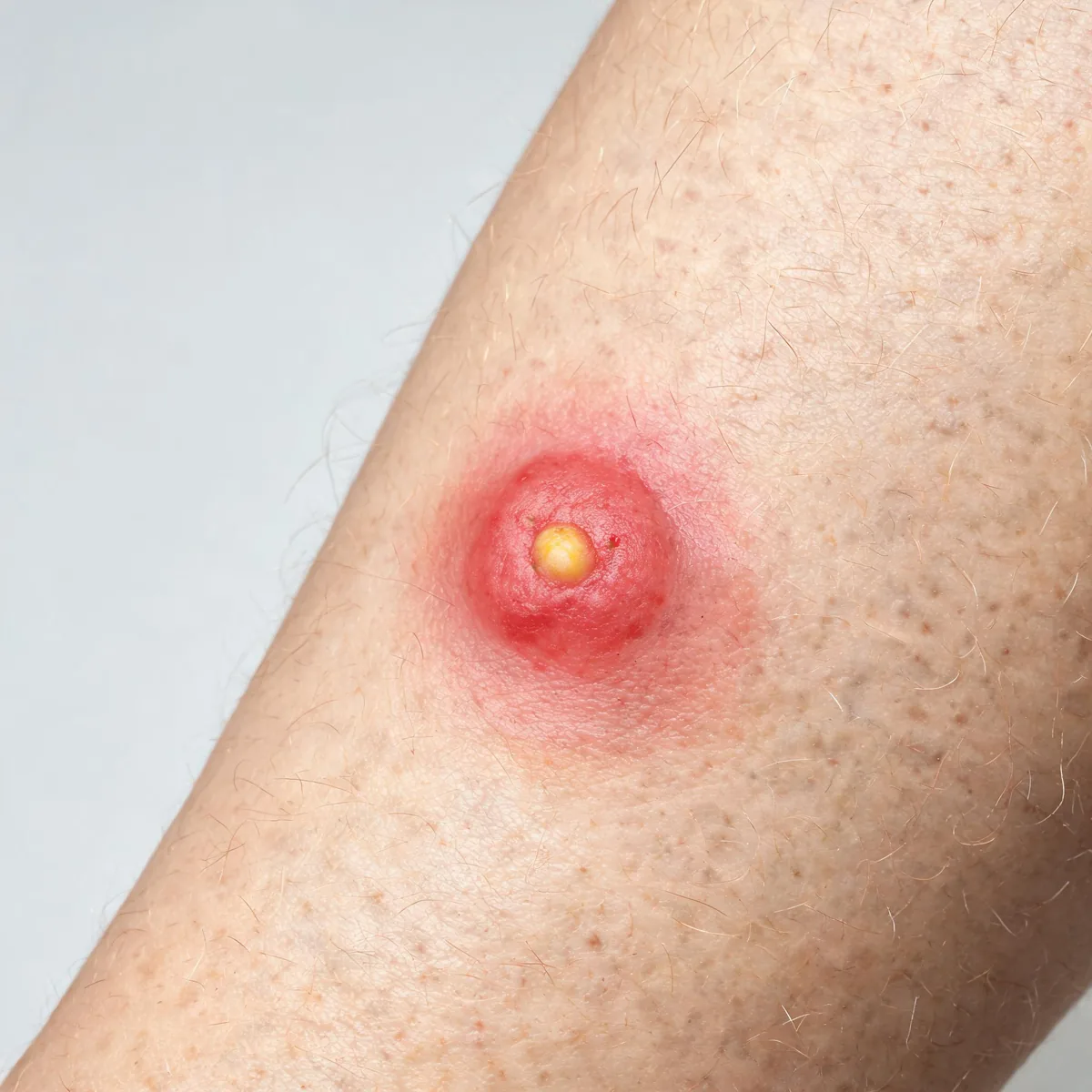
Understanding Boils
Chinese medicine calls a boil jie, and classifies it among the skin sores. The skin is governed by the Lung system and defensive Qi, which act as a barrier.
When that barrier is overwhelmed, or when internal heat and toxin build faster than the body can clear them, the boil forms: red, swollen, hot and painful, and eventually forming a pus head. The classical literature reads that as expulsion rather than as a purely local event.
The patterns describe where the heat sits. Toxic-Heat gives a rapid, angry boil with fever and thirst. Damp-Heat in the Lower Burner gives boils on the lower limbs, buttocks or groin that ooze and crust. Blood Stagnation gives a hard lump that does not come to a head easily, with fixed stabbing pain.
Deficiency patterns explain recurrence: Qi and Blood deficiency gives boils that heal slowly with thin clear discharge and return over weeks, while Empty-Heat from Yin deficiency gives small recurrent boils in someone with night sweats and dry mouth.
Where a boil appears narrows the field at once. Lesions on the face and upper body point to Heat gathering in the Lung and Stomach channels; crops on the legs, buttocks or groin suggest that Dampness and Heat have settled lower down. The behaviour of the lesion adds a second clue: a fast, angry, throbbing swelling belongs to Toxic-Heat, whereas a soft lesion that weeps clear fluid and itches speaks of Dampness rather than Fire, and a dark, hard lump that will not point speaks of Blood that has stopped moving.
A boil also has a stage of its own. Most move from a red, tense swelling through a pointing phase to discharge and then to healing, and where a person sits in that sequence changes the reading. A lesion that refuses to point, or that collapses into a slow weeping ulcer, tells a different story from one that is simply red and painful on the first day. Duration matters as much as appearance: crops that return over weeks, each healing incompletely, suggest that the internal conditions that produced the boil were never addressed.
The practical consequence is that two people with an identical-looking boil can need opposite treatment. Draining fire in someone who is already depleted can leave them weaker and more prone to recurrence, while a rich warming tonic given during an acute toxic flare may feed the infection. A practitioner therefore treats the branch during an attack and the root between attacks, and expects the pattern to shift as the lesion settles. The aim is to bring the present boil to a head and heal it, and to change the conditions that allow crops to return.
Conventional view
A boil, or furuncle, is a bacterial infection of a hair follicle, most often caused by Staphylococcus aureus. It forms a painful red pus-filled lump that gradually comes to a head and may drain, anywhere on the body but commonly on the neck, face, armpits and buttocks. Diagnosis is usually visual, and recurrent boils may prompt blood tests for diabetes or immune problems. Warm compresses help it point, and a doctor may occasionally lance and drain a large one; antibiotics are prescribed if infection spreads or immunity is weakened.
Standard care applies warm compresses to encourage drainage, keeps the area clean and covered, and uses incision and drainage for larger or multiple boils. Topical or oral antibiotics are used when infection is severe, spreading or accompanied by fever, and recurrent boils may be treated with longer antibiotic courses or decolonisation protocols to reduce staph on the skin.
Antibiotics clear the current infection but do not address why boils keep returning, and many people suffer repeated episodes despite good hygiene. Underlying factors such as a weakened constitution, dietary Heat or emotional stress are not part of the conventional plan, whereas TCM looks beyond the bacteria to the internal environment that allowed the boil to form.
Selected PubMed records
Real PubMed records for the conventional discussion above, selected by condition name and title relevance. They are references, not a claim that any treatment is proven for this condition.
- Interventions for bacterial folliculitis and boils (furuncles and carbuncles).. The Cochrane database of systematic reviews, 2021. PMID: 33634465.
How it connects
Boils and abscesses belong to one spectrum. When defensive Qi cannot clear a local infection, Toxic-Heat or Damp-Heat deepens and a small boil can turn into a larger, more painful abscess, often with several lesions clustered together. Acne shares the same ground: the Heat and Dampness that block the pores are the same, but a boil is the more intense, confined flare, which is why long-standing acne can turn into boils during stress or dietary excess. These overlaps matter for treatment as much as for explanation. Because the soil is shared, a formula that clears heat-toxin for boils often settles acne at the same time, and a lesion that has deepened into a larger abscess is usually the same process pushed one layer further. That is why a practitioner asks about both rather than treating each lesion as a separate event, and why clearing the pattern matters more than chasing individual boils as they appear.
How it is assessed
The practitioner notes the site, the stage of the boil, and the constitutional signs around it.
What a practitioner looks for
- Site: face and upper body suggest heat rising; lower limbs and groin suggest Damp-Heat in the Lower Burner.
- Stage: red and hot without a head is Toxic-Heat; a hard lump that will not point suggests stasis; thin clear discharge suggests deficiency.
- Systemic signs: fever, thirst, constipation and restlessness indicate the severity of the heat.
- Recurrence: repeated crops over months point to an underlying deficiency rather than a local problem.
The first pass is visual and tactile. The practitioner notes colour, temperature, size and site, whether the centre is pointing, and whether fluid or pus is escaping. Pain quality is asked about directly: a throb that keeps the patient awake differs from a dull ache, and a fixed stabbing sensation that intensifies at night points somewhere else again. Whole-body signs are then drawn out, including fever, thirst, appetite, bowel habit, urine colour and energy, because they show whether the reaction is an acute excess one or the surface expression of a long-standing weakness.
Tongue and pulse complete the picture. A red tongue with a dry yellow coat and a rapid, forceful pulse fits Toxic-Heat; a thick greasy yellow coat most marked at the root, with a slippery rapid pulse, fits Damp-Heat in the lower body. A pale, thin tongue with a weak fine pulse accompanies the deficient picture, while a dusky or purple tongue with a choppy pulse and dark sublingual veins indicates stasis. Red sides under a thin yellow coat, with a wiry rapid pulse, point to Liver Qi constraint that has turned to Heat, and a red, cracked, coating-less tongue with a fine rapid pulse indicates Empty-Heat.
Duration and repetition matter as much as appearance. A single boil in an otherwise robust person is treated as an acute event, whereas crops returning over weeks invite questions about diet, sleep, stress, blood sugar and immune health. The practitioner also checks for warning signs that place the case outside ordinary TCM care, such as a lesion on the central face, spreading redness, high fever, or a boil that will not point despite treatment.
TCM patterns in Boils
Six patterns account for most boils. Four describe what is lodged in the skin: Toxic-Heat gives a fast, red, hot, throbbing swelling with fever and thirst; Damp-Heat in the Lower Burner gives weeping, crusting crops on the legs or groin; Blood Stagnation gives a hard, dark lump with stabbing pain that will not point; and Liver Qi Stagnation turning into Heat gives boils that arrive with irritability and rib-side distension. The other two describe a body that cannot clear the lesion: Qi and Blood Deficiency gives slow-healing, recurrent boils with thin discharge in someone pale and tired, and Empty-Heat from Yin Deficiency gives small recurrent boils with night sweats and dry mouth. These overlap, and a hot first episode can settle into recurrence. Reading site, stage and signs shows which pattern dominates now, and whether to drain, to dry, to move or to build.
| Pattern | Key signs | The itch | Tongue | Main formula |
|---|---|---|---|---|
| Toxic-Heat | Red swollen hot painful lump that may form a pus head | Not specified | Body: Red, often with raised red pointsCoat: Yellow, dry, sometimes thick | Not specified |
| Damp-Heat in the Lower Burner | Yellowish crusts; Dark scanty or burning urine | Oozing weeping or itchy lesions | Body: Red, slightly swollen, with a coating thickest at the rootCoat: Yellow and greasy | Not specified |
| Qi and Blood Deficiency | Not specified | Not specified | Body: Pale, possibly thin or with teeth marksCoat: Thin white | Not specified |
| Blood Stagnation | Fixed stabbing pain; Pain worse at night | Not specified | Body: Purple, dusky or with dark stasis spots; sublingual veins dark and distendedCoat: Often thin white; a yellow coat would suggest Heat as the cause | Not specified |
| Liver Qi Stagnation that transforms into Heat | Distending pain in the ribcage | Not specified | Body: Red, with the sides redder than the centreCoat: Yellow | Not specified |
| Empty-Heat caused by Yin Deficiency | Dry mouth and throat at night | Not specified | Body: Red, thin and dry, often crackedCoat: Little or none; the tongue may look peeled | Not specified |
Toxic-Heat
The acute, angry boil with fever and thirst.
Heat that has concentrated into toxin is the engine here. The source may be an external wind-heat that the body fails to disperse, or internal fire fed by alcohol, rich food and anger. When that heat gathers it obstructs Qi and Blood at one spot, and the pressure of the blocked movement produces redness, swelling, heat and a pain that throbs with the pulse. The defensive Qi then masses against the toxin, and pus forms as the by-product of that struggle, which is why a yellow head appears and why the whole lesion feels tense and angry before it discharges.
The tongue is red with a dry yellow coat and raised prickles, and the pulse is rapid, strong, and often overflows or feels slippery. Onset is fast, and the boil may come with fever, a general feeling of heat, thirst that only cold drinks satisfy, dark scanty urine and constipation. Spicy and fried food, alcohol, coffee, hot humid weather, anger and lost sleep all make it worse, while cooling compresses, plain food, water and rest ease it. Wu Wei Xiao Du Yin is the usual choice, with Huang Lian Jie Du Tang reserved for severe heat across all three burners; the herbs named for the pattern are Jin Yin Hua, Lian Qiao and Pu Gong Ying, and the points are Hegu (LI-4), Quchi (LI-11), Dazhui (DU-14) and Xuehai (SP-10).
Signs
- Red swollen hot painful lump that may form a pus head
- Fever with a feeling of heat
- Intense thirst for cold drinks
- Dark scanty urine and constipation
- Rapid onset and spread
Diet and lifestyle for this pattern: Eat cooling, plain food such as mung beans, cucumber, watermelon and leafy greens, and avoid spicy, greasy, fried and sweet food that generates Heat and Dampness. Drink enough water to help clear toxins, keep the area clean and dry, never squeeze a boil and give yourself enough rest to fight the infection.
Damp-Heat in the Lower Burner
Boils on the lower body that ooze and crust.
Dampness is heavy and tends to move downward, so when it combines with Heat the mixture settles in the lower half of the body rather than rising to the face. There it becomes stuck: the thick, sticky quality of Dampness blocks the channels of the skin so that Qi and Blood cannot pass freely, and the Heat keeps the area red and inflamed. Because the lesion is fed by moisture rather than by a single burst of fire, the boil oozes, weeps or itches and forms yellowish crusts instead of pointing briskly, while the limbs feel heavy and dragged down.
The tongue is red with a thick yellow greasy coat, most marked at the root, and there is a slippery, rapid pulse that feels soggy at the rear positions. The crops favour the legs, buttocks and groin, and may come with dark scanty or burning urine. Hot humid weather, greasy and sweet food, alcohol, and long hours of sitting or standing all aggravate it, while a cool environment, light bland meals, gentle movement and keeping the skin clean and dry help. Gan Lu Xiao Du Dan clears Heat, drains Dampness and resolves toxicity for this presentation, supported by Bi Xie, Huang Bo and Yi Yi Ren; the points named are Sanyinjiao (SP-6), Yinlingquan (SP-9) and Weizhong (BL-40).
Signs
- Boils on lower limbs, buttocks or groin
- Oozing weeping or itchy lesions
- Yellowish crusts
- Heaviness or dragging in the legs
- Dark scanty or burning urine
Diet and lifestyle for this pattern: Avoid greasy, sweet and spicy food that brews Dampness and Heat, and favour cooling, drying choices such as barley, mung beans, bitter greens and lightly cooked vegetables. Keep the skin dry, spend less time sitting in humid places, and take gentle daily exercise that produces a light sweat.
Qi and Blood Deficiency
Slow-healing, recurrent boils with fatigue.
This is the picture of a body that has the lesion but not the force to resolve it. Qi drives the defensive response and Blood supplies the material for repair, so when both are low the skin cannot wall off the infection or build a proper head. The boil forms slowly, aches rather than burns, discharges a thin clear fluid and takes weeks to close. Because nothing has been pushed out, the same site or a nearby one flares again, and each crop leaves the person more tired than the one before.
The tongue is pale and may be thin with teeth marks under a thin white coat; the pulse is fine and weak, most noticeably at the right Guan position. Fatigue, a pale or sallow face, dizziness, poor appetite and a tendency to slow healing accompany the skin. Overwork, skipped meals, heavy sweating and prolonged stress deplete the person further, while rest, warm nourishing food and gentle exercise rebuild them. Tuo Li Xiao Du San is the formula associated with this pattern because it tonifies Qi, nourishes Blood and still expels lingering toxin; Huang Qi, Dang Gui and Bai Zhu are the herbs named, with Zusanli (ST-36), Sanyinjiao (SP-6) and Qihai (REN-6) as the points.
Signs
- Boils heal slowly with thin clear discharge
- Recurrent boils over weeks or months
- Fatigue and general weakness
- Pale or sallow complexion
- Poor appetite
Diet and lifestyle for this pattern: Eat warm, cooked, nourishing food such as bone broth, congee with lean meat and steamed vegetables, and avoid raw, cold or greasy food that drains digestive fire. Protect sleep and keep exercise gentle, with walking or qigong, so Qi builds without being used up.
Blood Stagnation
A hard lump that will not come to a head, with fixed pain.
Here the obstruction is the problem rather than the quantity of heat. Blood that moves sluggishly congests in the fine collaterals of the skin, and the trapped Heat and toxin have no route out. The lesion therefore feels hard and rooted, dark or purplish, and it resists pointing because the channels around it are blocked. The pain is fixed and stabbing rather than throbbing, and it sharpens at night when circulation slows and the body is still.
The tongue is purple or dusky with stasis spots and distended dark sublingual veins under a thin white coat, and the pulse is choppy or wiry. Cold weather, immobility, tight clothing, pressure on the lesion and emotional tension all worsen it, while a warm compress and gentle movement loosen it. Xue Fu Zhu Yu Tang is the primary formula for moving Qi, invigorating Blood and unblocking the collaterals, with Tao Hong Si Wu Tang as an alternative that also nourishes Blood; Ru Xiang and Mo Yao are the herbs named, and the points are Xuehai (SP-10) and Taichong (LR-3).
Signs
- Fixed stabbing pain
- Hard lump that does not come to a head easily
- Dark purple discolouration around the boil
- Pain worse at night
Diet and lifestyle for this pattern: Add foods that gently move Blood, such as hawthorn, turmeric, black fungus and a little vinegar, and limit cold raw food and excess dairy that can congeal it. Keep gently active without putting pressure on the boil, and manage stress, since tension stagnates Qi and worsens stasis.
Liver Qi Stagnation that transforms into Heat
Boils that appear or worsen with stress.
Frustration, suppressed anger and unrelieved pressure keep Liver Qi from spreading freely. Qi that is held in this way heats up over time, much as a closed room becomes stuffy, and the accumulated heat rises and erupts through the skin. The lesion is red and painful, but the tell is the company it keeps: the boils arrive, or worsen, when emotional stress rises, and come with distension in the ribcage, explosive irritability and a bitter taste in the mouth.
The tongue body is red with especially red sides under a yellow coating; the pulse is wiry and rapid, strongest at the left middle position. Hot weather, overheated rooms, alcohol, spicy and fried food and late nights add heat and tighten the constraint further, while stress relief, cooling moistening foods and gentle movement release it. Dan Zhi Xiao Yao San courses the Liver, clears the heat and strengthens the Spleen, and it may be combined with Jin Yin Hua; Chai Hu, Zhi Zi and Mu Dan Pi are the herbs named, with Taichong (LR-3), Xingjian (LR-2), Quchi (LI-11) and Hegu (LI-4) as the points.
Signs
- Boils appear or worsen with emotional stress
- Distending pain in the ribcage
- Irritability and explosive anger
- Bitter taste in the mouth
Diet and lifestyle for this pattern: Unwind with tai chi or walking and protect your sleep. Avoid spicy, greasy and fried food that adds Heat, drink chrysanthemum tea, eat cooling vegetables such as cucumber and bitter gourd, and keep the skin clean and dry.
Empty-Heat caused by Yin Deficiency
Small recurrent boils with signs of depleted Yin.
Yin is the body's cooling and moistening reserve, and when it is spent the system runs warm with too little fluid to hold the heat in check. The result is not a raging fire but a low, smouldering warmth that keeps producing small lesions. Because the cause is depletion rather than infection alone, the boils are smaller and less angry than toxic ones, heal slowly, and return whenever the person is tired, sleepless or overworked.
The tongue is red, thin and dry with little or no coating and often cracks, and the pulse is fine and rapid. Night sweats, a dry mouth and throat that is worse at night, heat in the palms and soles and restless sleep accompany the skin. Late nights, overwork, saunas and heavy sweating, hot weather, spicy food, coffee and stress all consume Yin or stir the heat, while rest, water, cooling moistening foods and calm surroundings restore it. Zhi Bai Di Huang Wan nourishes Kidney Yin and clears deficiency Heat; the raw form of Rehmannia, Zhi Mu and Huang Bo are the herbs named, with Taixi (KI-3) and Zhaohai (KI-6) as the points.
Signs
- Recurrent small boils that heal slowly
- Night sweats
- Heat in palms and soles
- Dry mouth and throat at night
- Restless sleep
Diet and lifestyle for this pattern: Protect rest and avoid late nights above all. Nourish Yin with pear, black sesame, tofu, cucumber and barley, avoid spicy, fried and greasy food that generates Heat, and keep the skin clean and dry.
Treatment approach
How the tradition treats boils, with the herbs, formulas and points used for it.
Principles
- Clear heat and resolve toxicity while the boil is active, and support the body in bringing it to a head safely.
- Do not squeeze or lance a boil at home, especially on the face.
- Move Blood and resolve stasis where the lump is hard and will not point.
- Treat recurrence by strengthening Qi and Blood or nourishing Yin once the acute episode has settled.
- In practice the root and the branch are treated in sequence rather than all at once: an acute boil is brought to a head and drained with cooling, detoxifying herbs, then the underlying pattern is addressed so that crops stop forming. Where the two overlap, a formula such as Tuo Li Xiao Du San supports the interior while still resolving toxin, which is why the choice depends on whether the person is robust or depleted rather than on the appearance of the lesion alone.
Herbs used
Formulas
- Wu Wei Xiao Du Yin
- Huang Lian Jie Du Tang
- Gan Lu Xiao Du Dan
- Tuo Li Xiao Du San
- Xue Fu Zhu Yu Tang
- Tao Hong Si Wu Tang
- Dan Zhi Xiao Yao San
- Zhi Bai Di Huang Wan
Acupoints
- LI-4 (Hegu)
- LI-11 (Quchi)
- DU-14 (Dazhui)
- SP-10 (Xuehai)
- SP-6 (Sanyinjiao)
- SP-9 (Yinlingquan)
- BL-40 (Weizhong)
- ST-36 (Zusanli)
- qihai-ren-6
- LR-3 (Taichong)
- LR-2 (Xingjian)
- KI-3 (Taixi)
- KI-6 (Zhaohai)
What to expect
- A single boil is described as settling within one to two weeks.
- Recurrent crops are expected to need weeks to months of constitutional treatment.
- Any boil with spreading redness or fever requires medical treatment first.
- Timelines follow the pattern rather than the diagnosis. An acute toxic boil often settles within a few days to a week, damp-heat crops on the legs often need one to two weeks, and recurrent boils from deficiency usually need four to twelve weeks of consistent treatment before the cycle breaks. Improvement is rarely linear, and a flare during treatment is not automatically a failure; the practitioner looks at the trend across weeks.
Safety and when to get help
Seek medical help urgently for
- A boil on the face, especially near the nose, upper lip or eye - infection there can spread to the brain.
- Red streaks spreading from the boil, or fever with the boil.
- A boil that is rapidly enlarging, extremely painful, or in someone who is immune-suppressed.
For anything severe, sudden or spreading quickly, read when a skin problem needs urgent care.
Cautions
- Do not squeeze or cut a boil open at home.
- Diabetes makes boils more serious and needs medical input.
- Recurrent boils should be medically reviewed, including swabbing where indicated.
Using this alongside conventional care
- TCM is described as complementary to conventional care: . Where antibiotics or drainage are needed, those come first, and herbs are used alongside rather than instead.
- Combination with conventional care is usually straightforward but needs coordination. Herbs that clear heat and resolve toxin can be taken alongside a prescribed course of antibiotics, and the herbal and medical prescribers should each know what the other has advised. Two cautions matter most: blood-moving herbs such as Ru Xiang and Mo Yao may add to the effect of anticoagulants, and anyone with diabetes or an immune condition should have blood sugar and immune status monitored, because herbs can influence both. Topical applications such as Jin Huang San can be used alongside topical antibiotics if the skin tolerates them.
Diet and lifestyle
- The single most repeated rule is to avoid what creates heat and dampness: spicy, fried and greasy food, alcohol and excess sweets.
- Beyond avoiding heat and dampness, the details shift with the pattern. When the picture is toxic or damp, cooling and drying foods such as mung beans, cucumber, barley and bitter greens help, and alcohol, fried food and heavy sweets should be reduced. When the picture is deficient, the same cold foods can weaken digestion further, so warm congee, bone broth, slow-cooked vegetables and small amounts of protein suit better, and skipped meals do as much harm as heavy ones. During stasis, hawthorn, turmeric and a little vinegar are traditional additions, and in empty-heat, pear, black sesame and plenty of water are preferred.
If you're pregnant
Boils during pregnancy are not uncommon, since Heat and Dampness tend to increase. Many heat-clearing herbs are cold in nature and may disturb the fetus, so selection is cautious: Wu Wei Xiao Du Yin is generally considered safe because its ingredients, Jin Yin Hua, Pu Gong Ying and Zi Hua Di Ding, are mild and often used for mastitis, while Huang Lian Jie Du Tang, with strongly bitter-cold herbs such as Huang Lian, should be avoided or used only under strict guidance.
Hegu (LI-4) and Sanyinjiao (SP-6) are forbidden in pregnancy; safer points include Quchi (LI-11) and Dazhui (DU-14), and topical Jin Huang San is a traditional external option, although trial evidence for it is limited.
If you're breastfeeding
Breastfeeding women with boils should avoid strong bitter-cold herbs that can reduce milk supply or cause infant diarrhoea. Jin Yin Hua and Pu Gong Ying are particularly useful here, as they clear Heat and also promote lactation.
Huang Lian and Huang Bai can pass into milk and may upset the baby's digestion, so they are used cautiously. For Damp-Heat in the lower burner, Gan Lu Xiao Du Dan contains many aromatic and cold herbs, so a gentler alternative or a modified formula under professional guidance is preferred.
If treating a child
Children often develop boils on the head and face from Toxic-Heat or Damp-Heat arising from dietary irregularity. Their skin is delicate and they may not describe symptoms, so careful observation matters, and doses are reduced to a quarter to a half of the adult dose by age.
Topical Jin Huang San is particularly favoured, Wu Wei Xiao Du Yin can be used at reduced dose, and overly bitter herbs that damage the Spleen are avoided. Points such as Hegu (LI-4) and Quchi (LI-11) are traditionally used for clearing Heat, although trial evidence is limited.
If treating an elderly patient
In older people boils are often recurrent and slow to heal because of underlying Qi and Blood deficiency, so treatment shifts towards tonifying and supporting the body's ability to expel toxins. Tuo Li Xiao Du San is a key formula, with Huang Qi and Dang Gui at its centre.
Excessive cold, bitter herbs can weaken digestion further and are avoided, while acupuncture with moxibustion on Zusanli (ST-36) and Qihai (REN-6) is beneficial. Timelines are longer and close monitoring for polypharmacy interactions is essential.
Urgent-sign guidance is based on standard sources: NHS anaphylaxis, NHS cellulitis, NHS Stevens-Johnson syndrome, NHS melanoma.
Evidence
Evidence status
Compiled for this page from the classical and modern literature; not a systematic review, so treat it as a pointer to sources rather than clinical guidance.
High-quality English-language evidence for TCM in boils is limited. Chinese trials report good results with formulas such as Wu Wei Xiao Du Yin and Huang Lian Jie Du Tang for furunculosis and skin infections, but most are small and lack placebo controls. A systematic review protocol on Wuwei Xiaodu Drink for wound infections notes that rigorous evidence is still needed, and topical preparations such as Jin Huang San have been studied for skin and soft tissue infection with promising anti-inflammatory findings.
Studies often cited
Chinese clinical trials report good results for furunculosis and skin infection, but samples are small and placebo controls usually absent. Chinese clinical trials (as recorded in the source)
Studied for skin and soft tissue infections, with anti-inflammatory and antibacterial effects described as promising. Topical TCM studies (as recorded in the source)
A protocol for wound infections highlights that rigorous evidence is still needed, which is an honest statement of the current state. Systematic review protocol (as recorded in the source)
Classical record
「疖者,由风湿冷气搏于血,结聚所生也。人运役劳动,则阳气发泄,因而汗出,遇冷湿气,折于经络,血涩不通,结聚成疖。」
A boil arises when wind, dampness and cold qi contend with the blood and bind together. When a person labours, yang qi disperses and sweat appears; meeting cold-damp, it lodges in the channels, the blood runs sluggish and fails to pass, and the binding forms a boil.
Zhu Bing Yuan Hou Lun, Volume 31, On Boils - Classical citation: with the translation restated for this page.
Common questions
Can herbs bring a boil to a head?
The tradition describes clearing heat and resolving toxicity in the acute phase. It does not advise lancing a boil at home, and a boil on the face needs medical assessment.
Why do my boils keep coming back?
Recurrence is read as an underlying deficiency pattern, most often Qi and Blood deficiency or Empty-Heat, which is why the treatment changes once the acute episode settles.
Should I take antibiotics?
If the infection is spreading, or there is fever, or the boil is on the face, yes - medical treatment comes first. This page does not present herbs as a substitute.
Can I squeeze it?
No. The classical literature is explicit that squeezing, particularly on the face, risks spreading infection.
How long does it take for a boil to heal with TCM?
An acute hot red boil often begins to shrink within two or three days of the right formula and may settle inside a week. Slow-healing or recurrent boils take longer because the underlying deficiency has to be corrected, so the current lesion may improve within a week while full resolution and prevention of new crops can take four to twelve weeks of consistent treatment.
Is it safe to use TCM while I am taking antibiotics?
In most cases the two can be used together, and the herbs may ease some of the digestive upset that antibiotics cause. The essential step is disclosure: tell the TCM practitioner which antibiotic you have been given and tell the prescribing doctor which herbs you are taking, because a small number of herbs can interact with specific medicines.
Can acupuncture help with a boil?
Needles are not placed into a boil, but they are used to clear heat and toxin, ease pain and support the body's defences. Quchi (LI-11) and Hegu (LI-4) are commonly chosen for skin infection, and for recurrent crops the point selection follows the underlying pattern, whether that means moving stagnant Qi, draining Dampness or building Qi and Blood.