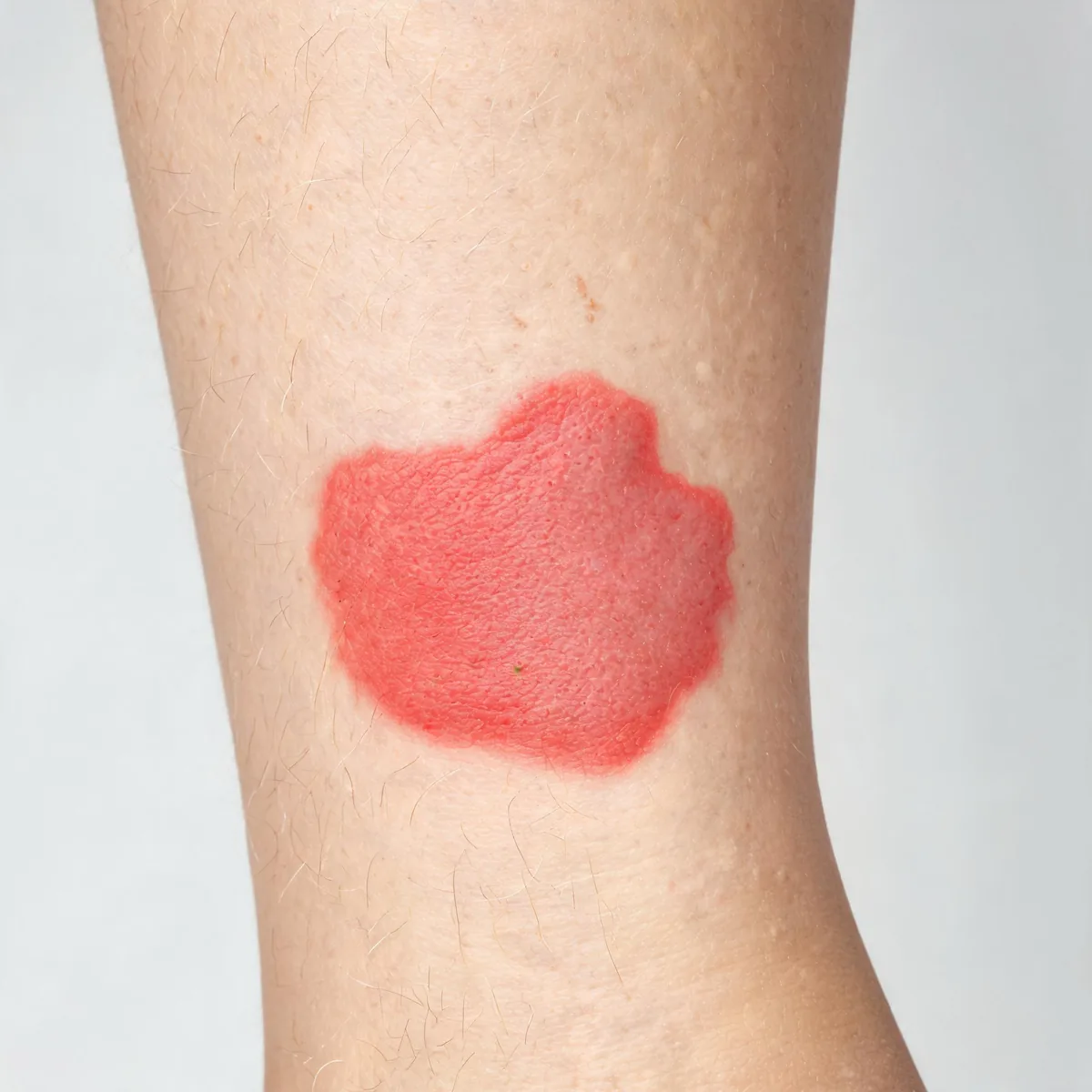
Understanding Erysipelas
The tradition describes erysipelas as fire toxin invading the skin, arising either from an external pathogen such as Wind-Heat or from internal heat and dampness.
The hallmark is a bright red, hot, swollen area with a clear border, burning pain, fever and chills. Toxic-Heat is the main pattern, and the classical literature treats it as the most intense.
Wind-Heat gives fever and chills before the rash appears, with the lesion on the face or head, headache and sore throat. Damp-Heat in the Lower Burner gives burning red swelling on the lower legs with heaviness, and the classical literature notes it is often preceded by athlete foot or cracks between the toes, which are the entry point.
Blood stagnation with heat gives a darker purplish-red plaque with fixed stabbing pain and hardness beneath the skin. Empty-Heat from Yin deficiency gives a duller, less fiery rash that worsens in the afternoon or evening, with night sweats.
Erysipelas is read as a fire that has found a way into the skin, and the traditional question is where that fire came from. Sometimes it arrives from outside, riding in on a Wind-Heat pathogen during a cold or a throat infection. Sometimes it brews inside, as Damp-Heat gathering in the lower body, or as a thin Yin that lets empty heat rise to the surface. Sometimes it is the remains of an earlier attack that was never fully cleared. Colour, border, speed of spread and the accompanying fever all describe which of these is happening, and the treatment changes with the answer.
Two features recur whatever the origin. The first is that fire toxin damages the small vessels of the skin, so the redness is sharply bordered and the surface feels hot, tight and painful rather than itchy. The second is that the pattern tends to become chronic: an attack that settles can leave heat trapped in stagnant blood, and the same site then flares whenever the body is tired, overheated or run down. That tendency to return is why treatment is judged by whether the terrain has changed, not only by whether the plaque has faded.
Conventional view
Erysipelas is a bacterial infection of the upper layers of the skin and the superficial lymph channels, usually caused by Group A Streptococcus. It produces a raised, bright red rash with a sharp border that feels hot and painful, most often on the face or lower leg, and it usually begins abruptly with high fever, chills and a general feeling of being unwell. The diagnosis is normally made on the appearance of the rash rather than on a laboratory test.
Oral antibiotics, most often penicillin or a close relative, are the mainstay and are taken for ten to fourteen days; severe cases need intravenous treatment in hospital. Supportive care includes rest, raising the affected limb to reduce swelling, and cool compresses for comfort. Most people improve quickly once the antibiotic is established, and the rash fades over the following week or two.
The shortfall is recurrence. Antibiotics clear the bacteria of the present episode but do not change the local conditions that invite the next one, so some people cycle through repeated infections that can end in lasting swelling and skin change. Fluid that pools in a leg, poor local circulation and a persistent fungal infection between the toes all remain after the course finishes. That is the gap a pattern-based approach tries to fill, alongside conventional treatment rather than instead of it.
Selected PubMed records
Real PubMed records for the conventional discussion above, selected by condition name and title relevance. They are references, not a claim that any treatment is proven for this condition.
- Streptococcus pyogenes Impetigo, Erysipelas, and Cellulitis.. , 2022. PMID: 36479753.
How it connects
Erysipelas and athlete's foot frequently appear together because they share a root in Damp-Heat. A chronic fungal infection such as athlete's foot represents Damp-Heat brewing in the lower body, and that damp hot environment weakens the skin's defences, creating the entry point for the fire toxin that triggers erysipelas; treating the underlying Damp-Heat often resolves both. When erysipelas is severe, the intense Toxic-Heat can liquefy local tissue and form an abscess, which is not a separate disease but a consequence of unresolved Toxic-Heat, so the same heat-clearing approach addresses both at source. The company erysipelas keeps is mostly a matter of shared terrain. Athlete's foot is the commonest companion, because a chronic fungal infection is Damp-Heat sitting in the lower body, and that warm damp skin both weakens the local defences and offers the toxin an entry. Treating the foot is therefore part of treating the leg, and the same draining formula addresses both. When an attack is severe, unresolved toxin can liquefy tissue and form an abscess, which the classical literature reads not as a separate illness but as fire toxin concentrating. Clearing the heat and letting the pus drain is the work of Huang Lian Jie Du Tang, which settles both at once.
How it is assessed
Speed and colour come first; the pattern describes the constitutional setting.
What a practitioner looks for
- Colour: bright red with clear borders suggests Toxic-Heat; duller red suggests Yin deficiency.
- Onset: fever and chills before a facial rash suggests Wind-Heat.
- Site: lower leg involvement often follows a break in the skin or athlete foot.
- Red flags: rapid spread, dusky or purplish skin, blistering or severe pain need urgent care.
The first pass is a safety check rather than a pattern question. A plaque that is spreading quickly, turning dusky or purple, blistering, or arriving with a high fever, shaking chills or confusion needs urgent medical assessment, and the classical literature is explicit that the herbal view comes after that decision. Once the infection is being treated, the pattern questions begin. How did it start, where is it, what colour is the border, and what else is happening in the body at the same time.
A facial plaque that followed a sore throat, with fever and chills before the redness, is Wind-Heat. A leg that swells, weeps and feels heavy in someone who also has athlete's foot is Damp-Heat in the Lower Burner. A bright plaque that spreads fast with high fever, thirst and restlessness, anywhere on the body, is Toxic-Heat and is read as the most serious. A dark plaque with hardness and fixed stabbing pain points to Blood Stagnation with Heat, while a dull rash that returns with night sweats and a dry mouth is Empty-Heat from Yin Deficiency.
TCM patterns in Erysipelas
The patterns are separated by how the plaque behaves rather than where it sits. Fire toxin that spreads fast, burns and brings high fever is Toxic-Heat, the most severe reading, where heat has left the skin for the whole body. A facial plaque that follows a sore throat, with chills and headache first, is Wind-Heat, where the pathogen is still being pushed outwards. A leg that swells and weeps after a fungal infection between the toes is Damp-Heat in the Lower Burner, and dampness is what makes it linger. A slower plaque tells another story. When the redness is dark, the skin feels thick and the pain is fixed, the original heat has been left in stagnant blood: Blood Stagnation with Heat. When the rash is duller, returns repeatedly and comes with night sweats and a dry mouth, the fire is empty, generated by a Yin too thin to cool the body. One person can move between them over time.
| Pattern | Key signs | The itch | Tongue | Main formula |
|---|---|---|---|---|
| Toxic-Heat | Bright red hot swollen skin with clear borders; Burning pain at the site | Not specified | Body: Red, often with raised red pointsCoat: Yellow, dry, sometimes thick | Not specified |
| Wind-Heat | Fever and chills before the rash; Bright red hot swollen skin on face or head | Not specified | Body: Red at the tip and edgesCoat: Thin yellow or white turning yellow | Not specified |
| Damp-Heat in the Lower Burner | Burning bright red swelling on the lower legs | Not specified | Body: Red, slightly swollen, with a coating thickest at the rootCoat: Yellow and greasy | Not specified |
| Blood Stagnation with Heat | Fixed stabbing pain; Dark purplish-red skin patches | Not specified | Body: Reddish-purple, with stasis spots and dark sublingual veinsCoat: Thin, dry and yellow | Not specified |
| Empty-Heat caused by Yin Deficiency | Dull red rash, less fiery than other types; Dry mouth and throat | Not specified | Body: Red, thin and dry, often crackedCoat: Little or none; the tongue may look peeled | Not specified |
Toxic-Heat
Bright red hot swollen plaque with clear borders and fever.
This is fire toxin in its most concentrated form. The heat may arrive from outside as a strong pathogen, or rise from inside where rich food, alcohol and stress have kept it building, and it travels through the blood into the skin. The vessels there are damaged by the intensity of it, so the plaque is bright, raised, sharply bordered, hot to the touch and painful with a burning quality. Because the toxin is systemic as well as local, the person is unwell all over, with high fever, chills, thirst, restlessness and dark scanty urine.
The tongue is red with thorns on its surface and a dry yellow coat, and the pulse runs rapid and forceful, full or overflowing, sometimes slippery. Spicy and fried food, alcohol, hot humid weather, overexertion and anger all feed it, while cool compresses, plenty of water, a cool room and light cooling food ease it. Huang Lian Jie Du Tang is the formula named, with Huang Lian, Lian Qiao and Jin Yin Hua, and Pu Ji Xiao Du Yin is added where the head and face are involved. The points are Dazhui (DU-14), Quchi (LI-11), Xuehai (SP-10) and Hegu (LI-4), all needled with reducing method.
Signs
- Bright red hot swollen skin with clear borders
- High fever and chills
- Burning pain at the site
- Thirst with restlessness
- Dark scanty urine
Diet and lifestyle for this pattern: Eat plenty of cooling, water-rich food such as cucumber, watermelon and mung beans. Avoid alcohol, coffee, spicy dishes and deep-fried food completely, which stoke the fire, and keep the skin clean and dry while resting in a cool aired room until fever and redness subside.
Wind-Heat
Fever and chills before a red facial plaque, with sore throat.
Here the fire starts at the surface. A Wind-Heat pathogen, usually picked up in a cold or a throat infection, lodges in the upper body and then transforms into toxin that rises to the face and scalp. Because the invasion is recent and still at the exterior, the first signs are fever and chills, headache and a sore throat, and the redness appears afterwards. The plaque is sharply bordered and hot to the touch, and it sits most often on the head or face, which is where Wind carries it.
The tongue is red at the tip and along the edges, with a thin yellow film, and the pulse floats and races. Spicy and greasy food, alcohol, exposure to wind and overwork with stress all make it worse, while cool compresses, a cool room to rest in and plenty of water help. Pu Ji Xiao Du Yin is the formula named, with Lian Qiao, Ban Lan Gen and Bo He, and it is the classic choice for a facial plaque. The points are Dazhui (DU-14), Fengchi (GB-20) and Hegu (LI-4).
Signs
- Fever and chills before the rash
- Bright red hot swollen skin on face or head
- Headache and sore throat
- Thirst
Diet and lifestyle for this pattern: Avoid spicy, fried and greasy food and alcohol, which add internal Heat. Drink plenty of room-temperature water and eat cooling food such as cucumber, pear and mung beans, rest in a cool aired room, and protect the face from strong wind and sun.
Damp-Heat in the Lower Burner
Burning red swelling of the lower legs, often after athlete foot.
Dampness and heat gather in the lower half of the body and pour downwards, and the leg is where they surface. The usual route in is a chronic fungal infection or a crack between the toes, which keeps the skin damp and gives the toxin a way through, while rich greasy food, sugary drinks and hot humid weather supply the rest. The leg becomes swollen, burning and bright red, the surface may weep or blister, and the limb feels heavy and dragging. Sticky foul-smelling stools and dark scanty urine show that the dampness is internal as well as local.
The tongue is red, a little swollen, and coated yellow and greasy with the thickest part at the root, while the pulse is slippery and rapid, most marked at the rear position. Heat and humidity, greasy and spicy food, alcohol and sugary drinks, and long hours standing all worsen it, while a cool dry environment, raising the leg, light cooling food and treating the foot infection help. Long Dan Xie Gan Tang is the formula named, with Long Dan Cao, Huang Qin and Ze Xie. The points are Sanyinjiao (SP-6), Yinlingquan (SP-9) and Taichong (LR-3).
Signs
- Heavy dragging sensation in the legs
- Burning bright red swelling on the lower legs
- Preceded by athlete foot or cracks between toes
- Scanty dark urine
Diet and lifestyle for this pattern: Avoid rich, greasy, fried and spicy food as well as alcohol and sugary drinks, which generate Dampness and Heat. Eat cooling, draining food such as barley, mung beans, cucumber and celery, keep the affected leg raised when resting, and treat any athlete's foot or cracked skin promptly to prevent recurrence.
Blood Stagnation with Heat
Dark purplish plaque with fixed stabbing pain and hardness.
This pattern belongs to the second or third attack rather than the first. Fire toxin that was not fully cleared leaves heat inside the small collaterals, where it thickens the blood and slows it, and the stasis that follows holds the heat in place. The plaque turns dark purplish-red, the skin beneath it feels thick and knotted, and the pain becomes fixed and stabbing rather than burning. It is worse at night, when circulation slows, and it does not fade or shift the way an acute plaque does.
The tongue is reddish-purple with stasis spots, distended veins beneath it and a thin dry yellow coat, and the pulse is choppy and rapid and may feel wiry. Spicy and fried food, alcohol, long periods on the feet, anger and overheating aggravate it, while cool compresses, raising the limb, lying down to rest and light cooling food help. Xian Fang Huo Ming Yin is the formula named, with Jin Yin Hua, Dang Gui and Xuan Shen. The points are Xuehai (SP-10), Weizhong (BL-40) and Taichong (LR-3).
Signs
- Fixed stabbing pain
- Dark purplish-red skin patches
- Pain and redness worse at night
- Hardness under the skin
- Dry mouth with urge to rinse
Diet and lifestyle for this pattern: Avoid spicy, greasy and fried food and alcohol, which add Heat and thicken the Blood. Eat cooling, blood-nourishing food such as mung beans, cucumber, celery and lightly cooked leafy greens, keep the limb raised, and rest whenever possible to support venous return and reduce stasis.
Empty-Heat caused by Yin Deficiency
A duller red rash that worsens later in the day, with night sweats.
When the cooling, moistening part of the body runs low, heat has nothing to hold it down and rises to the surface as a false fire. This is not the fierce toxin of an acute attack but a low persistent heat that produces a dull red rash, less swollen and less hot than the other patterns, and one that keeps returning. It tends to appear in people who are constitutionally thin, have been ill for a long time, or are exhausted and sleeping badly, and it worsens in the afternoon and evening when Yin should be at its fullest.
The tongue is red, thin and dry, often cracked and almost uncoated, and the pulse runs fine and rapid. Stress and worry, spicy and fried food, alcohol, hot dry weather, overwork and repeated infections all provoke it, while rest, sleep, a cool calm room, moistening foods such as pear and cucumber and cool compresses settle it. Zhi Bai Di Huang Wan is the formula named, with Zhi Mu and Huang Bo. The points are Taixi (KI-3), Sanyinjiao (SP-6), Zhaohai (KI-6) and Shenmen (HT-7).
Signs
- Dull red rash, less fiery than other types
- Worse in the afternoon or evening
- Night sweats with hot palms and soles
- Dry mouth and throat
Diet and lifestyle for this pattern: Eat cooling, moistening food such as pear, cucumber, tofu and black sesame, and avoid spicy, fried and greasy food and alcohol, which add Heat and dry Yin. Rest on a regular schedule matters, since overwork and late nights deplete Yin and can trigger a flare, and keep movement gentle.
Treatment approach
How the tradition treats erysipelas, with the herbs, formulas and points used for it.
Principles
- Antibiotics are the treatment; herbs are adjunct only.
- Clear heat and resolve toxicity, which is the traditional direction for the acute plaque.
- Treat the entry point: athlete foot and skin cracks on the feet need addressing to prevent recurrence.
- Watch for rapid spread or darkening skin, which needs emergency assessment.
- The acute plaque and the underlying terrain are treated in a different order from most conditions, because erysipelas can progress quickly. The first priority is conventional: antibiotics are started, and the herbal work is planned around them with the treating doctor informed. Within the herbal plan the branch is cleared first, meaning heat and toxin are drained with bitter cold herbs while the local inflammation is cooled with compresses and distal points. Only once the plaque is settling does the focus shift to the root, which in recurrent cases means moving stagnant blood, draining the dampness that keeps returning, or nourishing Yin so that empty heat stops rising.
Herbs used
Formulas
- Huang Lian Jie Du Tang
- Pu Ji Xiao Du Yin
- Long Dan Xie Gan Tang
- Xian Fang Huo Ming Yin
- Zhi Bai Di Huang Wan
Acupoints
- DU-14 (Dazhui)
- LI-11 (Quchi)
- LI-4 (Hegu)
- SP-10 (Xuehai)
- GB-20 (Fengchi)
- SP-6 (Sanyinjiao)
- SP-9 (Yinlingquan)
- LR-3 (Taichong)
- BL-40 (Weizhong)
- KI-3 (Taixi)
- KI-6 (Zhaohai)
- HT-7 (Shenmen)
What to expect
- With antibiotics, the redness usually begins to settle within a few days.
- Recurrence is common and often follows the same entry point.
- Untreated erysipelas can spread deeper and become serious quickly.
- With antibiotics the fever and the burning pain usually ease first, often within two or three days, and the redness and swelling follow over the next week or so. The skin may peel or leave a faint stain as it settles, which is expected. Recurrence is the part to plan for: the same leg tends to flare again if the entry point between the toes is left untreated, so the plan should cover the foot as well as the plaque. Chronic patterns take weeks of steady herbal treatment rather than days.
Safety and when to get help
Seek medical help urgently for
- A rash spreading rapidly, or skin becoming dusky, purple or black.
- High fever with severe pain, blistering or feeling very unwell.
- Any facial erysipelas with swelling near the eye.
For anything severe, sudden or spreading quickly, read when a skin problem needs urgent care.
Cautions
- Do not delay antibiotics.
- Treat fungal foot infection and skin cracks to prevent recurrence.
- People with diabetes or immune suppression need urgent medical care.
Using this alongside conventional care
- This page is complementary only: antibiotics are the treatment for erysipelas, and herbs should only be added with the treating doctor aware.
- Cooperation between the two systems matters more here than the choice of herbs. Antibiotics treat the infection and should never be delayed or reduced in favour of a decoction. The interaction to watch is bleeding risk: Dang Gui, Xuan Shen and the other blood-moving herbs that chronic patterns call for may add a mild antiplatelet effect, so anyone on warfarin, aspirin or clopidogrel needs the combination supervised. Bitter cold herbs can loosen the stool and upset a sensitive stomach, which matters when antibiotics are already causing digestive upset. Cool compresses and external washes are safe alongside antibiotics, and the treating doctor should be told about every herb being taken.
Diet and lifestyle
- Favour cooling heat-clearing food and avoid spicy, greasy and fried food and alcohol.
- The dietary rule for erysipelas is to stop the fire being fed. That means plain water instead of alcohol or coffee, no deep-fried or heavily spiced food, and less red meat and shellfish, which the tradition describes as worsening toxic heat. Cooling, water-rich food such as cucumber, watermelon, mung bean soup, bitter gourd and celery is favoured, and chrysanthemum or dandelion tea is used as a soothing drink. In the Damp-Heat pattern sugary drinks, dairy and greasy food are dropped as well, and in the Yin deficiency pattern pear, cucumber, tofu and black sesame are added to moisten. In every pattern the food should be freshly cooked and light rather than rich.
If you're pregnant
Erysipelas in pregnancy is serious and needs immediate medical care; the herbal discussion comes afterwards. The Lower Burner Damp-Heat picture may be commoner, because pregnancy naturally increases dampness and heat, but Toxic-Heat remains the most dangerous reading and must be treated promptly while the pregnancy is protected.
A good number of heat-clearing herbs are either contraindicated or used only with great care. Da Huang and Mang Xiao are avoided because they move the bowel strongly and can stimulate the uterus, while Huang Lian and Huang Qin are considered acceptable in small doses and are used to calm fetal heat. Pu Ji Xiao Du Yin can be modified by removing or reducing Ban Lan Gen and Ma Bo. Acupuncture is the safer adjunct, using points such as Dazhui (DU-14) and Quchi (LI-11), with gentle or avoided needling on the abdomen and lower back.
If you're breastfeeding
Bitter cold herbs such as Huang Lian and Huang Bo pass into breast milk and may cause diarrhoea or digestive upset in the infant. Milder heat-clearing herbs such as Jin Yin Hua and Lian Qiao are preferred during lactation, and cool compresses made with chrysanthemum or dandelion decoctions give local relief without any exposure to the baby.
If a strong formula such as Huang Lian Jie Du Tang is genuinely needed, the classical literature suggests expressing and discarding milk for the period of treatment. Acupuncture carries no risk to the infant and points such as Hegu (LI-4) and Xuehai (SP-10) can be used to clear heat and cool the blood.
If treating a child
In children erysipelas usually presents as Wind-Heat or Toxic-Heat, often after a respiratory infection. Neonatal erysipelas, called fetal toxin erysipelas, is a medical emergency: it begins around the umbilicus and spreads rapidly, and the infant needs hospital care at once.
Herbal doses are reduced to one quarter to one half of the adult dose according to age and weight, and paediatric formulas rather than the classical decoctions are often used. For mild cases external washes with Jin Yin Hua and Pu Gong Ying may be enough. Gentle acupressure along the Spleen and Stomach channels is preferred, since acupuncture is rarely used in very young children.
If treating an elderly patient
In older patients erysipelas tends to become recurrent because a deficiency sits underneath it. Blood Stagnation with Heat and Empty-Heat from Yin Deficiency are commoner than in younger adults, the plaque is darker and less fiery, and the systemic signs are milder, which can make it easier to underestimate. The tongue is red with little coating or with stasis spots, and the pulse is thin and rapid rather than forceful.
Doses are lower, around two thirds of the adult standard, with more emphasis on supporting upright Qi. Xian Fang Huo Ming Yin suits the stagnation pattern, though strong blood-moving herbs such as Hong Hua need care if the patient is anticoagulated, and Zhi Bai Di Huang Wan suits Yin deficiency but may need a long course. Acupuncture is well tolerated and can be combined with moxibustion at Zusanli (ST-36) to support resistance.
Urgent-sign guidance is based on standard sources: NHS anaphylaxis, NHS cellulitis, NHS Stevens-Johnson syndrome, NHS melanoma.
Evidence
Evidence status
Compiled for this page from the classical and modern literature; not a systematic review, so treat it as a pointer to sources rather than clinical guidance.
Evidence comes mainly from Chinese studies. Randomised trials of decoctions such as Pu Ji Xiao Du Yin and Huang Lian Jie Du Tang, usually added to conventional antibiotics, report faster fever resolution, quicker lesion healing and lower recurrence than antibiotics alone, with methodological limits from small samples and absent blinding. A smaller body of research supports acupuncture and bloodletting in acute erysipelas, but antibiotics remain the treatment.
The published work is almost entirely Chinese. Randomised trials of decoctions such as Pu Ji Xiao Du Yin together with Huang Lian Jie Du Tang, added to conventional antibiotics, report faster fever resolution, quicker healing of the lesion and fewer recurrences at six months than antibiotics alone, and the systematic reviews that pool them point the same way while warning that the trials are small and unblinded. A separate strand covers bloodletting and acupuncture at Weizhong (BL-40) plus local ashi points, where a trial of 120 people with erysipelas of the lower leg reported a quicker fall in pain, redness and swelling and less progression to abscess. None of this changes the first-line role of antibiotics, and larger blinded trials are still needed.
Studies often cited
Chinese randomised trials report faster fever resolution, quicker lesion healing and lower recurrence than antibiotics alone. Chinese randomised controlled trials (as recorded in the source)
A smaller body of research supports these in acute erysipelas, with limited quality. Clinical studies (as recorded in the source)
Pooling 18 randomised trials with over 1,500 patients, adding heat-clearing and toxin-resolving decoctions to antibiotics raised the total effective rate, shortened the time to fever resolution and lesion healing, and lowered recurrence at six months. Wang L, Zhang Y, Li J. Journal of Traditional Chinese Medicine. 2018;38(3):321-330.
In a trial of 120 people with acute erysipelas of the lower leg, adding bloodletting and acupuncture at Weizhong (BL-40) plus local ashi points to antibiotics eased pain, redness and swelling faster than antibiotics alone and lowered progression to abscess. Chen X, Liu H, Sun F. Chinese Acupuncture & Moxibustion. 2020;40(6):589-593.
Sixty-eight people with facial Wind-Heat erysipelas were treated with a modified Pu Ji Xiao Du Yin over ten days; 85 per cent resolved completely, three recurred within a year, and no serious adverse events were reported. Zhou M, Huang R. Journal of External Therapy of Traditional Chinese Medicine. 2016;25(4):22-24.
Classical record
Erysipelas arises when heart fire stirs recklessly and wind-heat from the triple burner takes advantage, thus it erupts on the surface of the skin. There are dry and damp types, and red and pale varieties.
- Wai Ke Zheng Zong (Orthodox Manual of External Medicine), chapter on Dan Du. The Chinese original is not reproduced here: it could not be recovered reliably from the source record, and is not guessed.
丹毒者,人身身體忽然焮赤,如丹塗之狀,故謂之丹毒。或發手足,或發腹上,如手掌大,皆風熱惡毒所為。
In erysipelas the body turns red and burning all at once, as though smeared with cinnabar, which is why it is named Dan Du. It can arise on hands and feet or on the belly, growing as big as a palm, and always comes from wind-heat and virulent toxin.
On the origin of the name Dan Du - Classical citation: Zhu Bing Yuan Hou Lun (Treatise on the Origins and Symptoms of Diseases), Volume 31, chapter on Dan Du.
Common questions
Can herbs treat erysipelas?
No. It is a bacterial infection needing prompt antibiotics. Herbs are described as supportive at most, with medical agreement.
Why does it keep coming back in the same leg?
Recurrence usually follows the same entry point, such as athlete foot or a skin crack, so that needs treating.
Is it contagious?
It is a bacterial skin infection rather than a transmissible disease, but the underlying bacteria can spread to broken skin, so wounds should be covered.
When is it an emergency?
Rapid spread, dusky or blackening skin, blistering, severe pain or high fever.
How quickly can herbs reduce the redness and pain?
The tradition describes burning pain easing and the bright redness fading within 24 to 48 hours of the correct formula, with the fever breaking first and swelling reducing over the following days. That description assumes the right pattern has been matched and that antibiotics are already treating the infection; herbs are not a substitute for them.
Is acupuncture safe on the infected skin?
Needles are never inserted into skin that is red, swollen or broken during an active plaque. Treatment instead uses distant points on the limbs and torso, chosen to clear heat, cool blood and support the organs involved, so a session stays safe and comfortable in an acute episode. Bloodletting at Weizhong is described for the leg, not into the lesion itself.
What should I eat to help clear the infection?
Cooling, light food that drains heat and dampness: cucumber, watermelon, mung beans and chrysanthemum tea, with bitter greens such as dandelion or bitter gourd. Spicy, greasy and deep-fried food, alcohol, coffee, and excess red meat or shellfish are avoided because they are described as fuelling the fire toxin. Plain water matters more than any single food.