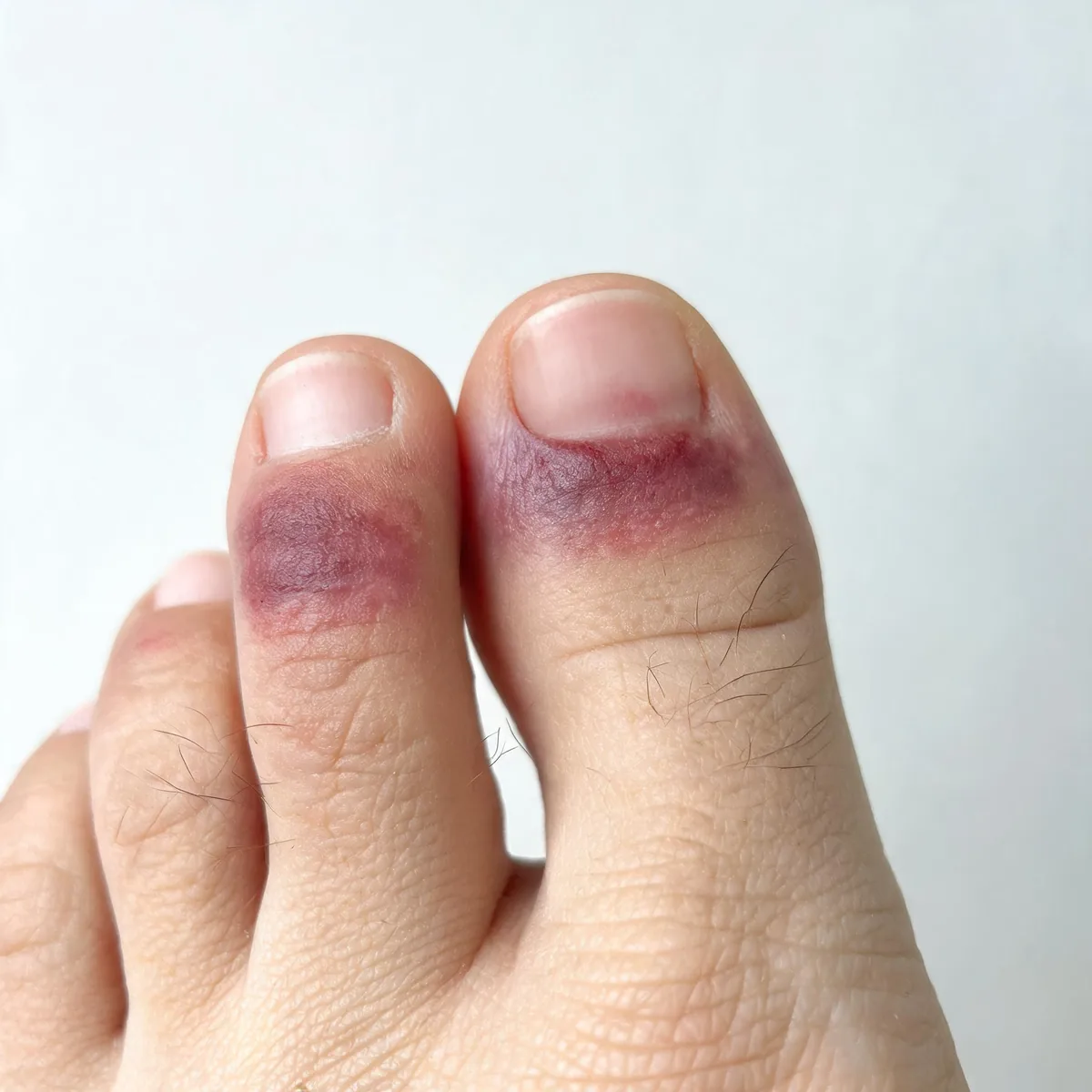
Understanding Chilblains
Note a source collision recorded rather than resolved: this page and the Frostbite page both carry the Chinese name 冻疮 (dòng chuāng). This page describes the superficial, recurring form.
The tradition describes chilblains as cold causing blood to congeal in the tiny vessels of the hands and feet, with the underlying issue a deficiency of Yang that fails to warm the limbs and repel cold.
Blood stagnation gives fixed stabbing pain with purple or dusky swelling, cold and numb extremities, worse with cold and better with warmth, without ulceration. Qi deficiency causing Blood stagnation gives aching cold pain with lesions that heal slowly, marked fatigue and breathlessness.
Yang deficiency with cold-damp gives icy hands and feet that are hard to warm, deep heavy aching in bones and joints, a cold sore lower back, a pale puffy face and mental fog. Blood stagnation with heat describes the lesion that has become red, hot and ulcerated with pus and fever, which needs medical attention.
The mechanism is easier to picture as a heating problem. A healthy body keeps the hands and feet at an even temperature by pushing warm Blood out to the surface, and the Spleen supplies the Qi and Blood that make this possible while the Kidney holds the Yang that keeps the whole system alight. When either is short, the periphery is the first place to lose its supply, so a cold morning that barely registers for one person leaves another with stiff, pale, aching toes. The same external cold then meets an interior that cannot answer it.
That is why two people can walk the same distance in the same weather and only one comes home with lesions. The person whose internal weather is already cold begins the exposure with vessels half closed and Qi too weak to push Blood through them, while the person with Yang intact simply warms up again. Reading chilblains this way turns a seasonal nuisance into a signal about the body's reserves, which is why a practitioner asks about energy, digestion, sleep and cold tolerance rather than about the toes alone.
There is also a turning point to watch for. Blood that has pooled for long enough stops being simply cold and still, and begins to generate Heat, in the way a jammed log pile can begin to smoulder. The lesion that was purple and numb becomes red, hot and swollen and may eventually discharge pus, and with it come thirst, feverishness and irritability. That change matters because the treatment reverses: warming herbs suited to the earlier stages would add fuel to an infected lesion, so the formula shifts towards clearing Heat and resolving toxicity while still moving Blood.
Conventional view
Chilblains, or pernio, are itchy painful red or purple swellings on fingers, toes, ears or nose after exposure to cold but not freezing temperatures. They result from abnormal blood-vessel constriction and inflammation when skin is rewarmed too quickly, heal on their own within a few weeks in most cases, and recur each winter in some people. Diagnosis rests on appearance and history of cold exposure.
Standard care is gentle rewarming, protective clothing and corticosteroid creams to calm inflammation, with nifedipine, a calcium-channel blocker that improves circulation, prescribed for severe or persistent cases. These manage symptoms rather than prevent future outbreaks, and side effects can limit long-term use.
Creams and vasodilators help an acute flare but do not address the susceptibility that leads some people to develop chilblains winter after winter, lesions often return as soon as cold weather arrives, and medication may lose effect over time. TCM asks why the body cannot keep the extremities warm and the Blood moving in the first place.
Selected PubMed records
Real PubMed records for the conventional discussion above, selected by condition name and title relevance. They are references, not a claim that any treatment is proven for this condition.
- Chilblains.. VASA. Zeitschrift fur Gefasskrankheiten, 2020. PMID: 31808732.
How it is assessed
The practitioner looks at the colour of the lesions and the person constitutional warmth.
What a practitioner looks for
- Lesion colour: purple dusky swelling suggests stagnation; icy pale skin suggests Yang deficiency.
- Healing: slow-healing lesions with fatigue suggest Qi deficiency.
- Constitutional signs: cold sore lower back, puffy face and foggy head suggest Yang deficiency with cold-damp.
- Infection: red hot ulcerated lesions with pus and fever need medical assessment.
A practitioner reads a chilblain in a set order. First comes the colour and temperature of the skin: bluish or purplish patches that feel cold and hurt sharply on pressure, with a tongue that is pale or carries purple spots and a pulse that is deep and wiry, describe Blood Stagnation. Second comes the person's stamina and healing speed: when numbness and swelling arrive with breathlessness on mild exertion, a pale face and lesions that take weeks to close, the pulse is weak and thready and the tongue pale and slightly dusky, and the reading is Qi Deficiency causing Blood Stagnation.
If the chill runs past the extremities, so that the whole body feels icy, the chills sit deep, the lower back aches and the mind is foggy, the practitioner expects a pale, puffy tongue and a pulse that feels deep, slow and faint, and treats the picture as Yang Deficiency with Cold-Damp. The distinction matters because the same purple lesion is being driven by a much deeper lack of fire, and the answer is moxibustion and a hot formula rather than a mild warming one.
The last question is whether the lesion has turned. Redness, heat, swelling, throbbing pain and any discharge of pus, together with thirst and a restless, feverish feeling, a red or purple-red tongue with a dry yellow coat and a rapid choppy pulse, mark the shift to Blood Stagnation with Heat. Infection is checked for directly at this stage, since it needs medical assessment as well as herbs, and the practitioner will ask whether the lesion has been scratched, rubbed or exposed to strong heat.
TCM patterns in Chilblains
Chilblains look much alike on the surface, so differentiation turns on what the skin does and on what the rest of the body is doing. Colour comes first: a dusky purple patch that feels cold and hurts sharply when pressed points to Blood Stagnation, where cold has congealed Blood in the vessels of the extremities. Healing speed comes second: when lesions reopen, close slowly and leave the person tired and short of breath on the stairs, Qi is too weak to push Blood along, which is Qi Deficiency causing Blood Stagnation. Temperature comes third: when hands and feet stay icy long after coming indoors, the lower back aches with cold and the face looks puffy, the lack has reached the Kidney's warming fire and the pattern is Yang Deficiency with Cold-Damp. Finally, a lesion that turns red, hot, swollen and discharging has had Heat added to the stasis.
| Pattern | Key signs | The itch | Tongue | Main formula |
|---|---|---|---|---|
| Blood Stagnation | Fixed stabbing pain in the affected area; Purple or dusky skin patches with swelling | Not specified | Body: Purple, dusky or with dark stasis spots; sublingual veins dark and distendedCoat: Often thin white; a yellow coat would suggest Heat as the cause | Not specified |
| Qi Deficiency causing Blood Stagnation | Aching cold pain in the lesions; Purple or dusky red lesions that heal slowly | Not specified | Body: Pale-dark or pale-purple, teeth-marked, possibly with stasis spots and dark sublingual veinsCoat: Thin white | Not specified |
| Yang Deficiency with Cold-Damp | Not specified | Not specified | Body: Pale, swollen and teeth-markedCoat: White, greasy and moist | Not specified |
| Blood Stagnation with Heat | Red hot swollen lesion, may ulcerate and discharge pus; Throbbing or stabbing pain | Not specified | Body: Reddish-purple, with stasis spots and dark sublingual veinsCoat: Thin, dry and yellow | Not specified |
Blood Stagnation
Purple dusky swelling with fixed stabbing pain, worse in cold.
Cold tightens the vessels of the fingers and toes, and in the extremities, where circulation is already weakest, the Blood inside them slows and then congeals. That patch of skin is left without fresh Blood to nourish it and without a way to carry waste away, so it swells, turns dusky purple and goes numb, while the pressure of trapped Blood produces the fixed stabbing pain that names the pattern. Nothing has ulcerated at this stage; the lesion is closed, cold and tender.
The tongue body looks pale or dusky purple, sometimes with stasis spots, under a thin white coat, and the pulse is deep, thin and choppy or wiry. Cold weather and cold water, damp conditions, tight clothing and shoes, cold drinks and long periods without movement all make it worse, while warmth, gentle exercise, warm cooked food, a warm room and ginger or cinnamon tea ease it. Treatment warms the channels and moves Blood with Dang Gui Si Ni Tang, built on Dang Gui, Gui Zhi, Chuan Xiong and Hong Hua, and the points are SP-10 Xuehai, LI-4 Hegu, ST-36 Zusanli and DU-4 Mingmen, with moxa where the cold is pronounced.
Signs
- Fixed stabbing pain in the affected area
- Purple or dusky skin patches with swelling
- Coldness and numbness in extremities
- Worse with cold, better with warmth
Diet and lifestyle for this pattern: Keep hands and feet warm with gloves and thick socks, and soak affected areas in warm rather than hot water with a few slices of ginger. Warming, blood-nourishing food such as lamb stew with dang gui and ginger helps, cold drinks and raw food do not, and gentle daily walking keeps blood moving.
Qi Deficiency causing Blood Stagnation
Slow-healing cold painful lesions with marked fatigue.
Qi is what propels Blood, so when Qi runs low the current slows everywhere and most of all at the ends of the limbs. Cold weather then congeals that sluggish Blood and the lesions appear, purple or dusky red and slow to mend. Because Qi also drives repair, the sores stay open longer, crust over and return with each cold snap, and the person notices tiredness, breathlessness on mild exertion and a pale or dusky complexion rather than the robust reaction of the stasis-only picture.
The tongue body is pale-dark or pale-purple, sometimes with purple spots and teeth marks, under a thin white coat, and the pulse is deep, fine or weak, and choppy. Cold and damp weather, overwork, long hours standing or sitting, cold food and drink and excessive worry all make it worse, while warmth, gentle exercise, warm cooked food, rest and moxibustion ease it. Bu Yang Huan Wu Tang supplies the answer, with Huang Qi driving the circulation and Dang Gui, Chuan Xiong and Gui Zhi moving Blood, and the points are ST-36 Zusanli with moxa, SP-6 Sanyinjiao, SP-10 Xuehai and LI-4 Hegu.
Signs
- Aching cold pain in the lesions
- Purple or dusky red lesions that heal slowly
- Cold numb fingers or toes
- Marked fatigue and weakness
Diet and lifestyle for this pattern: Eat warm, cooked food that builds Qi and Blood, such as slow-cooked stews with beef or chicken, root vegetables, ginger, cinnamon and small amounts of dates or goji berries. Avoid raw, cold and iced food, keep movement gentle and regular, and keep hands and feet warm with gloves, socks and a warm ginger soak.
Yang Deficiency with Cold-Damp
Icy limbs with deep aching and a cold sore lower back.
When the inner fire runs very low, the limbs stop being warmed and cold and dampness from outside are no longer held off. Cold drives in and thickens the Blood in the fine vessels of the toes and fingers, while Dampness adds weight and swelling, so the lesions are intensely cold, dusky purple and very slow to heal. The chill is not confined to the extremities: the whole body feels cold, the bones and joints ache deeply and, in severe cases, the mind becomes foggy.
The tongue body is pale and swollen with teeth marks under a white, greasy, moist coat, and the pulse is deep, slow and fine or soft. Cold damp weather, cold food and drink, overwork and long periods standing in cold water make it worse, while warmth, warm cooked food, rest, moxibustion and gentle exercise ease it. Si Ni Jia Ren Shen Tang restores the fire with Zhi Fu Zi, Gan Jiang and Ren Shen, and the points are DU-14 Dazhui, DU-4 Mingmen and ST-36 Zusanli, all with moxibustion to drive heat into the channels.
Signs
- Icy cold hands and feet hard to warm
- Deep heavy aching in bones and joints
- Cold sore lower back
- Pale puffy face with swollen tongue
- Mental fog
Diet and lifestyle for this pattern: Eat warming cooked food such as stews with ginger, cinnamon and lamb, and avoid cold raw salad, iced drinks and dairy. Keep the lower back and feet warm, a little daily moxa on the low back can help, and gentle walking circulates Yang without exhausting it.
Blood Stagnation with Heat
The infected variant: red hot ulcerated lesion with fever.
Blood that has been congealed long enough can begin to generate Heat, the way a jammed log pile starts to smoulder. That Heat inflames the chilblain, which becomes red, hot and swollen rather than dusky and cold. As it intensifies the tissue breaks down and produces pus, while the Heat travels upward through the body and brings feverishness, thirst and a restless, irritable mood. This is the stage at which a local problem becomes a general one, and the one that needs medical assessment.
The tongue body is reddish-purple with dark stasis spots and distended veins beneath it, under a thin dry yellow coat, and the pulse is choppy and rapid, often wiry. Spicy and fried food, alcohol, coffee, prolonged heat from hot baths or a heating pad, scratching the lesion and stress all aggravate it, while cool compresses, rest with the part raised, cooling foods such as cucumber and watermelon, and keeping the lesion clean and dry ease it. Si Miao Yong An Tang clears the Heat with Jin Yin Hua, Xuan Shen, Dang Gui and Dan Shen, and the points are SP-10 Xuehai, SP-6 Sanyinjiao, LI-4 Hegu, LI-11 Quchi and LR-3 Taichong.
Signs
- Red hot swollen lesion, may ulcerate and discharge pus
- Throbbing or stabbing pain
- Fever with thirst and irritability
- Dark or purplish-red tongue
Diet and lifestyle for this pattern: Keep the area clean and dry, avoid scratching or rubbing it, and use cool rather than ice-cold compresses if they soothe. Eat plenty of cooling, non-greasy food such as cucumber, watermelon, mung beans and leafy greens, avoid spicy fried or rich meals, and leave out alcohol and coffee while the lesion is inflamed.
Treatment approach
How the tradition treats chilblains, with the herbs, formulas and points used for it.
Principles
- Warm the Yang and move Blood, which is the core of treatment for chilblains.
- Dispel cold-damp where the limbs feel heavy and the face looks puffy.
- Clear heat where a lesion has become hot, ulcerated and infected.
- Keep the extremities warm and dry, and avoid smoking.
- Behind every protocol sits one strategy: open the vessels and drive out cold, then decide whether the problem is excess stasis or an underlying deficiency. The branch is the lesion, which wants warmth, movement and protection, while the root is the constitutional lack of Qi, Yang or Blood, and only the root determines whether a warming formula such as Dang Gui Si Ni Tang, a Qi-building formula such as Bu Yang Huan Wu Tang, or a cooling and detoxifying formula such as Si Miao Yong An Tang is chosen.
Herbs used
Formulas
Acupoints
- SP-10 (Xuehai)
- LI-4 (Hegu)
- ST-36 (Zusanli)
- DU-4 (Mingmen)
- SP-6 (Sanyinjiao)
- DU-14 (Dazhui)
- LI-11 (Quchi)
- LR-3 (Taichong)
What to expect
- Lesions are described as settling within two to four weeks with warmth and treatment.
- Recurrence each winter is expected unless the Yang deficiency is addressed.
- Ulcerated or infected lesions need medical review.
- Expect the first winter to be the treatment period and the second to be the test. Acute lesions usually settle in a fortnight of daily herbs and moxibustion, but recurrent cases need three to six months to rebuild Qi and Yang, and progress is measured by fewer fresh lesions, quicker closure and milder symptoms rather than by the fading of old scars. Once the pattern has been corrected, many people need only a short course each autumn as the cold returns.
Safety and when to get help
Seek medical help urgently for
- Blackened or blistered skin, which may indicate tissue death.
- Spreading redness, heat, red streaks or pus.
- Fever or chills with an ulcerated lesion.
For anything severe, sudden or spreading quickly, read when a skin problem needs urgent care.
Cautions
- Do not rub or apply strong heat directly to cold numb skin.
- People with diabetes or circulation disease need prompt review.
- Avoid smoking, which worsens vasoconstriction.
Using this alongside conventional care
- TCM is described as complementary to conventional care: prescribed vascular treatment continues, and infected lesions need medical care.
- Nifedipine and corticosteroid creams can be continued alongside herbs, but because some formulas also improve circulation, ask your prescriber to watch for flushing, headache or dizziness when the two are combined. Blood-moving herbs such as Dang Gui and Chuan Xiong may add to the effect of warfarin or aspirin, so both practitioners need the full medication list, and prescribed drugs should never be stopped abruptly. Keep the lesion clean and unbroken, tell your TCM practitioner if the skin has cracked, and keep moxibustion away from any area that is warm, red or weeping.
Diet and lifestyle
- Favour warm cooked food, soups, stews and warming spices, and avoid cold drinks and raw food.
- The general principle is to keep the interior warm and the fluids moving: soups, stews and ginger congee, lamb, chicken, walnuts, and slow-cooked greens, with warming spices such as cinnamon, clove and black pepper, while raw salads, iced drinks, ice cream and heavy dairy are reduced because they add cold and Dampness. Beyond that, the pattern decides the details: ginger and cinnamon tea with lamb and Dang Gui suits Blood Stagnation; slow-cooked beef or chicken with root vegetables suits Qi Deficiency; lamb, ginger and cinnamon with the lower back kept warm suits Yang Deficiency; and once a lesion is hot and red, cooling foods such as cucumber, watermelon and mung beans replace the warming spices until the Heat settles.
If you're pregnant
Pregnancy tends to shift chilblains towards Qi and Blood deficiency as the fetus draws on the mother's resources, and simple Blood stagnation or Yang deficiency patterns may deepen into a combined deficiency-stagnation picture, so lesions heal more slowly.
Blood-moving herbs such as Chuan Xiong, Hong Hua and Tao Ren are typically avoided because they may trigger contractions, while gentle warming external therapies such as moxibustion or topical ginger soaks are safer, and acupuncture can be used with careful point selection, avoiding points known to stimulate the uterus.
If you're breastfeeding
During breastfeeding the concern is that herbs passing into milk may affect the infant. Most warming herbs such as Dang Gui and Gui Zhi are considered safe, but potent blood movers such as Hong Hua are best avoided unless prescribed by an experienced practitioner.
For Blood stagnation with Heat, herbs such as Jin Yin Hua and Xuan Shen are unlikely to harm the baby and can be used if needed. Topical creams, moxibustion and acupuncture are preferred during this period because they carry virtually no risk to the nursing infant.
If treating a child
Chilblains are quite common in children, especially in damp cold climates, and children's Yang Qi is still developing, which makes them more susceptible to Cold invasion and Blood stagnation. The usual pattern is simple Blood stagnation without the deeper Yang deficiency seen in adults, with lesions on toes, fingers and ears.
Doses are reduced to about half to two-thirds of the adult dose by age and weight, and moxibustion and warm soaks are very effective and well tolerated. Parents should be warned never to rub or massage a chilblain vigorously, since that can damage fragile skin; gentle warming is key.
If treating an elderly patient
In older people chilblains are almost always rooted in Yang deficiency with Cold-Damp or Qi deficiency causing Blood stagnation, as the body's warming and circulating functions weaken with age and the extremities become vulnerable to even mild cold. Lesions heal more slowly and may be complicated by fragile skin and poor wound healing.
Doses start at about two-thirds of the standard adult dose and are adjusted carefully, and because many older patients take blood thinners, strongly blood-invigorating herbs such as Dan Shen need caution. Moxibustion on Mingmen (DU-4) and Zusanli (ST-36) warms Yang and promotes circulation gently without systemic side effects.
Urgent-sign guidance is based on standard sources: NHS anaphylaxis, NHS cellulitis, NHS Stevens-Johnson syndrome, NHS melanoma.
Evidence
Evidence status
Compiled for this page from the classical and modern literature; not a systematic review, so treat it as a pointer to sources rather than clinical guidance.
Evidence is limited: small Chinese studies and case series. A few randomised trials of oral formulas such as Dang Gui Si Ni Tang and of topical preparations report faster healing and symptom relief, but blinding and placebo controls are usually absent. Moxibustion and acupuncture have been studied for cold-induced vascular conditions, with some evidence for improved microcirculation and reduced pain.
What is published is small in scale and largely in Chinese. A few randomised trials have looked at oral formulas such as Dang Gui Si Ni Tang and at topical herbal preparations, reporting shorter healing times and better symptom relief, while case series describe moxibustion and acupuncture improving microcirculation and reducing pain in cold-induced vascular problems. Methodological quality is modest, with little blinding and few placebo controls, so these findings support a long traditional use without proving it. The honest position is that larger and better-designed trials are needed before chilblains can be called an evidence-supported indication.
Studies often cited
Randomised trials and case series report faster healing and symptom relief, with modest methodological quality. Chinese randomised trials and case series (as recorded in the source)
Some evidence suggests improved microcirculation and reduced pain. Clinical studies (as recorded in the source)
PubMed records for the TCM evidence
Real PubMed records for the TCM clinical evidence discussed above, selected by condition name and title relevance. They are references, not proof of benefit.
- Chilblains.. VASA. Zeitschrift fur Gefasskrankheiten, 2020. PMID: 31808732.
Classical record
Chilblains occur because cold congeals the blood and causes stagnation; Qi and Blood do not flow, hence purple swelling arises.
- Wai Ke Zheng Zong (Orthodox Manual of External Medicine), chapter on cold injury. The Chinese original is not reproduced here: it could not be recovered reliably from the source record, and is not guessed.
冻烂肿疮,由冬月冒寒,经络气血凝涩,皮肉受病,故令冻烂肿痛。
Sores that swell and ulcerate from cold come from braving the cold in the winter months: the Qi and Blood of the channels and collaterals congeal and move sluggishly, the skin and flesh are injured, and so the lesions swell and hurt.
Zhubing Yuanhou Lun on chilblains - Zhubing Yuanhou Lun (Treatise on the Origins and Symptoms of Diseases), chapter on frostbite, translated from the Chinese original as recorded in the classical literature.
Common questions
Why do I get chilblains every winter?
The classical literature reads recurrence as deficient Yang failing to warm the extremities, so the constitutional pattern needs treatment, not just the lesions.
Are chilblains and frostbite the same?
Both are called 冻疮 in this source, but they are different severities. This page covers the superficial recurring form; frostbite covers deeper injury.
Can I warm my feet on a radiator?
Direct strong heat on numb skin risks burns. Warm gradually and check the skin carefully.
When should I see a doctor?
If the skin blackens or blisters, or the lesion becomes hot, spreading and infected.
Can acupuncture really help chilblains?
Yes, and it is one of the main tools for this problem. Needling and moxibustion at points such as SP-10 Xuehai and ST-36 Zusanli improve local circulation, disperse cold and settle the itching and swelling, and many people notice the lesions calming within a few sessions. The effect is best when it is combined with herbs and with keeping the extremities warm between treatments.
Is moxibustion safe to use on chilblains?
Moxibustion is traditionally used on unbroken skin, where gentle heat warms the channels and moves stagnant Blood, although trial evidence is limited. It must never be applied over an open sore, a weeping lesion or an infected area, because heat on damaged tissue will aggravate it. Learn the technique from a practitioner first, keep the moxa at a comfortable distance, and check the skin of anyone with reduced sensation before and after each session.
How long does it take to see results?
A new chilblain often eases within days of starting treatment, with the colour and swelling improving inside the first two weeks. Recurrent cases are judged over months rather than days: four to eight weeks usually brings fewer new lesions, and a full winter of preventive treatment is what breaks the yearly cycle. Once the pattern has been corrected, many people need only a short course each autumn.
Will my chilblains come back after TCM treatment?
The aim is to rebuild the Qi and Yang that keep the extremities warm, so that cold weather no longer produces lesions. When that has been achieved most people stop getting chilblains each winter, though a severe cold snap, a period of overwork or a long illness can bring a brief return. A short tune-up course in early autumn, before the first frost, is the usual way to protect the result.