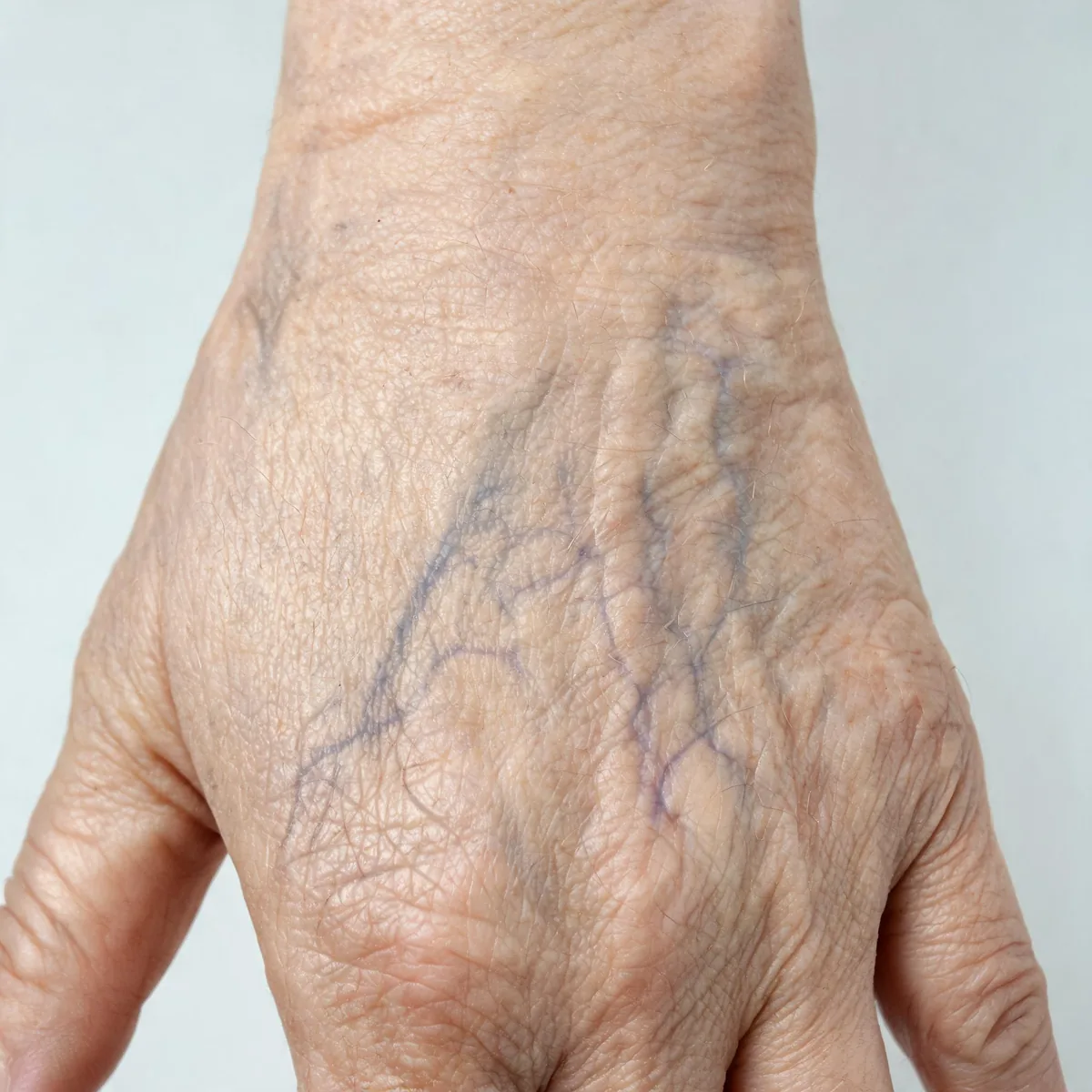
Understanding Wrinkled and shrunken skin
The tradition describes the skin as a mirror of inner vitality: the Lungs spread fluids to the skin, the Spleen transforms food into Qi and Blood that nourish it, and the Kidneys store the Essence that governs ageing.
Spleen and Kidney Qi deficiency gives sagging loose skin with deep wrinkles, a pale sallow complexion, chronic fatigue, poor appetite, loose stools and lower back weakness.
Empty-Heat from Yin deficiency gives dry cracked wrinkled skin worse in the evening, with afternoon heat, night sweats and a dry mouth with thirst for small sips. Blood stagnation gives tight-looking dark or purplish skin with hard fixed nodules under the skin, deep wrinkles, rough dry scaly texture and dark circles under the eyes.
Phlegm in the channels gives rough tightened skin with purplish discolouration, subcutaneous nodules, heaviness, puffy eyelids and chest tightness. Collapse of Yin is the emergency: profuse hot sticky sweat beading like oil, a burning hot body with warm hands and feet, extreme thirst, sunken eye sockets and deterioration.
Four organ systems are each given a share of the skin's condition. The Lungs spread fluids outward and govern the pores, so thin Lung Qi leaves the surface dry. The Spleen turns food into Qi and Blood, which is what fills and lifts the tissue. The Kidneys store Essence, which sets the pace of ageing. The Liver stores Blood and keeps Qi and fluids moving, so constraint there also shows on the face. When these are well resourced the skin stays full and supple; when any of them falters, the surface is the first place the shortage becomes visible.
The shortage may be one of substance or one of movement, and the two look different. Emptiness gives loose, sagging skin, soft deep creases, pallor and fatigue. Dryness with heat gives cracked, tight skin that worsens through the day. Obstruction gives skin that is tight, dark or purplish, sometimes with hard nodules, because the nourishment is present but cannot arrive. Ordinary ageing usually supplies the first of these, long strain and poor sleep sharpen it, and a sudden shrivelling with sunken eyes is not a pattern at all but an emergency.
Conventional view
Conventionally, wrinkled and shrunken skin is understood as the visible result of structural loss. The proteins that give skin its strength and rebound, collagen and elastin, decline with age, and the process is accelerated by ultraviolet exposure, smoking and pollution. Falling hormone levels after menopause thin the skin further. The surface loses volume, fine lines appear and then deeper creases, and the face can look drawn rather than merely lined. Diagnosis is by inspection. There is no laboratory test for ordinary ageing, and investigation is reserved for cases where a condition such as scleroderma is suspected.
Conventional treatment aims to slow further damage and to restore what has been lost. Topical retinoids and antioxidants are used to stimulate collagen and limit damage, moisturisers plump the surface temporarily, and sun protection is regarded as the single most useful preventive measure. Deeper lines are treated with procedures: injectable fillers, botulinum toxin and laser resurfacing, each working on a different layer or mechanism. These approaches are effective for many people, and they are well suited to the surface problem they address.
What they do not do is look inward. Topical and procedural treatment repairs visible damage or temporarily restores volume, without asking why this person's skin is ageing faster than expected. Internal factors such as poor circulation, chronic inflammation and nutritional deficiency lie outside their scope, and the procedures require repetition and carry cost. Topical creams may not reach the depth where the change begins. For someone whose skin changes track fatigue, hormonal shifts or digestive trouble, the conventional toolkit explains the appearance but not the cause, which is the gap a whole body approach tries to fill.
Selected PubMed records
Real PubMed records for the conventional discussion above, selected by condition name and title relevance. They are references, not a claim that any treatment is proven for this condition.
- Targeting Melasma: Innovations in Pigment Deposition and Photoaging in Cosmetic Dermatology.. Journal of cosmetic dermatology, 2026. PMID: 41508749.
- Sunscreens and Photoaging: A Review of Current Literature.. American journal of clinical dermatology, 2021. PMID: 34387824.
How it connects
The patterns overlap because they describe the same body from different angles. Long-standing Yin deficiency slows the flow of Blood until stasis appears on top of it, and a Spleen too weak to transform fluids lets Phlegm gather in the channels, so deficiency and obstruction often coexist. That is why the most prominent feature sets the order of treatment rather than excluding the others: dryness with heat that builds towards evening points towards Yin deficiency, tightness that worsens with cold and stillness leans towards stagnation, and deep soft creases with global fatigue lean towards Qi deficiency. A mixed picture is a reason to examine the tongue and pulse carefully, not a reason to treat everything at once.
How it is assessed
The practitioner establishes whether the change is gradual or sudden.
What a practitioner looks for
- Onset: sudden shrivelling with sunken eyes requires emergency care.
- Deficiency pattern: sagging skin with chronic fatigue suggests Spleen and Kidney Qi deficiency.
- Heat pattern: evening dryness with night sweats suggests Empty-Heat from Yin deficiency.
- Texture: purplish tight skin with nodules suggests stagnation or phlegm.
The practitioner asks about texture and sensation before appearance: whether the skin feels tight, dry, hot or numb, and when in the day it is worst. Texture carries a great deal. Skin that is loose with soft deep creases, in someone tired and pale, suggests Spleen and Kidney Qi deficiency, with a pale tongue, a thin white coat and a weak thready pulse. Dry cracked skin with heat that builds through the afternoon and evening suggests Empty-Heat from Yin deficiency, with a red tongue carrying little or no coating and a thin rapid pulse.
Skin that is tight and dark, possibly hard or lumpy to the touch, suggests Blood Stagnation, with a dusky tongue, purple spots and a choppy or wiry pulse. Skin that feels rough and thickened, as though trapped under a layer of dampness, points to Phlegm obstructing the channels, with a thick greasy coat and a slippery or deep pulse. Mixed pictures are common, and the first thing established is whether the change came on over years or over days, because the second requires urgent medical assessment.
TCM patterns in Wrinkled and shrunken skin
Five patterns are recorded, and they divide into two families. In three, the skin is starved of substance: Qi and Blood run low, Yin and its fluids run dry, or the Yin itself gives way and the skin shrivels within hours. In the other two the substance is adequate but cannot reach the surface, because stagnant Blood or accumulated Phlegm blocks the channels. The distinction matters more than the label, since the first family is treated by building and the second by unblocking. Four questions separate them: is the skin loose or tight, dry or thickened, pale or dusky, and did the change come slowly or suddenly? Loose sagging skin with fatigue puts deficiency first. Dryness with evening heat puts Yin deficiency first. Tightness that darkens with cold and stillness puts stagnation first. A rough nodular surface puts Phlegm first, and collapse with sunken eyes is not a pattern to match.
| Pattern | Key signs | The itch | Tongue | Main formula |
|---|---|---|---|---|
| Spleen and Kidney Qi Deficiency | Sagging loose skin with deep wrinkles | Not specified | Body: Pale and swollen with teeth marksCoat: White and moist or slippery | Not specified |
| Empty-Heat caused by Yin Deficiency | Skin dry cracked and wrinkled, worse in the evening; Dry mouth and throat with thirst for small sips | Not specified | Body: Red, thin and dry, often crackedCoat: Little or none; the tongue may look peeled | Not specified |
| Blood Stagnation | Skin feels tight and appears dark or purplish; Hard fixed nodules under the skin | Not specified | Body: Purple, dusky or with dark stasis spots; sublingual veins dark and distendedCoat: Often thin white; a yellow coat would suggest Heat as the cause | Not specified |
| Phlegm in the Channels (Joints and Muscles) | Rough tightened skin | Not specified | Body: Purple, with stasis spots and distended sublingual veinsCoat: White and greasy | Not specified |
| Collapse of Yin | Burning hot body with warm hands and feet | Not specified | Body: Deep red or crimson, completely dry, cracked and shrunkenCoat: None: a mirror tongue | Not specified |
Spleen and Kidney Qi Deficiency
Sagging wrinkled skin with chronic fatigue and poor appetite.
The Spleen makes Qi and Blood from food, and the Kidneys hold the Essence that underwrites all of it. When both are depleted, production falls short, and the skin, which is the outermost receiver of that production, loses its filling and its lift. Without Qi to hold tissue up, the face sags and deep soft creases form; without Blood to fill and moisten, the surface looks dull and dry. The whole picture is of a system running on reserve: fatigue, poor appetite, loose stools, sore lower back and knees, and cold hands and feet.
The tongue is pale and swollen with tooth marks and a white moist or slippery coat, and the pulse is deep, weak and fine, weakest at the right Guan and both Chi positions. Emotional strain, skipped meals, cold raw food and cold damp weather make it worse, while rest, sleep, warm cooked meals and gentle exercise help. Shi Quan Da Bu Tang is the formula named, tonifying Qi and Blood together, with Dang Gui, Huang Qi and Gou Qi Zi among its herbs. Zusanli (ST-36), Shenshu (BL-23) and Sanyinjiao (SP-6) are the points.
Signs
- Sagging loose skin with deep wrinkles
- Pale sallow complexion
- Chronic fatigue and low stamina
- Poor appetite with loose stools
- Lower back soreness and weakness
Diet and lifestyle for this pattern: Eat warm, cooked, easy food such as congee with goji berries, red dates and a little ginger, and avoid raw, cold and greasy food that further weakens the Spleen. Prioritise adequate sleep and gentle daily movement such as walking or qigong to support Qi circulation without depleting reserves.
Empty-Heat caused by Yin Deficiency
Dry cracked wrinkled skin with evening heat and sweats.
Yin is the cooling and moistening half of the body's balance, and when it runs low the warming half is left unopposed. The result is not a full heat but an empty one, a low smoulder that quietly evaporates fluids the way a pot left on a low flame reduces its contents. The skin, which depends on those fluids to stay supple, dries and cracks and creases, and the drying is worst as the day advances and the heat builds towards evening. Night sweats, a dry mouth with thirst for small sips, and warmth in the palms, soles and chest belongs to the same process.
The tongue is red, thin and dry with cracks and little or no coat, and the pulse is fine and rapid. Spicy fried food, overwork, hot weather, heavy sweating, stress, and alcohol or coffee make it worse, while a cool room, rest, small sips of warm water, and pears, cucumber or tofu help. Zhi Bai Di Huang Wan is the formula named, and Yang Yin Qing Fei Tang is used where the Lungs and dryness of the upper body dominate. Taixi (KI-3), Sanyinjiao (SP-6), Shenshu (BL-23) and Ganshu (BL-18) are the points.
Signs
- Skin dry cracked and wrinkled, worse in the evening
- Afternoon or evening feeling of heat
- Night sweats
- Dry mouth and throat with thirst for small sips
Diet and lifestyle for this pattern: Prioritise moistening, cooling food such as pear, honey, cucumber, tofu and black sesame, and avoid spicy, fried or greasy food that generates Heat. Sip warm water through the day, avoid late nights that deplete Yin further, and keep exercise gentle such as tai chi or walking to circulate fluids without overheating.
Blood Stagnation
Tight dark skin with hard nodules and dark circles.
It is worth noticing that this pattern dries the skin without any shortage of fluid. The small vessels that feed the surface are blocked, so what the body has made cannot be delivered, and the skin becomes tight, rough and deeply lined while the cause is a failure of delivery rather than of supply. Left long enough, that standing blood can harden into lumps you can feel beneath the skin, and the surface takes on a dark or dusky cast. Dark circles under the eyes and dark clotty periods belong to the same picture.
The tongue is dusky or purple with stasis spots, engorged dark veins beneath, with a thin white coating, while the pulse is choppy and uneven or wiry. Cold and damp, long periods of stillness, stress, cold raw food and old injury make it worse, while warmth, gentle exercise, warm meals, light facial massage and stress management help. Xue Fu Zhu Yu Tang is the primary formula, with Gui Zhi Fu Ling Wan used where palpable lumps have formed. Xuehai (SP-10), Geshu (BL-17) and Taichong (LR-3) are the points.
Signs
- Skin feels tight and appears dark or purplish
- Hard fixed nodules under the skin
- Deep wrinkles with rough dry scaly texture
- Dark circles under the eyes
Diet and lifestyle for this pattern: Eat blood-moving food such as dark leafy greens, turmeric and small amounts of red wine or vinegar, and avoid cold raw food and iced drinks that can congeal blood. Gentle daily walking or yoga keeps blood circulating, and stress management is key, since bottled-up emotions are a major cause of Qi and blood stasis.
Phlegm in the Channels (Joints and Muscles)
Rough tight skin with nodules, puffiness and chest tightness.
Phlegm in this framework is not only the stuff that is coughed up; it is a thicker form of dampness that can lodge in channels and muscles and physically obstruct the passage of Qi, Blood and fluids. When that happens the skin is starved in a different way: it becomes rough and tightened, sometimes purplish, with nodules or lumps beneath it, and heaviness or numbness may sit in the arms and legs, and puffy lids with a tight chest and catarrh belong to the same blockage. The skin here is not dehydrated so much as cut off.
The tongue is purple with stasis spots, a white greasy coat and distended veins beneath, and the pulse is wiry and choppy, or slippery where Phlegm dominates. Cold damp conditions, inactivity, greasy sweet or cold food and stress make it worse, while a warm dry environment, gentle exercise, warm cooked meals and a cleaner diet help. Er Chen Tang dries dampness and transforms Phlegm, with Tao Hong Si Wu Tang added where Blood stasis is established, and Ban Xia, Chen Pi, Fu Ling, Tao Ren and Hong Hua among the herbs. Fenglong (ST-40), Sanyinjiao (SP-6), Xuehai (SP-10) and Zusanli (ST-36) are the points.
Signs
- Rough tightened skin
- Purplish discolouration with subcutaneous nodules
- Heavy or numb sensation in the limbs
- Puffy eyelids with chest tightness
Diet and lifestyle for this pattern: Avoid Dampness-producing food such as dairy, sugar, greasy and fried food and excessive cold or raw items. Favour warm, cooked meals with moderate amounts of spices such as ginger and turmeric, and keep moving gently such as walking or tai chi so Qi and Blood move through the channels and stagnation does not set in.
Collapse of Yin
The emergency picture: oily sweat, sunken eyes and deterioration.
This is the one pattern on the page that is not managed at home. In this pattern the body's cooling and moistening reserves give way suddenly, and with them the fluid that keeps tissue plump. The skin does not merely wrinkle; it shrivels and turns papery within a short time, the eye sockets sink, and the person is emaciated, burning hot, intensely thirsty and agitated. In this framework it is a critical loss of fluids rather than an ageing process, and it arises from severe vomiting, diarrhoea, high fever or prolonged sweating. Emergency care comes first.
The tongue is deep red or crimson, completely dry with no coat, sometimes cracked and shrunken, and the pulse is fine, rapid and without force on deep pressure. Any stress, heat, exertion or delay makes it worse, and absolute bed rest, small frequent sips of cool water and a cool quiet room are what protect the little Yin that remains. Once the person is stabilised, Zeng Ye Tang is the formula named, generating fluids and rescuing Yin, with Raw Rehmannia, Mai Dong and Xuan Shen as its herbs. Taixi (KI-3), Sanyinjiao (SP-6) and Guanyuan (REN-4) are the points.
Signs
- Profuse hot sticky sweat beading like oil
- Burning hot body with warm hands and feet
- Extreme thirst for cold drinks
- Sunken eye sockets with confusion
Diet and lifestyle for this pattern: This is a medical emergency; seek immediate care. Once stabilised, sip small amounts of cool water or pear juice frequently, avoid all spicy, fried and drying food, and absolute bed rest in a cool quiet room is essential to preserve the last drops of Yin.
Treatment approach
How the tradition treats wrinkled and shrunken skin, with the herbs, formulas and points used for it.
Principles
- Treat sudden shrivelling with confusion as an emergency.
- Support Spleen and Kidney Qi where the change is gradual with fatigue.
- Nourish Yin where the skin is dry, cracked and worse in the evening.
- Move Blood or transform phlegm where the skin is tight, dark and nodular.
- The strategy is set by whether the problem is a shortage or a blockage. Where Qi, Blood or Yin is low, treatment builds, with tonics and moistening herbs chosen for the organ behind it, and the skin improves as a consequence rather than as the target. When Blood or Phlegm obstructs the channels, treatment opens them with moving or transforming herbs so that existing nourishment can reach the surface. Acupuncture and facial massage work locally on circulation, and internal and external methods are usually combined. Dosage and pace are moderated in older or depleted patients, since strong moving formulas can spend what little is left.
Herbs used
Formulas
- Shi Quan Da Bu Tang
- Zhi Bai Di Huang Wan
- Yang Yin Qing Fei Tang
- Xue Fu Zhu Yu Tang
- Gui Zhi Fu Ling Wan
- Er Chen Tang
- Tao Hong Si Wu Tang
- Zeng Ye Tang
Acupoints
- ST-36 (Zusanli)
- BL-23 (Shenshu)
- SP-6 (Sanyinjiao)
- KI-3 (Taixi)
- BL-18 (Ganshu)
- SP-10 (Xuehai)
- BL-17 (Geshu)
- LR-3 (Taichong)
- ST-40 (Fenglong)
- guanyuan-ren-4
What to expect
- Constitutional patterns improve slowly over months.
- Age-related and sun-related change can be slowed but not reversed.
- Sudden change needs urgent medical assessment.
- The first changes are usually felt before they are seen. Energy, digestion and sleep often improve in the opening weeks, and texture and hydration follow, with firmness and the depth of lines changing over months rather than weeks. Because the work is to rebuild a foundation, progress tends to be gradual but better sustained than a surface treatment, and it depends on sleep, food and smoking as much as on the formula. Age related change is slowed rather than reversed. A sudden change in the skin, especially with sunken eyes or confusion, is a medical matter and not a treatment timeline.
Safety and when to get help
Seek medical help urgently for
- Sudden severe skin shrivelling with sunken eyes and confusion - possible dehydration or shock.
- Skin tightness spreading rapidly, or generalised hardening.
- Marked weight loss with skin change.
For anything severe, sudden or spreading quickly, read when a skin problem needs urgent care.
Cautions
- Sudden change in skin and consciousness is an emergency.
- Weight loss with skin change needs medical review.
- Protect and moisturise fragile skin, and avoid sun damage.
Using this alongside conventional care
- TCM is described as complementary to conventional care: medical assessment and prescribed treatment continue alongside herbs.
- Most conventional skin care sits comfortably alongside treatment. Topical retinoids, moisturisers and sunscreens can continue, and herbs are added around them rather than instead of them. Where injectable fillers or botulinum toxin are planned, both the dermatologist and the practitioner should know the timing so that bruising and assessment are not confused. Blood moving herbs, among them Dang Gui and Chuan Xiong, can interact with anticoagulants, so a full medication list is shared with both. Skin changes that are sudden, one sided, or accompanied by weight loss or systemic illness need medical assessment before any herbal programme begins.
Diet and lifestyle
- Favour nourishing cooked food and adequate fluids; avoid excessive drying food and alcohol.
- The base is food that builds substance and holds moisture. Dark leafy greens, bone broths, walnuts and black sesame, with moderate high quality protein, supply Qi and Blood, while pears, cucumber and tofu moisten dryness, and goji berries and longan gently nourish Blood. Alcohol, smoking, fried food and excess sugar are limited because they generate heat and dampness, and the skin pays for both. Warm cooked meals are preferred to cold raw food, which asks more of the Spleen. When Yin deficiency dominates, moistening and cooling food is emphasised and late nights are avoided; where Phlegm or stagnation dominates, dairy, sugar and greasy food are reduced and warm aromatic spices such as ginger are used.
If you're pregnant
Pregnancy raises the demand for Blood and Yin sharply, which can deepen the deficiency patterns that leave skin dry and creased. The two patterns that most often flare at this moment are Blood deficiency and Yin deficiency. Many blood tonics, Dang Gui among them, are described as able to stimulate contractions, so they are used only under close professional guidance, and Shi Quan Da Bu Tang, which contains Dang Gui, may need modifying or avoiding altogether, especially in the first trimester.
Acupuncture is often preferred. Points that tradition avoids while a woman is pregnant, Sanyinjiao (SP-6) and Hegu (LI-4) among them, along with anything on the lower abdomen, are left out. A qualified practitioner chooses gentle alternatives instead, tonifying Qi and Blood through Zusanli (ST-36), using very light stimulation.
Gentle topical care, adequate sleep and nourishing warm meals support the skin through pregnancy, and sun protection matters because UV exposure accelerates collagen loss. Any formula that contains Dang Gui or other Blood-moving herbs should be reviewed by a practitioner before use, and acupuncture points on the lower abdomen and the strong points traditionally avoided in pregnancy are left out.
If you're breastfeeding
Feeding draws on Qi and Blood, so deficiency pictures can deepen after the birth rather than settle. Herbs that nourish Blood and Yin safely, Huang Qi and Gou Qi Zi among them, are generally compatible with breastfeeding, and they help the mother's skin and her milk supply together.
Bitter cold herbs are the exception. Zhi Mu and Huang Bai, both found in Zhi Bai Di Huang Wan, may pass into milk and cause diarrhoea in the infant, so they are used cautiously and only where clearly indicated. Acupuncture remains safe, and Shenshu (BL-23) with Taixi (KI-3) supports Kidney Yin without touching the milk. Dispersing techniques are kept light so that the mother's Qi is not drained.
Nourishing soups, bone broth, dark leafy greens and black sesame support the mother while she feeds, and gentle acupuncture on the back and legs fits around feeding times. Any formula that contains bitter-cold Yin-clearing herbs is used only when clearly indicated, and the practitioner reviews the whole picture at each visit because the demands of feeding change over the first year.
If treating a child
Shrivelled skin is very rare in children, and when it appears it signals an emergency such as severe dehydration or a collapse of Yin rather than a cosmetic concern. It usually follows prolonged vomiting, diarrhoea or high fever, and it needs immediate medical attention; fluid rescue with a formula such as Zeng Ye Tang belongs in a hospital setting.
In less acute cases, where poor nutrition over months has left the skin dry and loose, the pattern to consider is Spleen Qi Deficiency. Paediatric doses are far lower, usually a quarter to a half of the adult amount, and gentle Spleen fortifying formulas such as Shen Ling Bai Zhu San are preferred to the stronger tonics used in adults.
In a child, dry loose skin with sunken eyes, a dry mouth or reduced urine output is a medical emergency rather than a cosmetic concern and needs hospital fluid replacement immediately. Outside that acute picture, a child with persistently dry thin skin from poor nutrition needs gentle Spleen-strengthening food and treatment, with much lower doses and paediatric tuina preferred over strong tonics.
If treating an elderly patient
In older patients the change is usually natural ageing moving faster, driven by a slow falling away of Kidney Essence and of Spleen Qi. The dominant picture is Spleen and Kidney Qi Deficiency, often mixed with some Blood Stagnation left by years of shortage. Treatment is gentle and sustained, because aggressive blood moving formulas deplete a constitution that is already weak, and doses are commonly cut to about two thirds of the usual adult amount.
Acupuncture is well tolerated and especially useful, with Shenshu (BL-23) and Zusanli (ST-36) giving steady, mild tonification. Polypharmacy deserves attention, so herbs are chosen that do not interact with common medicines. Improvement is gradual, and the aim is modest and honest: to slow the decline and improve the quality of the skin over months rather than weeks.
Because the improvement is slow, the aim is to slow further decline and improve skin quality over months rather than weeks, with sun protection, nourishing meals, adequate sleep and gentle daily movement supporting the treatment. Treatment is reviewed regularly so that any medicine the person already takes is checked for interaction, and gentle acupuncture on points such as Zusanli ST-36 and Shenshu BL-23 is often the safest mainstay.
Urgent-sign guidance is based on standard sources: NHS anaphylaxis, NHS cellulitis, NHS Stevens-Johnson syndrome, NHS melanoma.
Evidence
Evidence status
Compiled for this page from the classical and modern literature; not a systematic review, so treat it as a pointer to sources rather than clinical guidance.
The evidence is weak and mainly from cosmetic acupuncture. An open-label single-arm pilot study of five facial acupuncture sessions in 28 women reported improved facial elasticity and reduced wrinkle depth with no adverse events, but without a control group. A systematic review of five randomised trials concluded that acupuncture can improve elasticity and reduce wrinkles while rating study quality poor and the evidence insufficient for firm conclusions.
A second strand of evidence is traditional rather than trial based. Traditional use is long for the great tonics, and Shi Quan Da Bu Tang is the example usually cited alongside the blood and Yin tonics that go with it, but the studies behind them are scarce and consist mainly of case reports and observational work published in Chinese language journals. That evidence supports plausibility and safety in experienced hands rather than efficacy. What the field would need is larger randomised trials with adequate controls, standardised needling or dosing, and outcome measures that include skin measurement rather than satisfaction alone, before either acupuncture or herbal treatment could be described as proven for this indication.
Studies often cited
In an open-label single-arm pilot study of 28 women, five sessions of facial acupuncture produced significant improvement in facial elasticity and reduced wrinkle depth, with no adverse events. The absence of a control group limits interpretation. Yun Y, Kim S, Kim M, et al. Evid Based Complement Alternat Med. 2013;2013:424313. doi:10.1155/2013/424313
The review of five randomised trials found that acupuncture can improve facial skin elasticity and reduce wrinkles, but the studies were of poor quality with high risk of bias, and the evidence was judged insufficient for firm conclusions. Lee MS, Shin BC, Ernst E. Acupunct Med. 2013;31(4):409-413. doi:10.1136/acupmed-2013-010398
Classical record
When there is blood stasis, the lips are withered and the tongue is blue, the mouth is dry but the patient only wishes to rinse and not swallow, and there is no fever or chill.
- Jin Gui Yao Lu, classical description of blood stasis, as recorded in the classical literature source.
病人胸满,唇痿舌青,口燥,但欲漱水不欲咽,无寒热,脉微大来迟,腹不满,其人言我满,为有瘀血。
When the patient has blood stasis, the lips are withered, the tongue is blue, the mouth is dry but the patient only wants to rinse and not swallow, there is no fever or chills, the pulse is faint, large and slow, and the abdomen is not distended yet the patient says it feels full.
Jin Gui Yao Lue, Chapter 22: Pulse, Symptom Complex and Treatment of Various Blood Stasis Disorders - Classical citation; the translation is our own. The passage describes the dry, scaly surface that accompanies internal blood stasis.
Common questions
Why is my skin suddenly shrivelled?
Sudden shrivelling with sunken eyes or confusion can indicate dehydration or shock and needs emergency care.
Can herbs reduce wrinkles?
The tradition describes nourishing Qi, Blood and Yin. It does not promise wrinkle removal, and age-related change can be slowed rather than reversed.
Is it just ageing?
Usually it is, but sudden or one-sided change and weight loss need medical review.
What helps generally?
Hydration, sun protection, not smoking, and supporting the constitutional pattern.
Why does my skin look worse in the evening?
That pattern belongs to empty heat from Yin deficiency. The cooling and moistening reserves are low, so an internal warmth builds through the day and evaporates what moisture remains. Skin that is dry, cracked and more creased by evening, with afternoon heat, night sweats and thirst for small sips, is the picture to look for.