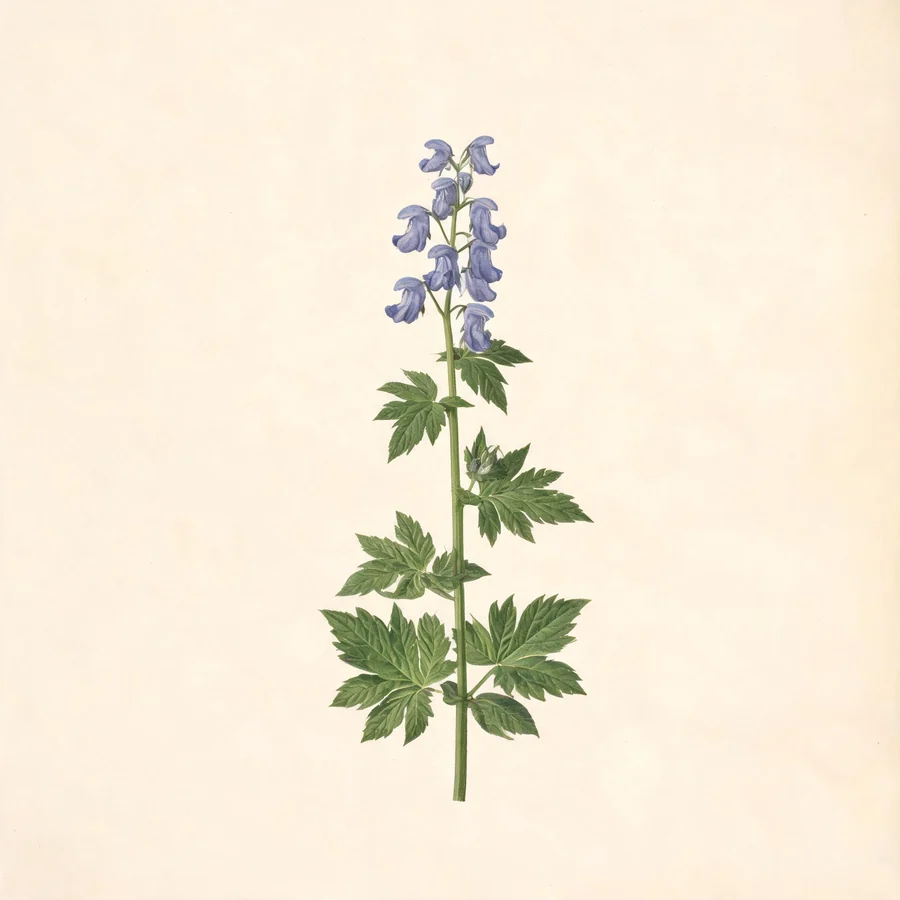
Skin profile
Where this herb sits in skin practice: the pattern it corrects, the skin signs it suits, and what it should not be used for.
Zhi Chuan Wu is on this page for cold that has settled in the channels and shows on the skin as pallor, dusky colour, nodules and numbness. Its heat is real and its toxicity is real, and the whole page is arranged around the second: processed root, small dose, long boiling, short course, and never outside practitioner care.
Skin signs that suggest it
- Skin over the affected area is cold, pale or dusky and feels cool under the hand
- Pain that is deep, fixed and boring, worse in cold and damp weather and relieved by warmth
- Numbness, tingling or a wooden, dead feeling in the fingers, toes or a patch of skin
- Chilblains that return each winter: purple-red, tender, itchy nodules on toes, fingers, ears or nose
- A pale, wet tongue and a deep, slow pulse, with a strong preference for warmth
When it is not the right herb
Never for skin that is red, hot, swollen, weeping or itching, which covers most eczema, rosacea, acne and infected lesions, because the hottest herb in the materia medica makes a heat pattern worse. Never raw, never as a powder, never in alcohol and never for self-treatment. Not in pregnancy or breastfeeding, not for a child, not for anyone with heart disease or an arrhythmia, and not for a person with liver or kidney impairment. Not alongside Bei Mu, Bai Ji, Bai Lian, Ban Xia, Gua Lou or Tian Hua Fen, under the Eighteen Incompatibilities.
What it does for skin
Skin-relevant actions only. Each one describes a mechanism in TCM terms and what it looks like on the skin.
Warms the channels where cold has settled
The picture it answers is a limb that is cold to the touch, dusky and heavy, with pain that deepens in cold weather. Its heat is described as penetrating and its movement as travelling through the channels rather than sitting in one organ, which is why it is used when milder warmers only reach the surface. What changes on the skin is colour and temperature, and that change is the visible sign that the dose is doing something; it is also the sign that the dose must not be increased.
Stops deep, fixed pain
Its pain relief cannot be separated from the alkaloids that make the herb dangerous: aconitine numbs nerve endings and blunts pain, while the same action unsettles the heart. That is why the tradition managed the risk by processing the root, boiling it for hours and keeping the dose small, and never removed it. In skin practice the pain is that of a chilblain or a cold, numb patch rather than of a hot lesion, and the root is given until the pain settles, then withdrawn.
Disperses cold swelling and softening nodules
Cold congealed in the small vessels produces hard, dusky, tender lumps, of which the chilblain is the commonest example. The root's acrid heat is used to scatter that cold and soften what it has hardened, usually with blood-moving herbs and always in a formula. A lump that is not cold, not tender and not related to cold exposure is not this pattern, and a new or growing lump needs diagnosis before it is called cold stasis.
Restores feeling to numb, cold skin
Numbness from cold-damp obstruction is the reason the herb appears in formulas for dead-feeling fingers and toes, where warmth and blood are not arriving together. The distinction that matters is between the numbness of the disease and the numbness the herb itself causes: tingling of the lips, tongue or fingertips after a dose is a sign of poisoning, not of a therapeutic effect, and it stops the course. A sudden numbness on one side of the body is a stroke warning, not a pattern.
Skin conditions it is used for
Mapped to the condition pages on this site. The pattern column shows what the skin is doing when this herb is the right choice.
| Condition | Pattern | Why it suits | Typical setting |
|---|---|---|---|
| Chilblains | Cold congealing the small vessels in a person who is cold all through | A chilblain is a local cold injury in tissue that warmth is not reaching, and the root is chosen when the lesions are dusky, hard and painful rather than bright red and itching. Its heat is carried into the small channels to scatter the cold that has congealed there, and it is given in a warming formula with blood-moving herbs rather than as a single remedy. Broken or ulcerated chilblains are not treated with a hot herb, and chilblains that persist outside cold weather need a vascular assessment. | Modified Dang Gui Si Ni Tang with Zhi Chuan Wu and Gui Zhi |
| Skin numbness | Cold-damp obstructing the channels with blood not reaching the skin | Numbness means the skin is not receiving Qi and Blood, and the pattern the root addresses is the cold one: the skin is cool and pale, the numbness is worse in winter, and the pulse is deep and slow. Warming alone will not fill empty vessels, so the root is paired with blood-moving and Qi-supporting herbs, and the course is short because cumulative exposure is the risk. Numbness that comes on suddenly or affects one side of the body is a stroke warning and needs emergency assessment. | Modified Huang Qi Gui Zhi Wu Wu Tang with Zhi Chuan Wu |
| Thickened or insensitive skin | Cold-damp lodged in the skin channels with stasis | Skin that has become hard, tight or insensitive is read as an obstruction in the skin channels, and cold-damp with stasis is the pattern in which a warming, dispersing root has a place. It is a supporting herb in a formula with blood-moving and channel-opening medicines, never the main treatment, and the response is measured in months rather than weeks. Hardening that is spreading quickly, or that comes with colour change in the fingers or internal organ symptoms, needs a diagnosis before any pattern reading. | Modified with Hong Hua, Chi Shao and Ji Xue Teng |
| Raynaud's disease | Cold in the channels with pain and colour change | Raynaud's is read as Qi and Blood failing to reach the fingers, and the cold pattern is the one the root suits, with white then blue then red colour change, pain and cold in a person who is cold all through. It differs from Fu Zi in emphasis: this root is chosen for the pain and the cold-damp obstruction rather than for collapse of Yang, and it is an adjunct in a warming formula. An attack that persists, colour change with ulceration, or symptoms in a child need vascular assessment. | Modified Dang Gui Si Ni Tang with Zhi Chuan Wu |
Combinations for skin
Herbs it is paired with when the skin, not an internal organ, is the target.
| Partner | Ratio | Why the pair is used |
|---|---|---|
| Gan Cao | 3 to 6 g Zhi Gan Cao with the processed root | Liquorice is added to control the aconite as much as to harmonise the formula: the old practice pairs the root with liquorice, ginger or ginseng expressly to make it safer, and the alkaloids do form less toxic complexes in its presence. It also protects the middle so that a heating course does not exhaust digestion. It is not a licence to exceed the dose or to shorten the boiling, and it does not make the root suitable for self-treatment. |
| Ma Huang | 6 to 9 g Ma Huang with 3 g Zhi Chuan Wu | The pairing defines the classical decoction for severe cold painful obstruction: Ma Huang releases the exterior and opens the pores, while the aconite carries warmth into the deeper channels and frees them. The logic is sequence, the surface opened first so the warmth can travel, and it is used where the limbs cannot flex and the exterior is also shut. Both herbs are restricted, and the combination belongs to a practitioner rather than to a home remedy. |
| Bai Shao | 9 to 12 g Bai Shao with 3 g Zhi Chuan Wu | Bai Shao enriches the Blood and eases the sinews; its sour, slightly cool character offsets the heat and dryness of the root. Together they address the blockage and the tight sinew that follows it, while the peony shields Yin and Blood a little. It suits a cold pain that comes with cramping and tightness, and it does not widen the narrow therapeutic margin of the aconite. |
| Huang Qi | 10 to 15 g Huang Qi with 3 g Zhi Chuan Wu | Huang Qi strengthens the Qi behind the Blood and guards the surface; together they serve the depleted person whose cold pain lingers because the circulation lacks drive. It is the pairing in the classical decoction for severe painful obstruction with sweating and weakness, and the logic is that warmth and movement need something to carry them. The dose ceiling of the aconite is unchanged by the addition. |
Formulas where it leads
- Wu Tou Tang (乌头汤) - Zhang Zhongjing's formula for joints so painful and stiff that the limbs will neither bend nor stretch, built on Wu Tou simmered in honey with Ma Huang, Bai Shao, Huang Qi and Gan Cao. Honey and long cooking are the earliest attempt on record to keep the pain relief while lowering the danger, and today's insistence on a long decoction descends from that practice. It is recorded here to explain the herb rather than as a skin formula: the same principle, a long honey-simmered decoction of processed root, underlies the warming treatment of chilblains and dead-feeling fingers, and it belongs to practitioner care.
- Xiao Huo Luo Dan (小活络丹) - A pill formula for cold-damp painful obstruction with numbness, containing processed Chuan Wu and Cao Wu with Ru Xiang, Mo Yao, Di Long and Dan Nan Xing. It is the classic illustration of the herb's place in stubborn cold pain with deadness of the limb, and it is a restricted formula rather than a household remedy. Two aconites in one pill make the margin narrower, not wider.
Safety for skin use
What to check before recommending or using it, including the cautions that matter most for skin patients.
Do not use, or use with caution
- Pregnancy and breastfeeding. The pharmacopoeia lists Chuan Wu as pregnancy-prohibited, no dose is treated as safe, and the lipophilic alkaloids are likely to pass into milk, where an infant cannot clear them.
- Heart disease, arrhythmia, or any unstable cardiac condition. Aconitine acts directly on cardiac sodium channels and can set off a fatal rhythm, and the root is refused rather than adjusted in that setting.
- Liver or kidney impairment. The alkaloids are cleared by hepatic metabolism and renal excretion, so impaired function allows accumulation at an ordinary dose.
- Any form of aconite incompatibility. Under the Eighteen Incompatibilities the Wu Tou family is incompatible with Bei Mu, Bai Lian, Bai Ji, Ban Xia, Gua Lou and Tian Hua Fen, and the rule is absolute.
- Children, and anyone outside practitioner supervision. The gap between a helpful and a harmful dose is narrow in an adult and less predictable in a child, and unprocessed root belongs to external use alone.
Pregnancy and breastfeeding
Contraindicated. The Pharmacopoeia of the People's Republic of China names Chuan Wu as forbidden in pregnancy (孕妇禁用) rather than merely cautioning against it, and that is the clearest line on the page. Its heat, its dispersing force and its alkaloid load all point the same way, so no dose is offered as safe. While breastfeeding it is also avoided: aconitine alkaloids are fat-soluble, so they may well reach milk, and a baby's liver and kidneys cannot clear what an adult's can. A woman who is trying to conceive is treated the same way, because the early weeks are when the exposure would matter most.
Interactions
- Cardiac glycosides such as digoxin and antiarrhythmics such as flecainide, lidocaine or amiodarone. Herb and drug alike act on the heart's electrical activity, and together they can trigger a rhythm that is hard to control, so the combination is refused rather than monitored casually.
- Beta-blockers and calcium channel blockers. Both kinds already slow the heart and reduce pressure, and aconitine poisoning does the same, so the effects may add and the margin narrows further in an older person already on several medicines.
- CYP3A4 inhibitors such as ketoconazole, erythromycin and grapefruit, and P-glycoprotein inhibitors. Both can raise circulating alkaloid levels, one by slowing metabolism and the other by blocking efflux, which is why grapefruit is avoided during a course.
- Alcohol and anaesthetics. Alcohol increases the uptake of the alkaloids and is the commonest setting for aconite poisoning, and the root's own numbing action makes anaesthetic effects less predictable, so it is stopped well before surgery.
Allergy and patch testing
A rash or itching after correctly processed aconite is a reason to stop rather than to adjust the dose. The tingling and numbness of early aconite poisoning can be mistaken for an allergy, so any new tingling of the mouth, tongue or face after a dose is treated as poisoning until proved otherwise. A previous reaction to any aconite, including Cao Wu or Fu Zi, rules out the whole group, and a liniment that has caused contact dermatitis is not reused.
General safety references
General references for herbal hepatotoxicity and herb-drug interactions; they are not specific to this herb.
- Review article: Herbal hepatotoxicity - an update on traditional Chinese medicine preparations. Alimentary Pharmacology & Therapeutics, 2014. PMID: 24844799.
- Interactions between herbal medicines and prescribed drugs: an updated systematic review. Drugs, 2009. PMID: 19719333.
- Warfarin and food, herbal or dietary supplement interactions: a systematic review. British Journal of Clinical Pharmacology, 2021. PMID: 32478963.
Evidence
The classical record is quoted with its source. The modern note states the level of evidence plainly.
Classical record
乌头,味辛,温。主治中风,恶风洗洗,出汗,除寒湿痹,咳逆上气,破积聚,寒热。
Acrid and warm, it addresses wind-stroke, the shivering aversion to wind with sweating, cold-damp painful obstruction, cough with rebellious Qi, and accumulations and gatherings that bring chills and fever.
Shen Nong Ben Cao Jing (Divine Husbandman's Classic of Materia Medica) - The earliest entry already marks out cold, pain and obstruction, which are still the root's territory today.
莽草为之使。反半夏、栝楼、贝母、白蔹、白及。恶藜芦。
Its envoy is Mang Cao. It is opposed to pinellia, fritillaria, bletilla, trichosanthes and ampelopsis, and averse to Veratrum.
Ben Cao Jing Ji Zhu (Collected Commentaries on the Classic Materia Medica), Tao Hongjing - Tao Hongjing's commentary is where the incompatibility rules begin, and they are still printed in modern pharmacopoeias, which is why the safety section here names the same five herbs.
病历节不可屈伸,疼痛,乌头汤主之。
Where the limbs will neither bend nor stretch, and the pain is sharp, the answer is Wu Tou Tang.
Jin Gui Yao Lue (Essential Prescriptions of the Golden Coffer), Zhang Zhongjing - The root is simmered in honey in Zhang Zhongjing's formula, alongside ephedra, astragalus, peony and liquorice; this is the oldest recorded way of making the root safer.
Modern evidence
Evidence status
- The pharmacology is established and it is toxicology rather than efficacy: aconitine and its relatives act on cardiac sodium channels, poisoning begins within twenty minutes to two hours with tingling, vomiting and weakness, and severe cases go on to ventricular arrhythmia and arrest. No antidote exists, and treatment is supportive and cardiac.
- Processing chemistry is the substance of the modern literature: prolonged soaking and boiling, or steaming, hydrolyses the diester alkaloids into less toxic monoester and amine forms, and the pharmacopoeia caps processed material at 0.040 per cent for total diester alkaloids, with total monoester alkaloids required to fall between 0.070 and 0.15 per cent. Even then the root is boiled alone first and tasted for numbness before it is served.
- No controlled trial supports processed aconite in chilblains, numbness or any skin condition, and the honest position is that its skin use rests on the traditional record. Regulatory status: processed aconite is a restricted substance in the Chinese Pharmacopoeia, and that restricted status is the main fact about it.
PubMed records
Selected real PubMed records for this herb's species or its constituents, chosen by species name and title relevance. They are references for the non-TCM discussion above, not proof that the herb treats any skin condition.
- Total alkaloids of Aconitum carmichaelii Debx alleviate cisplatin-induced acute renal injury by inhibiting inflammation and oxidative stress related to gut microbiota metabolism.. Phytomedicine : international journal of phytotherapy and phytopharmacology, 2024. PMID: 39442279 (skin-related record).
- Insights on neuropharmacological benefits and risks: Aconitum carmichaelii Debx.. Biomedicine & pharmacotherapy = Biomedecine & pharmacotherapie, 2024. PMID: 39527885 (safety record).
Dose and forms
Skin-practice dosing and the preparations that suit skin complaints.
| Form | Dose and notes |
|---|---|
| Decoction | 1.5 to 3 g of the processed mother root a day, in a formula under practitioner supervision. Do not exceed 3 g, and the range is small on purpose. |
| Mandatory pre-boiling | Before anything else joins it, the processed root boils on its own for thirty to sixty minutes at a rolling boil; the old check is the tongue, since faint numbness passes and a strong one sends the pot back to the flame. |
| Never | Never in powder form, never raw, never with alcohol and never self-prescribed. Unprocessed root is reserved for external use, and a liniment or wash touches only intact skin, briefly. |
| Course | Short courses only, stopped once the pain settles, since the danger accumulates with each dose. The herb is withdrawn rather than continued at a low dose for months. |
The range is 1.5 to 3 g of processed root by decoction, and those figures belong to practitioners because the substance can stop the heart and has no antidote. Each dose is weighed, simmered for half an hour or more and tasted before anyone drinks it; more than a faint tingle on the tongue means it stays on the heat. Powders, wines and capsules of uncertain processing are refused, as is anything that does not name the processed form.
Citations and further reading
Only real sources are listed: the classical materia medica passages quoted above, and the source works behind the botanical and safety statements.
- Shen Nong Ben Cao Jing (Divine Husbandman's Classic of Materia Medica), attributed compilation of the Han period - classical entry quoted above.
- Ben Cao Jing Ji Zhu (Collected Commentaries on the Classic Materia Medica), Tao Hongjing - classical entry on the incompatibilities.
- Jin Gui Yao Lue (Essential Prescriptions of the Golden Coffer), Zhang Zhongjing - classical entry on Wu Tou Tang.
- Pharmacopoeia of the People's Republic of China - Aconiti Radix Cocta monograph, processing requirements, alkaloid limits and the pregnancy prohibition.
- Eighteen Incompatibilities (shi ba fan) - the classical list behind the prohibition on combining Wu Tou with Bei Mu, Bai Ji, Bai Lian, Ban Xia, Gua Lou and Tian Hua Fen.
- Modern evidence statement: toxicological and processing chemistry literature on the diester aconite alkaloids, summarised as a statement about the state of the evidence rather than as a cited finding.
- Botanical description and identification: botanical literature on Aconitum carmichaelii, Ranunculaceae.
Educational reference for qualified practitioners. This page is not medical advice, and skin conditions should be diagnosed by a clinician before treatment.