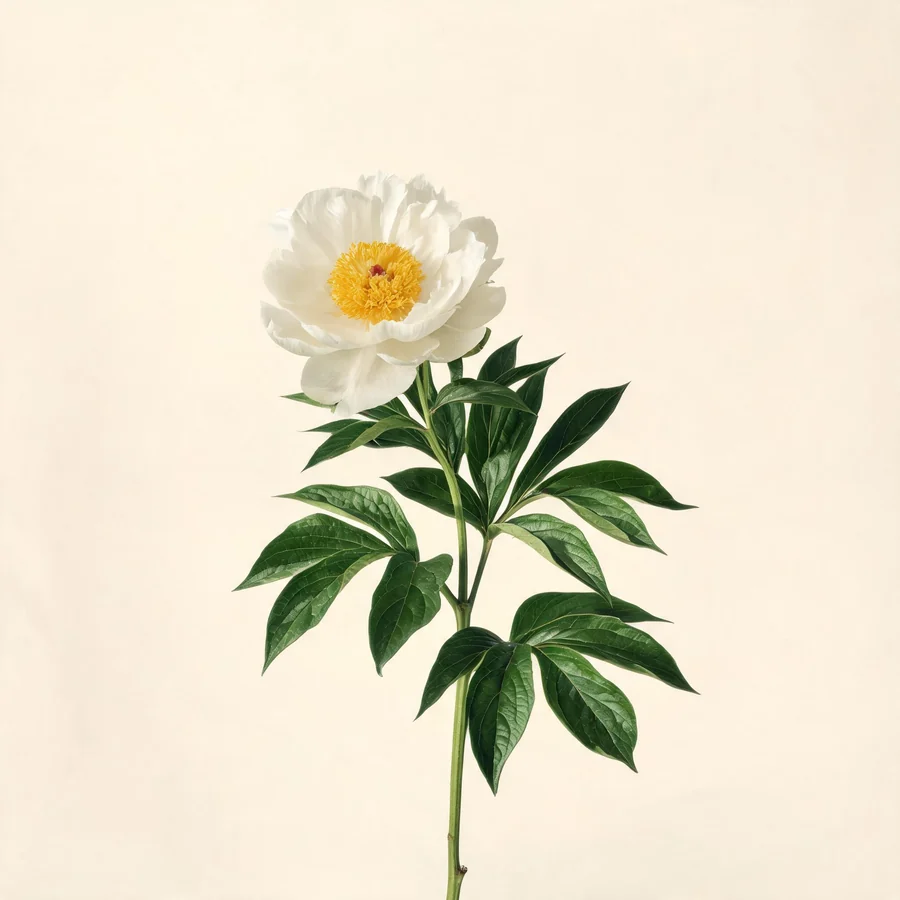
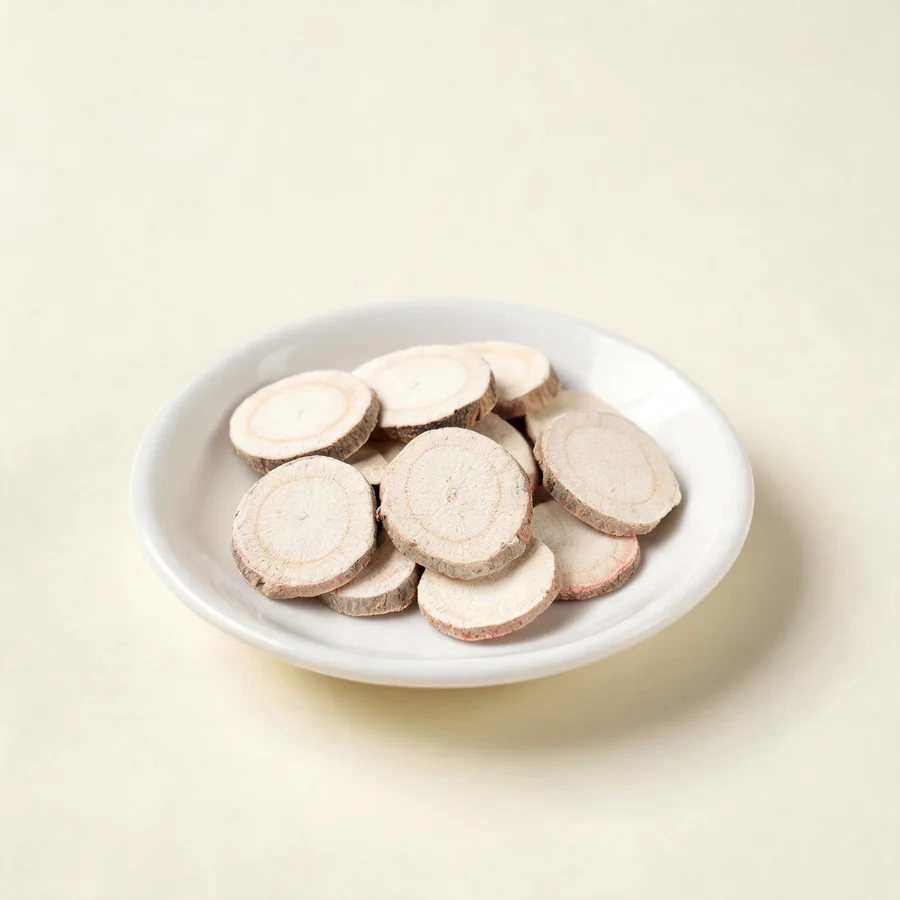
Skin profile
Where this herb sits in skin practice: the pattern it corrects, the skin signs it suits, and what it should not be used for.
Bai Shao is a builder in skin practice. It is chosen for dry, thin, pale skin and for itch that has thickened with years of scratching, and it is given for weeks. It has no place in a wet, hot, infected flare, where clearing and drying herbs do the work.
Skin signs that suggest it
- Dry, thin, pale skin that cracks and looks dull rather than red, with fine white scaling
- Chronic itchy plaques that have thickened and darkened from years of scratching, with little ooze
- Itch that flares with stress, broken sleep or the days before a period
- Pale lips and nail beds, dizziness on standing and scanty periods
- Cramping in the calves or the abdomen, and a tendency to startle easily
- A fine thin pulse and a pale tongue with a slightly dry coat
When it is not the right herb
Not for a wet, red, oozing flare, and not for skin that is hot, swollen or infected; a sour, cool, holding root does not clear damp-heat and can keep it in. Not where there is internal cold with loose stools, cold limbs and a swollen pale tongue, since the root is cool and slightly cloying. Not as the leading herb for fixed dark lesions or clotted bleeding, because its astringency holds what needs to move. And not a replacement for emollient, for a steroid when one is indicated, or for assessment of a lesion that is changing.
What it does for skin
Skin-relevant actions only. Each one describes a mechanism in TCM terms and what it looks like on the skin.
Nourishes blood so that dry skin can rebuild
Blood deficiency is read from the skin as much as from the pulse: thin, dry, dull, slow to heal, with pale lips and nails. The root is the standard blood-nourishing herb of the peony family, and it is used where the dryness is constitutional rather than caused by an irritant. It works over weeks rather than days, and it does nothing for skin that is dry because of a harsh soap, which is a matter of removing the soap.
Softens the Liver and loosens stress-driven itch
Itch that worsens with tension, appears at night when the mind will not settle and concentrates where the hand can reach is read as Liver qi constrained and blood unable to relax the surface. The root is included less as an antipruritic than as a relaxant of the whole pattern, beside herbs that move qi. It is one of the few herbs in this group that can be given for months without draining the person.
Holds fluids and reduces the dryness that follows loss
The sour quality is described as gathering, and it is used where fluid is leaking: night sweats, spontaneous daytime sweating and the dry skin that follows a long illness or a fever. Holding fluid and moistening the skin are two expressions of the same action in this reading. It is not a treatment for a sweating attack with fever, which needs assessment rather than astringency.
Settles a rising flush in the face
A red flush that comes with dizziness, irritability, headache and ringing in the ears is read as yang rising because the yin below is thin. The cool root enriches from below so that the flush has something to return to, and it is combined with herbs that anchor yang. Rosacea-like redness of this kind is different from the pustular, heat-toxin kind, and the two need different treatment.
Skin conditions it is used for
Mapped to the condition pages on this site. The pattern column shows what the skin is doing when this herb is the right choice.
| Condition | Pattern | Why it suits | Typical setting |
|---|---|---|---|
| Skin Dryness | Blood deficiency failing to moisten the skin | Dryness that is general, with pale thin skin, brittle nails and a fine pulse, is read as the skin being undernourished rather than under-greased. The root is a background herb in that picture, given for weeks in a blood-nourishing formula. Emollient and a humidifier do more for the surface immediately, and both are compatible with the herbs. | Si Wu Tang with He Shou Wu and Mai Men Dong |
| Eczema | Chronic dry eczema on a blood-deficient base | In eczema the root belongs to the dry, lichenified, long-standing phase rather than to the weeping flare. The picture is a thin person with a pale face, itchy dry patches, worse at night and after stress, and the formula is a blood-nourishing one with wind-expelling herbs. Where the skin is instead wet, red and hot, this root is the wrong choice and may hold the dampness in. | Dang Gui Yin Zi |
| Atopic Dermatitis | Blood deficiency with dry, thickened flexural skin | Long-standing atopic dermatitis in a thin, pale child or adult, with dry thickened flexures and itch that disturbs sleep, is treated by nourishing blood and moistening dryness while acute flares are handled separately. The root is part of that background work and is not expected to shorten a flare. Emollient therapy, trigger avoidance and any prescribed topical treatment remain the core of care. | Modified Dang Gui Yin Zi with Bai Zhu and Fu Ling |
| Neurodermatitis | Liver constraint with blood deficiency and lichenification | A single thickened, scratched plaque, often on the neck, ankle or genital area, in an anxious person, is read as tension held in the skin. The root softens and nourishes while other herbs move qi and blood, and the visible result is slower than with a topical steroid. Habit reversal and treatment of the anxiety matter as much, and a plaque that ulcerates or bleeds should be examined. | Xiao Yao San with Mu Dan Pi and Gou Teng |
| Senile Pruritus | Blood and yin deficiency in older skin | Itch in older people is commonly dry, generalised and worse at night and in winter, and the blood-nourishing approach is the one most used in traditional practice for it. The root suits that picture because it is gentle enough for a long course and does not drain. It is given alongside emollient and a review of medicines, since a dry itch in an older person is often caused by a drug or by over-washing. | Dang Gui Yin Zi with Sheng Di Huang and Ji Xue Teng |
| Melasma | Liver qi stagnation with blood deficiency | Brown symmetrical patches on the cheeks and forehead in a person with premenstrual tension, irritability and scanty periods are read as constrained Liver qi with thin blood, and the root is central to the formula used for that pattern. It is a slow treatment measured in months, and sun protection is not optional, because without it nothing else works. A pigment change that is new, uneven or one-sided should be examined. | Xiao Yao San with Bai Ji Li and Hong Hua |
Combinations for skin
Herbs it is paired with when the skin, not an internal organ, is the target.
| Partner | Ratio | Why the pair is used |
|---|---|---|
| Gan Cao | 10 to 15 g Bai Shao with 6 to 10 g honey-fried Gan Cao | The classical antispasmodic pair: the sour root relaxes and the sweet liquorice softens, and it is used for cramping in the abdomen, the calves and the hands. Its place on a skin page is indirect but real, because the same tension that cramps a calf keeps an itch going at night. The pair is a formula in itself and is taken as a short course. |
| Dang Gui | 9 to 12 g each | Angelica builds and moves the blood while the peony builds and holds it, so the pair gives both substance and circulation to a dry pale skin. This is the core of the blood-building formulas and the reason a thin, dry, dull complexion is treated with herbs rather than with cream alone. Angelica is warm and moistening, which balances the cool astringency of the peony. |
| Chai Hu | 6 to 9 g Chai Hu with 10 to 15 g Bai Shao | Bupleurum lifts and scatters constrained Liver qi while the peony gathers and nourishes the blood, so that the movements inward and outward correct each other without draining the person. It is the axis of the formula used for premenstrual tension, irritability and the pigment changes that accompany them. Where moving qi alone has left someone drier and more tense, the peony is what was missing. |
| Gui Zhi | 9 g each | Cinnamon twig opens and warms the defensive layer, while the peony nourishes and secures the nutritive layer, restoring the relationship between the surface and the interior. The pair is used where cold urticaria or a chill-prone, sweating presentation keeps recurring, and it is also the basis of the cold-extremity formula. It is a warming pair and does not suit a hot red flare. |
Formulas where it leads
- Si Wu Tang (四物汤) - Four herbs for blood: prepared rehmannia, angelica, peony and chuanxiong. It is the base formula for dry pale skin with scanty periods, dizziness and brittle nails, and the peony supplies the nourishing and holding half of it. It is a background formula taken for weeks rather than a treatment for an acute rash.
- Dang Gui Yin Zi (当归饮子) - The classical formula for chronic itch from blood deficiency, with angelica, peony, rehmannia, astragalus and wind-expelling herbs. It is used for the dry, thickened, generalised itch of an older or depleted person, and the peony is one of its nourishing supports. Expect slow change and keep emollient and trigger control in place while it works.
- Xiao Yao San (逍遥散) - The formula for constrained Liver qi with blood deficiency, used for stress-aggravated skin problems, premenstrual flares and melasma. The peony is paired with bupleurum so that qi moves without the blood being drained. It is a gentle formula for a long course and is not a treatment for an acute infected lesion.
Safety for skin use
What to check before recommending or using it, including the cautions that matter most for skin patients.
Do not use, or use with caution
- Internal cold with yang deficiency: chronic loose stools, cold limbs, a cold abdomen and a pale swollen tongue. The root is cool, sour and slightly cloying, and it makes that picture worse.
- A wet, hot, oozing or infected skin lesion. A holding, astringent herb does not clear damp-heat, and using it as the main treatment can keep a flare in place.
- Fixed, dark, painful lesions or clotted bleeding where blood needs to move. The astringency can hold stasis that should be dispersed, which is why the root is not the leading herb for a resolving bruise or for lochia that is not draining.
- Anticoagulant or antiplatelet treatment, and planned surgery. Two of its phenolic constituents have shown antiplatelet activity in laboratory work, so the prescriber should know the herb is being taken before an operation or a dose change.
- A known allergy to the peony family, or a previous reaction to a herb-containing cream or wash.
Pregnancy and breastfeeding
Used with care rather than forbidden. The root appears in classical formulas for abdominal pain in pregnancy and standard doses are widely regarded as acceptable, so the concern is one of dose and timing rather than of the herb itself. Big doses are avoided, especially during the first trimester and where there has been a miscarriage, because the oldest descriptions credit it with breaking hardness and removing blood impediment. It should be prescribed by a practitioner who can weigh the whole picture, and it is not a self-treatment in pregnancy.
Interactions
- Warfarin, heparin, aspirin and clopidogrel. Two phenolic constituents, catechin and ethyl gallate, have shown antiplatelet activity in laboratory work, so there is a theoretical additive bleeding risk. None has been demonstrated in people, but anyone taking an anticoagulant should inform both of the clinicians involved.
- Medicines handled by CYP2E1. Paeoniflorin has changed cytochrome activity in the laboratory, which leaves open the question of drugs using that route; it has not been demonstrated to matter clinically, and it argues for caution with a narrow-therapeutic-index drug rather than for avoiding the herb.
- Methotrexate, hydroxychloroquine and other immune-modifying treatment. The standardised peony glucosides are used alongside these in autoimmune care in China, and taking them together belongs under supervision, since the immune effect may shift while liver and blood counts are being monitored.
Allergy and patch testing
Reactions to the root itself are uncommon. Most reactions in practice come from a cream base, a preservative or another herb in a wash rather than from the peony, so a reaction should be investigated rather than blamed on the root. Patch test a new product on normal skin for twenty four hours, and stop any product that makes the skin more irritated rather than calmer.
General safety references
General references for herbal hepatotoxicity and herb-drug interactions; they are not specific to this herb.
- Review article: Herbal hepatotoxicity - an update on traditional Chinese medicine preparations. Alimentary Pharmacology & Therapeutics, 2014. PMID: 24844799.
- Interactions between herbal medicines and prescribed drugs: an updated systematic review. Drugs, 2009. PMID: 19719333.
- Warfarin and food, herbal or dietary supplement interactions: a systematic review. British Journal of Clinical Pharmacology, 2021. PMID: 32478963.
Evidence
The classical record is quoted with its source. The modern note states the level of evidence plainly.
Classical record
Pain, hardness beneath the heart, and pathogenic qi in the abdomen are what it governs.
Shen Nong Ben Cao Jing (Divine Husbandman's Classic of Materia Medica) - The pain and spasm indications are present in the oldest layer, which is why the root is described as an antispasmodic before it is described as a skin herb.
补血,泻肝,益脾,敛肝阴,治血虚之腹痛。
It supplements the blood, drains the Liver, benefits the Spleen, gathers Liver yin, and is used for abdominal pain that comes from blood deficiency.
Ben Cao Bei Yao (Essentials of the Materia Medica) - One line that carries the herb's double task: it fills what is empty and restrains the Liver at the same time. The pain referred to is the empty, cramping sort that pressure and warmth relieve.
治风补痨,主女人一切病,并产前后诸疾,通月水,退热除烦,益气。
It treats wind, rebuilds those worn down by long illness, governs what troubles women around childbirth, opens menstruation, clears heat, quiets restlessness and adds qi.
Ri Hua Zi Ben Cao (Ri Hua Zi's Materia Medica) - This is the line that ties the root to women's medicine, and it shows that the older writers saw more here than a blood tonic.
Modern evidence
Evidence status
- Paeoniflorin, the main constituent, has been studied for anti-inflammatory and immune-modulating effects in cell and animal models, and total glucosides of paeony are licensed in China as a standardised extract for autoimmune conditions. That work is largely pharmacological and clinical in rheumatology rather than dermatological.
- No adequately powered trial of Bai Shao in eczema, psoriasis or pruritus was identified. The skin use rests on the blood-nourishing tradition and on formula-level practice, and the extract's safety record in hospital use is better documented than its efficacy in skin disease.
- Safety data are comparatively reassuring: paeoniflorin is of low toxicity at the doses used clinically, and the effects reported from bigger or longer courses are loose stool, a full abdomen and slight nausea, all of which settle when the dose comes down.
PubMed records
Selected real PubMed records for this herb's species or its constituents, chosen by species name and title relevance. They are references for the non-TCM discussion above, not proof that the herb treats any skin condition.
- Total glucosides of paeony: A review of its phytochemistry, role in autoimmune diseases, and mechanisms of action.. Journal of ethnopharmacology, 2020. PMID: 32371143 (pharmacology or review record).
- Chinese herbal formulae for the treatment of menopausal hot flushes: A systematic review and meta-analysis.. PloS one, 2019. PMID: 31536531 (pharmacology or review record).
- The Traditional Applications, Phytochemistry, Pharmacology, Pharmacokinetics, Quality Control and Safety of Paeoniae Radix Alba: A Review.. The American journal of Chinese medicine, 2024. PMID: 39756831 (safety record).
Dose and forms
Skin-practice dosing and the preparations that suit skin complaints.
| Form | Dose and notes |
|---|---|
| Decoction | 6 to 15 g of the processed root daily in a formula. The lower half of the range suits a background blood-nourishing role and the upper half a main antispasmodic or moistening one. |
| Higher range | Fifteen to thirty grams appears for cramping pain or for a flush driven by rising yang, under supervision. Above about 30 g the sour gathering quality causes abdominal fullness and loose stools, and there is little to gain. |
| Forms | Raw root to cool and descend, dry-fried for a weak digestion, wine-fried for pain with cold and stasis, earth-fried for loose stools with Spleen deficiency. The gram range is the same and the emphasis shifts. |
| Course length | Weeks to months for a blood-nourishing background role, with review. Long courses are reasonable because the herb does not drain, but the dose and the form should be reassessed if the stools loosen. |
For skin work the ordinary range is enough, and the form matters more than the number. The raw root suits a dry, warm-skinned person with a rising flush; the dry-fried root suits a thin person with a delicate digestion who would otherwise get loose stools. It is nearly always given with other herbs, because its task is to supply what is missing while other herbs move, clear or warm.
Citations and further reading
Only real sources are listed: the classical materia medica passages quoted above, and the source works behind the botanical and safety statements.
- Shen Nong Ben Cao Jing (Divine Husbandman's Classic of Materia Medica), Han compilation - classical entry translated above.
- Ben Cao Bei Yao (Essentials of the Materia Medica) - passage quoted above.
- Ri Hua Zi Ben Cao (Ri Hua Zi's Materia Medica) - passage quoted above.
- Pharmacopoeia of the People's Republic of China - source for the accepted species, the peeled and boiled preparation and the part used.
- Modern evidence statement: summarised from pharmacological and clinical literature on paeoniflorin and total glucosides of paeony; no dermatological trial is presented as proof of effect.
- Botanical description and identification: botanical literature on Paeonia lactiflora, Paeoniaceae.
Educational reference for qualified practitioners. This page is not medical advice, and skin conditions should be diagnosed by a clinician before treatment.