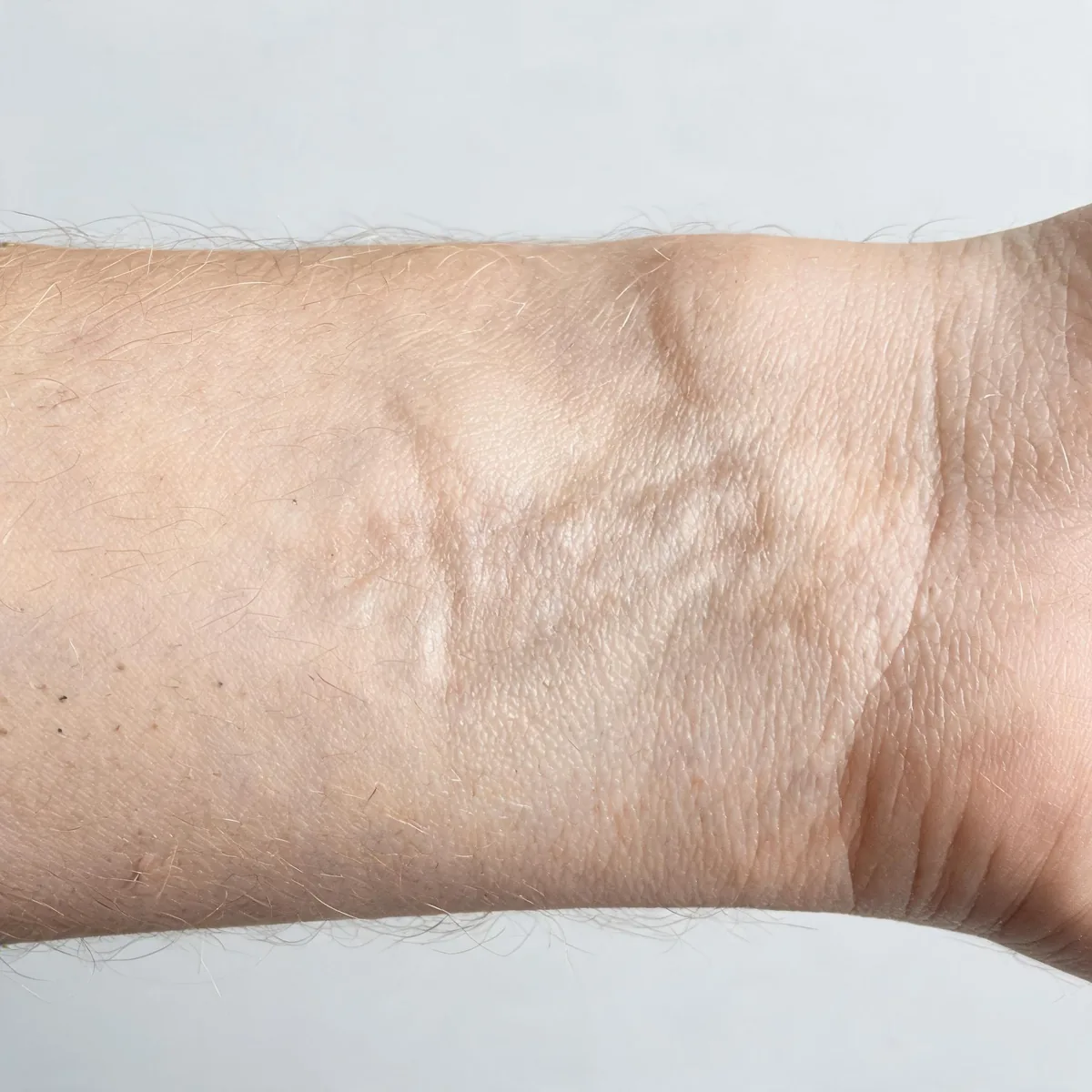
Understanding Thickened or insensitive skin
A name note recorded rather than resolved: this page and the Scleroderma page both use 皮痹 (pí bì) for skin impediment. This page covers thickened or insensitive skin as a symptom; the Scleroderma page covers the disease. Both are kept because the source describes them separately.
The tradition describes thickened or insensitive skin as a form of Bi syndrome lodged in the skin. The Lung governs the skin and defensive Qi guards it; when Wind, Cold or Dampness invade and lodge, the skin can thicken and lose sensation.
Wind-Cold-Damp gives skin that feels cold, with numbness or loss of sensation in patches, heaviness and stiffness, worse in cold damp windy weather and better with warmth. Blood Stagnation gives hard leathery skin like thick hide with purplish discolouration and fixed stabbing pain.
Damp heat in the channels gives red swollen hot skin with numbness and joint pain better with cold. Phlegm in the channels gives thick doughy putty-like skin with numbness, purplish patches and subcutaneous nodules. Painful obstruction with Qi and Blood deficiency gives thin tight hard skin - not thick and swollen - with numbness, dull pain worse with activity and fatigue.
Thickened or insensitive skin is understood as Bi syndrome that has settled in the skin, known as Pi Bi. The skin is governed by the Lung and protected by Defensive Qi, so when Wind, Cold or Dampness invade after the defences weaken, they block the small channels that carry Qi and Blood to the surface, and the skin becomes stiff, thick or numb, sometimes changing colour and temperature.
Not every case begins outside. Long-standing Blood Stagnation can make the skin hard and purplish, Phlegm from poor fluid metabolism can collect in the channels as doughy thick plaques, and Qi and Blood deficiency leaves the skin undernourished, thin, tight and numb. The quality of the change, whether cold, hot, heavy or dry, and what eases it, guides the pattern choice.
Conventional view
In Western medicine skin that feels thick, tight or numb is often linked to scleroderma or localised morphea, or to peripheral neuropathy. The skin can harden and lose sensation through excess collagen production, chronic inflammation or nerve damage, and diagnosis usually involves a physical exam, blood tests for autoimmune markers and sometimes a skin biopsy to assess the extent of tissue change.
Treatment focuses on the underlying condition and symptom relief: immunosuppressants or corticosteroids for autoimmune-related thickening, physical therapy to maintain mobility where joints are affected, and gabapentin or pregabalin for numbness. These can slow progression and ease discomfort, but rarely reverse established thickening or restore normal sensation, and long-term immunosuppression carries infection and other risks.
The conventional model applies the same few drug classes to most cases, without distinguishing whether cold, heat or deficiency is driving the change, which is the distinction central to TCM. It also leaves the person managing stiffness, numbness and slow skin change without a framework for the internal imbalance behind them.
Selected PubMed records
Real PubMed records for the conventional discussion above, selected by condition name and title relevance. They are references, not a claim that any treatment is proven for this condition.
- Fibromyalgia and small fiber neuropathy: the plot thickens!. Clinical rheumatology, 2018. PMID: 30238382.
- Early detection of diabetic neuropathy based on health belief model: a scoping review.. Frontiers in endocrinology, 2024. PMID: 38721145.
How it is assessed
The practitioner assesses temperature, texture and sensation, and looks for systemic disease.
What a practitioner looks for
- Temperature: cold thickened skin suggests Wind-Cold-Damp; red hot skin suggests damp heat.
- Texture: leathery hard skin suggests stagnation; doughy thick skin suggests phlegm; thin tight skin suggests deficiency.
- Sensation: patches of numbness need neurological and systemic review.
- Red flags: rapid spread of hardening, or hardening on the fingers and face.
The practitioner begins with what the skin actually feels like, whether cold, hot, numb or heavy, and what makes it better or worse, then confirms the pattern with the tongue and pulse. Cold numb skin with a pale colour that worsens in cold and damp weather points to Wind-Cold-Damp, with a pale tongue carrying a thin white coat and a pulse that is floating and tight or deep and thin.
Hard, thickened or purplish skin with stabbing pain or palpable lumps points to Blood Stagnation, often after long-standing obstruction, with a dark tongue and purplish spots and a choppy or wiry pulse. Red, swollen, warm skin with heaviness or low-grade fever points to Damp-Heat, with a red tongue and yellow greasy coating and a rapid slippery pulse, while doughy thickened skin with heavy numbness, a thick greasy coat and a slippery pulse points to Phlegm in the channels.
In chronic cases the skin becomes thin, dry and insensitive in a pale, exhausted person, which points to Qi and Blood deficiency, with a pale tongue with little coating and a deep weak pulse, often after long illness, poor appetite and fatigue.
TCM patterns in Thickened or insensitive skin
Thickened or insensitive skin is treated by pattern, because the same hardening can come from very different roots. Wind-Cold-Damp is an external blockage: the skin feels cold, numb and stiff and eases with warmth. Blood Stagnation gives hard, leathery, purplish skin with fixed stabbing pain. Damp-Heat gives red, hot, swollen skin with heaviness. Phlegm in the channels gives doughy thickening with nodules and numbness. Qi and Blood deficiency gives thin, tight, numb skin in a pale, tired person. The patterns can follow one another: an unresolved external pathogen can settle into stasis or Phlegm, and long illness drains the Qi and Blood that nourish the skin. The self-check above is a way into that differentiation, not a diagnosis.
| Pattern | Key signs | The itch | Tongue | Main formula |
|---|---|---|---|---|
| Wind-Cold-Damp | Skin feels cold to the touch; Heaviness and stiffness of the skin | Not specified | Body: Pale or slightly swollen, teeth-markedCoat: White, greasy and moist | Not specified |
| Blood Stagnation | Skin hard and leathery like thick hide; Fixed stabbing pain that does not move | Not specified | Body: Purple, dusky or with dark stasis spots; sublingual veins dark and distendedCoat: Often thin white; a yellow coat would suggest Heat as the cause | Not specified |
| Painful Obstruction due to Damp Heat in Channels | Red swollen hot skin with numbness; Joint pain better with cold and worse with warmth | Not specified | Body: Red, possibly slightly swollenCoat: Yellow and greasy | Not specified |
| Phlegm in the Channels (Joints and Muscles) | Skin feels thick and doughy, like putty | Not specified | Body: Purple, with stasis spots and distended sublingual veinsCoat: White and greasy | Not specified |
| Painful Obstruction with Qi and Blood Deficiency | Skin feels thin, tight and hard rather than thick and swollen; Dull joint or muscle pain worse with activity | Not specified | Body: Pale, possibly thin with teeth marksCoat: Thin white | Not specified |
Wind-Cold-Damp
Cold numb thickened skin worse in cold damp weather.
Wind, Cold and Dampness invade when the defences are weak and lodge in the skin, blocking the small channels. Cold contracts and congeals, Dampness adds heaviness, and Wind makes the symptoms shift, so the skin feels cold, numb, thick and stiff because it is starved of warm moving Qi.
The tongue is pale or slightly swollen with a white greasy moist coating, and the pulse is moderate or tight, becoming soggy when Dampness dominates. Cold damp weather, draughts, inactivity and cold raw food aggravate it, while warmth, gentle movement, massage and a dry warm climate ease it. Treatment expels the pathogens and warms the channels, with Du Huo Ji Sheng Tang as the standard formula and herbs such as Du Huo and Qiang Huo.
Signs
- Skin feels cold to the touch
- Numbness or loss of sensation in patches
- Heaviness and stiffness of the skin
- Worse in cold damp windy weather, better with warmth
Diet and lifestyle for this pattern: Eat warm, cooked food such as soups and stews with ginger, cinnamon and black pepper, and avoid raw, cold and greasy food that generates internal Dampness. Keep the skin warm and dry, keep moving gently such as walking or tai chi to move Qi and blood, and a warm bath with Epsom salts can temporarily ease the heavy, cold sensation.
Blood Stagnation
Hard leathery purplish skin with fixed pain.
When Qi and Blood fail to move freely through the skin over a long period, the Blood becomes stagnant. The stasis deprives the skin of nourishment, so it grows hard, thick and insensitive, and stagnant Blood shows through as a purplish discolouration or palpable lumps beneath the skin.
The tongue is dark purple or dusky with stasis spots and distended dark sublingual veins, and the pulse is choppy like a knife scraping bamboo, or wiry. Cold weather, cold drinks, inactivity and emotional stress aggravate it, while gentle movement, warmth and warm nourishing meals help. Treatment invigorates Blood and transforms stasis, with Shen Tong Zhu Yu Tang as the standard formula and herbs such as Dan Shen and Tao Ren, supported by Xuehai (SP-10).
Signs
- Skin hard and leathery like thick hide
- Purplish or dusky discolouration
- Fixed stabbing pain that does not move
- Pain and stiffness worse at night
Diet and lifestyle for this pattern: Keep the body warm and avoid cold, raw food that can congeal blood. Gentle daily walking or tai chi helps blood flow, and small amounts of warming spices such as turmeric and ginger in meals support circulation.
Painful Obstruction due to Damp Heat in Channels
Red hot swollen numb skin with joint pain better with cold.
Dampness and Heat combine into a sticky hot obstruction that clogs the skin's channels, so the surface cannot receive nourishment or sensation. Dampness swells and thickens the skin, Heat gives it a red hot appearance, and over time the accumulated fluids harden the area until it feels leathery.
The tongue is red with a yellow greasy coating and the pulse is slippery and rapid. Hot humid weather, spicy greasy food, overwork and stress aggravate it, while cold compresses, a cool dry environment and a light cooling diet ease it. Treatment clears Heat and dries Dampness, with Er Miao San or Xuan Bi Tang and herbs such as Huang Bo and Cang Zhu.
Signs
- Red swollen hot skin with numbness
- Joint pain better with cold and worse with warmth
- Heavy aching in the limbs
- Thirst with irritability
Diet and lifestyle for this pattern: Avoid greasy, spicy and sweet food that creates Dampness and Heat. Eat light, cooling food such as cucumber, mung beans and watermelon, keep the skin clean and dry, stay out of hot humid environments, and keep moving gently such as walking or stretching to prevent stagnation without overheating.
Phlegm in the Channels (Joints and Muscles)
Doughy thick skin with numbness and nodules.
When fluids are not transformed properly they congeal into Phlegm, a thick sticky substance that lodges in the skin and channels. The Phlegm blocks Qi and Blood, so the skin becomes doughy, thickened and insensitive, and the long stagnation adds Blood stasis with a purplish colour and fixed stabbing pain.
The tongue is purple with stasis spots, a white greasy coating and distended sublingual veins, and the pulse is wiry, choppy or slippery. Cold damp weather, rich greasy or sweet food, inactivity and cold raw food aggravate it, while gentle movement, massage, warmth and a dry climate help. Treatment transforms Phlegm and unblocks the channels, with Er Chen Tang and Shen Tong Zhu Yu Tang, herbs such as Ban Xia, and points chosen locally.
Signs
- Skin feels thick and doughy, like putty
- Numbness or heaviness in the limbs
- Purplish discolouration
- Subcutaneous nodules or hard lumps
Diet and lifestyle for this pattern: Avoid Dampness-producing food such as dairy, fried food and excessive sweets, which can worsen Phlegm. Gentle daily exercise such as walking or tai chi keeps Qi and blood moving, keep the affected areas warm and dry, and light massage can help soften thickened skin.
Painful Obstruction with Qi and Blood Deficiency
Thin tight hard skin with numbness and fatigue.
When Qi and Blood are insufficient the skin loses its nourishment, becoming dry, thin and stiff. The lack of Qi fails to bring warmth and sensation, so the skin feels numb, and the lack of Blood means it cannot be moistened, so tightness and hardness appear that resemble thickening but are really malnourishment.
The tongue is pale, possibly thin with teeth marks and a thin white coating, and the pulse is fine and weak, sometimes slow. Overwork, cold raw food, draughts and prolonged standing aggravate it, while rest, warm nourishing meals, gentle movement and moderate sun help. Treatment tonifies Qi and Blood and warms the channels, with Huang Qi Gui Zhi Wu Wu Tang as the standard formula and herbs such as Huang Qi, Dang Gui and Ji Xue Teng, supported by Zusanli (ST-36) and Xuehai (SP-10).
Signs
- Skin feels thin, tight and hard rather than thick and swollen
- Numbness or loss of sensation
- Dull joint or muscle pain worse with activity
- Fatigue with pale complexion
Diet and lifestyle for this pattern: Eat warm, cooked food such as bone broth, stews and dark leafy greens, and avoid raw, cold food that taxes the Spleen. Gentle daily walking or tai chi helps Qi flow without depleting it, and prioritise sleep while avoiding overwork.
Treatment approach
How the tradition treats thickened or insensitive skin, with the herbs, formulas and points used for it.
Principles
- Assess for connective tissue disease and neuropathy before treating locally.
- Warm and unblock the channels where the skin is cold and stiff.
- Move Blood where the skin is hard, leathery and painful.
- Nourish Qi and Blood where the skin is thin and tight.
- The overriding aim is to open the blocked channels, restore the flow of Qi and Blood, and treat the root. External patterns expel the pathogen and warm the channels, internal patterns move Blood and transform Phlegm, and deficiency patterns rebuild Qi and Blood. Points are chosen both locally around the affected skin and distally to regulate the organs, and the formula is adjusted as the pattern shifts.
Herbs used
Formulas
- Du Huo Ji Sheng Tang
- Shen Tong Zhu Yu Tang
- Er Miao San
- Xuan Bi Tang
- Er Chen Tang
- Huang Qi Gui Zhi Wu Wu Tang
Acupoints
- BL-12 (Fengmen)
- ST-36 (Zusanli)
- DU-14 (Dazhui)
- LI-11 (Quchi)
- SP-10 (Xuehai)
- SP-6 (Sanyinjiao)
- ST-40 (Fenglong)
- SP-9 (Yinlingquan)
- BL-17 (Geshu)
What to expect
- The tradition describes gradual softening when the pattern is addressed.
- Structural skin change may stabilise rather than reverse.
- Rapid spread of hardening needs urgent medical review.
- Changes come slowly. The first signs are usually less stiffness, better warmth and a slight softening of the skin, and over weeks to months the skin may become more pliable and sensitive. Skin tissue regenerates slowly, so patience and steady treatment matter, and the formula is adjusted as the pattern changes.
Safety and when to get help
Seek medical help urgently for
- Sudden rapid spreading of skin thickening or hardening.
- Skin that becomes hot, red and painful over a large area.
- New numbness with weakness, or hardening of the fingers and face.
For anything severe, sudden or spreading quickly, read when a skin problem needs urgent care.
Cautions
- Thickened or numb skin needs a medical cause identified.
- Protect numb skin from injury, burns and pressure.
- Do not delay specialist assessment where connective tissue disease is suspected.
Using this alongside conventional care
- TCM is described as complementary to conventional care: specialist assessment and prescribed treatment continue alongside herbs.
- TCM can be integrated with conventional care, but coordination matters. Tell the TCM practitioner about immunosuppressants, corticosteroids or blood thinners, because blood-moving herbs such as Dan Shen and Tao Ren can strengthen anticoagulants. Do not stop or reduce prescribed medication without the doctor's agreement, acupuncture is generally safe but can bruise on blood thinners, and bring a full medication list to every appointment.
Diet and lifestyle
- Favour warm cooked food and avoid cold raw food for cold-damp patterns.
- Avoid foods that create Dampness and Phlegm, such as dairy, sugar, fried food and excessive raw or cold items, and favour warm cooked meals such as soups, stews and steamed vegetables. Blood- and Qi-nourishing foods such as dark leafy greens, beetroot, bone broth and small amounts of good quality meat support the deficiency picture, while ginger, cinnamon and turmeric warm the channels. Warm water or tea is preferable to iced drinks.
If you're pregnant
In pregnancy the Qi and Blood deficiency pattern becomes more prominent because the growing fetus draws heavily on the mother's resources. If skin thickening and numbness appear or worsen, the cause is often insufficient nourishment rather than an external pathogen, and gentle tonifying formulas such as Huang Qi Gui Zhi Wu Wu Tang are preferred because they strengthen Qi and Blood without harsh dispersing.
Formulas that strongly invigorate Blood and break stasis, such as Shen Tong Zhu Yu Tang, are avoided or used only with extreme caution because Tao Ren and Hong Hua can stimulate uterine contractions. Acupuncture is a safer option in the first trimester, using points such as Zusanli (ST-36) and Sanyinjiao (SP-6) with caution and avoiding points traditionally contraindicated in pregnancy.
If you're breastfeeding
Most herbs used for skin Bi pass into breast milk only in very small amounts, but treatment still needs care. Warming surface-relieving formulas such as Du Huo Ji Sheng Tang are generally considered safe at standard doses in lactation, while bitter-cold herbs such as Huang Bo, as in Er Miao San, can cause mild digestive upset in the infant and are used only when clearly indicated and briefly.
Where the mother has a Damp-Heat pattern, milder alternatives or a reduced dose are preferable. Acupuncture is an excellent standalone option with no risk to the nursing infant and can reduce numbness and stiffness while stronger herbs are avoided.
If treating a child
Thickened or insensitive skin is uncommon in children, and when it appears it usually follows a strong invasion of Wind-Cold-Damp or, less often, Damp-Heat. Children's skin is delicate and their Defensive Qi not fully mature, so a localised skin Bi can develop after prolonged exposure to cold damp environments, and diagnosis relies more on observing a patch that feels cooler, firmer and less sensitive than the surrounding skin.
Doses are a quarter to a half of the adult dose, adjusted by weight, with shallow acupuncture or acupressure. Gentle warming formulas are preferred and strong blood-moving herbs are avoided, and the prognosis is usually good because children's abundant Qi and rapid healing often clear the blockage once the pathogen is expelled.
If treating an elderly patient
In older adults skin thickening and numbness almost always involve underlying Qi and Blood deficiency, even when an external pathogen is present. The skin becomes thin, tight and numb not only from blockage but from a lack of the nourishment that keeps it supple, so treatment balances gentle tonification with any needed pathogen-dispelling strategy, with formulas such as Huang Qi Gui Zhi Wu Wu Tang central.
Doses are lower, about two-thirds of the adult dose, and courses longer because the elderly body transforms herbs more slowly. Polypharmacy makes acupuncture the safer first choice, using points such as Zusanli (ST-36) and Xuehai (SP-10) to build Blood and move Qi without drug interactions, with progress measured in weeks to months.
Urgent-sign guidance is based on standard sources: NHS anaphylaxis, NHS cellulitis, NHS Stevens-Johnson syndrome, NHS melanoma.
Evidence
Evidence status
Compiled for this page from the classical and modern literature; not a systematic review, so treat it as a pointer to sources rather than clinical guidance.
There are no clinical studies recorded for this condition, so the evidence is classical rather than trial-based. The Inner Classic describes skin Bi (obstruction of the skin) that, if unresolved and re-invaded, lodges internally in the Lungs, which is the traditional reasoning for treating it early. Thickened or insensate skin can also be a sign of neuropathy, scleroderma or thyroid disease and needs medical assessment.
Classical record
If skin Bi is not resolved and one is re-invaded by pathogenic factors, it will lodge internally in the Lungs.
- Huang Di Nei Jing, Su Wen, Chapter 43 (Bi Lun).
风寒湿三气杂至,合而为痹也……以秋遇此者为皮痹。
When the three qi of wind, cold and dampness arrive together and combine, they cause Bi syndrome; encountering this in autumn results in skin Bi.
Huang Di Nei Jing, Su Wen, Chapter 43 (Bi Lun) - Classical citation; the translation is our own.
Common questions
Why is my skin hard and numb?
The classical literature calls it skin impediment from cold-damp, stasis, phlegm or deficiency. Conventional medicine looks for neuropathy and connective tissue disease.
Is it scleroderma?
Both use the name 皮痹 in this source. Hardening on the fingers and face needs specialist assessment to exclude connective tissue disease.
Can herbs soften the skin?
The tradition describes warming and moving treatment, with gradual change; structural change may stabilise rather than reverse.
When is it urgent?
Rapid spread of hardening, or new numbness with weakness.