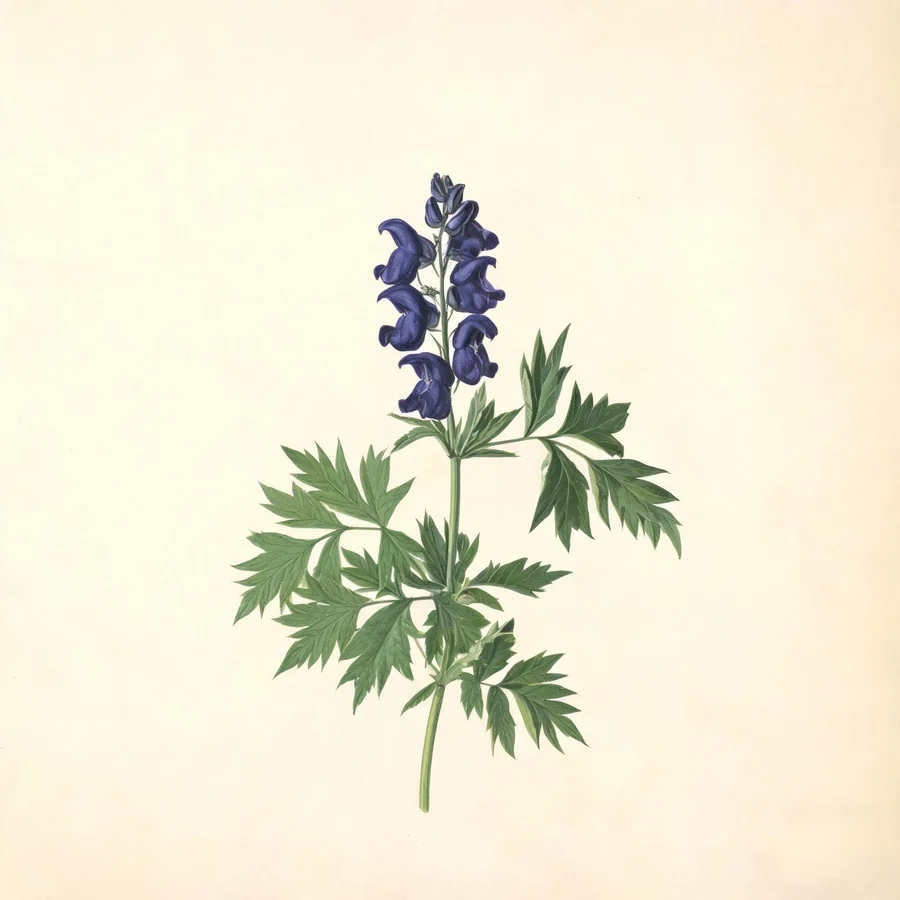
Skin profile
Where this herb sits in skin practice: the pattern it corrects, the skin signs it suits, and what it should not be used for.
Zhi Fu Zi is on this page for one skin picture: cold. Its value is in warming tissue that blood is not reaching, and every other consideration is subordinate to its toxicity, its processing and the fact that it is a practitioner-only substance with a narrow margin.
Skin signs that suggest it
- Fingers or toes that turn white, then blue, then red on cold exposure, with numbness and tingling during the attack
- Chilblains that return each winter: purple-red, itchy and tender swellings on toes, fingers, ears or nose
- Hands, feet, nose or knees that feel cool under the hand and take a long time to rewarm, in a person who feels cold all over
- Numbness or a wooden, dead feeling in the hands and feet with cold, pale skin and no rash
- A pale, swollen, wet tongue, a deep slow pulse, and a strong preference for warmth and warm drinks
When it is not the right herb
Never for skin that is red, hot, swollen, weeping or itching: the hottest herb in the materia medica added to a heat pattern makes it worse, and that covers most eczema, rosacea, acne and infected lesions. It is wrong for Yin deficiency with heat, where night sweats, flushing and a red peeled tongue show that the remaining fluids would be consumed. It is not for a child, for anyone pregnant or breastfeeding, for a person with heart disease or an arrhythmia, or for self-treatment at any age. It is not combined with Ban Xia, Bei Mu, Gua Lou, Tian Hua Fen, Bai Lian or Bai Ji, and it is never taken with alcohol.
What it does for skin
Skin-relevant actions only. Each one describes a mechanism in TCM terms and what it looks like on the skin.
Warms Yang so that blood reaches the surface
The skin picture it addresses is a supply failure at the periphery: cold, pale tissue, sluggish capillaries and a surface that stays cool in a warm room. Fu Zi warms the Kidney and Spleen Yang that the tradition treats as the body's furnace, and because it is described as walking through the channels rather than sitting in one organ, the warmth is carried outward to the hands, feet and face. What changes is colour and temperature at the extremities, not any lesion on the skin itself, and a warm room and warm clothing do much of the same work without any risk.
Disperses cold lodged in the channels and relieves its pain
Cold settled in the small channels produces pain that is severe, fixed, worse in cold weather and relieved by warmth, with joints and skin that feel cold and heavy. The root's acrid heat is said to reach all twelve channels, so it drives out cold that milder warmers do not reach, which is the reasoning behind the pairing with Gui Zhi when cold has settled in the joints. On the skin the visible change is that the livid, mottled colour of cold-exposed skin settles and the tissue feels warmer, and that change is the sign that the dose is doing something.
Restores warmth to tissue that cold has made stiff and thickened
Long-standing cold in the channels is described as making skin and flesh stiff, hard and insensitive rather than merely cool, and the traditional reading of hardening or woody skin includes a cold-stasis pattern. Fu Zi is a supporting herb there, given with blood-moving and channel-opening herbs, and it is never the answer on its own. Hardening, tightening or loss of skin movement needs a diagnosis before any pattern reading, because the treatable causes range far beyond cold and some of them are serious.
Rescues collapsed Yang when the surface goes cold and blue
In the extreme picture, Yang collapses and the extremities go cold and blue with a fading pulse and cold sweat. Fu Zi is the herb the tradition reserves for that state, and the skin sign is the cyanosis of the lips and fingertips. This is a hospital emergency and not a use for a decoction at home; the classical formulas such as Si Ni Tang are recorded here to explain the herb's reputation rather than to offer a treatment for a person who is blue and collapsing, which requires oxygen, monitoring and resuscitation.
Skin conditions it is used for
Mapped to the condition pages on this site. The pattern column shows what the skin is doing when this herb is the right choice.
| Condition | Pattern | Why it suits | Typical setting |
|---|---|---|---|
| Raynaud's disease | Yang deficiency with cold in the channels, blood failing to reach the fingers | Raynaud's is read as Qi and blood not arriving at the fingers, and the pattern that calls for this root is the cold one: white then blue then red on exposure to cold, in a person who is cold all through, with a pale tongue and a deep pulse. Fu Zi warms the Yang at the root and moves through the channels, which is the reasoning behind its place in the warming formulas for the phenomenon. It is an adjunct in a formula and never a single remedy, and any attack that persists, or colour change with ulceration, needs vascular assessment. | Modified Dang Gui Si Ni Tang with Zhi Fu Zi and Gui Zhi |
| Chilblains | Deficient Yang failing to warm the extremities in cold damp weather | A chilblain is a local cold injury in a person whose internal fire is not reaching the toes and fingers, and it recurs because the cause is internal rather than the weather alone. The root's heat is used to warm the channels, dry the cold dampness and settle the pain, in a formula with Gui Zhi and Dang Gui. The lesions themselves are left alone apart from gentle warmth, because rubbing or applying intense heat to numb cold tissue does more damage than good, and broken or ulcerated chilblains need clinical care. | Modified Dang Gui Si Ni Tang, or a warming formula with Gui Zhi and Rou Gui |
| Skin numbness | Cold in the channels with blood not reaching the skin | Numbness means the skin is not receiving Qi and blood, and the cold pattern is the one this root addresses, with pale cool skin, worse in winter, and a deep slow pulse. Its channel-walking heat is paired with blood-moving herbs so that warmth and blood arrive together, since warming alone will not fill vessels that are empty. Numbness that comes on suddenly, or on one side of the body, is a stroke warning and needs emergency assessment rather than a prescription. | Modified Huang Qi Gui Zhi Wu Wu Tang with Zhi Fu Zi |
| Cool or clammy skin sensation | Yang deficiency with cold settling at the surface | Cool, clammy skin is read as the body's warming energy not reaching the surface, and the chronic form of that picture is Yang deficiency, where the person is cold, tired, pale and wants warmth. Fu Zi is the strongest warming herb in the materia medica and is used in a formula to restore the Yang that should be holding the surface warm and dry, with the cold dampness that has collected drained at the same time. Sudden cold clamminess with chest pain, breathlessness or a fading pulse is a cardiac emergency and comes before any pattern reading. | Modified Si Ni Tang, or Zhen Wu Tang for cold dampness with fluid retention |
| Cyanosis | Collapsed Yang with cold blue extremities | Blue lips and fingertips mean blood is not receiving enough fresh Qi, and the tradition's Yang-collapse picture, with cold limbs, a fading pulse and cold sweat, is the extreme form of that. Fu Zi is the herb the tradition reserves for it, and the formulas recorded for it are historical answers to a resuscitation problem rather than a treatment for the home. Modern care for a blue, cold, breathless person is hospital care with oxygen and monitoring; the herb's place here is historical, and its use belongs to specialist practice if it is used at all. | Si Ni Tang, recorded as the classical Yang-rescuing formula |
Combinations for skin
Herbs it is paired with when the skin, not an internal organ, is the target.
| Partner | Ratio | Why the pair is used |
|---|---|---|
| Gan Jiang | 1:1 in Si Ni Tang | An old saying holds that aconite is not hot without dried ginger, and it captures how the two share the task: the root travels, taking warmth out to the limbs and the surface, while dried ginger stays in the middle and dries cold that sits in the Stomach. For a skin picture the pair is used where cold extremities sit on a cold, loose digestion, and it is a formula pair rather than a pair for self-use. Both are heating, so the pair is wrong for any red or itching skin. |
| Gui Zhi | 6 to 10 g Gui Zhi with 3 to 9 g Zhi Fu Zi | Cassia twig warms the channels and releases the surface while the root supplies heat from below, so the two reach the fingertips and the skin over the shoulders at the same time. It is the pairing behind the warming treatment of colour change on cold exposure and of chilblains that return each winter. Both are warming, so the combination belongs to the cold pattern and never to a red, hot or weeping lesion, and the root's processing rules still govern the pair. |
| Gan Cao | 3 to 6 g Zhi Gan Cao with the root | Liquorice is added to control the toxicity as much as to harmonise the formula: the old practice pairs aconite with liquorice, ginseng or fresh ginger expressly to make it safer, and modern chemistry explains why, since the alkaloids form less toxic complexes in its presence. It also protects the middle so that a warming course does not exhaust digestion. It is not a licence to use the root outside supervision, and it does not widen the dose ceiling. |
| Dang Gui | 9 to 12 g Dang Gui with 3 to 9 g Zhi Fu Zi | One warms and moves, the other fills the vessels, which is the logic of treating cold hands and feet: warmth without blood leaves the tissue warm and still empty. The pair is used for dry, cold, livid skin at the extremities and for numbness in a person who is also pale, and it is the pairing inside the warming formulas for cold-type limb pain. Dang Gui is moistening, so it balances the drying heat of the root, though it does not make the root any less toxic. |
Formulas where it leads
- Si Ni Tang (四逆汤) - The classical formula for rescuing Yang, made of Fu Zi, Gan Jiang and Zhi Gan Cao, and recorded for the cold limbs and fading pulse of collapse. It is on this page to explain the herb rather than to recommend it: the picture it treats is a resuscitation emergency, and such a formula belongs to supervised practice with processed root, a long decoction and compatibility herbs. Its logic, warming the root and drying the middle at once, is the logic of every skin use above.
Safety for skin use
What to check before recommending or using it, including the cautions that matter most for skin patients.
Do not use, or use with caution
- Heat in any form. Red, hot, swollen, weeping or itching skin, a red tongue with a yellow coating, or a person who is hot and thirsty: the hottest herb in the materia medica adds fuel to that fire.
- Pregnancy and breastfeeding. Avoided outright: the classical record lists abortion among its effects, aconitine crosses the placenta, and the alkaloids are likely to pass into milk, where an infant cannot clear them.
- An unstable or diseased heart, including any history of arrhythmia. Aconitine works on the ion channels of cardiac muscle and can set off or worsen a dangerous rhythm, so the root is withheld in that situation.
- Liver or kidney impairment. The alkaloids are cleared by hepatic metabolism and renal excretion, so impaired organ function allows them to accumulate even at an ordinary dose.
- Aconite incompatibility. Under the Eighteen Incompatibilities the Wu Tou family is incompatible with Ban Xia, Bei Mu, Gua Lou, Tian Hua Fen, Bai Lian and Bai Ji, and the rule is absolute rather than a caution.
- Children, and anyone outside practitioner supervision. The gap between a helpful and a harmful dose is narrow even in an adult, and a child clears the alkaloids less predictably.
Pregnancy and breastfeeding
Contraindicated. The classical materia medica records abortion as one of its effects, the alkaloid passes the placenta and has produced embryotoxicity in animal studies, and the standard materia medica classes the herb as a pregnancy-caution substance, which in practice means it is not used. The only defensible exception would be collapse that threatens life, and that belongs to specialist care. While breastfeeding it is also avoided, because the alkaloids are lipophilic, likely to pass into milk and unlikely to be cleared by an infant's liver and kidneys, so a safer warming herb is chosen instead. For a skin page the practical answer is simple: cold hands in pregnancy are treated with warmth, movement and milder herbs.
Interactions
- Cardiac glycosides such as digoxin, and anti-arrhythmic medicines such as flecainide, amiodarone and lidocaine. Aconitine acts on cardiac sodium channels, so the combination can be unpredictably arrhythmogenic; those anti-arrhythmics are also part of how a poisoned patient is treated, which makes concurrent use a specialist problem rather than a routine one.
- Blood pressure medicines. The herb affects the cardiovascular system, so the combination can shift pressure unpredictably and needs monitoring rather than assumption, particularly in an older person who is already on several medicines.
- CYP3A4 inhibitors such as erythromycin, ketoconazole or grapefruit, and P-glycoprotein inhibitors. Both can raise circulating alkaloid levels, one by slowing metabolism and the other by blocking efflux, which narrows an already narrow margin.
- Alcohol. Aconitine dissolves in alcohol far more readily than in water, and preparations made with spirits are the commonest setting for aconite poisoning, so the root is never taken with alcohol and never steeped in it.
Allergy and patch testing
A rash or itching after correctly processed aconite has been reported and is a reason to stop rather than to adjust the dose. Because the tingling and numbness of early aconite toxicity can be mistaken for an allergy, any new tingling of the mouth, tongue or face after a dose is treated as poisoning until proved otherwise: stop the herb and seek urgent care. True allergy to the root is uncommon, but a previous reaction to any aconite, including Chuan Wu, rules out the whole group.
General safety references
General references for herbal hepatotoxicity and herb-drug interactions; they are not specific to this herb.
- Review article: Herbal hepatotoxicity - an update on traditional Chinese medicine preparations. Alimentary Pharmacology & Therapeutics, 2014. PMID: 24844799.
- Interactions between herbal medicines and prescribed drugs: an updated systematic review. Drugs, 2009. PMID: 19719333.
- Warfarin and food, herbal or dietary supplement interactions: a systematic review. British Journal of Clinical Pharmacology, 2021. PMID: 32478963.
Evidence
The classical record is quoted with its source. The modern note states the level of evidence plainly.
Classical record
主风寒咳逆邪气,温中,寒湿踒躄,拘挛膝痛,不能行步,破症坚积聚血瘕,金疮。
It governs wind-cold with cough and rebellious pathogenic Qi, warms the middle, and treats cold-damp that causes lameness and contracture with knee pain and inability to walk; it breaks hard accumulations and blood masses and heals metal wounds.
Shen Nong Ben Cao Jing (Divine Husbandman's Classic of Materia Medica) - The oldest text already names cold-damp pain and, in metal wounds, a use on broken skin that later practice developed.
脚疼冷弱,腰脊风寒,心腹冷痛,霍乱转筋,下痢赤白,坚肌骨,强阴,又堕胎,为百药长。
It treats cold weakness and pain of the legs, wind-cold of the lower back and spine, cold pain in the chest and abdomen, cholera with cramping, and dysentery with red and white discharge; it firms muscle and bone, strengthens Yin, and can also cause abortion. It is the chief of the hundred medicines.
Ming Yi Bie Lu (Supplement to the Classic of Materia Medica), Tao Hongjing - The same text that calls it chief of the hundred medicines records that it can end a pregnancy, which is why the safety section here runs longer than the skin section.
俗方每用附子,皆须甘草、人参、生姜相配者,正以制其毒故也。
Common prescriptions that use Fu Zi always combine it with liquorice, ginseng or fresh ginger, precisely in order to control its toxicity.
Ben Cao Jing Ji Zhu (Collected Commentaries on the Classic Materia Medica), Tao Hongjing - The earliest clear statement that the herbs around aconite are there to control it, which is the principle the combination and safety sections follow.
气锋锐,通经络,利关节,寻蹊达径,直抵病所。
Its Qi is sharp and piercing; it opens the channels and frees the joints, finding its way along the pathways straight to the seat of the disease.
Yao Xing Lun (Treatise on Drug Properties), Tang dynasty - The image of the root as a penetrator explains why it is chosen for cold that has settled in the small vessels of the fingers and toes.
Modern evidence
Evidence status
- The pharmacology is established, and it is toxicology rather than efficacy: aconitine and its relatives act on cardiac sodium channels, and poisoning begins within twenty minutes to two hours with tingling, vomiting and weakness, going on in severe cases to ventricular arrhythmia and arrest. No antidote exists, and treatment is supportive and cardiac.
- Processing chemistry is the substance of the modern literature: when the root is boiled, steamed or soaked in brine, the diester alkaloids are hydrolysed into less toxic monoester and amine forms, leaving only some eleven to sixteen per cent of the starting alkaloid content. Even then the decoction is boiled for at least half an hour, and tasted for numbness, before it is given.
- No controlled trial supports the root in Raynaud's phenomenon, chilblains or any skin condition, and the honest position is that its skin use rests on the traditional record. Regulatory status: processed aconite is a restricted, practitioner-only substance in the Chinese Pharmacopoeia, and that restricted status is the main point about it.
PubMed records
Selected real PubMed records for this herb's species or its constituents, chosen by species name and title relevance. They are references for the non-TCM discussion above, not proof that the herb treats any skin condition.
- Total alkaloids of Aconitum carmichaelii Debx alleviate cisplatin-induced acute renal injury by inhibiting inflammation and oxidative stress related to gut microbiota metabolism.. Phytomedicine : international journal of phytotherapy and phytopharmacology, 2024. PMID: 39442279 (skin-related record).
- Insights on neuropharmacological benefits and risks: Aconitum carmichaelii Debx.. Biomedicine & pharmacotherapy = Biomedecine & pharmacotherapie, 2024. PMID: 39527885 (safety record).
Dose and forms
Skin-practice dosing and the preparations that suit skin complaints.
| Form | Dose and notes |
|---|---|
| Decoction | Three to fifteen grams of the processed root, put in first and boiled for a long time, inside a formula and under practitioner supervision. Three to nine grams is usual for chronic cold, and fifteen grams is the ceiling the pharmacopoeia sets. |
| Mandatory decoction time | At least thirty to sixty minutes of boiling, and one to three hours in the old high-dose practice. The traditional test belongs to the dose: taste a little, and keep boiling while the tongue still tingles. |
| Course and timing | Five to seven days on, then two or three days off, so that the alkaloids do not accumulate. It is taken warm, and where interior cold is severe it can be given in smaller portions across the day. |
| Never raw, never in alcohol | Only material that has been boiled, steamed or soaked in salt brine is used, and never the raw root. Alcohol-based preparations are refused, because aconitine dissolves far more readily in alcohol than in water and they are the leading cause of poisoning. |
The dose belongs to a supervised poisonous substance rather than to a household herb, and processing is the safety step that gives the range any meaning at all. Material that still numbs the tongue has not been detoxified, slices that are salty from inadequate soaking or fumigated to improve colour are rejected, and the whole course opens at the lowest dose in the range, so that the patient's tolerance is seen before it is raised. Continuous use is discouraged, and the herb is stopped rather than increased if tingling, nausea, dizziness or palpitations appear. The margin stays narrow even after correct processing.
Citations and further reading
Only real sources are listed: the classical materia medica passages quoted above, and the source works behind the botanical and safety statements.
- Shen Nong Ben Cao Jing (Divine Husbandman's Classic of Materia Medica), attributed compilation of the Han period - classical entry quoted above.
- Ming Yi Bie Lu (Supplement to the Classic of Materia Medica), Tao Hongjing - classical entry quoted above.
- Ben Cao Jing Ji Zhu (Collected Commentaries on the Classic Materia Medica), Tao Hongjing - classical entry quoted above.
- Yao Xing Lun (Treatise on Drug Properties), Tang dynasty - classical entry quoted above.
- Zhi Fu Zi monograph: Pharmacopoeia of the People's Republic of China - processed aconite as a restricted substance, the accepted botanical source and the fifteen gram ceiling.
- Eighteen Incompatibilities (shi ba fan) - the classical list behind the prohibitions on combining Wu Tou with Ban Xia, Gua Lou, Tian Hua Fen, Bei Mu, Bai Lian and Bai Ji.
- Modern evidence statement: based on toxicological and processing chemistry literature on the diester aconite alkaloids, summarised as a statement about the state of the evidence rather than as one cited finding.
- Botanical description and identification: botanical literature on Aconitum carmichaelii, Ranunculaceae.
Educational reference for qualified practitioners. This page is not medical advice, and skin conditions should be diagnosed by a clinician before treatment.