Skin profile
Where this herb sits in skin practice: the pattern it corrects, the skin signs it suits, and what it should not be used for.
Gan Jiang is the warming herb for skin that has gone cold: pale, blue-tinged extremities, chilblains and deep indolent sores that will not fill in. It is the mirror image of the cooling herbs, and it belongs with building and channel-opening partners rather than alone.
Skin signs that suggest it
- Fingers or toes that go white and then blue in the cold, with numbness and a burning return of colour
- Skin that is pale, cool and clammy to the touch, with cold limbs and a strong preference for warmth
- Chilblains: itchy, tender, dusky swellings on the toes, fingers or heels in cold damp weather
- A chronic sore or abscess that is deep, pale, cold and slow to discharge, with little surrounding redness
- A pale, wet tongue with a white coating, a deep slow pulse and a dislike of cold drinks
When it is not the right herb
Not where the skin is red, hot, swollen or oozing, and not in anyone with a red face, thirst for cold drinks and a rapid pulse, because a hot drying herb aggravates that heat. It is not for dry skin with night sweats and a red peeled tongue, where the difficulty is a lack of fluid rather than heat. It is not for a chilblain that has broken down and become infected, which needs wound care rather than warming, and long courses are avoided because the herb dries.
What it does for skin
Skin-relevant actions only. Each one describes a mechanism in TCM terms and what it looks like on the skin.
Warms the interior so that warmth reaches the surface
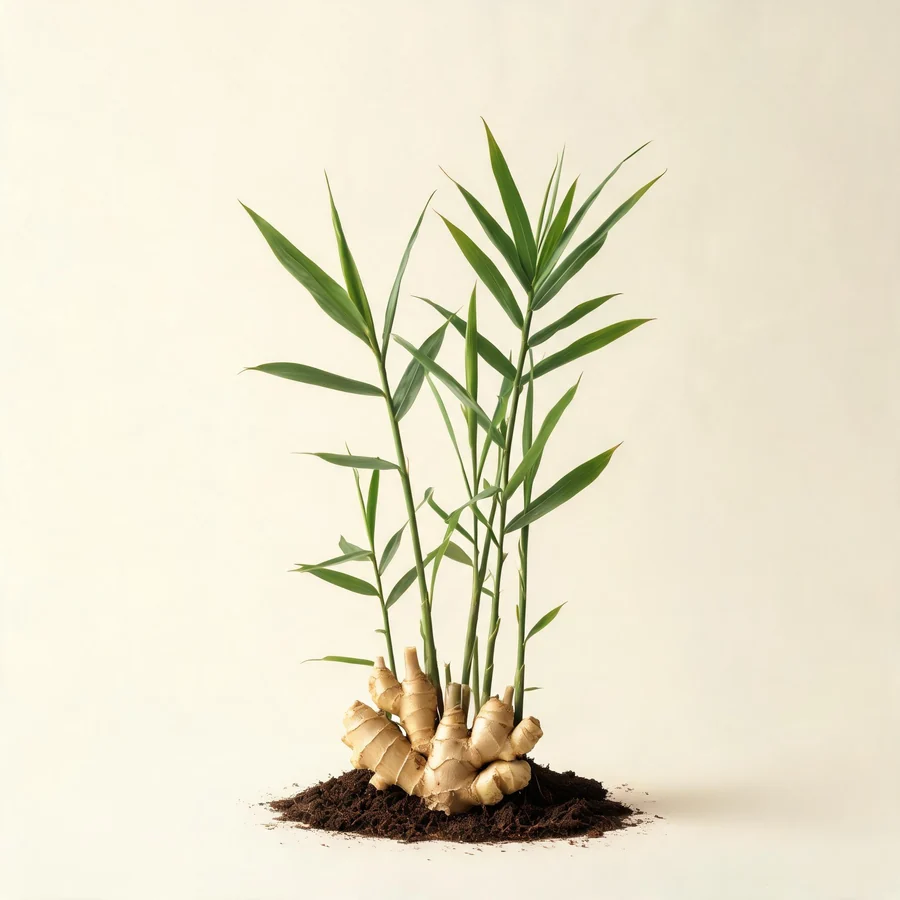
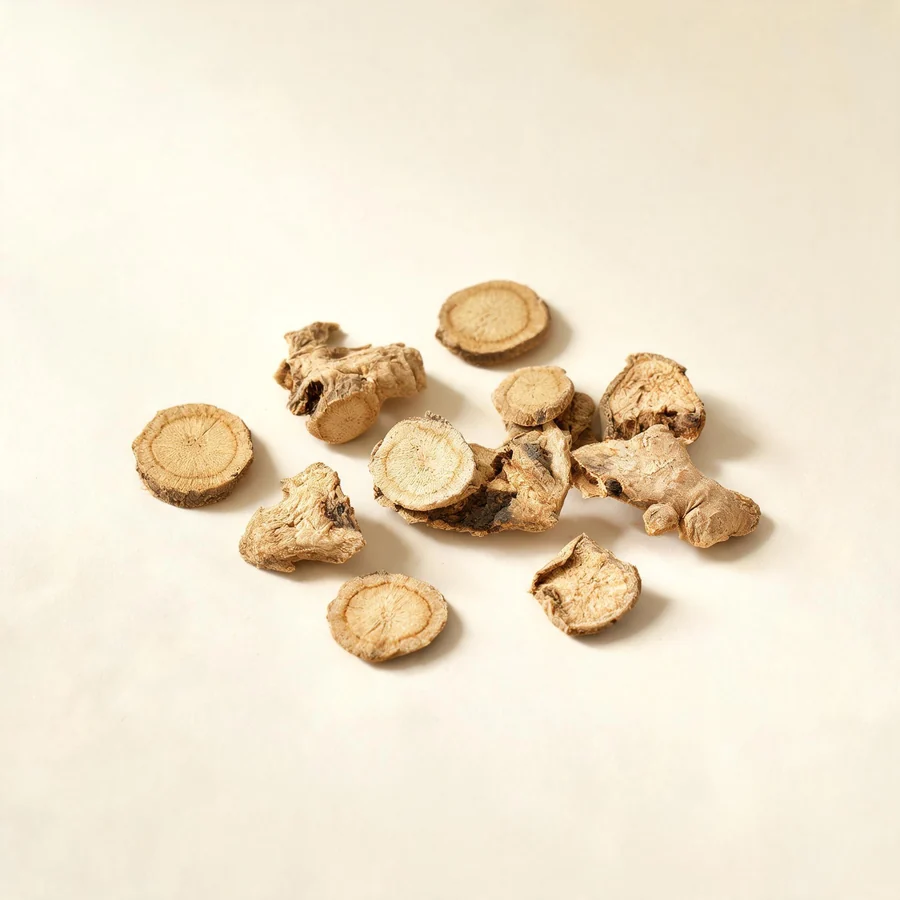
The dried rhizome is described as staying rather than travelling: it heats the centre, and warmth is then distributed outward. That is the reason it suits skin chilled from within, rather than skin chilled by the weather alone. The sign is a cold surface with a cold centre too: cold limbs, a cold abdomen, a pale wet tongue and a dislike of cold drinks.
Opens the channels where cold has narrowed them
Cold stiffens and narrows, and where it has settled in the vessels the skin over them is pale, cool and slow to refill after pressure. Warming the channels restores the movement, which is the reasoning behind its use in chilblains and in the dusky, cold extremities of a Raynaud's pattern. It is a supporting herb in those formulas, which also carry channel-opening and blood-moving partners so that the warmth is distributed rather than merely generated.
Resolves cold phlegm and dries what cold has congealed
Cold congeals fluids into a pale, thin discharge, and the skin equivalent is a cold indolent lesion that weeps thinly and shows no heat. The rhizome warms the Spleen, which the tradition holds responsible for transforming fluids, and warms the Lung, so that the fluid is moved rather than pooling. It is used with drying and transforming partners, and never on its own for a wet surface, since a cold wet lesion needs the cause cleared rather than only warmed.
Warms and builds so that a cold sore can close
A deep, pale, cold abscess or ulcer that will not fill in is read as Yang weakness rather than as infection. Dried ginger appears in the classical formula for such cold sores as the warming member beside the tonic and the channel-opening herbs, and the aim is to restore the circulation that healing needs. It is not a treatment for an infected, spreading or febrile lesion, which needs medical care before any warming herb is considered.
Skin conditions it is used for
Mapped to the condition pages on this site. The pattern column shows what the skin is doing when this herb is the right choice.
| Condition | Pattern | Why it suits | Typical setting |
|---|---|---|---|
| Chilblains | Cold and damp in the vessels of the extremities | Itchy, tender, dusky swellings on the toes and heels in cold damp weather are read as cold that has settled in the small vessels, with warmth unable to reach the surface. The dried rhizome warms the interior and opens the channels, and it is given with blood-moving partners so that warmth and blood arrive together. A chilblain that has broken down or become infected needs wound care, not a warming poultice. | Warm soak of Gan Jiang, with Rou Gui and Dang Gui internally |
| Raynaud's disease | Yang deficiency with cold in the vessels | Fingers that turn white and then blue in the cold, with numbness and a painful return of colour, are read as Yang failing to warm the extremities. The rhizome warms the middle so that heat is generated, while channel-opening partners carry it outward, which is the logic of the classical warming formulas for cold limbs. The condition needs medical assessment, and warming herbs are an adjunct rather than a substitute for it. | Dang Gui Si Ni Tang modified with Gan Jiang and Rou Gui |
| Cyanosis | Yang weakness failing to warm and move the surface blood | Bluish lips, fingers or toes with cold limbs and a deep weak pulse are read as Yang that can no longer drive blood to the surface. Dried ginger is used as the warming anchor while stronger Yang-restoring and blood-moving partners do the rest, and the pattern is one of the classical cold-limb pictures. Cyanosis of sudden onset, with breathlessness or chest pain, is an emergency and is not a herbal situation. | Si Ni Tang with Gan Jiang and prepared Fu Zi, under supervision |
| Cool or clammy skin sensation | Cold in the middle with Yang not reaching the surface | A persistent feeling of cold or clamminess on the skin, with cold limbs, a cold abdomen, loose stool and a pale tongue, is read as cold in the middle burner rather than as a surface problem. The rhizome warms the centre from which the surface is supplied, and it is given with Spleen-building partners so that the warmth is retained. A cold sweat with a faint pulse is a different and more urgent picture. | Li Zhong Wan with Gan Jiang and Bai Zhu |
| Skin abscess | Cold-type deep sore with Yang weakness | A deep, pale, cold swelling that is slow to come to a head and discharges thin fluid is read as a cold abscess rather than a hot one, and it needs warming and building treatment. The classical formula for this picture includes dried ginger as its warming member, working beside a tonic and channel-opening herbs. A hot, red, spreading or febrile abscess is the opposite pattern, and it needs medical care rather than warmth. | Yang He Tang, in which charred ginger is the warming member |
Combinations for skin
Herbs it is paired with when the skin, not an internal organ, is the target.
| Partner | Ratio | Why the pair is used |
|---|---|---|
| Rou Gui | 3 to 6 g Rou Gui with 6 to 10 g Gan Jiang | Cinnamon bark warms Kidney Yang lower and deeper while dried ginger warms the middle and reaches the Lung. Together they cover the centre and the root, so warmth is generated and then carried to the extremities, which is the picture in cold, dusky fingers and toes. Rou Gui also draws floating fire down, which keeps the combination from pushing heat upward. |
| Zhi Fu Zi | roughly 2 : 1 Gan Jiang to prepared Fu Zi, as in Si Ni Tang | The strongest Yang-restoring pair in the tradition: prepared aconite restores Yang at the root while dried ginger warms the middle, and the pattern is cold limbs with a faint pulse and dusky skin. The ratio is deliberate, with the ginger in support rather than in the lead. Fu Zi is aconite and toxic, so the pair belongs to a supervised formula and never to a household recipe. |
| Bai Zhu | 10 g each | The working core of the classical formula for middle deficiency cold: the rhizome brings warmth back to a Spleen that has lost it, while Bai Zhu restores the Spleen’s ability to transform fluids. The pair suits cold, indolent, weeping skin with loose stool, a poor appetite and a cold abdomen. One warms, the other builds, which is why the combination is used for weeks rather than days. |
| Dang Gui | 10 to 15 g Dang Gui with 6 to 10 g Gan Jiang | Dang Gui builds and moves blood while the rhizome supplies the warmth that lets it reach the surface, and the classical compendium describes dried ginger as leading blood-acting medicines into the blood aspect. The pair is used for dusky, cold skin and for slow-healing sores in a depleted person. Warmth without substance does not heal, and substance without warmth does not move. |
Formulas where it leads
- Yang He Tang (阳和汤) - The classical formula for cold-type sores and chronic abscesses, built on Shu Di Huang and Lu Jiao Jiao with Rou Gui, Ma Huang, Bai Jie Zi, charred ginger and Gan Cao. It warms and builds so that a deep, pale, indolent swelling can come to a head and heal, and it is the clearest example of ginger used as the warming member rather than as the leading herb.
Topical use
The dried rhizome is used externally for cold, pale and chilblained skin, usually as a warm soak or a brief poultice applied to restore warmth. The aim is to warm tissue, not to cook it: preparations are comfortably warm rather than hot, they are kept off skin that has broken or lost sensation, and they are removed at the first sign of stinging.
| Preparation | How and when it is used |
|---|---|
| Warm hand and foot soak | Ten to fifteen grams simmered for twenty minutes, then cooled to comfortably warm, makes a soak for ten minutes. Dry the skin carefully afterwards, including between the toes, and do not soak skin that is broken, blistered or numb. |
| Warming poultice | Ground rhizome is mixed with a little warm water to a paste and applied over a chilblain for ten to fifteen minutes, or spread thinly on the soles. It is removed at once if it stings, and it is never left on while the person sleeps. |
| Compress for a cold indolent sore | A cloth wrung out in the warm decoction is held over the area for a few minutes to encourage circulation, then the skin is dried and protected. A sore that is spreading, foul-smelling or accompanied by fever is a medical problem and is not treated with warmth. |
Patch test and cautions
Ginger preparations can burn, so the paste is warm rather than hot and is tested on the inner wrist first. Do not apply to skin that is broken, blistered, infected or numb from neuropathy, do not use it on the face or near the eyes, and stop if the skin becomes redder, drier or more painful. External warmth does not correct a circulation problem that needs medical assessment.
Safety for skin use
What to check before recommending or using it, including the cautions that matter most for skin patients.
Do not use, or use with caution
- Yin deficiency with empty heat: night sweats, a dry mouth, a red peeled tongue, heat felt in the palms and soles, with a thin and rapid pulse. What is missing is fluid, and a hot drying herb makes the lack worse; the same applies to a dry cough with scanty sticky sputum.
- Excess heat anywhere: fever, a red face, a yellow coating and a craving for cold drinks, with bright red bleeding and a rapid pulse. Dried ginger aggravates these, and the most dangerous form of the error is heat in the blood that is already causing nosebleeds or vomiting of blood.
- Dry, hot or inflamed skin: a red, hot, weeping lesion, a flushed rosacea, or a chilblain that has ulcerated. Warming the surface adds to the heat and can drive infection deeper rather than resolve it.
- Long courses without review: long use is held to injure Yin, so a course is reviewed rather than run on indefinitely, and pregnancy is a use-with-caution situation, not a routine one.
Pregnancy and breastfeeding
Use with caution rather than avoidance. The Jin Gui Yao Lue gives a dried ginger formula for stubborn vomiting of pregnancy, and that is the traditional basis for using it where cold clearly predominates. It is not permission to treat oneself: the dose stays modest, the problem defined, the course short, and a practitioner weighs the herb against the alternatives. A warm preparation on the skin in pregnancy is kept small and brief, since a hot poultice is a different matter from a warm one.
Interactions
- Anticoagulants and antiplatelet drugs: in laboratory work the pungent constituents of ginger reduce platelet clumping, and there are case reports of a rising INR when ginger supplements are taken alongside warfarin. A decoction contains little, but daily medicinal amounts should be mentioned to a prescriber, and ginger is usually stopped before surgery.
- Blood sugar medicines: ginger has been reported to lower glucose and improve insulin sensitivity, so regular use alongside insulin, metformin or a sulfonylurea calls for closer monitoring. Much of that work used concentrated extracts rather than decoctions.
- Antihypertensive medicines: a mild vasodilating effect could add to blood pressure drugs and cause dizziness on standing, which matters for an older person already taking several medicines.
- Topical rubefacients and warming plasters: applying a ginger paste at the same time as a capsaicin or menthol rub adds to the irritation and the burn risk, so the two are kept apart in time and never layered.
Allergy and patch testing
Irritant and allergic reactions to ginger on the skin are recognised, and the usual problem is burning or redness from the fresh juice rather than a true allergy. A paste or soak is patch tested on a small area of normal skin for twenty four hours before it goes on a chilblain, and it is kept off the face, the eyelids and broken skin. Stop if the area becomes more painful, blistered or spreading.
General safety references
General references for herbal hepatotoxicity and herb-drug interactions; they are not specific to this herb.
- Review article: Herbal hepatotoxicity - an update on traditional Chinese medicine preparations. Alimentary Pharmacology & Therapeutics, 2014. PMID: 24844799.
- Interactions between herbal medicines and prescribed drugs: an updated systematic review. Drugs, 2009. PMID: 19719333.
- Warfarin and food, herbal or dietary supplement interactions: a systematic review. British Journal of Clinical Pharmacology, 2021. PMID: 32478963.
Evidence
The classical record is quoted with its source. The modern note states the level of evidence plainly.
Classical record
干姜干久,体质收束,气则走泄,味则含蓄,比生姜辛热过之,所以止而不行,专散里寒。
Dried for a long time the rhizome’s substance contracts: its Qi still disperses while its flavour stays held in. It is hotter and more pungent than the fresh root, and because of that it remains in place rather than moving on, and its work is interior Cold.
Yao Pin Hua Yi (Analysis of Medicinal Properties) - No other passage states so plainly why drying turns the herb’s direction inward, and it is the origin of the later saying about ginger that guards versus ginger that moves. It is the reason the dried rhizome is used on cold that has settled rather than on the surface.
干姜,能引血药入血分、气药入气分。又能去恶养新,有阳生阴长之意,故血虚者用之。
Dried ginger is able to carry a blood medicine into the blood layer and a Qi medicine into the Qi layer. It takes away the stale and feeds the new, which is the sense in which Yang arising lets Yin grow, and it is for that reason given where blood is deficient.
Ben Cao Gang Mu (Compendium of Materia Medica), Li Shizhen - Li Shizhen describes a director as much as a warmer: the rhizome steers other herbs towards their target, which is how it works in a cold sore formula where the tonics do the building.
干姜,味辛,温。主胸满咳逆上气,温中止血,出汗,逐风湿痹,肠澼下利。生者尤良。
Dried ginger is pungent and warm. It governs fullness in the chest with cough and rebellious Qi; it warms the centre and arrests bleeding, promotes sweating, drives out wind-damp with painful obstruction, and for dysenteric diarrhoea it is also used; the fresh root is held to be better still.
Shen Nong Ben Cao Jing (Divine Husbandman's Classic of Materia Medica) - The oldest notice already separates the dried from the fresh root, the distinction on which the skin use depends: the dried article warms the interior, and the fresh one works at the surface.
Modern evidence
Evidence status
- In laboratory work the pungent constituents of ginger reduce platelet clumping, and case reports describe a rising INR when ginger supplements are taken alongside warfarin. A decoction provides only a little, yet daily medicinal amounts are worth mentioning to a prescriber, and ginger is usually stopped before surgery.
- Ginger has been reported to lower glucose and improve insulin sensitivity, mostly in studies of concentrated extracts rather than decoctions. No trial has tested dried ginger as a treatment for a skin condition, and the traditional indications for cold, pale and indolent skin are recorded practice rather than demonstrated outcomes.
- The dried rhizome is an accepted herbal substance in the Chinese Pharmacopoeia, where it is listed separately from the fresh root. The regulatory entry confirms identity and quality rather than any claim of benefit.
PubMed records
Selected real PubMed records for this herb's species or its constituents, chosen by species name and title relevance. They are references for the non-TCM discussion above, not proof that the herb treats any skin condition.
- A Novel Biocompatible Herbal Extract-Loaded Hydrogel for Acne Treatment and Repair.. Oxidative medicine and cellular longevity, 2021. PMID: 34765083 (skin-related record).
Dose and forms
Skin-practice dosing and the preparations that suit skin complaints.
| Form | Dose and notes |
|---|---|
| Decoction | Three to ten grams of the dried rhizome daily inside a formula. Three to six grams warms the centre gently, six to ten grams works on the Lungs and channels, and the large classical amounts belong to collapse and are given with prepared aconite under supervision. |
| Charred and sand-fried forms | Frying with hot sand until the surface browns produces a warmer, more staunching article that is treated as a different medicine. It is the form chosen for cold-type bleeding and for a very cold, weak digestion, not a stronger version of the plain rhizome. |
| Course length | Two to four weeks for a chronic cold pattern, with review. A sore throat, dry mouth or irritability while taking it means the amount is too high for that person or the course has run long enough. |
| External use | A warm soak or a brief poultice for ten to fifteen minutes on intact skin, tested on the wrist first. It is not left on overnight, and it is not repeated while the skin is already red and sore. |
One range covers several jobs: a little warms the centre, a moderate amount works on the Lungs and channels, and the large classical figures belong to collapse, where the rhizome is paired with aconite in the rescue formulas. Classical weights do not translate into modern ones, so the heroic figures in the Shang Han Lun cannot be converted straight into a prescription. Dry mouth, a sore throat or irritability while taking it means the amount is too much for that person.
Citations and further reading
Only real sources are listed: the classical materia medica passages quoted above, and the source works behind the botanical and safety statements.
- Shen Nong Ben Cao Jing (Divine Husbandman's Classic of Materia Medica), attributed compilation of the Han period - classical entry quoted above.
- Ben Cao Gang Mu (Compendium of Materia Medica), Li Shizhen, 1578 - classical entry quoted above.
- Yao Pin Hua Yi (Analysis of Medicinal Properties), classical materia medica - classical entry quoted above.
- Gan Jiang (Rhizoma Zingiberis) monograph: Pharmacopoeia of the People's Republic of China - source for the accepted botanical source, part used and the separate listing of the dried and fresh rhizomes.
- Modern evidence statement: based on pharmacological literature on gingerols and shogaols and on case reports of bleeding with anticoagulants, summarised as a statement about the level of evidence rather than as a cited trial.
- Botanical description and identification: botanical literature on Zingiber officinale, Zingiberaceae.
Educational reference for qualified practitioners. This page is not medical advice, and skin conditions should be diagnosed by a clinician before treatment.