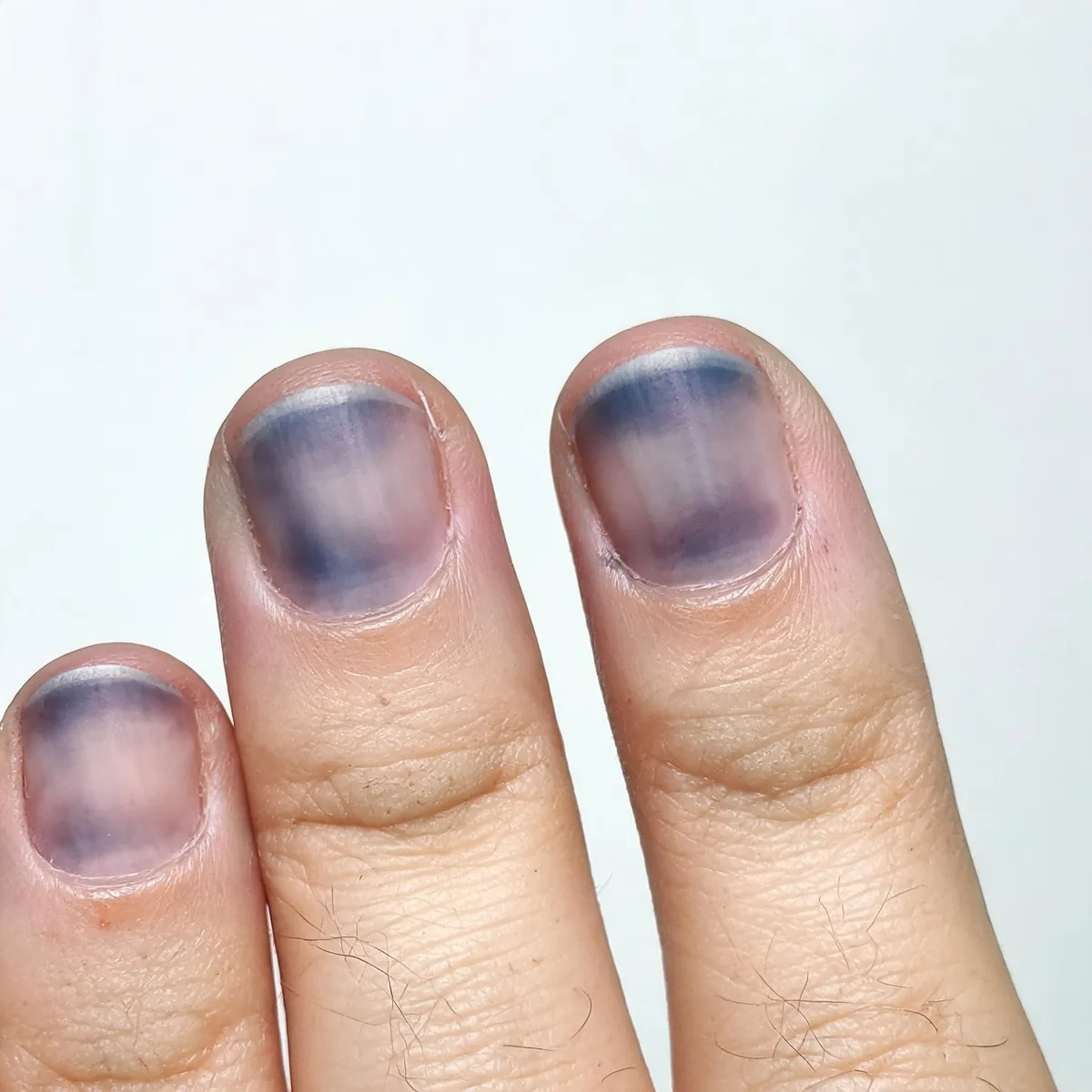
Understanding Cyanosis
The tradition describes cyanosis through Blood and Qi movement: the Heart governs Blood and vessels, the Lungs govern Qi and respiration, and when either is weak or obstructed the blood darkens.
It is rarely only a Heart or Lung problem. The classical literature also considers the Spleen and Kidneys, since Yang deficiency or water overflow can produce the same darkness at the surface.
Qi deficiency causing Blood stagnation gives blue-purple lips, nail beds or skin with deep fatigue, breathlessness on mild exertion and fixed stabbing pain. Blood stagnation alone gives fixed stabbing pain worse at night, dark lips and nail beds and dark clotted menstrual blood.
Empty-Heat from Yin deficiency gives dry purplish lips with night sweats and malar flush. Kidney Yang deficiency with water overflow gives swollen legs, cold lower back and bluish skin around the eyes and lips. Damp-Phlegm in the Lungs gives a cough with copious white sticky phlegm and chest fullness, and Qi and Yin deficiency gives bluish lips with extreme fatigue, dry mouth and night sweats.
The framework starts from the vessels rather than the skin. The Heart governs Blood and the vessels, the Lungs govern Qi and respiration, and the two are described as a single circuit: Blood needs the push of Qi and the freshness that breathing supplies, and when either is missing the colour of the Blood darkens and shows through the lips, nail beds and face, where the vessels lie closest to the surface. That is why the classical literature insists the tint is rarely only about oxygen.
Around that central circuit sit the organs that make and warm the Blood. The Spleen is the source of Blood, so a weak Spleen produces thin, insufficient Blood that cannot fill the surface vessels. The Kidneys hold the body's fundamental Yang, the warmth that keeps Blood moving, so Cold from a Kidney deficiency slows and congeals it. Three mechanisms are separated: Qi too weak to push, Cold that congeals, and Heat that thickens. A fourth is added, Phlegm-Dampness filling the chest so that the Lungs cannot take in fresh air and pass it on.
The result is that one blue tint can arise from six quite different states, and the classical literature works through them to show why the distinction matters in practice. A pale and exhausted person whose lips are blue and whose pulse is weak has an engine too weak to circulate Blood. Dark purple lips with stabbing chest pain and a choppy pulse mean something is physically blocking flow. Dry purple lips with night sweats and a thin rapid pulse follow from a lack of cooling fluids. Cold limbs with swelling belong to Yang deficiency and water, a greasy coat and dull tint to Phlegm, and bluish lips with dryness and a sense of overheating to combined Qi and Yin deficiency. Each needs a different treatment even though the sign looks the same.
Differentiation begins with one question: is the tint there because too little force sits behind the Blood, or because something is in its way? Stagnant Blood and Phlegm belong with obstruction, since both occupy the channels and narrow the passage. Weak Qi, depleted Yin and cold Kidney Yang belong with deficiency, where the vessels are open but there is too little strength or warmth to fill them. An obstructive picture is treated by moving and dredging, a deficient one by building and warming, and the classical literature is explicit that the same blue tint calls for a different strategy in each case. Getting that division right matters more than naming the shade, because the two directions of treatment pull against each other.
The classical account quoted in the classical literature comes from the Su Wen chapter of the Huang Di Nei Jing, where Cold settling in the channels and vessels makes the Blood congeal, and congealed Blood no longer moves freely; the colour turns blue-purple and pain follows, and the same chapter adds that warmth stops the pain at once. That one sentence underlies three of the six patterns, because Cold can arrive from outside, be generated by weak Kidney Yang, or travel with fluid the body has failed to clear. Heat works the other way, scorching and thickening what it touches, while Phlegm fills the chest and keeps fresh air from reaching the Blood at all.
None of this makes the colour itself the target. The tint is read as evidence, and the classical literature expects it to fade as the pattern is corrected, with lips and nail beds often returning to a healthy pink within weeks to a few months once the root is treated rather than the surface.
Conventional view
In Western medicine cyanosis is a bluish discolouration of skin and mucous membranes caused by increased deoxygenated haemoglobin. Central cyanosis on the lips and tongue points to heart or lung problems impairing oxygenation, while peripheral cyanosis in the fingers and toes often reflects cold exposure or poor circulation. Diagnosis uses pulse oximetry, blood gas analysis and imaging to find the underlying cause.
Treatment corrects that cause: oxygen therapy and bronchodilators for respiratory cyanosis, medication to improve cardiac output or surgery for congenital defects, and warming measures and vasodilators for peripheral cyanosis from cold or Raynaud's phenomenon. In every case the blue colour is treated as a symptom of a deeper process.
Conventional medicine excels at identifying life-threatening causes, but when cyanosis is chronic or mild patients are often told nothing more can be done if the underlying disease is stable, and the bluish tint may persist and cause worry. TCM reads the discolouration as a direct reflection of Qi, Blood, warmth and moisture, and works to correct those imbalances, often improving the complexion even when the Western diagnosis is unchanged.
Selected PubMed records
Real PubMed records for the conventional discussion above, selected by condition name and title relevance. They are references, not a claim that any treatment is proven for this condition.
- The terminology of skin disorders. Primary Care, 2000. PMID: 10815043.
How it connects
Three companions are recorded for cyanosis, and each shares the pattern rather than merely the symptom. Angina appears alongside it because both can rest on Blood Stagnation, or on Qi too weak to move Blood, so the same stasis that darkens the lips also produces chest pain, and easing the stagnation helps both. Asthma clusters with the Phlegm picture, since Phlegm blocking the descent of Lung Qi spoils the exchange of air and the tint deepens during a wheezing episode. Anaemia seems to be the opposite case, yet severe Blood Deficiency can leave a pale-bluish hue, and where Qi is short as well the Blood never reaches the surface. Because the root is shared, treating one complaint often eases the others.
How it is assessed
The first step is always to establish whether oxygen levels are dangerously low.
What a practitioner looks for
- Onset: sudden blue lips, face or tongue is an emergency.
- Distribution: lips, nail beds and fingertips suggest central or peripheral oxygen problems.
- Associated signs: chest pain, breathlessness, confusion or collapse.
- Chronic picture: fatigue, swelling and cough point to the underlying organ patterns.
The first thing established is not the pattern but the colour and where it sits, because both change with warmth, activity and rest. Lips, tongue and face suggest a central problem of oxygenation, while fingertips and nail beds that recover when warmed point to the periphery. From there the practitioner separates deficiency from excess: a pale complexion, a weak voice and exhaustion with a weak forceless pulse and a pale tongue with purple spots indicate Qi deficiency failing to move Blood, whereas fixed stabbing pain with a dark purple tongue, stasis spots and a choppy pulse indicates a blockage that rest does not relieve.
Dryness and heat form a separate group. A dry deep purple tongue with night sweats, a dry mouth and heat in the palms and chest, a thin rapid pulse and a darker drier tint mean Empty-Heat from Yin deficiency, the Blood being scorched and thickened. Cold with swelling is the Yang picture: pale or bluish skin, cold limbs, swollen lower legs, a pale puffy wet tongue and a deep weak pulse. A thick greasy coat with a slippery pulse and a cough of copious white phlegm ties the tint to respiratory congestion, and the least common combination, dryness with exhaustion and a weak rapid pulse, is recorded as Qi and Yin deficiency together.
TCM patterns in Cyanosis
Differentiation rests on three observations: whether the tint looks dry or wet, whether the limbs are cold or warm, and whether pain is fixed. A dry purple colour with heat in the palms and a thin rapid pulse is Yin deficiency with Empty-Heat. A dark purple colour with stabbing pain that stays in one place and worsens at night is Blood Stagnation. Blue lips with profound fatigue and breathlessness on slight effort, without a fixed site of pain, is Qi deficiency failing to move Blood, and once coldness and swelling are added the reading moves to Kidney Yang deficiency with water overflowing. A dull tint with a greasy coat and copious phlegm belongs to the Lungs, and bluish lips with dryness and overheating at once is the mixed Qi and Yin picture.
| Pattern | Key signs | The itch | Tongue | Main formula |
|---|---|---|---|---|
| Qi Deficiency causing Blood Stagnation | Blue-purple lips, nail beds or skin; Fixed stabbing pain worse with pressure | Not specified | Body: Pale-dark or pale-purple, teeth-marked, possibly with stasis spots and dark sublingual veinsCoat: Thin white | Not specified |
| Blood Stagnation | Fixed stabbing pain that does not move; Pain worse at night | Not specified | Body: Purple, dusky or with dark stasis spots; sublingual veins dark and distendedCoat: Often thin white; a yellow coat would suggest Heat as the cause | Not specified |
| Empty-Heat caused by Yin Deficiency | Dry purplish lips and tongue; Dry mouth and throat at night | Not specified | Body: Red, thin and dry, often crackedCoat: Little or none; the tongue may look peeled | Not specified |
| Kidney Yang Deficiency with Water overflowing | Swelling of legs and ankles; Bluish skin around eyes and lips | Not specified | Body: Pale, puffy and teeth-markedCoat: White and slippery, with a very wet surface | Not specified |
| Damp-Phlegm in the Lungs | Not specified | Not specified | Body: Pale, swollen and teeth-markedCoat: Thick white greasy, with a wet surface | Not specified |
| Qi and Yin Deficiency | Dry mouth and throat | Not specified | Body: Red or pale-red, thin and dry, possibly crackedCoat: Thin or absent | Not specified |
Qi Deficiency causing Blood Stagnation
Blue lips and nail beds with deep fatigue and breathlessness.
Qi is described as the force that drives Blood through the vessels. When it is weak the push falters, flow slows, and Blood pools in the periphery, which is why the lips, nail beds and skin take on a blue purple colour and why the face looks dusky with a greyish tinge. The same weakness explains the rest: deep persistent fatigue, breathlessness on mild exertion, dizziness and light headedness all follow from an engine that cannot keep up, rather than from a blockage inside the vessel itself.
The tongue is pale with a dark or purplish tinge, purple spots or stasis dots at the edges, sometimes slight swelling with teeth marks and distended veins beneath the tongue, and the pulse is deep and fine or weak with a rough choppy quality. Overexertion and prolonged standing, cold environments, cold raw or greasy food and worry all make it worse, while gentle regular movement, warmth and warm food, adequate rest and small frequent meals help. Bu Yang Huan Wu Tang is the formula named for it, built on Huang Qi with Dang Gui and Chuan Xiong. The points are ST-36 Zusanli, SP-10 Xuehai, SP-6 Sanyinjiao and LR-3 Taichong.
Signs
- Blue-purple lips, nail beds or skin
- Deep persistent fatigue
- Shortness of breath on mild exertion
- Fixed stabbing pain worse with pressure
Diet and lifestyle for this pattern: Eat small, warm, cooked meals that are easy to digest, such as soups, stews and congees, with Qi-building food such as beef, chicken, sweet potato and ginger, plus a little black rice vinegar or turmeric to move Blood. Avoid cold, raw and greasy food, keep daily movement gentle but regular and stop before exhaustion, protect against cold and rest well.
Blood Stagnation
Fixed stabbing pain with dark lips and nail beds.
Here the problem is obstruction rather than weakness. Blood that cannot move nourishes nothing, and the skin takes on a dark purplish or bluish hue, most visibly over the lips, nail beds and face, where circulation is easiest to see. Over time the pooled Blood darkens further, which is why the discoloration becomes dusky and fixed, and why the pain that accompanies it is stabbing, stays in one place and is worse at night.
The tongue body is dark purple with stasis spots, distended dark sublingual veins and a thin white coat, and the pulse is choppy, rough and uneven. Cold weather and cold food, prolonged sitting, stress and emotional upset, injury and heavy greasy meals all aggravate it; warmth, gentle movement such as walking, warming spices, stress relief and massage or acupressure help. Xue Fu Zhu Yu Tang is the formula named for this pattern, with Dan Shen and Chuan Xiong as the key herbs. The points are SP-10 Xuehai, BL-17 Geshu and LR-3 Taichong.
Signs
- Fixed stabbing pain that does not move
- Pain worse at night
- Dark purplish lips and nail beds
- Dark clotted menstrual blood
- Worse with cold
Diet and lifestyle for this pattern: Keep warm and avoid cold food and drinks that congeal Blood. Add warming spices such as turmeric, ginger and cinnamon to meals, keep moving with gentle daily exercise, avoid long stretches of sitting, and manage stress, since emotional tension worsens stagnation.
Empty-Heat caused by Yin Deficiency
Dry purplish lips with night sweats and malar flush.
Yin is the cooling, moistening side of the body, and when it is insufficient it no longer anchors the body's warmth. The result is a deceptive empty heat that rises and dries the fluids, and that heat slowly scorches the Blood, making it thick, sticky and slow. The tint that follows is bluish purple but noticeably dry, on the lips and tongue as much as on the nail beds, and it comes with a parched feeling rather than with coldness.
The tongue is red, thin and dry with cracks and little or no coat, and the pulse is fine and rapid. Alcohol and coffee, spicy and fried food, late nights and overwork, hot weather or saunas and anger worsen it, while a cool humid environment, frequent sips of water, rest and early nights, moistening food such as pear, and gentle movement help. Zhi Bai Di Huang Wan is the formula named for the pattern, with Mu Dan Pi and Dan Shen, and the points are SP-6 Sanyinjiao, KI-3 Taixi, SP-10 Xuehai and KI-6 Zhaohai.
Signs
- Dry purplish lips and tongue
- Night sweats
- Five-palm heat
- Dry mouth and throat at night
- Malar flush
Diet and lifestyle for this pattern: Eat moistening, cooling food such as pear, lily bulb and white fungus to replenish Yin. Avoid spicy, fried and drying food that consumes fluids, go to bed early rather than staying up, and keep exercise gentle such as tai chi or walking so Blood circulates without overheating.
Kidney Yang Deficiency with Water overflowing
Swollen legs with cold lower back and bluish lips.
The Kidneys hold the body's fundamental Yang, the warmth that propels Blood, and they also govern the transformation of water. When that Yang is deficient two things go wrong together: internal Cold congeals the Blood and slows it, and the Kidneys fail to manage water, so fluid accumulates and presses on the vessels. That double obstruction is why the colour is pale or bluish rather than purple, why it shows most around the eyes and lips and in the lower body, and why swelling, coldness and scanty urine arrive as a set.
The tongue is pale, puffy and teeth marked with a white slippery coat and an excessively wet surface, and the pulse is deep, slow and weak, most of all at the chi position. Cold weather and drafts, raw and cold food, long periods of standing, heavy fluid intake and chronic fear or stress make it worse, while warm socks and heating pads, warm cooked meals, gentle walking, rest with the legs raised and ginger tea help. Zhen Wu Tang is the formula named for it, with Zhi Fu Zi, Bai Zhu and Fu Ling, and the points are BL-23 Shenshu, DU-4 Mingmen, REN-4 Guanyuan, ST-36 Zusanli and SP-6 Sanyinjiao.
Signs
- Swelling of legs and ankles
- Coldness in lower back and legs
- Scanty or difficult urination
- Bluish skin around eyes and lips
- Sore weak lower back
Diet and lifestyle for this pattern: Eat warm cooked food such as soups and stews with ginger and cinnamon, and avoid raw, cold and Dampness-producing food such as dairy, cold drinks and raw salad. Keep the lower back and feet warm, walk gently or practise tai chi to move fluids without depleting Yang, and raise the legs when sitting to reduce swelling.
Damp-Phlegm in the Lungs
Cough with copious white phlegm and chest fullness.
The Lungs govern Qi and respiration. When Dampness and Phlegm accumulate they block the Lungs' ability to descend Qi and to exchange fresh air, so oxygenation suffers at its source. The stagnant Phlegm also obstructs the movement of Blood, and the combination produces a dull bluish tint on the skin, lips and nail beds, most noticeable in the face and extremities. The picture is cold and heavy rather than hot, which is why the phlegm is white and sticky and the person feels weighed down.
The tongue is pale and swollen with teeth marks and a thick white greasy coat, and the pulse is slippery, possibly soggy. Cold damp weather, overeating, rich greasy food, lying down too much and emotional stress worsen it, while a warm dry environment, light exercise, expectoration, warm cooked food and avoiding dairy and greasy food help. Er Chen Tang is the formula named for this pattern, often combined with Dan Shen, and the herbs are Ban Xia, Chen Pi, Fu Ling and Dan Shen. The points are ST-40 Fenglong, LU-1 Zhongfu, BL-20 Pishu and SP-10 Xuehai.
Signs
- Cough with copious white sticky phlegm
- Fullness and heaviness in the chest
- Poor appetite with loose stools
- Body heaviness and fatigue
- Pale complexion
Diet and lifestyle for this pattern: Avoid cold, raw and greasy food that creates Dampness. Eat warm cooked meals such as congee with ginger, keep moving gently to circulate Qi and clear phlegm, and keep the chest warm and dry.
Qi and Yin Deficiency
Bluish lips with extreme fatigue and dryness.
The two deficiencies work together. Qi pushes Blood, so when Qi is insufficient the push weakens and Blood does not reach the surface, so lips and nail beds stay pale or faintly blue. Yin cools and moistens, so when Yin is insufficient an empty heat dries and thickens the Blood, making it sluggish. The combination produces a cyanotic hue, often most obvious around the mouth, with a red dry tongue and the contradictory feeling of being tired and overheated at the same time.
The tongue is red with a thin or absent coat, dry and sometimes cracked, and the lips appear bluish purple; the pulse is fine, weak and often rapid. Overwork and stress, spicy and fried food, hot dry weather and excessive sweating worsen it, while rest and sleep, gentle movement, warm non spicy soups and a cool humid environment help. Sheng Mai San is the formula named for this pattern, with Ren Shen, Mai Dong and Wu Wei Zi, and the points are ST-36 Zusanli, KI-3 Taixi and SP-10 Xuehai.
Signs
- Bluish-purple lips and nail beds
- Extreme fatigue and weakness
- Dry mouth and throat
- Night sweats
- Dizziness
Diet and lifestyle for this pattern: Put rest first and avoid overexertion. Eat small, frequent, nutrient-dense meals such as congee with goji berries and yam, stay hydrated with warm water, and avoid spicy, fried or drying food that uses up Yin.
Treatment approach
How the tradition treats cyanosis, with the herbs, formulas and points used for it.
Principles
- Assess urgently: cyanosis is a sign of a medical problem, not a standalone condition.
- Support Qi and move Blood where the pattern is chronic and the cause is known and treated.
- Warm Yang and drain water where there is swelling and coldness.
- Transform phlegm where the lungs are congested, in coordination with medical care.
- The single aim is to restore a smooth, warm flow of Blood, and the strategy is chosen by the obstacle in the way: breaking stasis with Dan Shen and SP-10 Xuehai, building the force that pushes with Huang Qi and ST-36 Zusanli, warming Yang with Zhi Fu Zi and moxibustion at DU-4 Mingmen, nourishing Yin and cooling Blood with Di Huang and Mu Dan Pi, or drying Phlegm, using Ban Xia and Chen Pi. Because most people present with more than one of these at once, the classical literature notes that formulas are usually modified rather than used as written.
Herbs used
Formulas
- Bu Yang Huan Wu Tang
- Xue Fu Zhu Yu Tang
- Zhi Bai Di Huang Wan
- Zhen Wu Tang
- Er Chen Tang
- Sheng Mai San
Acupoints
- ST-36 (Zusanli)
- SP-10 (Xuehai)
- SP-6 (Sanyinjiao)
- LR-3 (Taichong)
- BL-17 (Geshu)
- KI-3 (Taixi)
- KI-6 (Zhaohai)
- BL-23 (Shenshu)
- DU-4 (Mingmen)
- guanyuan-ren-4
- ST-40 (Fenglong)
- LU-1 (Zhongfu)
- BL-20 (Pishu)
What to expect
- The classical literature does not describe cyanosis resolving with herbs alone; treating the underlying cause is the priority.
- Chronic patterns improve as the cardiac or respiratory condition is managed.
- Sudden cyanosis requires emergency care, not treatment at home.
- Two weeks of weekly treatment is enough to judge only the direction of travel, since warmth in the hands and feet and better energy usually arrive before the colour changes. Excess patterns are expected to fade within a month or so, deficiency patterns need several months, and the formula is reviewed as the tongue and pulse change.
Safety and when to get help
Seek medical help urgently for
- Sudden blue lips, face or tongue, especially appearing within minutes.
- Cyanosis with chest pain or pressure.
- Cyanosis with breathlessness, confusion, or fainting.
For anything severe, sudden or spreading quickly, read when a skin problem needs urgent care.
Cautions
- Cyanosis always needs medical assessment of heart and lung function.
- Do not delay emergency care to try herbs.
- Oxygen therapy and prescribed medication should not be altered without advice.
Using this alongside conventional care
- This page is complementary only: the underlying cardiac or respiratory condition requires medical management, and herbs are used for the constitutional pattern once the cause is known.
- Herbs and acupuncture are described as compatible with oxygen therapy and most cardiac medication, which makes them a complement rather than a substitute. The caution is bleeding risk: Dang Gui, Chuan Xiong and Dan Shen have mild antiplatelet effects and need reviewing if the person is on an anticoagulant or antiplatelet drug. A full medication list belongs in the consultation, and no prescribed medicine is stopped without the prescriber's agreement, since the cyanosis is usually the visible edge of a condition that medicine is already managing.
Diet and lifestyle
- Warm cooked food is advised, with ginger, cinnamon and turmeric used to warm the body gently, and cold food avoided.
- Warm cooked food is the base: soups, stews and steamed vegetables, with ginger, cinnamon and turmeric used to warm the body and encourage flow. Cold raw food and iced drinks are avoided because they constrict the vessels and add internal Cold, and greasy, fried and dairy heavy food is reduced because it creates the Dampness and Phlegm that obstruct circulation. Beyond that, the pattern decides the additions: beef, chicken, sweet potato and a little black rice vinegar where Qi is deficient, pear, lily bulb and white fungus where Yin is dry, and warm congee with ginger where Phlegm is the problem.
If you're pregnant
In pregnancy cyanosis may stem from Qi deficiency or Blood stagnation, but many blood-moving herbs are contraindicated because they may stimulate uterine contractions. Formulas such as Xue Fu Zhu Yu Tang, containing Tao Ren and Hong Hua, should be avoided, and milder blood-nourishing and Qi-tonifying approaches are preferred, such as a modified Bu Yang Huan Wu Tang with reduced blood-moving herbs, or acupuncture with careful point selection.
Points traditionally avoided in pregnancy, including Sanyinjiao (SP-6), Hegu (LI-4) and lower abdominal points, must be omitted, and the focus shifts to gentle Qi and Blood tonification using points such as Zusanli (ST-36) and Taixi (KI-3). Any treatment in pregnancy should be closely supervised by a practitioner experienced in maternal care.
If you're breastfeeding
While breastfeeding, the safety of herbs entering the milk is the primary concern. Strong blood-moving herbs such as Chuan Xiong and Dan Shen are generally considered safe in moderate doses, but very cold or hot herbs may affect the infant's digestion, and for empty-heat from Yin deficiency Zhi Bo Di Huang Wan may be used cautiously with monitoring for infant diarrhoea.
Acupuncture is widely used during breastfeeding because it introduces no substances into the milk, although trial evidence in this group is limited.
If treating a child
In children cyanosis most often arises from Damp-Phlegm in the Lungs because the Spleen is immature, or from congenital Heart Qi deficiency. Tongue and pulse diagnosis is harder because children's tongues are naturally redder and their pulses rapid, and doses are adjusted to about a quarter to a half of the adult dose.
For Damp-Phlegm, Er Chen Tang may be used cautiously, perhaps with mild Qi tonics, and paediatric tuina and acupressure are excellent alternatives to needles for moving Qi and resolving Phlegm. Any persistent or severe cyanosis in a child requires immediate medical evaluation to rule out structural heart or lung disease.
If treating an elderly patient
In older people cyanosis is almost always rooted in deficiency, most commonly Qi deficiency causing Blood stagnation or Kidney Yang deficiency with Water overflowing. Vital energy is already low, so treatment must be gentle and sustained, at about two-thirds of the adult dose to avoid overwhelming digestion.
Polypharmacy is a significant concern, so herb-drug interactions must be screened, and acupuncture is often better tolerated, given at a lower frequency such as once or twice a week. The timeline is longer, the goal is gradual improvement, and lifestyle measures such as gentle exercise and warm easy-to-digest food are emphasised.
Urgent-sign guidance is based on standard sources: NHS anaphylaxis, NHS cellulitis, NHS Stevens-Johnson syndrome, NHS melanoma.
Evidence
Evidence status
Compiled for this page from the classical and modern literature; not a systematic review, so treat it as a pointer to sources rather than clinical guidance.
Evidence is indirect, because cyanosis is a sign rather than a disease. Studies address the underlying conditions - chronic heart failure, COPD and congenital heart disease - where cyanosis appears. A 2022 Chinese guideline for chronic heart failure recommends patterns and formulas for the Qi deficiency and blood stasis that commonly underlie cyanosis, with randomised trials showing improved blood oxygenation and symptom scores. Quality is moderate, and the underlying condition must be treated medically.
Two qualifications belong with that picture. Most of the trials are Chinese, published in Chinese journals and small, and few take the blue tint itself as a measured outcome, so what is reported is better oxygenation and lower symptom scores for the heart or lung disease rather than a proven change in the colour of the lips. The reviewers call the quality moderate and ask for placebo-controlled work that measures cyanosis directly. Clinical experience with herbs and acupuncture for the microcirculation is described as strongly supportive but not rigorous, and none of it replaces medical treatment of the cardiac or respiratory cause.
Studies often cited
Recommends TCM patterns and formulas for Qi deficiency with blood stasis, the picture commonly underlying cyanosis. 2022 Chinese guideline (as recorded in the source)
Reported improved blood oxygenation and reduced symptom scores, with moderate quality evidence. Randomised controlled trials (as recorded in the source)
Classical record
In Jue Yin disease, there is cold in the extremities, bluish-purple lips, and a thready, weak pulse.
- Shang Han Lun, chapter on Jue Yin disease. The text links severe Yang deficiency with cyanosis and cold limbs. The Chinese original is not reproduced here: it could not be recovered reliably from the source record, and is not guessed.
寒气客于经脉之中,则血泣,血泣则不通
Where Cold settles in the channels and vessels the Blood congeals, and once it congeals it no longer moves freely.
Huang Di Nei Jing (Yellow Emperor's Inner Classic), Su Wen, chapter 39 - A Classical citation: ; it is the basis for reading cold-induced Blood stasis as a bluish-purple complexion.
Common questions
What should I do if my lips turn blue?
Seek emergency care immediately. Sudden cyanosis suggests low oxygen or a circulation emergency.
Can herbs treat cyanosis?
No. Cyanosis is a sign that needs a medical cause identified and treated. Herbs may support a chronic pattern alongside medical care.
Is cyanosis always serious?
It always deserves assessment. Sudden onset is an emergency; chronic mild bluish fingertips in cold still need review.
Why does cold make my fingers blue?
Cold reduces peripheral circulation, which the framework reads as Qi and Blood failing to reach the extremities. Persistent or one-sided change needs medical review.
Does acupuncture help blue lips and nail beds?
It can help when the tint comes from a pattern that responds to treatment. Points such as SP-10 Xuehai and BL-17 Geshu are used to invigorate Blood, while ST-36 Zusanli and BL-23 Shenshu are used to build Qi and Yang, and the colour often lightens as circulation improves. How much change is possible depends on the cause and on how long the tint has been present, and the underlying heart or lung condition still needs medical care.
How long does TCM take to change the colour?
The classical literature offers a rough guide rather than a promise. Where the pattern is one of excess, such as Blood Stagnation or Phlegm obstructing the Lungs, a noticeable change is described within two to four weeks. Where Qi, Yin or Yang is deficient, three to six months of regular treatment is more usual, because warmth and reserves have to be rebuilt. Progress is tracked through the tongue and pulse as well as through the colour.