Skin profile
Where this herb sits in skin practice: the pattern it corrects, the skin signs it suits, and what it should not be used for.
Zi Su Zi is a minor herb on a skin page. It is chosen for dry, flaky, itchy skin that travels with a tight chest and a sluggish bowel, and it is given in small amounts as the assistant in a moistening formula. It is wrong for damp-heat, for weeping skin and for loose stools, and it does not replace the assessment of a dryness that has a medical cause.
Skin signs that suggest it
- Dry, flaky, faintly itchy skin over the shins and forearms, in someone whose chest feels tight and whose cough will not settle
- Itch that is worse at night and in cold dry weather, with a dry throat but little wish for cold drinks
- Thin, papery skin with a dry stool that passes only every second or third day
- Flaking that improves when the bowel moves and worsens during a spell of constipation
- A dry cough at night, a hoarse voice and a sense of fullness in the chest alongside the skin dryness
When it is not the right herb
The wrong setting is any skin that is red, hot, weeping, crusted or infected. Oily warmth added to damp-heat makes a wet flare wetter, and the seed has nothing to offer a pustule or an ooze. It is not for loose stools or for anyone whose digestion is already too loose, since the oil loosens it further, and it is not for a damp picture with a greasy tongue coat and a heavy body. It is also not a stand-alone treatment: a persistent dry itch, a rash that is spreading, or dryness with weight loss, hair loss or cold intolerance needs medical assessment before any herb is considered.
What it does for skin
Skin-relevant actions only. Each one describes a mechanism in TCM terms and what it looks like on the skin.
Descends Lung Qi so that fluid reaches the surface
The tradition gives the Lung charge of the skin and hair and of dispersing fluid outward, and it holds that when Lung Qi rebels upward the surface is left dry. The seed is the part of perilla that pushes Qi down, so it is used where the dryness sits with a cough, a tight chest and a throat that feels closed. It does not add moisture; it restores the movement that distributes what moisture there is, which is why it is paired with herbs that nourish rather than used alone.
Oils the bowel and so eases the dryness behind the itch
The Large Intestine is paired with the Lung, and the seed is roughly half fixed oil, so it moistens the lower passage without the griping of a purgative. The skin observation behind the pairing is practical: dry flaky skin and a dry stool so often arrive together, and both settle when the bowel moves freely. The seed is used in small amounts for that purpose, and the oil, not a stimulating laxative action, is what does the work. Loose stools are the signal to stop.
Warms without parching, which is why thin, dry skin tolerates it
Aromatics that resolve phlegm usually parch the mouth, and seeds that lubricate the bowel often sit heavy on the stomach. This seed is milder on both counts: its gentle warmth moves the cold phlegm that comes with a winter itch, while the oil it carries stops the warmth drying the surface. That balance is why the tradition keeps it in a prescription for weeks at a time in a frail older patient, where a stronger expectorant would leave the throat raw and the skin still drier.
Keeps a rich, moistening skin formula from sitting
Chronic dry skin is often treated with heavy, sticky, nourishing herbs, and those herbs can overload a weak digestion, producing a coated tongue, a full abdomen and a stool that turns loose. A small quantity of the seed, added as an assistant, keeps the richer ingredients from obstructing the middle and settles the chest at the same time. It is a supporting action rather than a treatment, and it is the reason the seed appears in the formulas for the dry skin of old age.
Skin conditions it is used for
Mapped to the condition pages on this site. The pattern column shows what the skin is doing when this herb is the right choice.
| Condition | Pattern | Why it suits | Typical setting |
|---|---|---|---|
| Skin dryness | Lung Qi failing to descend with intestinal dryness | Dry, flaky, tight skin over the limbs, a chest that feels constricted, a cough that lingers and a stool that passes every few days together make the picture the tradition calls Lung and Large Intestine dryness. The seed is the assistant that brings Qi down and keeps the bowel open so that a moistening prescription can work; it is never the main herb. Dryness that is generalised, that comes with weight loss or that has appeared after a new medicine needs assessment before it is treated as a pattern. | With Xing Ren, Mai Men Dong and Dang Gui in a moistening formula |
| Senile pruritus | Blood and fluid dryness in old age with Qi rebelling | Itch in the eighth or ninth decade, with thin papery skin, broken sleep, a dry stool and a cough that comes and goes, is read as Blood and fluid too thin to nourish the surface while Qi rises instead of settling. The seed contributes descent and oil rather than nourishment, so it is a minor member of a formula led by Blood-nourishing herbs. Itch in an older person can also come from iron deficiency, kidney disease, thyroid disease or a medicine, and those causes are looked for rather than assumed away. | Modified Dang Gui Yin Zi with Zi Su Zi |
| Itchy skin | Dry itch with a tight chest and a sluggish bowel | Itch without redness, ooze or swelling, worse at night and worse in a cold dry spell, is not a heat pattern and is not treated with cooling herbs. Where it travels with constipation and a sense of chest tightness, the seed is a reasonable assistant because it addresses both ends of the same channel pairing. It quiets nothing directly: the itch is expected to ease as the dryness and the stagnation ease, over weeks rather than days, and a short trial is the honest way to judge it. | With Bai Xian Pi, Fang Feng and Dang Gui in a moistening formula |
| Cracked skin | Dryness of the Lung and Intestine with loss of surface moisture | Cracks at the heels, the knuckles and the fingertips in winter, in a person whose skin is otherwise dry and whose bowel is slow, are read as fluid failing to reach the surface. The seed's contribution is indirect: it keeps the bowel moving and the chest settled while moistening herbs are given. Fissures that bleed, that are painful, or that appear in someone with diabetes or poor circulation need clinical care, and a seed is not a dressing. | With Mai Men Dong, Sheng Di Huang and Dang Gui in a moistening formula |
Combinations for skin
Herbs it is paired with when the skin, not an internal organ, is the target.
| Partner | Ratio | Why the pair is used |
|---|---|---|
| Xing Ren | 6 to 10 g each | Almond seed and perilla seed are both oily and both push Lung Qi downward, so they are the usual pair when a dry cough and dry skin arrive together. Xing Ren is milder and suits hot and cold pictures alike, while the perilla seed is the warmer of the two and works better against abundant pale phlegm with wheeze. Because Xing Ren carries amygdalin, it is given in carefully measured amounts; the two seeds are therefore not interchangeable. |
| Dang Gui | 10 to 15 g Dang Gui with 3 to 6 g Zi Su Zi | Dang Gui builds Blood and moistens the skin, and a generous dose of it can sit heavily in a person with a weak stomach. A small amount of the seed keeps the tonic moving and settles the chest, so a dry, pale, itchy picture can be treated for weeks without the digestion giving way. It is a workhorse pairing in the skin formulas for old age. |
| Mai Men Dong | 10 to 15 g Mai Men Dong with 3 to 6 g Zi Su Zi | Mai Men Dong nourishes Lung and Stomach fluid and is the herb chosen when the throat is parched and the skin is dry and tight. The seed contributes the descending half: fluid is nourished below and Qi is brought down above, which suits a dry cough, a dry mouth and a dry surface at once. The seed is kept small, since its oil is not needed in quantity. |
| Lai Fu Zi | 6 to 10 g each | Both seeds descend Qi and both transform phlegm, but Lai Fu Zi is the stronger for food stagnation and abdominal distension while the perilla seed is the one that moistens. Together they suit a person whose itch flares after a heavy meal, with a full abdomen, belching and a tight chest. The pair is given short term, until the middle is clear. |
Formulas where it leads
- Su Zi Jiang Qi Tang (苏子降气汤) - The classical descending formula, built on the perilla seed with Ban Xia, Hou Po, Qian Hu, Dang Gui and Rou Gui, for a wheeze with copious phlegm where the upper body is full and the lower body is depleted. Its skin relevance is indirect and honest: it is the formula that demonstrates the seed's downward action, and it is the model for using the seed as the assistant in a dry skin prescription for an older person.
- San Zi Yang Qin Tang (三子养亲汤) - A mild three seed formula of perilla seed, mustard seed and radish seed, named for the care of elderly parents, for a cough with phlegm and a heavy chest. The seeds are crushed and taken as a decoction, and the formula is the practical source of the small-dose, short-course use described here. It is not a skin formula, but it explains why a modest amount of an oily seed is added to a nourishing prescription.
Safety for skin use
What to check before recommending or using it, including the cautions that matter most for skin patients.
Do not use, or use with caution
- Loose stools, diarrhoea or a sensitive digestion. Its fixed oil makes up roughly half the seed, and the lubricating effect on the bowel can turn a formed stool loose; a pressed, largely de-fatted form exists for anyone whose chest needs settling while the bowel cannot tolerate the oil.
- Damp-heat or damp skin: red, weeping, crusted or greasy lesions, a thick yellow or greasy tongue coat, and a heavy body. A warm oily seed adds to that picture rather than clearing it.
- Qi deficiency with a weak, chronic cough and spontaneous sweating. A descending seed is a poor choice when the Qi is already too weak to hold, and it is used only with a tonic alongside it.
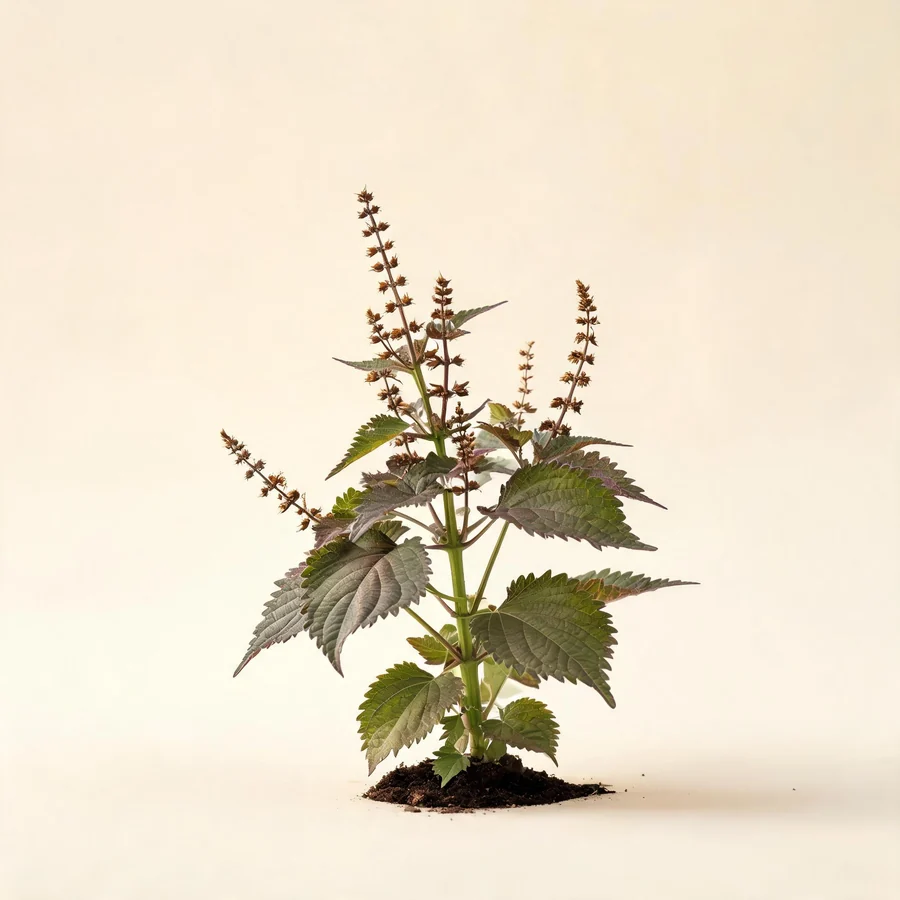
- Allergy to the mint family. Perilla is a Lamiaceae plant, and a reaction to basil, mint or sage is a reason for caution rather than a reason to test the seed at full dose.
Pregnancy and breastfeeding
Traditionally regarded as acceptable in a short course. The seed is a food, it is not on the classical lists of prohibited substances, and both the leaf and the stem of perilla appear in pregnancy prescriptions for nausea and for a restless fetus. The reservation is that the seed descends and lubricates: where there has been bleeding, a previous loss or a threatened miscarriage, that downward action is not wanted. A cough or a dry itch in pregnancy is treated with the smallest useful dose and with the prescriber or midwife informed, and any bleeding in pregnancy is a medical matter rather than a reason to take more of the herb.
Interactions
- Anticoagulants and antiplatelet medicines. Perilla seed oil is high in alpha-linolenic acid, so a heavy medicinal intake could theoretically strengthen warfarin or clopidogrel a little. The amount is small next to a spoonful of culinary oil and no case has been recorded at decoction strength, but someone whose clotting is monitored should declare the herb and keep the daily amount constant.
- Blood pressure and glucose medicines. Extracts of the plant have lowered blood pressure and blood glucose in animal work, so readings are worth watching in anyone on treatment for either, although the doses used in that work are far above a decoction.
- Laxatives and stool softeners. Because the seed oils the bowel, it can add to the effect of a laxative or a softener, and the combination is the usual reason a skin patient notices loose stools during a course.
Allergy and patch testing
Perilla is a mint-family plant, and people who react to basil, mint or sage may react to it. Contact dermatitis to perilla oil in creams and massage oils is reported, so a topical product is patch tested on a small area for a day before wider use. Stop at once if the skin becomes more irritated, and treat swelling of the lips or throat, wheeze or faintness as an emergency.
General safety references
General references for herbal hepatotoxicity and herb-drug interactions; they are not specific to this herb.
- Review article: Herbal hepatotoxicity - an update on traditional Chinese medicine preparations. Alimentary Pharmacology & Therapeutics, 2014. PMID: 24844799.
- Interactions between herbal medicines and prescribed drugs: an updated systematic review. Drugs, 2009. PMID: 19719333.
- Warfarin and food, herbal or dietary supplement interactions: a systematic review. British Journal of Clinical Pharmacology, 2021. PMID: 32478963.
Evidence
The classical record is quoted with its source. The modern note states the level of evidence plainly.
Classical record
无毒。
Free of toxicity: the seed carries no poison.
Yao Xing Lun (Discussion of Drug Properties) - The shortest of the early entries, and the basis for counting the seed as a food as much as a medicine.
Acrid and warm in nature, it brings Qi downward and drives Cold from the middle, and for this work the seed is the better part of the plant.
Ming Yi Bie Lu (Supplement to the Classic of Materia Medica) - The first text to separate seed from leaf, and the source of the seed's reputation for descent, which is the action used on dry skin with a tight chest.
Leaf and seed do the same work in different places: the leaf is chosen to scatter Wind, the seed to settle Qi both above and below.
Ben Cao Gang Mu (Compendium of Materia Medica), Li Shizhen - Li Shizhen's division of labour within one plant, and the reason a skin formula takes the seed when the chest is involved.
Aromatics as a class dry the body, yet this seed alone moistens; that is why it is the remedy chosen for the cough of exhaustion.
Ben Cao Feng Yuan (Origins of the Materia Medica) - A Qing remark that accounts for the seed's place in thin, dry patients, and the line behind pairing it with a dry cough when the surface is dry as well.
Modern evidence
Evidence status
- Laboratory work on perilla seed oil and its alpha-linolenic acid reports anti-inflammatory and antioxidant activity in cell and animal models, and perilla extracts have been examined for effects on allergic responses. These are mechanistic studies at concentrations that a decoction does not reproduce, and they do not establish a skin benefit.
- Human evidence in skin disease is essentially absent. Perilla extracts have been tested in small trials for other indications, and the seed appears in the literature mostly as a food oil or as one ingredient of a multi-herb formula, so no conclusion about dry skin or itch can be drawn.
- Regulatory status: the fruit is an accepted herbal substance in the Chinese Pharmacopoeia as Fructus Perillae, and the seed appears among the substances recognised as both food and medicine. This page describes traditional practice and the state of the evidence; it is not a claim of proven benefit.
PubMed records
Selected real PubMed records for this herb's species or its constituents, chosen by species name and title relevance. They are references for the non-TCM discussion above, not proof that the herb treats any skin condition.
- Comparison of the Anti-Inflammatory Activities of Supercritical Carbon Dioxide versus Ethanol Extracts from Leaves of Perilla frutescens Britt. Radiation Mutant.. Molecules (Basel, Switzerland), 2017. PMID: 28218690 (skin-related record).
Dose and forms
Skin-practice dosing and the preparations that suit skin complaints.
| Form | Dose and notes |
|---|---|
| Decoction (internal) | 3 to 10 g of crushed seed daily, inside a formula. Between three and six grams suffices when other seeds share the descending work; six to ten grams is chosen when one seed must cover the chest and the bowel together. |
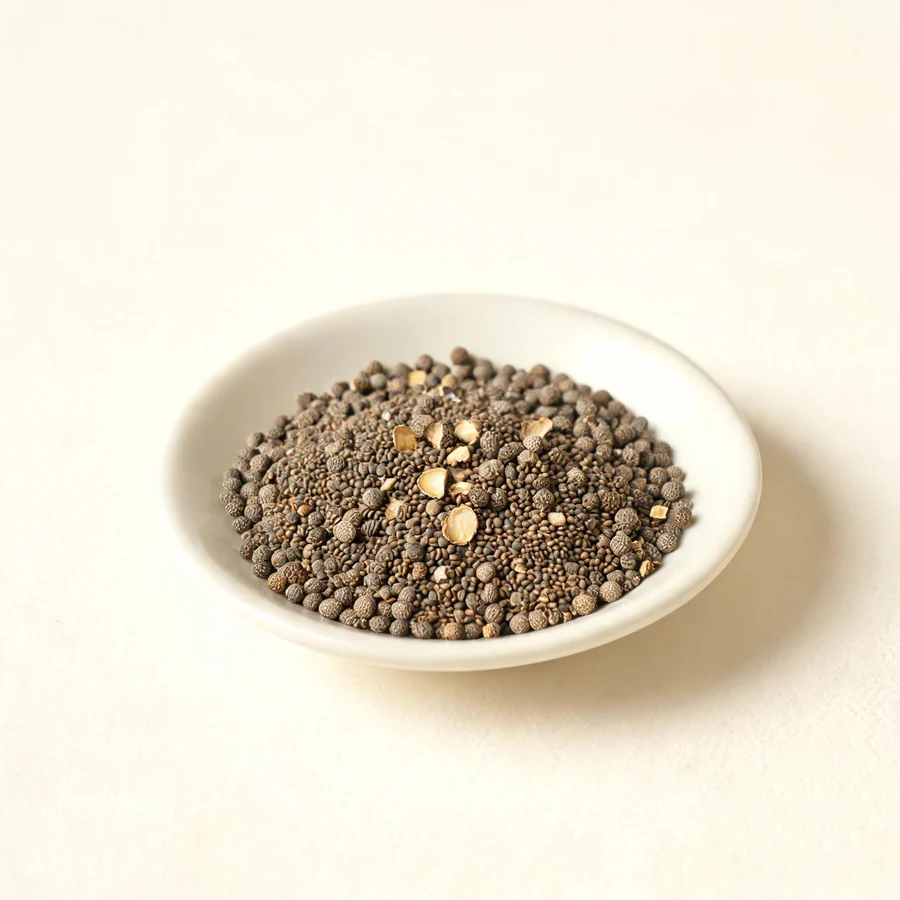
| Preparing the seed | The seed is crushed first, so that its oil can be released, and it joins the pot with the other aromatics towards the end, because a long simmer carries the volatile fraction away. In the classical three seed prescription the crushed seeds sit in a cloth bag, which keeps the powder from clouding the drink. |
| Course length | Weeks rather than months, with the stool watched. A dry itch that has not eased after a few weeks of a proper formula is a reason to review the pattern rather than to raise the dose. |
Two things decide the amount: how dry the person is and how loose the stool already is. Pressed seed, once most of the oil has been extracted, keeps the descending effect and drops the laxative one, and it is chosen on purpose where the chest needs settling while the bowel cannot take oil. A culinary quantity of perilla seed is a condiment and a medicinal one is only a few times larger, so the margin is wide; the limit on a skin course is dryness and loose stool rather than toxicity.
Citations and further reading
Only real sources are listed: the classical materia medica passages quoted above, and the source works behind the botanical and safety statements.
- Yao Xing Lun (Discussion of Drug Properties), Zhen Quan, Tang dynasty - classical entry quoted above.
- Ming Yi Bie Lu (Supplement to the Classic of Materia Medica), Tao Hongjing - classical entry quoted above.
- Ben Cao Gang Mu (Compendium of Materia Medica), Li Shizhen, 1578 - classical entry quoted above.
- Ben Cao Feng Yuan (Origins of the Materia Medica), Qing period - classical entry quoted above.
- Fructus Perillae monograph: Pharmacopoeia of the People's Republic of China - source for the accepted botanical source, part used and food-medicine status.
- Modern evidence statement: based on laboratory and animal literature on perilla seed oil, summarised as a statement about the level of evidence rather than as a cited finding.
- Botanical description and identification: botanical literature on Perilla frutescens, Lamiaceae.
Educational reference for qualified practitioners. This page is not medical advice, and skin conditions should be diagnosed by a clinician before treatment.