Skin profile
Where this herb sits in skin practice: the pattern it corrects, the skin signs it suits, and what it should not be used for.
Lai Fu Zi is a mover rather than a surface herb: it is used where greasy skin, blocked pores and soft Phlegm nodules sit on a sluggish digestion, and it clears the accumulation rather than the lesion. It is neutral in temperature and can be added to a hot or a cold formula, and it is stopped when the middle settles.
Skin signs that suggest it
- Greasy shine on the face, especially the forehead and nose, with a thick greasy tongue coating and heaviness after eating
- Soft, painless lumps under the skin that move slightly and have no redness, in a person who eats richly and digests slowly
- Seborrhoeic scale that is yellow and greasy rather than dry and white, with an oily scalp
- Papules and blocked pores that flare after rich, starchy or late meals, with bloating and belching
- A coated tongue, a slippery pulse and a tendency to loose, urgent stool after a heavy meal
When it is not the right herb
Not for a person who is depleted without stagnation: fatigue, a pale tongue and no fullness mean a descending herb moves Qi that is already low. It is not for a dry, thin skin with no oil and no coating, and not for a red, hot, spreading eruption, which needs cooling and toxin-resolving herbs rather than a downward push. It is not for diarrhoea from Spleen deficiency, where the seed moves the wrong way and makes the looseness worse. The raw seed is avoided in pregnancy because it is emetic, while the stir-fried seed is a caution rather than a prohibition. It should not be taken at the same time as a tonic, since tradition holds that the seed undoes ginseng. A lump that is growing, fixed, painful or ulcerated is a diagnosis before it is Phlegm, and a new nodule on the breast, neck or testis needs assessment rather than a digestive herb.
What it does for skin
Skin-relevant actions only. Each one describes a mechanism in TCM terms and what it looks like on the skin.
Descends Qi and clears the stagnation that shows as oil and greasy scale
Oiliness and greasy scale are read as dampness and Phlegm rising to the surface from a middle that is not transforming food. The seed sends Qi downward and breaks the accumulation, so the surface has less to push out, and the change is seen in the shine and the coating before it is seen in the lesion. It is a supporting action inside a formula, and the effect depends on the diet being lightened at the same time.
Transforms Phlegm that has thickened into a nodule
The tradition distinguishes thin Phlegm, which is coughed up, from thick Phlegm that collects under the skin as a soft, movable lump. The seed is one of the standard movers for the second kind, and the classical phrase for its force is that it can push down a wall. It is used in a formula for a small, soft, stable nodule, and it is not a treatment for a lump that is growing, hard or fixed.
Releases distension so that the surface settles
Bloating, belching and a feeling of fullness after eating are read as food that has not descended, and the skin flare that accompanies them is treated by clearing the middle rather than by adding another surface herb. For starch and grain the seed is the choice, while meat and fat call for hawthorn, and the fried version is standard. The link is indirect but reliable in practice: when the abdomen settles, the flush of oil and papules usually settles with it.
Brings a stalled rash to the surface when used raw
The classical record distinguishes the forms sharply: raw the seed rises and provokes vomiting, and it is described as scattering wind cold and bringing a rash out to the surface; stir-fried, it descends. The raw use belongs to the old treatment of a rash that has failed to express, and it is described here for completeness rather than recommended, because the dose that brings a rash out is close to the dose that causes vomiting.
Skin conditions it is used for
Mapped to the condition pages on this site. The pattern column shows what the skin is doing when this herb is the right choice.
| Condition | Pattern | Why it suits | Typical setting |
|---|---|---|---|
| Acne | Food stagnation and Phlegm with damp-heat rising to the face | Papules and pustules that flare after rich or late meals, with a greasy shine, bloating and a thick coating, are read as food stagnation generating damp-heat that the skin pushes outward. The seed clears the stagnation and descends Qi, while cooling and toxin-resolving herbs handle the lesions themselves. It is a supporting herb for the digestive half of the picture, and it is stopped when the stool loosens. | Within a modified Bao He Wan with Huang Lian and Mu Dan Pi |
| Oily Skin | Damp-Phlegm rising from a sluggish middle | A waxy, greasy shine that returns soon after washing, with a thick coating and a heavy body, is read as damp-Phlegm rather than simple heat. The seed moves the accumulation that produces it, and it is combined with drying aromatics when the oil is wet and with cooling herbs when the face is flushed. It is a slow, supportive measure and it does not replace ordinary skin care. | Within a formula with Cang Zhu and Chen Pi |
| Sebaceous Cysts | Phlegm nodule: thickened dampness under the skin | A painless, soft, movable nodule with a central pore is read as Phlegm that has thickened into something sitting under the skin. The seed is one of the herbs used to move that kind of Phlegm, in a formula over weeks, and the classical caution stands: a cyst that is inflamed, rapidly growing or discharging needs a doctor, and an infected or ruptured cyst is not treated with herbs alone. | Within a Phlegm transforming formula with Ban Xia and Chen Pi |
| Subcutaneous Lipomas And Nodules | Phlegm collecting where the Spleen has failed to transform fluids | A soft, lobulated lump under the skin, slow growing and painless, is read as Phlegm that has collected because the Spleen is not transforming fluids. The seed moves the stagnation and descends Qi, and it is paired with Spleen supporting and Phlegm transforming herbs, over months rather than weeks. A lipoma is benign in most cases, but a new or changing lump needs examination, and no herb reliably dissolves one. | Within a formula with Ban Xia, Chen Pi and Fu Ling |
| Dandruff | Greasy scale from dampness and food stagnation | Flakes that are yellow and greasy, with an oily scalp and a thick coating, are the dampness version of dandruff rather than the dry, white version. The seed is used to clear the stagnation behind the oiliness, and it is combined with drying aromatics and with a medicated shampoo. Dry, white, itchy flaking points the other way, towards Blood and Yin deficiency, and the seed is then the wrong herb. | Within a drying aromatic formula with Cang Zhu and Bai Xian Pi |
Combinations for skin
Herbs it is paired with when the skin, not an internal organ, is the target.
| Partner | Ratio | Why the pair is used |
|---|---|---|
| Shan Zha | 6 g Lai Fu Zi with 12 to 15 g Shan Zha | Hawthorn is sour and warm and suits meat and rich fat, whereas the radish seed, being neutral, suits grain, flour and starch, and it adds a downward push that hawthorn does not have. The classical proportions keep hawthorn well ahead, with the seed as a supporting mover, and the pair is used when a mixed heavy meal leaves bloating and sour belching. |
| Ban Xia | 9 g each | Pinellia dries dampness, transforms Phlegm and stops nausea, and the radish seed breaks the food stagnation that usually sits behind the Phlegm while sending Qi downward. It is used where a mucky coating and a cough accompany bloating and nausea, and it suits older patients whose gut and lungs weaken together. Both are moving, so the pair is avoided in a depleted person without stagnation. |
| Chen Pi | 6 to 9 g each | Chen Pi moves Qi, dries dampness and settles the middle, and the radish seed breaks the actual food residue and pushes it down. Together they address the fullness, belching and poor appetite that accompany a greasy skin flare, and Chen Pi makes the pair gentler on a sensitive Stomach. It is the pairing to think of when the skin problem and the digestive heaviness are plainly one disturbance. |
| Bai Jie Zi | 6 to 9 g each | The classical pair for Phlegm and food stagnation: mustard seed is warm and searches out Phlegm that is stuck, while the radish seed descends Qi and clears the accumulation that feeds it. It is used for a soft nodule or a congested chest in an older person, and it is a short course rather than a long one because both herbs move and dry. |
Formulas where it leads
- San Zi Yang Qin Tang (三子养亲汤) - The formula whose name means three seeds to support one's elders, recorded in the Han Shi Yi Tong: radish seed, mustard seed and perilla seed, for an older person with cough, copious Phlegm and food stagnation. Its skin relevance is the picture it treats rather than the lesions, since the greasy coating, the oiliness and the soft nodule all belong to the same Phlegm and stagnation. It is the classical demonstration that the digestion and the surface are one problem.
Safety for skin use
What to check before recommending or using it, including the cautions that matter most for skin patients.
Do not use, or use with caution
- Qi deficiency without stagnation: fatigue, a pale tongue, no fullness and no coating. A descending herb moves Qi that is already low and leaves the person more tired.
- Loose stool from a weak Spleen, as opposed to food that has not passed: a downward mover worsens the looseness instead of easing it.
- Pregnancy in the raw form, which is emetic and strongly descending. The stir-fried seed is a caution rather than a prohibition, and use in the first three months, or after a miscarriage, is a practitioner's call.
- Tonics at the same time: tradition says the seed undoes ginseng, a claim that is disputed, but a tonic is best kept apart from the seed instead of sharing the cup.
- Dry, thin skin without oil or coating, and any red, spreading eruption, where a downward moving seed does nothing and cooling herbs are needed.
Pregnancy and breastfeeding
The classical sources treat the stir-fried seed as something to use with care rather than a ban, and it is accepted at ordinary doses for common indigestion in a pregnancy that is otherwise uncomplicated. The raw form is not used, since it provokes vomiting and pushes down hard, and the same applies in the first three months, or where a miscarriage has happened before, unless a practitioner directs it. Courses are short and the dose is modest, and the herb is stopped if the stool loosens. While breastfeeding no problem is recorded, and the theoretical concern is that a strongly descending herb might cut milk supply in a mother who is already short of it.
Interactions
- Blood pressure medicines: the seed has lowered blood pressure in laboratory work, so the effect could add to antihypertensive drugs, and pressure is worth watching if it is taken daily.
- Chemotherapy: erucic acid, the oil's main fatty acid, made doxorubicin more toxic in animals. That is a reason for care, not a ban, and anyone in cancer treatment should tell their oncology team.
- Iodine and the thyroid: glucosinolates in radish can compete with iodine uptake, so high doses over long periods are avoided in thyroid disease. The ginseng point also has laboratory backing, because the seed increased ginsenoside efflux in a cell model, though its clinical weight is disputed.
Allergy and patch testing
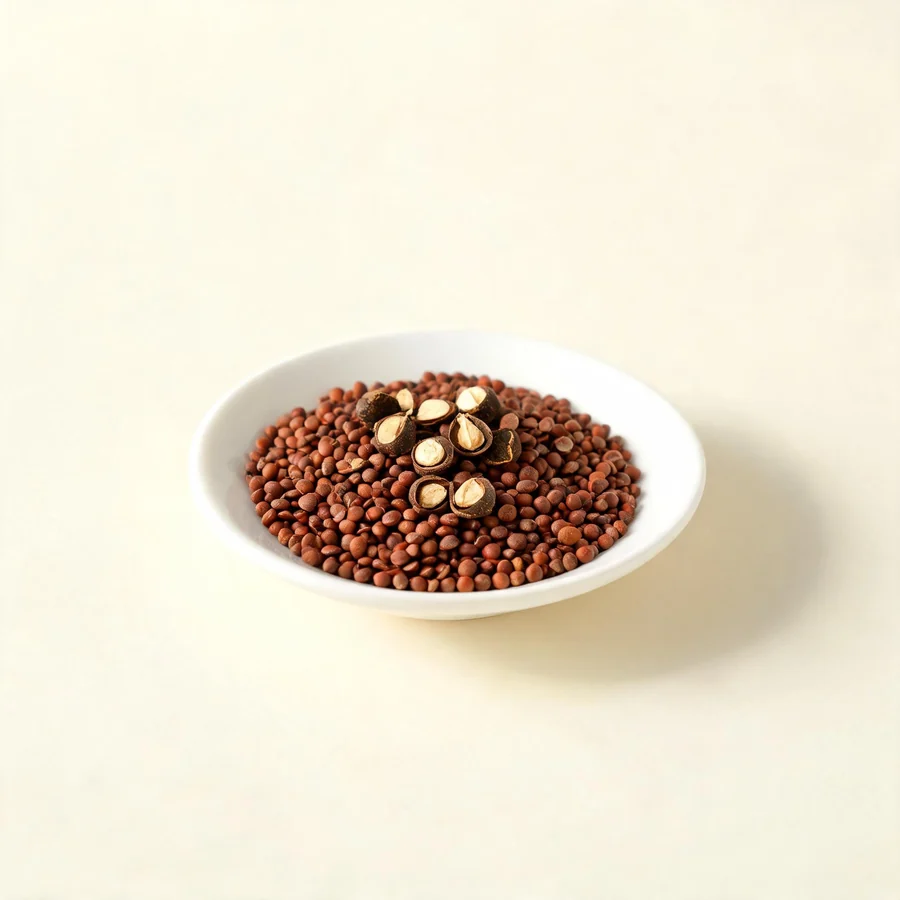
Radish seed is rarely allergenic, and the practical risk is substitution: mustard and other brassica seeds look similar but are round and pale, whereas real radish seed is oval, a little flattened, reddish brown and grooved lengthwise. A person with a known allergy to mustard or to brassica pollen should be cautious. Stop if a rash, itch or stomach upset appears, and buy from a supplier who can identify the seed.
General safety references
General references for herbal hepatotoxicity and herb-drug interactions; they are not specific to this herb.
- Review article: Herbal hepatotoxicity - an update on traditional Chinese medicine preparations. Alimentary Pharmacology & Therapeutics, 2014. PMID: 24844799.
- Interactions between herbal medicines and prescribed drugs: an updated systematic review. Drugs, 2009. PMID: 19719333.
- Warfarin and food, herbal or dietary supplement interactions: a systematic review. British Journal of Clinical Pharmacology, 2021. PMID: 32478963.
Evidence
The classical record is quoted with its source. The modern note states the level of evidence plainly.
Classical record
莱菔子之功,长于利气。生能升,熟能降。
Its strength lies in moving Qi. Used raw it rises, and used fried it descends. Rising, it makes a person vomit wind Phlegm, disperses wind cold and brings a rash out to the skin; descending, it calms wheezing and cough caused by Phlegm, relieves the straining of dysentery and settles pain inside. Each of those effects is an effect of moving Qi.
Ben Cao Gang Mu (Compendium of Materia Medica), Li Shizhen - This passage settled the split between raw and fried, and it is the one classical line that mentions a rash.
莱菔子治痰,有推墙倒壁之功。
For Phlegm the radish seed can topple a wall and bring down a barrier.
Dan Xi Xin Fa (Danxi's Heart Method) - This is the line practitioners quote to show how hard the seed pushes through a stubborn accumulation, a Phlegm nodule included.
莱菔子,味辛过于根,以其辛甚,故升降之功亦烈于根也。
The seed is more pungent than the root, and a stronger pungency gives it a fiercer power to lift and to lower.
Ben Cao Jing Shu (Commentary on the Classic of Materia Medica) - The point is practical: the seed moves far more than the vegetable it came from, so it is dosed as medicine, not as food.
Modern evidence
Evidence status
- Laboratory work on the seed oil, including erucic acid and the glucosinolate breakdown products, reports effects on blood pressure, on gut movement and on cholesterol handling, mostly in animals. None of this is evidence that the seed treats acne, a cyst or greasy skin.
- No controlled trial of Lai Fu Zi in a skin condition was identified. The clinical literature is largely Chinese studies of digestive formulas, and the skin uses described here are extrapolated from the digestive and Phlegm transforming actions rather than tested directly.
- Quality is rarely the problem: the seed is cheap, substitution is the usual issue rather than fraud, and the oil that carries the effect is lost in light, shrivelled or musty material.
PubMed records
Selected real PubMed records for this herb's species or its constituents, chosen by species name and title relevance. They are references for the non-TCM discussion above, not proof that the herb treats any skin condition.
- Comparison of Anti-Inflammatory and Antibacterial Properties of Raphanus sativus L. Leaf and Root Kombucha-Fermented Extracts.. International journal of molecular sciences, 2024. PMID: 38891811 (skin-related record).
Dose and forms
Skin-practice dosing and the preparations that suit skin complaints.
| Form | Dose and notes |
|---|---|
| Decoction | 6 to 10 g of the stir-fried and crushed seed a day, inside a formula. Crush the seed before brewing, or the oil stays locked in. |
| Upper range | As much as 30 g where food stagnation is acute, under supervision. For a child, use between one third and one half of the figure above. |
| Form | For digestion and Phlegm the fried seed is standard. The raw seed is used only in the old emetic tradition and is not used for skin. |
The raw and the fried seed point in opposite directions, and the dose refers to the fried form, which is the one for digestion and Phlegm work. Frying takes away the upward, queasy tendency and leaves only the descent, which is why the raw seed has no place in skin work. The seed must be crushed before decoction or the oil stays inside the coat, and the range is narrow because this is a mover rather than a tonic. Above ten grams it is reserved for acute fullness, and the herb is stopped when the abdomen settles or the stool loosens.
Citations and further reading
Only real sources are listed: the classical materia medica passages quoted above, and the source works behind the botanical and safety statements.
- Ben Cao Gang Mu (Compendium of Materia Medica), Li Shizhen, 1578 - the passage on raw and fried forms and on drawing out a rash is quoted above.
- Dan Xi Xin Fa (Danxi's Heart Method), Zhu Danxi, Yuan dynasty - the phrase on the force of the seed against Phlegm is quoted above.
- Ben Cao Jing Shu (Commentary on the Classic of Materia Medica), Miao Xiyong, Ming dynasty - the comparison of seed and root is quoted above.
- Semen Raphani monograph, Pharmacopoeia of the People's Republic of China - the accepted source, the part used and quality requirements.
- Botanical literature on Raphanus sativus, Brassicaceae - the distinction between radish seed and the mustard and turnip seeds sold alongside it.
- Modern evidence statement: based on published laboratory work on the seed oil and on the absence of identified skin trials, stated as a level of evidence rather than as a cited finding.
Educational reference for qualified practitioners. This page is not medical advice, and skin conditions should be diagnosed by a clinician before treatment.