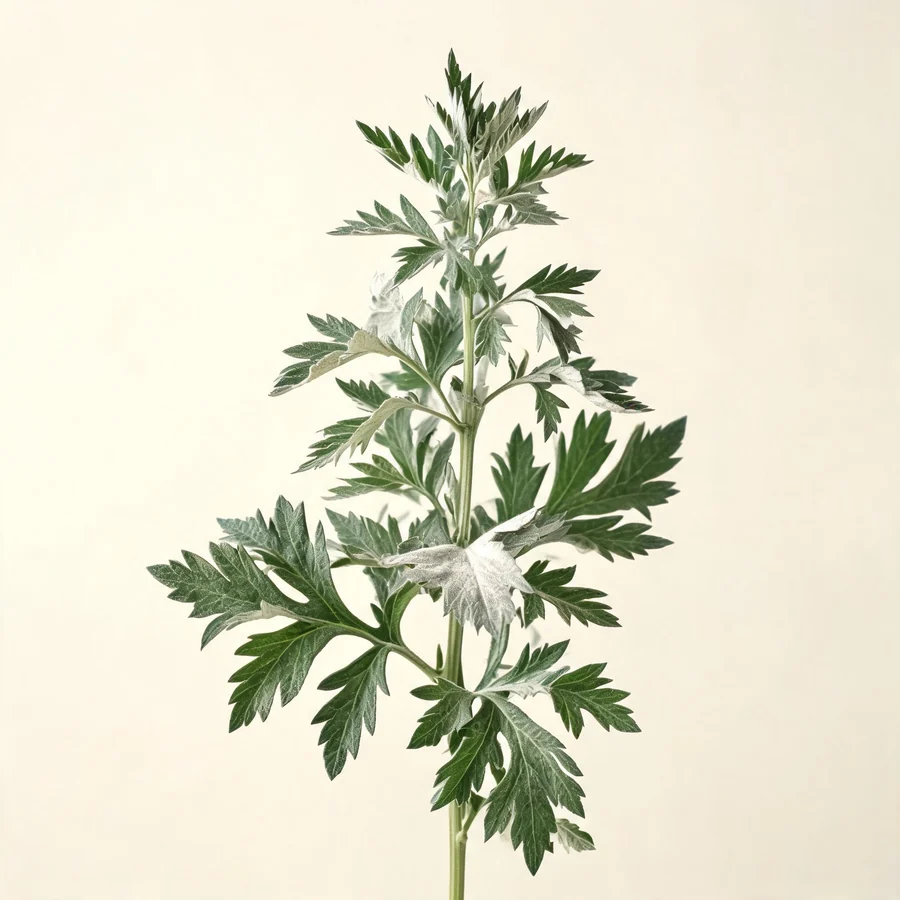
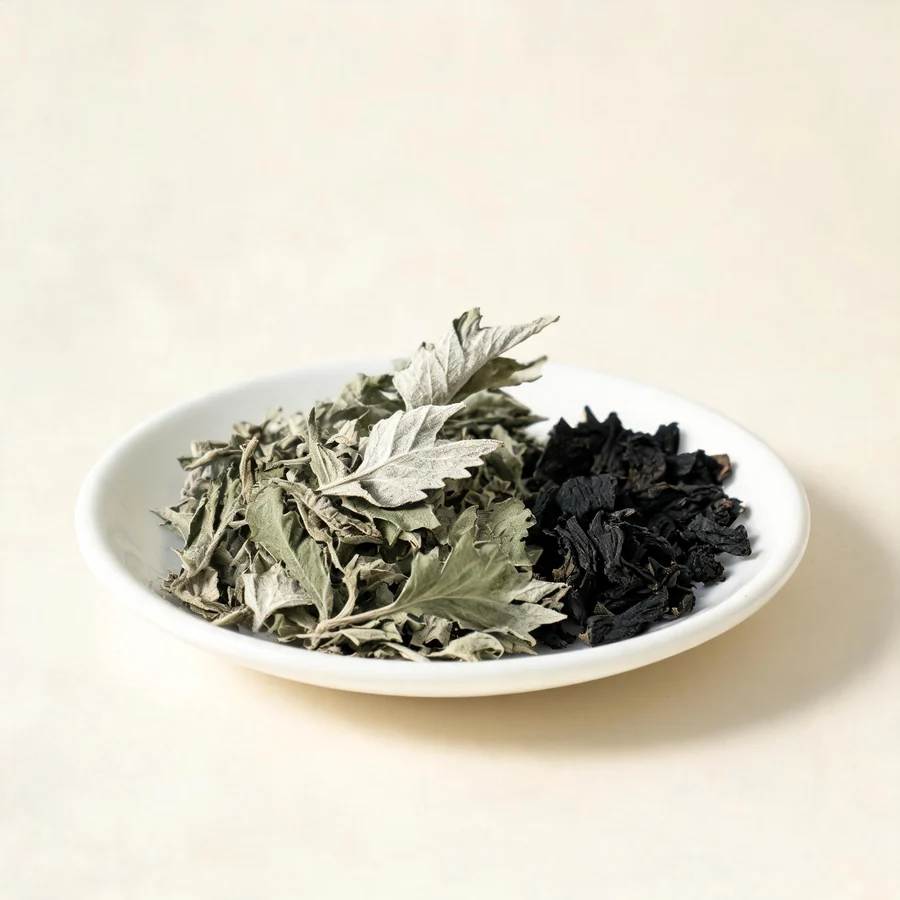
Skin profile
Where this herb sits in skin practice: the pattern it corrects, the skin signs it suits, and what it should not be used for.
Ai Ye is for skin that is cold, damp and itchy rather than red and hot: dusky chilblains, sodden thickened patches and pale genital itch. It is used as a wash far more often than as a drink, and the volatile oil is the reason the internal dose is capped.
Skin signs that suggest it
- Itch that is worse in cold, damp weather and eases when warmth is applied to the area (cold-damp)
- Skin that feels cold and clammy to the touch, with a pale or dusky colour and a sodden surface (cold-damp)
- Long-standing thickened patches that itch at night and have never been red or hot (wind-cold with dampness)
- Genital itch with a pale, moist look and no burning or offensive discharge (cold-damp in the lower body)
- Dusky, swollen toes or fingers in cold weather that sting or itch as they rewarm (chilblains)
- A pale tongue with a white, moist coating and a deep, slow pulse
When it is not the right herb
Not for red, hot, weeping skin with a burning quality, which is damp-heat and needs a cold herb; warmth pushes that picture further. Not for dry skin with night sweats, a dry mouth and a red tongue with little coating, where a warm drying leaf spends fluid the person does not have. Not for an acute infected or spreading lesion, and not on numb skin where a burn would go unnoticed.
What it does for skin
Skin-relevant actions only. Each one describes a mechanism in TCM terms and what it looks like on the skin.
Warms the channels and moves cold out of the tissue
Cold is what makes tissue sluggish, and the skin shows it as pallor, duskiness, clamminess and a lesion that will not heal. Ai Ye carries warmth into the surface so that blood moves again through the small vessels, which is the mechanism behind its use in chilblains and in itch that arrives with cold weather. The action is felt as warmth and a return of colour rather than as a numbing effect.
Dries dampness and stops itch
The leaf is the traditional wash for itchy skin that is sodden rather than hot, and the drying quality is the reason. Waterlogged, clammy patches with a pale base and no inflammation respond to a warm aromatic decoction, which reduces the surface moisture that keeps the skin irritated. It is a surface measure: it changes the environment of the lesion while the internal pattern is treated separately.
Stops small bleeding points on cold, thickened skin
Warming herbs that hold blood in the vessels are the tradition's answer to bleeding that comes with cold, and this leaf is one of the standard examples. On the skin the practical target is small: raw points left by scratching on lichenified, cold patches. The charred form is the one used, because charring drives off most of the volatile oil and concentrates the tannins, which is what a haemostatic wash needs.
Moves blood and disperses stasis in bruised, dusky tissue
The leaf is warm and dispersing, so it is used where cold has congealed blood into a dusky, hard or swollen area. Chilblains are the clearest case: the tissue is cold, purple and tender, and warmth plus movement of blood is exactly what the picture asks for. The same reasoning is applied to an old bruise that has stayed hard and cold.
Acts as heat when burned, which is a practitioner technique
Moxibustion is the other way this leaf reaches skin, and it is the opposite of a wash: the processed leaf is burned near an acupuncture point so that the tissue receives heat rather than a decoction. It is effective and it also carries a genuine burn risk, so it belongs in trained hands. This page treats it as a separate modality, with its own cautions, rather than as a home remedy.
Skin conditions it is used for
Mapped to the condition pages on this site. The pattern column shows what the skin is doing when this herb is the right choice.
| Condition | Pattern | Why it suits | Typical setting |
|---|---|---|---|
| Itchy skin | Cold-damp on the surface, with itch that is worse in cold, damp weather | Itch without redness is the picture this leaf suits best. When the skin is cold, slightly clammy and itchy in wet weather, and the itch eases as warmth is applied, the reading is cold-damp sitting on the surface rather than heat. A wash carries warmth and a mild drying action into the skin at once, and the itch quietens because the tissue underneath has been warmed and dried, not because the sensation has been blocked. | A cooled Ai Ye wash, or Ai Ye with Ku Shen and She Chuang Zi as a rinse |
| Eczema | Chronic cold-damp eczema: thickened, pale, moist but not hot | Eczema is not one pattern, and this leaf belongs to the cold end of it. The patches are thickened and lichenified, the colour is pale or dusky rather than red, the surface is sodden rather than crusted with yellow, and the person feels the cold. A warm drying wash suits that surface. The red, hot, oozing flare of damp-heat needs a cold herb such as Huang Qin and would be aggravated by warmth. | An Ai Ye wash alongside an internal formula that warms and dries, with Dang Gui and Bai Zhu |
| Itchy genitalia | Cold-damp pouring downward, with pale moist itch and no burning | Genital itch with a pale, moist surface, a cold feeling and no burning or offensive discharge reads as cold-damp in the lower body, and a warm wash is the traditional answer. The leaf is used as a sitz bath rather than as a strong internal medicine. Itch with redness, heat, a yellow discharge or an odour is damp-heat and needs the opposite approach, and unexplained or persistent genital itch needs a diagnosis first. | An Ai Ye sitz bath, or Ai Ye with She Chuang Zi and Ku Shen |
| Chilblains | Cold congealing blood in the small vessels of the fingers and toes | Chilblains are the clearest skin use of a warming leaf. Cold contracts the small vessels, blood congests, and the toes or fingers turn dusky, swollen and itchy or stinging as they rewarm. Ai Ye has a long record as a warming wash for exactly this, applied at a temperature that is comfortable rather than hot, on intact skin, to move the congestion. Ulcerated or infected chilblains are a different problem and need medical care. | A warm Ai Ye fomentation, or Ai Ye with Gui Zhi and Hong Hua as a soak |
| Neurodermatitis | Long-standing thickened patch with wind-cold and dampness | A patch scratched for years becomes thick, leathery and pale, and the itch often arrives at night or in cold weather. The internal reading of neurodermatitis is usually blood deficiency with wind, which a warming leaf does not correct. What the leaf offers is a surface measure: a warm drying wash reduces the sodden quality and takes the edge off the itch long enough for the internal treatment to work. | An Ai Ye wash alongside an internal blood-nourishing formula with Dang Gui and Bai Shao |
Combinations for skin
Herbs it is paired with when the skin, not an internal organ, is the target.
| Partner | Ratio | Why the pair is used |
|---|---|---|
| Ku Shen | 10 to 15 g each in a wash | The two are used together as a rinse for stubborn itch, and the pairing is a deliberate correction of temperature. Ku Shen is cold and bitter and dries damp-heat strongly, while Ai Ye is warm and aromatic and moves cold, so one clears what is hot in the lesion and the other warms what has gone cold and sluggish around it. That makes the pair useful for thickened patches that are moist in the folds but pale on the surface. |
| She Chuang Zi | 10 g Ai Ye with 10 to 15 g She Chuang Zi in a sitz bath | She Chuang Zi is the standard herb for damp itch of the lower body, including genital and perianal itch, and it is drying in its own right. Combined with a warm mugwort bath it gives a wash that dries the surface and warms the tissue. Both herbs are drying, so the course is short, and the bath is used on intact skin only. |
| Bai Xian Pi | 10 to 15 g each in a decoction | Bai Xian Pi clears heat, dries dampness and quiets itch, and it is the herb most often reached for in a stubborn itch whatever the pattern. Pairing it with a warming leaf produces a balanced wash for itch where the surface is pale and sodden but the person still carries some heat. Bai Xian Pi supplies the cooling and Ai Ye the warmth, so the mix can be shifted toward whichever side dominates. |
| Di Fu Zi | 10 g each in a wash | Di Fu Zi is a drying, itch-quieting herb that is applied rather than swallowed in most skin protocols, and it is used for damp, scurfy and itchy skin. With Ai Ye it forms a simple wash for areas that are moist without being inflamed. Both are drying, so the course is short, and a plain moisturiser is used between washes if the skin begins to feel tight. |
Topical use
A wash is where this leaf earns its place on a skin page. The dried leaf is simmered briefly, strained and cooled to a comfortable temperature, then used as a rinse, a soak or a fomentation. The volatile oil that carries most of the aroma is also what limits the herb, so the pot is kept partly covered and the decoction is not boiled hard for a long time. Nothing here is applied to broken, ulcerated or infected skin.
| Preparation | How and when it is used |
|---|---|
| Decoction wash | 15 to 30 g of dried leaf in 1 litre of water, brought to a simmer for 15 minutes with the lid on, then strained and cooled. Rinse the area, or soak a clean cloth and hold it in place for 10 minutes, once or twice daily. Discard what is left rather than keeping it for the next day. |
| Sitz bath | A stronger decoction of 30 g in 2 litres, poured into a basin of warm water, is used for 10 minutes where cold, itchy skin affects the genital or perianal area. The water is warm rather than hot, the skin is patted dry afterwards, and the basin is not shared. |
| Warm fomentation for chilblains | A cloth wrung out in the cooled decoction is laid over dusky, intact toes or fingers for 10 minutes. The liquid should feel comfortably warm on the wrist and never hot, because numb or chilled skin cannot register a burn, and the skin is inspected afterwards. |
Patch test and cautions
Patch test on the inner forearm for 24 hours first. Do not use it on broken, ulcerated or infected skin, and do not use it on the feet of anyone with diabetes or reduced sensation without clinical advice, since warmth and numbness make a poor combination. Keep the wash away from the eyes, and never add essential oil to it, because the oil is far more concentrated than the decoction. Stop if the skin stings, reddens, or becomes drier and tighter.
Safety for skin use
What to check before recommending or using it, including the cautions that matter most for skin patients.
Do not use, or use with caution
- Yin deficiency with blood heat: a dry mouth, night sweats, a red tongue with little coating, heat in the palms and skin that is dry and hot. A warm, drying, dispersing leaf adds heat and spends the fluid the person is already short of, and the itch usually worsens.
- Red, hot, weeping skin with burning or thirst. That is damp-heat, and warmth drives it further, so the leaf is the wrong temperature for an acute flare, a pustular eruption or an infected lesion.
- Seizure disorders and children under one year. The volatile oil contains thujone, which is neurotoxic in quantity, and the leaf is not given internally in these groups. A small external wash is a much lower exposure but is still a practitioner question.
- Liver disease or heavy alcohol use. Liver injury has been reported with concentrated mugwort oil, so internal courses are avoided where the liver is already burdened, and the essential oil is never taken by mouth.
Pregnancy and breastfeeding
Ai Ye is treated here as contraindicated in pregnancy. The old literature does place the leaf among herbs given to steady a pregnancy, and one classical formula is built on that idea, but the leaf itself moves blood, brings warmth to the uterus, and its oil acts on the nervous system once the amount is large. Modern practice avoids it, and this page does not offer it for self-treatment at any dose. Moxibustion over the abdomen or lower back is avoided for the same reason. A small external wash on the hands, for chilblains for instance, is a far lower exposure than a decoction, though it still belongs to a practitioner's decision. During breastfeeding, ordinary external use is not a concern; internal use is kept short, because a herb that warms and dries, kept up for weeks, can cut into fluids and milk.
Interactions
- Anticoagulants and antiplatelet drugs. A herb whose job is to check bleeding pulls against warfarin, heparin, aspirin and clopidogrel, while some Artemisia species also contain coumarins that could push the same drugs the other way. Anyone on one of these medicines should not begin internal courses without supervision and monitoring.
- Sedatives, anticonvulsants and alcohol. The oil is active on the brain, and its thujone and camphor may either reinforce or scramble the action of benzodiazepines, sleeping tablets, anticonvulsants and alcohol. This matters for internal use and for any prolonged exposure to the oil.
- Other medicines that load the liver. Paracetamol taken at its ceiling, methotrexate, some statins and long-term alcohol all compete with the organ that has to process the oil, so internal courses are kept short and are avoided in liver disease.
- Prescription topical treatments. Washing with a herb while using a steroid cream or a calcineurin inhibitor is common in clinic, but the two are spaced apart across the day so that neither dilutes the other and a reaction can be pinned on one product.
Allergy and patch testing
Mugwort pollen is one of the commonest aeroallergens, and people who react to it in late summer may react to the leaf on their skin, with itching, redness or a contact rash. A reaction is also possible in anyone who has reacted to another daisy-family plant, including chamomile, chrysanthemum and ragweed. Test it on a small patch first, keep the opening application brief, and give it up straight away if the skin reacts rather than settles.
General safety references
General references for herbal hepatotoxicity and herb-drug interactions; they are not specific to this herb.
- Review article: Herbal hepatotoxicity - an update on traditional Chinese medicine preparations. Alimentary Pharmacology & Therapeutics, 2014. PMID: 24844799.
- Interactions between herbal medicines and prescribed drugs: an updated systematic review. Drugs, 2009. PMID: 19719333.
- Warfarin and food, herbal or dietary supplement interactions: a systematic review. British Journal of Clinical Pharmacology, 2021. PMID: 32478963.
Evidence
The classical record is quoted with its source. The modern note states the level of evidence plainly.
Classical record
艾叶,味苦,微温,无毒。主灸百病,可作煎,止下痢,吐血,下部匿疮,妇人漏血,利阴气,生肌肉,辟风寒,使人有子。
Bitter, gently warm and free of poison. Burned as moxa it serves against a hundred illnesses; made into a decoction it checks dysentery, halts vomiting of blood, heals sores of the lower body, stops leaking uterine bleeding, assists the yin qi, promotes flesh growth, repels wind and cold, and allows a woman to conceive.
Ming Yi Bie Lu (Supplement to the Classic of Materia Medica), Tao Hongjing - The first formal pharmacological notice of the leaf, and it sets out both jobs at once: what is burned in moxibustion, and what is boiled as a warming haemostatic. The mention of lower-body sores and of growing flesh is the earliest basis for treating skin.
服之则走三阴,而逐一切寒湿,转肃杀之气为融和;灸之则透诸经而治百种病邪,起沉疴之人为康泰,其功亦大矣。
Swallowed, it travels the three yin channels and drives out cold and damp of every kind, turning a killing harshness into mildness; burned as moxa it reaches through all the channels and answers a hundred pathogenic influences, raising the gravely ill into comfort. Great indeed is its achievement.
Ben Cao Gang Mu (Compendium of Materia Medica), Li Shizhen - Li Shizhen keeps the swallowed leaf apart from the burned one, and his line about harshness becoming mild is the plainest statement in the classics of what warmth does to tissue that has gone cold.
Modern evidence
Evidence status
- Laboratory work on the leaf and its essential oil reports antimicrobial, antifungal, anti-inflammatory and antioxidant activity, largely in cell and animal models. The same oil contains thujone and camphor, so those findings describe a material that is also the toxic fraction, and they are no licence to apply the oil neat to skin.
- No adequately powered dermatological trial of Ai Ye was identified for this page. Trials of moxibustion exist, but they test heat applied at acupuncture points rather than the leaf as a topical medicine, and they do not establish that the leaf treats skin disease.
- Regulatory and safety position: the leaf is an accepted herbal substance in the Chinese Pharmacopoeia, and mugwort pollen is a common aeroallergen. Thujone is restricted as a food flavouring in several jurisdictions, which is why internal courses stay short and the essential oil is not taken internally.
PubMed records
Selected real PubMed records for this herb's species or its constituents, chosen by species name and title relevance. They are references for the non-TCM discussion above, not proof that the herb treats any skin condition.
- Artemisia argyi volatile oil ameliorates allergic contact dermatitis via modulating TRPA1/CGRP signaling.. Journal of ethnopharmacology, 2024. PMID: 39019419 (skin-related record).
Dose and forms
Skin-practice dosing and the preparations that suit skin complaints.
| Form | Dose and notes |
|---|---|
| Decoction (internal) | 3 to 9 g of dried leaf daily, inside a formula and for a short course, where a cold pattern with itching or small bleeding points has been identified. Add the leaf near the end of the boil, for five to ten minutes at most, so the aromatic oil is not driven off. |
| External wash | 15 to 30 g simmered in 1 litre of water for 15 minutes, strained and cooled to a comfortable temperature, then used as a rinse, a compress or a sitz bath for 10 to 15 minutes once or twice daily. |
| Charred leaf | Ai Ye Tan, the charred form, is chosen when the aim is to stop small bleeding points on cold, thickened skin. Charring drives off most of the volatile oil and concentrates the tannins, so it is the form used in a haemostatic wash. |
| Course length | Five to seven days for an itchy or chilblain flare, with review. Prolonged daily use of a warming, drying leaf is not advised, and the wash is stopped once the skin settles. |
Internal and external dosing are different questions. Inside the body the leaf is really a dose of its aromatic oil, which is why there is a ceiling and why it is added late; a wash of 15 to 30 g over intact skin delivers very little thujone and can be repeated through the day. The raw leaf is used for washing and for warming, the charred leaf for bleeding, and aged leaf is preferred because keeping it mellows the oil.
Citations and further reading
Only real sources are listed: the classical materia medica passages quoted above, and the source works behind the botanical and safety statements.
- Ming Yi Bie Lu (Supplement to the Classic of Materia Medica), Tao Hongjing, around 500 - classical entry quoted above.
- Ben Cao Gang Mu (Compendium of Materia Medica), Li Shizhen, 1578 - classical entry quoted above.
- Ai Ye monograph: Pharmacopoeia of the People's Republic of China - source for the accepted botanical source, part used and quality requirements.
- Modern evidence statement: based on laboratory and toxicological literature on Artemisia argyi and its essential oil, stated as a description of the level of evidence rather than as a cited finding.
- Botanical description and identification: botanical literature on Artemisia argyi, Asteraceae, including the leaf indumentum used to distinguish it from related wormwoods.
Educational reference for qualified practitioners. This page is not medical advice, and skin conditions should be diagnosed by a clinician before treatment.