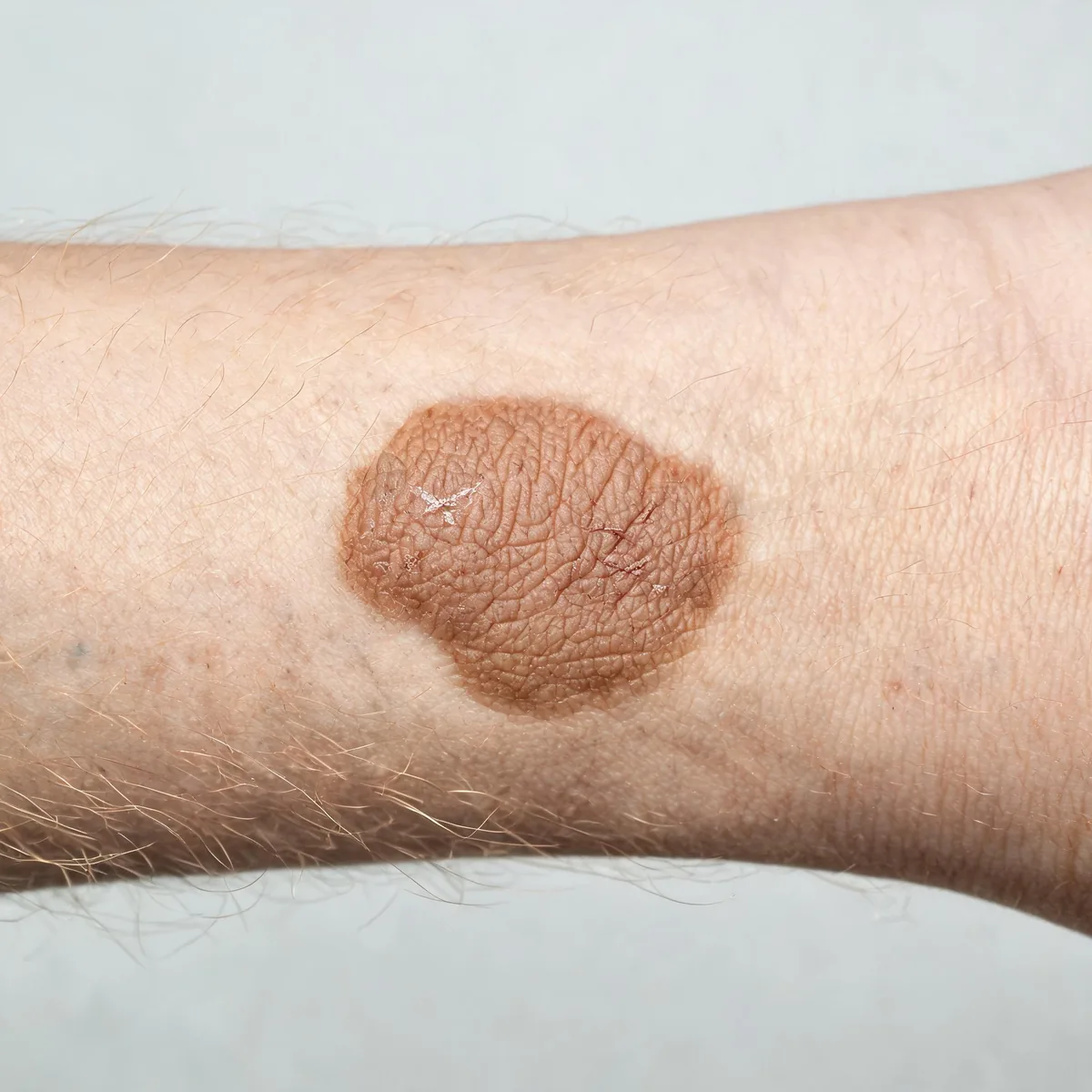
Understanding Neurodermatitis
A name note: the Chinese name 牛皮癣, literally ox-hide sore, is also used loosely for psoriasis in some traditions. Here it describes the thickened plaque of neurodermatitis. This page follows the source usage.
The tradition describes the condition as a Blood disorder manifesting on the skin. Skin is nourished and moistened by healthy Blood; when the Blood becomes too hot, too dry or stagnant, the skin itches and thickens.
Blood deficiency with external wind is the commonest picture: leathery thickened lichenified plaques with intense itch worse at night, dry flaky skin and a pale complexion. That is the familiar itch-scratch-thicken cycle described in this framework.
Liver Qi stagnation transforming into heat gives red hot itchy lesions that worsen with stress and anger, with a bitter taste and rib-side distension. Blood stagnation gives dark purplish thick leathery plaques that feel hard and fixed, with stabbing discomfort worse at night. Damp-Heat in the Liver channel gives moist oozing plaques, often in the groin or inner thighs.
Wind is the organising idea in this account: an invisible, restless force rather than a substance. It explains why the itch wanders, why one plaque settles as another appears, and why a scratch can start a fresh patch somewhere else. Wind is bred inside when the Blood is too dry to anchor it, and it is stirred up when heat rises from swallowed feeling. Because the Liver stores Blood and governs the even spread of Qi, an unsettled Liver is almost always part of the story.
The Spleen supplies the second thread. Digestion weakened by irregular meals, overwork or worry fails to transform fluids, and the dampness that remains combines with heat. This is the mechanism behind the moist, weeping plaques that choose the groin, the genitals and the skin folds, and it explains why one person with this diagnosis looks papery and another looks sodden.
None of these mechanisms excludes the others. A stressful year can heat the Blood, dry it out and leave the skin inflamed and undernourished at the same time, so treatment usually follows a leading pattern while watching for a second. The tongue and pulse decide the balance, and the formula is revised as the picture moves rather than fixed at the first visit.
Conventional view
Conventional dermatology calls the same condition lichen simplex chronicus: a patch of skin that has become thick and leathery because it has been rubbed and scratched repeatedly. The usual beginning is one small itchy place which, driven by the itch-scratch cycle, turns into a well-defined plaque, most often at the nape of the neck, the ankles, the wrists or the genitals. Examination and the exclusion of eczema or psoriasis establish the diagnosis, and stress, dry skin and irritants are the usual triggers.
Treatment aims at the cycle itself. Topical corticosteroids are the mainstay, with occlusion or intralesional steroid injections for thick plaques, oral antihistamines for night-time itch, and emollients to repair the barrier. Habit reversal and stress management are commonly added, because scratching is the engine of the disease.
Steroids and antihistamines quiet a flare effectively but do not remove the tendency to form plaques, so many people relapse soon after stopping, and prolonged use of potent steroids thins the skin. Behavioural work interrupts the scratching but does not account for the constitutional factors, such as Blood dryness or heat from emotion, that TCM treats as the drivers.
Selected PubMed records
Real PubMed records for the conventional discussion above, selected by condition name and title relevance. They are references, not a claim that any treatment is proven for this condition.
- Cupping for neurodermatitis: A protocol of systematic review and meta-analysis.. Medicine, 2020. PMID: 33019475.
How it connects
Neurodermatitis rarely travels alone: anxiety and low mood are its most frequent companions. In TCM the Liver governs the smooth flow of Qi and emotions; when stress or frustration cause Liver Qi to stagnate, it generates Heat and Wind that rise to the skin, creating the red itchy plaques of neurodermatitis together with the irritability or sadness of emotional distress. Treating the Liver stagnation at its root often calms both the skin and the mind. The companionship is mechanical as well as constitutional: itch is worst at night, when there is nothing to distract from it, so sleep erodes and mood with it, and the resulting fatigue lowers the threshold for the next flare. That loop is worth naming, because treating only the skin leaves it running. Points that calm the spirit, herbs that settle the Liver and a plan for the small hours are as much part of the work as the formula for the plaque.
How it is assessed
The practitioner examines the plaque, its location, and the emotional and sleep picture.
What a practitioner looks for
- Texture: leathery thickened plaque with dry scaling suggests Blood deficiency with wind.
- Colour: red hot lesions flaring with stress suggest Liver Qi stagnation transforming into heat.
- Hardness: dark purple fixed plaques suggest Blood stagnation.
- Site and moisture: oozing plaques in the groin suggest Damp-Heat in the Liver channel.
Reading a plaque means reading four things together: its colour, its thickness, how moist it is, and how long it has been present. The quality of the itch matters as much as the appearance. An itch that wakes the patient and worsens in dry windy weather points one way; an itch that flares within hours of an argument, with heat and redness, points another; a wet, oozing itch in the folds points a third.
When the plaque is pale or dull red, leathery and thickened, and the patient looks tired with brittle nails and dry hair, the picture is Blood deficiency with external wind. The tongue is pale and thin with a white coat that has started to dry, and the pulse is fine, wiry at the left Guan position and floating at the right Cun. Hot showers and hard scrubbing aggravate it because they strip the little moisture the skin retains.
Red, hot and intensely itchy lesions that follow stress belong to Liver Qi stagnation turning into heat, with a red tongue, redder sides, a yellow coat and a wiry rapid pulse at the left middle. Plaques that have grown thick, hard and dark purple over years indicate Blood stagnation, with a dusky tongue showing stasis spots and a choppy or wiry pulse. Moist plaques in the groin, a heavy body, a bitter taste and scanty dark urine indicate damp-heat in the Liver channel, confirmed by a yellow greasy coat and a pulse that is wiry, slippery and rapid.
TCM patterns in Neurodermatitis
Four patterns sit behind this single Western diagnosis, and the skin separates them. The first question is texture: a leathery plaque with fine scaling and no oozing speaks of dryness. The second is heat: redness that deepens within hours of an argument, with a bitter taste and a tight chest, points to constrained Liver Qi that has turned to fire. The third is time: plaques hardened into dark, almost purple leather over many years have moved past dryness into stasis. The fourth is moisture and site: weeping lesions of the groin and inner thighs belong to damp-heat travelling the Liver channel. Since these overlap, and since one can evolve into another as the condition becomes chronic, a practitioner reads tongue and pulse instead of trusting the plaque alone.
| Pattern | Key signs | The itch | Tongue | Main formula |
|---|---|---|---|---|
| Blood Deficiency with External Wind | Leathery thickened lichenified plaques; Dry flaky or rough skin | Intense itching worse at night | Body: Pale and thin, sometimes slightly dryCoat: Thin, white and a little dry | Not specified |
| Liver Qi Stagnation that transforms into Heat | Not specified | Red hot itchy skin lesions | Body: Red, with the sides redder than the centreCoat: Yellow | Not specified |
| Blood Stagnation | Dark purplish thick leathery plaques that feel hard and fixed | Not specified | Body: Purple, dusky or with dark stasis spots; sublingual veins dark and distendedCoat: Often thin white; a yellow coat would suggest Heat as the cause | Not specified |
| Damp-Heat in the Liver Channel | Moist oozing or weepy plaques; Lesions mainly in groin, genitals or inner thighs | Not specified | Body: Red, with redder sides and edgesCoat: Yellow and greasy, thicker at the centre and root | Not specified |
Blood Deficiency with External Wind
Leathery thickened plaques with night itch and dry skin.
Blood that has been short for a long time cannot keep the surface fed, so the skin becomes dry, thin and fragile. Dryness then breeds its own wind, an internal restlessness that produces the intense, shifting itch and drives the patient to scratch, which thickens the plaque and tightens the cycle. With the surface poorly defended, drafts and dry weather enter easily and add external wind to the internal kind, so the itch spreads and the scaling increases.
The tongue is pale and thin with a white, slightly dry coat, and the pulse is fine, wiry at the left Guan and floating at the right Cun. Windy dry weather, overwork, spicy and fried food, coffee and alcohol all aggravate it, as does a hot shower or a rough towel, while an unscented moisturiser, blood-nourishing meals, gentle daily walking and still warm weather bring relief. Dang Gui Yin Zi is the formula named, built on Dang Gui, He Shou Wu and Fang Feng, with ST-36 Zusanli, SP-6 Sanyinjiao, SP-10 Xuehai and LI-4 Hegu as the supporting points.
Signs
- Leathery thickened lichenified plaques
- Intense itching worse at night
- Dry flaky or rough skin
- Aversion to wind and drafts
- Pale or sallow complexion
Diet and lifestyle for this pattern: Eat regularly and include blood-nourishing food such as dark leafy greens, black sesame, eggs and small amounts of red meat or liver. Keep the skin well moisturised with unscented cream, especially after bathing, protect yourself from wind and draughts with sleeves and a scarf outdoors, and keep movement gentle such as walking or tai chi so Blood circulates without overheating.
Liver Qi Stagnation that transforms into Heat
Red hot itchy lesions that flare with stress.
Emotion that is swallowed rather than expressed leaves Liver Qi unable to spread. Held in place long enough, it begins to heat, and that heat rises to the skin, so the lesions are red, hot and angry rather than dry. The same pressure shows in a short temper, broken sleep, and the bitter taste that arrives when the patient is most wound up.
Expect a red tongue with redder sides and a yellow coat, and a pulse that is wiry and rapid, strongest at the left middle position. Anger, prolonged stress, spicy and greasy food, coffee and alcohol and hot weather all push it further, while stress reduction, cool drinks, cool compresses and gentle daily movement ease mood and skin together. Dan Zhi Xiao Yao San is the formula the classical literature names, with Mu Dan Pi, Zhi Zi and Chai Hu as its key herbs, and LR-3 Taichong, LR-14 Qimen, LI-4 Hegu and SP-6 Sanyinjiao as the points that clear the channel and settle the heat.
Signs
- Red hot itchy skin lesions
- Worse with stress and anger
- Irritability and explosive temper
- Bitter taste with rib-side distension
Diet and lifestyle for this pattern: Avoid spicy, greasy and fried food as well as alcohol and coffee, which all add Heat. Favour cooling, calming food such as cucumber, celery, chrysanthemum tea and pear, keep moving gently so Liver Qi flows, and put stress management first through meditation, deep breathing or counselling, since emotional balance directly cools the skin.
Blood Stagnation
Dark purple hard leathery plaques with fixed stabbing discomfort.
When the condition has lasted for years, the early dryness and wind can thicken into stasis. Blood moving sluggishly cannot reach the fine collaterals of the skin, so the plaque becomes hard, leathery and dark purple and stops responding to what worked before. The lesion feels fixed, and the stasis appears elsewhere too, in a dusky complexion, dark rings under the eyes and clotted, painful periods.
The tongue is purple or dusky with stasis spots and distended dark veins beneath it, and the pulse is choppy or wiry. Cold weather, long inactivity, cold greasy food and unspoken resentment make it worse, while warmth on the skin, regular gentle exercise, warm cooked meals and emotional release help it move. Tao Hong Si Wu Tang is the formula given, with Tao Ren, Hong Hua and Dan Shen moving the Blood, and SP-10 Xuehai, LR-3 Taichong, SP-6 Sanyinjiao and BL-17 Geshu selected to invigorate and soften the plaque.
Signs
- Dark purplish thick leathery plaques that feel hard and fixed
- Stabbing discomfort worse at night
- Dark menstrual blood with clots
- Dark or dusky complexion
Diet and lifestyle for this pattern: Eat warming, blood-moving food such as turmeric, black fungus, ginger and small amounts of saffron, and avoid cold raw food and iced drinks that congeal Blood. Gentle daily walking, stretching or tai chi keeps Qi and Blood flowing, and manage stress with breathing or meditation, since emotional repression can worsen stasis.
Damp-Heat in the Liver Channel
Moist oozing plaques, often in the groin or inner thighs.
Dampness and heat that collect in the Liver channel follow the channel's route to the surface, which is why these plaques choose the groin, the genitals and the inner thighs. Heat reddens and inflames, while dampness makes the lesion weep. The combination is heavy, sticky and stubborn, and it itches in a way that feels wet and hot rather than dry.
Look for a red tongue whose sides are redder still, its coat yellow and greasy and thickest towards the centre and root, with a pulse that is wiry, slippery and rapid. Hot humid weather, alcohol, coffee and fried food add fuel, and stress contributes by stalling Qi into further heat, while cooling damp-draining food, a dry environment, clean dry skin and stress relief all help. Long Dan Xie Gan Tang is the classic here, with Long Dan Cao, Huang Qin, Zhi Zi and Ze Xie, supported by LR-3 Taichong, LR-2 Xingjian, GB-34 Yanglingquan and SP-6 Sanyinjiao.
Signs
- Moist oozing or weepy plaques
- Lesions mainly in groin, genitals or inner thighs
- Bitter taste in the mouth
- Dark scanty painful urination
Diet and lifestyle for this pattern: Avoid spicy, greasy and deep-fried food as well as alcohol and sugar, which create Dampness and Heat. Eat cooling, Dampness-draining food such as mung beans, Job's tears, bitter gourd and cucumber, keep the affected area clean and dry in loose breathable cotton, and manage stress with gentle movement, as emotional tension worsens Liver Qi stagnation.
Treatment approach
How the tradition treats neurodermatitis, with the herbs, formulas and points used for it.
Principles
- Nourish Blood and moisten the skin where plaques are dry, thickened and itchy.
- Move Liver Qi and cool heat where flares follow stress.
- Move Blood and soften the plaque where it is dark, hard and fixed.
- Break the itch-scratch cycle, which both frameworks treat as central.
- The root is the state of the Blood and the branch is the plaque, so the formula always works on both: it corrects what has turned hot, dry or stuck, and adds the herbs that calm itch and settle wind. Where patterns are mixed, the leading one is treated first and the prescription is revised as the skin changes rather than repeated unchanged for months.
Herbs used
Formulas
Acupoints
- ST-36 (Zusanli)
- SP-6 (Sanyinjiao)
- SP-10 (Xuehai)
- LI-4 (Hegu)
- LR-3 (Taichong)
- LR-14 (Qimen)
- BL-17 (Geshu)
- LR-2 (Xingjian)
- GB-34 (Yanglingquan)
What to expect
- The tradition describes softening and reduced itch over months, not weeks.
- Relapse with stress is common.
- Infected or rapidly changing plaques need medical review.
- Itch usually settles before the plaque does, often within two or three weeks of steady treatment, and softening follows over months. Progress is rarely a straight line: a stressful month or a cold dry spell can set it back without undoing the gain. Once the skin is clear, a lighter maintenance formula and occasional sessions carry the patient through the seasons that previously provoked a flare.
Safety and when to get help
Seek medical help urgently for
- Signs of skin infection: increasing pain, warmth, red streaks or pus.
- A plaque that bleeds, ulcerates or changes rapidly.
- Severe sleep loss or distress from itch - seek support.
For anything severe, sudden or spreading quickly, read when a skin problem needs urgent care.
Cautions
- Scratching is the driver; keeping nails short and using emollients helps.
- Do not stop prescribed topical steroids abruptly.
- Stress and sleep need as much attention as the skin.
Using this alongside conventional care
- TCM is described as complementary to conventional care: prescribed topical treatment and antihistamines continue alongside herbs and acupuncture.
- Herbs and acupuncture sit alongside steroid creams, moisturisers and antihistamines rather than replacing them, and improvement is usually used to taper the topical steroid slowly under dermatological supervision rather than stopping it outright, since an abrupt stop can provoke a severe rebound. Blood-moving herbs such as Dang Gui and Dan Shen carry a mild anticoagulant effect, so anyone on warfarin, an antiplatelet drug or an antidepressant should tell both prescribers and bring a full medication list to every appointment.
Diet and lifestyle
- Avoid adding heat, dampness or wind: favour simple cooked food and reduce alcohol, spicy and fried food.
- The general rule is to add nothing that behaves like heat, dampness or wind, which in practice means plainly cooked vegetables, whole grains and modest amounts of lean protein, with dark leafy greens, black sesame, goji berries and mulberries to build Blood. Pattern adds detail. For dry pale plaques the blood-nourishing foods matter most and shellfish is best left out; for red hot stress-triggered lesions, cucumber, celery, pear and chrysanthemum tea cool the picture while spicy food, coffee and alcohol go first; for damp weeping lesions, mung beans, coix seed, bitter gourd and cucumber drain, with sugar and fried food reduced; for dark hard plaques, small amounts of turmeric, ginger and black fungus support movement while iced drinks are avoided.
If you're pregnant
Pregnancy concentrates the picture on Blood deficiency with external wind, because the body is sending Blood towards the fetus and leaving the skin comparatively undernourished. In this setting Dang Gui Yin Zi is the formula most often chosen, since it moistens and nourishes while leaving heat and Blood largely alone. Formulas that do either, Dan Zhi Xiao Yao San among them, call for close professional supervision.
Acupuncture is often preferred in the first trimester, but points traditionally avoided in pregnancy, including LI-4 Hegu, SP-6 Sanyinjiao and any point on the lower abdomen, are left out or needled with great care. Herbal washes and plain moisturising oils are useful low-risk additions for the itch.
If you're breastfeeding
Blood-nourishing formulas such as Dang Gui Yin Zi are considered compatible with breastfeeding and may help recovery after birth. The bitter-cold herbs of Long Dan Xie Gan Tang, Long Dan Cao among them, can enter breast milk, and an infant may then pass loose stools or show digestive upset, so that formula is best avoided unless the damp-heat is severe and supervised. Acupuncture is safe while nursing and is a practical way to quiet the itch and settle the mind.
If treating a child
In children the condition often follows atopic dermatitis, and Spleen deficiency with damp-heat is a common root, though Blood deficiency with external wind also appears. The skin is thinner and the doses smaller, usually a third to a half of the adult amount by age and weight. Herbal baths and gentle moisturisers are especially valuable, and because a child cannot always describe the itch or the mood behind it, the practitioner reads the skin, the sleep and the digestion instead.
School stress can still stall Liver Qi, so a calm and supportive setting is part of the treatment, and paediatric needling is brief, light and uses fewer points.
If treating an elderly patient
Older patients tend to present with Blood deficiency and Blood stagnation together, and their skin is thinner, drier and slower to recover. The usual choices are Dang Gui Yin Zi where deficiency leads and Tao Hong Si Wu Tang where stasis dominates, at roughly two-thirds the usual adult amount, while movers such as Dan Shen or Hong Hua need caution in anyone on anticoagulants. Treatment runs longer, with more emphasis on rebuilding Yin and Blood while loosening stasis.
Acupuncture is well tolerated and reduces itch without drug interactions, and herbal oils applied regularly together with more blood-nourishing food support the result.
Urgent-sign guidance is based on standard sources: NHS anaphylaxis, NHS cellulitis, NHS Stevens-Johnson syndrome, NHS melanoma.
Evidence
Evidence status
Compiled for this page from the classical and modern literature; not a systematic review, so treat it as a pointer to sources rather than clinical guidance.
Evidence is growing but modest. Chinese trials report that Dang Gui Yin Zi and acupuncture reduce itching, improve the thickened plaque and quality of life, and a 2013 systematic review of Dang Gui Yin Zi in chronic pruritic skin conditions found it effective, though included studies were small and methodologically limited. Small randomised trials of acupuncture report symptom relief and stress reduction; high-quality English double-blind trials remain scarce.
Two limits shape this literature. Most of the trials are small, single-centre and published in Chinese, so a promising result is repeated many times without ever being tested at the scale that would settle it, and few have been replicated by independent groups working in English. Against that, the direction of the findings is consistent across formulas and points, and a long record of clinical use is reassuring, which is why the classical literature treats this as a reasonable option rather than a proven one.
Studies often cited
Effective across chronic pruritic skin conditions, though the included studies were small and methodologically limited. 2013 systematic review (as recorded in the source)
Small randomised trials report symptom relief and stress reduction. Small randomised controlled trials (as recorded in the source)
PubMed records for the TCM evidence
Real PubMed records for the TCM clinical evidence discussed above, selected by condition name and title relevance. They are references, not proof of benefit.
- Fire needling therapy for neurodermatitis: a systematic review and meta-analysis of randomized controlled trials.. Frontiers in medicine, 2025. PMID: 41357504.
- The Efficacy and Safety of Acupuncture in the Treatment of Neurodermatitis: A Systematic Review and Meta-Analysis.. Evidence-based complementary and alternative medicine : eCAM, 2022. PMID: 36091587.
Classical record
Oxhide lichen resembles the skin on an ox neck - stubborn, hard and firm - and feels like rotten wood when scratched. It arises from blood dryness and wind toxin lodging in the Spleen and Lung channels.
- Wai Ke Zheng Zong (Orthodox Manual of External Medicine), Volume 4. The Chinese original is not reproduced here: it could not be recovered reliably from the source record, and is not guessed.
干癣者,但有匡郭,皮枯索痒,搔之白屑出是也。皆因风湿邪气,客于腠理,复值寒湿,与血气相搏,则血气否涩,发此疾也。
Dry lichen shows clear borders, withered and itching skin, and white scales that come away when scratched. It arises when wind and dampness lodge in the pores and are joined by cold and dampness, contending with Blood and Qi so that their flow becomes blocked and the disease develops.
Zhu Bing Yuan Hou Lun, Chapter on Skin Diseases - Classical citation: (Zhu Bing Yuan Hou Lun, Chapter on Skin Diseases); the short Chinese original is quoted as the classical literature gives it.
Common questions
Why does scratching make it worse?
Because the plaque is the end point of an itch-scratch cycle. Both frameworks agree that breaking the cycle is essential.
Is it the same as psoriasis?
No, although the Chinese name 牛皮癣 is sometimes used for psoriasis in other traditions. This page follows the source naming for neurodermatitis.
Can herbs soften the plaque?
The tradition describes nourishing Blood and moving stasis, with gradual softening over months.
Is stress really a factor?
Yes - the Liver Qi stagnation pattern describes flares driven by stress and anger, and conventional medicine also links the condition to anxiety.
Can Chinese medicine cure neurodermatitis?
It can clear the skin and stop the itch for long stretches, and many patients reach that point, but the underlying tendency usually remains. Most people therefore need some maintenance, whether a lighter formula during stressful periods or a short course of sessions at the change of season, to keep the plaques from returning.
How long before treatment makes a difference?
Itch is the first thing to change, sometimes within two or three weeks of consistent herbs and weekly sessions. Red, recently flared lesions may settle within a month, while a plaque that has been thick and leathery for years usually needs three to six months, and the dark, very hard plaques of Blood stagnation can take six to twelve.
Can I keep using my steroid cream?
Yes, and it is usually sensible to continue at first so the skin is not left unsupported. As the herbs and acupuncture take effect, the strength or frequency can be reduced in discussion with the dermatologist who prescribed it. Stopping a strong topical steroid abruptly can trigger a rebound flare, so taper rather than stop.
Will I have to change my diet?
Not drastically. The usual advice is to cut back on spicy, fried and deep-fried food, alcohol and caffeine, to be cautious with shellfish if it has caused reactions before, and to add blood-nourishing foods such as dark greens, black sesame and lean cuts of meat when the plaques are dry and pale.
Are the herbs safe to take for months?
Prescribed and monitored by a qualified practitioner, the formulas used here are generally taken safely for long periods, which chronic skin conditions often need. The prescription is reviewed as the pattern shifts, liver and kidney function may be checked during very long courses, and herbs should come from a supplier who tests for contaminants.