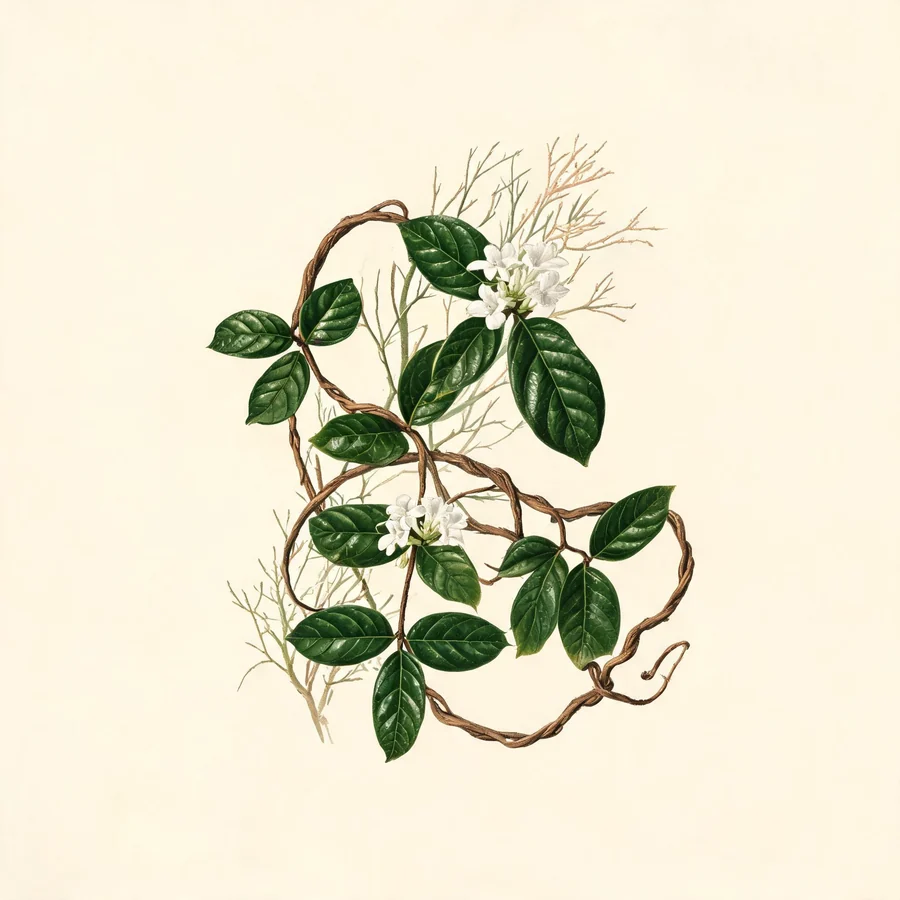
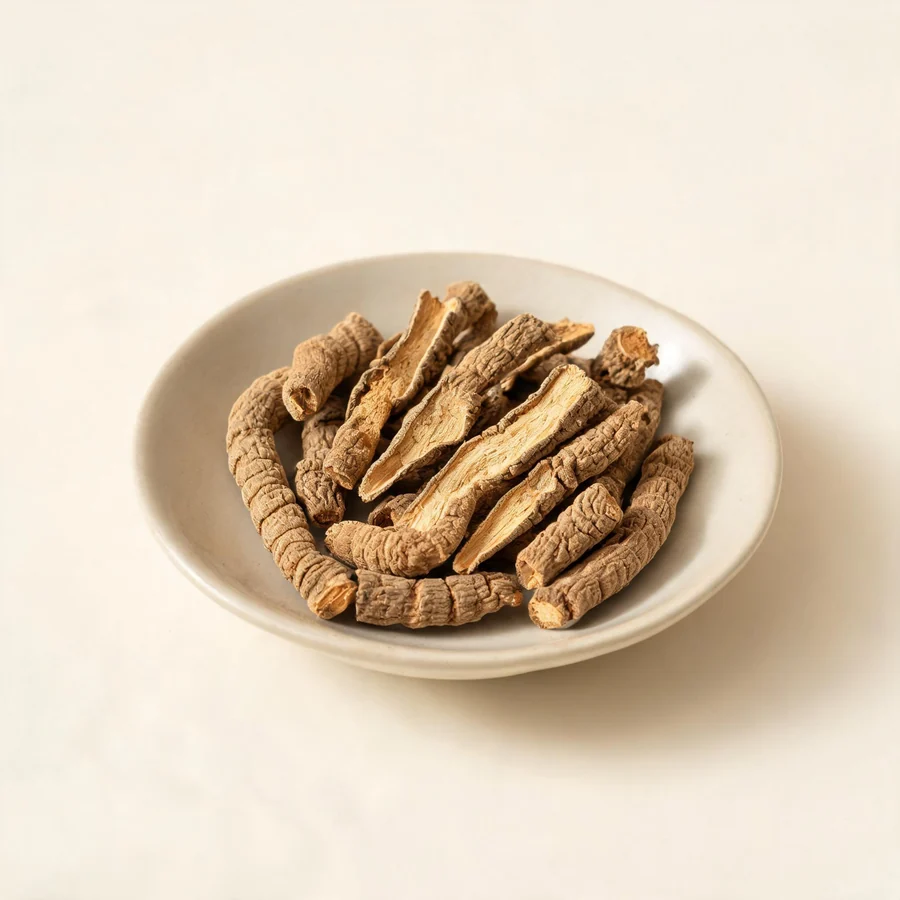
Skin profile
Where this herb sits in skin practice: the pattern it corrects, the skin signs it suits, and what it should not be used for.
Ba Ji Tian warms gently and works slowly: on skin it is for cold, pale, dry and lifeless surfaces, for slowly spreading white patches and for the wandering facial wind of the old texts. It is a supporting herb in a chronic picture and is wrong wherever heat or dryness leads.
Skin signs that suggest it
- Skin that is cool to the touch, pale, dry and dull, with little natural shine
- Itching or faint flushing that wanders over the head and face and settles nowhere
- White patches that have spread slowly over months, with cold limbs and a weak lower back
- Aching lower back and cold knees alongside the skin complaint, worse in cold weather
- A pale, slightly swollen tongue with a thin white coat and a deep, weak pulse
When it is not the right herb
Wrong where heat or dryness dominates. A person with night sweats, flushing in the evening, a red tongue with little coat and a rapid thin pulse has too little fluid already, and a warming root will consume more. It is also wrong for a hot, red, weeping or spreading rash, for damp-heat with a greasy tongue, and for children, in whom the patterns it addresses are rare. White patches that are spreading quickly, or a rash that is new and changing, need a dermatologist before any warming tonic is considered.
What it does for skin
Skin-relevant actions only. Each one describes a mechanism in TCM terms and what it looks like on the skin.
Warms the Kidney so that warmth reaches the surface
The tradition treats the Kidney as the source of the body's heat, and a surface that is cold, pale and slow is read as heat that is not arriving. The root warms gently, without the drying that the hotter Yang tonics produce, and it is given over weeks so that warmth builds rather than arriving in a rush. The signs that it is working are warmer hands, better sleep and skin with more colour, not a change in a lesion.
Dispels wind that wanders over the head and face
The classical commentary names wind wandering across the head and face as one of the root's targets, and the picture is an itch or a faint rash that moves from cheek to forehead to scalp without settling. The reasoning is that wind lodges where the ground is weak, so the root is used with wind-releasing herbs such as Fang Feng and Bai Zhi. It is a supporting measure, and a fixed, scaly or ulcerated facial rash needs a proper diagnosis.
Supports the Blood that colours and feeds the skin
The root is described as supplementing the Sea of Blood, the reservoir on which the skin draws, and the sweet taste is what nourishes. It is used where cold and depletion appear together, with angelica and rehmannia, for skin that is dry, pale and slow. It is not a blood tonic in its own right, and it is not given where dryness comes with heat.
Firms the frame that the skin sits on
Weak, aching legs and a cold lower back alongside a skin problem are read as one deficiency showing in the structure beneath the surface. Strengthening the sinews and bones is therefore part of treating the skin in this pattern, and the root is combined with eucommia or dipsacus. Improvement is judged over weeks by standing, walking and cold tolerance rather than by the lesion.
Skin conditions it is used for
Mapped to the condition pages on this site. The pattern column shows what the skin is doing when this herb is the right choice.
| Condition | Pattern | Why it suits | Typical setting |
|---|---|---|---|
| Vitiligo | Kidney and Liver depletion with wind: slowly spreading white patches, cold limbs and a weak back | Vitiligo is read in the tradition as a failure of the Blood and the Kidney to colour the skin, with wind disturbing what remains. The root warms the Kidney, supports the Sea of Blood and is used with wind-releasing and blood-nourishing herbs over months, which is the pace at which the pattern is expected to change. It is not a cure, the response is variable, and a new or rapidly spreading patch should be assessed by a dermatologist first. | With He Shou Wu, Dang Gui and Ci Ji Li in a Kidney-supplementing formula |
| Facial plaque | Wandering wind on the face over a cold, depleted base | The old commentary names wind that wanders across the face, an eruption that shifts site and leaves no fixed scale. When it appears in a cold, tired person with a weak back, the root is used to warm the base while wind-releasing herbs deal with the surface. A fixed plaque, a plaque with a hard edge, or one that bleeds needs a dermatologist, and the root is never applied to the face. | With Fang Feng, Bai Zhi and Dang Gui in a warming, wind-releasing formula |
| Cool or clammy skin sensation | Yang failing to warm the surface: cold, damp-feeling skin with cold limbs | Skin that feels cold and slightly damp to the person, with cold hands and feet and a dislike of draughts, is read as Yang that is not reaching the surface. The root warms from the centre, and it is used with cinnamon twig and astragalus so that the warmth is carried out rather than pooling. A cold, clammy skin that comes with breathlessness, chest pain or a sudden fall in blood pressure is an emergency and not a pattern. | With Huang Qi, Gui Zhi and Dang Gui in a warming formula |
| Thickened or insensitive skin | Cold and depletion leaving the surface thick, dry and dull of feeling | Skin that has thickened, dried and lost sensation over a cold limb is read as Yang failing to nourish the surface while damp and cold lodge in the channels. The root warms and disperses while blood-nourishing herbs restore the tissue, and the aim is softer, more sensitive skin over months. Loss of sensation that is sudden, patchy or follows a nerve injury needs neurological assessment, and the root does not restore a damaged nerve. | With Dang Gui, Chuan Xiong and Huang Qi in a warming, nourishing formula |
Combinations for skin
Herbs it is paired with when the skin, not an internal organ, is the target.
| Partner | Ratio | Why the pair is used |
|---|---|---|
| Du Zhong | 1 to 1, about 10 g of each | Eucommia and morinda both warm the Kidney and strengthen the sinews, and they are the standard pair for a cold, aching lower back. Eucommia is the better known bone herb and morinda the warmer and more wind-dispelling partner, so the pair covers both the ache and the cold that makes it worse. Skin use follows the same logic: warmth and structure restored together. |
| Rou Cong Rong | 1 to 1, about 10 g of each | Both warm the Kidney and both are mild enough for months of use, but one moves and the other moistens. Morinda is the acrid member, dispersing cold and firming the sinews, while cistanche is the moistening member that supplements essence and lubricates the bowel. The pair is chosen where warmth is needed without dryness, which is exactly the balance dry, cold skin requires. |
| Dang Gui | about 10 g of morinda to 10 g of angelica | Angelica nourishes the Blood that colours the skin and morinda supplies the warmth that moves it to the surface. The pair suits a cold, pale, dry person whose skin has lost its colour and its shine, and it is the combination behind the idea that the root supplements the Sea of Blood. Where dryness is marked, the angelica is increased. |
| Fang Feng | about 10 g of morinda to 6 to 10 g of Fang Feng | Fang Feng releases wind from the surface, and morinda repairs the ground the wind lodged in, which is the classical answer to wind that drifts across the face. The wind herb deals with the moving itch and the warming root with the cold, depleted base beneath it, so the two are used together for a shifting facial eruption in a tired person. |
Formulas where it leads
- Er Xian Tang (二仙汤) - Two immortals: curculigo, epimedium, morinda, angelica, phellodendron and anemarrhena, written for the change of life where cold and flushing appear together. Skin practice borrows it for a face that flushes while the body is cold, adding the root's warming to the cooling herbs. It is a formula of mixed temperature and is not used for a simple hot pattern.
- Huan Shao Dan (还少丹) - A warming pill for the depletion of later life, containing morinda with cistanche, eucommia, rehmannia, yam and cornus. Skin practice draws on it for cold, dry, lifeless skin in an older person with a weak back and cold limbs. It is a slow formula for a chronic picture and is not given in an acute illness.
Safety for skin use
What to check before recommending or using it, including the cautions that matter most for skin patients.
Do not use, or use with caution
- Yin deficiency with empty heat: night sweats, flushing towards evening, a dry mouth, a red tongue with sparse coating and a rapid, thin pulse. Warming the Yang here takes fluid that is already scarce.
- Heat in the blood or a hot, red, weeping, spreading rash, where a warming tonic adds to the fire rather than settling it.
- Damp-heat with a greasy yellow tongue coat, heaviness and a bitter taste, where the warmth thickens what is already turbid.
- Children and infants, in whom the patterns of decline this root addresses are rare and in whom warming Yang medicines are not routine.
Pregnancy and breastfeeding
Best avoided unless a practitioner prescribes it directly. It is not on the classical list of forbidden herbs, but warming Yang tonics are handled cautiously in pregnancy, above all where heat is present or a pregnancy has been lost before. The worry is theoretical, not documented. A settled pregnancy with a genuinely cold, depleted pattern might be given a reduced dose briefly; one with bleeding, cramping or raised blood pressure should not.
Interactions
- Hormonal medicines. In laboratory animals extracts have shifted the hypothalamic and pituitary control of sex hormones, which raises a theoretical question about use alongside hormone replacement, the contraceptive pill or anti-androgen treatment. Any effect is likely to be additive rather than dangerous, but the prescriber should be told.
- Blood pressure medicines. Dosing animals with the root has produced a modest drop in blood pressure, which could reinforce an antihypertensive and bring dizziness on standing, especially in an older person.
- Serotonergic medicines. Its oligosaccharides behaved like antidepressants in animal models, apparently acting through serotonin pathways. No interaction has been reported in people and the concern is slight, but a psychiatric medicine should be disclosed to the prescriber.
Allergy and patch testing
Reactions are uncommon. The root is woody and slightly sweet, and preparations sold under the name have been mixed with other species of the same family, so a reaction may be to what the product contains rather than to Morinda itself. Stop if a new itch or rash appears after a dose, and patch test any preparation that is applied to the skin.
General safety references
General references for herbal hepatotoxicity and herb-drug interactions; they are not specific to this herb.
- Review article: Herbal hepatotoxicity - an update on traditional Chinese medicine preparations. Alimentary Pharmacology & Therapeutics, 2014. PMID: 24844799.
- Interactions between herbal medicines and prescribed drugs: an updated systematic review. Drugs, 2009. PMID: 19719333.
- Warfarin and food, herbal or dietary supplement interactions: a systematic review. British Journal of Clinical Pharmacology, 2021. PMID: 32478963.
Evidence
The classical record is quoted with its source. The modern note states the level of evidence plainly.
Classical record
巴戟天,味辛,微温。主大风邪气;阴痿不起;强筋骨。安五脏,补中;增志,益气。生山谷。
Acrid and mildly warm. It is used against great wind pathogens and against the male organ failing to rise; it firms sinew and bone, settles the five viscera, supplements the centre, strengthens resolve and augments Qi. It is found in mountain valleys.
Shen Nong Ben Cao Jing (神农本草经), Han compilation - The oldest entry, and both lasting uses are already present: wind, and impotence. The grade is mild warmth rather than heat, which is why later authors call the root gentle.
巴戟天,主大风邪气,及头面游风者……巴戟天性能补助元阳,而兼散邪,况真元得补,邪安所留,此所以愈大风邪气也。
It governs great wind pathogens and wind that wanders across the head and face. The root assists the original Yang and disperses the pathogen at the same time: once the true source is supplemented, there is nowhere left for the pathogen to lodge, and that is how severe wind is resolved.
Ben Cao Jing Shu (本草经疏), Ming dynasty - A clear account of how a tonic can also disperse: mend the ground and the pathogen has nowhere to stand. This is the classical warrant for using the root on the face.
治脚气,去风疾,补血海。
It treats the swollen, weak legs of dampness, removes wind disorders, and supplies the Sea of Blood.
Ben Cao Gang Mu (Compendium of Materia Medica), Li Shizhen, 1578 - Li Shizhen's compressed entry adds the Sea of Blood, on which the skin use rests, and it keeps wind in view.
Modern evidence
Evidence status
- Laboratory work on Morinda officinalis reports anti-inflammatory, antioxidant and antidepressant-like activity, and effects on bone and on sex hormones, largely in animals and cell models. None of it is a trial in people, and none of it establishes benefit for vitiligo, a facial eruption or cold skin.
- No controlled clinical trial of Ba Ji Tian in a skin condition was identified. Its skin use follows the classical warming of the Kidney and the Sea of Blood and the commentary on wandering wind of the face, so the page describes traditional practice rather than demonstrated outcomes.
- Regulatory status: the root is an accepted article in the Chinese Pharmacopoeia as Radix Morindae Officinalis, and the quality question is identity, since related lianas with a thicker woody core are sold under the same name.
PubMed records
Selected real PubMed records for this herb's species or its constituents, chosen by species name and title relevance. They are references for the non-TCM discussion above, not proof that the herb treats any skin condition.
- Anti-inflammatory monoterpenes from morinda (Morinda officinalis How.).. Phytochemistry, 2024. PMID: 38382668 (skin-related record).
Dose and forms
Skin-practice dosing and the preparations that suit skin complaints.
| Form | Dose and notes |
|---|---|
| Decoction | 6 to 12 g of dried root a day within a formula, reduced to 3 to 6 g where other warming herbs are already in the pot. |
| Prepared root | Processing takes out the woody core: after steaming, the core is lifted away while the root is still hot and the flesh is dried in short lengths. Salt carries it to the Kidney, and wine strengthens its warming. |
| Course length | Six to twelve weeks for a chronic cold picture, with review. Reduce or pause if thirst, a dry mouth or restless sleep appear. |
As a warming tonic, the limit is tolerance rather than toxicity: excess brings thirst, a dry mouth, broken sleep and sometimes flushing, and the answer is to cut back rather than push on. Courses last weeks, and progress is read from cold tolerance, back strength and the look of the skin rather than from a single measure. The core is inert and is always taken out.
Citations and further reading
Only real sources are listed: the classical materia medica passages quoted above, and the source works behind the botanical and safety statements.
- Shen Nong Ben Cao Jing (神农本草经), Han compilation - the passage on its acrid, mildly warm nature is quoted in the original above.
- Ben Cao Jing Shu (本草经疏), Ming dynasty - the passage on wind that drifts across the face is quoted in the original above.
- Ben Cao Gang Mu (本草纲目), Li Shizhen, 1578 - the entry on wind, the legs and the Sea of Blood is quoted in the original above.
- Radix Morindae Officinalis monograph, Pharmacopoeia of the People's Republic of China - accepted source, part and quality requirements.
- Modern evidence statement: drawn from published laboratory work on Morinda officinalis, presented as a statement about the level of evidence rather than as a cited finding.
- Botanical description and identification: botanical literature on Morinda officinalis, family Rubiaceae.
Educational reference for qualified practitioners. This page is not medical advice, and skin conditions should be diagnosed by a clinician before treatment.