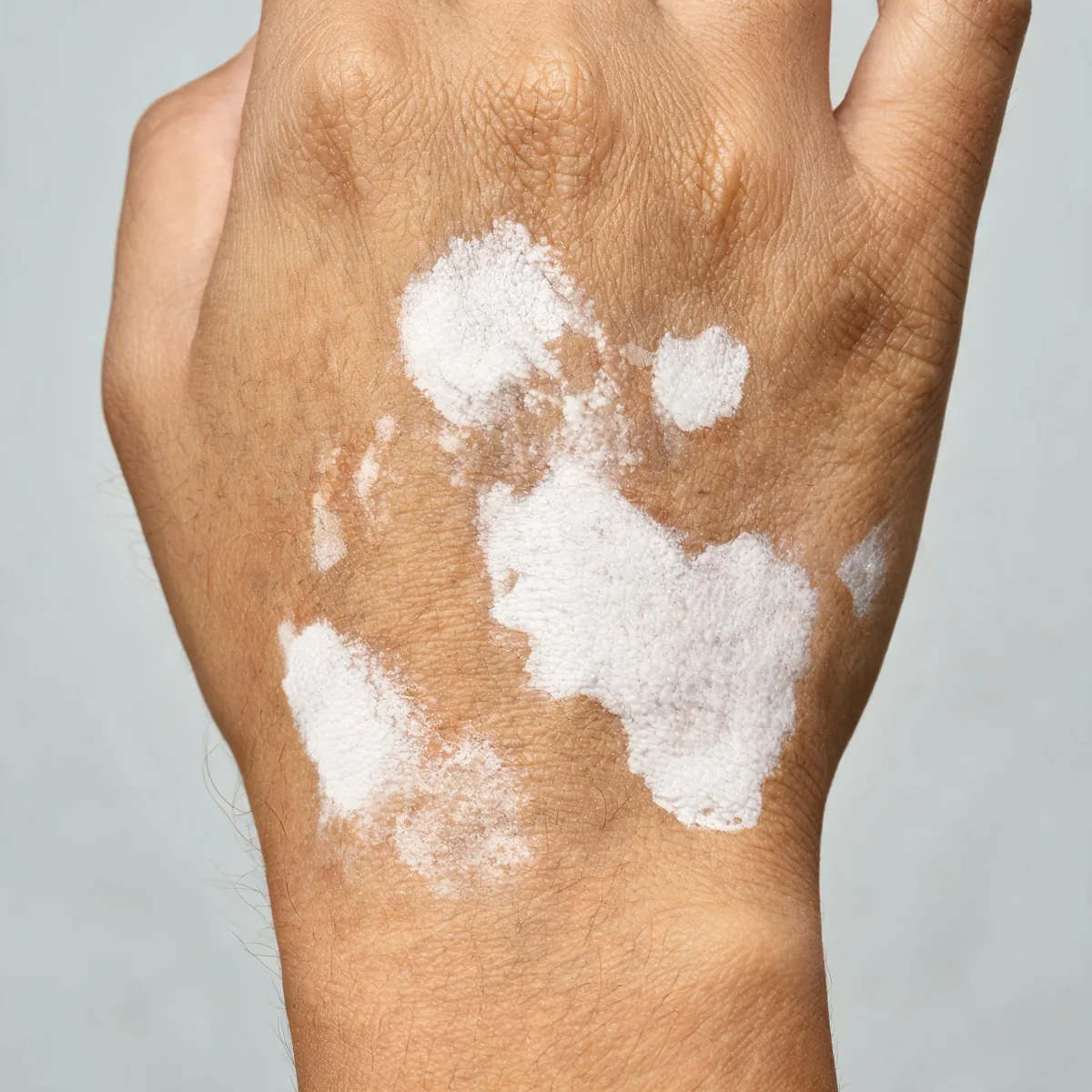
Understanding Vitiligo
The tradition describes the skin as a mirror of internal balance, particularly the state of Qi, Blood, and the organs that produce them.
The Liver stores Blood and keeps it moving, the Kidneys store Essence which fuels Blood production, and the Spleen transforms food into Qi and Blood. When any of these is depleted or blocked, the skin is said to lose its nourishment, and pale patches appear where the supply fails.
Emotional constraint is given a specific role: Liver Qi stagnation is described as worsening patches during stress, with rib-side distension, sighing and irritability. Blood stasis is described for patches with clear or darkened borders and a dusky complexion, where the supply is blocked rather than absent.
The classical literature is careful about expectations: repigmentation is slow and variable, and the treatment aim is to correct the internal imbalance while accepting that the skin may respond gradually.
Two things follow from this. First, the same white patch can arise from opposite situations, from a supply that is blocked and from a supply that is simply too small, so the colour of the patch alone does not decide treatment. Second, the emotional and digestive history is not background detail but part of the diagnosis, because constraint and depletion are treated in entirely different ways.
The classical literature also describes how patterns evolve into one another. Constrained Liver Qi that is not resolved can deepen into Blood stasis in the small vessels of the skin, and long-standing stasis can further deplete the Blood that feeds the surface. Treatment therefore follows the stage as well as the pattern, and the practitioner expects the formula to change over the months rather than stay fixed.
Conventional view
Vitiligo is a chronic condition in which patches of skin lose their pigment because melanocytes, the cells that make melanin, are destroyed or stop working. It is regarded as an autoimmune disorder and is more common in people who have other autoimmune conditions such as thyroid disease. Diagnosis is usually clinical, sometimes helped by a Wood's lamp that makes depigmented areas stand out.
Conventional care aims to restore colour or to even out skin tone. Topical corticosteroids and calcineurin inhibitors reduce inflammation, narrowband UVB phototherapy stimulates melanocytes, and oral immunosuppressants are used in some cases. Where vitiligo is extensive, the remaining pigmented skin may be depigmented deliberately, and cosmetic camouflage is a common and reasonable option.
These treatments need long-term use and carry costs: steroids can thin the skin, phototherapy can burn, and repigmentation is often slow and incomplete, with patches returning once treatment stops. Conventional care also does not address the stress, digestive weakness or constitutional depletion that patients often report as triggers, which is the gap a pattern-based approach tries to fill.
Selected PubMed records
Real PubMed records for the conventional discussion above, selected by condition name and title relevance. They are references, not a claim that any treatment is proven for this condition.
- [Vitiligo].. Ugeskrift for laeger, 2025. PMID: 40171901.
- Phototherapy for Vitiligo: A Systematic Review and Meta-analysis.. JAMA dermatology, 2017. PMID: 28355423.
- Comorbidities in Patients with Vitiligo: A Systematic Review and Meta-Analysis.. The Journal of investigative dermatology, 2023. PMID: 36574529.
How it is assessed
Diagnosis looks at the patches, their borders and distribution, and at the constitutional signs behind them.
What a practitioner looks for
- Patch quality: milky or porcelain-white patches with white hairs suggest deeper deficiency; duller patches with blurred edges suggest Spleen deficiency.
- Borders: clear or hyperpigmented borders and a dusky complexion point to Blood stasis.
- Emotional picture: stress-linked worsening with rib-side distension points to Liver Qi stagnation.
- Constitutional signs: low back weakness, night sweats, appetite, stools and fatigue decide which deficiency is present.
The practitioner looks first at the patches themselves: whether they are porcelain white or dull, whether the border is sharp, blurred or darkened, whether hairs within the patch have lost colour, and whether the area itches or burns. Distribution is noted too, since patches around the mouth and eyes, and on the hands and feet, behave differently.
The constitutional enquiry comes next: energy through the day, sleep, dreams, night sweats, low back strength, appetite, stools, menstrual pattern and mood. A thin rapid pulse with a red cracked tongue points to Yin deficiency, a wiry pulse with red tongue sides to constraint, a choppy pulse with a purple tongue to stasis, and a weak pulse with a pale puffy tongue to Spleen deficiency. A pale thin tongue with a fine wiry pulse suggests Blood deficiency with Wind.
Rapid spread changes the reading. When patches enlarge over weeks, the practitioner looks for an active factor, often a strong emotional trigger or external Wind, and treats that first while continuing to address the longer-standing root. Sudden widespread loss with fever or illness, or a lesion that bleeds or changes shape, is referred for medical assessment instead.
TCM patterns in Vitiligo
Six patterns are described for vitiligo, and they divide along a simple line. In stagnation patterns the supply of nourishment is blocked: Liver Qi stagnation, where constraint stops Qi moving Blood to the skin, and Qi and Blood stagnation and Blood Stagnation, where the blockage has become physical in the small vessels and the patches acquire clear or darkened borders. In deficiency patterns the supply is too small: Kidney and Liver Yin deficiency, where Essence and Blood run low; Spleen and Stomach Qi deficiency, where food is not transformed into enough Blood; and Blood deficiency with external Wind, where the dry undernourished surface admits Wind. Differentiation rests on patch colour and border, on the accompanying constitutional signs, and on the tongue and pulse. The patterns are not fixed boxes, since constraint can deepen into stasis and stasis can deplete Blood.
| Pattern | Key signs | The itch | Tongue | Main formula |
|---|---|---|---|---|
| Kidney and Liver Yin Deficiency | Not specified | Not specified | Body: Red, thin and dry, often crackedCoat: Little or none; the tongue may look peeled | Not specified |
| Liver Qi Stagnation | Irregular or painful menstruation | Not specified | Body: Normal or slightly dark, with red or purple sidesCoat: Thin white | Not specified |
| Blood Stagnation | Fixed stabbing pain worse at night; Rough dry scaly skin | Not specified | Body: Purple, dusky or with dark stasis spots; sublingual veins dark and distendedCoat: Often thin white; a yellow coat would suggest Heat as the cause | Not specified |
| Qi And Blood Stagnation | Fixed stabbing pain elsewhere | Itching or burning in the patches | Body: Purple or dark, with stasis spots; sublingual veins dark and distendedCoat: Thin white | Not specified |
| Spleen and Stomach Qi Deficiency | Not specified | Not specified | Body: Pale, puffy and teeth-markedCoat: Thin white | Not specified |
| Blood Deficiency with External Wind | Pale complexion and dull skin; Dry skin, hair and brittle nails | Dry itchy white patches | Body: Pale and thin, sometimes slightly dryCoat: Thin, white and a little dry | Not specified |
Kidney and Liver Yin Deficiency
Milky white patches with signs of depleted Yin.
Blood is stored by the Liver and Essence by the Kidney, and between them they supply the nourishment that keeps skin and hair coloured. When both Yin aspects are depleted, Essence and Blood run short, the surface is undernourished and pigment fades, and because the deficiency is deep the patches are milky or porcelain white and the hairs within them may lose colour.
A red thin tongue with cracks and little or no coating, and a fine rapid wiry pulse that is weak at the left Chi and thin at the left Guan, confirm the picture. Overwork, late nights, stress, spicy food, alcohol and sweating all consume Yin further, while rest, pears, cucumber, goji berries and black sesame help. Qi Bao Mei Ran Dan supplements Liver and Kidney and nourishes Essence and Blood, with Er Zhi Wan added to enrich Yin and settle the heat that comes with depletion, and Nu Zhen Zi, Mo Han Lian and He Shou Wu do most of the nourishing. KI-3 (Taixi), BL-23 (Shenshu), BL-18 (Ganshu) and SP-6 (Sanyinjiao) are used.
Signs
- Milky or porcelain-white patches, often with white hairs
- Dizziness and ringing in the ears
- Sore weak lower back and knees
- Night sweats and heat in palms and soles
- Insomnia with vivid dreams
Diet and lifestyle for this pattern: Prioritise rest on a regular sleep schedule to preserve Yin, and eat Yin-nourishing food such as black sesame, goji berries, walnuts and black beans. Avoid spicy, fried and overly heating food and limit alcohol and caffeine, keep exercise gentle such as walking or tai chi, and avoid excessive sweating that depletes fluids.
Liver Qi Stagnation
Patches that worsen with stress, with rib-side distension and irritability.
The Liver keeps Qi moving smoothly, and when frustration, anger or prolonged stress build up that movement is constrained. Qi no longer pushes Blood and nourishment out to the skin, so patches appear or enlarge during difficult periods and settle when the person feels calm. The blockage is functional rather than structural, which is why the patches are usually unremarkable in colour and border.
A normal or slightly dark tongue with red or slightly purple sides and a thin white coat, and a wiry pulse like a taut string, support it. Alcohol, greasy and spicy food and a sedentary routine add heat and dampness and worsen the constraint, while calming practice, gentle exercise and warm light meals ease it. Xiao Yao San courses the Liver, nourishes Blood and strengthens the Spleen, and Chai Hu Shu Gan San is used when rib-side distension and chest tightness dominate, with Chai Hu, Bai Shao and Xiang Fu. LR-3 (Taichong), LI-4 (Hegu) and SP-6 (Sanyinjiao) are the points.
Signs
- Patches worse with emotional stress
- Chest or rib-side distension
- Frequent sighing
- Irritability or mood swings
- Irregular or painful menstruation
Diet and lifestyle for this pattern: Make stress reduction a daily practice, with gentle yoga, walking or meditation keeping Liver Qi moving. Limit alcohol, coffee and spicy or greasy food, which add Heat to an already stagnant Liver, eat plenty of leafy greens, and a little mint or rose tea can gently lift the Qi.
Blood Stagnation
Well-defined patches with a dusky complexion and fixed pain.
When Qi has been blocked long enough, often through stress, injury or chronic illness, Blood stops moving freely in the small vessels that feed the skin. The patch is starved of nourishment at the same time as the surrounding skin darkens, so the border becomes clear and sometimes hyperpigmented while the complexion takes on a dusky tone.
A dark purple tongue with stasis spots and distended dark veins beneath the tongue, with a choppy or wiry pulse, confirm it. Cold, a sedentary life, suppressed emotion and injury to the skin aggravate it, while warmth, gentle movement, stress reduction and warm spiced food ease it. Xue Fu Zhu Yu Tang invigorates Blood and opens the collaterals, and Tong Qiao Huo Xue Tang is chosen when the patches sit mostly on the head and face, with Dang Gui, Chuan Xiong, Hong Hua and Tao Ren supplying the movement. SP-10 (Xuehai), BL-17 (Geshu), LR-3 (Taichong) and SP-6 (Sanyinjiao) are used.
Signs
- White patches with clear or hyperpigmented borders
- Dusky or dark facial complexion
- Dark purplish lips and nails
- Fixed stabbing pain worse at night
- Rough dry scaly skin
Diet and lifestyle for this pattern: Eat warming, moving food such as turmeric, black pepper, cinnamon and small amounts of red meat, and avoid cold raw food and iced drinks that congeal blood. Gentle daily walking or tai chi keeps Qi and blood flowing, avoid prolonged sitting, and manage stress with meditation or journalling, since emotional tension worsens stagnation.
Qi And Blood Stagnation
Well-defined patches with burning or itching and emotional tension.
This is the earlier, more functional stage of the same process. Qi sticks first, under emotional pressure, and because Qi commands Blood the Blood begins to slow as well, so the small vessels feeding the skin are obstructed before any fixed change has set in. The patches are well defined and may itch or burn, because stagnant Qi and Blood stir up internal Wind.
A purple or dark tongue with stasis spots and distended sublingual veins, and a pulse that is both wiry and choppy, describe it. Stress, inactivity, cold, spicy greasy food and injury worsen it, while gentle exercise, warmth, stress reduction and loose clothing help. Xue Fu Zhu Yu Tang moves Qi, invigorates Blood and resolves stasis in the collaterals, with modifications that add Wind-dispelling herbs such as Fang Feng when itching is prominent, and Tao Ren, Hong Hua and Chuan Xiong do the moving. SP-10 (Xuehai), LR-3 (Taichong) and SP-6 (Sanyinjiao) are chosen.
Signs
- Well-defined white patches
- Itching or burning in the patches
- Darkish or purplish complexion
- Chest or rib distension
- Fixed stabbing pain elsewhere
Diet and lifestyle for this pattern: Gentle daily walking or tai chi keeps Qi and Blood flowing. Avoid prolonged sitting and tight clothing that restricts circulation, manage stress with meditation or deep breathing, since emotional tension directly worsens this pattern, and eat warm, lightly cooked food while limiting cold, raw or greasy items that can congeal Blood.
Spleen and Stomach Qi Deficiency
Dull patches with blurred edges and a digestive deficiency picture.
The Spleen and Stomach turn food into Qi and Blood, and when that production line is weak the skin is fed less than it needs. Because the shortfall is general rather than local, the patches are dull and their edges blurry, and the same weakness shows elsewhere as tiredness, a poor appetite, bloating after eating and loose stools.
A pale puffy tongue with tooth marks and a thin white coat, and an overall weak soft pulse that is empty at the right middle position, confirm it. Skipped meals, raw and iced food, overwork, worry and heavy greasy meals all make it worse, while warm cooked meals, rest, gentle exercise and small frequent meals help. Shen Ling Bai Zhu San tonifies Spleen Qi, drains dampness and firms the stool, with Dang Shen, Bai Zhu and Fu Ling, and treatment uses ST-36 (Zusanli), SP-6 (Sanyinjiao), BL-20 (Pishu) and REN-6 (Qihai).
Signs
- Dull milky-white patches with blurry edges
- Fatigue worse with exertion
- Poor appetite
- Bloating after meals
- Loose or unformed stools
Diet and lifestyle for this pattern: Eat warm, cooked, easy food such as congee, soups and stewed vegetables, and avoid raw, cold and greasy food that taxes the digestive fire. Eat at regular times, chew thoroughly and stop before feeling full, and gentle movement such as walking or tai chi after meals supports Qi flow without draining energy.
Blood Deficiency with External Wind
Dry, itchy white patches with signs of Blood deficiency.
When Blood is deficient the skin becomes dry, pale and fragile, and the small cracks that form admit external Wind. Wind lodges in the surface and disrupts the local movement of Qi and Blood, so the patches are dry and itchy and may shift or change rather than stay fixed. The Wind is secondary: it is the lack of Blood that made the surface vulnerable.
The tongue is pale and thin with a thin, slightly dry white coat, and the pulse fine and wiry, sometimes floating at the front. Wind and drafts, cold weather, stress, overwork and a poor diet of raw, cold or spicy food aggravate it, while warmth, rest, warm nourishing food and moisturising help. Dang Gui Yin Zi nourishes Blood, moistens dryness and dispels Wind, with Dang Gui, Fang Feng and Bai Shao, and treatment uses SP-10 (Xuehai), LI-11 (Quchi), GB-20 (Fengchi) and ST-36 (Zusanli).
Signs
- Dry itchy white patches
- Pale complexion and dull skin
- Aversion to wind and drafts
- Dry skin, hair and brittle nails
- Dizziness or light-headedness
Diet and lifestyle for this pattern: Eat nourishing blood-building food such as dark leafy greens, beetroot, black sesame, bone broth, eggs and moderate amounts of organ meat. Avoid raw, cold and spicy food that can disrupt digestion and stir Wind, protect the skin from cold and wind with appropriate clothing, keep it moisturised, keep exercise gentle such as tai chi or walking, and protect rest to preserve Blood.
Treatment approach
How the tradition treats vitiligo, with the herbs, formulas and points used for it.
Principles
- Nourish the source: tonify Kidney and Liver, or Spleen and Stomach, according to the deficiency found.
- Move Qi and Blood where the patches are fixed or the pattern is stagnant, rather than only adding nourishment.
- Address emotional constraint where stress clearly drives the change.
- Protect the depigmented skin from sunburn, which the classical literature treats as part of care.
- Because most people present with a mixture, the formula is usually built rather than chosen whole: a base that moves Qi and Blood where patches are fixed, or that nourishes Kidney and Liver where they are porcelain white, with additions for Wind, dampness or constraint as the tongue and pulse indicate. Treatment is also staged, since an actively spreading picture calls for calming the acute factor first and turning to the deeper deficiency once the spread has stopped. Patches on the face and trunk are treated with more expectation than those on the hands and feet, which need longer.
Herbs used
Formulas
- Qi Bao Mei Ran Dan
- Er Zhi Wan
- Xiao Yao San
- Chai Hu Shu Gan San
- Xue Fu Zhu Yu Tang
- Tong Qiao Huo Xue Tang
- Shen Ling Bai Zhu San
- Dang Gui Yin Zi
Acupoints
- KI-3 (Taixi)
- BL-23 (Shenshu)
- BL-18 (Ganshu)
- SP-6 (Sanyinjiao)
- LR-3 (Taichong)
- LI-4 (Hegu)
- SP-10 (Xuehai)
- BL-17 (Geshu)
- ST-36 (Zusanli)
- BL-20 (Pishu)
- qihai-ren-6
- LI-11 (Quchi)
- GB-20 (Fengchi)
What to expect
- Repigmentation, where it happens, is described as slow, often taking months.
- Patches on the trunk and recent patches are described as more responsive than long-standing patches on the hands and feet.
- Stability, meaning no new patches, is treated as a meaningful early result.
- A halt in spread and slight darkening at the edges are the first signs looked for, usually after three to four months, and full repigmentation is described as taking six to eighteen months when it happens. Facial patches are said to respond faster than those on the hands and feet, and some areas may not repigment at all. Progress is judged over months rather than weeks, and treatment usually continues after the spread has stopped.
Safety and when to get help
Seek medical help urgently for
- White patches with severe blistering or pain.
- Signs of infection in a patch: redness, swelling, warmth or pus.
- A rapidly changing or raised pigmented lesion needs dermatological review.
For anything severe, sudden or spreading quickly, read when a skin problem needs urgent care.
Cautions
- Do not use strong topical preparations without advice.
- Vitiligo is associated with other autoimmune conditions; new systemic symptoms need medical review.
- Sun exposure needs protection on depigmented skin.
Using this alongside conventional care
- TCM is described as complementary to conventional care: prescribed topical treatment and phototherapy can continue alongside herbs and acupuncture, with changes to prescribed therapy made by the treating dermatologist.
- Herbs and acupuncture are described as sitting alongside topical steroids, calcineurin inhibitors and narrowband UVB phototherapy, and some herbs are suggested to improve the skin's response to light treatment. The practical rule is disclosure in both directions, so that the dermatologist and the TCM practitioner each know the full plan. Where oral immunosuppressants are used, herbs that strongly move Blood need discussing because of possible interaction with anticoagulants, and prescribed treatment is adjusted by the prescriber rather than stopped suddenly.
Diet and lifestyle
- The advice is to limit greasy, fried and sugary food that is said to create dampness and obstruct flow, and to favour lightly cooked vegetables, whole grains and lean protein.
- The general rule is to avoid what creates dampness and heat and obstructs flow, so greasy, fried and sugary food and excess dairy are reduced, and warm cooked soups and stews are favoured. Foods that build Blood and Essence are then added according to the pattern: mulberries, black sesame, goji berries and dark leafy greens for the deficiency patterns, and mint or rose tea, taken as a light infusion, to lift constrained Liver Qi. Since stress drives many patterns, cutting caffeine and alcohol also helps steady the Liver.
If you're pregnant
Carrying a child asks more of Blood and Essence, so deficiency pictures may deepen, Blood deficiency with external Wind and Kidney and Liver Yin deficiency in particular. Herbs that move Blood strongly, including Tao Ren, Hong Hua, Chuan Xiong and San Leng, are avoided, and formulas including Xue Fu Zhu Yu Tang or Tong Qiao Huo Xue Tang are considered unsuitable. Gentle nourishment with Bai Shao and He Shou Wu is preferred, Dang Gui is used only in small doses with caution, and acupuncture is usually preferred, with ST-36 and SP-6 used cautiously after the first trimester and LI-4 and lower abdominal points avoided.
If you're breastfeeding
Bitter or cold herbs can pass into breast milk and may cause diarrhoea or digestive upset in the infant, so Huang Lian and Da Huang are avoided, and formulas whose action strongly moves Blood, Xue Fu Zhu Yu Tang among them, are used cautiously. Milder nourishing formulas such as Er Zhi Wan or Shen Ling Bai Zhu San are considered safe and address the underlying deficiency. Acupuncture carries no risk to the infant and also supports the mother's energy and mood in the months after birth.
If treating a child
Vitiligo in children often points to an insufficiency present from birth, whether of the Spleen and Stomach or of Kidney Essence, and Spleen and Stomach Qi deficiency is especially common, the patches dull and poorly defined, the tongue pale and puffy, and the history showing fussy eating or repeated colds. Doses are reduced to a third or a half of the adult dose, gentle sweet herbs such as Dang Shen, Fu Ling and Bai Zhu are preferred, and acupuncture uses few needles with light stimulation, often replaced by tuina or moxibustion at ST-36.
If treating an elderly patient
In older adults the root is almost always deficiency, most often Kidney and Liver Yin deficiency, or deficiency of Spleen and Stomach Qi, and the patches progress slowly while repigmentation is also slower because Essence and Blood have declined with age. Treatment is gentler and more sustained, doses are roughly two thirds of the usual adult dose, and multiple medications mean herb interactions must be checked with the other prescribers. Acupuncture is often better tolerated, using mild stimulation at KI-3, BL-23 and ST-36.
Urgent-sign guidance is based on standard sources: NHS anaphylaxis, NHS cellulitis, NHS Stevens-Johnson syndrome, NHS melanoma.
Evidence
Evidence status
Compiled for this page from the classical and modern literature; not a systematic review, so treat it as a pointer to sources rather than clinical guidance.
The evidence is moderate and consists mainly of consensus, prescribing-pattern surveys and clinical reports. A national expert consensus sets out five main patterns with recommended formulas and external therapies, an analysis of published prescriptions found Kidney and Liver Yin Deficiency the commonest pattern with He Shou Wu and Nu Zhen Zi among the most used herbs, and a clinical report of combined acupuncture and plum-blossom needling reported high response rates in early localised cases. Blinding and controls are generally absent.
Three records are cited. The 2020 expert consensus from the Dermatology Branch of the China Association of Chinese Medicine sets out five patterns with formulas, points and external therapies. A 2022 analysis of prescriptions by Wang and colleagues, in Frontiers in Chinese Medicine Research, found Kidney and Liver Yin deficiency the most common pattern at sixteen per cent, followed by Blood stasis and channel obstruction at ten and Liver Qi stagnation at eight, with Nu Zhen Zi, He Shou Wu, Chuan Xiong and Dang Gui the herbs most often used. A 2021 clinical report published by the China Association of Acupuncture-Moxibustion describes body needling with local plum-blossom needling and ear acupressure, reporting over ninety per cent total effectiveness in early localised cases.
Studies often cited
The consensus outlines the main patterns for vitiligo (Qi and Blood Disharmony, Liver Qi Stagnation, Spleen and Stomach Deficiency, Channel and Collateral Stasis, and Liver and Kidney Deficiency) with recommended formulas, acupuncture points and external therapies, serving as the primary clinical reference in China. China Association of Chinese Medicine, Dermatology Branch. Chinese Journal of Dermatology. 2020.
A review of published prescriptions found Kidney and Liver Yin Deficiency the most common pattern, followed by Blood Stasis and Channel Obstruction, Liver Qi Stagnation and Qi and Blood Disharmony, with He Shou Wu, Nu Zhen Zi, Dang Gui and Chuan Xiong the most frequently used single herbs. Wang X, et al. Frontiers in Chinese Medicine Research. 2022.
A protocol combining body acupuncture at set points, local plum-blossom needling of the patches and ear acupressure reported a total effective rate above 90 percent, with the best results in early, localised cases. China Association of Acupuncture-Moxibustion, clinical observation report. 2021.
PubMed records for the TCM evidence
Real PubMed records for the TCM clinical evidence discussed above, selected by condition name and title relevance. They are references, not proof of benefit.
- Plant-Derived Compounds as Promising Therapeutics for Vitiligo.. Frontiers in pharmacology, 2021. PMID: 34858164.
- Stress-immune-Repigmentation niche in vitiligo: Mechanistic integration and therapeutic implications.. International immunopharmacology, 2026. PMID: 41855777.
Classical record
White patch wind is mostly caused by pathogenic Wind striking the skin, leading to disharmony of Qi and Blood, which then fail to nourish the skin and flesh.
- Wai Ke Zheng Zong (Orthodox Manual of External Medicine), section on Bai Bo Feng.
白癜者,面及颈项身体皮肉色变白,与肉色不同,亦不痒痛,谓之白癜。
In white patches the flesh of the face, neck and trunk turns white, unlike the normal hue of the skin, and there is neither itch nor pain, which is what the name describes.
Zhu Bing Yuan Hou Lun, chapter on Bai Dian - Classical citation: Zhu Bing Yuan Hou Lun (Treatise on the Origins and Symptoms of Diseases), chapter on Bai Dian.
Common questions
Can TCM restore pigment in vitiligo?
The classical literature aims to correct the internal imbalance and records slow, variable repigmentation rather than a guaranteed result. It does not claim a cure.
How long does treatment take?
Months, not weeks. Stopping new patches from appearing is described as an early and meaningful sign of progress.
Is vitiligo contagious?
No. It is described as an internal condition expressed on the skin.
Does stress make it worse?
The classical literature lists Liver Qi stagnation as a pattern in which patches worsen with emotional stress, anger and frustration.
Can I use TCM alongside phototherapy?
Yes, herbs and acupuncture are often used with narrowband UVB and other light therapy, and some herbs are thought to improve the skin's response to light. Both the dermatologist and the TCM practitioner should know the whole plan so that timing and dosage can be coordinated safely.
Does diet need to change?
Diet is treated as part of the work. Greasy, fried and sugary food is reduced because it creates dampness and heat, warm cooked meals are favoured, and Blood and Essence-building foods such as goji berries, black sesame and dark leafy greens are added to support the skin.
Can children be treated safely?
Treatment can be adapted. Herbal doses are scaled to age and weight, and acupuncture may be gentler or replaced with acupressure or tuina. A practitioner experienced with children should guide the plan, and the child's paediatrician should be kept informed.
What if the patches are spreading fast?
Rapid spread is read as an active imbalance, often after a strong emotional trigger or an external factor such as Wind, and treatment aims to calm that first, for instance by calming the Liver or dispelling Wind, while the longer root is addressed in parallel. Spread with fever, blistering or pain needs medical assessment rather than TCM alone.