Skin profile
Where this herb sits in skin practice: the pattern it corrects, the skin signs it suits, and what it should not be used for.
Fang Feng is the mild, surface-directed wind herb, chosen when itch moves and the skin is not heavily damaged. It clears the surface without drying it, which is why it appears in chronic itchy conditions, in children and in formulas where the other wind herbs would be too harsh.
Skin signs that suggest it
- Weals that rise and fade within hours, with an itch that moves from place to place (Wind in the skin)
- Itch that worsens on exposure to wind, draughts or a change of weather
- A rash that appears on one area and then another, without settling into a fixed plaque
- An itchy eruption in a person who is thin and dry, where the harsher wind herbs cause stinging
- A pale or pink surface with little ooze, rather than a wet, yellow-crusted lesion
When it is not the right herb
Not for Blood deficiency with a dry, thickened plaque, where the itch comes from the skin being undernourished rather than from Wind, and a dispersing action would spend what little is left. It is also a poor choice in a person who already sweats spontaneously, in severe Qi deficiency, and in a headache from rising Liver Yang rather than from an exterior invasion. It is warm and drying in larger amounts, so long courses are avoided in thin, dry patients.
What it does for skin
Skin-relevant actions only. Each one describes a mechanism in TCM terms and what it looks like on the skin.
Disperses Wind and quiets a moving itch
Traditional teaching holds that itching follows wherever Wind is dominant, and Wind in the skin is read from an eruption that shifts, rises and fades rather than staying put. Fang Feng drives that influence out through the surface again, which is why it is used for hives, for itchy rashes that travel, and for the itch that arrives with a cold. It works best where the skin is not deeply damaged, because it acts at the surface rather than in the tissue.
Clears the surface without drying it
Among the wind herbs, this one is described as moistening, a relative term that is clinically useful. Where Jing Jie, Qiang Huo and Ma Huang are drying and can leave the skin tight, Fang Feng disperses gently and can be used on a dry, thin surface or in a child. That is why it appears in long courses for recurrent colds and in formulas for elderly or depleted skin.
Relieves itch by addressing its trigger
Fang Feng is not a sedating antipruritic and does not numb the skin. It reduces itch by moving the Wind that drives it, and its value is judged by whether the eruption becomes less mobile and the itch less provoked by weather. It is paired with blood-nourishing herbs when the skin is dry and with heat-clearing herbs when the rash is red, so that the cause is treated alongside the surface.
Disperses wind-damp that settles in the skin and limbs
Wind joined with Dampness produces a heavy, aching, itchy surface and joints that feel worse in damp weather, and the root disperses both. On the skin this shows as a rash that is itchy and slightly boggy, or as itch over swollen, aching joints in a cold, damp season. Its action is mild, so it assists stronger herbs rather than leading in severe obstruction.
Skin conditions it is used for
Mapped to the condition pages on this site. The pattern column shows what the skin is doing when this herb is the right choice.
| Condition | Pattern | Why it suits | Typical setting |
|---|---|---|---|
| Urticaria | Wind in the skin, with weals that rise and fade | Hives are the clearest picture of Wind in dermatology: the weal appears, moves and disappears within a day, and the itch travels with it. Fang Feng is the standard herb for that pattern and is combined with Jing Jie for a cold, pale weal or with Huang Qin and Chan Tui for a red, heat-provoked one. In recurrent cases it is continued for some weeks after the wheals settle, because the aim is to change the tendency rather than to chase each weal. | Xiao Feng San, or Fang Feng with Jing Jie and Chan Tui |
| Eczema | Wind-damp itch on a surface that is not deeply damaged | Fang Feng is an assistant in eczema rather than a leading herb. It is chosen when itch and mobility dominate and the lesions are neither heavily weeping nor thickened, and it is paired with drying herbs for a wet flare and with blood-nourishing herbs for a dry one. Its gentleness is why it can be used in children with atopic skin, where the stronger wind herbs provoke stinging. | Xiao Feng San with Bai Xian Pi and Ku Shen |
| Itchy skin | Itch with no fixed lesion, driven by Wind | When the main complaint is itch and there is little to see between the scratch marks, the tradition reads Wind moving across the surface, often on a ground of dry Blood. Fang Feng addresses the movement and lets the blood-nourishing herbs address the ground. It is one of the few wind herbs that can be given for weeks in a dry, thin person without making the skin tighter. | Dang Gui Yin Zi with Fang Feng and Bai Xian Pi |
| Contact dermatitis | An acute surface reaction with wind-heat at the point of contact | Contact dermatitis begins where something touched the skin, and the tradition reads it as a surface invasion at that point: red, raised, itchy and sometimes spreading beyond the area of contact. Fang Feng disperses the surface reaction while the cooling herbs in the formula settle the heat. The offending substance still has to be identified and avoided, and a severe reaction with blistering needs medical care. | Modified Xiao Feng San with Fang Feng, Jing Jie and Ku Shen |
| Seborrhoeic dermatitis | Wind and damp-heat rising to the scalp and face | The greasy yellow scale and red base of seborrhoeic dermatitis are read as damp-heat, and the itching plus the tendency to move across the scalp and face as Wind. Fang Feng is added to carry the other herbs to the surface of the upper body and to settle the itch, and it is paired with Huang Qin and Zhi Zi for the heat and dampness beneath. | Huang Qin with Zhi Zi and Fang Feng, or a diluted scalp wash |
| Neurodermatitis | Wind settling in a plaque that itch keeps provoking | A lichenified plaque is a fixed lesion, but the itch that maintains it still behaves like Wind: it comes in attacks, worse at night or with stress, and scratching spreads it. Fang Feng is used as an assistant to blood-nourishing and itch-settling herbs rather than alone, and its role is to break the cycle at the surface while the Blood is restored underneath. The plaque softens slowly, and only when the scratching stops. | Modified Dang Gui Yin Zi with Fang Feng and Chan Tui |
| Psoriasis | Wind-damp with blood dryness in a scaling plaque | In the blood-deficiency presentation of psoriasis the plaques are pale or dull red, the scale is fine and the itch is marked, and Fang Feng is one of the wind herbs used to settle the surface while Dang Gui and Bai Shao nourish the Blood. It is not a herb for the thick, bright red, heat-dominated plaque, where stronger cooling is needed, and it does not replace the blood-moving part of treatment. | Dang Gui Yin Zi, modified with Fang Feng and Bai Xian Pi |
Combinations for skin
Herbs it is paired with when the skin, not an internal organ, is the target.
| Partner | Ratio | Why the pair is used |
|---|---|---|
| Jing Jie | 6 to 10 g each | The standard surface-releasing pair, and it is rare to see one without the other. Both are warm and acrid and both move Wind; Jing Jie opens the skin and provokes a sweat, while this root works further in, drying Dampness and easing pain along the channels. The equal proportion is traditional, and the pair is used for an early cold with an itchy surface and for itch where Wind leads. |
| Huang Qi | 10 to 15 g Huang Qi with 6 to 10 g Fang Feng | Huang Qi secures the surface and builds defensive Qi while Fang Feng patrols it, which is the logic of the jade-screen formula. On skin the pair is used for the person who reacts to every change of weather with an itchy rash, and for the weak surface that lets a rash flare with each cold. One strengthens the gate and the other keeps it clear. |
| Bai Zhu | 10 to 12 g each | Bai Zhu dries Dampness and strengthens the Spleen's production of Qi, so the dispersing root has something to work with instead of simply spending what is there. The pair is used where a dispersing herb would otherwise leak Qi that is already short, and on the skin it suits a damp, itchy eruption in a person with a poor appetite and loose stools. |
| Chan Tui | 6 to 10 g each | Cicada slough is light and works at the surface, and it is chosen for itch and for the eyes and throat, while Fang Feng ranges more widely. The two are used where itch will not settle once Wind has lodged in the skin, as in nettle rash and eczema, and where a rash is held back at its first appearance. The combination tends to cool rather than warm, so a red, hot itch suits it better than a pale cold one. |
Formulas where it leads
- Xiao Feng San (消风散) - The core dermatological formula for a wind-damp-heat eruption that is red, itchy and spreading. Fang Feng supplies the wind-dispersing element while Jing Jie, Chan Tui and Niu Bang Zi move the surface and Shi Gao, Zhi Mu and Ku Shen cool and dry the heat beneath. It is the setting in which the root's place in skin practice is easiest to see.
- Dang Gui Yin Zi (当归饮子) - A formula for chronic itchy skin on a base of Blood deficiency, where the surface is dry and the itch is worse at night. Fang Feng is the wind herb that keeps the surface clear while Dang Gui, Bai Shao, Sheng Di Huang and He Shou Wu restore the Blood, and its mildness is what allows it to be given for weeks without drying the skin further.
Safety for skin use
What to check before recommending or using it, including the cautions that matter most for skin patients.
Do not use, or use with caution
- Blood deficiency with spasm, tremor or a dry thickened plaque. When trembling or tightness comes from Blood that no longer nourishes the skin and sinews, a dispersing herb spends what little remains and the problem worsens.
- Spontaneous sweating from Qi or Yang deficiency, and night sweats from Yin deficiency. A person who already sweats does not need a surface-opening herb, and giving one deepens the loss.
- Headache from rising Liver Yang or from Yin deficiency rather than an exterior invasion, and diarrhoea from deficiency rather than cold-damp: in both the herb addresses the wrong mechanism.
- Severe Qi deficiency with a chronic illness that is not Wind or Dampness; a dispersing root weakens what is already thin.
Pregnancy and breastfeeding
Standard doses are generally considered acceptable when needed, since the root is mild and is not on the classical list of prohibited herbs. Long courses at high dose are still avoided without supervision, since dispersing Qi too freely might disturb the fetus; no harm has been reported in practice. While breastfeeding it is regarded as compatible at ordinary doses, with the usual practitioner oversight.
Interactions
- Anticoagulants and antiplatelet drugs. Animal extracts reduce blood viscosity, so anyone taking warfarin, heparin or clopidogrel should tell their prescriber about the herb rather than combine the two quietly; at ordinary doses the evidence for any real effect is slight.
- Antihistamines and sedatives. Extracts inhibit mast cell degranulation and show mild sedative and anticonvulsant activity in animal work, so they may add to antihistamines, benzodiazepines or other sedatives. Nothing has been documented in people.
- Strong diaphoretics and other surface-opening herbs. Combining them can produce excessive sweating, dryness and a depleted feeling, which is the expected result of too much dispersal rather than a toxic effect.
Allergy and patch testing
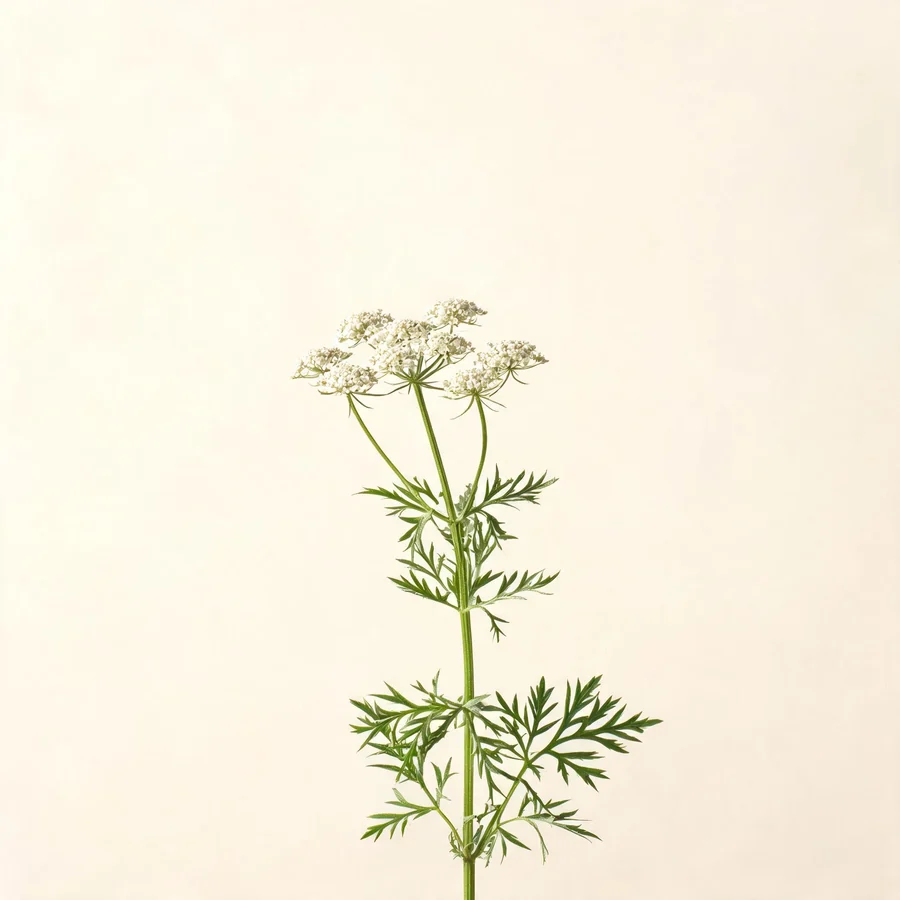
Fang Feng belongs to the Apiaceae family, and people who react to celery, fennel, parsley or other umbellifers may in theory be sensitive to it. Reactions are uncommon and usually mild, but a rash, wheeze, lip swelling or faintness after a dose needs urgent assessment. Any herb applied to the skin should be patch tested, and a previous reaction to a herb-containing wash is a reason to avoid the same herb again.
General safety references
General references for herbal hepatotoxicity and herb-drug interactions; they are not specific to this herb.
- Review article: Herbal hepatotoxicity - an update on traditional Chinese medicine preparations. Alimentary Pharmacology & Therapeutics, 2014. PMID: 24844799.
- Interactions between herbal medicines and prescribed drugs: an updated systematic review. Drugs, 2009. PMID: 19719333.
- Warfarin and food, herbal or dietary supplement interactions: a systematic review. British Journal of Clinical Pharmacology, 2021. PMID: 32478963.
Evidence
The classical record is quoted with its source. The modern note states the level of evidence plainly.
Classical record
It governs wind and the pain of the head and body, and the eyes.
Shen Nong Ben Cao Jing - The Wind indications have not changed in two thousand years, and the aching head and body belong to the surface territory that skin herbs still work in.
防者,御也。其功疗风最要,故名。
Fang means to defend. Its work in treating wind is of the first importance, and from that it takes its name.
Ben Cao Gang Mu (《本草纲目》), Li Shizhen, 1578 - More a gloss on the name than a medical claim, yet it settled the root's identity as a defender of the surface, not only an expeller of Wind.
身:去上风;梢:去下风。
The body of the root drives out wind above; the tip drives out wind below.
Zhen Zhu Nang (《珍珠囊》), Li Dongyuan, Jin dynasty - A dispensing instruction, and a reminder that one root once served two opposite ends of the body.
Modern evidence
Evidence status
- Laboratory studies of the chromones and coumarins of Saposhnikovia divaricata, including prim-O-glucosylcimifugin and 5-O-methylvisammioside, report anti-inflammatory, analgesic and antipruritic activity in cell and animal models. These are laboratory findings and do not establish benefit in skin disease.
- Clinical trial evidence for Fang Feng in skin disease is limited and mostly indirect, coming from studies of multi-herb formulas for urticaria and eczema rather than from trials of the single root. No robust conclusion about its own efficacy can be drawn from that literature.
- Safety: the oral median lethal dose in mice is about 214 g per kg, an extremely wide margin, with no toxic constituent identified. What limits use in practice is the warmth and dryness of the herb, not toxicity.
PubMed records
Selected real PubMed records for this herb's species or its constituents, chosen by species name and title relevance. They are references for the non-TCM discussion above, not proof that the herb treats any skin condition.
- Saposhnikovia divaricata (Turcz.) Schischk.: A review of botany, ethnomedicinal uses, phytochemistry, pharmacology, pharmacokinetics, toxicology, and quality control.. Journal of ethnopharmacology, 2027. PMID: 42586391 (safety record).
- Toxicological Evaluation of Saposhnikoviae Radix Water Extract and its Antihyperuricemic Potential.. Toxicological research, 2019. PMID: 31636848 (safety record).
Dose and forms
Skin-practice dosing and the preparations that suit skin complaints.
| Form | Dose and notes |
|---|---|
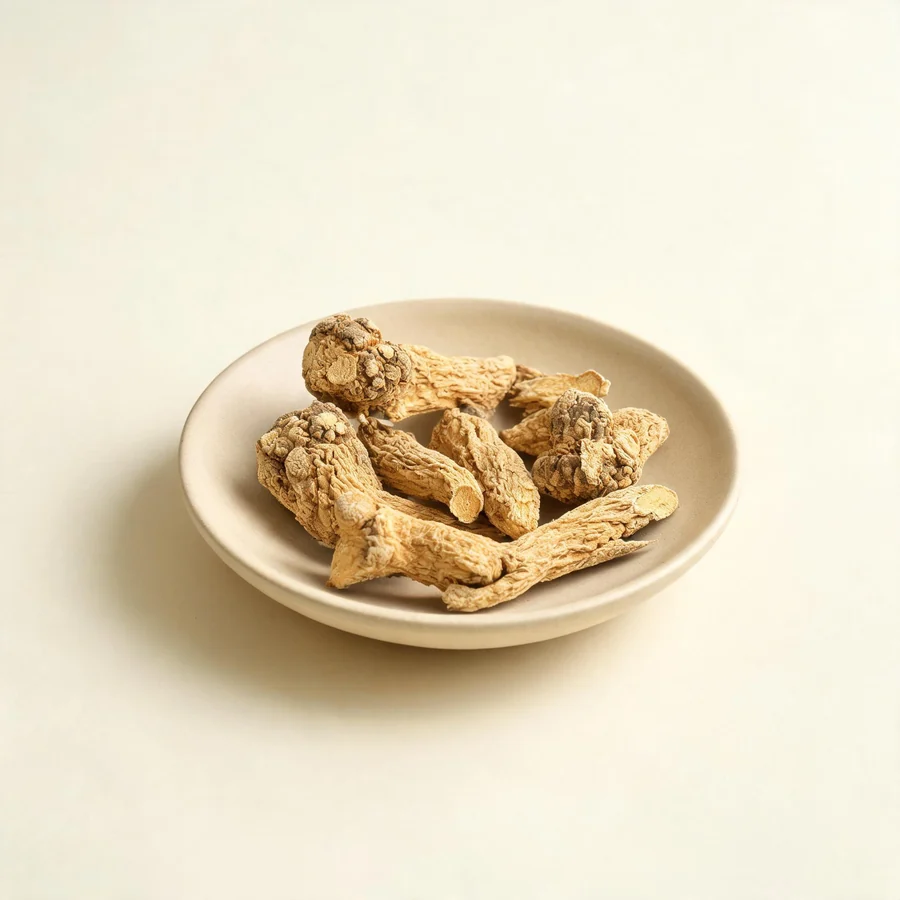
| Decoction (internal) | 3 to 10 g of dried root daily in a formula. Three to five grams is used where it assists other wind herbs, and five to ten grams for releasing the surface, easing joint pain and settling itch. |
| Processed forms | The dry-fried root at 5 to 10 g is chosen when the target is the intestine rather than the skin, and the charred form when there is bleeding with pale blood. Neither is a skin preparation, but they are the forms the same root is dispensed in. |
| Higher dose under supervision | Up to 15 to 30 g appears only in acute wind-damp obstruction and under supervision, and it is not a household dose. |
| Course length | Short courses for an acute rash, and longer courses in recurrent hives only with review, since the herb is drying in larger amounts. |
The margin is wide, so the pattern sets the dose rather than toxicity does. Two classical points survive: one root once served two opposite ends of the body, and stir-frying redirects it from the surface to the intestine. Because the herb dries in larger amounts, courses are kept short in a person who is already thin and dry, and it is stopped if the skin becomes tighter rather than calmer.
Citations and further reading
Only real sources are listed: the classical materia medica passages quoted above, and the source works behind the botanical and safety statements.
- Shen Nong Ben Cao Jing (Divine Husbandman's Classic of Materia Medica), attributed compilation of the Han period - classical passage quoted above.
- Ben Cao Gang Mu (Compendium of Materia Medica), Li Shizhen, 1578 - classical passage quoted above.
- Zhen Zhu Nang (Pearl Sack), Li Dongyuan, Jin dynasty - classical passage quoted above.
- Fang Feng monograph: Pharmacopoeia of the People's Republic of China - source for the accepted botanical source, part used and quality requirements.
- Modern evidence statement: based on laboratory literature on the chromones and coumarins of Saposhnikovia divaricata, summarised as a statement about the level of evidence rather than as a cited finding.
- Botanical description and identification: botanical literature on Saposhnikovia divaricata, Apiaceae.
Educational reference for qualified practitioners. This page is not medical advice, and skin conditions should be diagnosed by a clinician before treatment.