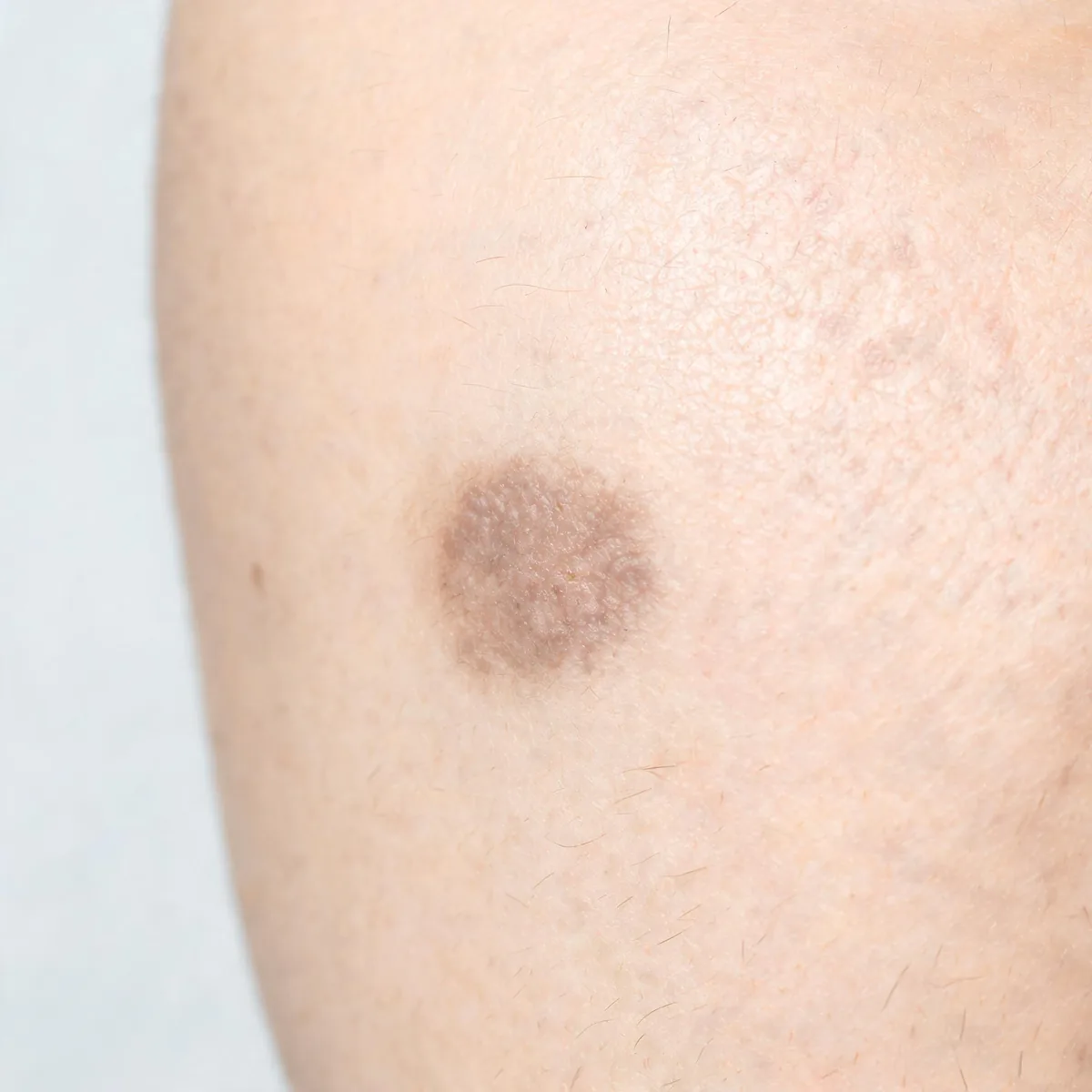
Understanding Facial plaque
A name note recorded rather than resolved: 黧黑斑 (lí hēi bān) is also the classical name used on the Melasma page, and this source keeps a separate page for facial plaque. Both are built and both record the overlap.
The tradition describes the face as a mirror of the Liver, Spleen and Kidneys. When they fall out of balance, Qi and Blood fail to rise and nourish the complexion, and stagnation, dampness or heat accumulates as pigment.
Liver Qi stagnation gives brown or dark brown patches on the cheeks and forehead with a diffuse patchy distribution that fluctuates with mood, plus irritability and mood swings. Qi and Blood stagnation gives dark brown, grey-brown or blackish plaques that do not shift, with painful periods with dark clots and fixed lower abdominal pain.
Spleen deficiency with dampness gives dull dusty-brown patches as if dirt is stuck to the face, with fatigue worse after eating, poor appetite, bloating and loose stools. Kidney and Liver Yin deficiency gives dull grey-brown plaques with dizziness, tinnitus, low back and knee soreness and dry eyes with blurred vision.
The Liver is usually the first to falter. Stress, frustration and anger that is never expressed hold Qi back, and Qi that will not move cannot push Blood, so the face is poorly supplied and pigment settles where the flow is slowest. A Spleen too weak to transform fluids sends dampness upward instead, and overwork or ageing drains Kidney Yin, so the deepest reserves of moisture and nourishment run low.
Colour and position carry much of the diagnosis. A practitioner reads the shade of the patch, whether it shifts, and what the tongue, pulse and menstrual history add, then treats the process behind it rather than the patch itself.
Conventional view
Melasma is an acquired hyperpigmentation disorder: symmetric patches, from pale to deep brown, on the parts of the face the sun reaches, most often the cheeks, the forehead, the upper lip and the chin. Women are affected far more than men, particularly in pregnancy and among those on the contraceptive pill, and the cause is a mix of sun exposure, hormonal change and genetic tendency. Diagnosis is usually visual, sometimes with a Wood's lamp to judge how deep the pigment sits.
Management rests on strict sun protection and on lightening creams: hydroquinone, tretinoin, azelaic acid and kojic acid among them. Resistant cases may be offered a chemical peel, a laser or light treatment, or oral tranexamic acid, though results vary and the pigment often returns once treatment stops, especially without sun avoidance.
The treatments act on pigment already in the skin and do nothing about the internal signals that keep melanocytes producing it. Lightening creams irritate sensitive facial skin, lasers can cause post-inflammatory hyperpigmentation in darker skin, and every melasma is treated as one condition, where the classical literature separates a stress-driven patch, a dull patch with sluggish digestion and a sallow patch with backache as different problems.
Selected PubMed records
Real PubMed records for the conventional discussion above, selected by condition name and title relevance. They are references, not a claim that any treatment is proven for this condition.
- Symmetrical Facial Giant Plaque-Type Juvenile Xanthogranuloma: Case Report and Review of the Literature.. Case reports in dermatology, 2021. PMID: 34413740.
How it is assessed
The practitioner checks that the plaque is not suspicious, then assesses the pattern.
What a practitioner looks for
- Movement: plaques that fluctuate with mood suggest Liver Qi stagnation.
- Fixity: dark fixed plaques that do not shift suggest Qi and Blood stagnation.
- Digestion: dusty patches with bloating suggest Spleen deficiency with dampness.
- Red flags: irregular borders, multiple colours, or a lesion that bleeds or itches.
In Liver Qi Stagnation the patches are a brownish bronze haze over cheeks and forehead, spreading or deepening under stress, frustration or before a period. Expect irritability, frequent sighing, breast tenderness and a feeling of bloating. On the tongue, redness shows most clearly at the sides, and the pulse is wiry, like a string pulled tight.
Once the stagnation has moved from Qi into Blood, the plaques darken towards grey-brown or purplish and stop moving. Periods are painful with dark clots, the tongue body is dusky or shows purple spots, and the pulse is choppy or wiry and hesitant, reflecting blood that is stuck rather than merely slow.
Spleen Deficiency with Dampness leaves the face dusty and dull, as though a film of soil had settled on it, with chronic tiredness, a poor appetite and loose stools or bloating after eating. The tongue looks pale and puffy, with scalloped edges, and the pulse feels soft and weak. Where the root is Kidney and Liver Yin Deficiency, the patches are dark and sallow, the whole complexion looks lacklustre and aged, and dizziness, tinnitus, sore lower back and knees, dry eyes and broken sleep come with them; there the tongue is red, thin and cracked with little coating, and the pulse fine, rapid and wiry.
TCM patterns in Facial plaque
Four patterns account for most facial plaques, and the skin gives the first clue. A patch that shifts with mood, one that never moves, a dusty film sitting alongside digestive tiredness, and a dark sallow patch that arrives with backache are four pictures of the same surface. The distinction turns on whether Qi is merely stuck or Blood has congealed, and on whether the deficiency sits in the Spleen or reaches as deep as Kidney and Liver Yin. It matters clinically because the strategies differ: one pattern calls for moving, one for invigorating, one for strengthening and draining, one for enriching deep reserves. Patterns follow each other too, since long-standing Liver Qi stagnation tends to deepen into Blood stasis, and a weak Spleen can let dampness settle while Yin quietly declines. Read the signs dominating now, and let a practitioner confirm their order with tongue and pulse.
| Pattern | Key signs | The itch | Tongue | Main formula |
|---|---|---|---|---|
| Liver Qi Stagnation | Not specified | Not specified | Body: Normal or slightly dark, with red or purple sidesCoat: Thin white | Not specified |
| Qi And Blood Stagnation | Dark brown, grey-brown or blackish plaques that do not shift; Menstrual pain with dark clotted blood | Not specified | Body: Purple or dark, with stasis spots; sublingual veins dark and distendedCoat: Thin white | Not specified |
| Spleen Deficiency with Dampness | Not specified | Not specified | Body: Pale and swollen, often with teeth marks along the edgesCoat: White, greasy and moist, thick in the middle | Not specified |
| Kidney and Liver Yin Deficiency | Dull grey-brown or dark facial plaques; Dry eyes with blurred vision | Not specified | Body: Red, thin and dry, often crackedCoat: Little or none; the tongue may look peeled | Not specified |
Liver Qi Stagnation
Brown patches on cheeks and forehead that fluctuate with mood.
The Liver keeps Qi moving through the whole body, the face included. When stress, frustration or swallowed anger blocks that flow, Qi and Blood slow down and the complexion is no longer properly supplied, so pigment collects in patches that are diffuse rather than sharply outlined. Because the cause is movement rather than substance, the patches come and go with the emotional weather.
The tongue is normal or slightly dark, with red or faintly purplish sides and a thin white coat. The pulse is wiry, like a taut guitar string. Patches deepen with stress, alcohol, spicy or greasy food, skipped or oversized meals, inactivity and the premenstrual days, and ease with calming practice, peppermint or rose tea taken warm, gentle exercise, open expression of feeling and regular sleep. Irritability, sighing, breast tenderness and rib-side distension usually accompany them. Xiao Yao San, with Chai Hu, Dang Gui and Bai Shao, is the formula, and the points LR-3 (Taichong), LI-4 (Hegu), SP-6 (Sanyinjiao) and SP-10 (Xuehai).
Signs
- Brown or dark brown patches on cheeks and forehead
- Diffuse patchy distribution that fluctuates with mood
- Irritability or feeling on edge
- Rib-side discomfort
Diet and lifestyle for this pattern: Manage stress with meditation or gentle yoga, and sip warm peppermint or rose tea to move Liver Qi gently. Avoid alcohol, coffee and spicy, greasy food that aggravates stagnation, keep up regular moderate exercise such as walking, and hold to a consistent sleep schedule.
Qi And Blood Stagnation
Fixed dark or blackish plaques with painful clots periods.
When stress and frustration persist, the Liver loses its hold on the flow long enough for Blood to begin congealing. The stagnation is no longer functional but physical: Blood pools in the small vessels of the face, and the pigment that settles there stays put. That is why these plaques keep their shape and shade while mood-driven patches fade and return.
The tongue is dark purple with stasis spots and distended sublingual veins. The pulse is wiry and choppy. Cold and raw food, cold weather and long sedentary stretches make it worse, while gentle exercise, warmth and warm drinks, calming practice and stress reduction help. Menstrual pain with dark clots, stabbing pain low in the abdomen or the ribs, and a dusky complexion or lips are typical. Tao Hong Si Wu Tang, often adjusted with Liver-soothing herbs and containing Tao Ren, Hong Hua and Dang Gui, is the formula, and the points LR-3 (Taichong), SP-10 (Xuehai) and SP-6 (Sanyinjiao).
Signs
- Dark brown, grey-brown or blackish plaques that do not shift
- Menstrual pain with dark clotted blood
- Fixed stabbing lower abdominal pain
- Dusky complexion
Diet and lifestyle for this pattern: Eat small amounts of blood-moving food such as black fungus, hawthorn and turmeric, and avoid cold raw food and iced drinks that slow circulation. Gentle daily walking or tai chi helps Qi push Blood, while sitting still for hours worsens stasis.
Spleen Deficiency with Dampness
Dusty-brown patches with fatigue, bloating and loose stools.
The Spleen turns food into Qi and Blood and keeps fluids moving. When it weakens, fluids are not transformed and Dampness rises to the face, settling as patches of dull dusty brown that look as though dirt is clinging to the skin. The whole body slows with it: energy is low, digestion is sluggish, and the patches are the visible edge of the dampness the Spleen cannot clear.
The tongue is pale and swollen with teeth marks at the edges, covered by a moist white greasy coat. The pulse is soggy and slow, soft, lacking force, and weakest at the right Guan position. Symptoms worsen with cold, raw or greasy food, irregular meals, a damp home, inactivity and emotional strain, and ease with warm cooked meals, gentle exercise, ginger tea and enough rest. Fatigue after eating, a poor appetite, bloating and loose stools are usual. Shen Ling Bai Zhu San, with Bai Zhu, Fu Ling, Yi Yi Ren and Shan Yao, is the classic, and the points ST-36 (Zusanli), SP-6 (Sanyinjiao), SP-10 (Xuehai) and BL-20 (Pishu).
Signs
- Dull dusty-brown patches as if dirt is stuck to the face
- Fatigue worse after eating
- Poor appetite with bloating and loose stools
- Heaviness
Diet and lifestyle for this pattern: Favour warm, cooked, easy food such as congee, soups and steamed vegetables, with barley, adzuki beans and ginger to help drain Dampness. Avoid cold, raw, greasy and sugary food that burdens the Spleen, and keep moving gently so Dampness does not settle.
Kidney and Liver Yin Deficiency
Dull grey-brown plaques with dizziness and low back soreness.
The deep reserves of Kidney and Liver Yin are the source of moisture and lustre in the skin. Chronic stress, overwork and the passage of years draw them down, so the face loses its glow and takes on dark sallow patches. The deficiency also produces a quiet internal heat that rises upward and darkens the complexion the way a dry pan scorches, which is why these patches look grey-brown rather than red.
The tongue is red and thin, cracked, with almost no coating and a dry surface. The pulse is fine and rapid, and wiry, weakest at the left Chi position. Overwork and lost sleep, alcohol, spicy or greasy food, stress, hot dry rooms and overexertion worsen it, while sleep, cool moist air, hydrating food such as pear, cucumber and black sesame, gentle exercise and calm ease it. Dizziness, ringing in the ears, soreness in the lower back and knees, dry eyes and night sweats accompany it. Qi Ju Di Huang Wan, with Shu Di Huang, Gou Qi Zi and Shan Zhu Yu, is the formula, and the points KI-3 (Taixi), SP-6 (Sanyinjiao) and BL-23 (Shenshu).
Signs
- Dull grey-brown or dark facial plaques
- Dizziness and ringing in the ears
- Lower back and knee soreness
- Dry eyes with blurred vision
Diet and lifestyle for this pattern: Protect sleep and avoid late nights, since Yin is replenished at night. Eat moistening, Yin-nourishing food such as black sesame, goji berries, mulberries, pear and cucumber, keep spicy, greasy and fried food to a minimum, and choose gentle grounding exercise such as tai chi or walking. Protect the face from strong sun, which dries and darkens the skin further.
Treatment approach
How the tradition treats facial plaque, with the herbs, formulas and points used for it.
Principles
- Have any changing or irregular lesion assessed before treating pigment.
- Move Liver Qi where plaques fluctuate with mood.
- Move Blood where plaques are fixed and dark.
- Strengthen the Spleen or nourish Kidney and Liver Yin according to the deficiency, with sun protection throughout.
- The common thread is to restore the movement of Qi and Blood and to replenish whatever has been depleted, and the method divides by pattern: the Liver is soothed where patches follow stress, Blood is invigorated where they are dark and fixed, the Spleen strengthened and dampness drained where they are dull and dusty, and Kidney and Liver Yin enriched where darkening comes with age and dryness.
- Acupuncture, herbs and diet are combined, so a stress-driven patch may take Xiao Yao San with LR-3 (Taichong), a fixed one Tao Hong Si Wu Tang with SP-10 (Xuehai), and a sallow one Qi Ju Di Huang Wan with KI-3 (Taixi). Sun protection belongs to the treatment in every case.
Herbs used
Formulas
Acupoints
- LR-3 (Taichong)
- LI-4 (Hegu)
- SP-6 (Sanyinjiao)
- SP-10 (Xuehai)
- ST-36 (Zusanli)
- BL-20 (Pishu)
- KI-3 (Taixi)
- BL-23 (Shenshu)
What to expect
- The tradition describes change over months, not weeks.
- Pigment may lighten rather than clear, and sun protection is essential.
- A lesion that changes needs dermatological review.
- Weekly acupuncture for the first four to eight weeks, then fortnightly or monthly for maintenance, with herbs taken daily as tea or granules, is the usual plan.
- Sleep, mood and digestion often improve before the skin changes, because the skin renews on a four to six week cycle, and lightening usually begins at the edge of a patch and works inward. Topical herbal masks can support that, but the work is internal and change is measured in months.
Safety and when to get help
Seek medical help urgently for
- A facial spot that suddenly appears, changes shape, or has irregular borders.
- A patch or mole that bleeds, itches or ulcerates.
- Rapidly spreading or multiple new dark lesions.
For anything severe, sudden or spreading quickly, read when a skin problem needs urgent care.
Cautions
- Any changing lesion needs dermatological assessment.
- Sun protection is part of treatment in both frameworks.
- Avoid unregulated lightening products.
Using this alongside conventional care
- TCM is described as complementary to conventional care: prescribed topical treatment and sun protection continue alongside herbs.
- Conventional care continues alongside: topical creams, chemical peels and oral medicines such as tranexamic acid are not disturbed by acupuncture, but both clinicians should know what is being used. Some herbs raise photosensitivity, so sun protection matters more, and Dang Gui has a mild oestrogenic effect worth mentioning in hormone-sensitive conditions. Strong Blood-moving herbs may be paused before a laser or a deep peel because of bruising, and no prescribed medicine should be stopped abruptly.
Diet and lifestyle
- Favour warm nourishing food and avoid greasy and sugary food that is said to create dampness.
- The diet supports the Spleen and avoids adding dampness or stagnation: warm cooked food, soups, congees and steamed vegetables, dark leafy greens, black sesame, goji berries and antioxidant-rich produce, with cold, raw, greasy and very spicy food, dairy, sugar and alcohol kept to a minimum. Warm water or chrysanthemum and rose tea suits most patterns. Add black sesame and goji where Yin is low, ginger and barley where dampness dominates, rose or peppermint tea where Qi is stuck, and small amounts of black fungus, hawthorn and turmeric where Blood is stagnant. Sunscreen is part of the prescription.
If you're pregnant
Facial pigment in pregnancy is common enough to carry its own name, chloasma, the mask of pregnancy. In TCM the pregnancy depletes Kidney and Liver Yin while the growing fetus presses upon the Liver channel and creates Qi stagnation, which is why patches appear. Treatment has to be cautious: Tao Ren, Hong Hua and large doses of Dang Gui move Blood and are avoided because they can threaten the pregnancy. Acupuncture is the safer route, and LR-3 (Taichong) and SP-6 (Sanyinjiao) are used with care or left out in the first trimester. Gentle measures such as rose tea and black sesame, with strict sun protection, carry much of the work.
If you're breastfeeding
Making milk continues to draw on Qi and Blood, which often deepens Spleen deficiency and Kidney Yin deficiency. Many formulas are safe, but strong Blood-moving or heat-clearing ones, Tao Hong Si Wu Tang among them, are used cautiously because their components reach the milk. Xiao Yao San is generally considered gentler, at a reduced dose. Acupuncture passes nothing to the infant and is an excellent choice, and topical masks of pearl powder or licorice can be used alongside.
If treating a child
Facial plaques are rare in children. When they appear they are usually mild and tied to Spleen deficiency with food stagnation from a poor diet or weak digestion, showing as dusty pale patches with a poor appetite, bloating and tiredness. Blood-moving herbs of any strength are never given to children; gentle digestive tonics such as Shen Ling Bai Zhu San in small age-adjusted doses may be considered, and warm cooked food with fewer cold and greasy snacks often resolves both the digestion and the discolouration. Any persistent pigmentation in a child should be seen by a doctor.
If treating an elderly patient
In older adults the patches usually reflect a decline in Kidney and Liver Yin, since reserves fall with age, so they are darker and drier and come with dizziness, tinnitus and lower back weakness. Nourishing Yin and Blood with a formula such as Qi Ju Di Huang Wan is the aim, at about two thirds of the adult dose to protect digestion. Acupuncture is well tolerated and helpful, interactions with other medication need checking, and results take longer than in younger skin.
Urgent-sign guidance is based on standard sources: NHS anaphylaxis, NHS cellulitis, NHS Stevens-Johnson syndrome, NHS melanoma.
Evidence
Evidence status
Compiled for this page from the classical and modern literature; not a systematic review, so treat it as a pointer to sources rather than clinical guidance.
Evidence is growing but mixed. Systematic reviews and meta-analyses of randomised trials suggest acupuncture can significantly reduce melasma area and severity, often outperforming placebo or topical hydroquinone. Chinese herbal formulas, particularly Xiao Yao San and Tao Hong Si Wu Tang, show promising reductions in pigmentation and improved quality of life in Chinese-language studies, though trials are often small and unblinded.
The systematic reviews and meta-analyses of randomised trials report that acupuncture reduces melasma area and severity, often by more than placebo or topical hydroquinone, and Chinese-language studies of Xiao Yao San, and of Tao Hong Si Wu Tang, report lighter patches and better quality of life. Both bodies of work are limited: samples are small, blinding is rare, most trials come from China, and English-language randomised trials are still scarce. The therapies appear safe, particularly when acupuncture and herbs are combined, but standardised protocols are still to be established.
Studies often cited
Systematic reviews and meta-analyses suggest significant reduction in melasma area and severity, often exceeding placebo or topical hydroquinone. Systematic reviews and meta-analyses (as recorded in the source)
Reported reduced pigmentation and improved quality of life in Chinese-language studies, with methodological limits. Chinese clinical studies (as recorded in the source)
Classical record
This condition arises from insufficiency of Kidney qi, leading to blood stasis and stagnation, which fails to nourish and brighten the face, thus causing dark, dull facial spots.
- Zhu Bing Yuan Hou Lun (General Treatise on the Causes and Symptoms of Diseases), Volume 39, facial blackish dullness. The Chinese original is not reproduced here: it could not be recovered reliably from the source record, and is not guessed.
Common questions
Is this the same as melasma?
The source uses the classical name 黧黑斑 for both pages. This page covers facial plaques; the Melasma page covers the patterned form. Both are built.
Can herbs fade a facial plaque?
The tradition describes treating the internal pattern, with change over months and sun protection throughout.
When should a plaque be checked?
If it changes shape or colour, has irregular borders, or bleeds, itches or ulcerates.
Do I need sun protection?
Yes. Sun exposure drives facial pigment in both frameworks.
How long before the patches lighten?
Lightening usually begins at the edges after four to eight weeks, with weekly acupuncture and daily herbs, and the full effect takes three to six months because skin renewal is slow. Excess patterns respond sooner than deficiency patterns, which have deep reserves to rebuild.
Does stress really darken the patches?
In TCM it does. Emotional stress stagnates Liver Qi, and prolonged stagnation turns into Blood stasis and pigment, which is why patches often deepen during hard periods. Managing stress is part of the treatment rather than a lifestyle extra.
Can TCM help plaques that came with pregnancy or the pill?
Yes. Pregnancy and hormonal contraception draw heavily on the Kidney and Liver systems, producing Yin deficiency or Qi stagnation, and treatment aims to regulate those shifts. Progress can be slower while hormones are still fluctuating, but the patches are less likely to deepen.