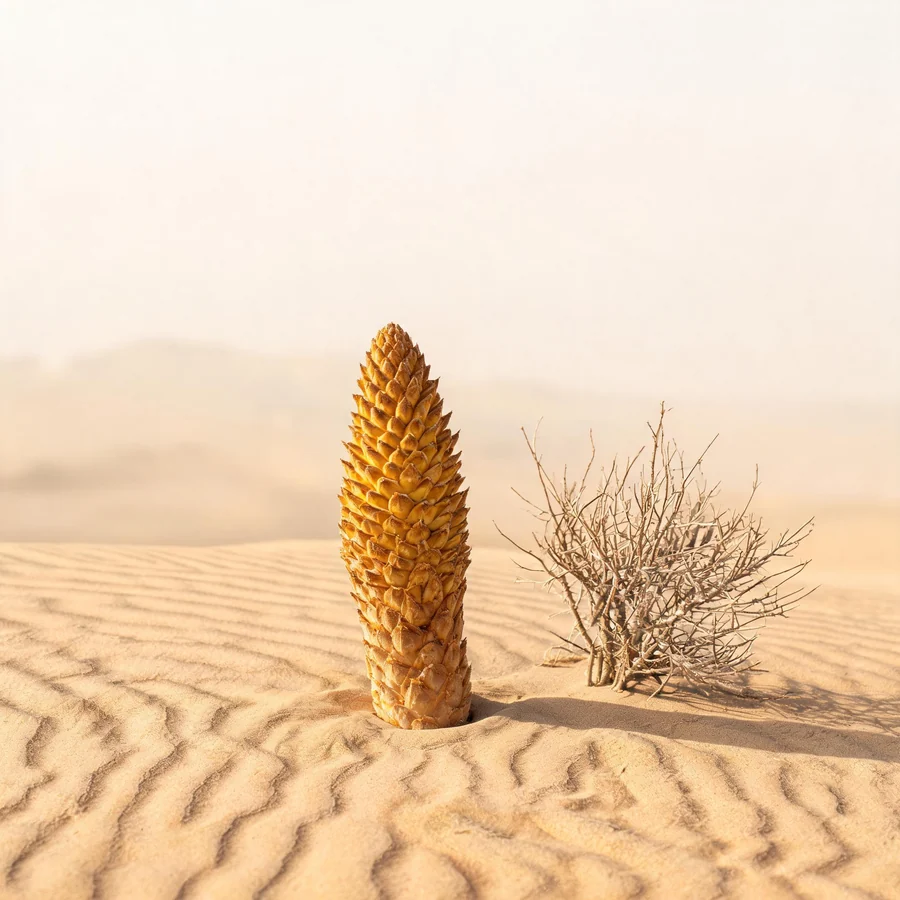
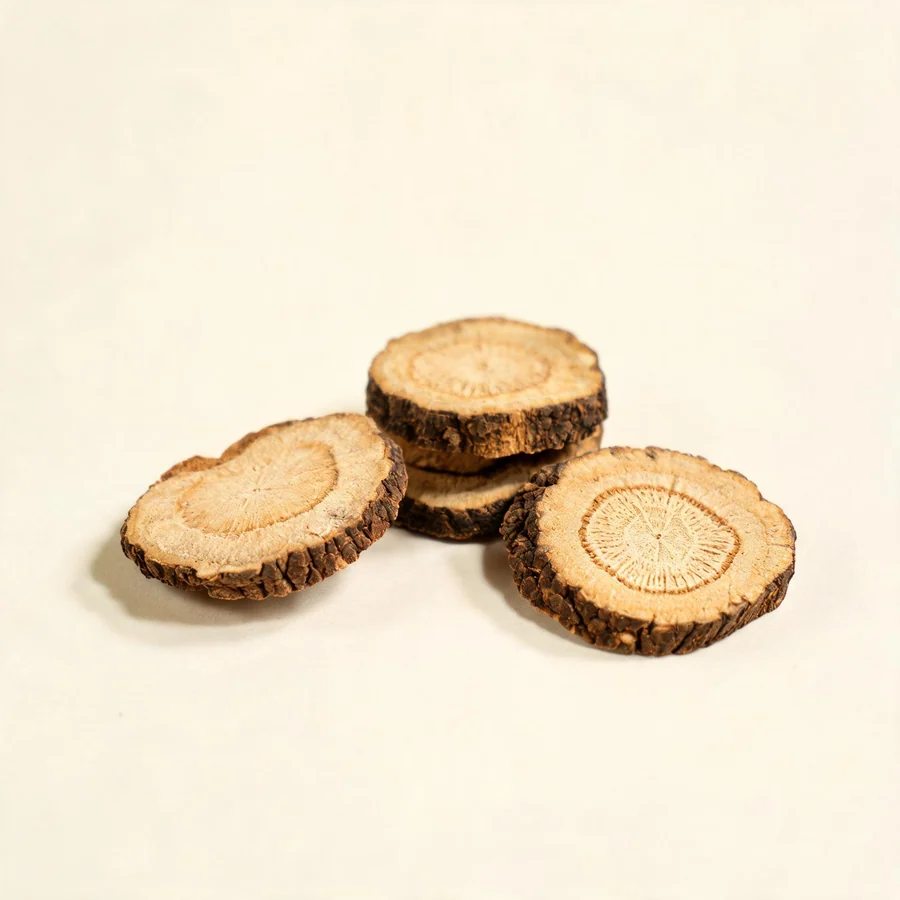
Skin profile
Where this herb sits in skin practice: the pattern it corrects, the skin signs it suits, and what it should not be used for.
Rou Cong Rong is a slow warming filler for cold, dry, thin skin in a depleted person, and it moistens the bowel at the same time. It is not a skin herb in the ordinary sense: it is a base in deficiency patterns, and it is wrong wherever there is heat, dampness or looseness.
Skin signs that suggest it
- Dry, thin, cold skin that has lost its oil and its substance, in an older person with a cold lower back and weak knees
- A dry, hard stool passed with effort, without thirst for cold drinks and without any heat signs
- Skin that is slow to heal, or a pale, indolent lesion with no redness and little discharge
- Fine wrinkles and a lax, papery texture that outrun the person's age, with cold limbs
- A pale, swollen tongue with a moist coat and a deep, weak pulse, and no redness anywhere
When it is not the right herb
Red, greasy, weeping or infected skin rules it out, and so do acne, rosacea, seborrhoeic dermatitis and any lesion with heat in it, since a warming moistening tonic feeds such eruptions. Yin deficiency with empty heat is wrong too: night sweats, hot palms, flushing and a dry red tongue mean the remaining Yin would be burned up. Dampness, with a greasy coat, heaviness and a foggy head, is another bar, and loose stools or diarrhoea rule it out because it lubricates the bowel. A healthy young person with nothing lacking gains nothing and may simply get a loose stool and a restless, over-warm feeling.
What it does for skin
Skin-relevant actions only. Each one describes a mechanism in TCM terms and what it looks like on the skin.
Warms the Kidney so the periphery is supplied
In the tradition the Kidney is the body's furnace, and once it cools the periphery turns pale, cold and poorly nourished. Rou Cong Rong warms that furnace slowly, and the skin change follows the general one: hands and feet warm, colour improves, and an indolent lesion begins to granulate. Weeks rather than days are needed, and none of this substitutes for treating infection or poor blood supply.
Fills Essence and Blood, which give the skin substance
Essence is the store a person inherits at birth and spends over a lifetime; Blood is what keeps the surface filled and supple. Age, long illness and overwork thin both, and the skin then looks deflated rather than simply dry. Sweet, salty and unusually moist, the stem suits a person in whom plain warming would add dryness, and it is taken for months rather than days.
Moistens the bowel, treating dryness from below
A hard, dry stool in a thin, cold person is read as a cold Kidney failing to move fluid, and the skin is dry for the same reason, so this is not a bowel problem in isolation. The stem lubricates without griping and without creating dependence, which is why it is chosen in later life, after childbirth and during convalescence. Softening the stool is also what allows a long course to continue, and it shows within about a week.
Supports repair in a cold, depleted constitution
When a lesion or a crack persists because warmth and building material are lacking, the stem supplies both, and it is combined with blood-moving and Qi-building herbs. Dose modest, course long, and it stops at the first heat sign. Wound care, pressure relief and treatment of a circulation problem are not replaced by any of this.
Skin conditions it is used for
Mapped to the condition pages on this site. The pattern column shows what the skin is doing when this herb is the right choice.
| Condition | Pattern | Why it suits | Typical setting |
|---|---|---|---|
| Skin Dryness | Kidney Yang and Essence deficiency: dry, thin, cold skin with a dry stool | Dryness accompanied by coldness, a hard stool, a cold low back and a pale tongue is read as a lack of warmth and substance rather than of oil alone. Because the stem warms and moistens together, it is preferred to the cooling Yin tonics in that picture, and it is given in a compound for weeks. Generalised scaling with a family history of ichthyosis, or with a thyroid problem, needs a diagnosis first. | Ji Chuan Jian, or with Dang Gui and Bai Zhu |
| Wrinkled And Shrunken Skin | Essence depletion with cold: thin, lax, deflated skin in later life | Thinning and wrinkling beyond what age explains, in a person with an aching cold back and weak knees, is read as Essence no longer filling the skin. A small dose over months rebuilds rather than smooths, and the effect is constitutional. Sun damage and smoking-related ageing will not respond, and anyone with heat signs should not take it. | Within a long-course tonic formula with Dang Gui and Gou Qi Zi |
| Cool Or Clammy Skin Sensation | Yang deficiency with cold-damp: skin cold to the touch and slow to warm | Skin that feels cold to the hand, with cold limbs, a pale face and a deep weak pulse, is the Yang-deficient surface. The stem warms from the centre outward at a modest dose over weeks, together with herbs that warm the channels. Cold clammy skin with heavy sweating, chest pain or breathlessness is something else entirely and is an emergency. | Within a warming formula with Ren Shen and Rou Gui |
| Cracked Skin | Cold dryness with loss of suppleness: thick fissures on heels and hands in winter | Fissures that open in cold weather on heels that are dry, thick and cold are read as skin lacking both warmth and moisture, and the stem addresses both. It supports from within while an emollient and a barrier cream do the local work. A crack that bleeds, weeps or looks infected needs treatment, and a foot fissure in diabetes needs proper foot care rather than a tonic. | Within a moistening and warming formula with Dang Gui |
| Senile Pruritus | Dryness from declining Essence and Blood, with cold rather than heat | Itch in later life with dry, thin, cold skin and a hard stool, worse in winter and at night, is read as dryness from declining Blood and Essence. For the cold-dry version the stem is a supporting herb, given with blood-nourishing medicines rather than alone. Itch with weight loss, jaundice, a new rash or a changing mole needs medical assessment before any tonic. | With Dang Gui, Bai Shao and Gou Qi Zi |
Combinations for skin
Herbs it is paired with when the skin, not an internal organ, is the target.
| Partner | Ratio | Why the pair is used |
|---|---|---|
| Dang Gui | 10 g of each, or 10 g of stem to 15 g Dang Gui | Blood is moistened and built by Dang Gui while the stem brings warmth to the Kidney and repairs its handling of fluid, so a dry stool caused by depletion of both Yang and Blood is treated from two sides. The pair sits at the centre of the classical prescription for that pattern, and it fits constipation that has become chronic in older age or after childbirth, with dry skin, pallor and a weak pulse. |
| Tu Si Zi | 10 to 15 g of each | Kidney tonics both, but of different texture: the stem is heavy, rich and moist, while tu si zi is lighter, said to top up the Yin and the Yang of the Kidney at once while holding in whatever leaks. Filling and containing happen together, and the pair suits coldness with dryness and lost Essence, where a plainly warming formula would prove too drying. |
| Huai Niu Xi | 10 g of stem with 10 to 15 g Huai Niu Xi | Warmth and moisture arrive from above with the stem, while Huai Niu Xi steadies the low back, strengthens the knees and draws the formula into the legs. Dry, cold skin on the legs, a weak low back and a dry stool make the picture, and the pair is one of the descending elements in prescriptions for frail older patients. |
| Suo Yang | 10 g of each | Suo Yang, the nearer relative, is the more astringent partner, better at stopping Essence from leaking, whereas the stem is moister and better at filling and at lubricating the bowel. The pair is used when cold deficiency shows on the skin as dryness and pallor together with night emissions or frequent urination. |
Formulas where it leads
- Ji Chuan Jian (济川煎) - The prescription for constipation caused by Kidney deficiency, containing the stem, Dang Gui, Huai Niu Xi, Ze Xie, Zhi Ke and Sheng Ma. Its link to the skin is indirect but genuine: dry skin and a dry stool share a cause, and smoothing the bowel while warming and filling the Kidney is what allows a long course to continue. It is not a purgative and is not for constipation with heat.
Safety for skin use
What to check before recommending or using it, including the cautions that matter most for skin patients.
Do not use, or use with caution
- Damp-heat in the skin: lesions that are red, greasy, weeping or pustular, with a greasy yellow tongue coat. A warming moistening tonic feeds this pattern and worsens the eruption.
- Loose stools or diarrhoea from a weak Spleen. The stem lubricates, so a person already loose becomes looser; the classical commentaries regard diarrhoea as a reason to stop rather than to reduce the dose.
- Yin deficiency with empty heat: night sweats, hot palms and soles, flushing, a dry red tongue and scanty urine. Warming burns up the Yin that remains, leaving the skin hotter and drier.
- Excess fire with a closed stool, or a distended abdomen from Qi stagnation. A rich supplement adds fuel to fire and makes distension worse.
- Children, unless a paediatric practitioner is involved. The indications are adult ones, and the moistening quality can loosen a small child's stool.
Pregnancy and breastfeeding
Only under supervision. It is not among the herbs forbidden in pregnancy, does not move Blood and has no uterine action, so the worry is theoretical: a lubricating herb could loosen the bowel and push too much downward. Dose is kept modest, the course short and the case reviewed. Breastfeeding follows the same reasoning, since the moistening quality might in principle reach the milk and make the infant's stool looser.
Interactions
- Stimulant and osmotic laxatives. In animals the stem hurries food along the gut and lets the large bowel reclaim less water, which is the same direction as senna, bisacodyl or a macrogol. Taken together the effects could add up, and regular users of laxatives should talk the combination through rather than stacking them.
- Glucose-lowering medicines. An effect on glucose handling has been seen for its echinacoside content in preclinical work, so readings should be watched when it is taken regularly alongside insulin, metformin or a sulphonylurea.
- Blood pressure medicines. A fall in pressure has appeared in early animal studies, a theoretical additive effect for someone treated for hypertension, particularly with a diuretic.
Allergy and patch testing
Genuine allergy is rarely reported, and the practical risk is the material rather than the plant. The approved stem is frequently replaced by related Cistanche species and by other parasitic plants, and a reaction may be to what the product contains rather than to Cistanche deserticola. Dense, dark, oily, pliant stem with a faint sweet smell is the material to look for, and any new rash, itch or gut upset while taking it is a reason to stop and check the source.
General safety references
General references for herbal hepatotoxicity and herb-drug interactions; they are not specific to this herb.
- Review article: Herbal hepatotoxicity - an update on traditional Chinese medicine preparations. Alimentary Pharmacology & Therapeutics, 2014. PMID: 24844799.
- Interactions between herbal medicines and prescribed drugs: an updated systematic review. Drugs, 2009. PMID: 19719333.
- Warfarin and food, herbal or dietary supplement interactions: a systematic review. British Journal of Clinical Pharmacology, 2021. PMID: 32478963.
Evidence
The classical record is quoted with its source. The modern note states the level of evidence plainly.
Classical record
The five viscera are built by it, the lower back is warmed and the body strengthened. It belongs to the superior grade, the class the old texts held safe for prolonged use.
Shen Nong Ben Cao Jing (Divine Husbandman's Classic of Materia Medica), Han compilation - The superior-grade placing is the classical basis for the long, gentle courses that skin practice uses in older, depleted patients.
Ben Cao Hui Yan calls it guardian of the root of life: it strengthens Kidney Qi and replenishes Essence and Blood alike. Nothing about it is extreme, the text continues, being warm and not hot, fortifying and not harsh, warming without parching, moistening without draining away.
Ben Cao Hui Yan (Collected Explanations of Materia Medica), Qing dynasty - The most quoted summary of why the stem suits long courses in depleted people, and of why it is chosen over the harsher warming tonics for cold, dry skin.
Yu Qiu Yao Jie says it feeds the wood element and calms wind, enriches Blood and softens dryness. Smoothing the large intestine until bound stool passes is where it excels, yet it works without haste and never becomes so damp that the Spleen is harmed, which is more than other moistening medicines manage.
Yu Qiu Yao Jie (Understanding of Materia Medica), Qing dynasty - A Qing commentary on the bowel action and its limits, and on the balance that makes the herb usable in a frail person.
Modern evidence
Evidence status
- Laboratory and animal studies of the stem's phenylethanoid glycosides, chiefly echinacoside and acteoside, report antioxidant, anti-inflammatory and wound-healing activity, along with effects on fatigue and on bone. None of this is a trial in people with dry or ageing skin.
- No controlled clinical trial of Rou Cong Rong in a skin condition was identified. Small clinical studies of the material in constipation and in age-related fatigue have been published, mostly in Chinese, but they do not establish a skin benefit and are not a basis for treating a skin disease.
- Sourcing belongs to the evidence question. Cistanche deserticola is subject to international trade control, wild populations are depleted, most material now comes from cultivation, and substitution with related species is common. Regulatory status: the stem is an accepted article in the Chinese Pharmacopoeia.
PubMed records
Selected real PubMed records for this herb's species or its constituents, chosen by species name and title relevance. They are references for the non-TCM discussion above, not proof that the herb treats any skin condition.
- Cistanche deserticola extract and its active components, echinacoside, ameliorate sarcopenia by activating the IGF-1/PI3K-AKT pathway to modulate ferroptosis.. Phytomedicine : international journal of phytotherapy and phytopharmacology, 2025. PMID: 41106096 (pharmacology or review record).
Dose and forms
Skin-practice dosing and the preparations that suit skin complaints.
| Form | Dose and notes |
|---|---|
| Tonic dose | 6 to 10 g of dried stem daily in a formula, continued over weeks to months. That range suits slow warming of Kidney Yang while Essence and Blood are replenished, and it is kind to a delicate digestion. |
| Bowel-focused dose | 10 to 20 g daily when dryness of the bowel dominates, under supervision. Figures as high as 30 g appear in the literature for severe dryness, and those belong in a practitioner's hands. |
| Forms | Plain dried slices are for moistening the bowel; wine-steamed stem, being warmer, is used for Kidney Yang work; salt-cured pieces have lost most of their warmth and are rinsed well first. |
The dose is modest because the action is slow and cumulative. It goes into the pot with everything else and needs no special handling, although salt-cured pieces need soaking and rinsing first. Months rather than weeks is the usual span, with review, and it stops if the stool loosens, the mouth dries with thirst or any heat sign appears. Salt-cured material behaves mainly as a laxative and cannot replace the plain stem in Kidney work.
Citations and further reading
Only real sources are listed: the classical materia medica passages quoted above, and the source works behind the botanical and safety statements.
- Shen Nong Ben Cao Jing (Divine Husbandman's Classic of Materia Medica), Han compilation - the superior-grade entry is summarised above, the original not quoted.
- Ben Cao Hui Yan (Collected Explanations of Materia Medica), Qing dynasty - the summary of even supplementation is given in translation above.
- Yu Qiu Yao Jie (Understanding of Materia Medica), Qing dynasty - the commentary on its bowel action is given in translation above.
- Ben Cao Gang Mu (Compendium of Materia Medica), Li Shizhen, 1578 - the gloss on the name as a description of mildness.
- Herba Cistanches monograph, Pharmacopoeia of the People's Republic of China - accepted source, part and quality requirements.
- Modern evidence statement: based on published laboratory and animal work on Cistanche phenylethanoid glycosides, presented as a statement about the level of evidence rather than as a cited finding.
Educational reference for qualified practitioners. This page is not medical advice, and skin conditions should be diagnosed by a clinician before treatment.