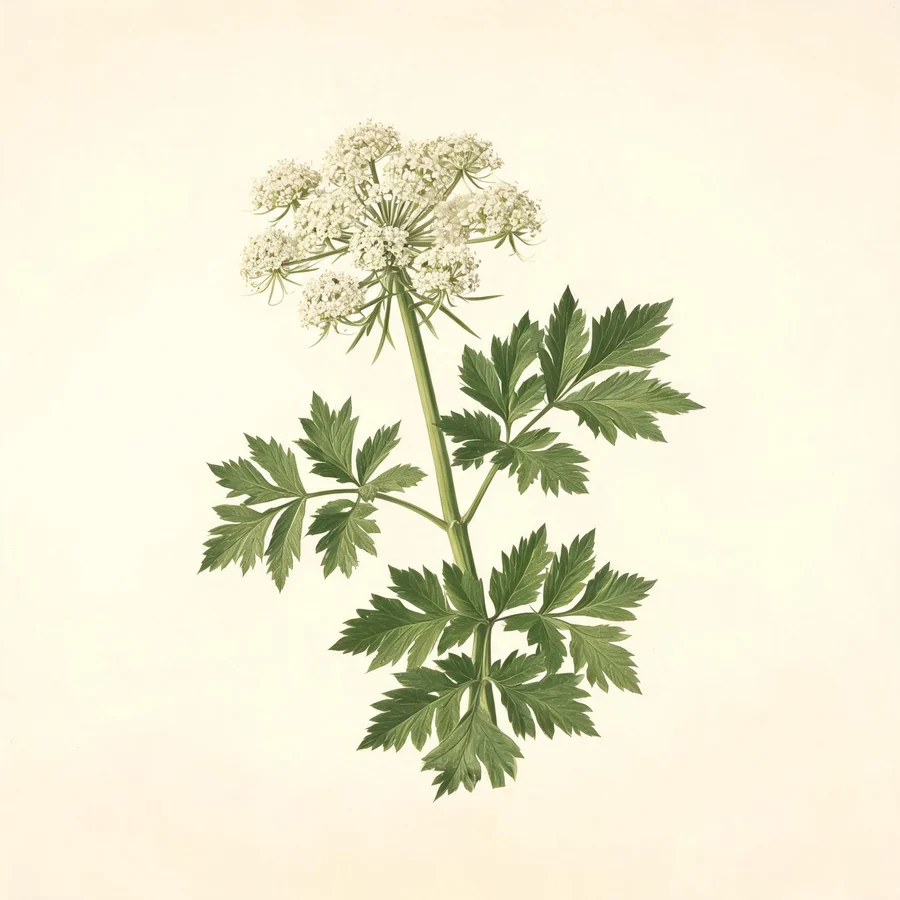
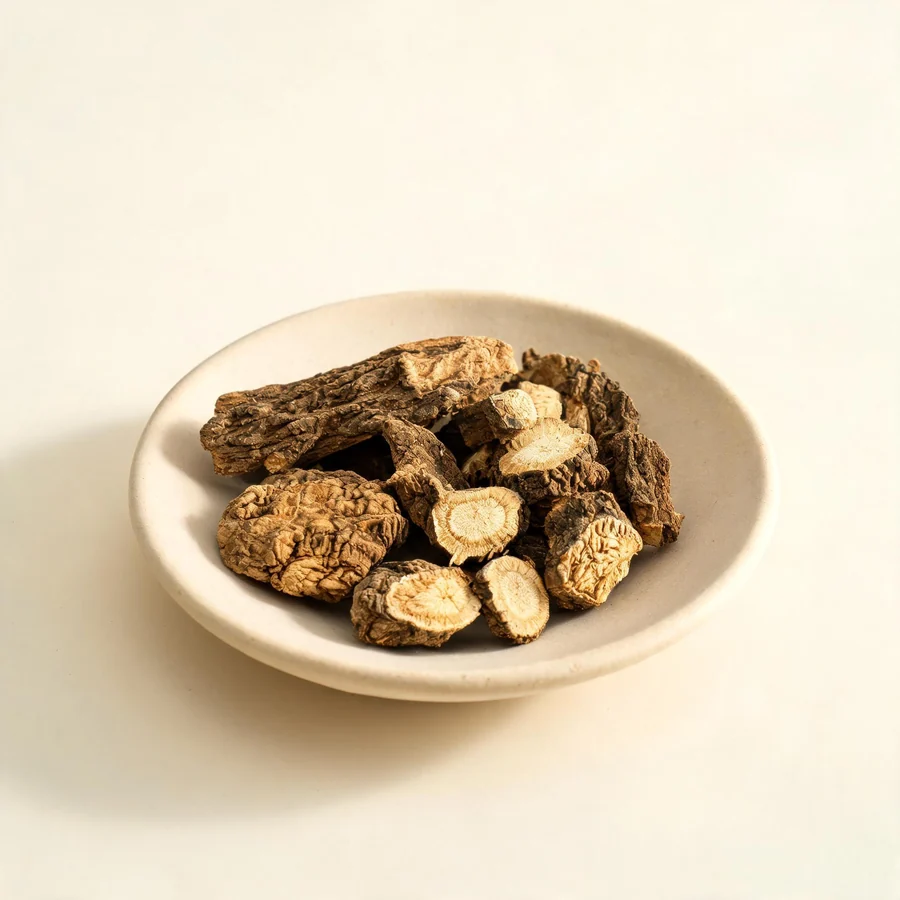
Skin profile
Where this herb sits in skin practice: the pattern it corrects, the skin signs it suits, and what it should not be used for.
Du Huo is a lower-body Wind-Damp root for cold, numb, tight skin and weather-sensitive aching. It warms, dries and disperses, so it belongs with nourishing herbs and short courses, and never on hot, red or dry skin.
Skin signs that suggest it
- Numb, cold, wooden patches of skin, often on the legs, that ache in damp weather
- Skin that feels tight and stiff rather than red, worse in cold and damp
- Deep, heavy aching in the lower back, hips or legs with the skin changes
- Chilblains: dusky, cold, itchy or painful toes and fingers that recur in winter
- A pale or greasy tongue coat, and a deep or wiry pulse
When it is not the right herb
Not for dry, thin skin with night sweats, a dry mouth and a red tongue with little coat: a warm drying root takes moisture that is already short. Not for hot, red, swollen joints or skin, which belong to a cooling strategy, and not for pain or numbness that comes from deficiency with nothing to expel. Not for internal Wind with tremor and dizziness, which is a different mechanism. Not for a new, severe or progressive weakness, and not for a leg that is swollen, hot or painful, which needs assessment for a clot or infection.
What it does for skin
Skin-relevant actions only. Each one describes a mechanism in TCM terms and what it looks like on the skin.
Dispels Wind-Cold-Damp from the channels
The root is warm, bitter and acrid, and its job is to move out the combination of Wind, Cold and Dampness that settles into channels and produces heaviness, stiffness and pain. On the skin that is a cold, numb, wooden patch rather than a red rash, and the response is slow because the pathogen is deep. It is nearly always given with herbs that address the underlying deficiency, since the pattern recurs when the ground stays cold and damp.
Warms and opens the skin in the lower body
Location is the root's signature: it is chosen for the waist, hips, knees, legs and feet, and for skin changes in those areas, where other Wind-Damp herbs are thought to reach less well. The warmth moves Blood and Qi into tissue that has gone cold and still, which is why the skin softens and sensation returns over weeks. It does not restore sensation that has been lost to nerve damage, and that distinction needs a medical assessment.
Eases pain that is heavy, cold and weather-sensitive
The pain it addresses is dull and heavy rather than sharp and hot, worse in cold damp weather and better with warmth. That quality is the practical guide: the same root given for a hot, red, throbbing joint will aggravate it. The pain relief is part of the dispersing action rather than a separate one, and it arrives slowly.
Dries the dampness that keeps a lesion indolent
Where a patch of skin stays moist, heavy and slow to change, the drying quality of the root is part of the treatment, and it is balanced with herbs that protect fluids. The drying is real, so a course is kept short and the skin is watched for signs of over-drying, such as tightness, fine scaling and a dry mouth.
Skin conditions it is used for
Mapped to the condition pages on this site. The pattern column shows what the skin is doing when this herb is the right choice.
| Condition | Pattern | Why it suits | Typical setting |
|---|---|---|---|
| Thickened or insensitive skin | Wind-Cold-Damp: skin cold, stiff and numb in patches | The pattern is skin that is cold to the touch, stiff and numb, worse in cold damp wind and better with warmth. Du Huo is one of the standard dispersing herbs for it, paired with Qiang Huo and Gui Zhi to warm and open the channels. Rapidly spreading hardness, tight skin with Raynaud's phenomenon or a new connective tissue diagnosis needs specialist care rather than a Wind-Damp formula. | A modified Juan Bi Tang with Qiang Huo, Gui Zhi and Dang Gui |
| Skin numbness | Wind-Damp in the channels: numbness that shifts with weather | Numbness that moves, with heaviness and aching in the limbs and a clear link to damp or windy weather, is Wind-Damp. The root disperses it and opens the channels, with Blood-moving and Qi-moving herbs alongside. Sudden numbness, one-sided numbness, or numbness with weakness or speech change is a stroke warning and needs emergency assessment. | Du Huo with Qiang Huo, Dang Gui and Chuan Xiong |
| Skin tightness | Wind-Cold-Damp: tightness with cold swelling and no redness | Tightness that comes with coldness, heaviness and stiffness rather than heat is the pattern the root suits. It warms and disperses, and the softening is gradual. Tight skin with fever, breathlessness or a rapidly changing surface is not this pattern and needs urgent assessment. | A modified Juan Bi Tang or Du Huo Ji Sheng Tang |
| Chilblains | Yang deficiency with Cold-Damp in the extremities | Icy hands and feet that are hard to warm, with dusky, itchy or painful lesions in winter, are read as Yang failing to reach the extremities with Cold-Damp settled there. The root warms and disperses, and it is used in a formula that also builds Yang and moves Blood. A chilblain that ulcerates, becomes hot and spreading, or appears in someone with poor circulation needs medical care. | With Gui Zhi, Dang Gui and Huang Qi in a warming, Blood-moving formula |
Combinations for skin
Herbs it is paired with when the skin, not an internal organ, is the target.
| Partner | Ratio | Why the pair is used |
|---|---|---|
| Qiang Huo | 6 to 10 g each in decoction | The classical contrast, and why the two are so often paired. Qiang Huo rises and works vigorously on the neck and shoulders, on the upper back and on the head. The lower root is heavier, gentler and works on the waist, hips, knees and legs. Between them they cover the upper and outer body and the lower and deeper body, so a formula with both reaches a pattern spread through the whole frame. |
| Du Zhong | 10 to 15 g Du Zhong with 6 to 10 g Du Huo | Both address the lower back, one by strengthening and one by clearing. Eucommia tonifies the Kidney and the bone, while Du Huo disperses the Wind-Cold-Damp that has settled on top of the weakness. The pair is the standard answer to a chronic ache that is worse with effort and in cold damp weather, and it is the reason the root appears in the formulas for long-standing lower-back pain. |
| Fang Feng | 6 to 10 g each | Both expel Wind, but at different depths. Fang Feng works broadly at the surface, releasing the exterior and moving Wind near the skin; Du Huo travels inward to Wind that has lodged deep in the channels, and it handles Dampness far better. One opens the door; the other works deeper, which suits the aches of cold damp weather with a surface component. |
| Dang Gui | 10 to 15 g Dang Gui with 6 to 10 g Du Huo | Angelica supplies the Blood that a warm drying root spends as it disperses, which is what makes the pair usable over weeks rather than days. It suits dry, thin skin with a cold ache in a pale person, and it answers the main objection to the root, which is that it dries what is already short. Both are warming, so a thin, hot, restless person is not the right candidate. |
Formulas where it leads
- Du Huo Ji Sheng Tang (独活寄生汤) - The formula that made the root's reputation, for chronic lower-body pain and stiffness on a base of Liver and Kidney deficiency. Du Huo disperses the Wind-Cold-Damp while the tonic herbs rebuild what is empty, so the pattern does not simply return. The skin expression is cold, numb, stiff legs, and the formula is a longer course with review rather than a short intervention.
- Juan Bi Tang (蠲痹汤) - A formula for Wind-Cold-Damp painful obstruction, with heavy, cold, stiff limbs that are worse in damp weather. Du Huo is one of its dispersing herbs, and the combination warms and opens the channels while the Qi and Blood are moved. It is not for hot, red, swollen joints, which need a cooling approach instead.
Safety for skin use
What to check before recommending or using it, including the cautions that matter most for skin patients.
Do not use, or use with caution
- Yin deficiency or Blood dryness: dry thin skin, night sweats, a dry mouth, thirst and a thin rapid pulse. The root is warm and drying and will deepen the dryness.
- Hot, red, swollen joints or skin, and any acute inflammation. A warm dispersing root on a hot lesion increases redness and pain.
- Pain or numbness from deficiency with no Wind-Cold-Damp factor, and internal Wind with tremor or dizziness. There is nothing to expel, and dispersal costs Qi and Blood.
- A new, severe, progressive or one-sided weakness, or a hot swollen leg. These need urgent medical assessment.
Pregnancy and breastfeeding
The classical texts do not list the root among those absolutely forbidden in pregnancy, but the caution is real: animal studies report relaxation of uterine muscle, and the root moves Blood, opens the channels and is warm and drying. It is avoided unless a clear Wind-Cold-Damp picture justifies it, and then only at a lower dose, briefly, with supervision. During breastfeeding, standard doses are treated as compatible, though the taste of milk may change and a short course is sensible.
Interactions
- Anticoagulants and antiplatelets: coumarins including osthole thin the blood mildly in laboratory work, so the effect of warfarin, heparin, aspirin or clopidogrel may be increased. Watch for bruising and bleeding.
- Photosensitising drugs: several medicines, among them tetracyclines, fluoroquinolones, sulphonamides and psoralens, make skin react more to light, and the furanocoumarins in the root add to that, so strong sun is the thing to avoid.
- Antihypertensives and sedatives: extracts lower blood pressure in animal work and have mild sedative and analgesic activity, so dizziness on standing and added drowsiness are plausible.
Allergy and patch testing
Contact dermatitis to the root and to liniments containing it is possible, and the furanocoumarins can produce a phytophotodermatitis: redness and blistering in a pattern that follows sun exposure. Patch test a liniment, keep treated skin out of strong sun, and stop if a rash develops.
General safety references
General references for herbal hepatotoxicity and herb-drug interactions; they are not specific to this herb.
- Review article: Herbal hepatotoxicity - an update on traditional Chinese medicine preparations. Alimentary Pharmacology & Therapeutics, 2014. PMID: 24844799.
- Interactions between herbal medicines and prescribed drugs: an updated systematic review. Drugs, 2009. PMID: 19719333.
- Warfarin and food, herbal or dietary supplement interactions: a systematic review. British Journal of Clinical Pharmacology, 2021. PMID: 32478963.
Evidence
The classical record is quoted with its source. The modern note states the level of evidence plainly.
Classical record
甘,微温,无毒。
Sweet, slightly warm and free of toxicity.
Ming Yi Bie Lu (Supplement to the Classic of Materia Medica) - The earliest grading of the root, and the basis for the warm, drying character that governs both its use and its limits.
It treats what Wind-Cold has struck, stops the pain of metal wounds, and is used for running piglet Qi, for epilepsy with convulsions, and for hernial masses in women.
Shen Nong Ben Cao Jing (Divine Husbandman's Classic of Materia Medica) - The oldest entry, which begins with Wind-Cold and wounds; the wound half is the earliest trace of its external use. The original Chinese is not reproduced here.
Du Huo moves well through the Blood level; it is a herb that dispels Wind, moves Dampness and scatters Cold. Wind conditions such as a neck that cannot bend, a back and knees that cannot flex, painful obstruction that makes walking hard and numbness that costs function all come from Wind and Cold, and the bitter acrid warmth of Du Huo is what activates Qi and Blood and disperses the Cold pathogen.
Ben Cao Hui Yan (Collected Discourses on Materia Medica), Ni Zhuomo - The fullest classical statement of its role, and the sentence that names numbness as part of the picture, which is the bridge to the skin uses.
Modern evidence
Evidence status
- Laboratory and animal work on Angelica pubescens extracts reports anti-inflammatory, analgesic and vasodilator activity, with osthole and the furanocoumarins among the constituents studied. None of it is a skin trial.
- Photosensitivity is the best documented practical effect: the furanocoumarins can produce a phytophotodermatitis, so sun exposure after handling the powder or applying a liniment is a real risk.
- No controlled trial of Du Huo in a skin condition was identified. The Wind-Damp and numbness uses rest on traditional practice, and a neurological cause of numbness needs investigation first.
PubMed records
Selected real PubMed records for this herb's species or its constituents, chosen by species name and title relevance. They are references for the non-TCM discussion above, not proof that the herb treats any skin condition.
- The ethnopharmacology, phytochemistry and pharmacology of Angelica biserrata - A review.. Journal of ethnopharmacology, 2019. PMID: 30408534 (pharmacology or review record).
- Pharmacological features of osthole.. Postepy higieny i medycyny doswiadczalnej (Online), 2017. PMID: 28513464 (pharmacology or review record).
Dose and forms
Skin-practice dosing and the preparations that suit skin complaints.
| Form | Dose and notes |
|---|---|
| Decoction | 3 to 10 g of the dried root in a formula, with 3 to 6 g where it supports a larger formula and 6 to 10 g where it leads a lower-body Wind-Damp prescription. |
| Course length | Short courses. Above 10 g is a short-term decision, and the drying effect accumulates over weeks. |
| External wash | A decoction of 10 to 15 g used cool as a wash or soak for cold, stiff feet or chilblains, once daily, with the skin checked for irritation. |
The dose follows the job rather than the severity: a supporting role needs three to six grams, a leading Wind-Damp role six to ten, and anything higher is a brief decision. Because the root is warm and drying, the signs of too much are dryness rather than toxicity: a dry mouth, restlessness, tight skin and stomach upset. Reduce rather than continue when those appear.
Citations and further reading
Only real sources are listed: the classical materia medica passages quoted above, and the source works behind the botanical and safety statements.
- Ming Yi Bie Lu (Supplement to the Classic of Materia Medica), Tao Hongjing, Southern and Northern Dynasties - passage quoted above.
- Shen Nong Ben Cao Jing (Divine Husbandman's Classic of Materia Medica), Han period compilation - entry quoted above.
- Ben Cao Hui Yan (Collected Discourses on Materia Medica), Ni Zhuomo, 1624 - passage quoted above.
- Radix Angelicae Pubescentis monograph: Pharmacopoeia of the People's Republic of China - accepted species, part used and quality requirements.
- Photosensitivity statement: based on published reports of phytophotodermatitis from furanocoumarin-containing Angelica species, given as a safety finding rather than as a claim of benefit.
- Modern evidence statement: based on laboratory and animal literature on Angelica pubescens and osthole, summarised as a statement about the level of evidence rather than as a cited finding.
Educational reference for qualified practitioners. This page is not medical advice, and skin conditions should be diagnosed by a clinician before treatment.