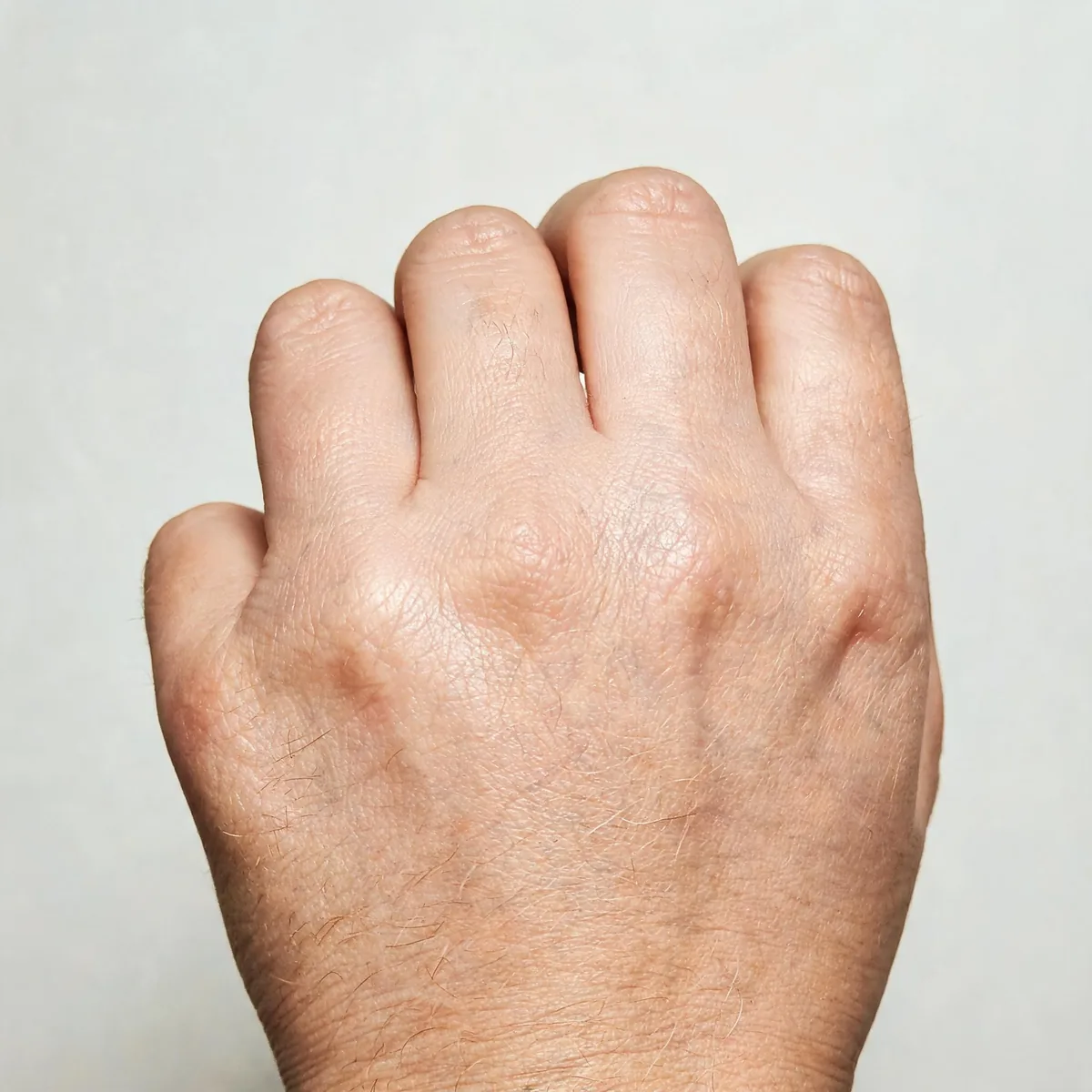
Understanding Skin tightness
The tradition describes skin tightness as an outer mirror of internal flow. The Spleen and Stomach produce Qi and Blood, and when they are insufficient the skin is not nourished.
Qi and Blood deficiency gives thin dry skin with loss of elasticity, pallor, fatigue and poor appetite. Blood stagnation gives tight hard thickened skin with numbness, dusky discolouration and fixed stabbing pain - the picture shared with early scleroderma.
Damp-Heat gives skin that feels red, warm and swollen with a heavy sticky tightness and a greasy coating. Wind-Cold-Damp gives tightness with swelling but no redness or heat, cold to the touch, with aching limbs stiffening in the cold.
Kidney and Spleen Yang deficiency gives tight cold puffy skin with leg and ankle swelling, early-morning diarrhoea and cold limbs. The classical literature treats rapid spread of tightness as urgent, since it can signal a severe reaction or progressive scleroderma.
Chinese medicine reads the skin as a surface report on what the organs are doing, and tightness is seldom a local fault. The Spleen and Stomach make the Qi and Blood that reach the surface, the Liver keeps that Blood moving into every tissue, and the Kidneys supply the warmth that keeps fluids circulating instead of pooling. Weaken or block any of the three and the skin loses its give and begins to feel drawn.
There are two directions this can take. In deficiency the skin is underfed, so it grows thin and dry and feels pulled taut, as cloth does once it has shrunk. In excess something obstructs the fine channels that feed it: stagnant Blood makes the skin hard and numb, Damp-Heat makes it warm and swollen, and Wind-Cold-Damp arriving from outside leaves it puffy and cold. Identical complaints therefore sit on opposite internal landscapes.
Outside influences matter too. Wind, Cold and Dampness can settle into the surface and contract the tissues, which is why the sensation grows worse in cold wet weather and settles once warmth is applied. Deciding whether the cause is deficiency, an internal excess or an invasion from outside is what lets a practitioner choose a formula that nourishes, moves, clears or warms, rather than treating every tight patch as dry skin. The earliest classical description of skin impediment already linked the problem to wind, cold and dampness arriving together.
Conventional view
Western medicine treats tight skin as a clue to look for a disease. Scleroderma, eczema, contact dermatitis and thyroid disorder are the usual lines of enquiry, with blood tests and sometimes a skin biopsy. When nothing is found, the sensation is put down to dryness, sensitive nerves or stress, and care turns to protecting the barrier and managing whatever condition was identified.
Standard treatment means barrier creams and emollients, topical steroids or calcineurin inhibitors to calm inflammation, and oral antihistamines when itch is part of the picture. A diagnosed autoimmune condition such as scleroderma brings immunosuppressants or other disease-modifying drugs. For many people the tightness persists even with normal test results, and moisturisers are all that is offered.
None of these approaches reaches the internal imbalance behind the sensation, and at best they work at the surface or damp down inflammation. Long-term topical steroids thin the skin and leave it more fragile. The conventional model also does not separate tightness from dryness and poor nourishment, tightness from poor circulation and tightness from trapped fluid, which is exactly the distinction that decides TCM treatment.
Selected PubMed records
Real PubMed records for the conventional discussion above, selected by condition name and title relevance. They are references, not a claim that any treatment is proven for this condition.
- Hyaluronic acid, a promising skin rejuvenating biomedicine: A review of recent updates and pre-clinical and clinical investigations on cosmetic and nutricosmetic effects.. International journal of biological macromolecules, 2018. PMID: 30287361.
- Cosmetic Treatments with Energy-Based Devices in Skin of Color.. Facial plastic surgery : FPS, 2023. PMID: 37557909.
How it connects
Tight skin usually arrives with company. The same Yang deficiency or external cold that tightens the surface also leaves the hands, feet and limbs cold, so cold extremities and a deep aversion to cold cluster with it and point to a pattern that needs warming. Joint pain and stiffness join in when Wind-Cold-Damp or Blood Stagnation reaches the larger joints as well as the skin, and treating only the surface tends to fail. Numbness alongside hardness is the signature of Blood Stagnation, because starved nerves and starved skin fail together, and moving Blood is what restores sensation.
How it is assessed
The practitioner assesses temperature, texture, swelling and speed of onset.
What a practitioner looks for
- Texture: thin and dry suggests deficiency; hard and thickened suggests stagnation.
- Temperature: cold tight skin suggests cold or Yang deficiency; warm red tight skin suggests damp heat.
- Swelling: puffy swelling with tightness suggests Yang deficiency or cold-damp.
- Red flags: tightness spreading over hours, or with breathing difficulty or facial swelling.
The first questions are about quality and temperature. Skin that feels thin, pale and drawn, on a person who looks tired and washed out, points to Qi and Blood Deficiency, with a pale tongue and a deep fine pulse showing that nourishment is not reaching the surface. If the drawn area is dark, hard and numb as well, Blood Stagnation is the likely reading, and the practitioner looks for purple spots or bluish veins under the tongue, a fine choppy pulse and fixed stabbing pain elsewhere in the body.
Warm, thick, red and swollen skin belongs to Damp-Heat, with a red tongue, a greasy yellow coat and a slippery rapid pulse, often with heaviness in the limbs. Tightness that is swollen and cold but not red suggests Wind-Cold-Damp, typically after exposure to weather, with a thin white coat and a floating tight pulse. Tightness that sits deeper and lasts, with puffiness and hands and feet that are icy cold the pattern is Kidney and Spleen Yang Deficiency, where a pale puffy tongue and a deep thin slippery pulse show that warming and fluid transformation have failed. Rapid spread, breathing difficulty or facial swelling needs medical review at once.
TCM patterns in Skin tightness
Five patterns produce tight skin, and temperature is the fastest way to sort them. Skin that is thin, dry and drawn belongs to Qi and Blood Deficiency. Skin that is hard, thickened and numb, with a dusky hue and fixed stabbing pain, belongs to Blood Stagnation. Skin that is warm, red and swollen, with a heavy sticky tightness, belongs to Damp-Heat. Skin that is puffy and cold to the touch, with aching limbs that stiffen in the cold, belongs to Wind-Cold-Damp. Skin that is cold and puffy with swelling of the legs and ankles, cold limbs and loose stools before dawn, belongs to Kidney and Spleen Yang Deficiency. The tongue refines each picture: pale and thin for deficiency, dusky with stasis spots for stagnation, red with a greasy yellow coat for Damp-Heat, pale and swollen for external cold and damp, and puffy with tooth marks for Yang deficiency. Pulse and onset decide urgency.
| Pattern | Key signs | The itch | Tongue | Main formula |
|---|---|---|---|---|
| Qi and Blood Deficiency | Skin feels thin and dry with loss of elasticity | Not specified | Body: Pale, possibly thin or with teeth marksCoat: Thin white | Not specified |
| Blood Stagnation | Tight hard thickened skin with numbness; Fixed stabbing pain worse at night | Not specified | Body: Purple, dusky or with dark stasis spots; sublingual veins dark and distendedCoat: Often thin white; a yellow coat would suggest Heat as the cause | Not specified |
| Damp-Heat | Skin feels red warm and swollen | Not specified | Body: Red, often swollen with teeth marksCoat: Yellow, greasy and thick, usually in the middle and at the root | Not specified |
| Wind-Cold-Damp | Tightness with swelling but no redness or heat; Skin feels cold to touch | Not specified | Body: Pale or slightly swollen, teeth-markedCoat: White, greasy and moist | Not specified |
| Kidney and Spleen Yang Deficiency | Skin feels tight, cold and puffy; Swelling of legs and ankles | Not specified | Body: Pale, swollen and teeth-markedCoat: White and slippery | Not specified |
Qi and Blood Deficiency
Thin dry skin that has lost elasticity, with fatigue.
Qi warms and moves, Blood moistens and fills. When both run short the skin receives neither, so it loses its plumpness, grows thin and dry, and cannot stretch without complaint. The tightness here is not the tightness of swelling or hardness; it is the feeling of a surface that has lost its oil, closer to brittle fabric than to stretched leather. It tends to creep in over months rather than arrive overnight.
The tongue is pale, sometimes thin or marked by the teeth, with a thin white coat, and the pulse is fine and weak. Overwork, skipped meals, cold raw food, worry and heavy menstrual bleeding all drain the supply, while rest, warm cooked meals, gentle daily movement and moderate warmth rebuild it. Shi Quan Da Bu Tang is the formula most often used to tonify Qi and Blood and restore nourishment to the skin, supported by ST-36 Zusanli, SP-6 Sanyinjiao and REN-4 Guanyuan.
Signs
- Skin feels thin and dry with loss of elasticity
- Pale or sallow complexion
- Fatigue and general weakness
- Dizziness or light-headedness
- Poor appetite
Diet and lifestyle for this pattern: Prioritise warm, cooked, easy meals such as soups and stews, and include blood-nourishing food such as organic red meat, liver, dark leafy greens, black sesame, goji berries and dates. Avoid raw, cold and iced food that weakens the Spleen, get plenty of rest without overworking, and keep movement gentle such as walking or tai chi so Qi circulates without draining it.
Blood Stagnation
Tight hard thickened skin with numbness and dusky colour.
Blood carries moisture to the smallest vessels, and when its movement stalls those vessels go hungry. Injury, years of held stress or internal cold can all slow it, and the skin over the area turns hard, thick and dry, with a dusky or purplish cast. Because the same stagnation starves the fine nerves, numbness often accompanies the tightness, and the pain is fixed and stabbing, worse at night.
The tongue is purple or dusky with stasis spots and dark distended veins beneath, and the pulse is choppy, sometimes wiry when Qi is also stuck. Cold weather, iced drinks, long sitting, heavy fried food and old injuries that never fully resolved all deepen it, while gentle daily movement, warmth, warming spices, massage or cupping and adequate rest loosen it. Xue Fu Zhu Yu Tang opens the collaterals and moves Blood, Fu Yuan Huo Xue Tang is the alternative after trauma, and the points used are LI-4 Hegu, LI-11 Quchi, SP-6 Sanyinjiao and LR-3 Taichong.
Signs
- Tight hard thickened skin with numbness
- Dusky or purplish discolouration
- Fixed stabbing pain worse at night
- Rough dry scaly texture
Diet and lifestyle for this pattern: Gentle, consistent movement such as walking, tai chi or yoga is the best ally here, keeping Blood from pooling. Add warming, circulation-friendly spices to meals such as turmeric, ginger, cinnamon and a pinch of black pepper, avoid icy drinks and raw cold food straight from the fridge, since cold congeals Blood, and if tightness follows an old injury, topical warming liniments or self-massage with sesame oil can encourage local flow.
Damp-Heat
Red warm swollen tight skin with a heavy sticky feeling.
Dampness and heat together behave like steam trapped in a closed kitchen. Lodged in the skin and its fine channels, the dampness weighs the tissue down and makes it sticky, while the heat reddens it and makes it feel warm. Between them they clog the flow that keeps the surface supple, so the skin feels thick and tight at once, and humid weather or a rich meal can make the whole picture denser within hours.
A red tongue with a yellow greasy coat that is hard to scrape, and a slippery rapid pulse, confirm the combination. Damp humid weather, fried and heavy food, alcohol, sweets and long inactivity feed it, while cool dry weather, light bland food such as barley, mung beans and cucumber, gentle sweating through exercise and clean dry skin ease it. Si Miao Yong An Tang clears the heat, drains the dampness and resolves toxicity, with LI-11 Quchi, SP-6 Sanyinjiao, GB-34 Yanglingquan and LI-4 Hegu.
Signs
- Skin feels red warm and swollen
- Tightness with a thick heavy sticky sensation
- Yellow greasy coating
- Body heavy and sluggish
Diet and lifestyle for this pattern: Avoid greasy, fried, spicy and very sweet food as well as alcohol, which all generate internal Dampness and Heat. Favour lightly cooked vegetables, barley, mung beans and cooling herbal teas such as chrysanthemum, keep the skin clean and dry, and include gentle daily movement that produces a light sweat to help the body expel Dampness.
Wind-Cold-Damp
Tight swollen skin with no heat, cold to the touch.
When Wind, Cold and Dampness reach the surface together they settle into the skin and the channels beneath it. Cold contracts the tissue, Dampness adds weight and swelling, and Wind explains why the tightness can shift and why drafts make it worse. The flow of Qi and Blood through the area is blocked, so the skin is left puffy, cold to the touch and poorly nourished, and the limbs ache and stiffen.
The tongue is pale or slightly swollen with a white greasy coat and a moist surface, and the pulse runs slow or moderate, tight or floating to the touch. Cold damp windy weather, raw cold or greasy food, inactivity and direct drafts aggravate it, while warmth, a dry room, warm cooked meals and gentle daily movement ease it, along with cover from damp cold. Juan Bi Tang expels the three pathogens and warms the channels, and the points named are LI-4 Hegu, ST-36 Zusanli, GB-34 Yanglingquan and SP-6 Sanyinjiao.
Signs
- Tightness with swelling but no redness or heat
- Skin feels cold to touch
- Heaviness and aching in the limbs
- Stiffness improved by warmth
Diet and lifestyle for this pattern: Keep the body warm and dry, especially in cold or humid weather. Eat warming, cooked food such as soups with ginger and cinnamon, avoid raw, cold or greasy items that worsen Dampness, and keep moving gently such as walking or stretching so Qi flows and stiffness does not set in.
Kidney and Spleen Yang Deficiency
Tight cold puffy skin with swelling and early-morning diarrhoea.
The Spleen and Kidneys supply the body's warming and transforming power. When that Yang is spent, internal cold takes hold and fluids are no longer moved properly, so dampness and phlegm collect beneath the skin. The result is skin that is tight, cold and puffy, worst in the limbs and face, with swelling of the legs and ankles. The cold reaches the hands, the feet and the lower back, and the day often starts with loose stools before dawn.
The tongue is pale and puffy, its edges marked by the teeth, under a white slippery coat, and the pulse is deep, weak and slow, weakest at the rear and right middle positions. Cold weather, iced drinks, raw food, overwork, damp humid air and long sitting all deepen the deficiency, while warmth from a heating pad, warm cooked meals, gentle movement, a dry warm climate and rest restore it. Fu Zi Li Zhong Tang warms the middle and dispels the cold, and BL-23 Shenshu, BL-20 Pishu, DU-4 Mingmen, ST-36 Zusanli and SP-6 Sanyinjiao are used, often with moxa.
Signs
- Skin feels tight, cold and puffy
- Swelling of legs and ankles
- Early-morning diarrhoea
- Chronic loose stools with undigested food
- Feeling cold
Diet and lifestyle for this pattern: Eat warm, cooked food such as soups and stews seasoned with ginger and cinnamon, and avoid all cold, raw and iced food. Keep the body warm, especially the lower back, abdomen and feet, keep movement gentle such as walking in the sun so Yang circulates, and moxibustion on the lower abdomen and low back, practised regularly, can be deeply supportive.
Treatment approach
How the tradition treats skin tightness, with the herbs, formulas and points used for it.
Principles
- Nourish Qi and Blood where the skin is thin and elastic loss is the main feature.
- Move Blood and resolve stasis where the skin is hard, thickened and numb.
- Drain damp heat where tightness is warm and swollen.
- Warm Yang where the skin is cold and puffy, and treat rapid spread as urgent.
- The aim is to restore flow to the skin, and the method follows the root: tonify Qi and Blood or warm Yang where the surface is underfed, and clear stagnation where something is blocking it. Formulas such as Shi Quan Da Bu Tang, Xue Fu Zhu Yu Tang, Si Miao Yong An Tang, Juan Bi Tang and Fu Zi Li Zhong Tang show how far apart those choices sit, and a mixed picture is usually worked in phases, clearing first and nourishing afterwards.
Herbs used
Formulas
- Shi Quan Da Bu Tang
- Xue Fu Zhu Yu Tang
- Fu Yuan Huo Xue Tang
- Si Miao Yong An Tang
- Juan Bi Tang
- Fu Zi Li Zhong Tang
Acupoints
- ST-36 (Zusanli)
- SP-6 (Sanyinjiao)
- guanyuan-ren-4
- LI-4 (Hegu)
- LI-11 (Quchi)
- LR-3 (Taichong)
- GB-34 (Yanglingquan)
- BL-23 (Shenshu)
- BL-20 (Pishu)
- DU-4 (Mingmen)
What to expect
- Constitutional patterns are described as improving over months.
- Hardened thickened skin responds slowly, if at all.
- Rapidly spreading tightness needs emergency assessment.
- Timelines follow the pattern. Wind-Cold-Damp and Damp-Heat often loosen within two to four weeks of herbs and weekly acupuncture, Blood Stagnation usually softens over six to eight weeks, and deficiency pictures need three to six months of steady care because reserves rebuild slowly. Progress is judged by feel and by the tongue and pulse before the skin looks different, and a setback in cold weather or during overwork is expected rather than a reason to change course.
Safety and when to get help
Seek medical help urgently for
- Skin tightness spreading rapidly over hours or days.
- Tightness with difficulty breathing or facial or lip swelling.
- Tightness with fever or spreading redness.
For anything severe, sudden or spreading quickly, read when a skin problem needs urgent care.
Cautions
- Tight hardened skin needs medical assessment to exclude scleroderma or another connective tissue disease.
- Do not delay emergency care for rapid spread.
- Emollients and gentle movement help maintain flexibility.
Using this alongside conventional care
- TCM is described as complementary to conventional care: prescribed treatment and monitoring continue alongside herbs.
- Moisturisers, barrier creams, topical treatments and most oral drugs can continue alongside herbs, and keeping the surface hydrated while the internal picture is treated is sensible rather than contradictory. The practitioner needs a full medication list, because blood-moving herbs, Dang Gui, Chi Shao and Hong Hua among them, can add to anticoagulant or antiplatelet drugs. Corticosteroids or immunosuppressants are never stopped abruptly; if the skin improves, the dose is reduced with the prescribing doctor.
Diet and lifestyle
- Favour warm cooked food such as soups, stews, congee, whole grains and dark leafy greens.
- Warm, cooked food supports the Spleen's work of making Qi and Blood, so soups, stews, congee, whole grains and plenty of dark leafy greens form the base, with a moderate amount of good protein. Cold raw food and iced drinks constrict the channels and make tightness worse, and greasy, fried or sugary food generates the dampness and heat that thicken the skin. Warming spices such as ginger, turmeric and black pepper help move Blood, and pattern needs are layered on top: barley and mung beans for Damp-Heat, black sesame and goji berries for deficiency, and plenty of ginger and cinnamon when cold dominates.
If you're pregnant
The Qi and Blood Deficiency picture often deepens in pregnancy, because resources are directed towards the growing baby. Gentle tonics, Dang Gui and Shu Di Huang among them, are generally considered safe, and they help the skin recover its suppleness, but any herb that strongly moves Blood or breaks stasis, including Hong Hua, Tu Bie Chong and Chi Shao, is avoided because of miscarriage risk. Acupuncture is safer in the first trimester provided strongly descending or blood-moving points are left out; SP-6 Sanyinjiao and LI-4 Hegu are traditionally forbidden, while ST-36 Zusanli and REN-4 Guanyuan, used with care, gently support Qi and Blood.
If you're breastfeeding
Most herbs for this symptom reach milk in small amounts, so gentle tonics are preferred. Dang Gui, Huang Qi and Bai Zhu are generally regarded as safe and help rebuild the mother's Qi and Blood, while strongly bitter cold herbs such as Jin Yin Hua in high doses may loosen the infant's stools and are used cautiously or replaced. Blood-moving formulas, Xue Fu Zhu Yu Tang among them, are best avoided while feeding unless a specialist is monitoring both mother and baby.
If treating a child
In children the tightness is usually a localised, itchy, tight patch, most often from Damp-Heat or Wind-Cold-Damp. Immature Spleen Qi makes damp accumulation easy, and external pathogens combine with it to produce skin signs. Because the sensation is hard to describe, practitioners rely on the look, temperature and texture of the skin and on how the child avoids touch, with doses around a third to a half of the adult amount. Gentle damp-draining or mild exterior-releasing herbs are used, and acupressure or paediatric tui na replaces needles.
If treating an elderly patient
In older adults the root is nearly always deficiency, most often a shortfall of Qi and Blood, or of Kidney and Spleen Yang, and the skin is thin, dry and tight because too little nourishment arrives. Treatment is gentle and long term rather than quickly dispersing, with doses around two-thirds of the standard adult amount to spare a slower digestion. Polypharmacy is a real concern and interactions are screened carefully, which makes acupuncture attractive because it adds no substance. Improvement may take weeks or months, and the aim is steady restoration rather than a fast result.
Urgent-sign guidance is based on standard sources: NHS anaphylaxis, NHS cellulitis, NHS Stevens-Johnson syndrome, NHS melanoma.
Evidence
Evidence status
Compiled for this page from the classical and modern literature; not a systematic review, so treat it as a pointer to sources rather than clinical guidance.
The classical literature records no clinical studies for this page, so there is no evidence base to report here. Tightness is a sensation rather than a disease, and it appears across sclerosing, inflammatory and simply dry skin conditions with very different implications. This tab is left explicit rather than filled with citations from unrelated conditions.
A fuller reading of the source record does list clinical evidence, drawn mainly from systemic sclerosis, where skin hardening is a hallmark. Several randomised trials and meta-analyses report that blood-invigorating formulas, Xue Fu Zhu Yu Tang among them, improve scores for skin thickness as well as quality of life when given alongside conventional care, and small pilot studies of acupuncture report reduced tightness and better microcirculation. The quality is only moderate, with small samples, little blinding and much of the work published in Chinese. Larger multicentre trials with standard measures are still needed, while dermatology departments continue to rely on pattern-based prescribing.
Classical record
风寒湿三气杂至,合而为痹也…以秋遇此者为皮痹。
When wind, cold and dampness come as one they join to form impediment; met in autumn, this becomes skin impediment.
Huang Di Nei Jing Su Wen, Chapter 43 (Bi Lun) - Classical citation: which calls it the earliest description there of tight, hard skin caused by external pathogens lodged in the skin.
Common questions
Why does my skin feel tight?
The tradition describes low Qi and Blood, blocked Blood, damp heat, cold-damp, or Yang deficiency failing to moisten and support the skin.
Is tight skin a sign of scleroderma?
It can be. Hardened skin on the fingers and face needs medical assessment to exclude connective tissue disease.
Can herbs soften tight skin?
The tradition describes nourishing and warming treatment with slow improvement over months; hardened skin may stabilise rather than reverse.
When is it an emergency?
Tightness spreading over hours, or with breathing difficulty or facial swelling.
How long until the skin feels looser?
It depends on the pattern. Tightness from a recent external invasion such as Wind-Cold-Damp may ease within two to three weeks, while a deficiency picture often needs three to six months of steady herbs and acupuncture before it rebuilds. A practitioner gives a more precise estimate after the first assessment.
Can I keep using my usual moisturiser?
Yes. Treatment works from the inside, and a gentle moisturiser on the surface is compatible with it. Keeping the barrier hydrated while the internal picture is corrected is a reasonable partnership, and any medicated cream should be mentioned to the practitioner.
Is tight skin always a sign of something serious?
No. Much of the time it reflects a functional imbalance, poor circulation or a mild Qi and Blood Deficiency for instance, which responds to treatment. Tightness that spreads quickly, comes with breathing difficulty, or appears alongside other systemic symptoms needs medical assessment to exclude serious disease.