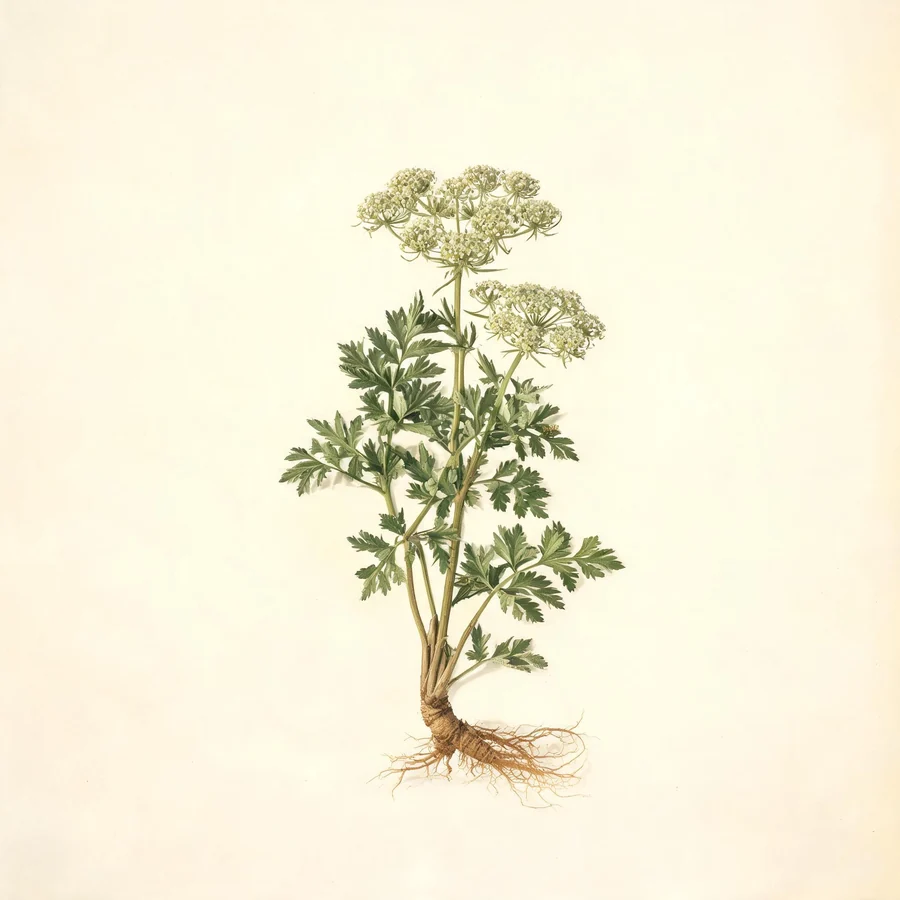
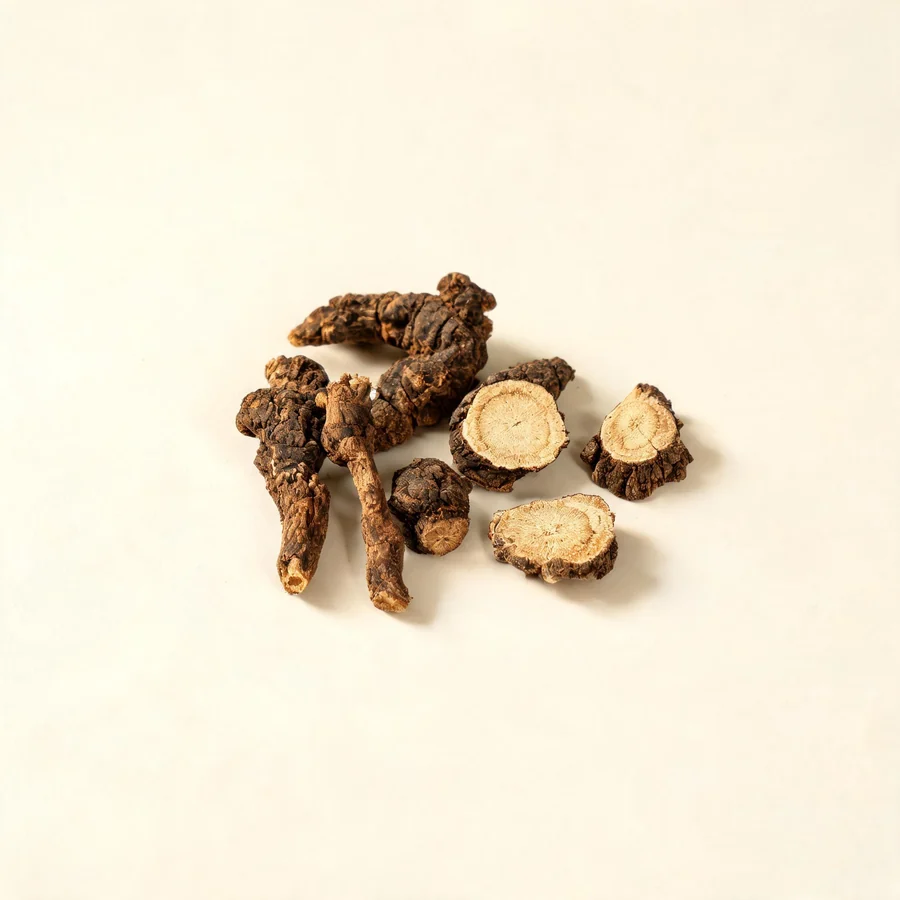
Skin profile
Where this herb sits in skin practice: the pattern it corrects, the skin signs it suits, and what it should not be used for.
Qiang Huo is a surface herb for cold and dampness: it opens a closed exterior, dries clamminess and eases the ache that sits under cool, heavy skin. It is warm and drying, so the red, weeping and infected pictures are the ones to keep it away from.
Skin signs that suggest it
- Pale or pink wheals that come up after cold exposure or a draught, with chilliness and no thirst (wind-cold)
- Itch with a heavy, achy quality and little redness, worse in wet or windy weather (wind-damp)
- Puffiness of the face or limbs that is not red or hot, with scanty urine and a feeling of chill (wind-damp)
- Skin that is cool and clammy over aching shoulders and neck, eased by warmth (cold-damp in the channels)
- Cold, dusky fingers and toes that swell and itch in damp cold weather (chilblains)
- A pale tongue with a white or greasy coat and a tight or floating pulse
When it is not the right herb
Not for red, hot, weeping or pustular skin, and not for anything that looks infected: a warm drying herb adds fuel to Heat and Toxin, and it will leave a wet lesion tighter and more irritated. Not for dry, thin skin that has lost its fluid, with night sweats, a red tongue carrying little coat and a dry throat, because sweating and drying take more away. Not for someone who sweats without effort or catches cold after cold, since dispersing thins a defence that is already leaking. Not for a weak stomach that reacts to aromatic food, and not as a long course: full doses over weeks are said to injure Qi and Yin. The classical warning about abscesses is specific. It is the early, deep, undischarged swelling with chills that warming herbs address, not the red, hot, pointing abscess that needs draining.
What it does for skin
Skin-relevant actions only. Each one describes a mechanism in TCM terms and what it looks like on the skin.
Opens a surface that cold has shut
Cold contracts, and the tradition reads a closed surface as the reason an eruption comes up pale while the person feels chilled and unable to sweat. Acrid warmth is said to undo that closure and draw a gentle sweat, and for that reason it belongs at the opening stage of a chill that has arrived with a rash or with hives. The sweat is deliberately mild, and the instruction is to support it with warmth and a hot drink rather than to drive it.
Dries dampness out of the channels
Heavy, sluggish damp, once lodged in the tissue, leaves a surface that feels thick and clammy rather than warm. The bitter taste dries and the acrid warmth moves what has been dried, which is the old principle of using Wind to overcome Dampness. On the skin the result is less puffiness, less heaviness and less clamminess, and it is the reason the herb appears in formulas for swelling that comes with a foggy head and a greasy coating.
Eases the ache that sits under the skin
Pain is put down to blockage, which makes clearing the channels and calming the ache a single job. Where the skin over the shoulders and neck is cold, tight and tender, and the discomfort deepens in wet weather, the root is used to move what has stalled. It is an adjunct in that work rather than a cure, and a new, severe or one-sided pain with numbness or weakness needs assessment, not a decoction.
Lifts water that has puddled at the surface
The upper body is where a closed Lung shows first, and puffiness around the eyes or across the face after a chill is read as water that cannot descend. The root opens the surface above, and a draining herb below gives the fluid a route out. This is a gentle effect used in the early, exterior stage, never for long-standing swelling of the legs, which points to the Heart, Liver or Kidney and needs investigation.
Skin conditions it is used for
Mapped to the condition pages on this site. The pattern column shows what the skin is doing when this herb is the right choice.
| Condition | Pattern | Why it suits | Typical setting |
|---|---|---|---|
| Urticaria | Wind-Cold: pale wheals after cold exposure and drafts, with chills and no thirst | Hives that appear within minutes of a cold wind, fade in warmth and leave the person chilled are read as Wind-Cold held in the surface. The root opens the exterior and disperses the cold, and it is used with the other surface herbs in a wind-cold formula. Where the wheals are bright red and burning, or where the lips or throat swell, both the pattern and the urgency are different. | Jing Fang Bai Du San with Qiang Huo |
| Cool or clammy skin sensation | Wind-Cold-Damp: cool clammy skin with aching, worse in wet weather | Skin that feels cool and damp to the touch, over muscles that ache in cold wet weather, is read as Wind, Cold and Dampness together in the surface and channels. Warmth, dryness and dispersal answer all three at once, and when the trouble sits in the nape, shoulders and upper back this root is chosen ahead of anything directed below the waist. Fever, spreading redness or a hot joint moves the picture away from this pattern. | Qiang Huo Sheng Shi Tang |
| Skin swelling | Wind-Damp: puffy, non-red swelling with heaviness and scanty urine | Swelling that is soft, pale and heavy rather than red and tight, arriving with a chill and a foggy head, is read as Wind-Damp obstructing the surface. The root disperses the Wind, dries the Dampness and opens the route by which fluid descends, and it is combined with herbs that strengthen the Spleen or move water. Swelling with breathlessness, or swelling that pits deeply and climbs, needs medical assessment first. | Wu Ling San modified with Qiang Huo and Fang Feng |
| Chilblains | Yang deficiency with cold-damp in the vessels | The dusky, swollen, itching lesions of chilblains are read as cold that has settled in the small vessels because the body's fire is not reaching the extremities. The root is a modest part of that treatment: it warms, dries and disperses, and it is given with yang-warming and blood-moving herbs, while warmth, dry gloves and gradual re-warming do most of the work. A chilblain that becomes hot, red and discharging has turned to Heat and infection, and the warming herb is then stopped. | A modified Dang Gui Si Ni Tang with Qiang Huo |
Combinations for skin
Herbs it is paired with when the skin, not an internal organ, is the target.
| Partner | Ratio | Why the pair is used |
|---|---|---|
| Du Huo | 6 to 10 g each, roughly equal parts | The upper and lower halves of one idea. Notopterygium is directed above the waist and pubescent angelica below it, so together they cover a body-wide ache or a swelling that moves between the shoulders and the legs. In skin practice the pair is used where cold-damp is widespread, and the balance shifts towards Qiang Huo when the neck and upper back dominate. |
| Fang Feng | 6 to 10 g each | Fang Feng is the softer of the wind herbs, called the oil among dispersers because it blunts an edge that would otherwise parch. Paired, they reach a broad stretch of channels, and that is why the two appear in formulas for a chill with aching limbs and for damp swelling above the waist. A dry-skinned person tolerates the pair better than Qiang Huo alone. |
| Cang Zhu | 6 to 10 g each | Atractylodes works on damp at its origin in the Spleen; the notopterygium root expels it from the surface and the channels. They are chosen when heaviness, a muzzy head and a greasy coating say that damp leads the picture, and when the climate keeps topping it up. A clammy, puffy skin with a poor appetite is the typical setting. |
| Chuan Xiong | 6 g Chuan Xiong with 6 to 10 g Qiang Huo | Ligusticum carries Blood and Qi up towards the head and keeps things flowing where an ache has settled. With Qiang Huo the pathogen is driven out of the channel while the stasis that followed it is moved, which suits a dusky, cold lesion or a stiff neck with a fixed ache. It is an addition to the warming and dispersing work, not a substitute for it. |
Formulas where it leads
- Jing Fang Bai Du San (荆防败毒散) - A wind-cold formula built on Jing Jie and Fang Feng, with Qiang Huo and Du Huo among its surface herbs. Skin practice uses it for an early, pale, itchy eruption with chills, aching and no sweat, and for wheals that appear after exposure to cold. It is a short-course formula and is stopped once the surface is open.
- Qiang Huo Sheng Shi Tang (羌活胜湿汤) - The standard formula for wind-damp obstruction of the upper body, with heaviness, a foggy head and aching shoulders. Its relevance to the skin is indirect but real: the same dampness that aches in the muscles leaves the surface puffy and clammy, and the formula is the model for treating that combination.
Safety for skin use
What to check before recommending or using it, including the cautions that matter most for skin patients.
Do not use, or use with caution
- Red, hot, weeping or pustular skin, and anything that looks infected. A warm drying herb feeds Heat and Toxin and will leave the lesion tighter and more irritated.
- Dry, thin skin with night sweats, a dry throat and a red tongue carrying little coat. Sweating and drying take fluid that is already short.
- Spontaneous sweating, or a history of catching cold after cold. Dispersing thins a defensive layer that is already leaking.
- A sensitive stomach, reflux or a history of nausea from aromatic food. The oil that carries the action is the part that irritates.
Pregnancy and breastfeeding
Used with caution, and only for a clear acute cold. The root is acrid, warm and strongly moving, and the tradition treats that force as a reason to avoid it in pregnancy unless the indication is definite. If it is used at all, the course is brief and the amount small, and the call is made by someone who has weighed the alternatives. For skin complaints there is almost never a reason to take that risk, since the conditions it suits are cold-driven and often settle with warmth and rest. Breastfeeding mothers are usually advised to keep to a brief supervised course and to watch the baby for loose stools or unusual sleepiness.
Interactions
- Warfarin, heparin and antiplatelet drugs. The coumarins in the root, including notopterol and the furocoumarins, make a mild added anticoagulant effect plausible, so bleeding should be watched if the two are combined.
- Photosensitising medicines and light treatment. The furocoumarins raise sensitivity to ultraviolet light, which matters for anyone on tetracyclines, fluoroquinolones or psoralen phototherapy, and sun exposure should be limited during a course.
- Blood pressure medicines. Sweating can lower pressure, so dizziness is possible in someone on an antihypertensive, especially in heat.
Allergy and patch testing
The root is a member of the carrot family, and people who react to celery, fennel, parsley or carrot may react to it too. Contact allergy from a wash or a liniment is possible, so a patch test on the inner arm for a day is sensible before a preparation is used on a rash. Photosensitivity is the other reaction to know about: a burning, streaky redness after sun exposure is not the condition worsening, and the herb should be stopped.
General safety references
General references for herbal hepatotoxicity and herb-drug interactions; they are not specific to this herb.
- Review article: Herbal hepatotoxicity - an update on traditional Chinese medicine preparations. Alimentary Pharmacology & Therapeutics, 2014. PMID: 24844799.
- Interactions between herbal medicines and prescribed drugs: an updated systematic review. Drugs, 2009. PMID: 19719333.
- Warfarin and food, herbal or dietary supplement interactions: a systematic review. British Journal of Clinical Pharmacology, 2021. PMID: 32478963.
Evidence
The classical record is quoted with its source. The modern note states the level of evidence plainly.
Classical record
In Zhang Yuansu's account the root belongs with the Wind medicines of the hand and foot Taiyang. He lists five jobs for it: guiding other herbs into those channels, treating Wind combined with Dampness, raising pain out of the limbs and joints, expelling the toxin of abscesses and Blood that has stagnated, and clearing headache of the Wind-Damp kind.
Yi Xue Qi Yuan (医学启源), Zhang Yuansu, five uses - This is the list that turned the root into a channel guide as well as a medicine, and the one old line to speak plainly of abscesses and of Blood that has stopped moving.
Its substance is light and its Qi clear, acrid and dispersing, and it never stays still. For that reason it goes up to the head, down to the feet and out to every limb, and wherever it arrives it clears what is pathogenic at the level of Qi.
Ben Cao Hui Yan (本草汇言), on its reach - A Qing description of movement rather than of constituents, and the old warrant for calling it an upper-body herb that nonetheless goes everywhere.
Both roots expel Wind and govern Dampness, they open what is blocked and free the joints, but the strength of their Qi differs, one being firm and forceful, the other gentle and mild.
Ben Cao Gang Mu (本草纲目), Li Shizhen, on the pair - The Ming statement of the division between the two roots, and the reason they are combined rather than exchanged.
Modern evidence
Evidence status
- No clinical trial of Qiang Huo in urticaria, swelling or any other skin condition was identified. The skin uses rest on the classical descriptions of Wind-Cold-Damp and on formula tradition, not on controlled evidence.
- Laboratory work on the root describes anti-inflammatory and analgesic activity for notopterol and related coumarins in cell and animal models, along with antimicrobial effects. These findings do not establish a benefit for a rash or a swelling in a person.
- The one clinical property that is well documented is sensitivity to sunlight, a consequence of the furocoumarins, and it argues for care rather than for any therapeutic claim. Quality is the other modern issue: sliced material sold under the name is often another umbellifer, and whole rhizome with a strong clean aroma is the safer purchase.
PubMed records
Selected real PubMed records for this herb's species or its constituents, chosen by species name and title relevance. They are references for the non-TCM discussion above, not proof that the herb treats any skin condition.
- A review of the ethnopharmacology, phytochemistry and pharmacology of Notopterygium incisum.. Journal of ethnopharmacology, 2017. PMID: 28336469 (pharmacology or review record).
- Phytochemistry and Biological Profile of the Chinese Endemic Herb Genus Notopterygium.. Molecules (Basel, Switzerland), 2024. PMID: 39064831 (pharmacology or review record).
Dose and forms
Skin-practice dosing and the preparations that suit skin complaints.
| Form | Dose and notes |
|---|---|
| Decoction | 3 to 6 g when the root is included mainly to guide a formula to the upper body, and 6 to 10 g for an acute wind-cold with aching or for wind-damp swelling. For severe acute pain, up to 15 g has been given under supervision. |
| Ceiling and stomach | Much beyond 10 g the oil tends to turn the stomach, bringing nausea, retching and a hot sensation, and a delicate digestion gives way sooner. Dropping the amount and adding ginger or another Stomach-calming herb generally settles it. |
| Preparation | Since the oil carries the effect, a short simmer of 15 to 20 minutes will do; prolonged boiling drives off both the dispersing and the easing qualities. No special handling is needed otherwise. |
| Course length | A few days to two weeks. Weeks at full dose are held to damage Qi and Yin by dispersal and dryness, and the skin ends up more parched than it began. |
What sets the amount is the job rather than the diagnosis: a little steers a formula towards the top of the body, a full dose meets an acute chill or a damp-swollen surface, and the stomach, not toxicity, fixes the ceiling. Because the oil is the active fraction, the smell is a fair test of quality, and material that has lost its aroma has lost its use.
Citations and further reading
Only real sources are listed: the classical materia medica passages quoted above, and the source works behind the botanical and safety statements.
- Yi Xue Qi Yuan (医学启源), Zhang Yuansu, Jin dynasty - classical entry summarised above.
- Ben Cao Hui Yan (本草汇言), Ni Zhuomo, Ming dynasty - classical entry summarised above.
- Ben Cao Gang Mu (本草纲目), Li Shizhen, 1578 - classical entry summarised above.
- Notopterygii Rhizoma et Radix monograph: Pharmacopoeia of the People's Republic of China - source for the accepted species, part and quality requirements.
- Modern evidence statement: based on pharmacological literature on notopterol and the furocoumarins of the root, summarised as a statement about the level of evidence rather than as a cited finding.
- Adulteration and identification: literature on substitution of the rhizome with other umbellifers and on DNA barcoding of Notopterygium.
Educational reference for qualified practitioners. This page is not medical advice, and skin conditions should be diagnosed by a clinician before treatment.