Skin profile
Where this herb sits in skin practice: the pattern it corrects, the skin signs it suits, and what it should not be used for.
Ban Xia comes into skin practice for two things only: the greasy, boggy skin of damp-phlegm, and the firm nodule or the boil that will not point. Everything else it does belongs to the stomach and the lungs, and the drying that makes it useful there is what makes it risky on dry skin.
Skin signs that suggest it
- Pale, puffy, boggy skin with a greasy sheen and coarse pores (phlegm-damp)
- Firm, round lumps under normal-coloured skin, such as a cyst or a phlegm nodule
- A boil or carbuncle that is swollen and painful but slow to point
- Greasy scaling at the scalp, eyebrows or nasolabial folds, with a heavy, tired feeling
- A greasy white tongue coat with a slippery pulse, and nausea or a stuffed feeling after eating
When it is not the right herb
Not for dry, thin, hot skin, and not for the bright red, weeping, inflamed lesion of damp-heat, which needs cooling rather than warming. Not for a dry cough, a dry throat, a red tongue without a coat or a person short of fluid, where the acrid warmth and the drying both make things tighter. Not internally in raw form under any circumstances. It is a poor stand-alone treatment for a rash, and a lump that is new or changing needs assessment before anyone calls it phlegm.
What it does for skin
Skin-relevant actions only. Each one describes a mechanism in TCM terms and what it looks like on the skin.
Dries dampness that shows as grease and puffiness
Dampness in the skin is not a rash but a texture: pale, waterlogged skin that holds a mark, a greasy shine, coarse pores and a heavy body behind it. The acrid warmth dries that ground, and the tradition points at the Spleen as the organ that failed to transform the fluid in the first place. It is usually paired with Chen Pi to move the Qi and Fu Ling to drain the water, and that combination is why a greasy scalp and a stuffed abdomen are treated as one problem.
Transforms phlegm and softens a nodule
When Dampness thickens it becomes Phlegm, and a phlegm nodule is the visible result: a smooth, firm lump that is not inflamed, often a cyst, a lipoma or an enlarged gland. Its acrid quality opens the knot and its warmth loosens what has congealed, and the herb is given alongside others that soften hardness, since drying on its own will not dissolve a lump. The expectation is slow, the lump must be examined first, and a nodule that is growing is not treated with herbs.
Draws swelling and pain from a boil, externally and raw
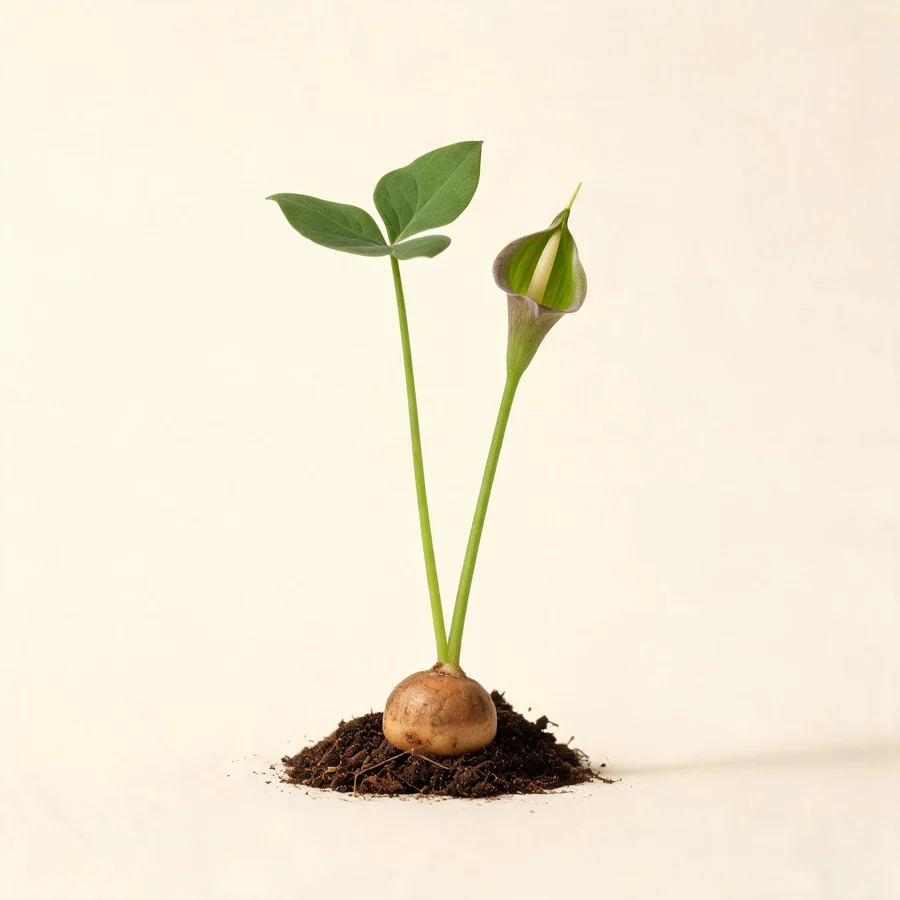
This is the one setting where the untreated corm is used. Ground and mixed to a paste, it is laid on the skin around a carbuncle or a boil, and it is held to pull the swelling down and ease the pain. The action is partly the same irritant chemistry that makes the raw tuber dangerous: the oxalate needles redden and stimulate the surface. The paste stays on intact skin around the lesion rather than on an open centre, for a short time, and no part of the raw material is ever taken by mouth.
Keeps the middle dry so that dampness is not remade
A skin problem that keeps returning with a greasy coat, a poor appetite and loose stools is read as Dampness being produced faster than it is cleared. By drying the Spleen and descending Stomach Qi, Ban Xia reduces the supply, which is why it sits in the longer prescriptions for damp-phlegm skin rather than only in a short course for a flare. This is the least dramatic of its actions and the one that changes the pattern most.
Skin conditions it is used for
Mapped to the condition pages on this site. The pattern column shows what the skin is doing when this herb is the right choice.
| Condition | Pattern | Why it suits | Typical setting |
|---|---|---|---|
| Boils | Phlegm-damp swelling that is slow to point | The raw poultice is the classical external measure for a boil that swells and will not come to a head, the reasoning being that acrid warmth draws the swelling and the pain down. It goes around the lesion on intact skin, for a short time, and not on skin that has already broken. A boil on the face, a boil with spreading redness or fever, or a boil in a diabetic person needs medical care rather than a poultice. | Raw-tuber paste locally, with Sheng Jiang and Jin Yin Hua in an internal formula |
| Skin abscess | Cold-phlegm swelling with little heat | An abscess that feels hard and deep and is not especially hot is the phlegm-damp type, and the drying and dispersing action is aimed at it. The herb is an adjunct: an established collection needs drainage, and a spreading infection needs antibiotics. The paste comes off the skin once it has broken, and the internal formula does the work a surface application cannot. | A modified toxin-resolving formula with Jin Yin Hua and Lian Qiao, plus a local paste |
| Subcutaneous lumps and nodules | Phlegm nodule with a greasy tongue coat | A smooth, firm lump that is not tender, in a person with a greasy coat and a heavy body, is read as Phlegm that has congealed under the skin. Ban Xia both dries the Dampness feeding the nodule and opens the knot itself, and it is used with herbs that soften hardness. The lump is examined first, and the course is measured in weeks. | Er Chen Tang with Zhe Bei Mu and Mu Li |
| Sebaceous cysts | Dampness and phlegm collecting in a closed sac | A cyst is a pocket of material the body has walled off, and the tradition reads that as Phlegm and Dampness with stagnation, which is why the drying Qi-moving approach is used for the surrounding tissue and the greasy skin that favours them. The herb does not dissolve a cyst that is already walled off, and an inflamed, tender or rapidly enlarging cyst needs a clinician rather than a poultice. | Modified Er Chen Tang with Zhe Bei Mu, and local care of the skin |
| Localised skin swelling | Dampness and phlegm gathering where Qi has stopped | A doughy or firm swelling that came up slowly and is not hot is read as Dampness and Phlegm gathering in one place, and the drying and descending action is directed at it. It is treated locally with a paste and internally with a formula that moves Qi and dries Dampness, which is the structure of the classical phlegm-dispelling decoctions. A swelling that is hot, spreading or painful out of proportion needs urgent assessment. | Dao Tan Tang, or a raw paste applied around the swelling |
Combinations for skin
Herbs it is paired with when the skin, not an internal organ, is the target.
| Partner | Ratio | Why the pair is used |
|---|---|---|
| Sheng Jiang | 9 g processed Ban Xia with 9 to 12 g fresh ginger | The best known pairing in the whole materia medica: ginger settles the Stomach, and it also lowers the irritant burden of the corm, which is why the two are boiled together and why a ginger-processed form exists at all. In skin work the pair is chosen when a cold middle and nausea accompany the skin picture, and it is what lets a weak digestion carry a drying herb. |
| Chen Pi | Equal parts, as in Er Chen Tang | Chen Pi moves the Qi that has stagnated while Ban Xia works on the Phlegm itself, so the pair treats the substance and the blockage that produced it. Er Chen Tang is built on the two of them, and most later damp-phlegm prescriptions for a greasy scalp or a boggy, dull complexion grow from that base. |
| Fu Ling | 9 g Ban Xia with 12 g Fu Ling | Fu Ling sends the fluid down and out by way of the urine while steadying the Spleen that let it gather, which a drying herb cannot do for itself. Ban Xia warms and dries while Fu Ling opens a route of escape, and the pair is used for puffy, weeping, waterlogged skin with a heavy body and loose stools. |
| Zhe Bei Mu | 9 g each | Zhe Bei Mu is bitter, cold and stronger at softening hardness while Ban Xia is warm and drying, so the pair covers a nodule that is firm with a hint of heat or tenderness. Both are used for phlegm nodules and for enlarged glands, and the cool herb keeps the warm one from adding heat to a lesion that is already a little warm. |
Formulas where it leads
- Er Chen Tang (二陈汤) - The foundational phlegm-transforming prescription and the clearest demonstration of why the prepared tuber sits at the centre of that whole family. In skin practice it is the base for a greasy scalp, a boggy complexion and a damp, non-weeping eczema, modified with cooling or itch-quieting herbs according to what the skin is doing.
- Dao Tan Tang (导痰汤) - Adds Tian Nan Xing and Zhi Ke to the Er Chen structure for a phlegm nodule or a thick, greasy skin picture with a heavy chest. Ban Xia remains the drying centre of the prescription, and the two arums together are the stronger version of the approach for a lump that will not shift.
Topical use
On the skin the raw tuber is used for a boil, a carbuncle or an insect bite, ground down and applied so that the swelling and the pain are drawn out. The poultice has a real sting to it, because the untreated corm is an irritant by design, and the crystals that make it work will burn any skin left in contact too long.
| Preparation | How and when it is used |
|---|---|
| Raw tuber paste | Raw corm ground and mixed with vinegar or water to a thick paste, spread on the intact skin around a boil, leaving the centre free. Apply for 15 to 30 minutes, remove and wash. Gloves are worn while handling it, it is kept away from the eyes and mouth, and nothing containing raw tuber is ever swallowed. |
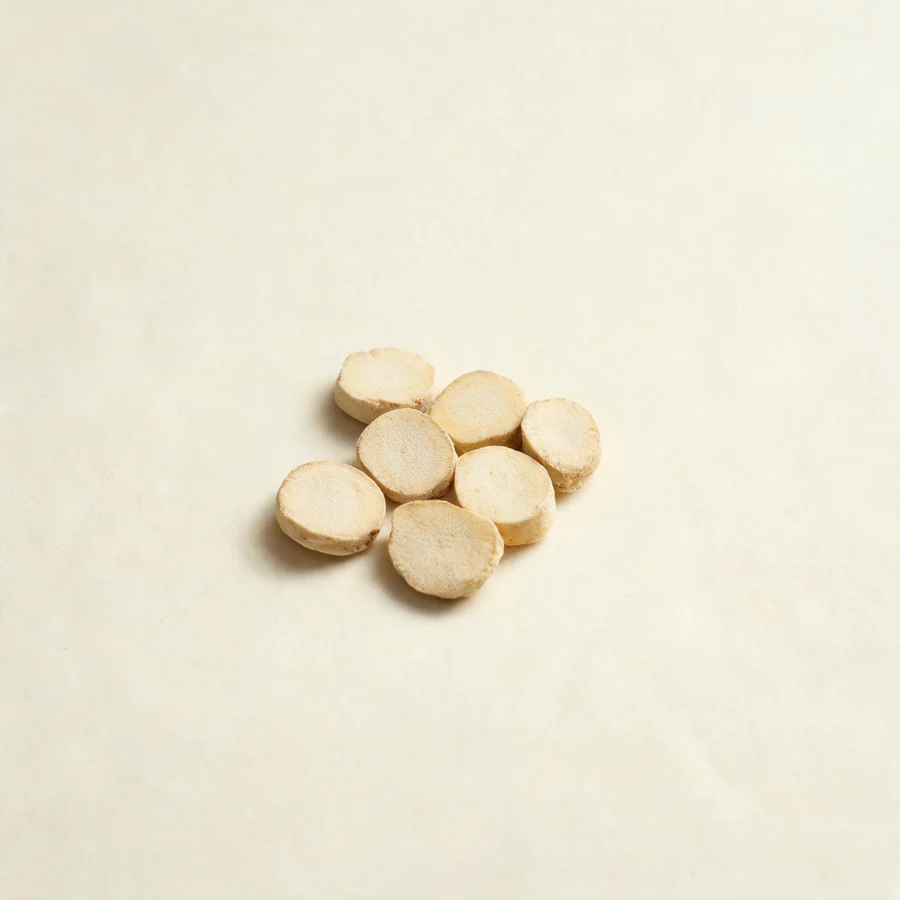
| Processed powder paste | Jiang Ban Xia or Fa Ban Xia powder mixed with water or fresh ginger juice to a softer paste for a hard, non-inflamed swelling or a patch of numb, thick skin. It is much milder than the raw paste, but it still needs a patch test and a daily check of the skin underneath. |
Patch test and cautions
Patch test for 24 hours before use, and never apply to broken, ulcerated or infected skin, to the face, or to a mucous membrane. Keep the paste thin, leave it uncovered and take it off on time. Stop at once if the skin burns, numbs, blisters or spreads red, and rinse with plenty of water. Anyone who has reacted to an Araceae plant should not use it at all.
Safety for skin use
What to check before recommending or using it, including the cautions that matter most for skin patients.
Do not use, or use with caution
- Pregnancy. Contraindicated, because a protein isolated from the tuber has shown activity relevant to early pregnancy in animal work, and because the raw material is toxic in its own right.
- Any internal use of the raw tuber. The mouth, tongue and throat burn and swell within minutes, and the airway can be compromised; only the prepared forms are internal medicine.
- Dry skin, a dry cough, a dry throat or a red tongue without a coat. A warm drying herb makes a dry picture tighter and can leave the mouth dry and the stool hard.
- Active bleeding, including coughing or vomiting blood, and lesions that are hot, raw and burning, where acrid warmth aggravates rather than soothes.
- Aconite (Wu Tou) in the same formula, which is a classical prescribing rule rather than a caution to be weighed.
Pregnancy and breastfeeding
Contraindicated in pregnancy. A protein isolated from the tuber showed activity against early pregnancy in animals, and large doses of raw powder damaged both mother and embryo, which makes the prohibition specific rather than a general preference. Zhang Zhongjing did use the herb for vomiting in pregnancy, and a prepared form is still allowed where vomiting is severe and the indication clear, under supervision, but a skin complaint is not that indication and simpler measures come first. Breastfeeding follows the same logic: no data, and no need.
Interactions
- Aconite (Wu Tou). Ban Xia is listed in the Eighteen Incompatibilities against aconite, and laboratory work offers a mechanism: boiling the two together slows the breakdown of the toxic diester alkaloids, so more aconitine survives in the liquid.
- Pharmaceutical antiemetics such as ondansetron may add to the anti-emetic effect, and the combination has been examined for chemotherapy nausea, so the dose may need review.
- Cough suppressants and opioid antitussives. In animals the alkaloids suppress cough about as effectively as codeine at matching doses, so the combination may suppress more than intended.
- Qing Ban Xia, processed with alum, leaves aluminium behind, which matters for anyone taking aluminium-containing antacids or with impaired kidney function.
Allergy and patch testing
Contact with the raw tuber produces numbness, itching and burning in most people, which is irritation from the oxalate crystals rather than allergy, but a genuine reaction is possible, and people who react to other Araceae plants are the most likely. Patch test a processed paste for 24 hours before it goes on a lesion, keep it off the face and the mucosa, and stop at the first sign of blistering.
General safety references
General references for herbal hepatotoxicity and herb-drug interactions; they are not specific to this herb.
- Review article: Herbal hepatotoxicity - an update on traditional Chinese medicine preparations. Alimentary Pharmacology & Therapeutics, 2014. PMID: 24844799.
- Interactions between herbal medicines and prescribed drugs: an updated systematic review. Drugs, 2009. PMID: 19719333.
- Warfarin and food, herbal or dietary supplement interactions: a systematic review. British Journal of Clinical Pharmacology, 2021. PMID: 32478963.
Evidence
The classical record is quoted with its source. The modern note states the level of evidence plainly.
Classical record
主伤寒寒热,心下坚,下气,喉咽肿痛,头眩胸胀,咳逆肠鸣,止汗。
It governs Cold Damage with chills and fever, hardness below the Heart, descending Qi, swelling and pain of the throat, dizziness and chest distension, cough with rebellious Qi and bowel sounds; it also stops sweating.
Shen Nong Ben Cao Jing (Divine Husbandman's Classic of Materia Medica) - The oldest entry already treats the herb as a descending medicine for hardness and swelling, which is the basis for calling it a breaker of nodules.
半夏上有鄛涎,若洗不尽,令人气逆,肝气怒满。
Ban Xia carries a slime on its surface; if this is not washed off completely it drives Qi upward and leaves the Liver Qi congested and full.
Lei Gong Pao Zhi Lun (Master Lei's Treatise on Preparing Drugs) - An early statement that the raw surface is the problem and washing is the remedy, and the ancestor of the soaking steps that became formal processing.
脾无留湿不生痰,故脾为生痰之源,肺为贮痰之器。半夏能主痰饮及腹胀,因为其体滑而辛温。
Where the Spleen holds no Dampness, no Phlegm is made; the Spleen is therefore the source of Phlegm and the Lung the vessel that stores it. Ban Xia governs phlegm-fluid retention and abdominal distension because its body is slippery and its flavour acrid and warm.
Ben Cao Gang Mu (Compendium of Materia Medica), Li Shizhen - The Spleen is named as the source of Phlegm and the Lung as its store, which is why the herb is used for greasy, boggy skin as well as for a cough.
Modern evidence
Evidence status
- Laboratory work reports alkaloids, lectins and anti-inflammatory activity in Pinellia, and the toxicology of the untreated corm is well characterised: calcium oxalate raphides held in mucilage cells, with irritant proteins, together produce the burning and swelling that start in the mouth and spread to the throat.
- No clinical trial of Ban Xia in a skin condition was identified. The external use for boils and bites rests on classical practice, and the dermatological literature concerns the toxicity and the processing rather than outcomes.
- Regulatory status: only the prepared forms are accepted for internal use in the Chinese Pharmacopoeia, and the raw tuber is classified as toxic. The three pharmacopoeial forms differ in emphasis, so the label on the packet matters for safety as much as for effect.
PubMed records
Selected real PubMed records for this herb's species or its constituents, chosen by species name and title relevance. They are references for the non-TCM discussion above, not proof that the herb treats any skin condition.
- Neuroprotective effect of a chuk-me-sun-dan on neurons from ischemic damage and neuronal cell toxicity.. Neurochemical research, 2006. PMID: 16474991 (safety record).
Dose and forms
Skin-practice dosing and the preparations that suit skin complaints.
| Form | Dose and notes |
|---|---|
| Decoction (processed only) | 3 to 9 g of processed tuber daily, with 6 to 9 g the usual working range. The raw tuber has no internal dose in modern practice, and the classical raw decoction with ginger is an expert technique rather than a home method. |
| By processed form | Jiang Ban Xia is the most anti-emetic and the commonest, Fa Ban Xia the mildest and best where the Spleen needs harmonising, and Qing Ban Xia the most strongly drying and phlegm-transforming. The gram range is shared, but the choice of form changes the formula. |
| External paste | Raw or processed powder mixed to a paste and applied around a boil or over a firm swelling for 15 to 30 minutes, once or twice daily, on intact skin only and with a patch test first. |
| Course length | Two to four weeks with review for the internal use. Stop if the mouth dries, the skin tightens, the stool hardens or the appetite falls, and do not continue a drying herb through a hot, dry season. |
These figures describe prepared tuber. Raw material is toxic and no longer used internally, and the preparing is a safety step rather than a refinement, since it breaks the oxalate crystals and denatures the irritant proteins. Amounts above about 15 g for severe phlegm obstruction belong to a practitioner with monitoring, and no dose whatever makes raw corm safe to swallow.
Citations and further reading
Only real sources are listed: the classical materia medica passages quoted above, and the source works behind the botanical and safety statements.
- Shen Nong Ben Cao Jing (Divine Husbandman's Classic of Materia Medica), attributed compilation of the Han period - classical entry quoted above.
- Lei Gong Pao Zhi Lun (Master Lei's Treatise on Preparing Drugs) - classical entry quoted above.
- Ben Cao Gang Mu (Compendium of Materia Medica), Li Shizhen, 1578 - classical entry quoted above.
- Ban Xia monograph: Pharmacopoeia of the People's Republic of China - source for the accepted species, the three processed forms, the 3 to 9 g dose and the toxic classification.
- Modern evidence statement: based on laboratory and toxicological literature on Pinellia alkaloids, lectins and calcium oxalate raphides, summarised as a statement about the level of evidence.
- Botanical description and identification: botanical literature on Pinellia ternata, Araceae.
Educational reference for qualified practitioners. This page is not medical advice, and skin conditions should be diagnosed by a clinician before treatment.