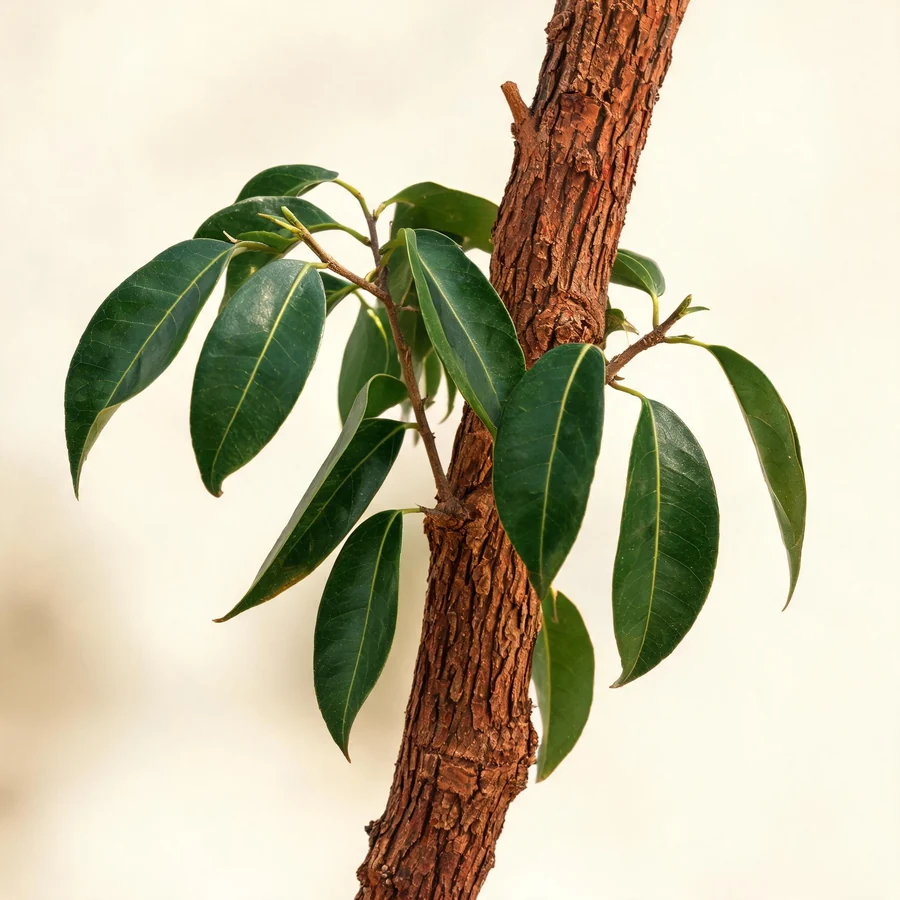
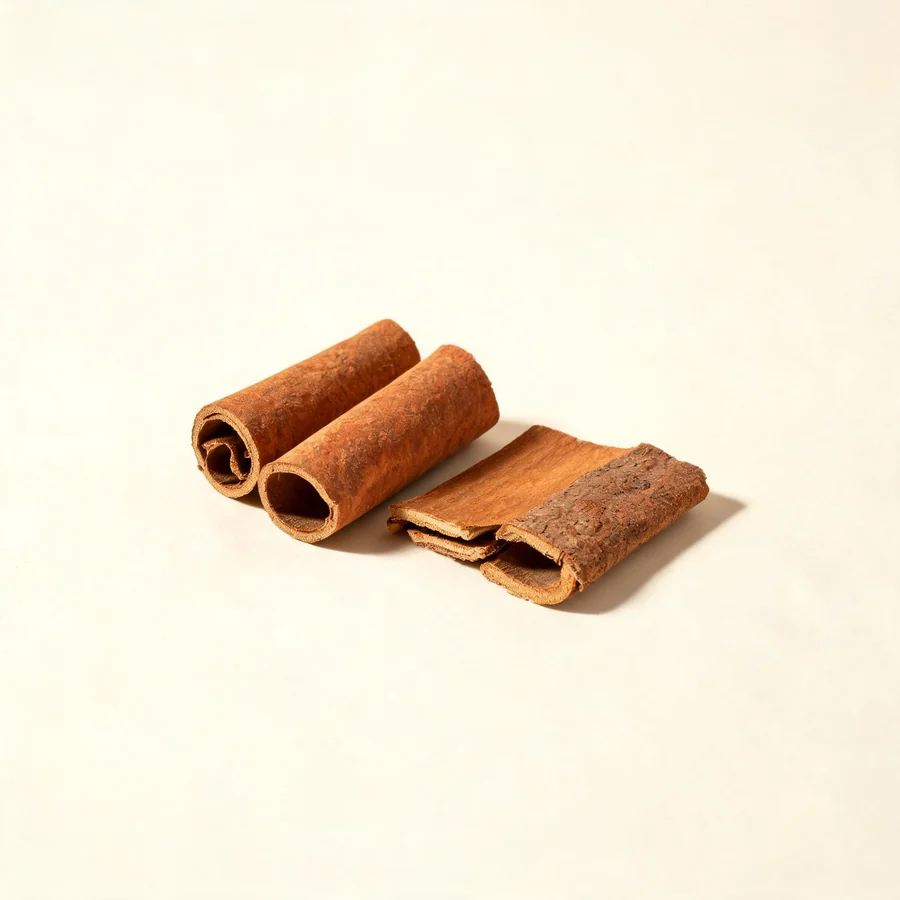
Skin profile
Where this herb sits in skin practice: the pattern it corrects, the skin signs it suits, and what it should not be used for.
Rou Gui is the bark for cold that has reached the skin: dusky, slow-healing, cold to the touch, and the deep pale swelling that will not point. Its small dose is deliberate, its coumarin load keeps courses short, and it is the wrong herb for anything red, hot and dry.
Skin signs that suggest it
- Dusky, cold, slow-healing skin on the fingers, toes or lower legs
- Chilblains that itch and burn on warming, in a person whose hands and feet are always cold
- A deep, pale, hard swelling that does not redden or come to a head
- A flushed face with cold legs and a deep, weak pulse, meaning false heat above and cold below
- A pale, swollen tongue and a slow, deep pulse in a person who feels the cold
When it is not the right herb
Not for skin that is dry, red and hot, and not for someone who sweats at night, wakes with a parched mouth and shows a red tongue with almost no coat: a hot drying bark makes that picture worse. Not for a full heat pattern with high fever, a red face and a forceful pulse. Not for a red, swollen sore throat in a feverish person, which looks similar to the cold-limbed throat the bark is for and could hardly be more different. Avoided in pregnancy in medicinal doses, and used with care where there is unexplained bleeding.
What it does for skin
Skin-relevant actions only. Each one describes a mechanism in TCM terms and what it looks like on the skin.
Warms the channels and moves Blood that cold has slowed
Cold contracts, and the tradition reads a dusky, cold, slow-healing surface as blood that has been slowed rather than blood that is absent. The bark is said to reach the blood level and warm it, so cold and stasis are treated from both sides at once. That is the reasoning behind its place in formulas for chilblains, for cold-type joint and muscle pain, and for the dusky skin of a chronically cold person.
Brings a deep, cold swelling to a resolution
The deep, pale, hard swelling that neither reddens nor points is read as cold and phlegm congealed in the channels, and the treatment is to warm it and open it rather than to clear it. The bark is a leading ingredient in that approach, used in a small dose with herbs that nourish, disperse and move blood. A swelling that is hot, red and spreading is the opposite picture and needs medical care rather than warming.
Draws floating Yang back down to its source
Where a flushed face, a red throat or mouth ulcers appear above cold legs and a deep weak pulse, the heat is read as Yang that has lost its anchor rather than as excess. The bark warms the Kidney below and is said to lead the Yang home, which is why it can settle what looks like heat. The distinction matters on the skin, because cooling a flushed face on its own is said to drive the deficiency underneath deeper.
Warms the Spleen and Kidney so that the surface is supplied
Cold skin that does not heal is often part of a wider cold-deficiency picture: cold limbs, a cold lower back and loose stools before dawn. The bark enters both the Spleen and the Kidney and warms the middle while feeding the fire below, since the tradition holds that digestion stays warm only while the Kidney's store holds out. It is a supporting ingredient in that kind of formula, dosed small, and the improvement in the skin follows the improvement in the whole picture.
Skin conditions it is used for
Mapped to the condition pages on this site. The pattern column shows what the skin is doing when this herb is the right choice.
| Condition | Pattern | Why it suits | Typical setting |
|---|---|---|---|
| Chilblains | Yang Deficiency with Cold-Damp in the extremities | Chilblains recur because the internal fire is not reaching the extremities, and the bark addresses exactly that: it warms the channels and moves the blood that cold has slowed. It is used internally in a warming formula and, in some traditions, in a warming wash, and the practical measures matter as much: warm dry footwear, a gradual warm-up rather than a hot soak, and no smoking. Broken or ulcerated chilblains need care rather than a warming plaster. | A warming formula such as Dang Gui Si Ni Tang with Rou Gui added |
| Raynaud's disease | Kidney Yang Deficiency with Blood Stagnation in the channels | The white then blue then red sequence in the fingers is read as blood failing to reach the extremities, and a cold-deficient constitution with a deep weak pulse is the pattern the bark suits. It is used with blood-moving and warming herbs, and the effect is on the pattern rather than on a single attack. Raynaud's can be the first sign of a connective tissue disease, so the diagnosis comes first and a warming herb is an adjunct at most. | A Kidney-warming, blood-moving formula, with Dang Gui and Huang Qi |
| Skin abscess | Cold and Phlegm congealed in the channels, the yin-type swelling | The yin-type abscess is deep, pale, hard and slow, and it neither reddens nor points. Warming and dispersing is the traditional treatment, and the bark is the warming ingredient that leads the formula, with herbs that nourish the Blood, disperse phlegm and open the channels. This is the opposite of the hot, red, painful abscess, which needs drainage and antibiotics; the two must not be confused, because warming a hot abscess makes it worse. | Yang He Tang (阳和汤), with Shu Di Huang, Bai Jie Zi and Ma Huang |
| Scleroderma | Kidney and Spleen Yang Deficiency with Cold and Blood Stagnation in the skin | Skin that is tight, hard and cold, with cold limbs and a waxy pallor, is read as cold and stagnation in the channels over a deficiency beneath, and the treatment is to warm, move and nourish at the same time. The bark is a supporting herb in that kind of formula, never the main one and never the whole treatment. Scleroderma is a serious systemic disease, so any herbal work belongs beside specialist care and not instead of it. | A warming, blood-moving formula with Huang Qi, Dang Gui and Bai Jie Zi |
| Cool or clammy skin sensation | Yang Deficiency with Cold-Damp at the surface | Skin that stays cool and clammy, with a dislike of cold, cold limbs and a deep weak pulse, is read as Yang failing to warm the surface, and the bark warms the source rather than the surface alone. It is used in a small dose inside a warming formula, with herbs that support the defensive Qi. Sudden cold clamminess with chest pain or breathlessness is a cardiac emergency and comes before any herbal question. | A warming formula with Huang Qi and Bai Zhu |
Combinations for skin
Herbs it is paired with when the skin, not an internal organ, is the target.
| Partner | Ratio | Why the pair is used |
|---|---|---|
| Shu Di Huang | 10 to 15 g Shu Di Huang with 1.5 to 3 g Rou Gui | The bark warms but supplies nothing, so in a depleted person it is given with a large dose of a nourishing herb and in a small dose itself. Prepared rehmannia supplies the substance and the bark supplies the warmth that moves it, which the tradition describes as seeking Yang within Yin. It is the basis of the tonifying formulas and of the cold-swelling formulas alike. |
| Huang Lian | 1 to 2 g Rou Gui with 3 to 6 g Huang Lian | A scalding bark beside a freezing root, in a proportion weighted heavily toward the root, for heat gathered above with cold beneath: the bark pulls the fire down while the root clears what has lodged at the top. No other pairing shows so plainly that the bark is picked for where it sends warmth, not for how hot it is. Reserve it for a flushed face over cold legs, not for a body that is hot throughout. |
| Dang Gui | 6 to 10 g Dang Gui with 1.5 to 3 g Rou Gui | When the Blood is short and cold at the same time, feeding and warming have to happen together: Dang Gui manufactures the Blood, and the bark heats the vessels it flows through. The two meet in formulas for period pain of the cold type and for dusky skin that heals slowly, with the bark kept small so that it heats without parching. |
| Bai Jie Zi | 3 to 6 g Bai Jie Zi with 1.5 to 3 g Rou Gui | Mustard seed disperses phlegm that has congealed into a nodule, and the bark warms the cold that let it congeal, so the pair is aimed at deep, hard, pale swellings rather than at infection. They are the operative pair in the classic formula for yin-type abscesses, where the aim is to make the mass resolve or come to a head slowly. A hot, red swelling is not this picture. |
Formulas where it leads
- Yang He Tang (阳和汤) - The formula for deep, cold, pale swellings and chronic non-healing sores, built on prepared rehmannia and the bark with mustard seed, antler glue and a little ephedra. Its whole design is warming and dispersing, and it is the clearest example of the bark being used for its direction as much as for its heat.
- Jiao Tai Wan (交泰丸) - A two-herb formula of the bark and Coptis for the state where heat is above and cold below, with a flushed face, a red throat and cold legs. The proportions give the cold herb the larger share, and the bark is present to lead the Yang back down rather than to warm the body.
Topical use
The bark appears in external warming plasters and washes rather than in cooling preparations, and the aim is always to bring warmth and movement to a cold, dusky area. Two cautions govern it. The first is that heat applied to skin with poor sensation can burn without the person noticing, which matters in diabetes and in neuropathy. The second is that cinnamaldehyde, the main volatile constituent, is a recognised contact allergen, so a plaster that suits one person will inflame another.
| Preparation | How and when it is used |
|---|---|
| Warming plaster over a cold swelling | A prepared plaster containing cinnamon bark is applied over a deep, pale, cold swelling or a chronically cold area on intact skin, for a set period rather than overnight. It is not used on broken skin, over a numb area or on the face, and it is removed if burning starts. |
| Warming wash for cold hands and feet | A weak decoction of the bark is used as a hand or foot soak for cold, dusky extremities, at a comfortable warmth rather than at a hot temperature. Numb or insensitive feet are not soaked, because the person cannot judge the temperature, and broken chilblains are not soaked at all. |
| What is not done | The bark is not applied neat as a powder to a wound, not used on a red, hot or weeping lesion, and not used on the face. A home plaster is a poor substitute for a prepared product, because the strength and the allergen load are both unknown. |
Patch test and cautions
Patch test before the first proper application, keep the area small, and remove the preparation at once if it stings or the skin reddens more than the lesion. Do not apply heat to skin with reduced sensation, and do not use warming plasters on a hot, red or spreading lesion. In pregnancy, external use over a small area is a different matter from internal use, but it should still be discussed before it is started.
Safety for skin use
What to check before recommending or using it, including the cautions that matter most for skin patients.
Do not use, or use with caution
- Yin deficiency with heat: sweating at night, a parched mouth after sleep, hot palms and a red tongue with almost no coat. A hot drying bark worsens the dryness and the sweating.
- Any full heat pattern: high fever, a flushed face with a bounding pulse, constipation with a parched mouth, or mouth ulcers in someone strong. This bark belongs to cold and to deficiency, and handing it to a hot pattern is described as throwing fuel on a fire.
- A red, swollen sore throat in a feverish person, which must not be mistaken for the cold-limbed throat the bark is used for.
- Unexplained bleeding, heavy periods or bleeding after childbirth, since the bark both heats and stirs the Blood.
- Pregnancy in medicinal doses, and active liver disease or heavy alcohol use, because of the coumarin load.
Pregnancy and breastfeeding
Avoided at medicinal strength. The old texts state outright that the bark is capable of ending a pregnancy, and present-day practice leaves it out unless a supervised formula is thought essential; the worry is a heating, stirring medicine that acts on the uterus. Cinnamon in a dessert is a far smaller exposure than a decoction, and only the decoction is at issue here. A small area of skin is generally thought less risky, though it still deserves a conversation, and breastfeeding follows the same short-course reasoning.
Interactions
- Anticoagulants. The coumarin in cassia disturbs clotting that depends on vitamin K, and warfarin taken alongside it has been reported to push the INR upward, so clotting needs measuring rather than assuming; aspirin, clopidogrel and heparin carry the same warning.
- Glucose-lowering medicines. Cassia has been examined for its effect on blood sugar, and whatever it does is added to insulin, metformin or a sulfonylurea, so readings are worth watching and no one should change a dose because of the herb.
- Liver-loading medicines and alcohol. Coumarin is why the bark sits in the restricted group, and the worry is what accumulates across months, which is greater in people taking drugs that compete for the same enzymes.
Allergy and patch testing
Cinnamaldehyde is one of the standard patch-test allergens, and contact dermatitis to cinnamon in foods, cosmetics and plasters is well recognised. Patch test a prepared plaster before use, keep the application to a small area, and stop if the skin becomes more irritated rather than warmer and calmer. A person who reacts to cinnamon in food may also react to it on the skin.
General safety references
General references for herbal hepatotoxicity and herb-drug interactions; they are not specific to this herb.
- Review article: Herbal hepatotoxicity - an update on traditional Chinese medicine preparations. Alimentary Pharmacology & Therapeutics, 2014. PMID: 24844799.
- Interactions between herbal medicines and prescribed drugs: an updated systematic review. Drugs, 2009. PMID: 19719333.
- Warfarin and food, herbal or dietary supplement interactions: a systematic review. British Journal of Clinical Pharmacology, 2021. PMID: 32478963.
Evidence
The classical record is quoted with its source. The modern note states the level of evidence plainly.
Classical record
菌桂,味辛温。主百病,养精神,和颜色,为诸药先聘通使。久服轻身不老。
The inner bark is acrid and warm. It is set down for a wide range of complaints, for nourishing the spirit, for harmonising the complexion, and for acting as the envoy that leads the other ingredients. Taken over long periods it is said to lighten the body and hold off ageing.
Shen Nong Ben Cao Jing (Divine Husbandman's Classic of Materia Medica) - The complexion line is the oldest skin claim for the bark, and the envoy line explains the small dose that later practice kept: it leads a formula rather than dominating it.
主心痛,胁风,胁痛,温筋通脉,止烦出汗。能堕胎,坚骨节,通血脉。
It is recorded for pain around the Heart, for wind and pain in the flanks, for warming the sinews and freeing the vessels, and for settling restlessness with sweating. The same entry says that it can end a pregnancy, and credits it with firming the bones and joints and opening the blood vessels.
Ming Yi Bie Lu (Supplement to the Classic of Materia Medica) - Warming the sinews and opening the vessels is the classical basis for using the bark where cold has slowed the blood in the skin, and the pregnancy warning is classical rather than a modern addition.
肉桂,治沉寒痼冷之药也。
Rou Gui is the medicine for cold that has sunk deep and settled into a chronic complaint.
Ben Cao Hui Yan (Collected Sayings on Materia Medica) - One line that places the bark precisely: not a general warmer but the remedy for cold at the deepest layer, which on the skin means the dusky, cold, long-standing lesion rather than a recent chill.
Modern evidence
Evidence status
- Coumarin is the modern concern. The bark contains up to about 1 per cent, and its metabolite is toxic to liver cells in laboratory work; European authorities have set intake limits, aimed chiefly at daily culinary spice use rather than at a short medicinal decoction. At 1 to 5 g for an appropriate period the exposure is small, which is why the dose and the duration carry the safety argument.
- Cinnamaldehyde makes up 50 to 60 per cent of the volatile oil and is an established contact allergen, which is the skin-specific side of the same chemistry: the constituent that gives the warmth is the one that sensitises. This is why plasters containing the bark cause dermatitis in some people and why patch testing is not optional.
- Clinical evidence for the bark in skin disease is very limited. The cinnamon literature is dominated by glucose and lipid studies in diabetes, and the dermatological use rests on tradition; no trial of Rou Gui in chilblains, Raynaud's phenomenon or scleroderma is available to support the claims made for it.
PubMed records
Selected real PubMed records for this herb's species or its constituents, chosen by species name and title relevance. They are references for the non-TCM discussion above, not proof that the herb treats any skin condition.
- A review: the botany, ethnopharmacology, phytochemistry, pharmacology of Cinnamomi cortex.. RSC advances, 2021. PMID: 35480649 (pharmacology or review record).
Dose and forms
Skin-practice dosing and the preparations that suit skin complaints.
| Form | Dose and notes |
|---|---|
| Decoction | 1.5 to 4 g of bark, put in for the final five minutes of the brew, or infused on its own and then combined with the strained liquid, since prolonged boiling loses the oil that holds the warmth. Past roughly 5 g the coumarin taken in climbs faster than any benefit might. |
| Powder | 1 to 2 g, taken with a mouthful of warm water or mixed into liquid that has already been strained, a route that preserves more of the aromatic oil than boiling does. The old texts name this form for pain of the cold type. |
| When it only leads | Under 2 g, when the bark steers a tonic formula instead of treating cold; the figure comes from the formula as a whole rather than from the symptoms. |
The quantity is small, and the distance between a spice and a medicine is where the safety argument lives. Two grams of bark in a decoction over several days is nothing like a spoonful of cassia stirred into breakfast every morning for a year, and official coumarin advice is written for the second habit. Add the bark late because its heat is volatile, take it with food since a pungent powder taken fasting can smart, and stop rather than press on if the skin or eyes yellow, the urine darkens or tiredness arrives without explanation.
Citations and further reading
Only real sources are listed: the classical materia medica passages quoted above, and the source works behind the botanical and safety statements.
- Shen Nong Ben Cao Jing (Divine Husbandman's Classic of Materia Medica), attributed Han compilation - classical entry quoted above.
- Ming Yi Bie Lu (Supplement to the Classic of Materia Medica), Tao Hongjing, Southern and Northern Dynasties - classical entry quoted above.
- Ben Cao Hui Yan, Ni Zhumo, Ming dynasty - classical entry quoted above.
- Rou Gui monograph: Pharmacopoeia of the People's Republic of China - source for the accepted botanical source, part used and dose range.
- European health authority assessments of coumarin intake - source for the statement that the limits are aimed at daily culinary use rather than at short medicinal courses.
- Modern evidence statement: based on literature on coumarin hepatotoxicity and cinnamaldehyde contact allergy, summarised as a statement about the level of evidence rather than as a cited finding.
Educational reference for qualified practitioners. This page is not medical advice, and skin conditions should be diagnosed by a clinician before treatment.