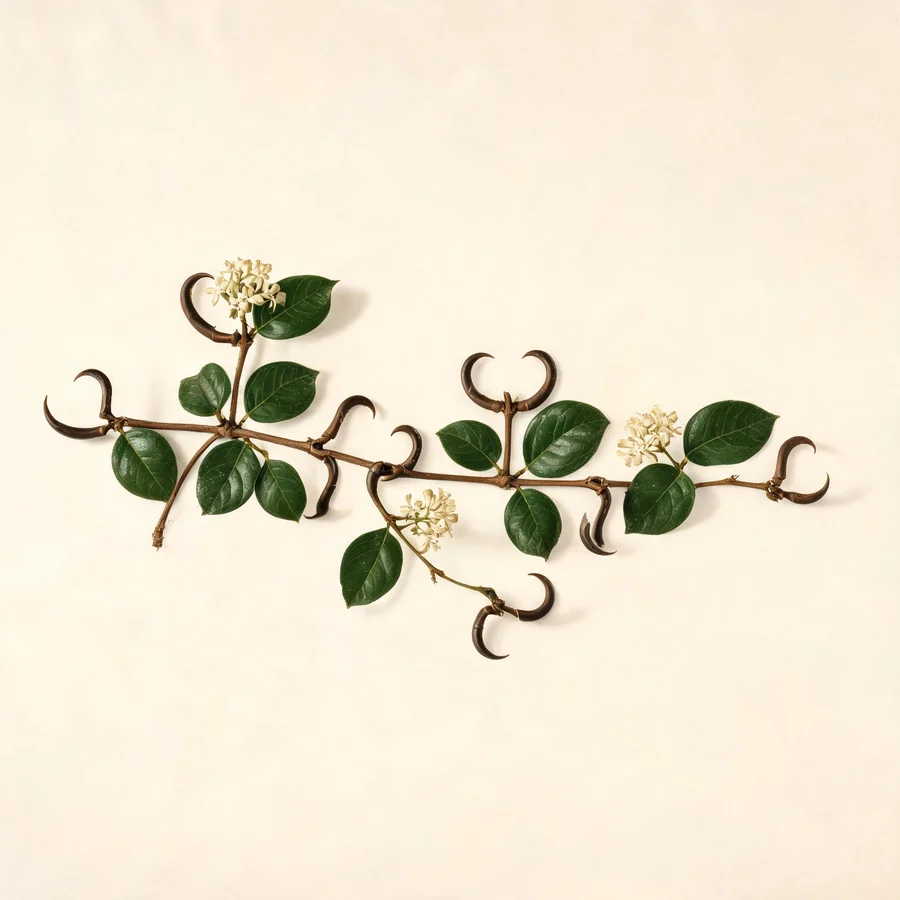
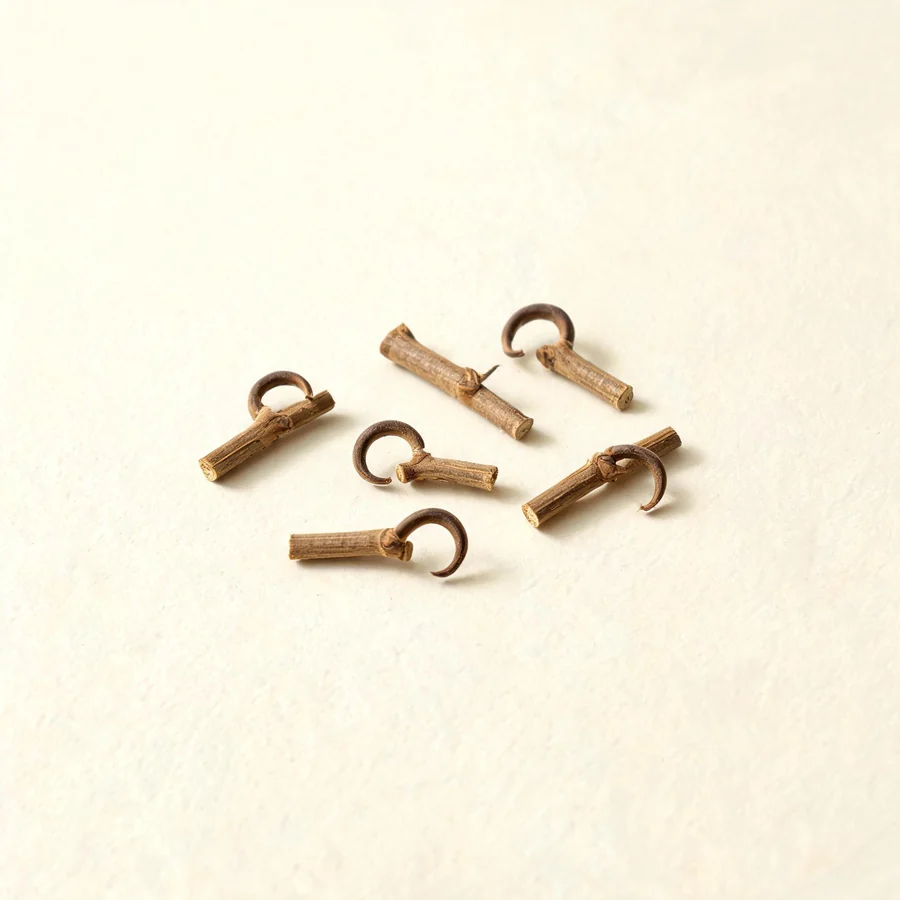
Skin profile
Where this herb sits in skin practice: the pattern it corrects, the skin signs it suits, and what it should not be used for.
Gou Teng is a settling herb, and the only skin lesions it settles are the ones that move: hives, migrating itch and the flushed face of rising Yang. It is cool, gentle and always a supporting herb in a formula, and the practical check before using it is the person's blood pressure.
Skin signs that suggest it
- Wheals that move from place to place, flare with stress or heat, and fade within hours
- Itch that migrates, worsens at night and is worse in an irritable person who sleeps badly
- A flushed or blotchy face with a throbbing headache, dizziness and a wiry pulse
- Thickened, lichenified skin from a long itch-scratch cycle that flares in stressful weeks
- Skin that stings or burns to a light touch, with restlessness and a red tongue edge
When it is not the right herb
Not for someone pale, cold and exhausted whose dizziness or itch comes from depletion: a cool settling herb pulls in the wrong direction there. It is not a treatment for hives on its own, and it is not for a first convulsion, a febrile child who is drowsy, or a rash with fever and breathing difficulty, all of which are medical emergencies. It is used with care by anyone on blood pressure medicine, because it lowers pressure and the effect adds up. It is not given in pregnancy outside supervised obstetric care, and it is not a herb to take for years without review.
What it does for skin
Skin-relevant actions only. Each one describes a mechanism in TCM terms and what it looks like on the skin.
Settles Wind that moves the skin
Wind is the name for what arrives suddenly, moves and disappears, and that is the behaviour of a hive rather than the behaviour of a plaque. Gou Teng works on that movement: the wheals settle, the itch that migrates from one area to another quietens, and a flare that follows a stressful hour is shorter. It is not an antihistamine and it does not block the trigger; it is used inside a formula that also clears the heat or releases the surface, and in that formula it is a supporting herb rather than the engine.
Cools the Liver and takes the flush out of the face
Rising Yang shows in the face before anywhere else: flushing, a throbbing headache, dizziness, red eyes and a temper that goes off quickly. The stem is cool and sweet, so it eases that ascending force downward without the drying a bitter cold herb would cause, and it suits a person who is flushed, irritable and sleeping badly. The skin change it addresses is a transient flush rather than a fixed red plaque, and a fixed plaque belongs to a different herb and a different pattern.
Quiets the itch-scratch cycle that stress keeps going
In neurodermatitis the plaque is the end point of a long cycle, and the part of that cycle this stem addresses is the wind-driven urge to scratch in a person whose Liver Qi is constrained. It is combined with herbs that build blood and soften the plaque, because settling the itch without restoring the skin leaves the lesion in place. The measure of success is a shorter itch episode and less night scratching, not the disappearance of a thickened plaque, and a plaque that is changing should be looked at.
Calms the restlessness that comes with a hot, itchy surface
A hot, itchy surface in a child or a tense adult produces restlessness, poor sleep and irritability, and the stem's mild settling quality addresses that state rather than the skin itself. It is why it appears in the traditional paediatric formulas for a fretful child with fever and a rash. It is not a sedative, it does not replace treating the rash, and a child who is drowsy, floppy or breathing oddly needs urgent assessment rather than a decoction.
Skin conditions it is used for
Mapped to the condition pages on this site. The pattern column shows what the skin is doing when this herb is the right choice.
| Condition | Pattern | Why it suits | Typical setting |
|---|---|---|---|
| Urticaria | Wind in the skin, with heat and a wiry pulse | Hives are read through the one feature they share with Wind: they arrive suddenly, move and disappear, and what decides the treatment is whether the wheals are hot or cold. This stem suits the hot type in an irritable, flushed person, because it settles the Wind while it cools the Liver that is driving it. It is combined with herbs that release the surface and clear heat, and it is not used on its own. Swelling of the lips or tongue, wheeze or breathing difficulty is an emergency. | Modified Xiao Feng San with Gou Teng and Fang Feng |
| Itchy skin | Wind-heat itch with Liver Yang and irritability | Itch is given the name Wind in this framework because it moves, comes and goes and worsens at night, and this stem is chosen when the person is also flushed, irritable and sleeping badly, which points to the Liver rather than to dryness or dampness. It settles the moving component while other herbs clear the heat or nourish the blood. It is a poor choice for the dry, pale winter itch of an older person, where there is nothing to settle and the coolness adds nothing. | Modified Xiao Feng San, or with Ju Hua and Bai Xian Pi |
| Neurodermatitis | Liver constraint with Wind on a blood-deficient plaque | Neurodermatitis is read as a disorder of the blood showing on the skin, with a thickened leathery plaque at the end of a long itch-scratch cycle, and the stem's place is in the wind and constraint component rather than in the blood deficiency itself. It suits the person whose itch flares in stressful weeks and who is tense, sighing and sleeping badly. The herbs that nourish blood and soften the plaque do the main work, and the stem is added to shorten the itch episodes that keep the cycle going. | Modified Dang Gui Yin Zi with Gou Teng and Bai Ji Li |
| Skin hypersensitivity to touch | Wind and heat irritating the surface nerves | Skin that stings or burns to a light touch is read as a weakened surface defence letting Wind and Heat irritate the nerves, and the stem's settling quality is used for the heightened sensitivity rather than for any visible lesion. It suits the irritable, flushed person whose skin is uncomfortable without being inflamed. It is a supporting herb only, and it is not used where the sensitivity comes with spreading redness, fever, blistering or breathing difficulty, all of which need urgent care. | Modified Xiao Feng San with Gou Teng, Chan Tui and Bai Ji Li |
Combinations for skin
Herbs it is paired with when the skin, not an internal organ, is the target.
| Partner | Ratio | Why the pair is used |
|---|---|---|
| Tian Ma | 9 g Tian Ma with 12 g Gou Teng | These two are the fixed pair for rising Yang with Wind, one the stronger at extinguishing Wind and the other adding the cooling and the gentle settling. For the skin the pair is used where a flushed, throbbing face and a migrating itch appear in the same irritable person, and it is a formula pair rather than a pair for home use. |
| Ju Hua | 9 g each | Chrysanthemum cools Liver heat and clears the eyes, while the stem settles Yang and Wind, so the pair suits a headache with eyes that are sore, red and sensitive to light, and a face that flushes. Neither herb dries, which makes the pair suitable for an irritable, dry-eyed person rather than a robust, congested one. On the skin it is used for the flushing that comes with that picture, not for a fixed plaque. |
| Fang Feng | 6 to 10 g each | Fang Feng releases Wind from the surface while the stem settles the Wind underneath it, so one works at the boundary and the other within. It is the pairing used for red, migrating hives and for itch that moves around the body, and it is the most directly skin-directed combination on this page. Both belong to an acute flare, and neither is a long-term treatment for a dry, deficient skin. |
| Bai Xian Pi | 6 to 10 g each | Bai Xian Pi is the skin-specific heat and wind herb with a strong antipruritic record, and the stem adds the settling action on the nervous component of itch. The pair is used for an itch that is both inflammatory and stress-driven, where clearing alone leaves the person scratching. The stem is cool and the bark is colder, so the pair is kept short in a person with a cold digestion. |
Safety for skin use
What to check before recommending or using it, including the cautions that matter most for skin patients.
Do not use, or use with caution
- Cold and deficiency: someone pale, cold and tired whose dizziness or itch comes from depletion. A cool settling herb deepens the cold and adds to fatigue, so the pattern is confirmed before it is used at all.
- Low blood pressure, or antihypertensive treatment. The drop in pressure is reliable enough that a person already medicated, or already running low, may feel faint when standing up.
- A first convulsion, a drowsy febrile child, or a rash with fever and breathing difficulty. These are medical emergencies, and a Wind-settling herb is not a treatment for them.
- Pregnancy outside supervised obstetric care. The obstetric history is real, but it belongs to hospital practice for a specific indication and never to self-medication.
Pregnancy and breastfeeding
Requires supervision in every case. The eclampsia formula recorded in the Tai Chan Xin Fa gives the herb a genuine obstetric history, yet it remains a specialist tool rather than a generally safe one. Two things drive modern caution: animal work in which rhynchophylline stimulates uterine muscle, and the effect on blood pressure, which in a pregnant woman may help or may overshoot. Its place is hospital obstetrics for a clear indication, never self-medication. While nursing, the concern is theoretical, since a sedative and hypotensive alkaloid could in principle enter the milk, and a baby who is sleepy and floppy would be the sign that mattered.
Interactions
- Antihypertensive medicines. The fall in pressure adds to that of ACE inhibitors, calcium channel blockers, angiotensin receptor blockers, beta-blockers and diuretics, so pressure is watched, the dose of the herb is kept small, and faintness on standing is reported rather than put up with.
- Sedatives and alcohol. Animal work shows the stem lowering cortical excitability, so it may deepen the effect of benzodiazepines, barbiturates and sleeping tablets, and of alcohol, and the sign to watch for is drowsiness during the day.
- Blood thinners. Rhynchophylline inhibits platelet clumping in laboratory work, so warfarin, aspirin, heparin and clopidogrel all warrant care. The alkaloids are handled by CYP3A4 as well, which leaves a theoretical interaction with medicines using that pathway.
Allergy and patch testing
A reaction to the stem is uncommon, and when it happens it is usually a mild contact or oral sensitivity rather than a true allergy. A previous reaction to a herb-containing wash or tea is a reason for caution, and a first dose is best taken in the daytime so that any drowsiness or light-headedness is noticed. Stop at once if a rash, swelling of the lips or face, or breathing difficulty develops after a dose, and do not continue a preparation that has caused any reaction.
General safety references
General references for herbal hepatotoxicity and herb-drug interactions; they are not specific to this herb.
- Review article: Herbal hepatotoxicity - an update on traditional Chinese medicine preparations. Alimentary Pharmacology & Therapeutics, 2014. PMID: 24844799.
- Interactions between herbal medicines and prescribed drugs: an updated systematic review. Drugs, 2009. PMID: 19719333.
- Warfarin and food, herbal or dietary supplement interactions: a systematic review. British Journal of Clinical Pharmacology, 2021. PMID: 32478963.
Evidence
The classical record is quoted with its source. The modern note states the level of evidence plainly.
Classical record
Slightly cold and non-toxic. It is used for the chills and fever of children and for the twelve kinds of childhood seizure.
Ming Yi Bie Lu (Supplement to the Classic of Materia Medica) - This is the oldest notice of the herb, and it sets its reputation as a children's medicine. Nothing about the skin appears in it, but it establishes the Wind-settling character that the itch and wheal uses draw on.
The stem is assigned to the hand and foot Jueyin. Wind belongs to the foot Jueyin and Fire to the hand Jueyin, so fits, epilepsy and giddiness all come from Liver Wind and from ministerial Fire. Because it joins the Pericardium to the Liver, once the Wind is still and the Fire damped down the signs disappear of themselves.
Ben Cao Gang Mu (Compendium of Materia Medica), Li Shizhen - the channels - The line that explains how a children's medicine also reaches the adult picture of flushing and rising Yang, which is the part of its action a flushed, itching face uses.
It governs the frightened crying of children, their twitching, and the congestion of Heat.
Yao Xing Lun (Treatise on Drug Properties) - A further early indication in children, and the origin of the use for night crying and restlessness that accompanies a hot, itchy surface.
Modern evidence
Evidence status
- Laboratory work on rhynchophylline and the related alkaloids describes sedative, blood-pressure-lowering and platelet-inhibiting activity, mostly in animals. None of it tests the stem against hives or itch in people, and the blood-pressure effect is the one that has been studied most thoroughly.
- No controlled clinical trial of Gou Teng in urticaria, itch or neurodermatitis is available to cite. Its skin use is recorded formula practice, usually as a supporting herb inside a larger prescription, and the paediatric record behind it belongs to febrile convulsion rather than to the skin.
- Regulatory status: the hook-bearing stem is an accepted herbal substance in the Chinese Pharmacopoeia and is classified as non-toxic at ordinary doses. The cautions attached to it are pharmacological, namely lowered blood pressure, mild sedation and the pregnancy question, rather than toxicological.
PubMed records
Selected real PubMed records for this herb's species or its constituents, chosen by species name and title relevance. They are references for the non-TCM discussion above, not proof that the herb treats any skin condition.
- Pharmacokinetic interaction between rhynchopylline and pellodendrine via CYP450 enzymes and P-gp.. Pharmaceutical biology, 2021. PMID: 34757861 (safety record).
Dose and forms
Skin-practice dosing and the preparations that suit skin complaints.
| Form | Dose and notes |
|---|---|
| Decoction | Six to fifteen grams of the dried stem, and nine to twelve grams is the usual working dose in a formula. Higher figures, up to thirty grams, appear in Chinese reports on raised blood pressure and belong to supervised practice. |
| Late addition | It goes in for the final five to fifteen minutes. A long boil is said to break down the alkaloids which carry the sedative and pressure-lowering effects, and no other handling rule matters as much. |
| Course length | Weeks rather than months in skin practice, with review. Because the stem settles rather than drains, a prolonged course is paired with herbs that nourish Yin or clear the fire underneath. |
What the herb is for decides the amount: three to nine grams inside a formula will do for a mild headache, while the blood-pressure reports go to nine or fifteen grams and sometimes thirty, noting that the smaller figures often leave the pressure unchanged. Since the alkaloids are destroyed by heat, the timing of the addition matters as much as the weight, and a larger amount boiled for an hour may deliver less than a smaller one put in late. In skin practice the dose stays modest because the herb is a supporting element, and an itch that needs a large dose is an itch that needs a clearer diagnosis.
Citations and further reading
Only real sources are listed: the classical materia medica passages quoted above, and the source works behind the botanical and safety statements.
- Ming Yi Bie Lu (Supplement to the Classic of Materia Medica), Tao Hongjing - classical entry quoted above.
- Ben Cao Gang Mu (Compendium of Materia Medica), Li Shizhen, 1578 - classical entry quoted above.
- Yao Xing Lun (Treatise on Drug Properties) - classical entry quoted above.
- Gou Teng monograph: Pharmacopoeia of the People's Republic of China - accepted Uncaria species, part used and the non-toxic classification.
- Modern evidence statement: based on pharmacological literature on rhynchophylline and the related alkaloids, summarised as a statement about the level of evidence rather than as one cited finding.
- Botanical description and identification: botanical literature on Uncaria rhynchophylla and related species, Rubiaceae.
Educational reference for qualified practitioners. This page is not medical advice, and skin conditions should be diagnosed by a clinician before treatment.