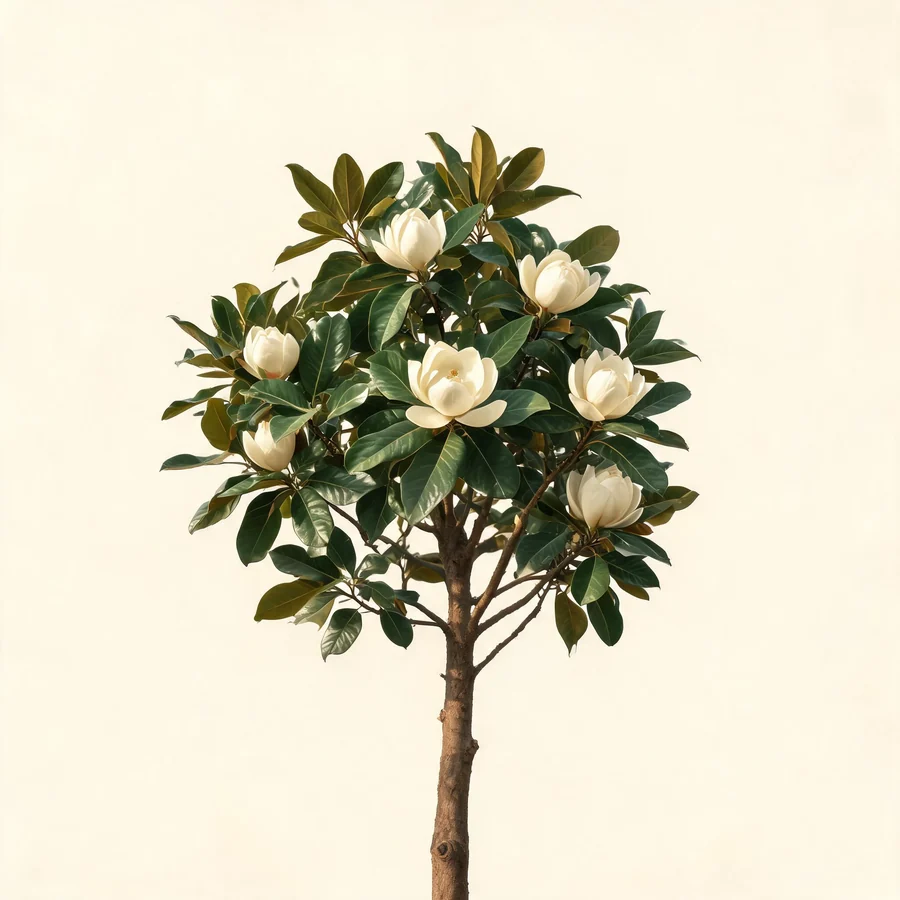
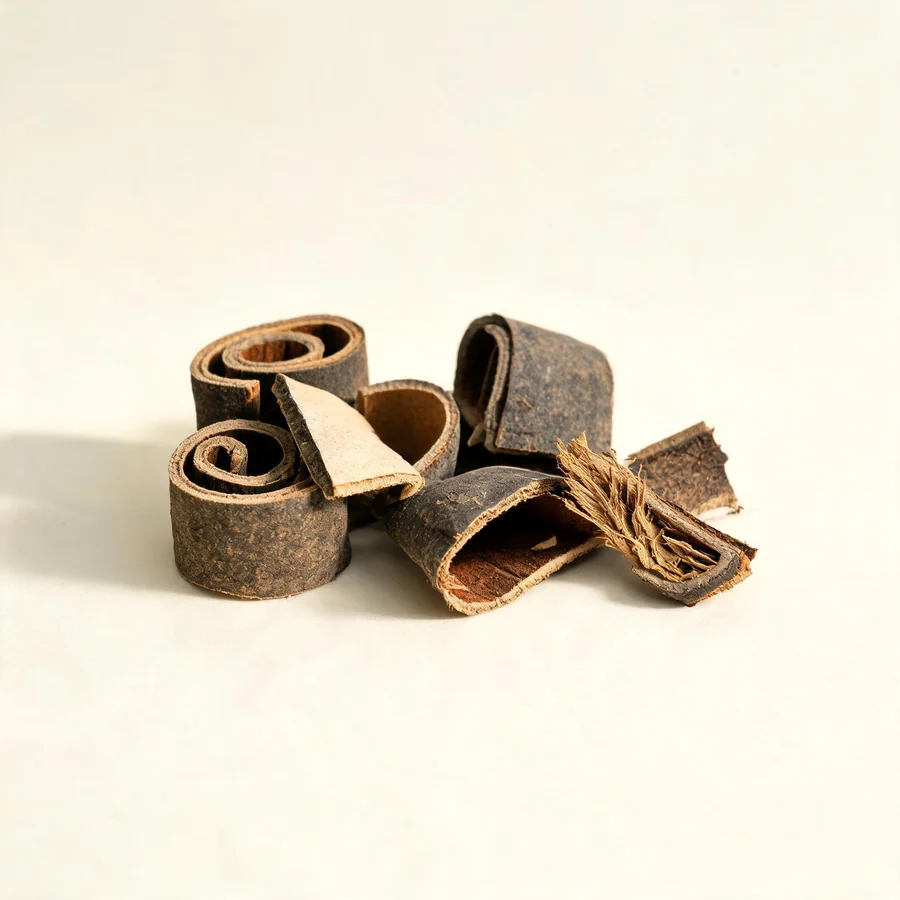
Skin profile
Where this herb sits in skin practice: the pattern it corrects, the skin signs it suits, and what it should not be used for.
Hou Po is a drying herb borrowed for skin that has become damp, greasy and heavy. The signs that make it plausible are oiliness, a thick greasy coating, puffiness and a doughy slow lesion. The signs that forbid it are dryness, thinness, heat and thirst. It is not an anti-itch herb, it does not clear heat, and its most useful contribution to a skin formula is often the least visible one: it keeps the middle moving so that the rest of the prescription does not sit there and turn into more dampness.
Skin signs that suggest it
- Greasy, waxy or sticky skin, with a thick greasy coating on the tongue
- Puffiness or heaviness of the face and eyelids, worse in the morning, with a sense of fullness
- Red, greasy, yellowish scaling in the nasolabial folds, eyebrows or scalp that keeps returning
- Hives or a rash that flares with abdominal distension, belching and a coated tongue
- An area of skin that is dusky, cool, doughy and slow to heal, with induration under it
When it is not the right herb
Not for dry, thin, hot skin, a dry mouth, night sweats or a red tongue without coating: the bark is warm and drying and takes the moisture a dry person has left. Not for fullness that comes from weak digestion rather than from excess, which is the classical warning. Not for heat-type diarrhoea or for a hot, red, spreading skin lesion. Pregnancy is the last exclusion: the action runs downward and outward, and the bark is used only when a practitioner has judged the case to warrant it.
What it does for skin
Skin-relevant actions only. Each one describes a mechanism in TCM terms and what it looks like on the skin.
Dries Dampness and takes the grease out of the surface
Dampness on the skin reads as oil, weight and stickiness rather than as redness: a face that shines, a scalp that scales yellow and greasy, folds that stay moist. The bark is among the driest herbs available and it is used to change that quality, usually with atractylodes and poria so that the dampness is drained as well as dried. It is stopped when the skin begins to feel tight, because that is the sign the drying has gone far enough.
Descends Qi and relieves the distension that comes with a rash
A rash that appears with bloating, belching and a coated tongue is read as the same stagnation showing in two places, and the treatment addresses the middle rather than the skin. The bark's downward action is what makes it useful there: it moves what has stalled in the digestion, and the skin is expected to settle as the middle clears. This is the gut and skin link in practical form, and it is the commonest reason the bark appears in a skin formula.
Transforms Phlegm and softens a doughy induration
Phlegm in the skin is read as a swelling that is soft, doughy and slow, without the sharpness of heat. The bark's phlegm-transforming action is used with citrus and pinellia in that kind of picture, more often for nodules and thickened patches than for a rash. Its role is small and drying, and it is not a substitute for assessing a lump that is new or changing.
Moves stagnant flesh that has become dusky and slow
The classical phrase for this is dead flesh, and it describes skin that has lost its colour and its ability to heal: dusky, cool, thickened and unresponsive. The bark is used to move what has stagnated there, in formulas that also warm and invigorate the Blood. Any area of true necrosis, or a wound that is blackening, is a medical emergency and has nothing to do with a decoction.
Skin conditions it is used for
Mapped to the condition pages on this site. The pattern column shows what the skin is doing when this herb is the right choice.
| Condition | Pattern | Why it suits | Typical setting |
|---|---|---|---|
| Eczema | Dampness with heaviness: greasy, thickened eczema and a thick coating | Eczema that is heavy, greasy and slow, in a person with a coated tongue, abdominal fullness and a sense of weight, is read as dampness rather than heat. The bark dries and moves while the atractylodes and citrus drain the middle, and the skin is expected to follow. A hot, red, sharp-edged flare with thirst is a different pattern, and the bark has no place in it. | Ping Wei San with Er Chen Tang, modified for the skin |
| Seborrhoeic dermatitis | Damp-heat rising along the face, with greasy yellow scale | The greasy yellow scale and red base of seborrhoeic dermatitis are read as damp-heat that keeps returning to the same folds, and the bark deals with the damp half while cooling herbs deal with the heat. It is a supporting ingredient rather than the lead, because the heat is what makes the condition red and active. The areas it suits are the oily ones, not the dry scaly patches elsewhere on the body. | Modified Ping Wei San with Huang Qin and Zhi Zi |
| Oily skin | Dampness and phlegm settling in the face | Facial oil is read as the visible state of digestion, and a waxy, thick shine with a greasy coating is dampness and phlegm rather than simple heat. The bark is used to dry and descend, and it is paired with draining and aromatic herbs so that the oiliness is not simply driven elsewhere. It is a short course, because a face that is dried too hard becomes tight and reactive. | Ping Wei San with Er Chen Tang |
| Urticaria | Wind-damp with food stagnation and abdominal distension | Hives that arrive with a bloated abdomen, a coated tongue and a sense of heaviness are read as wind stirred by dampness and stagnation rather than by heat. The bark moves the middle while the aromatic herbs release the surface, and the wheals are expected to settle as the digestion clears. Hives with swelling of the lips or tongue, wheezing or faintness are an emergency and need immediate medical care. | Huo Xiang Zheng Qi San with added wind-releasing herbs |
Combinations for skin
Herbs it is paired with when the skin, not an internal organ, is the target.
| Partner | Ratio | Why the pair is used |
|---|---|---|
| Cang Zhu | 6 to 10 g each in decoction | Atractylodes lancea is aromatic and drying and the bark is bitter and descending, and together they are the core of the classical formula for dampness in the middle. On the skin they are used for greasy scaling, oiliness and a heavy coated tongue, with the atractylodes doing the drying and the bark the moving. Both are warm and dry, so the pair is stopped when the mouth dries or the skin tightens. |
| Chen Pi | 6 to 10 g Chen Pi with 3 to 6 g Hou Po | Aged citrus peel moves Qi gently and transforms phlegm, while the bark moves it forcefully and downward. The pair suits a rash with distension and a coated tongue, and it also stops a rich tonic from sitting heavily in someone whose digestion is sluggish. The proportions matter: more peel for gentle regulation, more bark for a pronounced obstruction. |
| Fu Ling | 10 to 15 g Fu Ling with 6 to 10 g Hou Po | Poria drains dampness through the urine and the bark dries it in the middle, so the two work on the same fluid by different routes. The combination is used in weeping and greasy skin conditions where a draining action is wanted alongside drying. Because the pair moves fluid, it is used with care in anyone who is already thin and dry. |
| Huo Xiang | 6 to 10 g Huo Xiang with 3 to 6 g Hou Po | Patchouli is aromatic, releases the surface and transforms dampness, and the bark dries and descends. The pair is the aromatic answer to dampness that sits both on the skin and in the digestion, and it is why the two appear together in the classical formula for summer dampness with nausea and a greasy coating. |
Formulas where it leads
- Ping Wei San (平胃散) - The classical formula for dampness obstructing the Spleen and Stomach, with atractylodes, the bark, citrus and liquorice. Its skin relevance is the greasy, oily, heavy picture with a thick coating, and it is the base on which drying additions are made.
- Er Chen Tang (二陈汤) - The foundational phlegm-transforming formula, with pinellia, citrus, poria and liquorice, to which the bark is added when the phlegm is also causing distension. On the skin it is used for doughy swellings and greasy scale rather than for a red rash.
- Huo Xiang Zheng Qi San (藿香正气散) - An aromatic formula for dampness with a surface component, used for summer dampness with nausea, heaviness and a greasy coating. Its skin use is the rash or hives that come with those digestive signs, where the middle has to clear before the surface settles.
Safety for skin use
What to check before recommending or using it, including the cautions that matter most for skin patients.
Do not use, or use with caution
- Dryness or Yin deficiency: a dry mouth and throat, night sweats, a red tongue with little coating, thirst. The bark is warm and drying and will consume what moisture remains.
- Fullness that comes from a weak middle rather than from excess, and vomiting that comes from a Stomach that is deficient, not from cold phlegm. The old commentary is explicit that this bark disperses and does not gather, with no supplementing power whatsoever.
- Diarrhoea of the heat type, with fire driving downward, and any hot, red, spreading skin lesion. A warming, drying bark feeds heat instead of clearing it.
- Pregnancy, and the weeks after childbirth when fullness follows Blood loss. A strongly descending, dispersing action is the opposite of what either state asks for.
Pregnancy and breastfeeding
Downward, dispersing and drying at once, this bark is held to unsettle a pregnancy, and the old commentary names a string of pregnancy presentations in which it is refused, with morning sickness, the dizziness of pregnancy, and abdominal pain with diarrhoea among them. It does not sit with the strongly Blood-moving herbs that are prohibited outright, though the gap between them is one of degree rather than of kind, and omission remains the default. A pregnant woman with a greasy coat and a heavy body is better served by gentler drying herbs. No external tradition offers a safer route, and a drying, Qi-moving bark is kept to short courses during breastfeeding, if it is used at all.
Interactions
- Sedatives, including benzodiazepines, zolpidem and similar sleeping tablets. Magnolol and honokiol act at the same receptor complex as positive modulators, so the combination could in theory deepen sedation, and the bark is not added quietly to a sedative prescription.
- Medicines with a narrow margin that are cleared by the liver, such as warfarin and some statins. Laboratory work suggests the bark's compounds can influence the cytochrome enzymes of the 2C and 3A families, although whether a decoction reaches a relevant concentration is unknown.
- Antiplatelet and anticoagulant medicines. In the laboratory the same two compounds reduce platelet aggregation, which argues for caution and monitoring rather than alarm.
Allergy and patch testing
Contact dermatitis from bark dust and from herbal washes is well recognised, and a drying wash on already dry skin can produce irritation that looks like an allergy. Patch test any external preparation, keep it off the face and off broken skin, and stop if the skin becomes redder, tighter or itchier. Anyone who has reacted to other Magnoliaceae plants should be cautious.
General safety references
General references for herbal hepatotoxicity and herb-drug interactions; they are not specific to this herb.
- Review article: Herbal hepatotoxicity - an update on traditional Chinese medicine preparations. Alimentary Pharmacology & Therapeutics, 2014. PMID: 24844799.
- Interactions between herbal medicines and prescribed drugs: an updated systematic review. Drugs, 2009. PMID: 19719333.
- Warfarin and food, herbal or dietary supplement interactions: a systematic review. British Journal of Clinical Pharmacology, 2021. PMID: 32478963.
Evidence
The classical record is quoted with its source. The modern note states the level of evidence plainly.
Classical record
主中风伤寒,头痛,寒热惊悸,气血痹,死肌,去三虫。
The entry covers wind-stroke and Cold Damage, headache, alternating chills and fever with palpitations from fright, impediment of Qi and Blood, and dead flesh, and it expels the three worms.
Shen Nong Ben Cao Jing (神农本草经) - The phrase for dead flesh is the one direct skin indication in the earliest entry, and it fits the bark's later use on dusky, stagnant and slow-healing skin.
温中益气,消痰下气。疗霍乱及腹痛胀满,胃中冷逆及胸中呕不止,泄痢淋露,除惊,去留热心烦满,厚肠胃。
It warms the centre and supports Qi, dissolves phlegm and brings Qi downward. The list runs on: cholera-like turmoil with abdominal pain and swelling, counterflow cold in the Stomach with unrelenting vomiting, dysentery and dripping urine, fright, and restless fullness from retained heat. The closing phrase claims that it thickens the intestines and the Stomach.
Ming Yi Bie Lu (名医别录) - The entry widens the range beyond the earliest one, and its closing claim that a drying bark thickens the bowel is why later authors argued about whether it strengthens or scatters.
气味辛温,性复大热,其功长于泄结散满,温暖脾胃。然而性专消导,散而不收,略无补益之功。
Acrid and warm in flavour, strongly hot in nature, its strength is in releasing knots, dispersing fullness and warming the Spleen and Stomach. Its character, though, is to disperse and to drive downward and nowhere to gather: of supplementing power it has none at all.
Ben Cao Jing Shu (本草经疏) - A warning rather than a recommendation, and the plainest statement of the bark's limits: it is never given alone in deficiency, and its drying quality is why courses stay short.
Modern evidence
Evidence status
- The two constituents most studied are magnolol and honokiol. Laboratory work describes anti-inflammatory, antibacterial and antioxidant activity, including against organisms associated with skin infection, in cell and animal systems. Those are laboratory findings and they do not measure a clinical skin outcome.
- No controlled trial of Hou Po in eczema, seborrhoeic dermatitis, acne, oily skin or urticaria was identified, and the drying action has not been compared with standard treatment in patients. The skin use rests on the dampness pattern and on the classical formula tradition.
- Regulatory status: the dried bark is an accepted article in the Chinese Pharmacopoeia, and the traditional sweating process that turns the inner surface purple-brown also lowers its magnocurarine content. The safety position is one of familiar use, not evidence of benefit.
PubMed records
Selected real PubMed records for this herb's species or its constituents, chosen by species name and title relevance. They are references for the non-TCM discussion above, not proof that the herb treats any skin condition.
- Honokiol attenuates acetaminophen-induced acute liver injury by inhibiting hepatic CYP1A2 activity and improving liver mitochondrial dysfunction.. Chinese herbal medicines, 2023. PMID: 37265773 (safety record).
Dose and forms
Skin-practice dosing and the preparations that suit skin complaints.
| Form | Dose and notes |
|---|---|
| Decoction | A daily decoction of 3 to 10 g. At the lower end the bark supports a formula for fullness; at the upper end it meets a marked obstruction of dampness, with distension and a thick coat. |
| Ginger-processed bark | The ginger-prepared form is standard in many dispensaries: strips are moistened with fresh ginger juice, then stir-fried until they darken and turn aromatic. Ginger tempers the harshness and adds warmth of its own, which is why this form suits a delicate stomach or nausea. |
| Course length | One to three weeks with review, then a break. Drying herbs are given for a defined dampness picture and not as maintenance, and a dry mouth or tight skin is the signal to stop. |
What limits this bark is its drying and scattering, not any poison. A short course in the ordinary range for a clear dampness picture is unremarkable; harm comes from repeating it in someone thin and dry, since nothing in the bark restores what it disperses. Traditional practice also notes that weight changes the effect: a large dose breaks Qi apart, a small one merely frees Yang. Breaking the bark into small pieces before decocting helps extraction, and the sweating process belongs to quality control rather than to safety.
Citations and further reading
Only real sources are listed: the classical materia medica passages quoted above, and the source works behind the botanical and safety statements.
- Shen Nong Ben Cao Jing (神农本草经), attributed compilation of the Han period - classical entry quoted above.
- Ming Yi Bie Lu (名医别录), Tao Hongjing, Southern and Northern Dynasties - classical entry quoted above.
- Ben Cao Jing Shu (本草经疏), Miao Xiyong, 1625 - classical entry quoted above.
- Magnoliae Officinalis Cortex monograph: Pharmacopoeia of the People's Republic of China - accepted botanical source, part used and quality requirements.
- Modern evidence statement: based on published laboratory literature on magnolol and honokiol, summarised as a statement about the level of evidence rather than as a cited finding.
- Botanical description and identification: botanical literature on Magnolia officinalis, Magnoliaceae.
Educational reference for qualified practitioners. This page is not medical advice, and skin conditions should be diagnosed by a clinician before treatment.