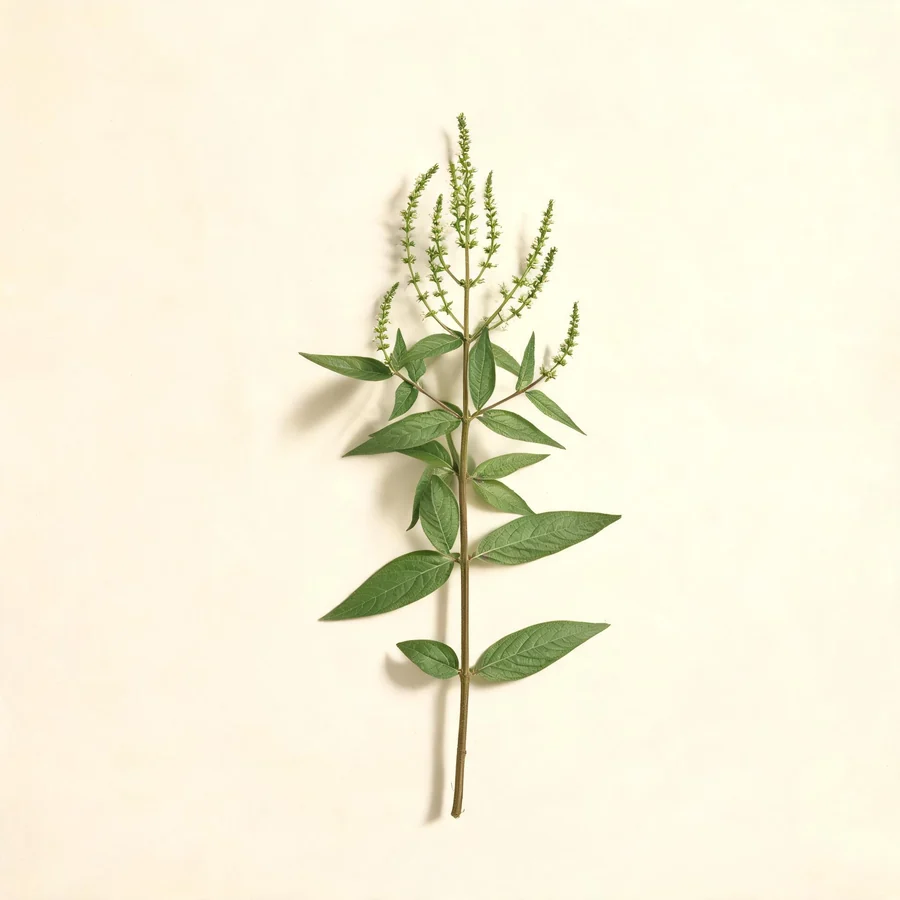
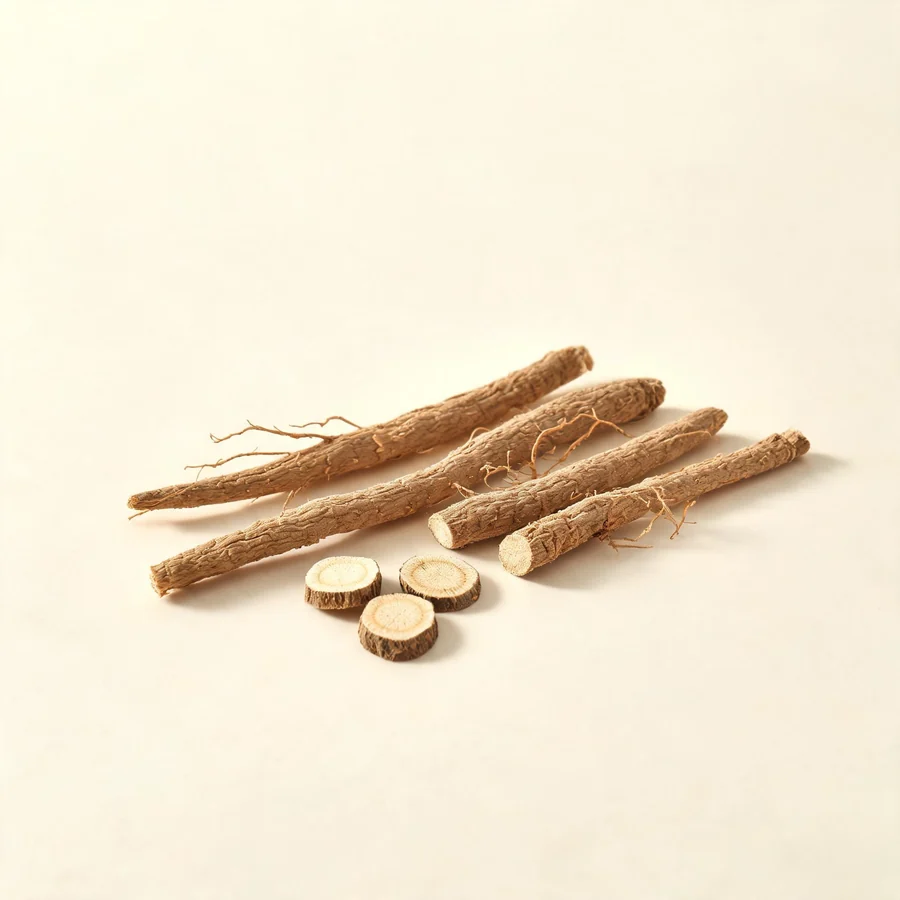
Skin profile
Where this herb sits in skin practice: the pattern it corrects, the skin signs it suits, and what it should not be used for.
Huai Niu Xi is a lower-body herb: it is chosen when discolouration, cold, swelling or numbness sits below the waist and the tissue looks starved of moving blood. Its classical association with sores and with damage from heat and fire is the warrant for skin use, and that use is supportive and chronic rather than acute.
Skin signs that suggest it
- Dusky, purple or brown discolouration that outlasts the injury that caused it (Blood stasis in the skin)
- Toes and fingers that turn cold, dusky and tender in winter and sting when they warm up (cold congealing Blood at the surface)
- Tender red or purple nodules on the shins that are sore to the touch (heat and stasis in the deeper tissue)
- Feet that are red, hot and swollen by the end of the day, with a fixed aching pain (damp-heat pouring downward)
- Patches of numb, insensitive skin on the legs, with a pale tongue and a fine pulse (Blood not reaching the surface)
When it is not the right herb
Not for skin that is hot, red, weeping or spreading, and not where there is active bleeding: heavy periods, a clotting disorder, or blood-thinning medicine. A herb that moves Blood downward can add to blood that is already escaping. It is also the wrong herb for dry, thin, pale skin with no stasis at all, where the task is to nourish rather than to move. The legs are assessed first, because a dusky, slow-healing lower leg, a cold white foot or a sudden painful swelling needs medical diagnosis before any blood-moving herb is considered.
What it does for skin
Skin-relevant actions only. Each one describes a mechanism in TCM terms and what it looks like on the skin.
Moves Blood and disperses stasis in the skin
Stasis shows at the surface as colour that stays: a bruise still visible months later, dusky patches on the shins, a purple rim around an old scar, or a fixed spot that hurts when pressed. Huai Niu Xi breaks up that pooled blood and restores flow through the small vessels of the skin. It is a moderate mover rather than an aggressive one, so it is used over weeks for stubborn discolouration, and it is judged by whether the colour fades and the tissue warms rather than by any immediate change.
Guides the formula downward to the legs and feet
The root is the envoy that carries other herbs toward the lower half. In skin practice that means it is added when the problem is confined to the legs: stasis discolouration, chilblains, nodules on the shins, swollen ankles and feet that are slow to heal. Without a guiding herb the cooling or nourishing part of a formula tends to act on the upper body and the face, so the legs receive less of it. The direction is a traditional property, used as a prescribing device rather than as a measurable effect.
Strengthens the Liver and Kidney so the lower body can repair
The root tonifies the two systems held to govern sinews, bones and the lower limbs, and it is unusual in doing that while keeping the same area circulating. On the skin that suits chronic problems in a depleted person: thin, dry, easily marked skin on the shins, slow healing after a knock, and a lower leg that always feels cold. The wine-fried form is the one chosen when tonifying is the aim, and it is given over weeks rather than days.
Addresses the tissue damage left by heat and fire, in the classical record
The oldest entry for the herb lists damage from heat and fire among the things it governs, and later materia medica adds swellings and foul ulcers. Read carefully, that is not a licence to use it on a fresh burn or an open sore. It describes the aftermath, when tissue is discoloured, indurated or slow to close and the problem is blood that has stopped moving through damaged ground. Fresh burns, spreading infection and any open wound belong to medical care first.
Skin conditions it is used for
Mapped to the condition pages on this site. The pattern column shows what the skin is doing when this herb is the right choice.
| Condition | Pattern | Why it suits | Typical setting |
|---|---|---|---|
| Bruising | Blood Stagnation | A bruise is blood that has left the vessels and stopped moving, and when the colour lingers for weeks the stasis has outlasted the injury. Huai Niu Xi is the herb added when bruising is slow to clear, when the skin marks easily, or when an old injury stays tender and discoloured. It moves the pooled blood without being harsh, and it is combined with Blood-nourishing herbs so that clearing the stasis does not leave the area more depleted than before. | Huai Niu Xi with Tao Ren and Hong Hua in a blood-moving formula |
| Chilblains | Blood Stagnation | Chilblains are cold that has slowed the Blood in the smallest vessels of the toes, fingers, ears and nose, and they recur because the periphery stays cold and poorly supplied. Huai Niu Xi moves the blood that has stalled and carries the warming and Blood-nourishing herbs of a formula down to where the cold sits. It is used with Dang Gui and cinnamon twig rather than alone, and keeping the feet warm and dry remains the first measure. | Huai Niu Xi with Dang Gui and Gui Zhi in a warming, blood-moving formula |
| Red and swollen feet | Damp-Heat in the Lower Burner | Red, hot, swollen feet at the end of the day, with a fixed ache and sometimes dark urine, are read as damp-heat that has settled in the lowest part of the body. The root is bitter enough to help drain the dampness, and its downward direction keeps the clearing herbs acting where the problem is. It also moves the blood that has stalled around the swelling, which is what takes the fixed quality out of the pain. A hot swollen foot with fever or spreading redness needs medical assessment first. | Huai Niu Xi with Huang Bai and Yi Yi Ren for damp-heat in the lower body |
| Erythema nodosum | Damp-Heat in the Lower Burner | Tender red or purple nodules on the shins are read as heat and dampness lodged in the deeper tissue, with blood stagnant around each nodule. Huai Niu Xi suits the picture because it works low, moves the blood and adds a draining quality, and it is given with herbs that clear the damp-heat underneath. The nodules can follow a streptococcal infection, a drug reaction or sarcoidosis, so the diagnosis is medical and the herb is only ever part of the management. | Huai Niu Xi with Huang Bai and Tao Ren for nodules on the shins |
| Skin numbness | Blood Stagnation | Numbness means the skin is not receiving Qi and Blood, and where the cause is stasis rather than a stroke or a nerve injury, moving the blood is the traditional approach. Huai Niu Xi is chosen when the numbness is in the legs and feet, when the skin feels dead rather than tingling, and when the limb is cold and dusky. Sudden numbness on one side of the body, or numbness with weakness, is an emergency and is not a pattern for herbs. | Huai Niu Xi with Huang Qi and Dang Gui in a Qi and Blood formula |
Combinations for skin
Herbs it is paired with when the skin, not an internal organ, is the target.
| Partner | Ratio | Why the pair is used |
|---|---|---|
| Dang Gui | 10 to 15 g each in decoction | One nourishes the Blood and the other moves it downward, so the pair suits skin that is both underfed and stagnant: dry, thin shins with dusky discolouration, bruises that will not fade, and slow healing after an injury. Dang Gui adds substance and Huai Niu Xi adds direction, which is why the two appear together in formulas for the lower body rather than as alternatives to each other. |
| Tao Ren | 10 g each in decoction | Tao Ren breaks stasis and Huai Niu Xi moves it downward into the pelvis and legs, so the pair is used where the stasis has both a substance and a place. On the skin that means fixed discolouration on the lower limbs, old injury marks and nodules that stay tender. Tao Ren supplies the breaking and Niu Xi the direction, and neither is given in pregnancy. |
| Huang Bai | 10 g Huang Bai with 10 to 15 g Huai Niu Xi | Huang Bai clears damp-heat from the lower body and Huai Niu Xi takes it there while adding a blood-moving action that a purely drying herb lacks. The pair is used for red, hot, swollen feet and for the fixed ache that follows, where drying alone would leave the tissue stiff. It is the clearest illustration in skin practice of what the guiding action is for. |
| Sheng Di Huang | 10 to 15 g Sheng Di Huang with 10 g Huai Niu Xi | Sheng Di Huang cools and nourishes the Blood while Huai Niu Xi directs that cooling downward, so the pair suits dryness with low-grade heat in the lower body: shins that are dry and feel hot, night sweats with a dry mouth, and a tendency to nosebleeds or dark urine. One replaces what is missing and the other sends it where it is needed. |
Safety for skin use
What to check before recommending or using it, including the cautions that matter most for skin patients.
Do not use, or use with caution
- Pregnancy, at any stage and in any form. The root's saponin fraction excites uterine muscle in laboratory studies, which is the mechanism behind its old use for a blocked period, and the downward, blood-moving action adds a second reason. It must not be given where a pregnancy cannot be excluded.
- Active bleeding: heavy or prolonged periods, bleeding between periods, a known clotting disorder, or anticoagulant and antiplatelet medicine. A herb that drives Blood downward may worsen bleeding that has already started.
- A lower leg that is dusky, cold, swollen or slow to heal, and any foot that is white and pulseless. These need a circulation assessment first, because arterial disease and a deep vein problem are not patterns to be treated blind.
- Red, hot, spreading skin with fever, which may be cellulitis or another infection and needs urgent medical care rather than a formula.
Pregnancy and breastfeeding
Contraindicated. The Han classic lists miscarriage among the herb's actions, and laboratory work has since found that a saponin fraction raises the tone of isolated uterine muscle and the size of its contractions. The tradition adds a second argument: a pregnancy is held to depend on Blood gathering and settling, and this root pushes Blood downward and out. It is never given to provoke a late period, it should not be taken unknowingly inside a blended formula, and the caution covers the small guiding doses as much as the large ones.
Interactions
- Anticoagulants and antiplatelet drugs, including warfarin, heparin, aspirin and clopidogrel. Laboratory work shows anticoagulant activity in the root, so clotting may be affected more than by either agent alone; new bruising or bleeding means stopping and taking advice.
- Potassium-sparing diuretics such as spironolactone, triamterene and amiloride. The root is fairly potassium-rich, and these drugs already retain potassium, so the pair can raise serum potassium to a hazardous level. Poor kidney function makes the same load more dangerous.
- Digoxin. Digoxin toxicity is governed by potassium, so a herb that moves potassium can unsettle a previously stable dose, and the safe window is narrow.
- Antihypertensive medicines. A blood pressure lowering effect has been shown in animal work, so the fall may be larger than intended in someone whose pressure is already controlled, and measurement is the only way to know.
General safety references
General references for herbal hepatotoxicity and herb-drug interactions; they are not specific to this herb.
- Review article: Herbal hepatotoxicity - an update on traditional Chinese medicine preparations. Alimentary Pharmacology & Therapeutics, 2014. PMID: 24844799.
- Interactions between herbal medicines and prescribed drugs: an updated systematic review. Drugs, 2009. PMID: 19719333.
- Warfarin and food, herbal or dietary supplement interactions: a systematic review. British Journal of Clinical Pharmacology, 2021. PMID: 32478963.
Evidence
The classical record is quoted with its source. The modern note states the level of evidence plainly.
Classical record
主寒湿痿痹,四肢拘挛,膝痛不可屈伸,逐血气,伤热火烂,堕胎。久服轻身耐老。
It is used for cold-damp atrophy and painful obstruction, for cramping of the four limbs, and for knees that cannot bend or straighten for pain. It disperses stagnant and gathered blood, addresses damage from heat and from fire, and expels a pregnancy; long use is said to lighten the body and delay ageing.
Shen Nong Ben Cao Jing (Divine Husbandman's Classic of Materia Medica) - Two items here are skin business, the damage from heat and fire and the sores that later texts add, and the pregnancy warning in this oldest layer is the one that still governs the herb.
治久疟寒热,五淋尿血,茎中痛,下痢,喉痹,口疮,齿痛,痈肿恶疮,伤折。
It covers chronic malaria with chills and fever, strangury with blood in the urine, urethral pain, dysentery, throat blockage, mouth sores, toothache, swellings, foul ulcers and fractures.
Ben Cao Gang Mu (Compendium of Materia Medica), Li Shizhen - The sores and swellings in this list are the classical warrant for using the root on damaged and discoloured skin, and they sit beside the pain and injury uses rather than replacing them.
Modern evidence
Evidence status
- The clearest pharmacological finding is that the total saponins of the root excite uterine smooth muscle in the laboratory. That explains the pregnancy contraindication and is a safety finding, not evidence of benefit for the skin.
- No clinical trial of Huai Niu Xi in a skin condition was identified for this page. The statements here about bruising, chilblains, nodules and numbness rest on the traditional record and on the herb's place in blood-moving formulas, not on trial evidence.
- Regulatory position: the root is an official drug in the Chinese Pharmacopoeia, and Huai and Chuan material are different species sold under one name. What is in the bag matters before any effect is discussed, because the two are used for different jobs.
PubMed records
Selected real PubMed records for this herb's species or its constituents, chosen by species name and title relevance. They are references for the non-TCM discussion above, not proof that the herb treats any skin condition.
- Evaluation of oral toxicity and genotoxicity of Achyranthis Radix extract.. Journal of ethnopharmacology, 2021. PMID: 33711437 (safety record).
Dose and forms
Skin-practice dosing and the preparations that suit skin complaints.
| Form | Dose and notes |
|---|---|
| Decoction | 5 to 15 g of dried root daily inside a formula. Five to ten grams is the directing dose when the aim is to carry other herbs downward, and ten to fifteen grams is the working range for stasis in the lower body. |
| Wine-fried root | The wine-fried form is warmer and is chosen for chronic lower-limb problems with weakness, where the aim is to tonify as well as to move. The raw root is used when movement is the whole object. |
| Course length | Several weeks rather than days for stubborn discolouration, with review. Stop if new bruising, heavier periods or unexpected bleeding appears. |
Dose is set by purpose rather than by a ceiling, because the same root directs at a small dose, moves at a moderate one and subdues at a large one. In skin practice only the first two bands are relevant. The pregnancy warning applies at every dose, including the small doses used to guide a formula downward.
Citations and further reading
Only real sources are listed: the classical materia medica passages quoted above, and the source works behind the botanical and safety statements.
- Shen Nong Ben Cao Jing (Divine Husbandman's Classic of Materia Medica), attributed compilation of the Han period - classical entry quoted above.
- Ben Cao Gang Mu (Compendium of Materia Medica), Li Shizhen, 1578 - classical entry quoted above.
- Huai Niu Xi monograph: Pharmacopoeia of the People's Republic of China - source for the accepted botanical source, part used and quality requirements.
- Modern evidence statement: based on laboratory literature on the saponin fraction of Achyranthes bidentata, presented as a statement about the level of evidence rather than as a claim of effect.
- Botanical description and identification: botanical literature on Achyranthes bidentata, Amaranthaceae, including the distinction between the Huai and Chuan drugs.
Educational reference for qualified practitioners. This page is not medical advice, and skin conditions should be diagnosed by a clinician before treatment.