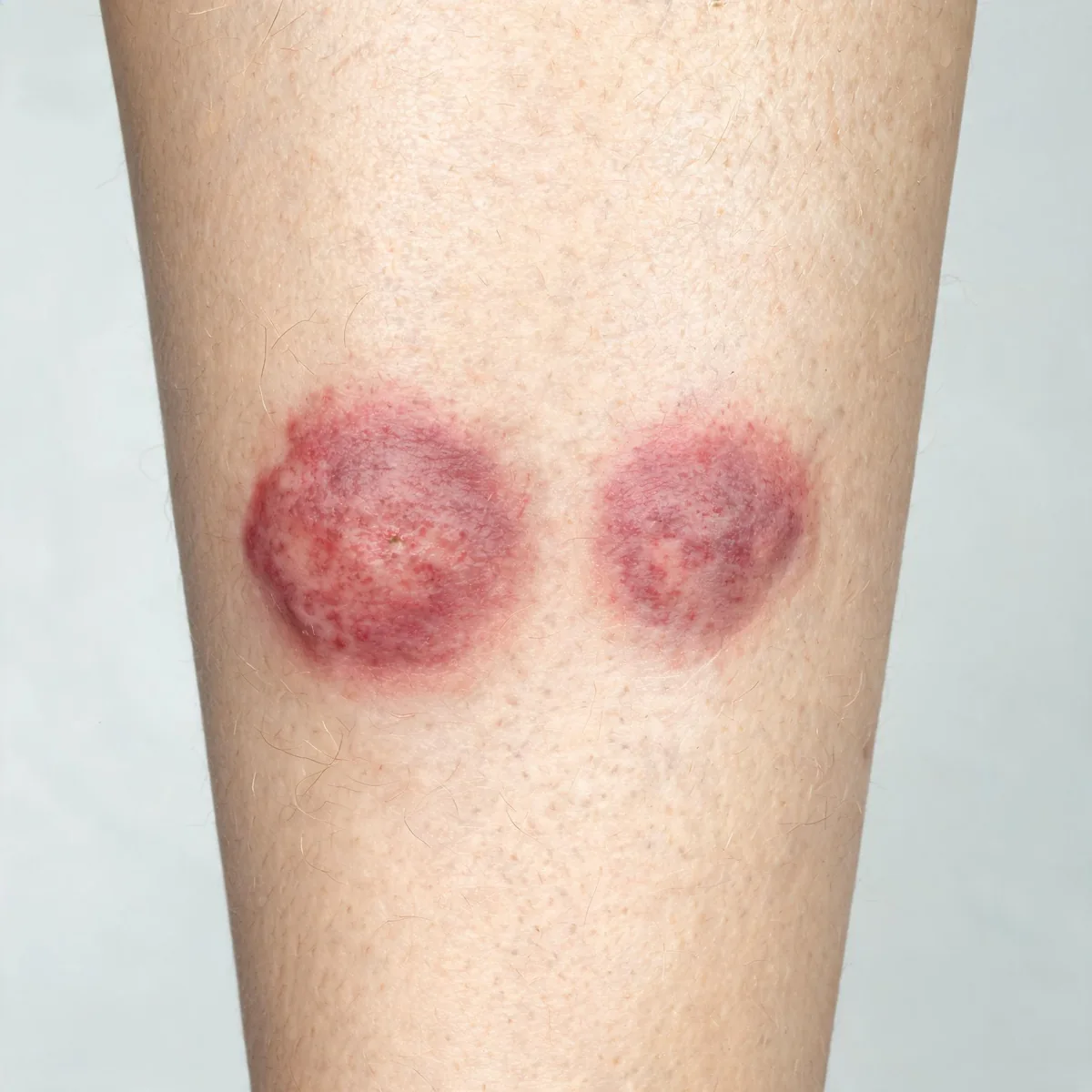
Understanding Erythema nodosum
The tradition describes the skin as a reflection of the internal organs, particularly the Lungs, which govern the protective barrier, and the Spleen, which manages fluids.
When Wind, Cold, Dampness or Heat invades, or when internal imbalance produces heat and dampness, the result can be tender nodules in the deeper skin. The shins are the classic site.
Toxic-Heat stagnation gives bright red, hot, swollen nodules with burning pain, fever and sore throat. Damp-Heat in the Lower Burner gives red hot nodules on the shins specifically, with heaviness, a yellow greasy coating and scanty dark urine.
Cool, dull red or skin-coloured nodules that worsen in cold damp weather are read as Wind-Cold-Damp. Recurrent dull nodules with fatigue and loose stools are read as Spleen deficiency with dampness, and fixed dull nodules with marked fatigue as Qi deficiency causing Blood stagnation.
The deeper point is that the nodule is an endpoint rather than the disease itself. Heat makes the blood thick, Cold makes it congeal, Dampness makes it sluggish, and weak Qi cannot push it along, yet all four roads arrive in the same place: blood that no longer moves freely through the small channels beneath the skin, pooling into a firm lump that can be felt through the surface. That is why moving the blood appears in every plan, even where the main work is clearing heat or draining dampness.
The other consequence is that one outbreak looks different in different people. A younger person with a recent sore throat produces bright red, hot nodules and a fever, while an older person with a long-standing Spleen weakness produces dull recurrent ones and no fever at all. The tongue and pulse say whether the constitution is robust or depleted, and that decides the dose, the length of treatment and how much of the plan can be aimed at the root. Correcting that root is what separates one episode from a pattern of recurrence.
Conventional view
Erythema nodosum is a panniculitis, an inflammation of the fat layer beneath the skin, which produces tender red raised nodules, most often on the shins. It is usually a reaction rather than a disease in itself, triggered by an infection, especially a streptococcal one, by a medication, by inflammatory bowel disease or by sarcoidosis, although in up to half of cases no cause is identified. The nodules tend to appear suddenly, sometimes with fever, fatigue and joint pain, and generally settle within a few weeks, leaving a bruise-like stain that fades.
Treatment is directed at the symptoms and at any trigger that is found. Nonsteroidal anti-inflammatory drugs such as ibuprofen are first-line for pain and inflammation, and more severe or persistent cases may need oral corticosteroids or potassium iodide. An identified infection is treated with antibiotics, and rest with the legs raised is advised to reduce discomfort.
The limitation is that suppressing the inflammation does not change the tendency to form these nodules. Recurrence is common where the root cause, whether an autoimmune process or a chronic infection, remains unaddressed, and long courses of corticosteroids carry their own risks. Conventional assessment also does not distinguish the different presentations that TCM describes, which may explain why some people respond well to standard care and others do not.
Selected PubMed records
Real PubMed records for the conventional discussion above, selected by condition name and title relevance. They are references, not a claim that any treatment is proven for this condition.
- Erythema Nodosum: A Practical Approach and Diagnostic Algorithm.. American journal of clinical dermatology, 2021. PMID: 33683567.
How it connects
Erythema nodosum rarely appears in isolation: its root often lies in a prior infection or systemic imbalance that affects other parts of the body. A classic example is acute pharyngitis or tonsillitis from streptococcus, understood in TCM as an external toxic Heat pathogen that first attacks the throat and then penetrates deeper into the Blood, scorching the vessels and producing the bright red painful nodules on the shins. Joint pain and arthritis frequently accompany the nodules because the same pathogenic factors, whether Damp-Heat, Toxic-Heat or Wind-Cold-Damp, can obstruct the channels in the joints as easily as they clog the vessels under the skin. Abdominal pain may co-occur when Damp-Heat or Toxic-Heat also inflames the intestines. The nodules rarely arrive alone, and the company they keep usually points to the trigger. A sore throat or tonsillitis a week or two earlier is the classic sequence: in TCM terms an external toxic heat attacks the throat first and then moves deeper into the blood, so throat and shins are two stages of one process. Joint pain and arthritis commonly accompany an outbreak because the same Damp-Heat, Wind-Cold-Damp or Toxic-Heat that clogs the vessels under the skin also clogs the channels in the knees and ankles. Abdominal pain may appear when the same heat and dampness inflame the intestines, as in inflammatory bowel disease, which is one reason the trigger is investigated rather than assumed.
How it is assessed
The practitioner assesses the nodules and looks for the trigger.
What a practitioner looks for
- Temperature: hot red nodules suggest heat; cool dull nodules suggest cold-damp.
- Site: shins with heaviness suggest Damp-Heat in the Lower Burner.
- Recurrence: recurrent dull nodules with fatigue suggest Spleen deficiency.
- Triggers: recent infection, new medication and bowel symptoms are all asked about.
The practitioner begins with the nodules: their colour, their temperature and how tender they are. Bright red nodules that are hot and very tender, arriving suddenly with a fever or after a sore throat, point to a heat pattern, and the tongue is probably red with a yellow coat while the pulse runs rapid and slippery. When the nodules are red and swollen but the legs feel heavy and thirst comes without a wish to drink, the reading shifts to Damp-Heat, and the practitioner asks about digestion and confirms that the nodules sit on the shins, since dampness sinks.
Cool, dull purple nodules that hurt more in cold or damp weather, with no fever, a pale tongue and a deep tight pulse, point to Wind-Cold-Damp obstructing the channels. Recurrent nodules with little colour or heat, together with fatigue, a poor appetite and loose stools, all point to a weak Spleen that cannot transform fluids. Slightly raised, non-hot nodules in someone pale and easily tired, with a weak pulse, point to Qi too weak to move the blood. Each answer changes both the formula and the prognosis.
TCM patterns in Erythema nodosum
Five patterns are described, and the quickest way to tell them apart is to feel the nodule and ask what came before it. A hot bright red nodule that followed a sore throat is Toxic-Heat Stagnation, where toxin has entered the blood. Red hot shin nodules with heaviness, a greasy coating and scanty dark urine are Damp-Heat in the Lower Burner, with dampness sunk low. Cool, dull or skin-coloured nodules that hurt more in cold damp weather are Wind-Cold-Damp blocking the channels. The other two are deficiency pictures, and both recur. Dull flesh-coloured nodules with fatigue, a poor appetite and loose stools come from a Spleen too weak to move fluids, so Dampness accumulates. Fixed dull nodules that are not hot, in someone pale and short of breath on mild effort, come from Qi too weak to push the blood on. A deficiency lets the other patterns in, so one person may show a mixed picture.
| Pattern | Key signs | The itch | Tongue | Main formula |
|---|---|---|---|---|
| Toxic-Heat Stagnation | Bright red hot swollen nodules; Burning or throbbing pain | Not specified | Body: Deep red or crimson with raised red pointsCoat: Thick, dry and yellow | Not specified |
| Damp-Heat in the Lower Burner | Red swollen hot nodules on the shins | Not specified | Body: Red, slightly swollen, with a coating thickest at the rootCoat: Yellow and greasy | Not specified |
| Painful Obstruction with Wind-Cold-Damp | Nodules dull red, purplish or skin-coloured and cool; Pain and swelling worse in cold damp weather | Not specified | Body: Pale and slightly swollen, teeth-markedCoat: White, greasy and moist | Not specified |
| Spleen Deficiency with Dampness | Recurrent dull flesh-coloured or slightly red nodules | Not specified | Body: Pale and swollen, often with teeth marks along the edgesCoat: White, greasy and moist, thick in the middle | Not specified |
| Qi Deficiency causing Blood Stagnation | Not specified | Not specified | Body: Pale-dark or pale-purple, teeth-marked, possibly with stasis spots and dark sublingual veinsCoat: Thin white | Not specified |
Toxic-Heat Stagnation
Bright red hot nodules with fever and sore throat.
Toxic heat reaches the blood and scorches it. A strong pathogen, typically streptococcus arriving through the throat, or heat built up internally from diet and emotion, moves inwards and heats the vessels until the blood inside them thickens and stops flowing freely. The result is bright red, hot, swollen nodules beneath the skin, most often on the shins, that burn or throb rather than ache. Because the heat is systemic, the person also has fever, a sore throat, intense thirst for cold drinks and restlessness.
The tongue is deep red or crimson with its papillae raised and a thick dry yellow coat, and the pulse is rapid and forceful, perhaps overflowing. Spicy and fried food, alcohol and coffee, hot humid weather, lost sleep, overexertion and anger all stir it up, while cool compresses on the nodules, rest, stress reduction, plenty of water, light cooling food and gentle stretching help. Fu Yuan Huo Xue Tang is the formula named, usually with heat-clearing herbs such as Lian Qiao and Jin Yin Hua added, and the key herbs are Dan Shen and Chi Shao. The points are Hegu (LI-4), Quchi (LI-11), Xuehai (SP-10) and Dazhui (DU-14).
Signs
- Bright red hot swollen nodules
- Burning or throbbing pain
- Fever and sore throat
- Intense thirst for cold drinks
- Restlessness and irritability
Diet and lifestyle for this pattern: Eat plenty of cooling food such as cucumber, watermelon, mung beans and leafy greens, and avoid spicy, greasy and fried food as well as alcohol and coffee. Stay hydrated and rest enough to help the body clear the Heat.
Damp-Heat in the Lower Burner
Red hot shin nodules with heaviness and scanty dark urine.
Dampness and heat combine and sink, and the shins are where they settle. The heat inflames the small vessels while the dampness makes everything heavy and slow, so the nodules are red and hot but the legs also feel dragged down and tired. Humid weather, greasy and spicy food, alcohol and long hours standing keep fluid pooling in the lower body. The heat explains the redness and the thirst without a wish to drink; the dampness explains the greasy coating, the scanty dark urine and the sluggish pulse.
The tongue is red, with a greasy yellow coat whose thickest part sits at the root, and the pulse is slippery and rapid, most pronounced at the rear position. Hot humid weather, greasy and spicy food, prolonged standing and alcohol aggravate it, while cool dry weather, light cooling food, raised legs and warm rather than hot showers help. Si Miao San is the formula named, with Huang Bo, Yi Yi Ren, Chi Shao and Cang Zhu. The points are Yinlingquan (SP-9), Sanyinjiao (SP-6), Hegu (LI-4) and Xuehai (SP-10).
Signs
- Red swollen hot nodules on the shins
- Heavy dragging sensation in the legs
- Yellow greasy coating thickest at the root
- Scanty dark yellow urine
- Thirst without wanting to drink much
Diet and lifestyle for this pattern: Eat light, cooling food such as barley, mung beans, cucumber and celery, and avoid greasy, spicy and dairy-heavy food that creates Dampness and Heat. Keep the legs raised when resting and avoid standing for long periods, which lets fluid pool.
Painful Obstruction with Wind-Cold-Damp
Cool, dull nodules worse in cold damp weather.
Wind, Cold and Dampness invade together and settle in the channels that lie just under the skin. Cold draws the tissue tight and congeals what is inside it, Dampness is heavy and sticky, and Wind moves the discomfort about, so the three together trap Qi and Blood and let the nodules form. Because the pathology is cold, the lumps feel cool, lack the angry colour of a heat pattern and hurt more as the weather turns cold or wet. Stiffness and aching in the joints and limbs, an aversion to cold and a preference for warmth belong to the same picture.
The tongue is pale and a little swollen, marked by teeth, and carries a white greasy coat with a wet look, while the pulse is wiry and tight, or slow and soggy where Dampness dominates. Cold damp and rainy weather, sitting still, cold raw food and iced drinks, and exposure to wind after sweating all make it worse, while warm compresses or moxibustion, gentle movement, warm dry weather and ginger or cinnamon tea help. Gui Zhi Fu Ling Wan is the formula named, with Gui Zhi and Bai Zhu. The points are Dazhui (DU-14) with moxibustion, Geshu (BL-17), Zusanli (ST-36) and Yanglingquan (GB-34).
Signs
- Nodules dull red, purplish or skin-coloured and cool
- Pain and swelling worse in cold damp weather
- Heaviness and stiffness in limbs
- Aversion to cold
Diet and lifestyle for this pattern: Keep the legs warm and dry, avoiding cold surfaces and damp clothing. Gentle daily walking or stretching moves Qi without straining the joints, and warm cooked food with modest amounts of ginger, cinnamon and black pepper helps, while raw, cold and greasy food feeds internal Dampness.
Spleen Deficiency with Dampness
Recurrent dull nodules with fatigue and loose stools.
The Spleen turns food into Qi and keeps fluids moving. When it is weak, both jobs suffer and a heavy sticky moisture accumulates instead of being carried away. Because Dampness is heavy it sinks downwards, and in the legs it blocks the movement of Qi and blood, producing nodules that are dull, recurrent and only faintly red. Fatigue, a poor appetite with bloating, heaviness in the limbs and loose unformed stools are the signs that the Spleen is the root rather than the nodules themselves.
The tongue is pale and puffy, marked by teeth, with a white greasy coat on a wet surface, and the pulse is soggy and slow, or slippery, soft and weak. Cold raw and greasy food, damp humid weather, overexertion and worry make it worse, while warm cooked meals, rest with gentle walking, a dry warm environment and small frequent meals help. Shen Ling Bai Zhu San is the formula named, with Bai Zhu, Fu Ling and Yi Yi Ren. The points are Zusanli (ST-36), Sanyinjiao (SP-6) and Yinlingquan (SP-9).
Signs
- Recurrent dull flesh-coloured or slightly red nodules
- Fatigue and lack of energy
- Poor appetite with bloating
- Loose or unformed stools
- Heaviness in limbs and body
Diet and lifestyle for this pattern: Eat warm, cooked, easy food such as soups, stews and congee, and avoid cold, raw and greasy food that overwhelms a weak Spleen. Gentle daily walking moves Qi without exhausting you, and keep the legs warm and dry, away from damp living spaces.
Qi Deficiency causing Blood Stagnation
Fixed dull nodules with marked fatigue.
Qi is what pushes blood through the vessels. When long tiredness, illness or weak digestion leaves it depleted, the blood slows and pools, and slightly raised dull nodules form where it settles, usually on the shins. They feel like a heavy ache rather than a burn, are not hot and do not come and go. The rest of the picture is one of depletion: marked fatigue, a pale or dusky complexion, breathlessness on mild effort, and nodules that worsen with exertion and long periods on the feet.
The tongue is pale-dark or pale-purple, perhaps with stasis spots and teeth marks, and carries a thin white coat, while the pulse is deep, fine or weak and choppy. Exertion and prolonged standing, cold damp weather and anger make it worse, while rest with enough sleep, warm cooked meals, gentle walking, raised legs and warmth help. Bu Yang Huan Wu Tang is the formula named, with Huang Qi, Dang Gui and Chuan Xiong. The points are Zusanli (ST-36), Qihai (REN-6), Xuehai (SP-10) and Sanyinjiao (SP-6).
Signs
- Dull fixed nodules that are not hot
- Marked fatigue and weakness
- Pale or dusky complexion
- Worse with exertion and prolonged standing
- Shortness of breath on mild activity
Diet and lifestyle for this pattern: Put rest first and do not push through exhaustion. Eat warm cooked meals such as congee with a little ginger and dates to support Spleen Qi, walk gently or practise tai chi to move Qi without depleting it, and raise the legs whenever you sit to reduce blood pooling.
Treatment approach
How the tradition treats erythema nodosum, with the herbs, formulas and points used for it.
Principles
- Clear heat and resolve toxicity where nodules are hot and painful.
- Drain dampness where there is heaviness and a greasy coating.
- Warm and dispel cold-damp where nodules are cool and weather-sensitive.
- Support the Spleen and Qi where nodules recur with fatigue.
- Two fronts are worked at once: the factor obstructing the channels is cleared, and the body's own strength is supported so that nodules stop forming. Moving blood runs through every plan, because stasis is the common endpoint whichever pathogen began the process, but its partner changes. Heat is cooled and toxin resolved, Dampness is drained, Cold-Damp is warmed and dispelled, the Spleen is strengthened and Dampness drained, and Qi is tonified so that it can move blood on its own. In an acute outbreak the clearing work takes the larger share; in a recurrent one the tonifying work does, and the formula is revised as the balance shifts.
Herbs used
Formulas
Acupoints
- LI-4 (Hegu)
- LI-11 (Quchi)
- SP-10 (Xuehai)
- DU-14 (Dazhui)
- SP-9 (Yinlingquan)
- SP-6 (Sanyinjiao)
- BL-17 (Geshu)
- ST-36 (Zusanli)
- GB-34 (Yanglingquan)
- qihai-ren-6
What to expect
- The tradition describes nodules settling over two to six weeks once the pattern and trigger are addressed.
- Recurrence is expected if the underlying trigger is not found.
- Fever with spreading redness needs medical care.
- An acute outbreak is usually treated with a decoction once or twice a day and acupuncture once or twice a week, and pain and redness are expected to ease within one to two weeks. As the nodules flatten the formula is often reduced to a milder maintenance dose aimed at the root. Recurrent deficiency patterns run for months rather than weeks, with sessions spaced further apart, and progress is judged on energy, digestion and the tongue as much as on the nodules.
Safety and when to get help
Seek medical help urgently for
- High fever with chills.
- Rapidly spreading redness or streaks from the nodules, which may indicate cellulitis.
- Nodules that break open or ulcerate.
For anything severe, sudden or spreading quickly, read when a skin problem needs urgent care.
Cautions
- Erythema nodosum is often a reaction to something else; the trigger needs investigating.
- Nodules that ulcerate need medical review.
- Bed rest and support of the legs are part of conventional advice too.
Using this alongside conventional care
- TCM is described as complementary to conventional care: investigating and treating the underlying trigger continues, with herbs for the pattern.
- Most people use both approaches at once, and there is rarely a reason not to. Neither NSAIDs nor corticosteroids rule out acupuncture or most of the herbs used here, but the combination still needs disclosing, because blood-moving herbs such as Dan Shen and Chuan Xiong may add to the effect of warfarin, aspirin or clopidogrel. Prescribed medication should never be stopped abruptly, and if the nodules settle the reduction should be planned with the prescriber. A full medication list at the first consultation is what makes the combination safe rather than merely possible.
Diet and lifestyle
- Eat simple warm easily digestible food, and avoid spicy, fried and greasy food.
- Simple warm food that is easy to digest is the base, because a weak Spleen sits behind so many of these patterns: cooked vegetables, whole grains, lean protein and soups, with few cold drinks, raw salads or dairy, which add Dampness. Spicy, fried and greasy food is reduced because it generates heat. Beyond that the pattern decides. Hot red nodules do better with cooling food such as cucumber, watermelon and mung beans, while dull cool nodules do better with warming spices such as ginger, cinnamon and black pepper, and the Damp-Heat pattern also calls for less alcohol and less rich food.
If you're pregnant
Pregnancy itself can trigger erythema nodosum, probably through the rise in blood volume and heat, and the commonest pattern in pregnancy is a blend of Damp-Heat with blood heat. Many herbs that cool the blood or move stasis are avoided, among them Chi Shao and Dan Shen, with Tao Ren above all, because they may stimulate uterine contractions, and Fu Yuan Huo Xue Tang is usually left out.
Gentler heat-clearing herbs such as Jin Yin Hua and Lian Qiao in modest doses, with damp-draining Fu Ling and Yi Yi Ren, are the safer alternatives. Si Miao San can be adjusted for a sensitive digestion by taking out or reducing the bitter cold Huang Bo. Acupuncture is often the first choice, avoiding the lower abdomen and sacrum, with distal points such as Hegu (LI-4) used cautiously and Zusanli (ST-36) for support.
If you're breastfeeding
Strong blood-moving and bitter cold herbs may pass into breast milk and affect the infant. Chi Shao, Dan Shen and Tao Ren are used sparingly and only under professional guidance, and bitter cold herbs such as Huang Bo or Ku Shen can cause loose stools or digestive upset in a nursing baby, so milder alternatives such as Yi Yi Ren and Fu Ling are preferred for draining dampness.
Cooling herbal pastes applied to the skin are safe and give local relief without systemic absorption, and acupuncture is an excellent drug-free option during lactation. Where herbs are needed, a short course of a modified Si Miao San focusing on draining dampness and mild heat clearing can be used while the baby's digestion and stool are watched.
If treating a child
Erythema nodosum is uncommon in children, but when it appears it almost always follows a streptococcal throat infection, which makes Toxic-Heat Stagnation the usual pattern. The nodules are bright red, hot and very tender and the child may have a fever and a sore throat. Diagnosis leans more on looking at the nodules and the tongue, which is red with a yellow coat, because children describe symptoms poorly.
Doses are reduced to one quarter to one half of the adult dose according to age and weight. Fu Yuan Huo Xue Tang can be modified with milder blood-moving herbs and more emphasis on clearing heat from the throat with Jin Yin Hua and Lian Qiao. Acupuncture is well tolerated, with Quchi (LI-11) and Dazhui (DU-14) used to clear heat, and recovery is usually faster than in adults once the infection is treated.
If treating an elderly patient
In older adults the acute hot presentation is less likely and a chronic recurrent one rooted in deficiency is more common. Spleen Deficiency with Dampness and Qi Deficiency with Blood Stagnation dominate, producing dull purplish nodules that are less painful, are not hot and come with fatigue and a poor appetite. The tongue is pale and swollen and the pulse is weak.
Shen Ling Bai Zhu San strengthens the Spleen and drains dampness, and Bu Yang Huan Wu Tang boosts Qi and moves blood, both at about two thirds of the adult dose. Courses run longer because deficiency resolves slowly, and blood-moving herbs need caution in anyone on anticoagulants. Zusanli (ST-36) and Qihai (REN-6) are safe supportive points, and moxibustion can be added for the cold-damp pattern.
Urgent-sign guidance is based on standard sources: NHS anaphylaxis, NHS cellulitis, NHS Stevens-Johnson syndrome, NHS melanoma.
Evidence
Evidence status
Compiled for this page from the classical and modern literature; not a systematic review, so treat it as a pointer to sources rather than clinical guidance.
Evidence is developing: mostly small Chinese trials and case series using modified classical formulas such as Si Miao San or Fu Yuan Huo Xue Tang. They report good symptom resolution and reduced recurrence, with variable methodology and rare placebo controls. Acupuncture as an adjunct may reduce pain and inflammation faster than conventional care, but no large multicentre English-language trials exist. Because erythema nodosum is often reactive, the trigger still needs investigating.
The evidence base is still thin. Most published work consists of small Chinese trials and case series using modified classical formulas such as Si Miao San and Fu Yuan Huo Xue Tang, and these generally report good resolution of the nodules and fewer recurrences, with variable methods and almost no placebo control. Acupuncture has been examined as an adjunct, with reports of faster pain and inflammation reduction than conventional care alone, but no large multicentre trial has appeared in the English-language literature. Because the condition is so often reactive, the classical literature argues that future work should combine pattern differentiation with proper Western diagnostic criteria, so that the trigger is accounted for rather than averaged away.
Studies often cited
Small Chinese trials and case series report good symptom resolution and reduced recurrence, with variable quality. Chinese clinical trials and case series (as recorded in the source)
Reports suggest faster reduction in pain and inflammation than conventional care alone. Clinical reports (as recorded in the source)
PubMed records for the TCM evidence
Real PubMed records for the TCM clinical evidence discussed above, selected by condition name and title relevance. They are references, not proof of benefit.
- Erythema nodosum caused by goserelin acetate sustained-release: Case report and literature review.. International journal of rheumatic diseases, 2023. PMID: 37114900.
Classical record
Dan Du is a fire pathogen, red like cinnabar, unbearably painful.
- Wai Ke Zheng Zong, Volume 4, sores and ulcers. The Chinese original is not reproduced here: it could not be recovered reliably from the source record, and is not guessed.
熱毒客於皮膚,則生赤腫,痛如火燎
Heat toxin settling in the skin gives rise to red swellings that burn like fire.
On heat toxin lodging in the skin - Classical citation: Zhu Bing Yuan Hou Lun (Treatise on the Origins and Symptoms of Diseases), Volume 35, the discussion on various sores.
Common questions
Why do the nodules appear on my shins?
The classical literature reads them as heat and dampness settling in the deeper tissues, with the Lower Burner pattern specifically affecting the shins.
Do I need tests?
Yes. Erythema nodosum is often reactive, and infection, medication, bowel disease and sarcoidosis are among the recognised triggers.
How long do they last?
The tradition describes two to six weeks, with recurrence if the trigger persists.
Should I walk on them?
Gentle movement is fine, but prolonged standing and exertion worsen the Qi deficiency pattern. Rest with legs supported is commonly advised.
What do the red nodules mean in TCM?
They are read as blood stasis and channel obstruction, and their colour, temperature and pain quality describe the cause. Bright red and hot points to heat toxin in the blood; dull purple that feels cool suggests Cold-Damp obstruction; red and swollen with heavy legs means Damp-Heat. The tongue and pulse complete the picture before herbs and points are chosen.
Do I need to change my diet for erythema nodosum?
Diet supports treatment rather than replacing it. Spicy, greasy and deep-fried food is reduced because it creates heat and dampness, and cold raw food and iced drinks are limited because they weaken the Spleen. For Damp-Heat, alcohol and rich food are the first to go; for Cold-Damp, warming spices such as ginger and cinnamon are added. Advice is matched to the pattern.
Is acupuncture painful when I have tender nodules?
The needles are very fine and are usually felt only as a slight sensation. Practitioners avoid needling directly into an inflamed nodule and instead choose points on the limbs and trunk that clear the pattern and get blood moving in the channels involved. Many people find the session relaxing and notice less tenderness afterwards, though the nodules themselves take longer to resolve.