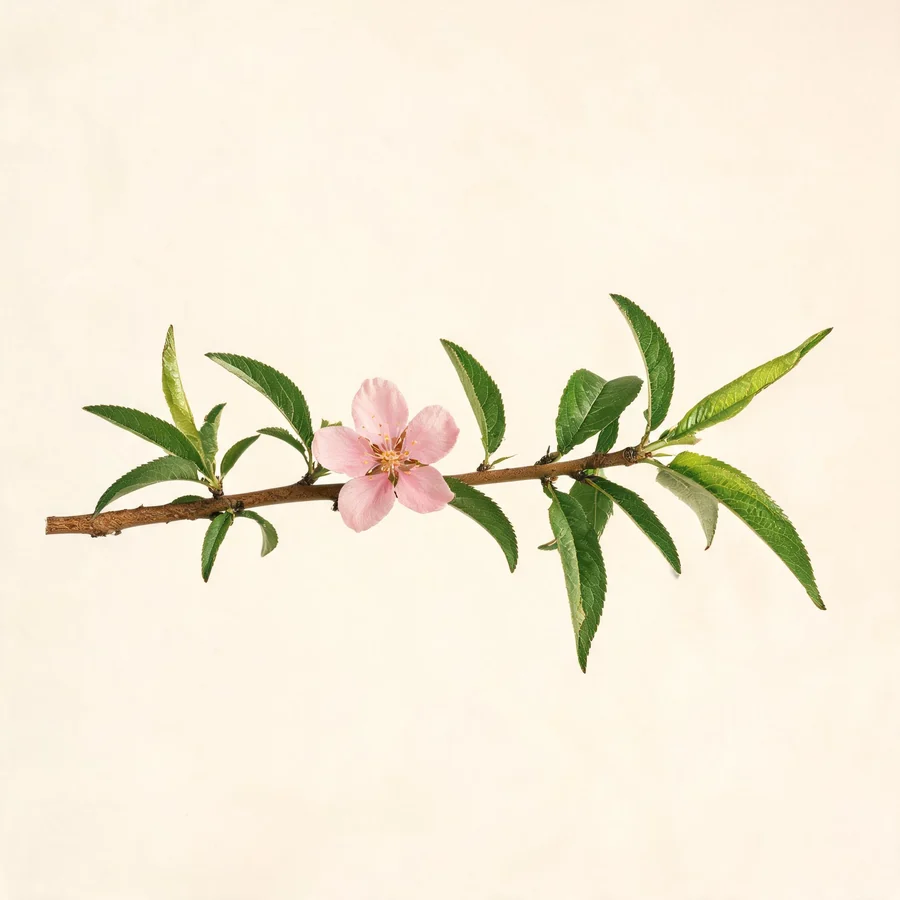
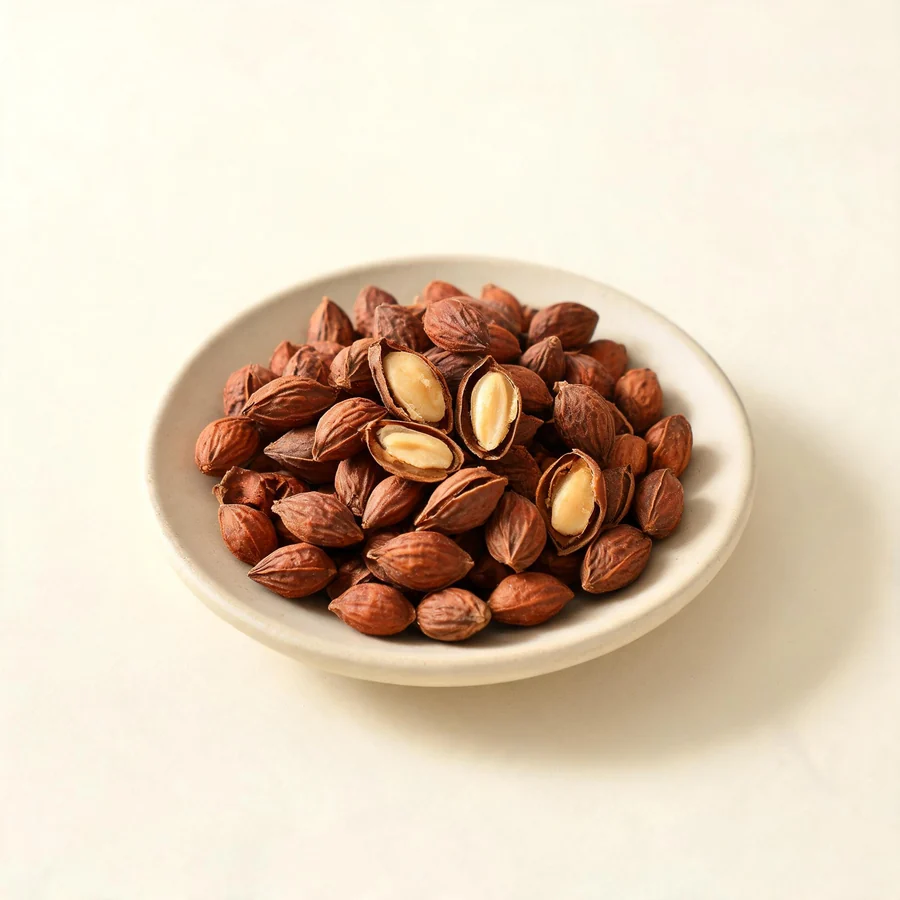
Skin profile
Where this herb sits in skin practice: the pattern it corrects, the skin signs it suits, and what it should not be used for.
Tao Ren treats colour that stays: the bruise that will not fade, the dusky patch, the purpuric spot, the firm scar. It is the mildest of the strong movers, which is why it is used so often, and the bleeding risk is what decides whether it can be used at all.
Skin signs that suggest it
- Bruises that remain dark purple or yellow-brown for weeks after the injury
- Fixed dusky or purple patches that do not fade and are not hot to touch
- Pinpoint bleeds into the skin that do not blanch when pressed
- Firm, tender nodules under the skin, or a raised scar that itches or aches
- A purple or dusky tongue, sometimes with dark spots
When it is not the right herb
Not for skin that is pale, thin and dry with no fixed or dark component, and not where the person bleeds easily, bruises without reason or is on an anticoagulant. It is contraindicated in pregnancy and avoided before surgery or dental extraction. It is not for a weak digestion with loose stools, where the oil in the seed loosens the bowel further. It must never be taken as a food, as whole kernels or as a raw seed, and it is not a substitute for treating the cause of purpura, which may be a platelet or clotting disorder.
What it does for skin
Skin-relevant actions only. Each one describes a mechanism in TCM terms and what it looks like on the skin.
Breaks Blood stasis in the skin
Stasis in the skin shows as colour that stays: a bruise that will not clear, a dusky patch, a fixed tender lump. The kernel is described as breaking clotted Blood rather than moving free-flowing Blood, which is why it is chosen for these fixed lesions and not for general poor circulation. It is combined with Hong Hua, the pair being the standard stasis combination in the tradition, and the two are rarely separated in skin formulas.
Clears the colour left by injury and inflammation
After an injury, or after an inflamed lesion has settled, the skin often keeps a brown or purple mark long after the damage has healed. This is read as Blood that leaked and stayed, and the treatment is to move it rather than to bleach it. The kernel is used in the fading phase, when the surface is intact, and the mark is expected to lighten over weeks rather than days. Sun protection still matters, because ultraviolet light darkens the same marks.
Softens firm nodules and raised scars
A keloid or a firm nodule is Blood and tissue that has been laid down and not remodelled. The kernel breaks the stagnant Blood within it, and it is used with stronger stasis-breaking herbs when the nodule is hard. It is a supporting measure: steroid injections, silicone sheeting and pressure remain the treatments with evidence behind them for scarring, and no herb should delay them.
Moves Blood without adding heat or cold
Its neutral temperature is the practical reason it appears in so many formulas. A hot, inflamed lesion can be treated with cooling herbs without the mover adding warmth, and a cold, dusky patch can be treated with warming herbs without the mover adding cold. That neutrality is why it is the default partner for both Chi Shao and Gui Zhi.
Skin conditions it is used for
Mapped to the condition pages on this site. The pattern column shows what the skin is doing when this herb is the right choice.
| Condition | Pattern | Why it suits | Typical setting |
|---|---|---|---|
| Bruising | Blood stasis held in the tissue after injury | A bruise is blood outside its vessels, and the tradition treats the purple, then yellow, then fading stages as stagnant Blood being slowly reabsorbed. The kernel is used when a bruise has stopped being fresh, is not spreading, and has become a fixed tender patch. It is combined with Hong Hua and Dang Gui, and the same formula is used for the stiffness that follows a deep bruise. A bruise that enlarges, is extremely painful or follows a minor knock needs medical review. | Tao Hong Si Wu Tang |
| Purpura | Stasis with heat in the small vessels | Purpuric spots that do not blanch are read as Blood that has left the vessels and stayed in the skin. The kernel moves that Blood while cooling herbs address the heat that damaged the vessels in the first place. It is used only after assessment, because purpura can come from a platelet disorder, a vasculitis or a drug reaction, and those causes need their own treatment. It is never given while bleeding is active. | Tao Hong Si Wu Tang with Mu Dan Pi and Chi Shao |
| Melasma | Blood stasis in the facial vessels, often with Liver Qi constraint | Brown symmetrical patches on the cheeks and forehead are read in this tradition as stasis in the fine vessels of the face, often on a background of constrained Qi, poor sleep or hormonal change. The kernel is used in a blood-moving formula with Chai Hu and Bai Shao. It is a slow treatment, sun protection is the single most effective measure, and the hormonal and drug causes should be identified rather than treated through the skin alone. | Tao Hong Si Wu Tang with Chai Hu and Bai Shao |
| Keloids | Stasis bound in the scar after the wound has closed | A scar that keeps thickening and extends beyond the original wound is read as Blood that has been laid down and not cleared. The kernel is used with stronger breakers such as San Leng and E Zhu, in a formula given for months. It is an adjunct, and the dermatological options should be offered first, because they have the evidence and the herb does not. | Tao Hong Si Wu Tang with San Leng and E Zhu |
| Acne | Nodular acne with stasis and heat | When acne lesions have become deep, dusky and indurated rather than red and pustular, the picture is heat that has entered the Blood with stasis. The kernel disperses the induration while the cooling herbs deal with the heat, and it is used in the nodular and scarring phase rather than in acute pustular flares. Isotretinoin and other medical treatment remain the main options for severe nodular acne, and the herb is supportive. | Modified Qing Wei San with Tao Ren and Mu Dan Pi |
| Psoriasis | Blood stasis with thickened plaques | Long-standing plaques that are thick, dusky and slow to change are read as stasis in the Blood beneath the scale. The kernel is used in blood-moving formulas in the chronic plaque phase, and it is combined with cooling herbs when the plaque is still red. It does not replace topical treatment or systemic therapy for moderate to severe disease, and it is stopped before surgery or if bleeding appears. | Tao Hong Si Wu Tang with Ji Xue Teng and Mu Dan Pi |
Combinations for skin
Herbs it is paired with when the skin, not an internal organ, is the target.
| Partner | Ratio | Why the pair is used |
|---|---|---|
| Hong Hua | 10 g Tao Ren with 6 to 10 g Hong Hua | The standard Blood-stasis pair, and the two are named together in almost every formula that moves Blood. The kernel is the heavier breaker of what has already clotted, while the flower is the lighter circulator, so a fixed lump and the sluggish flow around it are treated at once. For the skin it is the pair used on fixed dark patches, old bruises and thickened plaques. |
| Dang Gui | 10 g each | Dang Gui both builds and moves Blood, which protects against the depletion a strong breaker can cause. The pair suits a person who is pale and tired as well as bruised or duskily marked, and it is the pair reached for when stasis sits on top of Blood deficiency. It is also what allows the kernel to be given to someone frail or older. |
| Mu Dan Pi | 10 g each | Mu Dan Pi is a cooling herb, and it deals with the heat that stagnant Blood produces. The pair is used where a fixed patch or a purpuric spot carries heat signs: warmth in the area, a red tongue, restlessness. Cooling and moving at the same time is the specific advantage over a warming mover such as Gui Zhi. |
| Gui Zhi | 10 g each | Gui Zhi brings warmth to the channels, which gives the kernel something to move. The pair is used for cold stasis: dusky, cold, mottled skin on the hands and feet, chilblains, and old injuries that ache in cold weather. In that picture the warmth does the decisive work, while the kernel adds the breaking force. |
Formulas where it leads
- Tao Hong Si Wu Tang (桃红四物汤) - Si Wu Tang with peach kernel and safflower added, the standard formula for Blood stasis with deficiency. In skin practice it is the base for fixed dark patches, old bruising and the dusky phase of chronic eczema or psoriasis, where moving Blood and nourishing it have to happen together.
- Xue Fu Zhu Yu Tang (血府逐瘀汤) - Wang Qingren's formula for stasis in the chest, built on the same two movers. Its relevance to the skin is the principle rather than the indication: fixed, sharp, night-worse pain and dusky colour are treated by breaking stasis, and the formula is the model for that approach in the fixed lesions of the skin.
Safety for skin use
What to check before recommending or using it, including the cautions that matter most for skin patients.
Do not use, or use with caution
- Pregnancy. It is a strong mover, and animal studies report the uterus contracting and, in high doses, skeletal defects in the fetus. Rather than reduce it, practitioners leave it out of pregnancy formulas altogether.
- Active bleeding, a bleeding disorder, recent surgery or a dental extraction. A strong blood mover is the wrong tool while bleeding is underway or expected.
- Anticoagulant or antiplatelet treatment. Clotting time is lengthened by the kernel in laboratory work, so the pair makes bruising and bleeding more likely.
- No stasis: pale, thin, dry skin in a tired person. Where the problem is thin blood rather than stuck blood, there is nothing for the kernel to break, and the person may end up weaker.
- Loose stools or a cold, weak digestion. The oil in the seed softens the bowel, which is helpful in constipation and unhelpful in anyone already loose.
- Raw or whole kernels, or the kernel as a food. Amygdalin and emulsin release hydrogen cyanide, and a small handful of raw kernels can cause vomiting and dizziness.
Pregnancy and breastfeeding
Contraindicated. It is a strong mover; in animals the uterus contracts and, at high dose, the fetal skeleton is affected. The classical tradition is equally clear that it is avoided in pregnancy, and practitioners leave it out of formulas altogether rather than reduce it. The same advice applies while trying to conceive, and to breastfeeding, where there are no safety data and the cyanogenic glycoside could in theory reach the infant. No topical form is recommended either, because the concern is systemic.
Interactions
- Anticoagulants and antiplatelet drugs. The kernel lengthens clotting time and reduces platelet clumping in laboratory work, so warfarin, heparin, aspirin, clopidogrel and the newer oral anticoagulants could add to the effect. Anyone on one of these should agree it with their prescriber, and dark stool or bruising without a cause means stopping and getting advice.
- Anaesthesia and surgery. Because it moves Blood and affects platelets, it is a poor companion to an operation; practitioners stop it one to two weeks ahead of a planned procedure or a dental extraction, and the anaesthetist is told it has been taken.
- Blood pressure medicines. In animals the extracts lower blood pressure. With antihypertensives that could add up, especially in a person who already feels faint when standing, so pressure is worth watching rather than assuming either that nothing will happen or that it must.
Allergy and patch testing
Peach allergy is the specific caution. People who react to peaches, almonds or other stone fruit may react to the kernel, and the pattern is often oral allergy syndrome, with itching of the mouth and throat rather than a skin rash. A known peach or almond allergy is a reason to avoid the kernel altogether. A new rash while taking it should be assessed rather than assumed to be part of the original condition, and topical products containing it should be patch tested before use.
General safety references
General references for herbal hepatotoxicity and herb-drug interactions; they are not specific to this herb.
- Review article: Herbal hepatotoxicity - an update on traditional Chinese medicine preparations. Alimentary Pharmacology & Therapeutics, 2014. PMID: 24844799.
- Interactions between herbal medicines and prescribed drugs: an updated systematic review. Drugs, 2009. PMID: 19719333.
- Warfarin and food, herbal or dietary supplement interactions: a systematic review. British Journal of Clinical Pharmacology, 2021. PMID: 32478963.
Evidence
The classical record is quoted with its source. The modern note states the level of evidence plainly.
Classical record
味苦,平,无毒。主瘀血,血闭,癥瘕,邪气,杀小虫。
The flavour is bitter, the nature balanced, and the substance is not poisonous. It is indicated for blood that has clotted, for menstruation that has stopped, for hard masses in the belly and for noxious Qi, and it destroys small parasites.
Shen Nong Ben Cao Jing (Divine Husbandman's Classic of Materia Medica), Han compilation - No bowel, no skin: the earliest entry is a list of stasis and parasites. The skin applications of later centuries were reasoned out from that stasis core.
桃仁,为血瘀血闭之专药。苦以泄滞血,甘以生新血。
For blood that is stagnant and blocked, the peach kernel is the one herb singled out. Bitterness carries the stale blood away; sweetness brings new blood into being.
Ben Jing Feng Yuan (Original Encounters with the Materia Medica), Qing dynasty - One line carries the whole doctrine: breaking the old blood and making the new are a single act, which is the argument for using the kernel on dark, fixed lesions.
桃仁行血宜连皮尖生用,润燥和血,宜汤浸去皮尖炒黄用。
Where the aim is to move blood, the kernel goes in raw, coat and pointed tip still attached; where the aim is to moisten dryness and settle the blood, it is steeped in hot water, the coat and tip removed, and fried until it yellows.
Ben Cao Gang Mu (Compendium of Materia Medica), Li Shizhen, 1578 - Practical rather than doctrinal, and still followed: for skin work the kernel is blanched or fried, and the raw form is kept for robust stasis under supervision.
Modern evidence
Evidence status
- The cyanogenic mechanism is established. Amygdalin and the seed's own emulsin, with gut bacteria, release hydrogen cyanide, and the oral route is the dangerous one. Blanching, dry-frying and boiling at the traditional dose reduce the exposure, which is why processing is a safety step rather than a refinement.
- Laboratory work reports anti-inflammatory and antiplatelet activity, and animal studies describe prolonged clotting time. No clinical trial of the kernel in bruising, purpura, melasma or scarring was identified, and the skin uses rest on tradition.
- Regulatory status: the processed kernel is an accepted article in the Chinese Pharmacopoeia and is classified as slightly toxic, with a narrow recommended dose range. Poisoning from eating the kernels is recorded, which is why they are handled as a medicine rather than a food.
PubMed records
Selected real PubMed records for this herb's species or its constituents, chosen by species name and title relevance. They are references for the non-TCM discussion above, not proof that the herb treats any skin condition.
- Antioxidant Activity and Preclinical Safety of Semen persicae Extract.. International journal of molecular sciences, 2024. PMID: 39201267 (safety record).
Dose and forms
Skin-practice dosing and the preparations that suit skin complaints.
| Form | Dose and notes |
|---|---|
| Decoction of processed kernel | 5 to 10 g daily in a formula, with 5 to 6 g the usual skin dose. The kernel is crushed before decoction, because a whole oily seed gives up very little. |
| Form | Blanched kernels with the skin removed are the everyday form; dry-fried kernels lean towards moistening and harmonising. The raw kernel is the strongest breaker and is not used for skin at home. |
| Course length | Two to four weeks with review, and stop a week or two before planned surgery. Long unsupervised courses are not appropriate for a cyanogenic seed. |
| Upper range | The older literature allows up to 15 g when stasis has formed a mass or followed serious injury, under supervision, and that is not a skin dose. |
The kernel is a cyanogenic medicine, so the dose is small because of its chemistry rather than its strength. Normal boiling at 5 to 10 g does not produce dangerous cyanide levels, but the raw seed, the unprocessed kernel and the double kernel were all treated as hazardous. A course is short and tied to a formula, the processed form is used throughout, and anyone who becomes dizzy, nauseated or confused after taking it should seek medical help at once.
Citations and further reading
Only real sources are listed: the classical materia medica passages quoted above, and the source works behind the botanical and safety statements.
- Shen Nong Ben Cao Jing (Divine Husbandman's Classic of Materia Medica), Han compilation - classical entry quoted above.
- Ben Jing Feng Yuan (Original Encounters with the Materia Medica), Qing dynasty - classical entry quoted above.
- Ben Cao Gang Mu (Compendium of Materia Medica), Li Shizhen, 1578 - classical entry quoted above.
- Semen Persicae monograph: Pharmacopoeia of the People's Republic of China - source for the accepted botanical source, the processing requirement and the dose range.
- Modern evidence statement: based on published work on amygdalin, emulsin and hydrogen cyanide release, and on laboratory work on platelet function; no clinical trial in skin disease is presented as proof of effect.
- Botanical description and identification: botanical literature on Prunus persica and P. davidiana, Rosaceae.
Educational reference for qualified practitioners. This page is not medical advice, and skin conditions should be diagnosed by a clinician before treatment.