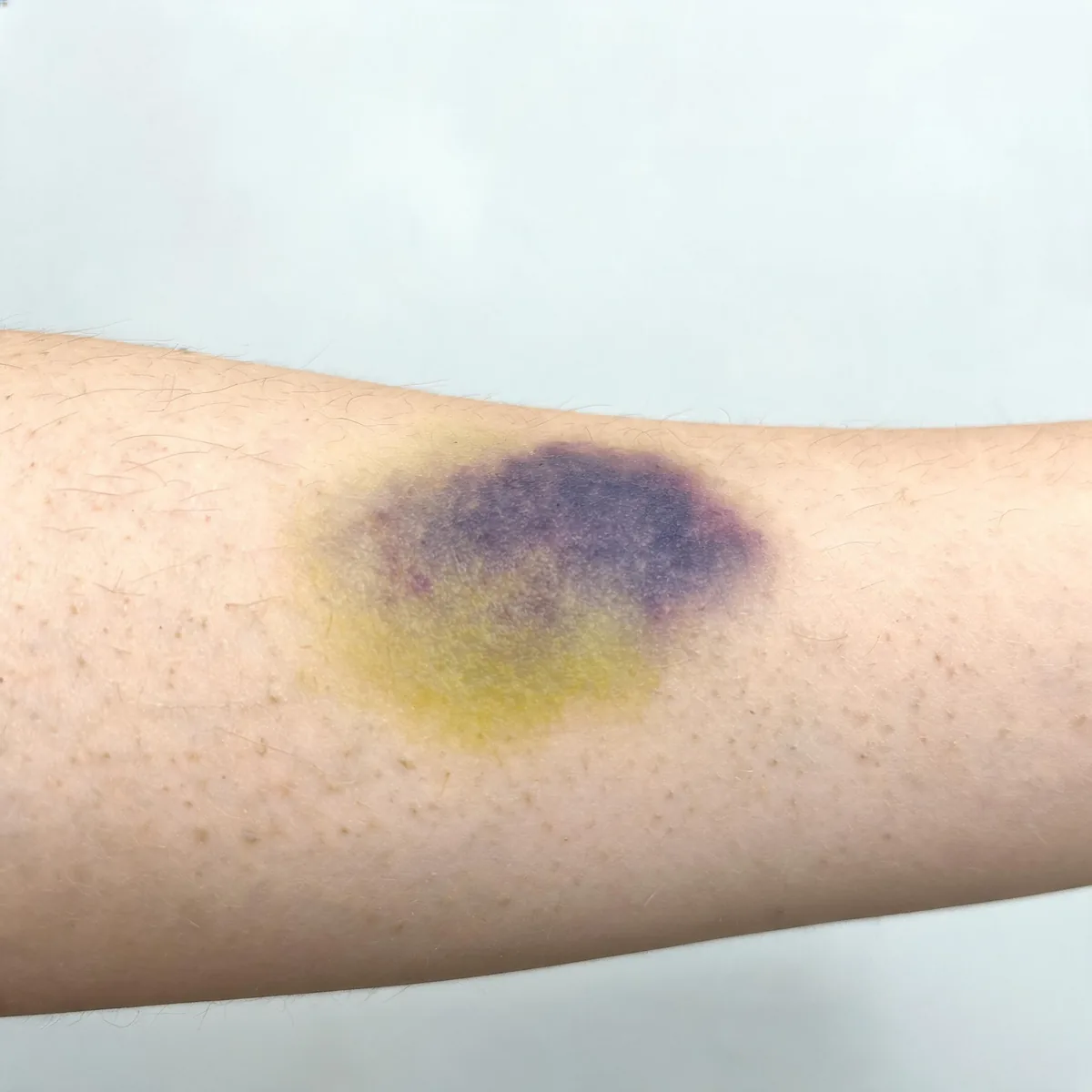
Understanding Bruising
The classical literature defines a bruise as Blood Stagnation: blood that has leaked out of the vessels and become stuck in the tissues.
The Liver is described as responsible for the smooth flow of Qi and Blood, and the Spleen for holding blood within the vessels. When Qi moves strongly, blood circulates; when it is deficient or stuck, blood pools and the bruise stays dark and slow to fade.
The patterns separate by feel and by colour. Fixed stabbing pain with a dark purple bruise is Blood Stagnation. Distending pain that shifts and worsens with stress is Qi and Blood stagnation. Bruises that fade very slowly in a tired person are Qi deficiency failing to move blood.
Pale lingering bruises with easy bruising, a pale complexion and breathlessness are read as Qi and Blood deficiency. A bruise that is red, swollen and hot is Blood Stagnation with heat, and the classical literature treats it as a possible infection if there is pus or spreading heat. Bruises on joints that feel cold and stiffen in cold weather are Cold invading the channels.
Seen through TCM, a bruise is blood that has left its proper route and lodged in the tissue, where it stops moving. Because the escaped blood no longer circulates it congests, and the congestion is what produces both the colour and the tenderness. Fresh bruising reads blue or purple and feels sore and puffy; over the following days the shade passes through green and yellow before fading, which the tradition reads as stale blood being slowly broken up and carried away. The same pressure that discolours the skin also obstructs the local flow of Qi, and that obstruction explains why a bruise can ache, throb or sting instead of merely looking marked. None of this conflicts with the Western account of blood leaking from torn capillaries; the two describe one event in two languages.
Two people can take the same knock and end up with very different marks. In one the discolouration settles quickly, in the other it spreads, hardens and lingers for weeks. TCM explains the gap by what else is happening in the body. Cold, whether from weather, a draught or iced drinks, tightens the channels and slows the movement of blood, so a bruise that would otherwise clear stays stiff and aches in chilly conditions. Heat reddens and inflames, and where heat is already present a bruise may turn hot, angry and slow to settle. Weakness matters as much: when Qi is thin the vessels are less resilient and stale blood is cleared sluggishly, so marks appear from trivial knocks and outlast their welcome. That is the practical reason one symptom is separated into six patterns, since two bruises of identical size may need quite different herbs, points and food.
Conventional view
A bruise, or ecchymosis, occurs when small blood vessels break and leak blood into the tissues beneath the skin, usually after a bump, and the trapped blood causes the familiar blue, purple or black discolouration that changes colour as it heals. Most bruises are harmless and fade within two weeks; when bruising happens very easily or without remembered injury, doctors may investigate bleeding disorders, vitamin deficiencies or blood-thinning medication.
For a fresh bruise the usual advice is rest, ice, compression and elevation to limit swelling, with paracetamol for discomfort and NSAIDs sometimes avoided because they can increase bleeding. For people who bruise easily, treatment targets the underlying cause by adjusting medication, supplementing vitamin C or K or addressing a bleeding disorder.
Conventional care is excellent at ruling out serious disease and managing acute symptoms, but has little to offer the person who simply bruises more than others or whose bruises take a long time to fade, and it treats all bruises the same way without asking why one heals quickly and another lingers. TCM looks deeper, at the strength of Qi, the quality of Blood and the presence of internal Cold or Heat.
Selected PubMed records
Real PubMed records for the conventional discussion above, selected by condition name and title relevance. They are references, not a claim that any treatment is proven for this condition.
- The terminology of skin disorders. Primary Care, 2000. PMID: 10815043.
How it connects
Bruising rarely arrives alone, and the companions usually share its root. Where Qi deficiency is underneath, the person is often flat by mid-afternoon, has a poor appetite and catches colds easily, because the same thin Qi that fails to move blood also fails to sustain energy and defence. Where Qi and Blood stagnation is underneath, anxiety, irritability and a tight chest commonly travel with the marks, since the constrained Liver Qi that pools blood also disturbs mood. Cold-type bruising tends to come with cold hands and feet, a general aversion to cold and morning stiffness. Treating the shared root often eases several complaints at once, which is why fatigue, digestion, sleep and mood are all part of the bruising consultation.
How it is assessed
The practitioner asks how the bruise appeared, how it feels and how long it takes to fade.
What a practitioner looks for
- Onset: bruising without injury, or over large areas, needs medical assessment.
- Pain: fixed stabbing pain suggests stagnation; distending shifting pain suggests Qi involvement.
- Temperature: a hot red swelling suggests heat and possible infection; cold joints suggest cold invasion.
- Constitution: fatigue, pallor and breathlessness point to deficiency patterns.
The consultation begins with the story of the mark rather than the mark alone. How it appeared, whether there was a knock, how fast it darkened and how the shade has changed all carry information. The practitioner then tests the area with a light touch, because warmth, swelling and a sharp reaction to pressure point one way while a cold, pale, stiff patch points another. Pain quality matters. A stabbing pain that stays in one place, worse at night and worse on pressing, belongs to stagnation; a distending ache that wanders and tightens when the person is frustrated suggests that Qi is the obstructed element. Energy and digestion come next, since fatigue with a poor appetite and loose stools shifts the reading towards deficiency. Tongue and pulse settle the question: a dusky tongue with dark veins beneath and small stasis spots, matched by a choppy pulse, supports stagnant blood.
Bleeding elsewhere is checked, because a tendency that shows up in several places is read differently from a single injury. Heavy or prolonged periods, blood on the toothbrush, nosebleeds and blood in the stool all suggest that the vessels are not being held closed, which points towards the Spleen or towards depletion rather than a local stasis. A bruise that appeared with no remembered knock, or several that arrived together, is treated as a question for medicine first, and TCM is then used alongside the investigation rather than instead of it. The practitioner will also want to know about blood-thinning drugs, steroids and any supplement that affects clotting before recommending herbs that move blood.
The tongue and pulse findings are matched to the pattern rather than read in isolation. A red or purple tongue with a rapid pulse adds heat to the picture and calls for cooling, while a pale, swollen tongue with a weak pulse suggests that the body cannot hold or move blood properly and that tonifying comes before moving. Where the tongue is pale yet carries purple spots, deficiency and stasis are present together, and the two need addressing in the right order.
TCM patterns in Bruising
Differentiating the pattern turns a bruise into a plan. It asks what kind of stasis is present and what allowed it to form. Three of the six patterns are excess pictures: blood congealed after a blow, stalled Qi and pooled blood after emotional strain, and stagnant blood joined by heat. The other three describe a body that cannot manage the traffic, with Qi too weak to push blood along, Qi and Blood too depleted to seal the vessels, or cold settled in the channels. A mark that stays in one place points to stagnation; a wandering ache suggests Qi is the obstructed element. Heat reddens and swells; cold stiffens and pales. How energy runs across the day separates a full picture from a deficient one, where a strong moving formula would exhaust rather than help. The patterns overlap, since stasis drains Qi and thin Qi lets stasis settle, so treatment follows whichever dominates.
| Pattern | Key signs | The itch | Tongue | Main formula |
|---|---|---|---|---|
| Blood Stagnation | Fixed stabbing pain at the bruise; Pain worse at night and with pressure | Not specified | Body: Purple, dusky or with dark stasis spots; sublingual veins dark and distendedCoat: Often thin white; a yellow coat would suggest Heat as the cause | Not specified |
| Qi And Blood Stagnation | Distending pain that may shift | Not specified | Body: Purple or dark, with stasis spots; sublingual veins dark and distendedCoat: Thin white | Not specified |
| Qi Deficiency causing Blood Stagnation | Not specified | Not specified | Body: Pale-dark or pale-purple, teeth-marked, possibly with stasis spots and dark sublingual veinsCoat: Thin white | Not specified |
| Qi and Blood Deficiency | Not specified | Not specified | Body: Pale, possibly thin or with teeth marksCoat: Thin white | Not specified |
| Blood Stagnation with Heat | Bruise red, swollen and hot to touch; Fixed stabbing pain worse at night | Not specified | Body: Reddish-purple, with stasis spots and dark sublingual veinsCoat: Thin, dry and yellow | Not specified |
| Cold invading the Channels (Joints and Muscles) | Pain and stiffness worse in cold weather; Deep fixed joint pain | Not specified | Body: Pale, moistCoat: Thin white | Not specified |
Blood Stagnation
Dark fixed bruise with stabbing pain that fades slowly.
A direct blow tears the smallest vessels and blood escapes into the surrounding tissue, where it has no route out. Stagnant blood is heavy and immobile: it presses on the local nerves and blocks the free passage of Qi through the area, which is why the pain is sharp, fixed and worse when the spot is pressed. The same congestion explains the colour. The mark is dark purple or almost black, it stays exactly where it started, and it does not fade in the usual way. Where the stasis has been there a while, the lips, nails or complexion may take on a dusky cast and menstrual blood may run dark and clotted.
The tongue is purple or dusky with stasis spots and dark distended veins beneath, under a thin white coat, and the pulse is choppy like a blade drawn over bamboo, or wiry where Qi is also held tight. Cold drinks, cold weather and long hours of sitting thicken the picture, while gentle movement, local warmth and elevating the area ease it. Xue Fu Zhu Yu Tang is the usual choice where the chest and ribs are involved, and Tao Hong Si Wu Tang where stasis sits alongside thin Blood. The herbs named are Dang Gui, Chuan Xiong, Tao Ren and Hong Hua. Xuehai (SP-10) is the central point, supported by Hegu (LI-4) and Sanyinjiao (SP-6).
Signs
- Fixed stabbing pain at the bruise
- Pain worse at night and with pressure
- Dark purple or blackish bruise that fades slowly
- Dark lips or nails with a dusky complexion
Diet and lifestyle for this pattern: Avoid cold and raw food that congeals Blood, and add modest amounts of Blood-moving food such as turmeric, dark cherries, aubergine and dark leafy greens. Keep moving gently with walking or stretching, though avoid heavy impact on the bruise, and a brief warm compress after the first day can help circulation.
Qi And Blood Stagnation
Shifting distending pain, worsened by stress.
Here the obstruction starts in the emotions rather than in the tissue. Frustration, swallowed anger or a long stretch of pressure knots the Liver's Qi, and because Qi is what propels blood, the blood behind the blockage slows and pools. A knock may be the visible trigger, but the susceptibility was already there. This is why the mark can appear or darken after an argument, why the pain feels distended or pressure-like rather than sharply localised, and why it may seem to move. Tightness in the chest, discomfort along the ribs and a short temper usually accompany it.
The tongue is dark purple with stasis spots and tortuous veins underneath, under a thin white coat, and the pulse is wiry and choppy at once, taut yet uneven. Stress, inactivity, cold weather and heavy greasy food all make it worse, while gentle movement, warmth, light massage around the area and deliberate relaxation help. Xue Fu Zhu Yu Tang is named for this pattern because it moves blood and frees Qi together. The herbs are Chai Hu, Chuan Xiong and Yan Hu Suo, and the points are Taichong (LR-3), Hegu (LI-4), Sanyinjiao (SP-6) and Xuehai (SP-10).
Signs
- Distending pain that may shift
- Bruising worsens with emotional stress
- Irritability or mood swings
- Chest or rib-side tightness
Diet and lifestyle for this pattern: Keep the body moving gently with walking, stretching or tai chi, and warm the cooking with turmeric and ginger. Avoid cold raw food that congeals blood, and deal with stress through breathing, meditation or talking, so Liver Qi does not knot up.
Qi Deficiency causing Blood Stagnation
Easy bruising with fatigue and very slow fading.
This pattern turns on a shortage of pushing power. Qi is described as the force that drives blood through the vessels, so when Qi runs low the flow loses momentum, slows and pools, and the pooled blood leaks out under the skin after contact that would barely register in a robust person. The mark is often pale purple rather than black and takes weeks to clear, because clearing stale blood is itself work that requires energy. The person is persistently tired, short of breath on effort, and slow to recover from anything.
The tongue is pale with a purple cast, teeth marks and perhaps small stasis spots, under a thin white coat, and the pulse is deep, fine and choppy. Overexertion, long hours on the feet, cold or raw food, stress and cold weather all deepen the problem, while rest, warmth, gentle movement and Qi-building foods such as congee and dates help. Bu Yang Huan Wu Tang is the formula named here, built on Huang Qi with Dang Gui and Chuan Xiong to move blood. The points are Zusanli (ST-36), Sanyinjiao (SP-6), Xuehai (SP-10) and Qihai (REN-6).
Signs
- Easy bruising from minor contact
- Persistent fatigue and weakness
- Bruises fade very slowly
- Shortness of breath on exertion
Diet and lifestyle for this pattern: Eat warm cooked food such as congee, stews and soups with Qi-building ingredients such as astragalus, dates and ginger, and avoid raw cold food that weakens digestive Qi. Gentle daily exercise moves Qi and Blood without overexertion.
Qi and Blood Deficiency
Pale lingering bruises with a deficient picture.
With both Qi and Blood running low, blood is neither held firmly in its vessels nor repaired promptly once it leaks. Capillaries become fragile, so slight knocks that would leave nothing on a robust person produce pale marks that spread and linger. Qi is too weak to clear the stale blood and there is too little Blood to rebuild the tissue, which is why these bruises fade far more slowly than ordinary ones. The picture is one of overall depletion: a washed-out face and lips, dizziness on standing, breathlessness on stairs and a fatigue that sleep does not fully clear.
The tongue is pale, sometimes thin, showing teeth marks at the edges under a thin white coat, and the pulse is fine and weak, lacking force. Overwork, skipped meals, cold or raw food and prolonged stress all worsen it, while rest, warm nourishing meals and gentle movement rebuild the ground. Ba Zhen Tang is the formula named, with Huang Qi and Dang Gui as the key herbs. The points are Zusanli (ST-36), Sanyinjiao (SP-6) and Pishu (BL-20), where moxa or gentle needling suits the deficiency.
Signs
- Pale lingering bruises
- Easy bruising from minor bumps
- Fatigue and general weakness
- Pale complexion and lips
- Dizziness or light-headedness
Diet and lifestyle for this pattern: Choose warm, cooked, easily digested meals such as soups and stews, with bone broth, dark leafy greens, a little red meat if tolerated, and a few dates or goji berries. Avoid cold raw food and iced drinks, keep movement gentle, and treat deep rest as part of the treatment.
Blood Stagnation with Heat
A hot, red, swollen bruise with internal heat.
A bruise that becomes infected, or a body that already carries internal heat, turns simple stagnation into something hotter and more destructive. Trapped blood is an irritant, and heat accelerates the damage, so the area becomes red, swollen, tight and intensely painful rather than merely tender. The two elements feed each other: stuck blood generates more heat, and heat thickens and congeals the blood further, so the mark spreads and the skin may look purplish-red or develop pus. Thirst with a wish to rinse the mouth without swallowing, restlessness and a sense of internal heat are typical.
The tongue is reddish-purple with stasis spots, distended veins beneath and a thin dry yellow coat, and the pulse is choppy, rapid and often wiry. Alcohol, spicy and fried food, hot weather, and pressing or rubbing the bruise all aggravate it, while a cool compress, rest with the area raised and cooling foods such as cucumber and pear settle it. Liang Xue Di Huang Tang is the formula named, cooling the blood while it moves it. The herbs are Chi Shao and Tao Ren, and the points are Xuehai (SP-10), Taichong (LR-3) and Quchi (LI-11).
Signs
- Bruise red, swollen and hot to touch
- Fixed stabbing pain worse at night
- Internal heat with restlessness
- Dark purplish-red skin
Diet and lifestyle for this pattern: Avoid spicy, greasy and fried food that generates internal Heat, keep the bruise clean and protected, and use a cool rather than freezing compress to soothe swelling. Add cooling, blood-moving food such as cucumber, celery and a little black fungus.
Cold invading the Channels (Joints and Muscles)
Bruises on joints that feel cold and stiffen in cold weather.
Cold contracts and congeals. Once it settles into the channels, joints and muscles it narrows the vessels and slows the flow, so blood pools and marks appear without any blow at all. This bruising favours the joints and exposed limbs, and the skin over the area feels cold to the touch. The accompanying pain is deep and fixed, with stiffness that is worst on first moving and eases only once the area is warm. It typically flares in cold, damp weather and improves in summer or on holiday in a warm climate.
The tongue is pale, moist, and carries a thin white coat, and the pulse is tight and wiry, sometimes slow. Cold weather, draughts, iced drinks, damp rooms and long periods of sitting still all provoke it, while warmth, moxibustion, warming food and movement that heats the joints relieve it. Qiang Huo Sheng Shi Tang is named for dispelling cold, wind and dampness from the channels, with Tao Hong Si Wu Tang added to move the blood. The herbs are Rou Gui, Chuan Xiong and Gui Zhi, and the points are Xuehai (SP-10), Zusanli (ST-36) and Fengchi (GB-20).
Signs
- Bruises on joints or exposed limbs
- Area feels cold to touch
- Pain and stiffness worse in cold weather
- Deep fixed joint pain
- Aversion to cold
Diet and lifestyle for this pattern: Keep the bruised area warm with clothing or a heat pack, and stay out of cold and draughts. Eat warming food such as ginger, cinnamon, lamb and cooked vegetables, avoid raw chilled food and iced drinks, and move in a way that warms the joints without strain.
Treatment approach
How the tradition treats bruising, with the herbs, formulas and points used for it.
Principles
- Move Blood and resolve stasis, which is the basic treatment for a bruise.
- Move Qi where the pain shifts and stress clearly worsens it.
- Strengthen Qi and Blood where bruising is easy and slow to fade.
- Clear heat where the bruise is red, hot and swollen, and treat spreading heat as possible infection.
- The strategy pairs a branch measure that clears the visible stasis with a root measure aimed at whatever let it form. A cold picture is warmed while blood is moved, a depleted one is tonified before it is moved, and a heated one is cooled rather than simply dispersed. Formula choice follows the same logic, with Xue Fu Zhu Yu Tang for straightforward stasis, Bu Yang Huan Wu Tang where Qi is the weak link, Ba Zhen Tang where Qi and Blood are both thin, Liang Xue Di Huang Tang where heat is involved and Qiang Huo Sheng Shi Tang where cold has settled into the channels.
Herbs used
Formulas
- Xue Fu Zhu Yu Tang
- Tao Hong Si Wu Tang
- Bu Yang Huan Wu Tang
- Ba Zhen Tang
- Liang Xue Di Huang Tang
- Qiang Huo Sheng Shi Tang
Acupoints
- SP-10 (Xuehai)
- SP-6 (Sanyinjiao)
- LR-3 (Taichong)
- LI-4 (Hegu)
- ST-36 (Zusanli)
- qihai-ren-6
- BL-20 (Pishu)
- LI-11 (Quchi)
- GB-20 (Fengchi)
What to expect
- An ordinary bruise is described as fading over one to three weeks.
- Easy unexplained bruising should be medically reviewed rather than only treated.
- Deficiency patterns need constitutional treatment over months.
- An uncomplicated bruise is expected to clear within two to three weeks, and treatment mainly shortens that and eases the discomfort. Recovery is not a straight line: a mark can look better for several days and then darken again as deeper blood is broken up and reabsorbed, which is normal rather than a setback. Where deficiency is the root, the first change is usually fewer new marks rather than faster fading, and the older stains take months to resolve, so consistent treatment matters more than a strong short course.
Safety and when to get help
Seek medical help urgently for
- Bruising without any known injury, or covering a large area.
- Bruising with severe pain, swelling or inability to move a joint.
- A bruise that becomes hot, spreading and painful, or develops pus.
For anything severe, sudden or spreading quickly, read when a skin problem needs urgent care.
Cautions
- Bruising while taking anticoagulant medication needs medical advice.
- Repeated unexplained bruising should have blood tests.
- Do not massage a fresh bruise vigorously.
Using this alongside conventional care
- TCM is described as complementary to conventional care: prescribed medication continues unchanged, and unexplained bruising should be medically investigated.
- TCM sits alongside conventional care rather than replacing it, and the one place the two must be coordinated is bleeding risk. Dang Gui, Chuan Xiong, Hong Hua and other blood-moving herbs can add to the effect of warfarin, aspirin, clopidogrel or a newer anticoagulant, and the practical rule is that nobody on those drugs starts a moving formula without both prescribers knowing. A full medication list, including supplements such as fish oil, ginkgo and high-dose vitamin E, belongs at the TCM consultation. For pain, paracetamol is generally preferred over anti-inflammatory drugs while a moving formula is being taken. Nothing prescribed should be stopped or altered without medical advice, and any bruise that appears without injury still needs investigating.
Diet and lifestyle
- Favour warm cooked food that supports circulation, and reduce excess cold or raw food, which is said to slow the flow.
- Food is chosen to keep blood moving and to strengthen whatever produces it. The rule is warm, cooked, easily digested meals: congee, soups, stews, well-cooked vegetables, ginger, turmeric and black pepper, with dark leafy greens, cherries and pineapple for their moving quality. Cold and raw food, iced drinks and heavy greasy or very sweet dishes are the usual things to limit, since cold congeals the flow and dampness clogs it. Pattern by pattern the additions differ. Stagnation does well with turmeric, dark cherries, aubergine and a little vinegar; a Qi picture wants congee, dates, astragalus and ginger cooked into soups; Qi and Blood deficiency asks for bone broth, dark greens, a few dates or goji berries and a little red meat if tolerated; heat calls for cucumber and celery while spicy and fried food is dropped; cold patterns want ginger and cinnamon with nothing served chilled.
If you're pregnant
Pregnancy consumes a great deal of Qi and Blood, making deficiency patterns more likely, and bruising may appear more easily, especially in the second and third trimesters as Qi and Blood deficiency becomes pronounced.
Treatment must be very cautious because many classic blood-moving herbs are contraindicated: Tao Ren, Hong Hua and Chuan Xiong can stimulate uterine contractions and risk miscarriage, and even strong Qi-moving herbs such as Chai Hu are used sparingly. Gentle blood-nourishing and Qi-tonifying formulas such as Ba Zhen Tang, with Dang Gui used cautiously, may be considered under professional guidance.
Acupuncture is often a safer first line, gently tonifying with points such as Zusanli (ST-36) and Qihai (REN-6) while avoiding strong stimulation of Sanyinjiao (SP-6) and Hegu (LI-4), which can induce labour. Cooling or warming compresses are safe, and any herbal poultice should be reviewed so no significant blood-moving herb is absorbed through the skin.
If you're breastfeeding
Most TCM treatment for bruising is compatible with breastfeeding, since herbs are used briefly and at moderate doses. Strong blood-invigorating herbs such as Tao Ren and Hong Hua can pass into milk in small amounts and may cause infant diarrhoea or irritability, so they are best avoided or used only under strict supervision, and gentler alternatives such as small doses of Dang Gui are preferred.
Acupuncture carries no risk of herb transfer and points such as Xuehai (SP-10) and Zusanli (ST-36) promote circulation without affecting the baby. For a large or infected bruise a short course of herbs may be used while watching the infant's stool and behaviour, and pumping and discarding milk is rarely needed but can be discussed with a lactation consultant if high doses are required.
If treating a child
Children are naturally active and prone to bumps and falls, so acute traumatic bruising is very common, usually simple Blood stagnation from local trauma, sometimes with Qi stagnation if the child is upset. Internal deficiency patterns are rare in otherwise healthy children, so treatment focuses on moving Blood and relieving pain, at about a quarter to a half of the adult dose for children under twelve, with milder formulas such as Tao Hong Si Wu Tang at reduced strength.
Many parents prefer external treatment: topical herbal plasters or liniments are safe on intact skin, and paediatric tuina along the limb plus gentle acupressure on points such as Xuehai (SP-10) and Hegu (LI-4) can speed healing without needles. If a child bruises easily from minimal contact, a deeper pattern such as the Spleen not controlling Blood should be investigated, with professional evaluation to rule out blood disorders.
If treating an elderly patient
In older people bruising is often a sign of underlying Qi and Blood deficiency, with fragile skin and vessels so that even minor bumps leave large slow-healing marks. Treatment must be gentle and patient, building Qi and Blood rather than aggressively moving stasis, at about two-thirds of the adult dose, with formulas such as Ba Zhen Tang or Bu Yang Huan Wu Tang preferred over strong blood-invigorating decoctions such as Xue Fu Zhu Yu Tang, and Huang Qi and Dang Gui as the workhorses.
Polypharmacy needs caution, since many older patients take blood thinners and adding blood-moving herbs such as Chuan Xiong could raise bleeding risk. Acupuncture is often safer and better tolerated, recovery takes several weeks, and gentle daily movement such as tai chi or walking plus warm compresses and rest support circulation and prevent future bruising.
Urgent-sign guidance is based on standard sources: NHS anaphylaxis, NHS cellulitis, NHS Stevens-Johnson syndrome, NHS melanoma.
Evidence
Evidence status
Compiled for this page from the classical and modern literature; not a systematic review, so treat it as a pointer to sources rather than clinical guidance.
The evidence is modest and mostly concerns acute traumatic injury rather than spontaneous bruising. Chinese trials of topical herbal preparations report faster resolution of bruising and less pain after surgery or trauma than standard care, though samples are small and blinding is limited. Acupuncture for acute soft tissue injury has been studied more widely, and the overall quality remains low to moderate.
Beyond the studies already noted, the picture is thin and tilted towards injury rather than spontaneous bruising. Chinese clinical work has mostly examined topical herbal preparations applied after surgery or trauma, and acupuncture for acute soft tissue injury, with reports of quicker clearing of discolouration, less swelling and less pain than routine care. The weaknesses repeat across that literature: small numbers, seldom blinded, rarely placebo-controlled, and outcome measures that vary from one study to the next. Laboratory work on herbs that resolve stasis suggests improved microcirculation and lower blood viscosity, and animal studies support faster reabsorption of pooled blood, but this is supporting evidence rather than clinical proof. The honest summary is that TCM is plausible and widely used here, on low to moderate quality evidence.
Studies often cited
Trials report faster resolution of ecchymosis and reduced pain after surgery or trauma compared with standard care. Chinese clinical trials (as recorded in the source)
More extensively studied than herbal treatment for bruising, with low to moderate methodological quality. Clinical trials (as recorded in the source)
Classical record
人有所堕坠,恶血留内,腹中满胀,不得前后,先饮利药。
When someone has fallen or been struck, stale blood stays inside, the abdomen becomes full and distended, and urine and stool do not pass; the first step is to give a draining medicine.
Huang Di Nei Jing Ling Shu, chapter 10, Jing Mai (The Meridians) - Classical citation: for this page. It links traumatic injury with retained stagnant blood and shows that clearing it was treated as urgent rather than incidental.
Common questions
Why do I bruise so easily?
The framework points to Qi deficiency failing to move and hold blood, or to Blood deficiency. Because easy bruising can also indicate a bleeding disorder, medical review comes first.
Can herbs help a bruise fade?
The tradition describes moving Blood and resolving stasis, with ordinary bruises fading over one to three weeks.
Is a hot bruise a problem?
A bruise that is hot, red, spreading and painful may be infected and needs medical assessment.
Should I take herbs while on blood thinners?
Only with medical advice, because several herbs that move Blood can affect coagulation.
How long does TCM take to change a tendency to bruise?
A single fresh bruise often settles within a week of treatment. Chronic easy bruising or an old mark that will not fade usually takes four to twelve weeks of consistent work, because the aim is to rebuild Qi and Blood rather than to shift one stain. Progress is judged on energy, tongue and pulse as much as on the skin.
Can acupuncture help an old bruise that still aches?
Yes. Blood that has sat for weeks or months can leave a dull persistent ache, and needling both locally and at distant points such as Hegu (LI-4) and Taichong (LR-3) is used to break up that residue and restore circulation. People often report the ache easing before the discolouration finally goes.
What should I eat while a bruise is healing?
Warm cooked food that encourages circulation suits most patterns: turmeric, black pepper, ginger, cherries, pineapple and leafy greens. Excess cold or raw food is best avoided because it is said to constrict the vessels and slow the clearing. If bruising is easy, add Qi and Blood foods: slow cooked broth, a few dates and a little lean meat.