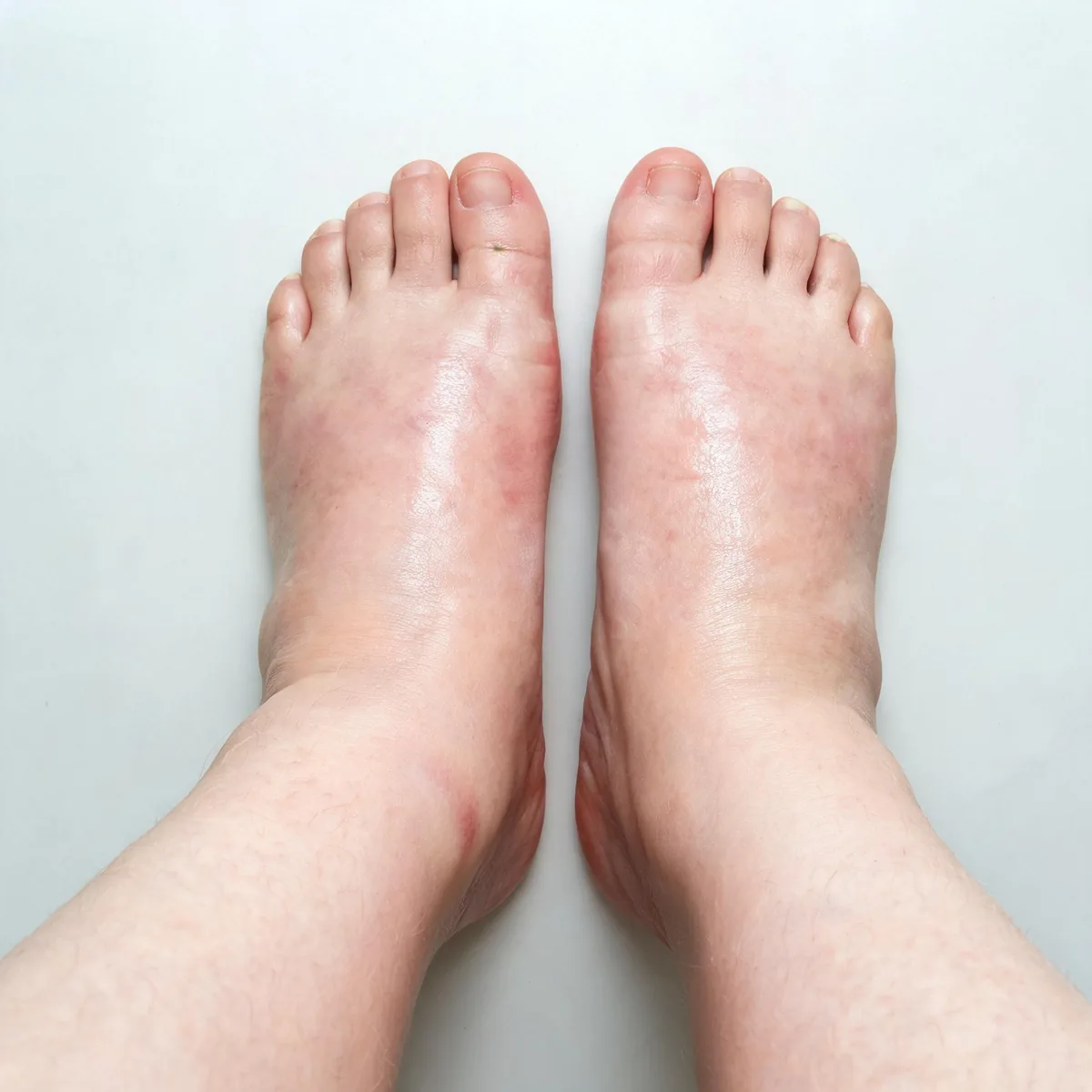
Understanding Red and swollen feet
The tradition describes the feet as especially vulnerable to heat, fluid and blood sinking downward. The Spleen transforms fluids; when it is weak, dampness accumulates in the lowest part of the body.
Damp-Heat in the Lower Burner gives red hot swollen feet with heavy legs, burning or throbbing pain, dark scanty urine and a greasy yellow coating at the tongue root.
Blood Stagnation gives fixed stabbing pain worse at night, dark purplish-red discolouration, swelling that feels firm or nodular and is tender to pressure. Toxic-Heat is the severe picture: high fever and chills, intense burning pain, blistering or blackened skin suggesting necrosis - a surgical emergency.
Qi and Blood deficiency gives dull dusky redness rather than bright red, with mild swelling that resolves slowly, fatigue, a pale complexion and numbness or tingling. Yang deficiency with cold-damp gives swelling that feels cold to the touch with a dusky pale red or purplish hue, a heavy aching sensation and worse pain in cold damp weather.
The feet sit at the very bottom of the body, so in this framework they collect whatever sinks: fluids, Blood or Heat. The Spleen is the organ that transforms fluids, and when it is weak, Dampness gathers and pools in the lowest part of the body, producing swelling. If Heat joins that Dampness, often from a rich diet or from stress, the result is the burning, heavy, red foot that the classical literature calls Damp-Heat in the Lower Burner.
The Liver plays a different part, since it keeps Qi and Blood in motion. When stress, an injury or long-standing inflammation interrupts that motion, Blood Stagnation follows, and the foot becomes dusky and purplish with a fixed, stabbing pain instead of bright red heat. The Kidneys hold the body's Yang, which warms and moves everything; when Yang is deficient, chill and Dampness gather in the feet, the swelling appears pale and puffy, and the treatment must warm rather than cool. Two further pictures complete the set: Toxic-Heat, an overwhelming heat toxin usually from a severe infection, and Qi and Blood Deficiency, where the redness is dull and the swelling lingers because the body lacks what it needs to repair itself.
Conventional view
Red and swollen feet are a symptom rather than a diagnosis in Western medicine, and the redness and swelling reflect inflammation: fluid gathers in the tissues, vessels widen, and the area feels warm and often painful. Causes run from injury and infection such as cellulitis or gout through to venous insufficiency, lymphoedema and inflammatory arthritis. Assessment uses examination, blood tests, imaging and sometimes analysis of fluid drawn from the joint.
Treatment follows the cause. Infections are treated with antibiotics, gout flares with anti-inflammatory drugs, colchicine or corticosteroids, and injuries with rest, ice, compression and elevation. Long-standing venous trouble may improve with graded stockings and with raising the leg, and inflammatory arthritis is treated with drugs that modify the disease. Over-the-counter anti-inflammatories such as ibuprofen ease pain and swelling but do not address the cause.
The gap is that these treatments target the immediate problem rather than the tendency that keeps producing it. Compression helps but does not stop flares, and long-term anti-inflammatory use carries digestive and kidney risks. The classical literature presents TCM as a complement: addressing the internal conditions that let Dampness, Heat or Blood Stagnation collect in the feet offers a route to lasting relief rather than repeated suppression, while urgent causes are still managed conventionally first.
Selected PubMed records
Real PubMed records for the conventional discussion above, selected by condition name and title relevance. They are references, not a claim that any treatment is proven for this condition.
- Erythromelalgia. Part II: Differential diagnoses and management.. Journal of the American Academy of Dermatology, 2024. PMID: 37364616.
- Erythromelalgia: A Review of Medical Management Options and Our Approach to Management.. Mayo Clinic proceedings, 2023. PMID: 36470753.
How it connects
These states blend and shift. Long-standing Damp-Heat can damage the vessels and leave Blood Stagnation behind, so one foot can be hot and puffy yet also carry dark patches that look bruised. A deficiency background can sit under repeated flares, and someone exhausted who never quite recovers may have Qi and Blood Deficiency as the terrain even when some heat is present. The response to temperature is the simplest guide: relief from cold applications and flares after alcohol or greasy meals favour Damp-Heat, improvement with warmth favours Yang Deficiency, and a sharp fixed pain that temperature barely changes favours Blood Stagnation.
How it is assessed
The practitioner checks temperature, firmness and whether the person is systemically unwell.
What a practitioner looks for
- Temperature: hot red feet suggest Damp-Heat; cold swelling suggests Yang deficiency with cold damp.
- Firmness: firm nodular swelling with fixed pain suggests Blood stagnation.
- Severity: blistering, blackening skin or high fever indicates necrosis or severe infection.
- Deficiency: dull dusky redness with slow resolution and fatigue suggests Qi and Blood deficiency.
The consultation begins with sensation and speed. Is the foot hot and throbbing, or cool and aching? Did the swelling come on suddenly and angrily, which suggests an excess pattern, or creep up over months, which suggests deficiency? One foot or both, any recent injury, and the footwear worn are all noted, because they narrow the possibilities quickly. An angry flare after alcohol or a heavy meal, in a foot that is bright red and puffy, points to Damp-Heat.
The rest of the picture separates the remaining patterns. A darker, purplish colour with pain that stays in one place and stabs rather than throbs points to Blood Stagnation, and the swelling may feel hard while the skin looks bruised. Scarlet skin that blisters, intense pain and a high fever mean Toxic-Heat, which is a medical emergency in both traditions. Dull redness with mild persistent swelling and slow healing suggests Qi and Blood Deficiency, while a pale or dusky foot that is cold to the touch and worse in chilly weather suggests Yang Deficiency with Cold-Damp. The tongue and pulse confirm which is dominant.
TCM patterns in Red and swollen feet
Five patterns are described, and they are told apart by how the foot feels and how it behaves. Temperature is the first division: a foot that is hot, bright red and puffy belongs to Damp-Heat, while one that is cold to the touch and worse in cold damp weather belongs to Yang Deficiency with Cold-Damp. Colour and pain then separate the rest. A dusky, purplish foot with fixed stabbing pain that is worse at night and tender to pressure is Blood Stagnation. Scarlet skin, blistering and a high fever mark Toxic-Heat, which needs urgent hospital assessment before any herbal treatment. Finally, a dull redness with a mild swelling that never quite resolves, in someone tired and pale, points to Qi and Blood Deficiency. Acute excess patterns usually respond within days, while deficiency patterns are slower, and the two can coexist.
| Pattern | Key signs | The itch | Tongue | Main formula |
|---|---|---|---|---|
| Damp-Heat in the Lower Burner | Red hot swollen feet; Burning or throbbing pain | Not specified | Body: Red, slightly swollen, with a coating thickest at the rootCoat: Yellow and greasy | Not specified |
| Blood Stagnation | Fixed stabbing pain worse at night; Dark purplish-red discolouration | Not specified | Body: Purple, dusky or with dark stasis spots; sublingual veins dark and distendedCoat: Often thin white; a yellow coat would suggest Heat as the cause | Not specified |
| Toxic-Heat | Intense burning pain in the foot; Blistering or blackened skin | Not specified | Body: Red, often with raised red pointsCoat: Yellow, dry, sometimes thick | Not specified |
| Qi and Blood Deficiency | Dull dusky redness rather than bright red; Mild swelling slow to resolve | Not specified | Body: Pale, possibly thin or with teeth marksCoat: Thin white | Not specified |
| Yang Deficiency with Cold-Damp | Swelling feels cold to the touch; Dusky pale red or purplish hue | Not specified | Body: Pale, swollen and teeth-markedCoat: White, greasy and moist | Not specified |
Damp-Heat in the Lower Burner
Red hot swollen feet with heavy legs and burning pain.
Fluids that are not transformed properly leave Dampness behind, and Dampness mixed with Heat becomes a heavy, heated obstruction. That mixture moves downwards into the lower part of the body, where it blocks the channels and inflames the tissue, so the foot turns red, feels hot, swells and hurts. Rich, greasy, spicy or sweet food often overloads the Spleen, and a humid climate does much the same, producing internal Damp-Heat that drains downwards into the legs.
The tongue is red and slightly swollen, with a yellow greasy coat that is thickest at the root. The pulse is slippery and rapid, sometimes soggy, and most marked at the rear position. Spicy greasy or fried food, alcohol, hot humid weather, long standing and occlusive footwear all make it worse, while keeping the foot dry in cool air, sipping cooling herbal teas, resting with the leg raised and eating light meals help. Si Miao San is the formula named for this pattern, with SP-9 (Yinlingquan), ST-36 (Zusanli) and SP-6 (Sanyinjiao).
Signs
- Red hot swollen feet
- Heavy sensation in the legs
- Burning or throbbing pain
- Dark scanty urine
- Greasy yellow coating at the tongue root
Diet and lifestyle for this pattern: Favour cooling, Dampness-draining food such as barley, mung beans, cucumber, celery and watermelon, and avoid greasy, fried, spicy and sugary food as well as alcohol, which all generate more Damp-Heat. Keep the feet clean and dry in breathable footwear, and avoid long periods standing or walking in hot humid conditions.
Blood Stagnation
Firm nodular swelling with fixed night pain.
When Blood moves sluggishly, or stops moving altogether, it collects in the lower limbs, so the foot swells and takes on a dark purplish red colour. An old injury, an operation or years of inflammation can damage the vessels and leave stasis behind. The pain stays in one place and stabs, because stagnant Blood presses on the tissue around it, and it is usually worse at night, when circulation naturally slows.
The tongue is purple or dusky with stasis spots and dark engorged veins beneath it, under a thin white coat. The pulse is choppy or wiry. Cold weather, prolonged standing or inactivity, emotional stress, cold food and drinks and a recent injury all aggravate it, while gentle stretching, a warm soak for the foot, massage and a warming liniment help. Xue Fu Zhu Yu Tang is the formula named here, and Tao Hong Si Wu Tang is the gentler option; the points used are SP-10 (Xuehai), BL-17 (Geshu) and LR-3 (Taichong).
Signs
- Fixed stabbing pain worse at night
- Dark purplish-red discolouration
- Swelling feels firm or nodular
- Pain worse with pressure
Diet and lifestyle for this pattern: Keep the feet warm and out of cold damp environments, since cold congeals blood and worsens stasis. Gentle daily walking or ankle circles encourage circulation without overstraining, a comfortably warm soak with a pinch of turmeric or ginger helps, and blood-moving food such as turmeric, black pepper and onion is useful while cold raw and greasy food slows digestion and blood flow.
Toxic-Heat
The emergency picture: fever with blistering or blackened skin.
Heat of this kind is not ordinary inflammation. It appears when a severe infection or a deep-seated inflammation overruns the body's defences, condensing into a toxin that travels along the channels and settles in the foot. The result is intense redness, swelling and burning pain that may blister or turn black. Because the whole body is involved, a high fever accompanies it, along with a tongue whose body is deep red and whose coat is thick and yellow.
The tongue body is deep red and studded with prickly thorns, and its coat is thick, dry and yellow. The pulse is rapid and forceful, often overflowing. Spicy greasy or fried food, alcohol, hot humid weather and overexertion add fuel, while cool compresses, raised legs and cooling drinks give some relief. Wu Wei Xiao Du Yin is the formula named for this pattern, with LI-4 (Hegu), SP-10 (Xuehai), ST-44 (Neiting) and ST-36 (Zusanli), but this presentation needs urgent medical assessment first.
Signs
- High fever and chills
- Intense burning pain in the foot
- Blistering or blackened skin
- Deep red tongue
Diet and lifestyle for this pattern: Avoid all spicy, greasy and heating food that can fan the flames. Eat cooling, detoxifying food such as mung beans, cucumber and watermelon, keep the feet clean and rested, and seek medical assessment if the redness, swelling or pain is spreading.
Qi and Blood Deficiency
Dull dusky redness with mild slow-resolving swelling.
Blood is pushed around the body by Qi, and it in turn feeds every tissue. When the pair run low, the foot, being the most distant part, receives sluggish circulation. It then looks dull red or dusky, swells a little, and repairs itself slowly, since there is not enough energy or nourishment to rebuild the area.
The tongue body looks pale, perhaps thin or marked by the teeth, under a thin white coat. The pulse is fine and weak, particularly at the right Guan position. Prolonged standing, overexertion, cold weather, missed meals and emotional stress all worsen it, while raised legs, warm nourishing meals, gentle massage and a warm room help. Ba Zhen Tang is the formula named for this pattern, with ST-36 (Zusanli), SP-6 (Sanyinjiao) and SP-10 (Xuehai).
Signs
- Dull dusky redness rather than bright red
- Mild swelling slow to resolve
- Fatigue with pale complexion
- Numbness or tingling in the feet
Diet and lifestyle for this pattern: Focus on warm, nourishing food such as bone broth, slow-cooked stews with root vegetables and moderate amounts of red meat to build Qi and Blood. Avoid raw cold food and excessive salad that taxes the Spleen, gentle walking and leg elevation help circulation without depleting energy, and put rest ahead of overexertion.
Yang Deficiency with Cold-Damp
Cold swollen feet with dusky hue and heavy ache.
Yang that is too weak cannot warm or transform fluids, so chill and Dampness build up internally. Dampness is heavy and moves downwards, gathering in the feet and producing swelling. That swelling is cool when touched, and the skin looks dusky, pale red or purplish, which reflects cold narrowing the flow of Qi and Blood rather than any Heat.
The tongue is pale and swollen with teeth marks, under a white greasy coat that is moist. The pulse is deep and slow, possibly fine or soggy. Cold weather or exposure, cold raw food and drinks, standing, overexertion and emotional stress worsen it, while warm foot soaks, keeping the feet warm, a warm dry climate, warm meals and gentle movement help. Zhen Wu Tang is the formula named here, with DU-4 (Mingmen), BL-23 (Shenshu) and SP-9 (Yinlingquan).
Signs
- Swelling feels cold to the touch
- Dusky pale red or purplish hue
- Heavy aching sensation
- Worse in cold damp weather
Diet and lifestyle for this pattern: Keep the feet warm and dry and avoid walking barefoot on cold floors. Eat warm cooked food such as soups and stews with ginger, cinnamon and black pepper, avoid raw, cold and greasy food that generates Dampness, keep movement gentle such as walking or tai chi, and home moxibustion over the lower back and abdomen can be very helpful.
Treatment approach
How the tradition treats red and swollen feet, with the herbs, formulas and points used for it.
Principles
- Treat spreading redness with fever, or blackened skin, as an emergency.
- Clear damp heat where the feet are hot, red and swollen.
- Move Blood where the swelling is firm and pain is fixed.
- Warm Yang where the feet are cold and the swelling weather-sensitive, and support Qi and Blood where resolution is slow.
- The aim is always to clear the obstruction and restore the flow of Qi, Blood and fluids through the channels, but the branch differs by pattern. Damp-Heat is drained and cooled, Blood Stagnation is moved and broken, Toxic-Heat is detoxified and cooled, and the deficiency patterns are built up with Qi, Blood or Yang so that the body can circulate and repair on its own. Local points on the foot and ankle are combined with distal points that treat the root, and herbs work alongside needling rather than instead of it.
Herbs used
Formulas
Acupoints
- SP-9 (Yinlingquan)
- ST-36 (Zusanli)
- SP-6 (Sanyinjiao)
- SP-10 (Xuehai)
- BL-17 (Geshu)
- LR-3 (Taichong)
- LI-4 (Hegu)
- ST-44 (Neiting)
- DU-4 (Mingmen)
- BL-23 (Shenshu)
What to expect
- Damp heat patterns improve within weeks with treatment and care.
- Deficiency and cold patterns take months.
- Necrosis and spreading infection need urgent hospital care.
- Timelines follow the pattern. Acute excess pictures such as Damp-Heat or Toxic-Heat often settle within days to a week, Blood Stagnation usually needs two to four weeks before the swelling and pain noticeably reduce, and the deficiency patterns take one to three months because reserves have to be rebuilt. Sessions are weekly at first and taper as things settle. Flare-ups are common if the diet or footwear that triggered the problem returns, so the maintenance habits matter as much as the treatment.
Safety and when to get help
Seek medical help urgently for
- Sudden rapidly spreading redness with fever and chills - possible cellulitis or sepsis.
- Blistering or blackened skin on the foot.
- Severe pain, or any foot infection in someone with diabetes.
For anything severe, sudden or spreading quickly, read when a skin problem needs urgent care.
Cautions
- Elevate and rest the feet where advised.
- Diabetic foot problems need urgent specialist review.
- Do not ignore one-sided swelling, which may indicate a clot.
Using this alongside conventional care
- TCM is described as complementary to conventional care: antibiotics and medical care come first where infection is suspected.
- Conventional care comes first where infection or a clot is possible, and treatment continues alongside it. Antibiotics, anti-inflammatory drugs and diuretics are taken as prescribed, and both the doctor and the TCM practitioner should know about them, because blood-moving herbs, Dang Gui and Hong Hua among them, can interact with anticoagulants. Nothing prescribed should be stopped abruptly. Acupuncture is generally safe alongside medication, but a bleeding disorder or blood thinners must be declared so that needling technique can be adjusted, and compression stockings can continue as advised.
Diet and lifestyle
- Avoid dampness-forming food such as sugar, dairy and greasy food, and favour cooling light meals for hot patterns.
- The general principle is to keep the diet light and reduce Dampness and Heat: less greasy, fried and spicy food, less alcohol and sugar, and more vegetables, plus barley, mung beans, cucumber and Yi Yi Ren, which drain Dampness and cool Heat. Warm water or herbal teas are better than iced drinks, which impair digestion and add to Dampness. Where the swelling feels cold, the emphasis shifts to warming food such as ginger, cinnamon and lamb. Pattern detail then refines it: mung bean soup and chrysanthemum tea for Toxic-Heat, bone broth and slow-cooked stews with root vegetables for deficiency, and no alcohol at all while the foot is hot and angry.
If you're pregnant
Pregnancy calls for extra caution with this presentation. Herbs that move Blood, Hong Hua and Tao Ren included, are contraindicated because they may stimulate the uterus. Where stasis is mild, a practitioner may substitute a small dose of Dang Gui or rely on needling alone, though SP-6 (Sanyinjiao) is itself used with care in early pregnancy. Damp-Heat can be managed with gentler herbs considered safe in pregnancy, Yi Yi Ren for example, while strong bitter cold herbs that might injure the Spleen are avoided. Toxic-Heat with a high fever is an emergency and belongs in hospital. Ba Zhen Tang is generally regarded as safe for Qi and Blood Deficiency when a qualified practitioner prescribes it, and formulas containing Fu Zi are strictly avoided because of toxicity.
If you're breastfeeding
The main question while nursing is how much of an herb reaches the milk. Bitter cold herbs used for Damp-Heat and Toxic-Heat, Huang Bai and Huang Lian among them, can pass into milk and may cause diarrhoea or digestive upset in the baby, so milder choices such as Yi Yi Ren, or treatment applied to the skin, are preferred. Acupuncture carries no risk to the infant and is a good option. Qi and Blood formulas, Ba Zhen Tang included, are generally thought safe and may even help milk supply. Any internal herb should be overseen by a practitioner with postpartum experience.
If treating a child
In children these feet are usually the result of an acute infection or an injury, so Toxic-Heat and Blood Stagnation dominate. In a child the Spleen has not finished developing, which means Dampness can gather quickly after a fever or a dietary lapse. Diagnosis leans on looking at the foot, watching how the child behaves and reading the tongue, since young children cannot describe the sensation reliably. Doses are scaled down by age and weight, typically to a quarter or a half of an adult amount. Needling is used sparingly in the very young, and acupressure or paediatric tuina at points such as ST-36 (Zusanli) and SP-9 (Yinlingquan) is often preferred. Spreading redness or a high fever needs immediate medical assessment.
If treating an elderly patient
In older patients the picture often combines a deficiency with stasis on top. Deficiency of Qi and Blood, or of Yang with Cold-Damp, is more usual than a pure excess pattern, and swelling resolves slowly because circulation and vitality are lower. Conditions such as diabetes or vascular insufficiency need careful thought, since they can imitate or complicate the TCM picture. Doses are usually cut to about two thirds of the usual adult amount, and strong blood-moving formulas such as Xue Fu Zhu Yu Tang are handled with care when anticoagulants are prescribed. Needling is well tolerated and can be the safer first option. Timelines are longer, and the emphasis sits on supporting the body's own healing rather than attacking the problem hard.
Urgent-sign guidance is based on standard sources: NHS anaphylaxis, NHS cellulitis, NHS Stevens-Johnson syndrome, NHS melanoma.
Evidence
Evidence status
Compiled for this page from the classical and modern literature; not a systematic review, so treat it as a pointer to sources rather than clinical guidance.
The evidence for this presentation is preclinical and traditional rather than clinical. A laboratory study of Si Miao San in an animal model of rheumatoid arthritis found reduced joint swelling and inflammatory markers through modulation of an inflammatory signalling pathway, which offers a pharmacological rationale for the formula's traditional use in hot, swollen lower-limb joints. No human trial specific to red and swollen feet was found.
Research on TCM for this presentation is embedded in studies of specific diseases such as gout, rheumatoid arthritis and cellulitis rather than in trials of red swollen feet as such. Acupuncture has moderate support for pain and swelling in acute gouty arthritis, with several small randomised trials reporting faster resolution when it is added to conventional care. Herbal formulas, Si Miao San in particular, have been examined in both experimental and clinical settings, including a 2025 laboratory study in a rheumatoid arthritis model that found reduced swelling and inflammatory markers through the AKT/ROS/autophagy pathway. Trials in gout and diabetic foot complications are promising but often published in Chinese, and high-quality English-language randomised evidence remains scarce.
Studies often cited
In an animal model, the formula significantly reduced joint swelling and inflammatory markers by modulating the AKT/ROS/autophagy signalling pathway, providing a modern pharmacological basis for its traditional use in hot, swollen and painful joints of the lower limbs. Preclinical study, 2025. Available at: https://pmc.ncbi.nlm.nih.gov/articles/PMC12278982
Classical record
The appearance of jiao qi (leg qi): from the knee to the foot, there may be swelling and fullness, or numbness, or weakness and inability to move.
- Zhu Bing Yuan Hou Lun (General Treatise on Causes and Manifestations of All Diseases), volume on jiao qi.
脚气之病,先从脚起,或肿,或不肿,或痛,或不痛,或麻痹不仁。
The disease of jiao qi begins in the feet, with swelling or none, pain or none, numbness or loss of feeling.
Jin Gui Yao Lue (Synopsis of the Golden Chamber) - Classical citation: from the chapter on jiao qi.
Common questions
Why do my feet swell and go red?
The classical literature reads it as heat, fluid or blood sinking to the lowest point; causes include damp heat, stagnation, toxicity or deficiency.
When is it an emergency?
Spreading redness with fever, blistering or blackened skin, or any foot infection with diabetes.
Can herbs reduce the swelling?
The tradition describes clearing damp heat or warming Yang depending on the pattern, with improvement over weeks.
What if only one foot is red and swollen?
One-sided swelling needs medical review - it may indicate infection or a clot.
How do I know whether it is Damp-Heat or something else?
A hot, bright red, puffy foot with a greasy yellow tongue coat points to Damp-Heat. Darker, purplish swelling with fixed stabbing pain points to Blood Stagnation, and a cold foot that improves with warmth points to Yang Deficiency. A practitioner confirms it on the tongue and pulse.
Is it safe to take herbs with blood pressure medication?
Usually yes, but both the doctor and the practitioner must know every medicine being taken. Some herbs affect blood pressure and a few interact with diuretics or anticoagulants, so the formula is chosen to avoid conflicts and pressure may be monitored more closely.