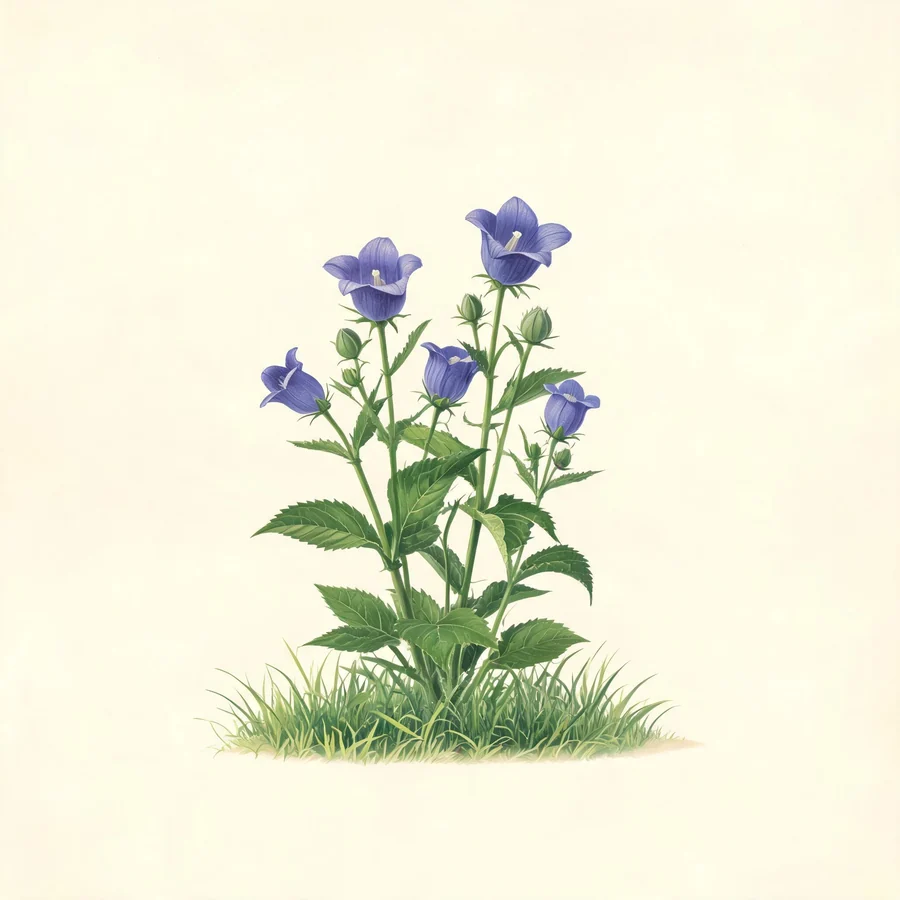
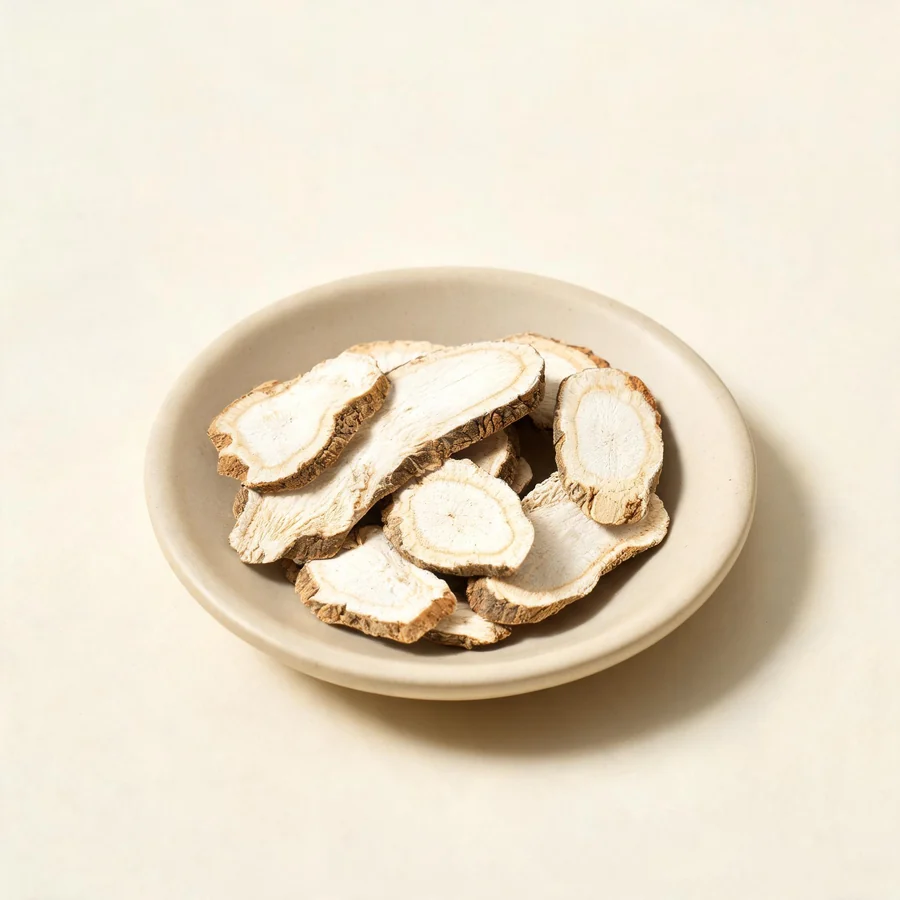
Skin profile
Where this herb sits in skin practice: the pattern it corrects, the skin signs it suits, and what it should not be used for.
Skin signs that suggest it
- A tense, red, pointing swelling or boil that needs to discharge pus
- Pustules or suppurating follicles with thick, enclosed pus and little natural drainage
- A firm nodule or cyst under the skin that is slow to disperse
- Facial or scalp lesions where the rest of the formula needs directing to the upper body
- A rash that is slow to come out, with tightness in the chest and a blocked feeling in the throat
When it is not the right herb
Not for dry skin or a dry, unproductive lesion. The root lifts and disperses, which spends fluid, so a thin, dry, scaling patch in a person with a dry throat, scanty sputum and night sweats has nothing to gain and may become drier. It is wrong where Qi is already rising: nausea, vomiting, hiccup, belching, or a flushed face with headache from rising Liver Yang. It is a support herb rather than a treatment for a spreading infection, and a boil with fever, red streaks or a large collection of pus needs medical care.
What it does for skin
Skin-relevant actions only. Each one describes a mechanism in TCM terms and what it looks like on the skin.
Expels pus and disperses a tense swelling
This is the action that brings the root into skin practice. Where pus has formed and the lesion is tight, painful and pointing, Jie Geng is held to open the pathway so the pus can leave rather than burrow. It is combined with heat-clearing and toxin-resolving herbs, and it is used for boils, abscesses and suppurating follicles rather than for dry plaques.
Carries a formula upward to the face and scalp
The boat action is a delivery role rather than a therapeutic one: the root is described as carrying other medicines up to the head and chest. That is why a small dose appears in prescriptions for facial acne, rosacea, scalp rashes and lesions around the ears, where the active herbs would otherwise be thought to work lower down. The dose for this role is deliberately light.
Opens Lung Qi so a surface that is tight can release
The tradition holds that the Lung governs the skin and body hair, and that a surface which cannot open keeps its pathogen. Jie Geng diffuses Lung Qi, and it is used where a rash is slow to emerge and the chest feels constricted, so that the eruption is not held back. This is a supporting action, used alongside the herb that actually clears the rash.
Disperses nodules that will not resolve
Its dispersing quality is applied to firm, enclosed swellings that are not frankly suppurating, where phlegm and stagnation have formed a nodule. The root is a helper in such formulas rather than the leading herb, and it is combined with herbs that transform phlegm and move blood. It will not dissolve a lesion on its own and it is not a substitute for assessing a new lump.
Skin conditions it is used for
Mapped to the condition pages on this site. The pattern column shows what the skin is doing when this herb is the right choice.
| Condition | Pattern | Why it suits | Typical setting |
|---|---|---|---|
| Skin Abscess | Toxic-heat with pus that has formed but is not discharging | A tense abscess that has formed pus and will not point is the clearest skin indication. Jie Geng opens the pathway and moves the pus outward, and it is combined with herbs that clear the toxin and cool the heat. A large, deep or febrile abscess needs medical drainage first, and the herb is support rather than a substitute. | With Jin Yin Hua, Pu Gong Ying and Zao Jiao Ci in a toxin-resolving formula |
| Boils | Toxic-heat with a single hot, pointing boil | A boil that is red, hot and coming to a head benefits from the pus-moving action, and the root is added to a formula that is already clearing heat and resolving toxin. It is used early, while the lesion is still tight, and stopped once the boil has discharged and is healing. Multiple recurrent boils need investigation rather than a longer course. | With Huang Lian, Lian Qiao and Gan Cao |
| Pustule | Heat toxin enclosed in the follicle, with thick pus | Pustules that are tense and slow to drain are a small-scale version of the abscess picture. Jie Geng helps the pus to leave and disperses the surrounding hardness, and its neutral temperature means it can sit in either a cooling or a warming formula. It is a minor component, and the heat-clearing herbs do the main work. | Within a heat-clearing formula with Huang Qin and Zhi Zi |
| Acne | Wind-heat in the Lung, with lesions on the face and upper back | The Lung channel reaches the face and the root diffuses Lung Qi, so it is a common guiding herb in acne prescriptions, particularly where lesions cluster on the face, chest and upper back. Its role is to direct the formula upward and to help papules resolve; it is not the herb that clears the inflammation. The dose for this role is small, and larger amounts only irritate the stomach. | Within Pi Pa Qing Fei Yin, at a guiding dose |
Combinations for skin
Herbs it is paired with when the skin, not an internal organ, is the target.
| Partner | Ratio | Why the pair is used |
|---|---|---|
| Gan Cao | 6 to 10 g Jie Geng with 3 to 6 g Gan Cao | The most compact formula recorded for moving pus: the root opens and lifts while liquorice soothes and moderates. In skin practice the pair is used for a tense, painful lesion that needs to drain, and it is the core to which toxin-clearing herbs are added. It is also the classical throat pair, which is why the two are so often found together. |
| Zao Jiao Ci | 6 to 10 g Jie Geng with 6 to 10 g Zao Jiao Ci | Zao Jiao Ci draws a swelling to a head and helps it discharge, while Jie Geng opens the pathway from within. The pair is used for a boil or abscess that is pointing but slow to break, and it is not used on a lesion that is already open and granulating. Both are support for a lesion that may still need drainage. |
| Huang Qin | 6 to 10 g Jie Geng with 6 to 10 g Huang Qin | Huang Qin clears the heat and toxin while Jie Geng moves the pus and carries the formula upward to the face and upper trunk. The combination suits pustular acne, folliculitis and small abscesses on the upper body. The root is neutral, so it does not blunt the cooling of the formula. |
| Yu Xing Cao | 6 to 10 g Jie Geng with 15 to 20 g Yu Xing Cao | The pair comes from the treatment of lung abscess, where one herb clears toxic heat and the other opens drainage. Its skin analogue is a deep, pus-filled lesion with surrounding redness, where the same division of labour applies: the infection is fought by one herb and the exit is kept open by the other. Neither replaces drainage or antibiotics when those are needed. |
Formulas where it leads
- Jie Geng Tang (桔梗汤) - Two herbs only, the root and liquorice, from the classical text on chest and lung abscess. It is the smallest demonstration of the pus-moving action and the source of the throat pair that later formulas borrowed.
Safety for skin use
What to check before recommending or using it, including the cautions that matter most for skin patients.
Do not use, or use with caution
- Yin deficiency with a dry cough or dry, thin skin: a parched throat, scant sticky sputum, night sweats and a tongue that is red with hardly any coating. The root lifts and disperses, which spends fluid already in short supply, and the dryness worsens.
- Qi that is already rising: nausea, vomiting, hiccup, belching, or a flushed face with headache and dizziness from rising Liver Yang. A herb whose job is to lift makes that movement worse.
- Never inject it. The platycodon saponins are haemolytic in the laboratory, and although oral saponins are broken down in the gut, a parenteral preparation is dangerous. Decoction and, where appropriate, an external wash are the only routes.
- A spreading infection: a boil with fever, red streaks, a large fluid collection, or a facial lesion in a person who is unwell. These need medical assessment and drainage, and a Lung herb is not the answer.
Pregnancy and breastfeeding
Ordinary decoction doses under guidance. The root appears on none of the classical lists of forbidden or cautioned medicines, and it appears as a vegetable dish in Korea and Japan, which suggests a wide margin. Its lifting, dispersing quality still argues for restraint: use a normal dose for a clear indication, do not push it upward, and do not take it daily as a tonic through the pregnancy. While breastfeeding, no specific prohibition is recorded and the old texts even call it a lactation-promoting herb, though that claim is traditional rather than tested; keep the course brief and stop if the baby seems unsettled.
Interactions
- No serious interaction is well documented at decoction doses. The saponins nonetheless give grounds for watching glucose: platycodin D has lowered blood sugar in animal experiments, so anyone using insulin or a sulphonylurea should check levels more often while taking the root regularly.
- Platycodin D has also shown anticoagulant activity in preclinical work, which is a theoretical concern with warfarin rather than a reported one. A person stable on an anticoagulant should mention the herb before starting it.
- A saponin-rich decoction may change the permeability of the gut, so other medicines swallowed at the same moment could be absorbed differently. Keep an hour or more between the decoction and other oral drugs, especially those with a narrow therapeutic window.
Allergy and patch testing
Reactions are uncommon, but a saponin-containing decoction or wash can sting or redden skin that is already inflamed. Patch test any wash for 24 hours on normal skin, dilute it well, and stop if burning or spreading redness develops. People who react to other Campanulaceae plants, including some ornamental bellflowers, should be cautious with the first use.
General safety references
General references for herbal hepatotoxicity and herb-drug interactions; they are not specific to this herb.
- Review article: Herbal hepatotoxicity - an update on traditional Chinese medicine preparations. Alimentary Pharmacology & Therapeutics, 2014. PMID: 24844799.
- Interactions between herbal medicines and prescribed drugs: an updated systematic review. Drugs, 2009. PMID: 19719333.
- Warfarin and food, herbal or dietary supplement interactions: a systematic review. British Journal of Clinical Pharmacology, 2021. PMID: 32478963.
Evidence
The classical record is quoted with its source. The modern note states the level of evidence plainly.
Classical record
桔梗一两,甘草二两。上二味,以水三升,煮取一升,分温再服,则吐脓血也。
One liang of the root with twice that weight of licorice is simmered in three sheng of water down to one sheng and taken warm in two drafts; the patient then coughs out pus and blood.
Jin Gui Yao Lue (Essentials of the Golden Cabinet), Jie Geng Tang - The smallest formula for pus, and the textual source of the pus-moving action that skin practice borrows for boils and abscesses.
桔梗系开提肺气之药,可为诸药舟楫,载之上浮。
Platycodon is a medicine that opens and raises Lung Qi. It can serve as boat and oar for other medicines, carrying them upward so that they float.
Ben Cao Qiu Zhen (Seeking the Truth in Materia Medica) - The boat image in its original words, and the reason a small dose of a Lung root appears in formulas for the face and scalp.
利五脏肠胃,补血气,除寒热、风痹,温中消谷,疗喉咽痛。
It benefits the five viscera and the intestines and stomach, supplements Qi and Blood, removes alternating cold and heat and wind obstruction, warms the middle and aids the digestion of grain, and treats pain of the throat.
Ming Yi Bie Lu (Supplement to the Classic of Materia Medica) - An early widening of the herb's range beyond the chest, and the first hint that its dispersing action reaches the surface and the throat.
Modern evidence
Evidence status
- Platycodin D and the crude saponin fraction have shown anti-inflammatory, immune-modulating and mucus-related activity in cell and animal studies. No clinical trial has tested Jie Geng for acne, boils, abscesses or any other skin condition, so the skin uses rest on the traditional record.
- The saponins are haemolytic in vitro, which is why the route matters: oral saponins are hydrolysed in the digestive tract, but an injected preparation would be dangerous. No parenteral product should be used.
- The root appears as a vegetable dish in Korea and Japan, which is a useful marker of a wide oral margin, though it says nothing about therapeutic effect. Above about 10 g the saponins cause nausea and gastric irritation rather than a stronger action.
PubMed records
Selected real PubMed records for this herb's species or its constituents, chosen by species name and title relevance. They are references for the non-TCM discussion above, not proof that the herb treats any skin condition.
- Network pharmacology and phytochemical composition combined with validation in vivo and in vitro reveal the mechanism of platycodonis radix ameliorating PM2.5-induced acute lung injury.. Journal of ethnopharmacology, 2025. PMID: 39278295 (pharmacology or review record).
- Bioactive platycodins from Platycodonis Radix: Phytochemistry, pharmacological activities, toxicology and pharmacokinetics.. Food chemistry, 2020. PMID: 32450486 (safety record).
- Platycodin D protects acetaminophen-induced hepatotoxicity by inhibiting hepatocyte MAPK pathway and apoptosis in C57BL/6J mice.. Biomedicine & pharmacotherapy = Biomedecine & pharmacotherapie, 2018. PMID: 30257399 (safety record).
Dose and forms
Skin-practice dosing and the preparations that suit skin complaints.
| Form | Dose and notes |
|---|---|
| Decoction | 3 to 10 g of dried root daily in a formula. The usual therapeutic range is 6 to 10 g; above that the saponins irritate the stomach, and the ceiling is one of tolerability rather than of potency. |
| Guiding dose | Three to six grams when the root is there chiefly to conduct the other herbs up to the face and scalp. A light dose does the conducting; a large one swamps the very formula it was added to steer. |
| Prepared forms | Slices of the dried root are standard. A dry-fried slice is chosen when the raw root upsets the stomach, and a honey-fried slice where the Lungs want moistening. The traditional preparation also scrapes the outer bark and steeps the slices in water from washed rice before drying them. |
Oral decoction is the only acceptable internal route, and an external wash made from the decoction is the only topical use; the material must never be injected. The dose stays small on purpose, because the upward direction sets the limit: past about ten grams the saponins mostly irritate the stomach instead of adding power. For skin work a light guiding dose is often all that is wanted, and a boil that is not draining needs a practitioner's hands rather than a larger dose.
Citations and further reading
Only real sources are listed: the classical materia medica passages quoted above, and the source works behind the botanical and safety statements.
- Essentials of the Golden Cabinet (Jin Gui Yao Lue), Zhang Zhongjing - the Jie Geng Tang passage is quoted above.
- Seeking the Truth in Materia Medica (Ben Cao Qiu Zhen), Qing dynasty - the boat passage is quoted above.
- Supplement to the Classic of Materia Medica (Ming Yi Bie Lu), attributed to Tao Hongjing - the early entry is quoted above.
- Pharmacopoeia of the People's Republic of China, Radix Platycodonis monograph - source for the accepted species, part and quality requirements.
- Modern evidence statement: laboratory literature on platycodin D and the crude saponin fraction, summarised as a statement about the level of evidence rather than as a cited finding.
Educational reference for qualified practitioners. This page is not medical advice, and skin conditions should be diagnosed by a clinician before treatment.