Skin profile
Where this herb sits in skin practice: the pattern it corrects, the skin signs it suits, and what it should not be used for.
Zao Jiao Ci is used where a lesion is stuck: pus that will not discharge, a swelling that will not point, a lump that will not soften. It is warm and dispersing rather than cold and clearing, so it is nearly always an assistant in a formula, and the patient's strength matters as much as the lesion.
Skin signs that suggest it
- A hot, red, hard swelling that throbs and will not come to a head (toxic swelling with pus forming)
- A boil that has ripened but stays tense and shiny, with no discharge (retained pus)
- A sluggish ulcer or cavity that drains reluctantly, or closes over while pus remains inside
- Firm, movable lumps under the skin that are slow to resolve and not obviously inflamed (phlegm and Blood stasis)
- Itchy, spreading, crusted or burrowing patches, worse at night (parasitic or Wind itch)
When it is not the right herb
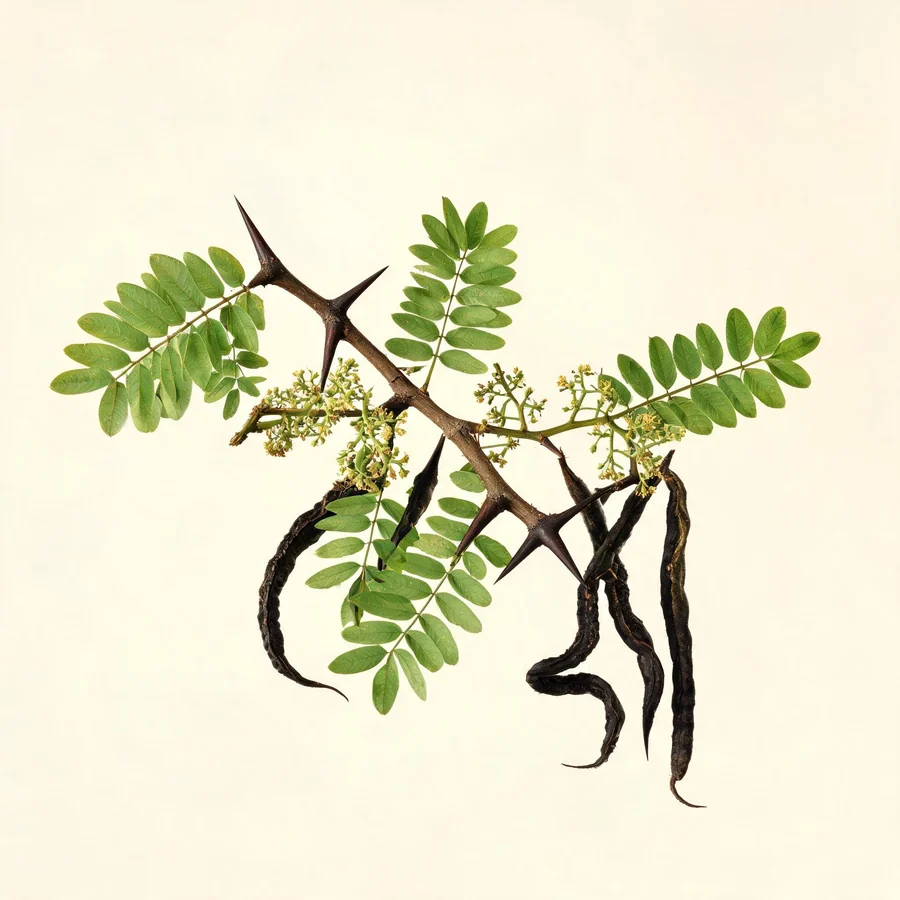
Avoid it once a lesion is draining well, and avoid it in a chronic ulcer that produces a pale, thin, watery fluid in someone already depleted: classical writers warned that forcing the exterior too hard produces empty blisters rather than healthy tissue. Pregnancy, active bleeding and heavy menstruation are further reasons for caution: this is a Blood-moving, dispersing herb. Dry, scaly skin with no swelling does not need an opener, and neither does an eruption that is hot and spreading, which calls for cooling instead. The pod of the same tree must never stand in for the thorn, because the pod is the part that carries the saponins.
What it does for skin
Skin-relevant actions only. Each one describes a mechanism in TCM terms and what it looks like on the skin.
Draws out toxin and brings a swelling to a head
The primary skin action. Before pus has collected, the aim is to scatter the swelling; after it has collected but the skin will not yield, the aim is to bring it outwards. Zao Jiao Ci is chosen at that stalled moment, when the lesion is drum-tight, glossy and pounding. It is not a cooling herb like honeysuckle and it is not a supporting tonic like astragalus: its contribution is to open the boundary between a collection and the surface, which is why a cooler and a tonic usually accompany it.
Expels pus and keeps a cavity draining
Leading outward is about direction; expelling is about the result, an enclosed collection that finally empties. Deep abscesses, infected folds and ulcers with a cavity that stays shut, or re-seals too early, are where the thorn is added. Since it acts on the exit rather than on the contents, it goes with herbs that deal with the toxin and with herbs that lend the patient enough vigour to discharge. Free drainage means the work is finished and the herb is stopped.
Disperses hardness and softens lumps
The acrid, warm, penetrating quality is borrowed for firm lumps that are not actively inflamed: subcutaneous nodules, thickened patches after repeated infection, and the hard root left behind when a boil settles. Small doses are described as lifting a lesion towards the surface and larger doses as breaking a mass down, a distinction that survives in modern practice. Any persistent lump still needs examination first, because the traditional reading explains a pattern and does not make a diagnosis.
Dispels Wind and kills parasites on the skin
The thorn is recorded as treating Wind and killing parasites, and the two are linked in the old reasoning: Heat breeds Wind, and Dampness breeds the parasites that make an itch spread and burrow. Burned to ash and dusted on, or simmered for a wash, it is used on scabies, on stubborn fungal patches and on chronic itchy eruptions that keep returning to the same place. A confirmed infestation still needs its specific treatment; the thorn settles the secondary eruption and the itch.
Skin conditions it is used for
Mapped to the condition pages on this site. The pattern column shows what the skin is doing when this herb is the right choice.
| Condition | Pattern | Why it suits | Typical setting |
|---|---|---|---|
| Boils | Toxic Heat with a boil that will not suppurate | A boil that has become a hard, tender, throbbing lump with no head is the lesion the thorn was made for. Its job is to lead the collection outward so that it points and opens, and to keep it open afterwards, which is why it sits in the great sore formulas beside honeysuckle and forsythia rather than replacing them. It is also used early, before pus forms, to disperse a swelling that is still only red and indurated. A boil on the face, or one with fever and spreading redness, needs medical assessment. | Xian Fang Huo Ming Yin with Zao Jiao Ci added, or Tuo Nong San for a depleted patient |
| Skin abscess | Retained pus in a deep or closed collection | When pus has collected but has no way out, the thorn is at its most useful, and the partner that matters is astragalus: one lends the force to expel, the other marks the way. Deep collections, infected cysts and cavities that refuse to close are treated this way, always within a formula. Anything deep, spreading or on the face is a medical problem, and here the herb supports treatment rather than replacing it. | Zao Jiao Ci with Huang Qi and Jin Yin Hua in a pus-expelling formula |
| Pustules | Heat toxin lodged at the follicle, with pustules that stay tense | Pustules that are slow to point, or that recur in the same follicles, are read as toxin that has consolidated without a route out. The thorn adds the opening action that a purely cooling formula lacks, which is why it appears in formulas for pustular acne, folliculitis of the beard and recurrent styes. It is a small component, not the leading herb, and it is stopped once the lesions settle rather than continued as maintenance. | A heat-clearing formula with Zao Jiao Ci and Lian Qiao |
| Folliculitis | Damp-heat and toxin at the hair follicle, recurring in the same sites | Folliculitis is where the thorn's two skin actions meet: there is a small collection to open and a toxin to draw out, and the lesions return in exactly the places where the tissue is congested. It is used where boils are small, multiple and stubborn rather than single and severe, and where the skin around each lesion is indurated. Shaving, occlusion and tight clothing keep the pattern alive, so the herb is only part of the management. | Zao Jiao Ci with Pu Gong Ying and Lian Qiao in a modified heat-clearing formula |
| Cellulitis | Toxic Heat spreading through the deeper tissue | Cellulitis is the one skin condition on this page where the herbal role is strictly secondary. The tradition describes spreading redness, heat, swelling and pain as Toxic Heat lodged deeper than the surface, and a herb that draws toxin outward has an obvious theoretical place. In practice the infection needs antibiotics promptly, and the thorn is used, if at all, during recovery, when an indurated area persists after the acute infection has been controlled. It is never a reason to delay medical treatment. | Supportive only, alongside antibiotics; not a stand-alone treatment |
| Scabies | Parasitic infestation with a secondary itchy eruption | The parasiticide action is the oldest of the thorn's skin uses and the most limited. It settles the itch and dries the secondary eruption, and the burned ash is the traditional external form. It does not kill the mite reliably, and a confirmed infestation needs the specific scabicide for the patient and for every household contact at the same time. The herb is comfort, not cure, and it should be described that way. | A wash of Zao Jiao Ci ash or decoction, alongside conventional scabies treatment |
Combinations for skin
Herbs it is paired with when the skin, not an internal organ, is the target.
| Partner | Ratio | Why the pair is used |
|---|---|---|
| Huang Qi | 10 to 15 g Huang Qi with 3 to 6 g Zao Jiao Ci | The pattern behind the classical pus-expelling method: one herb lends the force to push a collection outwards, the other marks the channel it travels. The quantities are intentionally lopsided, with astragalus given in the greater amount, because weakness is the reason the abscess is stranded. It fits a depleted patient with a ripened boil and no strength to bring it to the surface, and the decision belongs to a practitioner. |
| Jin Yin Hua | 10 to 15 g Jin Yin Hua with 6 to 10 g Zao Jiao Ci | One herb cools and neutralises the toxin, the other opens and steers. The pairing serves early boils and carbuncles which are red and hot, painful, and not yet discharging: cooling by itself would leave the collection sitting, and opening by itself would leave the Heat untouched. The cooling herb carries the heavier dose, because Heat is the measurable problem and the thorn is the facilitator. |
| Chuan Shan Jia | 6 to 10 g each where the material is lawfully available | The old pairing for a deep collection holding pus with no exit: one material breaks through stasis and softens hardness, the other decides where the contents leave. Pangolin is protected and its trade restricted, so contemporary practice usually replaces it with the thorn alone, or with astragalus. Knowing the comparison still helps, because it accounts for the thorn's reputation with hard lumps as well as with pus. |
Formulas where it leads
- Xian Fang Huo Ming Yin (仙方活命饮) - The standard formula for early, hot, painful sores and boils, and the context in which the thorn is most often taught. Honeysuckle, forsythia and the other clearers deal with the Heat and the toxin, while Zao Jiao Ci and Bai Zhi give the formula its outward direction, so that a swelling points and discharges rather than spreading inwards.
- Tuo Nong San (透脓散) - A formula built on astragalus and the thorn, with a little angelica and honeysuckle. It is chosen when an abscess has ripened but the patient lacks the strength to discharge it, and it demonstrates the division of labour plainly: tonics supply force, the thorn supplies the way out. Practitioner territory, not domestic.
Topical use
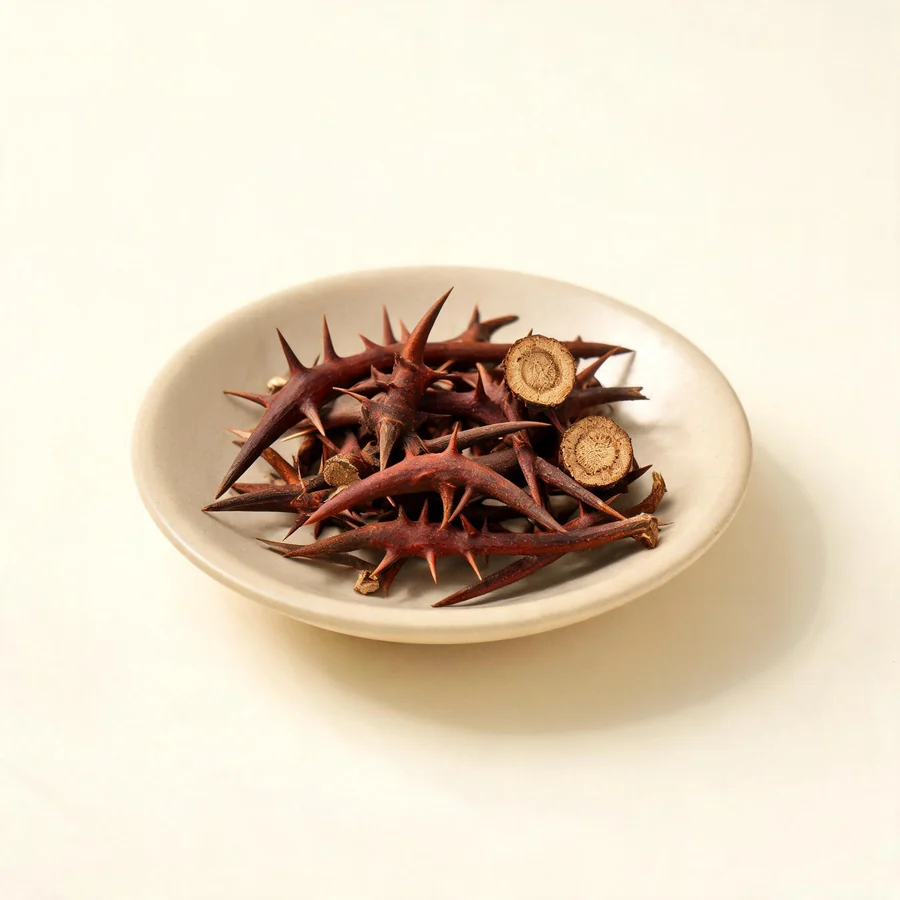
The thorn is used externally as a dusting powder and as a wash. The traditional preparation burns the dried thorn to ash, grinds it fine and applies it to a lesion that is slow to dry or slow to close; a decoction is used to bathe an area that needs the same opening and drying action without the grit. Topical use is limited to small areas, and it is always secondary to getting the internal formula and the medical assessment right.
| Preparation | How and when it is used |
|---|---|
| Thorn ash dusting powder | Burn clean dried thorn to a pale ash, grind it fine, and dust a thin film over a sluggish, weeping or slow-to-close lesion once a day. Charring is held to add an astringent quality and to lessen irritation. Do not use it on an openly infected area or a deep cavity without supervision, and stop if the surrounding skin grows redder. |
| Cooled decoction wash | Simmer 10 to 15 g of thorn in 500 ml of water for 20 minutes, strain and cool to skin temperature. Bathe or compress the area for 10 minutes once or twice daily, pat dry, and make a fresh batch each time rather than keeping the liquid. |
| Poultice around an indurated boil | Where a boil is hot and hard, the ash is sometimes blended with a cooling powder and applied sparingly around, not over, the opening. This is a traditional clinic preparation and is not a substitute for incision or for antibiotics when drainage is needed. |
Patch test and cautions
Patch test on normal skin for 24 hours before the first use. Do not apply to a deep, openly infected or facial lesion without clinical supervision, keep the powder and wash away from the eyes, and stop at once if burning or spreading redness develops. Do not cover a treated area with an occlusive dressing, and wash the hands after handling the powder because it can irritate the nose and throat.
Safety for skin use
What to check before recommending or using it, including the cautions that matter most for skin patients.
Do not use, or use with caution
- Pregnancy, and breastfeeding while supply is still being established. The thorn moves Blood and disperses, and it was once given to assist in expelling a retained placenta, the strongest indication that it acts on the uterus. Only a practitioner supervising a clear indication should consider it.
- Weakness with Qi deficiency. Pushing the exterior too hard in a depleted person can produce empty blisters rather than healthy tissue, so a Qi tonic such as astragalus belongs alongside it.
- An abscess that is already draining, or a chronic ulcer with pale, thin fluid. Opening action of this strength can prevent a wound from closing, so the herb is withdrawn as soon as drainage flows.
- Pod material is not a substitute. The thorn is non-toxic, but the pod contains saponins that inflame mucous membranes and provoke vomiting and diarrhoea, so a batch should be inspected for pod fragments.
Pregnancy and breastfeeding
Best avoided unless an experienced practitioner prescribes it for a definite reason. The worry is the uterus rather than poison: this is a Blood-moving herb, and the old use for a retained placenta is the most direct sign that it has an effect there. Breastfeeding is a different case, since the herb has a real place in postpartum breast problems, but the indication and the dose need a practitioner and the course should be brief.
Interactions
- Warfarin, heparin, aspirin and clopidogrel. Because this is a Blood-moving herb, the theoretical risk is additive bleeding, so anyone on an anticoagulant or antiplatelet drug should tell both prescriber and pharmacist, and unexplained bruising should prompt a stop.
- Nothing else is well documented for the thorn. With such a thin evidence base, the sensible habit is to leave an hour or two between it and other medicines, and to report anything unexpected rather than assume it cannot happen.
- Topical use alongside a prescription steroid cream or antibiotic ointment is common in clinic practice. Apply the two at different times of day so that neither dilutes the other, and stop the herbal preparation if the skin becomes more irritated rather than calmer.
Allergy and patch testing
Contact reactions to herbal dusting powders and washes are recognised, and the ash is abrasive enough to irritate intact skin if it is applied thickly. Patch test first, keep the preparation to a limited area, and stop immediately if the skin becomes redder, hotter or more itchy. Handling the fine powder can make a sensitive person sneeze or develop a rash on the hands, so gloves and a damp cloth are sensible when preparing it.
General safety references
General references for herbal hepatotoxicity and herb-drug interactions; they are not specific to this herb.
- Review article: Herbal hepatotoxicity - an update on traditional Chinese medicine preparations. Alimentary Pharmacology & Therapeutics, 2014. PMID: 24844799.
- Interactions between herbal medicines and prescribed drugs: an updated systematic review. Drugs, 2009. PMID: 19719333.
- Warfarin and food, herbal or dietary supplement interactions: a systematic review. British Journal of Clinical Pharmacology, 2021. PMID: 32478963.
Evidence
The classical record is quoted with its source. The modern note states the level of evidence plainly.
Classical record
皂荚刺,拔毒祛风。凡痈疽未成者,能引之以消散;将破者,能引之以出头;已溃者,能引之以行脓。于疡毒药中为第一要剂。
It pulls out toxicity and expels Wind. A swelling not yet formed is led towards dispersal, one about to break is led to a head, and one already open is led to discharge its pus; among sore medicines it ranks first.
Ben Cao Hui Yan (Collected Words on Materia Medica), Qing dynasty - The three-stage scheme that later writers repeat, and the reason the dose and the partner change as a boil evolves.
皂荚刺治风杀虫,功与荚同,但其锐利直达病所为异耳。
The thorn treats Wind and kills parasites, and its work matches that of the pod; what sets it apart is a sharpness that carries it straight to the seat of the illness.
Ben Cao Gang Mu (Compendium of Materia Medica), Li Shizhen - Li Shizhen settles the part question in one line, and his phrase about reaching the disease site is repeated by every later writer.
角刺治痘疹气滞,不能起顶灌脓者,功效最捷,而气虚者慎勿误用,恐透表过锐,反生虚泡也。
For pox with Qi stagnation that will not raise a head or fill with pus it acts quickly, yet in Qi deficiency it must not be misused, since too sharp a push through the exterior raises empty blisters instead.
Ben Jing Feng Yuan (Encountering the Origin in the Classic of Materia Medica), Qing dynasty - The classical basis for the warning about depleted patients, and the passage behind the modern pairing with astragalus.
Modern evidence
Evidence status
- Laboratory work on the thorn reports flavonoids such as fustin and fisetin, with anti-inflammatory and antimicrobial activity in cell and animal studies. Nothing in that work shows that the thorn opens an abscess in a person, and the traditional claim is about direction rather than about killing organisms.
- This edition found no trial of the thorn alone in skin infection or abscess. Reports of large doses for breast lumps rest on practitioner experience rather than controlled work, and they are far outside domestic use.
- Part identity is the practical safety question. Pharmacopoeial status separates the two parts: the thorn is non-toxic, whereas the pod is rated slightly toxic on account of its saponins. A batch should therefore be checked for pod fragments rather than assumed to be thorn.
PubMed records
Selected real PubMed records for this herb's species or its constituents, chosen by species name and title relevance. They are references for the non-TCM discussion above, not proof that the herb treats any skin condition.
- Profiling of widely targeted metabolomics for the identification of chemical composition in epidermis, xylem and pith of Gleditsiae Spina.. Biomedical chromatography : BMC, 2022. PMID: 35000209 (pharmacology or review record).
Dose and forms
Skin-practice dosing and the preparations that suit skin complaints.
| Form | Dose and notes |
|---|---|
| Decoction for skin lesions | 3 to 10 g of dried thorn daily inside a formula, for boils, abscesses and sluggish ulcers. The lower end suits an indurated swelling that needs help to point, and the upper end suits a collection with retained pus. |
| Higher supervised doses | 15 to 30 g is recorded for stubborn lumps, and specialist practice has reported far larger figures for breast masses. Those numbers belong to supervised care and should not be copied from a page. |
| External use | 10 to 15 g simmered for a wash, or the dried thorn burned to ash and dusted thinly. The external route is used on limited areas and does not replace drainage when a collection needs it. |
| Course length | Stop when the lesion has drained or the swelling has dispersed. A course is measured in days to a few weeks, and a boil that is no better, or is spreading, needs assessment rather than a longer course. |
Quantity follows the task rather than any toxic threshold, since toxicity is not what limits the thorn, and the pod carries that rating instead. A little is said to raise a swelling towards the skin, a lot to break a mass apart, which explains the very wide range on record. Two things set the ceiling: the Blood-moving action, which keeps the big numbers in supervised hands, and the need to verify which part of the tree is in the packet.
Citations and further reading
Only real sources are listed: the classical materia medica passages quoted above, and the source works behind the botanical and safety statements.
- Ben Cao Gang Mu (Compendium of Materia Medica), Li Shizhen, 1578 - thorn entry quoted above.
- Ben Cao Hui Yan (Collected Words on Materia Medica), Qing dynasty - three-stage passage quoted above.
- Ben Jing Feng Yuan (Encountering the Origin in the Classic of Materia Medica), Zhang Lu, 1695 - warning on Qi deficiency quoted above.
- Pharmacopoeia of the People's Republic of China - thorn monograph: botanical source, part used, non-toxic classification and quality requirements, and the separate entry for the pod.
- Modern evidence statement: based on laboratory literature on Gleditsia sinensis flavonoids, summarised as a statement about the level of evidence rather than as a cited finding. No clinical trial is presented as proof of effect.
- Botanical description and part identification: botanical literature on Gleditsia sinensis, Fabaceae, and pharmacognostic descriptions of the thorn.
Educational reference for qualified practitioners. This page is not medical advice, and skin conditions should be diagnosed by a clinician before treatment.