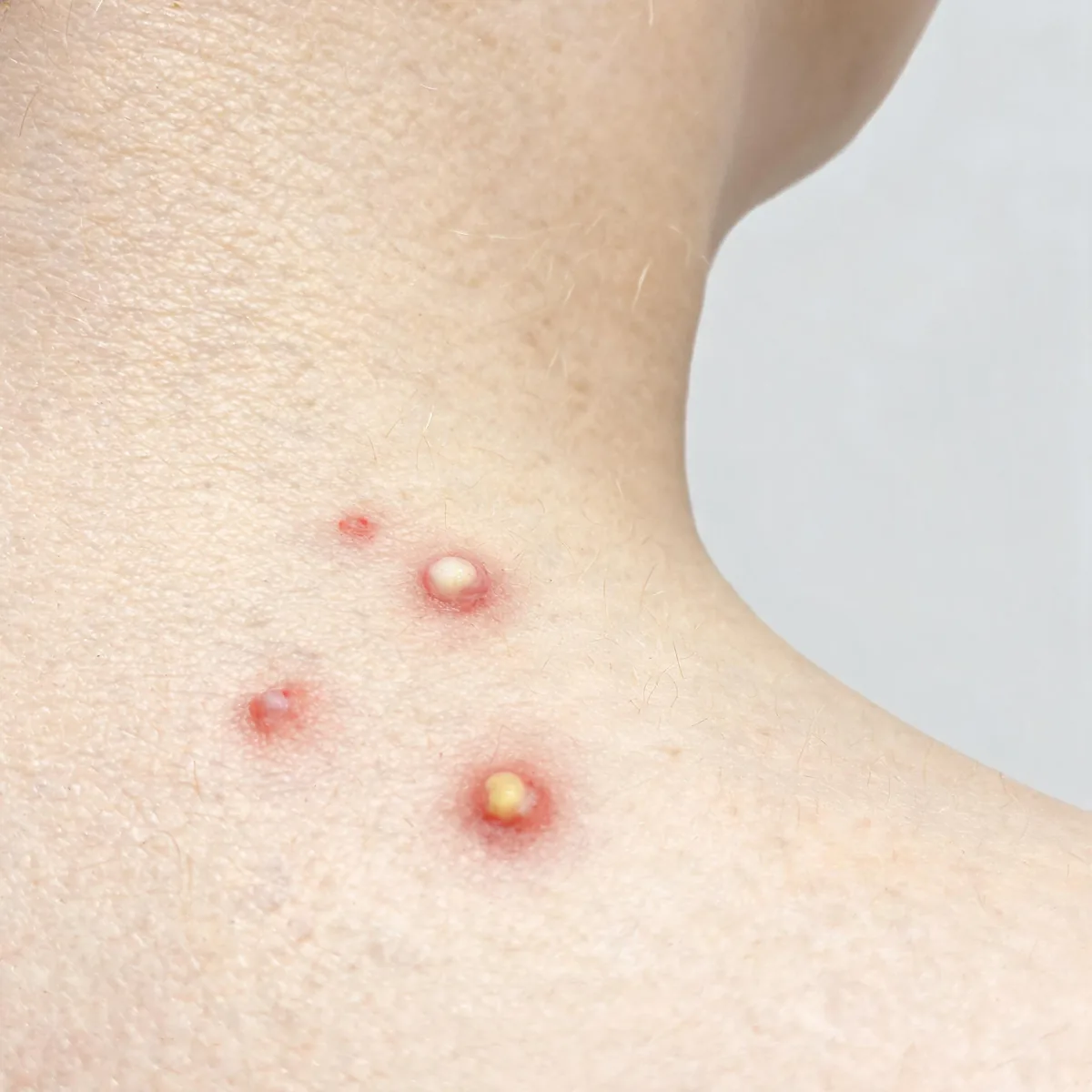
Understanding Pustule
The tradition describes a pustule as the result of heat and dampness accumulating at the surface: the heat dries the fluids and turns them into pus.
Summer Heat with Dampness is the seasonal pattern: dense clusters of yellow pustules with distinct red halos, thick yellow crusts after rupture, body heaviness and chest stuffiness. It appears in hot humid weather.
Toxic-Heat gives bright red, swollen, painful pustules with thick yellow crusts, high fever, intense thirst and a throbbing hot sensation. The classical literature treats this as the more severe picture.
Spleen deficiency with dampness gives the opposite: sparse pale pustules with faint or no red halo, poor appetite, bloating and fatigue. That is a deficiency pattern, where clearing alone would weaken the person further.
Seen through this lens, a pustule is a small local battle. The Lungs are said to govern the skin and the pores, and the Spleen to transform and transport fluids, so an eruption is read as those functions under strain rather than as a purely surface event. Where Heat and Dampness collect, the Heat thickens the fluids into pus and the Dampness leaves the tissue around it swollen and wet, which is why a pustule looks both angry and oozy. Its colour, the size of the red ring around it and the thickness of the crust are the practitioner's clues to how far the process has gone.
In summer the strain usually arrives from outside. Heat and Dampness in the air lodge in the skin and disturb the opening and closing of the pores, producing crops of bright yellow pustules ringed with red, the picture the classical literature calls Summer Heat with Dampness. If nothing checks it, the same heat can deepen into fire poison, with lesions that are red, swollen and throbbing and a person who is feverish, very thirsty and constipated. The opposite course is also possible: a Spleen weakened by poor food, long hours or illness stops managing fluids, and pale sparse pustules appear with tiredness and a poor appetite. Clearing suits the first two; the third needs building as much as clearing, which is why one diagnosis such as impetigo can call for three quite different formulas.
Conventional view
Conventionally a pustule is a small raised lesion containing pus, a visible collection of white cells, bacteria and tissue debris. It can arise from bacterial infections such as impetigo and folliculitis, inflammatory acne, pustular psoriasis or allergic reactions, and diagnosis is usually visual, with a swab or culture when the causative bacteria need identifying. Typical signs are redness, swelling, tenderness and a yellow or white head that may rupture and crust.
Treatment depends on the cause and severity: topical antibiotics such as mupirocin or fusidic acid for impetigo with oral antibiotics for widespread cases, topical benzoyl peroxide, retinoids or antibiotics for acne-related pustules, and universal advice on hygiene, gentle cleansing and not picking. Antiseptic washes are sometimes used to limit spread.
Antibiotics and topical agents kill bacteria and calm inflammation effectively but do not address the internal environment that allowed infection or inflammation to take hold, so pustules often recur in warm humid weather or in people with weakened immunity or poor digestion, and repeated antibiotic use raises resistance concerns.
Selected PubMed records
Real PubMed records for the conventional discussion above, selected by condition name and title relevance. They are references, not a claim that any treatment is proven for this condition.
- The terminology of skin disorders. Primary Care, 2000. PMID: 10815043.
How it is assessed
The practitioner assesses the pustules, the halos and the season.
What a practitioner looks for
- Halo: a distinct red halo suggests active heat or toxic heat.
- Density: dense clusters suggest Summer Heat with Dampness; sparse pale pustules suggest deficiency.
- Systemic signs: high fever and thirst indicate Toxic-Heat.
- Timing: appearance in hot humid weather supports the seasonal pattern.
A practitioner reads a pustule the way a surveyor reads ground: the colour of the pus, the sharpness of the halo, whether the lesions sit close together or apart, and what the crust looks like once a blister has broken. Questions follow about thirst, appetite, bowel movements, energy and fever, because a skin sign alone cannot separate a seasonal excess from a deficiency. The tongue and the pulse are then used to confirm the reading.
Dense crops of yellow or yellowish-brown pustules with a clear red ring, thick yellow crusts, thirst, constipation and dark urine point to Summer Heat with Dampness; the tongue is red under a greasy yellow coating and the pulse runs slippery and rapid. Stronger redness with swelling and throbbing pain, a fever that runs high, thirst that is hard to quench and constipation that is marked move the reading to Toxic-Heat, where the tongue is redder still and the pulse is rapid and forceful. In recurrent cases the picture reverses: lesions are few, pale and thinly crusted, the complexion is sallow, the stools are loose and the person is tired, with a pale tongue, a thin white coating and a soft slow pulse.
Because the same appearance can arise from several causes, the practitioner also asks when the eruption began, whether it followed hot humid weather or a change in diet, whether sleep and meals have been regular, and whether the lesions are being scratched. Scratching matters in this framework because it breaks the surface and is said to let damp-heat spread to new skin, which turns a small crop into a wider one and can leave marks behind.
TCM patterns in Pustule
Pustules are differentiated by how angry they look and by what accompanies them, not by the number of lesions alone. The first question is whether the process is excess or deficient: dense yellow pustules with a clear red ring, thick crusts, thirst and constipation describe too much Heat and Dampness, while sparse pale pustules with faint halos, a poor appetite and fatigue describe a weak Spleen that cannot move fluids. The second question is how deep the Heat has gone. A seasonal picture with heaviness, chest stuffiness and a fever that does not break with sweating stays near the surface, whereas bright redness, swelling, throbbing pain and a high fever signal that Heat has condensed into toxin and needs stronger, colder medicine. Those two excess patterns sit on one slope and often follow each other within days, so treatment is adjusted as the skin changes.
| Pattern | Key signs | The itch | Tongue | Main formula |
|---|---|---|---|---|
| Summer Heat with Dampness | Dense clusters of yellow pustules with red halos; Thick yellow crusts after rupture | Not specified | Body: RedCoat: White greasy, turning yellow greasy if Heat predominates | Not specified |
| Toxic-Heat | Bright red swollen painful pustules; Thick yellow crusts | Not specified | Body: Red, often with raised red pointsCoat: Yellow, dry, sometimes thick | Not specified |
| Spleen Deficiency with Dampness | Sparse pale pustules with faint or no red halo | Not specified | Body: Pale and swollen, often with teeth marks along the edgesCoat: White, greasy and moist, thick in the middle | Not specified |
Summer Heat with Dampness
Dense yellow pustules with red halos in hot humid weather.
This pattern belongs to the hot months. Heat and Dampness from the weather are said to enter through the skin and settle where the pores open and close, so the surface stops ventilating properly. Dampness gathers as small fluid-filled blisters, Heat thickens that fluid into yellow pus and reddens the skin around each one, and when a blister breaks the dampness leaks out and dries into a thick crust. Because the pathogen is heavy and turbid, the person feels weighed down: the body is heavy, the chest and upper abdomen feel stuffy, and a fever may persist without breaking into a sweat.
The tongue is red and carries a greasy coating, white or yellow, and the pulse is soggy and rapid, as though a wet cotton ball were being pressed. Hot humid weather, greasy or fried food, alcohol and scratching all make it worse, while a cool dry room, cooling food and gentle washing with cool water ease it. The classical literature names Wu Wei Xiao Du Yin to add when the pustules look infected, whose key herbs are Jin Yin Hua and Lian Qiao, and the points LI-4 (Hegu) and LI-11 (Quchi) to clear Heat from the surface.
Signs
- Dense clusters of yellow pustules with red halos
- Thick yellow crusts after rupture
- Body heaviness and fatigue
- Chest stuffiness
- Worse in hot humid weather
Diet and lifestyle for this pattern: Keep the skin clean and dry and bathe with cool or lukewarm water. Wear loose breathable cotton so heat and moisture do not get trapped, eat light cooling food such as mung bean soup, winter melon and cucumber, and avoid greasy, spicy and sugary food that creates internal Dampness and Heat.
Toxic-Heat
Bright red swollen painful pustules with fever.
When Heat is not cleared it can condense into toxin, a state the tradition describes as fire poison erupting through the skin. The heat is no longer only at the surface; it burns the tissues themselves, so the lesions are bright red, swollen, hard and throbbing, and pus forms quickly beneath thick yellow crusts. The same internal fire consumes fluids, which is why the person runs a high fever, drinks cold water in quantity, feels restless and passes dark scanty urine while the bowels become dry.
The tongue body is red and thorny under a dry yellow coat, and the pulse is rapid and forceful, often full or overflowing. Spicy and fried food, alcohol, sun exposure, anger and overwork all feed the fire, while cool compresses, plenty of water and a cool room are the measures that help. Wu Wei Xiao Du Yin is the first formula named, Huang Lian Jie Du Tang is added when the heat is systemic, and the points DU-14 (Dazhui) and LI-11 (Quchi) are used to clear Heat and resolve toxicity.
Signs
- Bright red swollen painful pustules
- Thick yellow crusts
- High fever with intense thirst
- Hot throbbing sensation in the lesions
Diet and lifestyle for this pattern: Avoid spicy, greasy and sugary food that adds fuel to the fire. Drink plenty of plain water and cooling herbal teas such as chrysanthemum, keep the skin clean and dry, never pick or squeeze pustules, which can spread the toxin deeper, and rest in a cool aired space so the body's Heat can dissipate.
Spleen Deficiency with Dampness
Sparse pale pustules with faint halos and fatigue.
Here the problem is not too much pathogen but too little capacity. A Spleen weakened by irregular meals, cold and raw food, overwork or a long illness cannot transform and transport fluids, so they pool as Dampness. That dampness eventually seeps outward into the skin, but because Qi is low and Heat is mild the pustules are few, pale yellow and barely ringed with red, and the crusts are thin. The same weakness shows elsewhere: a poor appetite, bloating after eating, heaviness in the limbs, drowsiness after meals and loose stools, with a sallow complexion and a tendency for the eruption to return whenever the person is tired or eats badly.
The tongue is pale, swollen and marked by teeth, with a coating that is white and greasy, or thin and white, over a moist surface; the pulse is soggy and slow, soft under pressure and weakest at the right guan position. Cold raw food, damp weather, overwork and worry make it worse, while warm cooked meals, small frequent portions, rest and gentle walking help. Shen Ling Bai Zhu San is the formula named, with Bai Zhu and Fu Ling as its key herbs, supported by BL-20 (Pishu) and ST-36 (Zusanli) to tonify the Spleen.
Signs
- Sparse pale pustules with faint or no red halo
- Poor appetite with bloating
- Heaviness in the body
- Fatigue and drowsiness
Diet and lifestyle for this pattern: Eat warm, cooked, easy food such as soups, stews and congees, and avoid cold, raw, greasy and dairy food that burdens the Spleen. Regular gentle exercise such as walking helps Qi move and Dampness disperse, and smaller frequent meals suit this pattern better than large ones.
Treatment approach
How the tradition treats pustule, with the herbs, formulas and points used for it.
Principles
- Clear heat and resolve toxicity where pustules are dense with red halos.
- Drain dampness in the seasonal pattern, and support the Spleen once the acute phase settles.
- Do not drain or squeeze pustules, which the classical literature treats as spreading infection.
- Treat fever or rapid spread as medical emergencies rather than herbal ones.
- Root and branch are treated in sequence rather than together at full strength. In an acute seasonal or toxic picture the branch comes first, with Wu Wei Xiao Du Yin or Huang Lian Jie Du Tang clearing Heat and toxin while topical washes cool the skin; once the lesions settle, the Spleen is supported with Shen Ling Bai Zhu San so that dampness does not rebuild. Where deficiency is the main story the order reverses: gentle tonification leads and only light heat-clearing herbs are added, because strong cold medicine would further weaken a Spleen that is already struggling.
Herbs used
Formulas
Acupoints
- LI-4 (Hegu)
- LI-11 (Quchi)
- SP-9 (Yinlingquan)
- DU-14 (Dazhui)
- BL-20 (Pishu)
- ST-36 (Zusanli)
- SP-6 (Sanyinjiao)
- zhongwan-ren-12
What to expect
- The tradition describes pustules settling within one to two weeks with treatment.
- The deficient pattern clears more slowly and requires Spleen support.
- Scarring is possible with deep or repeated pustular lesions.
- Change is usually seen first in the skin: redness settles and fewer new lesions appear before the old crusts have gone, so the visible improvement can lag behind the internal one. Setbacks are common in humid weather or after a run of late nights and rich meals, and they are read as information about the root rather than as failure. Once the skin is clear, many people keep a lighter diet and occasional treatment through the hot season to reduce recurrence.
Safety and when to get help
Seek medical help urgently for
- Pustules spreading rapidly across a large area.
- High fever, chills or feeling very unwell.
- A single painful hot swelling with fever, which may be an abscess.
For anything severe, sudden or spreading quickly, read when a skin problem needs urgent care.
Cautions
- Do not burst pustules.
- Recurrent pustules need medical review for the underlying cause.
- Diabetes and immune suppression make infection more serious.
Using this alongside conventional care
- TCM is described as complementary to conventional care: antibiotics or prescribed topical treatment come first where infection is spreading.
- Where the skin is infected, prescribed antibiotics or topical treatment come first and are not replaced by herbs; the two are used together, with the herbal part supervised. Jin Yin Hua and Lian Qiao are the herbs most often described as supporting that combined approach, and the classical literature notes that they may help recovery without substituting for antibiotics in a severe infection. Both practitioners should know the full list of medicines, and anyone with diabetes or a weakened immune system is advised to have the two plans coordinated rather than run in parallel.
Diet and lifestyle
- Reduce heat and dampness by avoiding spicy, fried, greasy and sweet food, and favour cooling fresh vegetables.
- For the excess patterns the useful additions are cooling and drying: cucumber, celery, bitter gourd, mung bean and winter melon, with plenty of room-temperature water and less fried, spicy and sugary food. For the deficient pattern the emphasis shifts to warm cooked meals such as congee, soups and steamed vegetables, in small frequent portions, with no cold drinks, raw salads or heavy dairy. In both cases regular meal times matter, because erratic eating is one of the ways the Spleen is said to lose its grip on fluids.
If you're pregnant
The classical literature advises caution rather than avoidance. Strong heat-clearing herbs such as Huang Lian are cold in nature and are used only under supervision, and applying a wash made from Wu Wei Xiao Du Yin is described as the safer route while pregnant. Internal formulas are adjusted by a practitioner who knows the pregnancy, no points are used on the lower abdomen or lower back, and distal points such as LI-4 (Hegu) and LI-11 (Quchi) are used instead.
If you're breastfeeding
Bitter-cold herbs such as Huang Lian and Huang Qin can enter breast milk and may loosen a baby's stools, so washing with Wu Wei Xiao Du Yin is preferred while nursing. Where internal herbs are needed, the milder options named in the classical literature are Jin Yin Hua, Fu Ling and Lian Qiao, and acupuncture is described as posing no risk to the infant. Dietary support for the Spleen is also suggested while milk is being established.
If treating a child
Impetigo is common in children, especially in hot humid summers, and because a child's Spleen is still developing the deficiency pattern is often underneath. Children cannot always describe thirst or heaviness, so the tongue and pulse and the look of the lesions carry more weight than the history. Doses are reduced to roughly a third to a half of the adult amount, washes are used freely, and Shen Ling Bai Zhu San is the formula named to reduce recurrence.
If treating an elderly patient
In older people Spleen and Kidney Yang decline, so the deficient pattern tends to dominate and lesions heal slowly. Very cold herbs can damp down an already weak digestive fire, so treatment balances clearing with support, and Shen Ling Bai Zhu San is favoured as a gentle root formula. Moxibustion at points such as ST-36 (Zusanli) and BL-20 (Pishu) is described as a way to lift Qi, and prevention matters more than speed.
Urgent-sign guidance is based on standard sources: NHS anaphylaxis, NHS cellulitis, NHS Stevens-Johnson syndrome, NHS melanoma.
Evidence
Evidence status
Compiled for this page from the classical and modern literature; not a systematic review, so treat it as a pointer to sources rather than clinical guidance.
Most research comes from China, where herbal washes and internal formulas are widely used. Randomised trials show Wu Wei Xiao Du Yin, as a topical wash or with an oral decoction, clearing lesions faster than antibiotic ointment alone, and studies of Shen Ling Bai Zhu San for recurrent impetigo suggest lower relapse rates by strengthening the Spleen. Large double-blind English-language trials are lacking, and where infection is spreading, antibiotics still come first.
Studies often cited
Randomised trials report faster lesion clearance than antibiotic ointment alone. Chinese randomised controlled trials (as recorded in the source)
Studies suggest reduced relapse rates by strengthening the Spleen. Clinical studies (as recorded in the source)
Classical record
When the Spleen is deficient and dampness prevails, it erupts on the skin as pustules that are pale, not red, and recurrent and hard to heal.
- Wai Ke Zheng Zong (Orthodox Manual of External Medicine), chapter on sores and ulcers. The Chinese original is not reproduced here: it could not be recovered reliably from the source record, and is not guessed.
脓疱疮者,由风湿热客于皮肤,搏于气血,乃生脓疱。
Where wind, Dampness and Heat settle into the skin and clash with the Qi and Blood, pustules form.
Zhu Bing Yuan Hou Lun (General Treatise on the Cause and Symptoms of Diseases), Volume 35 - Classical citation.; the translation is our own.
Common questions
Are pustules always infected?
No. The tradition describes them as heat and dampness at the surface, which may or may not involve bacterial infection, so severe or spreading cases need medical assessment.
Can herbs clear pustules?
The tradition describes clearing heat and toxicity, with improvement over one to two weeks.
Should I pop them?
No. Bursting spreads the process and risks infection.
When is it urgent?
Rapid spread, high fever, or a painful hot swelling with fever.