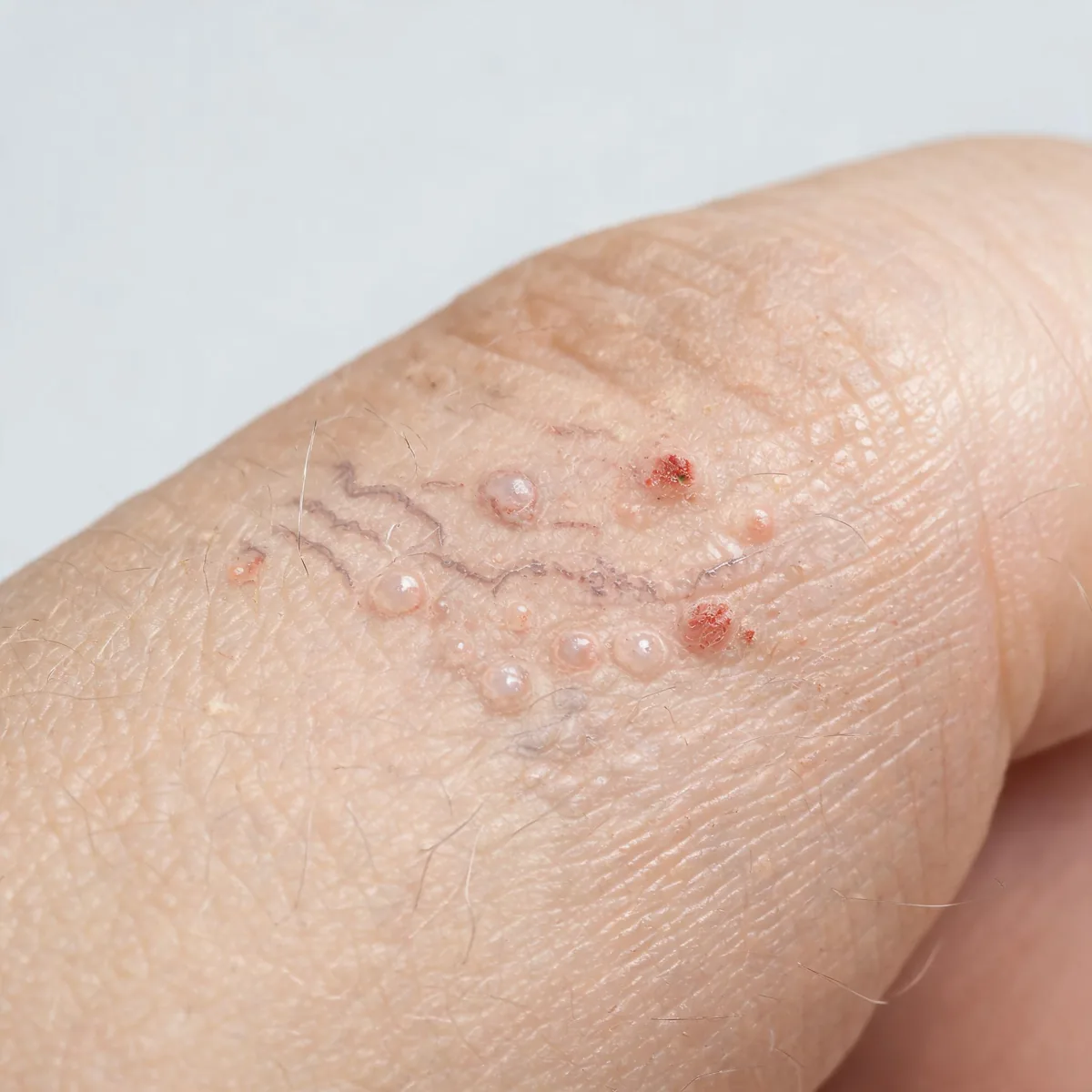
Understanding Scabies
The tradition describes the mites as parasitic toxin, an external invasion that interacts with the internal environment.
The important question in this framework is not whether mites are present but why one person develops severe inflamed lesions while another has mild symptoms. The answer lies in the pattern.
Wind-Heat gives intense itch that worsens at night and with heat, with red papules or tiny blisters in the skin folds, between the fingers and on the wrists. Damp-Heat gives oozing and crusting after scratching, with heaviness and a bitter sticky taste.
Blood deficiency with external wind gives dry scaly flaking lesions with intense night itch, a pale complexion and an aversion to drafts. That pattern explains the chronic itchy phase that persists after the mites are gone, which is a common reason people keep seeking treatment.
Two organs carry most of the explanation. The Liver is the organ that stores blood and keeps Qi moving smoothly, so when it is constrained heat can rise towards the surface. The Spleen is the organ that transforms fluids, and when that organ is weak dampness gathers, then spills into the skin channels, which is exactly the moist environment in which mites and secondary infection flourish. That is why the same infestation can look severe in one person and mild in another: the mites are the same, but the terrain they land on is not.
The quality of the itch is itself a diagnostic clue. An itch that arrives suddenly and seems to move about belongs to wind. An itch that persists and worsens in humid weather, with oozing and crusting, belongs to damp-heat. A dry itch that is worst at night, at the hour when blood should be nourishing the skin, belongs to blood deficiency. Listening to how the itch behaves, rather than only to where the rash is, is what allows a practitioner to choose between clearing, draining and nourishing.
Conventional view
Scabies is a highly contagious infestation by Sarcoptes scabiei, a microscopic mite. The female burrows into the skin to lay eggs, and the allergic reaction to the mite and its waste is what causes the intense itch, characteristically worse at night. The rash shows as small red bumps, blisters or thin wavy burrow lines, most often between the fingers and on the wrists, elbows, armpits, waist and genitals. Diagnosis is usually clinical, supported by a history of close contact and sometimes by skin scraping under a microscope.
Standard treatment is permethrin 5% cream applied from the neck to the toes and left on for 8 to 14 hours, repeated after a week. Oral ivermectin is an alternative, particularly for crusted scabies or in outbreaks. Antihistamines and topical corticosteroids may be used for the itch but do not kill mites, and every household member and close contact is treated at the same time to prevent reinfestation.
Killing the mite is not always the end of the problem. Itching can persist for weeks after the mites are gone, the treatment does nothing about the skin susceptibility that allowed the infestation to take hold, and reinfestation is common in crowded settings or where immunity is impaired. Resistance to permethrin and ivermectin is also emerging in some regions. A single protocol also makes no distinction between the hot red rash of a robust person and the dry, slow-healing lesions of an older or depleted one, and that distinction is where a pattern-based approach adds something.
Selected PubMed records
Real PubMed records for the conventional discussion above, selected by condition name and title relevance. They are references, not a claim that any treatment is proven for this condition.
- Failure of scabies treatment: a systematic review and meta-analysis.. The British journal of dermatology, 2024. PMID: 37625798.
- Scabies: Epidemiology, Diagnosis, and Treatment.. Deutsches Arzteblatt international, 2021. PMID: 34615594.
How it is assessed
The practitioner looks for the distribution and the skin reaction.
What a practitioner looks for
- Distribution: finger webs, wrists and skin folds are classic sites.
- Timing: itch worse at night is the strongest clinical clue.
- Skin state: red papules and blisters suggest Wind-Heat; oozing crusts suggest Damp-Heat; dry scaling suggests Blood deficiency.
- Household: itching in family members or partners strongly supports the diagnosis.
The first questions are about timing. When did the itching begin, and what makes it worse? An eruption that started suddenly, with fierce itching, red papules and a feeling of heat, is read as wind-heat, and it fits the early stage when the pathogen is still near the surface. The tongue is red and carries only a thin coat, while the pulse floats and is rapid.
If dampness has joined the heat, the itch becomes more persistent and the skin begins to ooze or crust, and the coating on the tongue turns yellow and greasy while the pulse becomes slippery and rapid. That points to the Spleen and Stomach producing internal dampness that keeps feeding the lesions. Heat that stays in the surface layer alone does not produce such a coating, so its presence turns the treatment towards draining as well as clearing.
In long-standing cases, and in older people, the skin turns dry and scaly, with an itch that is worst at night, a tongue that may be pale or red with very little coating, and a thin pulse. That combination is read as blood failing to nourish the skin, so that wind-dryness arises at the surface itself. It changes the treatment from clearing to nourishing, and it is the picture most often mistaken for ordinary dry skin.
TCM patterns in Scabies
Three patterns are used for scabies, and the quality of the itch separates them better than the rash does. Wind-heat is the acute, eruptive picture: itching that comes on fast, red papules and small blisters in the skin folds, between the fingers and on the wrists, sometimes with a mild fever or chill at the outset. Damp-heat is the weeping picture, where the lesions ooze and crust after scratching, the body feels heavy and sluggish, the mouth tastes sticky and bitter, and humid weather makes everything worse. Blood deficiency with external wind is the dry, chronic picture, with flaking and scaling, night-time itch, a pale complexion, dizziness and brittle nails. The three often overlap as the infestation evolves, and a practitioner will treat the mixture that is present rather than one label.
| Pattern | Key signs | The itch | Tongue | Main formula |
|---|---|---|---|---|
| Wind-Heat | Red papules or tiny blisters in skin folds, finger webs and wrists; Skin feels hot | Intense itching worse at night and with heat | Body: Red at the tip and edgesCoat: Thin yellow or white turning yellow | Not specified |
| Damp-Heat | Oozing crusting lesions after scratching | Not specified | Body: Red, often swollen with teeth marksCoat: Yellow, greasy and thick, usually in the middle and at the root | Not specified |
| Blood Deficiency with External Wind | Dry scaly or flaking lesions | Intense itching worse at night | Body: Pale and thin, sometimes slightly dryCoat: Thin, white and a little dry | Not specified |
Wind-Heat
Intense night itch with red papules in skin folds and finger webs.
Scabies is described as beginning when an external wind-heat pathogen reaches the skin, typically after close contact with an affected person or in crowded, humid conditions. Wind is what makes the itch move and appear suddenly, while heat inflames the skin and produces red papules along with a burning sensation. The intense itching comes from the contest between the invading pathogen and the defensive Qi that guards the surface, and it is worst at night, when Qi moves inward and the mites are most active.
The tip and edges of the tongue are red, the coating thin and yellow, and the pulse floats and is rapid. The skin feels hot, scratch marks and blood spots are prominent, and there may be a mild fever or chill at the onset along with thirst for cool drinks. Hot humid weather, spicy or greasy food, alcohol, scratching and stress make it worse, while a cool environment, cool compresses, light cooling food, rest and a sulfur-based ointment help. Xiao Feng San is the formula named, with Jing Jie, Fang Feng and Ku Shen as key herbs, and the points are DU-14 Dazhui, LI-11 Quchi and SP-10 Xuehai.
Signs
- Intense itching worse at night and with heat
- Red papules or tiny blisters in skin folds, finger webs and wrists
- Skin feels hot
- Restlessness with poor sleep
Diet and lifestyle for this pattern: Keep the skin clean and avoid scratching to prevent secondary infection, and wash all clothing and bedding in hot water to eliminate mites. Eat cooling, light food such as mung bean soup, chrysanthemum tea and cucumber, avoid spicy and fried food and alcohol, and keep the environment cool and aired to soothe the itching.
Damp-Heat
Oozing crusting lesions after scratching, with a heavy body.
This pattern develops when the Spleen and Stomach cannot transform fluids and dampness builds up internally. If heat is also present, the dampness becomes a warm, moist medium that settles in the skin channels and makes the surface an even better host for the mites. The result is relentless itching with weeping sores and thick crusts, and it is the pattern that feels worse in humid weather and after heavy or heating food.
The tongue is red, with a coating that is thick, yellow and greasy and hard to scrape off, and the pulse is soggy and rapid or slippery and rapid. A sticky bitter taste, loose sticky stools, a heavy sluggish body and an itch that worsens in warmth and humidity fit the picture. Sweating, hot weather, spicy or greasy food and alcohol aggravate it, while a dry, cool climate, plain light meals, cool showers and cotton clothing help. Long Dan Xie Gan Tang is the formula named, with Long Dan Cao, Huang Qin and Ku Shen as key herbs, and the points are LI-11 Quchi, SP-10 Xuehai and SP-6 Sanyinjiao.
Signs
- Oozing crusting lesions after scratching
- Heavy sluggish body sensation
- Sticky bitter taste in the mouth
- Loose sticky stools
Diet and lifestyle for this pattern: Avoid greasy, fried, spicy and sugary food as well as alcohol, which all create more Dampness and Heat. Eat light, cooling, easy meals such as steamed greens, mung bean soup and barley water, keep the skin clean and dry in breathable cotton, and change bedding frequently.
Blood Deficiency with External Wind
Dry scaly lesions with night itch persisting after treatment.
In this pattern the skin itself has become undernourished. When blood is deficient the surface is dry, fragile and poorly defended, and that dryness generates internal wind which joins any external wind to produce an intense, shifting itch. The mites find it easier to take hold because a barrier short of blood and moisture no longer keeps them out, and the same deficiency explains why the itch continues after the infestation has been treated.
The tongue is pale and thin with a thin white, slightly dry coating, and the pulse is fine, and wiry at the left middle position, perhaps floating at the right front. Dry scaly flaking lesions, night itch, a pale or sallow complexion, dizziness, an aversion to drafts and brittle nails belong here. Dry windy weather, spicy or greasy food, overwork and lost sleep, and emotional stress make it worse, while rest, a warm place out of the wind, soups and stews that nourish, and gentle stretching or tai chi help. Dang Gui Yin Zi is the formula named, with Dang Gui, He Shou Wu and Fang Feng as key herbs, and the points are SP-6 Sanyinjiao, SP-10 Xuehai, LI-11 Quchi and ST-36 Zusanli.
Signs
- Dry scaly or flaking lesions
- Intense itching worse at night
- Pale or sallow complexion
- Aversion to wind and drafts
- Dizziness or light-headedness
Diet and lifestyle for this pattern: Eat blood-nourishing, moistening food such as dark leafy greens, red dates, black sesame and bone broth, and avoid spicy, greasy or very drying food that depletes Blood and generates internal Wind. Keep the skin lightly moisturised, protect it from harsh wind and dry environments, and keep movement gentle such as walking or tai chi so circulation improves without exhausting the body.
Treatment approach
How the tradition treats scabies, with the herbs, formulas and points used for it.
Principles
- Eradicate the mite with a scabicide and treat all household contacts at the same time; herbs do not kill mites reliably.
- Settle Wind and clear heat for the itchy papular phase.
- Drain dampness where lesions ooze and crust.
- Nourish Blood where the skin stays dry and itchy after eradication.
- The two halves of the strategy are usually described together: the mite is dealt with externally, since herbs alone will not clear an infestation, while the internal pattern that made the skin vulnerable is corrected at the same time. Within that frame the method still varies, from cooling and dispersing in wind-heat to nourishing and moistening in blood deficiency, and both washes and acupuncture are drawn on whatever the pattern, to settle the itch.
Herbs used
Formulas
Acupoints
What to expect
- Itch can persist for two to four weeks after successful treatment and is not a sign of failure.
- Reinfection is common if contacts and bedding are not treated.
- Secondary bacterial infection changes the plan and needs medical care.
- The timelines differ more than the treatments do: wind-heat often settles within about ten days to two weeks, damp-heat in two to three weeks, and the blood deficiency pattern in an older person in four to six weeks. The whole course should be finished even after the itch has eased, and new burrows stopping is a better sign of success than the itch disappearing, since the itch can outlast the mite.
Safety and when to get help
Seek medical help urgently for
- Increasing pain, swelling, warmth, pus or red streaks - signs of bacterial infection.
- Fever with the rash.
- Widespread crusted scabies, which is highly contagious and needs urgent specialist care.
For anything severe, sudden or spreading quickly, read when a skin problem needs urgent care.
Cautions
- Treat all close contacts simultaneously, even if they have no symptoms.
- Wash bedding, towels and clothing at a high temperature after treatment.
- Do not use strong topical steroids, which can mask and worsen scabies.
Using this alongside conventional care
- TCM is described as complementary to conventional care: the scabicide is the treatment, and herbs are used for the itch and skin reaction alongside it.
- Neither herbs nor acupuncture interferes with permethrin or ivermectin, and they are chiefly useful for the itch that outlasts the mites and for healing the skin afterwards. Tell your practitioner if you are taking oral ivermectin, since some herbs are processed by the liver, and tell them about any corticosteroid cream you are using, because the aim is to need less of it over time. The scabicide should never be stopped without medical advice, and every close contact still needs treating at the same time.
Diet and lifestyle
- Favour cooling easily digestible food, and avoid spicy and greasy food while the skin is inflamed.
- The general principle is to eat cooling, easily digested food and avoid what generates heat and dampness. The foods named include cucumber and watermelon, with mung beans, bitter gourd and leafy greens. Spicy, greasy and fried food, alcohol, coffee and excess sugar are the things to cut, cold and raw food is limited because it weakens the Spleen, and iced drinks are avoided for the same reason. Where blood is deficient, cooked dark greens, black sesame and eggs are added, with a little lean meat or bone broth, and the pattern advice adds mung bean soup and chrysanthemum tea for wind-heat, barley water and steamed greens for damp-heat.
If you're pregnant
Herbs that are bitter and cold, among them Huang Qin and Long Dan Cao, are generally avoided in pregnancy, and blood-moving herbs such as Dang Gui and Chuan Xiong, both of which are in Dang Gui Yin Zi, are used with great caution, particularly during the first trimester. Where wind-heat is the pattern, Jing Jie and Fang Feng are the gentler choices and may be acceptable at a reduced dose, prescribed by a practitioner with pregnancy experience. External treatment is often the safest first line, since sulfur ointment is a classic scabicide and very little of it is absorbed. Acupuncture can relieve itch, but LI-4, SP-6 and any point on the lower abdomen are strictly avoided, and gentle washes containing Di Fu Zi and Ku Shen may be used externally.
If you're breastfeeding
Here the worry is that bitter-cold herbs such as Huang Qin, Long Dan Cao and Zhi Zi reach breast milk, where they may upset the infant's digestion or cause diarrhoea, and these are central to Long Dan Xie Gan Tang. Gentler choices such as Lian Qiao and Jin Yin Hua may be used instead, with more reliance on external washes and sulfur ointment. Dang Gui Yin Zi is generally considered safer while nursing, though the dose of Dang Gui is moderated. Acupuncture is a useful adjunct with no risk to the infant.
If treating a child
Children are especially susceptible, and the patterns seen in them are mostly wind-heat and damp-heat. The itch can be severe enough to disturb sleep and lead to secondary bacterial infection, and diagnosis relies on watching the child scratch, on sleep patterns and on finding burrows, since young children cannot describe the symptoms. Doses run from about a quarter to a half of the adult dose by age and weight, and Xiao Feng San may be used at reduced strength. External treatment is often the mainstay, with sulfur ointment or a mild wash of Ku Shen and Di Fu Zi, and acupressure or laser acupuncture can replace needles.
If treating an elderly patient
In older people the infestation often shows as a rash that is chronic, dry and intensely itchy, easily mistaken for dry skin or eczema. Blood deficiency with external wind is the commonest pattern, because ageing depletes blood and Yin and leaves the skin undernourished and open to wind. The itch is worse at night, the skin is flaky and the pulse is thin. Treatment nourishes blood and dispels wind with a formula such as Dang Gui Yin Zi at about two thirds of the adult dose, with bitter-cold drying herbs used sparingly so as not to damage Yin further. Gentle acupuncture and moisturising washes are best tolerated.
Urgent-sign guidance is based on standard sources: NHS anaphylaxis, NHS cellulitis, NHS Stevens-Johnson syndrome, NHS melanoma.
Evidence
Evidence status
Compiled for this page from the classical and modern literature; not a systematic review, so treat it as a pointer to sources rather than clinical guidance.
Research is limited and mostly Chinese-language. Trials typically combine a topical scabicide (permethrin or sulfur ointment) with herbal washes or oral formulas such as Xiao Feng San, reporting faster resolution of itch and lesions than conventional treatment alone, with variable methodology and rarely adequate blinding. Small pilot studies of acupuncture for scabies-related itch show promise. No large placebo-controlled trial exists, and the mite must still be eradicated medically.
Nothing in that literature supports herbs as a substitute for a scabicide. The trials that exist pair an established scabicide with a herbal wash or with a formula such as Xiao Feng San, and the reported advantage is in the speed of relief and the healing of the skin rather than in eradication. Acupuncture for the itch has been looked at only in small pilot studies, and no large placebo-controlled trial has been done. The source therefore treats this approach as an adjunct that reduces symptoms and supports healing.
Studies often cited
Reported faster resolution of itching and lesions than conventional treatment alone, with variable methodology. Chinese clinical trials (as recorded in the source)
Small pilot studies show promise for symptomatic relief. Pilot studies (as recorded in the source)
PubMed records for the TCM evidence
Real PubMed records for the TCM clinical evidence discussed above, selected by condition name and title relevance. They are references, not proof of benefit.
- Norwegian scabies hid in advanced AIDS-associated talaromycosis misdiagnosed as atopic dermatitis: a case report.. BMC infectious diseases, 2025. PMID: 40730984.
Classical record
Scabies arises from a combination of wind, dampness, heat and parasites. It presents in five forms: dry scabies, damp scabies, pustular scabies, sandy scabies and insect scabies.
- Wai Ke Zheng Zong (Orthodox Manual of External Medicine), chapter on scabies and tinea. The Chinese original is not reproduced here: it could not be recovered reliably from the source record, and is not guessed.
疥疮者,有虫,甚细微,形如疥虫,著于皮肤之间,令人瘙痒,搔之则起小疙瘩,或作脓疱。
In scabies there are insects, exceedingly small, shaped like the scabies mite, which lodge within the skin and cause itching; scratching raises small lumps or pustules.
Zhubing Yuanhou Lun on the mite in scabies - Classical citation: Zhubing Yuanhou Lun (General Treatise on the Cause and Symptoms of Diseases), Volume 35, chapter on scabies.
Common questions
Will herbs kill the mites?
No. Scabies needs a scabicide and treatment of all contacts. Herbs are described for the itch and skin reaction, not for eradication.
Why does it still itch after treatment?
Itch commonly persists for two to four weeks after successful treatment, and the classical literature reads that phase as Blood deficiency with external wind.
Do my family need treatment?
Yes. All close contacts should be treated at the same time, even without symptoms.
When should I see a doctor?
For signs of bacterial infection, fever, or widespread crusted scabies.
Do I still need the permethrin cream if I take Chinese herbs?
Yes. The scabicide is what kills the mites, and herbs do not replace it. Used together they work on different problems: the cream clears the infestation while the herbs calm the inflammation, help the skin heal and reduce the itch that lingers afterwards. Do not stop a prescribed scabicide without medical advice.
How quickly will the itching stop with TCM?
In wind-heat the sharpest itch may ease after two or three doses of the right formula. An itch of the damp-heat kind, more persistent and oozing, often takes about a week to calm, and the dry itch of blood deficiency improves gradually over one to two weeks as the blood is nourished. Acupuncture can give relief within a session, though it does not last.
Will the scabies come back after TCM treatment?
Less likely if the underlying pattern has been addressed, because the skin becomes a poorer host. The mites themselves can still be picked up again, so bedding and clothing need washing and close contacts need treating at the same time. What looks like recurrence is usually reinfestation rather than treatment failure.
What foods should I avoid if I have scabies?
Avoid food that generates Heat and Dampness, which can worsen itching and the lesions: spicy dishes, alcohol, greasy or fried food and excessive sugar, while dairy and cold raw food can weaken the Spleen and add Dampness. Focus instead on cooling, light meals such as mung bean soup, cucumber and leafy greens, and for Blood deficiency patterns add nourishing food such as dark leafy greens, eggs and bone broth.