Skin profile
Where this herb sits in skin practice: the pattern it corrects, the skin signs it suits, and what it should not be used for.
Niu Huang belongs on a skin page because of one formula and one action: Xi Huang Wan for a hard, dusky, painful boil, and the clearing of fire toxin that has concentrated in tissue. Its classical passages are about heat closing the orifices, and the boil use comes from the later surgical tradition, which is worth stating plainly rather than blurring. The material's practical questions are sourcing, substitution and the fact that its indications are emergencies.
Skin signs that suggest it
- A boil or carbuncle with a hard red base, a dusky centre and severe throbbing pain
- Hot, swollen, spreading redness of the skin with fever and restlessness
- Painful erosion or ulceration of the mouth or throat with heat signs
- Lesions that are dusky or purple rather than bright red, with a drawn, dry look
- A red tongue with a yellow coating, thirst and a rapid, forceful pulse
When it is not the right herb
Not for a cold or depleted person: a pale face, cold limbs, a weak pulse and a flat pale lesion describe a pattern in which a cooling, bitter material makes things worse, and the same applies to cold-type collapse. It is wrong for a chronic dry dermatosis, for a painless lump, and for a lesion without genuine heat. It is not a home remedy for a boil, and it is not a substitute for antibiotics in a spreading skin infection. Pregnancy is a contraindication rather than a caution, and the material should never be bought loose from an unverified source, because adulteration is common and the price invites fraud.
What it does for skin
Skin-relevant actions only. Each one describes a mechanism in TCM terms and what it looks like on the skin.
Clears fire toxin from a localised swelling
Fire toxin, in this framework, is heat that has concentrated until it destroys tissue, and its skin signature is a lesion that is not merely red but angry, hard and dusky in the centre with severe pain. The material is used for that intensity, not for ordinary inflammation, and it is combined with herbs that resolve toxin and move blood. In the classical formula the effect sought is that the swelling stops spreading and comes to a head rather than spreading into the surrounding tissue.
Cuts through phlegm-heat that keeps a lesion indurated
A boil that stays hard, dark and slow to suppurate is read as phlegm-heat congealed in the tissue, and its aromatic nature is held to penetrate that congelation while its coldness clears the heat that formed it. This is why it appears in formulas for scrofula and for masses as well as for boils, in each case with herbs that soften hardness. The logic is the same as for the orifices: the material is chosen where heat has produced a thick, obstructing substance.
Opens the orifices when heat clouds the senses
The action that made the material famous is not a skin action, but it matters on a skin page because the same heat that produces a spreading, dusky rash can cloud consciousness in a severe drug eruption or a febrile illness. In that situation the material belongs to a hospital formula such as An Gong Niu Huang Wan, and the rash is a warning sign rather than the target. No one should treat a febrile rash with a pill at home while waiting for help.
Works as a topical powder on a sore
A pinch of the powder, always from a prepared and documented product, is applied to the head of a boil, to an ulcer in the mouth or to the throat. The external use is the same idea in miniature: the material is held to clear the local toxin and to help the lesion resolve. It is a small, short application on a visible lesion, and it is not a dressing powder for an open or deep wound.
Skin conditions it is used for
Mapped to the condition pages on this site. The pattern column shows what the skin is doing when this herb is the right choice.
| Condition | Pattern | Why it suits | Typical setting |
|---|---|---|---|
| Boils | Fire toxin with a dusky, hard and intensely painful boil | A boil that is hard, dusky and throbbing rather than bright and superficial is read as fire toxin concentrated in one place, which is the intensity this material is reserved for. It is used in a compounded pill with blood-moving and orifice-opening herbs, and the classical formula for the picture is Xi Huang Wan. A boil with spreading redness, fever or a facial site needs medical care, and the pill is an adjunct at most. | Xi Huang Wan |
| Skin abscess | Toxic heat with pus and a hard, dusky rim | An abscess with a dark, hard rim and severe pain is the skin version of the concentrated heat the material addresses, and it is used with herbs that discharge pus and move blood. The limitation is important: an abscess needs drainage, and a pill does not drain a collection of pus. The traditional use belongs beside surgical care, not instead of it. | Xi Huang Wan with Pu Gong Ying and Lian Qiao |
| Cellulitis | Toxic heat spreading through the deeper tissue | Cellulitis is a spreading infection of the deeper skin, and the tradition describes that speed and severity as toxic heat lodged below the surface. The material appears in formulas for the early spreading phase, but cellulitis is a medical emergency and antibiotics are the treatment. A dusky, rapidly enlarging area with fever, pain out of proportion or systemic upset needs urgent assessment, and no herb changes that. | Xi Huang Wan alongside, not instead of, antibiotic treatment |
| Erysipelas | Fire toxin in the skin with a bright, sharply bordered plaque | Erysipelas is the clearest classical picture of fire toxin in the skin: a bright red, raised, clearly bordered plaque that spreads quickly and burns. The material's toxin-clearing action is the traditional match, and it is used inside a formula with herbs that cool the Blood and clear heat. It needs prompt antibiotics, and the herb belongs only to supervised care alongside them. | Modified Huang Lian Jie Du Tang with Niu Huang in a prepared pill |
Combinations for skin
Herbs it is paired with when the skin, not an internal organ, is the target.
| Partner | Ratio | Why the pair is used |
|---|---|---|
| She Xiang | 0.15 to 0.35 g Niu Huang with 0.1 to 0.3 g She Xiang, in a compounded pill | The classical resuscitation pair, and the core of Xi Huang Wan: one opens the orifices and penetrates, the other clears the heat that closed them. Their combination is not a sedative or a stimulant but a way of reaching heat that has produced obstruction, and in a skin lesion the same logic is applied to the congealed centre of a boil. Both are used in fractions of a gram and only inside a prepared medicine. |
| Ru Xiang and Mo Yao | 0.9 g Niu Huang with 30 g each of Ru Xiang and Mo Yao in a 100-pill batch | Frankincense and myrrh move blood, break stasis and relieve pain, and they supply the half of the formula that the material does not: the dispersal of the stagnant blood that walls off a boil. The three together are the classical answer to a hard, painful, dusky swelling, and the resins are what make the pill work on the tissue rather than only on the heat. |
| Huang Lian | 0.15 to 0.35 g Niu Huang with 3 to 6 g Huang Lian | Huang Lian is the stronger toxin-clearing herb for suppuration and spreading redness, and the material adds the ability to penetrate a hard, dusky centre. The pair is used where a lesion is both infected and indurated, and it is a formula-level combination rather than something assembled at home, because both are potent and the material is restricted. |
| Pu Gong Ying | 9 to 15 g Pu Gong Ying in decoction, with Niu Huang in a separate pill | Dandelion clears heat toxin and reduces swelling at ordinary decoction doses, and it is the everyday herb for the picture in which the material is the precious addition. Pairing them allows a full cooling formula to be built around a small quantity of the restricted material, which is how it is used in practice. The dandelion does the bulk of the work and the material supplies the intensity. |
Formulas where it leads
- Xi Huang Wan (犀黄丸) - From the surgical classic Wai Ke Quan Sheng Ji, built on Niu Huang, She Xiang, Ru Xiang and Mo Yao, and used for boils, carbuncles, scrofula and deep abscesses that are hard, painful and dusky. It defines the material's skin use and it also illustrates the limits: it is for the indurated, painful stage, it does not replace drainage, and the material at its centre is scarce, regulated and often substituted.
Topical use
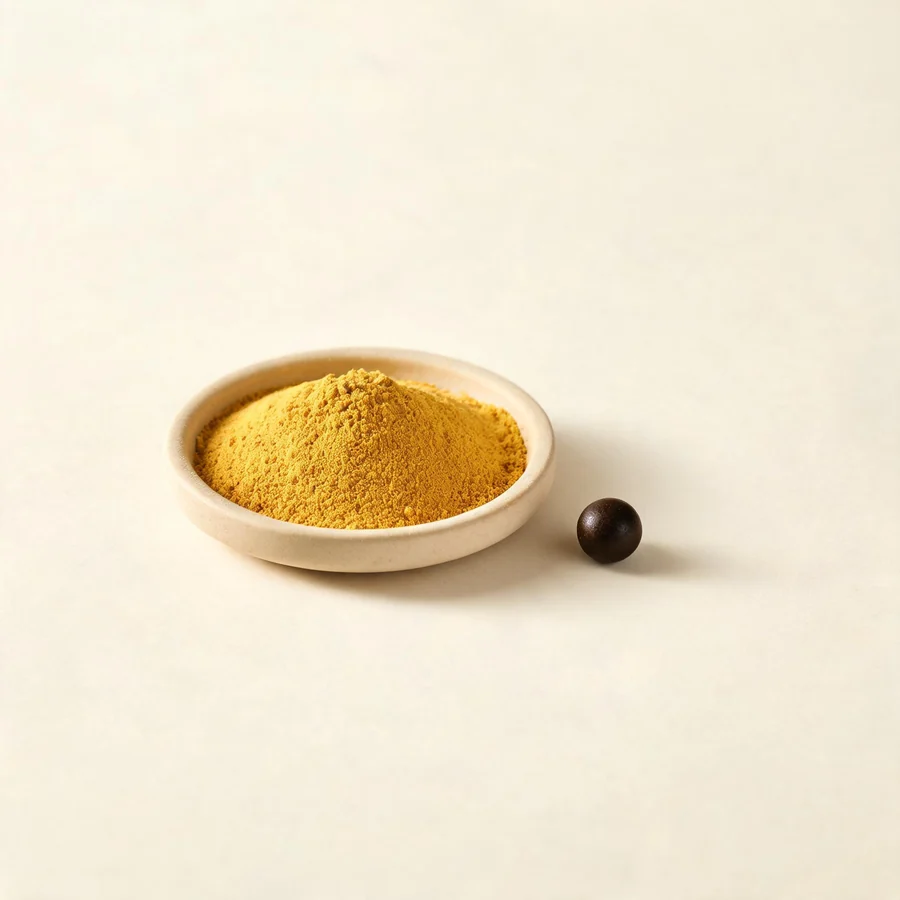
Niu Huang is applied as a very small quantity of powder, always from a documented prepared product, to the head of a boil, to an ulcer in the mouth or to the throat. The external use is a miniature of the internal one: the material is held to clear local toxin and to help a lesion resolve, and it is measured in pinches rather than grams. It is not a general dusting powder for a rash, it is not applied to a deep or spreading wound, and the risk of counterfeit material is higher for a loose powder than for a finished medicine.
| Preparation | How and when it is used |
|---|---|
| Pinch on a pointing boil | About 0.05 to 0.1 g of the powder from a prepared product is applied to the head of the boil once daily with a clean applicator, and a light dressing is placed over it. The surrounding skin is left bare, and the application stops when the lesion drains or when the redness spreads. |
| Mouth and throat application | A pinch is applied to an ulcer or blown onto the throat as part of a prepared medicine, two or three times daily for a few days. It is not swallowed in bulk, and a mouth ulcer that persists beyond two weeks needs examination rather than more powder. |
Patch test and cautions
Do not apply the powder to a deep, spreading or badly infected lesion, and do not cover a treated area with an occlusive dressing. Keep it away from the eyes and from broken skin beyond the lesion itself, stop at once if burning or spreading redness develops, and use only material from a documented, regulated product. A fever, a rapidly enlarging area of redness or pain out of proportion to the lesion is a reason to seek care, not to apply more powder.
Safety for skin use
What to check before recommending or using it, including the cautions that matter most for skin patients.
Do not use, or use with caution
- Pregnancy. The old texts say plainly that it can bring a pregnancy to an end, laboratory work has found that it makes uterine muscle contract, and the pharmacopoeia places it on the list of substances to avoid. Many finished pills also carry realgar or cinnabar, so the mineral content is a second risk.
- Absence of genuine heat, including cold-type collapse with cold limbs, a pale face and a weak pulse. A cooling, bitter material given here weakens the upright Qi and leaves the cause untouched.
- Known allergy to bovine material, or an earlier reaction to a proprietary medicine that contained it. Rashes, blistering and, rarely, anaphylaxis have been reported, so the history is taken before the product is given rather than after.
- Liver or kidney impairment. Bile acids are cleared more slowly when the liver or the kidneys are impaired, so the material is used only under specialist supervision, if at all, in such a patient.
- A spreading skin infection, fever or systemic illness. Cellulitis and erysipelas are antibiotic emergencies, and the material belongs only inside supervised care alongside them; a pill from a jar is not a treatment for a spreading infection.
Pregnancy and breastfeeding
Contraindicated. The old texts state without ambiguity that it can bring a pregnancy to an end, laboratory work has found a contracting effect on uterine muscle, and the pharmacopoeia therefore places it among the substances to avoid. Pills that contain it frequently carry realgar or cinnabar as well, and those minerals are a separate hazard to mother and unborn child. No one knows what fraction of the bile acids or the bilirubin passes into milk, and the indications are emergencies, so a nursing mother will already be under medical care.
Interactions
- Anticoagulants and antiplatelet drugs. Laboratory work has found that the material inhibits the clumping of platelets, so a person taking clopidogrel, warfarin or aspirin should not add a product that contains it without informing the prescriber. Bruising or bleeding without an explanation should be reported.
- Sedatives, anticonvulsants and opioid analgesics. The material quietens and suppresses fits in its own right, so the sedative load can accumulate, above all in an older patient already on a benzodiazepine or an opioid, where breathing is the thing to watch.
- Cardiac glycosides such as digoxin. Digoxin has a narrow margin, and the mineral ingredients that accompany the material in many compound formulas act on it directly, so the combination needs monitoring rather than an assumption.
Allergy and patch testing
An animal material can provoke a reaction even when it is not a common allergen. A new rash, weals, swelling or shortness of breath during treatment should be read as a possible reaction and not as part of the illness. Anyone who has reacted to bovine products before should not use it, and since such products are often given in an emergency, the allergy history is taken beforehand.
General safety references
General references for herbal hepatotoxicity and herb-drug interactions; they are not specific to this herb.
- Review article: Herbal hepatotoxicity - an update on traditional Chinese medicine preparations. Alimentary Pharmacology & Therapeutics, 2014. PMID: 24844799.
- Interactions between herbal medicines and prescribed drugs: an updated systematic review. Drugs, 2009. PMID: 19719333.
- Warfarin and food, herbal or dietary supplement interactions: a systematic review. British Journal of Clinical Pharmacology, 2021. PMID: 32478963.
Evidence
The classical record is quoted with its source. The modern note states the level of evidence plainly.
Classical record
主惊痫,寒热,热盛狂痫。
It is listed for epilepsy of the fright type, for chills and fever that alternate, and for mania and seizures arising when heat is at its peak.
Shen Nong Ben Cao Jing (Divine Husbandman's Classic of Materia Medica) - The earliest entry places the material in seizure and mania rather than in skin disease, and it is the origin of the resuscitation use rather than of the boil use.
疗小儿诸痫热,口不开;大人狂癫。又堕胎。
It serves for the fits of feverish children whose teeth are clenched, and for madness in grown adults; the same passage adds that it may bring on abortion.
Ming Yi Bie Lu (Supplement to the Classic of Materia Medica), Tao Hongjing - The abortion warning sits in the same short entry as the paediatric use, and it is the classical basis for the contraindication in pregnancy.
益肝胆,定精神,除热,止惊痢,辟恶气。
It is said to strengthen the Liver and Gallbladder, to steady the spirit, to dispel heat, to check the dysentery that follows fright and to keep malign influences at bay.
Qian Jin Yi Fang (Supplement to the Formulas of a Thousand Gold), Sun Simiao - Sun Simiao adds the clearing of heat and the repelling of noxious influences, which is the closest classical support for the use in toxic swellings of the skin.
Modern evidence
Evidence status
- Bilirubin, bile acids and taurine, the constituents that define the material, have been studied in laboratory work on inflammation and on the central nervous system. These are cell and animal experiments, not trials in skin infection, and they do not show that a boil resolves faster.
- No controlled clinical trial of Niu Huang in boils, abscesses or any skin condition is available to cite. The safety literature is dominated by reports involving finished pills that also contain realgar or cinnabar, where the minerals are the likelier cause of harm.
- Regulatory position: the natural stone is scarce, costly and restricted, and substitutes exist. One is a synthetic mixture of bile acids, one a calculus grown inside a living animal, one a material cultured outside the body. These are not interchangeable, and the cheapest synthetic version is excluded from a schedule of critical formulas on account of its much lower bilirubin content.
PubMed records
Selected real PubMed records for this herb's species or its constituents, chosen by species name and title relevance. They are references for the non-TCM discussion above, not proof that the herb treats any skin condition.
- Tailoring Genomic Selection for Bos taurus indicus: A Comprehensive Review of SNP Arrays and Reference Genomes.. Genes, 2024. PMID: 39766762 (pharmacology or review record).
- Bovine mastitis and intramammary drug delivery: review and perspectives.. Advanced drug delivery reviews, 2001. PMID: 11500230 (pharmacology or review record).
Dose and forms
Skin-practice dosing and the preparations that suit skin complaints.
| Form | Dose and notes |
|---|---|
| Powder in a prepared pill | 0.15 to 0.35 g daily, compounded in a pill rather than decocted. The amount is what the finished medicine declares, and the patient or family does not adjust it. |
| Topical | About 0.05 to 0.1 g of powder from a prepared product applied to a local lesion once daily, for a few days only. |
| Patent medicines | Read which substitute the product contains rather than assuming that the name settles the question, and follow the declared content on the label. |
| Course length | A defined short course under supervision, ending when the acute lesion settles. The material is not a maintenance medicine and is not given indefinitely. |
A fraction of a gram is the dose because the material is both potent and rare, not because a larger amount would be simpler to handle. It arrives as a manufactured medicine whose content is printed on the packet, and the pictures it serves are ones in which the first act is to summon help. Weight is therefore a secondary question beside the emergency, and no family should be adjusting a pill at home while an infection is spreading.
Citations and further reading
Only real sources are listed: the classical materia medica passages quoted above, and the source works behind the botanical and safety statements.
- Shen Nong Ben Cao Jing (Divine Husbandman's Classic of Materia Medica), attributed compilation of the Han period - classical entry quoted above.
- Ming Yi Bie Lu (Supplement to the Classic of Materia Medica), Tao Hongjing, Southern and Northern Dynasties - classical entry quoted above.
- Qian Jin Yi Fang (Supplement to the Formulas of a Thousand Gold), Sun Simiao, Tang dynasty - classical entry quoted above.
- Calculus Bovis monograph: Pharmacopoeia of the People's Republic of China - accepted source material, quality requirements and the status of the manufactured equivalents.
- Wai Ke Quan Sheng Ji, Wang Hongxu, 1740 - the surgical classic that is the source of Xi Huang Wan, the formula named above.
- Modern evidence statement: based on laboratory literature on bilirubin and bile acids, summarised as a statement about the level of evidence rather than as one cited finding.
Educational reference for qualified practitioners. This page is not medical advice, and skin conditions should be diagnosed by a clinician before treatment.