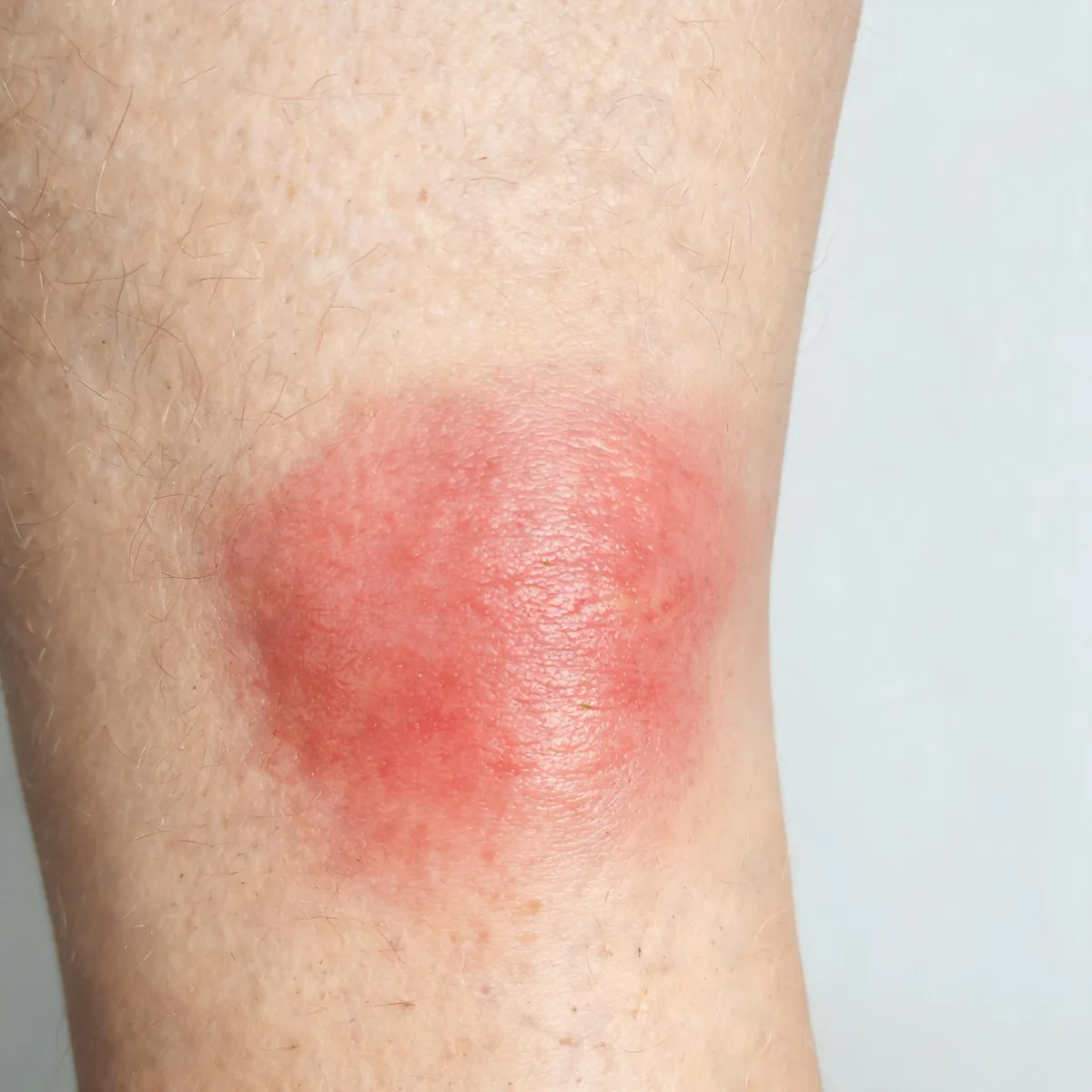
Understanding Cellulitis
The tradition describes cellulitis as external Wind, Heat and Dampness combining with internal heat to form Toxic-Heat that penetrates the deeper layers of the skin.
The skin is governed by the Lungs and defensive Qi. When that defence is weak or overwhelmed, pathogens penetrate and become trapped, producing the local redness, swelling and burning pain that characterise the condition.
Two pictures are described. Toxic-Heat stagnation gives localised redness, swelling and throbbing pain before any pus or discharge, with fever and thirst. Toxic-Heat adds pus formation with high fever and chills, which the classical literature treats as the more advanced stage.
The important thing about this page is its limit: cellulitis can progress to systemic infection quickly, and the classical literature itself starts with emergency warnings. The herbs and points below are documented as traditional adjuncts, not as an alternative to antibiotics.
The skin is the outermost layer of defence, and in this framework the Lungs govern it while defensive Qi patrols it. When that patrol is thin, or when the dose of pathogen is large, wind, heat and dampness get through the surface and lodge in the tissue beneath. There they combine with heat already present inside the body, and the mixture behaves like toxin: it reddens, swells, burns and hurts.
The same process is read in two stages. While the toxin is stuck in one place, the skin is hot and tight but no pus has formed, and the person often feels otherwise well; this is the stagnation stage. When the heat deepens, tissue liquefies, pus appears, fever and chills arrive, and the whole body is involved. The tongue and pulse follow the same progression, from red with a thin yellow coat and a slippery rapid pulse to a deeper red with a thick dry coat and a full forceful pulse.
Conventional view
Cellulitis is a common bacterial infection of the deeper layers of the skin, typically from Streptococcus or Staphylococcus entering through a crack or break. It causes a red, swollen, tender area that feels warm and may spread rapidly, and diagnosis is usually from the skin's appearance, sometimes with blood tests or cultures. Untreated, it can spread to lymph nodes and the bloodstream.
Standard treatment is oral antibiotics for mild cases and intravenous antibiotics for severe or rapidly spreading infection, with pain relief, rest and elevation of the affected limb, and recurrent cellulitis may need long-term low-dose antibiotics.
Antibiotics clear the bacteria but do not address why the body's defences failed to contain the infection, some people have recurrent episodes, and overuse can cause digestive problems or resistance. TCM adds a complementary strategy, strengthening Qi and clearing the underlying Heat and Dampness that create a welcoming environment for infection.
Selected PubMed records
Real PubMed records for the conventional discussion above, selected by condition name and title relevance. They are references, not a claim that any treatment is proven for this condition.
- Cellulitis: A Review of Pathogenesis, Diagnosis, and Management.. The Medical clinics of North America, 2021. PMID: 34059247.
- Cellulitis: A Review.. JAMA, 2016. PMID: 27434444.
- Cellulitis.. Infectious disease clinics of North America, 2021. PMID: 33494874.
How it connects
Cellulitis and abscess often appear together because they sit on one spectrum of Toxic-Heat. Cellulitis is the earlier stage, with Heat and toxin trapped in skin and tissue causing redness and swelling; if defensive Qi cannot clear it, the Heat intensifies and liquefies tissue into pus, forming an abscess. The abscess is a later chapter of the same story rather than a separate disease, which is why prompt clearing of Toxic-Heat is the shared priority. Patterns overlap because Toxic-Heat stagnation is the first chapter of the same story: a red hot painful patch that is still firm and dry fits stagnation, while the same patch softening, oozing or bringing fever means the heat has deepened into full Toxic-Heat. If the skin is angry but the person otherwise feels well the stagnation still dominates; if fever, chills or pus appear even in a small area the systemic pattern has taken over and clearing infection from the whole body is the priority, with urgent medical review for a spreading red streak.
How it is assessed
Diagnosis in this framework is secondary to recognising the medical emergency.
What a practitioner looks for
- Speed of spread: redness expanding over hours, or red streaks moving toward the body, needs emergency care.
- Systemic signs: fever above 38 C, shaking chills, feeling very unwell.
- Local signs: intense redness, heat, swelling and throbbing pain; pus formation indicates the more advanced pattern.
- Risk factors: breaks in the skin, diabetes, immune suppression, and previous cellulitis.
A practitioner looks at the patch before anything else. Colour, heat, tension and tenderness are noted, along with any break in the skin that could have let bacteria in, such as a scratch, an insect bite or a crack between the toes. The key question is whether the tissue is still firm or has begun to soften, because that single finding separates the stagnation stage from established toxic heat. Tongue and pulse add confirmation, and the coat thickens and the pulse fills out as the infection advances.
The differential matters as much as the staging. Arthritis hurts and swells inside a joint while the skin over it stays relatively quiet, and acute synovitis may redden the skin but is usually follows injury or crystal deposition rather than an entry wound. Cellulitis is a skin and soft tissue picture, red and hot even at rest. A red streak, a spreading edge, high fever or a pocket of pus moves the case out of pattern discussion and into urgent medical care.
TCM patterns in Cellulitis
Two patterns describe cellulitis, and they form a sequence rather than alternatives. Both are hot and excess, so the useful question is not deficiency but how far the heat has travelled. In the stagnation stage the toxin sits in the skin, the tissue stays firm, and throbbing pain, local heat and redness appear with fever and thirst before any pus has formed. In the second stage the heat deepens, the tissue softens, pus collects, and the symptoms intensify into high fever, chills and restlessness. Tongue and pulse track the same movement: both stages show a red tongue with a dry yellow coat and a rapid pulse, but the coat thickens and the pulse fills out as the infection advances. Because the stages form a continuum, the formula follows the stage actually present. One thing never changes: spreading redness, fever or pus needs urgent medical assessment alongside any traditional treatment.
| Pattern | Key signs | The itch | Tongue | Main formula |
|---|---|---|---|---|
| Toxic-Heat Stagnation | Localised redness and swelling; Burning or throbbing pain at the site | Not specified | Body: Deep red or crimson with raised red pointsCoat: Thick, dry and yellow | Not specified |
| Toxic-Heat | Red swollen burning pain | Not specified | Body: Red, often with raised red pointsCoat: Yellow, dry, sometimes thick | Not specified |
Toxic-Heat Stagnation
The early picture: localised redness and throbbing pain before pus forms.
In the opening stage, heat toxin reaches the skin and stops there. It may arrive from outside through a small wound, or it may be generated inside by spicy food, alcohol, heat and stress, but either way it collects in one patch of skin and the tissue beneath rather than circulating. The body fights the intruder on the spot, and the result is a red, hot, tight and throbbing area with no discharge. Because the heat is trapped rather than systemic, the person can still feel reasonably well, which is exactly what makes the stage easy to underestimate.
The tongue is deep red, its papillae raised and prickly, the coat thick and dry with a yellow tinge, and the pulse is rapid, forceful and often overflowing. Spicy or greasy food, alcohol, coffee, hot weather, saunas, overwork and anger all add heat, while cool compresses, rest, cooling foods and loose breathable clothing relieve it. Xian Fang Huo Ming Yin is the formula named for this stage, with Jin Yin Hua, Lian Qiao and Bai Zhi. Lian Qiao dissipates clumps and helps stop the stagnation turning into an abscess, while Bai Zhi reduces swelling, eases pain and guides the formula to the skin. Hegu (LI-4), Quchi (LI-11), Taichong (LR-3) and Dazhui (DU-14) are the points used.
Signs
- Localised redness and swelling
- Burning or throbbing pain at the site
- No pus or discharge yet
- Fever and intense thirst for cold drinks
- Restlessness and irritability
Diet and lifestyle for this pattern: Avoid spicy, greasy and fried food as well as alcohol and coffee, which add Heat. Drink plenty of water at room temperature, chrysanthemum tea or mung bean soup to help clear toxins, rest the affected area, keep the skin clean and dry, and use gentle cooling compresses without ever squeezing or puncturing the swelling.
Toxic-Heat
The advanced picture: pus formation with high fever and chills.
When the first stage is not cleared, the struggle between defensive Qi and the pathogen intensifies and generates more heat than the tissue can hold. That excess heat turns into toxin, which is why the pain sharpens, the redness deepens and the centre of the patch begins to soften as pus forms. The body is trying to expel the problem through the skin, and the systemic signs rise with it: fever, chills, thirst and restlessness.
The tongue is red with prickly thorns and a dry yellow coat, and the pulse is rapid and forceful, often full or overflowing. Heat-producing food, alcohol, hot weather and anger all worsen the picture, while cooling food and drink, cool compresses and rest support it. Xian Fang Huo Ming Yin is named again for its ability to expel pus and toxin, and Huang Lian Jie Du Tang is added when high fever and restlessness show the heat has reached all three burners. Jin Yin Hua, Lian Qiao and Huang Lian carry the clearing action. The points are Hegu (LI-4), Quchi (LI-11), Taichong (LR-3) and Dazhui (DU-14).
Signs
- Pus formation or abscess
- High fever and chills
- Intense thirst for cold drinks
- Red swollen burning pain
- Restlessness and irritability
Diet and lifestyle for this pattern: Eat cooling, light food such as mung bean soup, cucumber and watermelon, and avoid spicy, greasy and fried food that fuels Heat. Keep the skin clean and dry and never squeeze a pus-filled lesion; this pattern can escalate quickly, so it needs prompt medical assessment.
Treatment approach
How the tradition treats cellulitis, with the herbs, formulas and points used for it.
Principles
- Get medical treatment first. Antibiotics are the treatment for cellulitis; this page documents traditional adjuncts only.
- Clear heat and resolve toxicity, which is the traditional direction for the acute picture.
- Support recovery once the infection is controlled, particularly where healing is slow.
- Do not apply topical preparations or attempt drainage at home.
- The direction is the same in both stages, because the toxin has to be cleared, but the emphasis changes. Early on the aim is to disperse the stagnation and move the Qi so that pus never forms, with Xian Fang Huo Ming Yin as the vehicle. Once pus and fever are present, the priority is to drain pus, cool the blood and clear heat from the three burners, adding Huang Lian Jie Du Tang when the systemic signs are strong.
Herbs used
Formulas
Acupoints
What to expect
- With antibiotics, cellulitis usually begins to improve within one to two days; without them it can worsen rapidly.
- The traditional herbs described here are adjuncts and have no evidence for replacing antibiotics.
- Recurrence is common, and prevention focuses on skin care and treating risk factors.
- Early cases usually begin to settle within two to three days of starting herbs, with full resolution in one to two weeks, and acupuncture can be added once or twice a week for pain and to support the immune response. When pus has formed the timeline stretches to two to three weeks, especially when herbs are combined with antibiotics. Recurrence suggests that an underlying weakness in defensive Qi was never rebuilt.
Safety and when to get help
Seek medical help urgently for
- Redness spreading rapidly, or red streaks moving toward the body.
- High fever above 38 C with shaking chills.
- Severe pain, blistering, skin that is dark or numb, or feeling very unwell - this needs emergency care.
For anything severe, sudden or spreading quickly, read when a skin problem needs urgent care.
Cautions
- Do not delay antibiotics to try herbs.
- Do not massage, lance or apply heat to the area.
- Diabetes, immune suppression and previous cellulitis increase risk and need medical input.
Using this alongside conventional care
- This is the clearest complementary page in the set: antibiotics are the treatment, and TCM is adjunct only. Any herbal use should be discussed with the treating doctor so that nothing interferes with recovery.
- Antibiotics are the treatment for cellulitis, and herbs are adjunct. The herbs most often used, Jin Yin Hua and Lian Qiao, are traditionally described as anti-inflammatory and antimicrobial, and they are commonly combined with antibiotics without known negative interaction. The treating doctor still needs a full list of what is being taken. Blood-moving herbs such as Dang Gui can theoretically increase bleeding risk on warfarin, and no prescribed antibiotic should be stopped early because the skin looks better.
Diet and lifestyle
- During an acute episode a cooling, light diet is advised, with plenty of water. Good hydration and nutrition support recovery in both frameworks.
- During the acute phase the diet should be light and cooling: fresh vegetables, legumes, and fruit such as watermelon and pear, with plenty of water and chrysanthemum or dandelion tea. Alcohol, coffee, spicy food, red meat and fried food all generate heat and dampness and should be left out until the patch has settled. Once recovery is under way, keep meals moderate and avoid excessive raw and cold food, which can weaken the Spleen and slow the rebuilding of defensive Qi.
If you're pregnant
Cellulitis in pregnancy must be treated aggressively to prevent systemic infection, but herbal choices need care. The standard formula Xian Fang Huo Ming Yin contains Ru Xiang and Mo Yao, which invigorate Blood and are traditionally contraindicated in pregnancy, so a modified version may omit them and add milder heat-clearing herbs such as Jin Yin Hua and Lian Qiao, possibly with Huang Qin to calm the fetus.
Acupuncture is a safer first line, avoiding LI-4 and SP-6 because of their labour-inducing potential, while LI-11 and DU-14 can be used cautiously. Both a TCM practitioner and an obstetrician should be consulted.
If you're breastfeeding
For breastfeeding mothers the main concern is that bitter-cold herbs such as Huang Lian and Huang Qin from Huang Lian Jie Du Tang can pass into milk and cause infant diarrhoea or digestive upset.
Where a full Toxic-Heat picture is present, a shorter course of Xian Fang Huo Ming Yin may be used with monitoring of the infant for loose stools, and acupuncture avoids the risk entirely. Maintaining hydration matters for both milk supply and clearing Heat.
If treating a child
Cellulitis in children often follows a minor scratch or insect bite that becomes infected, and the pattern is almost always Toxic-Heat stagnation or Toxic-Heat, though immature Spleen function may add signs of Dampness.
Doses are reduced to a third to a half of the adult dose by age and weight, and Xian Fang Huo Ming Yin can be used but is strong, so a practitioner may modify it, for example by omitting some of the more potent blood-moving herbs. Tongue diagnosis is especially valuable, and parents should watch for a red tongue with yellow coating and a rapid pulse.
If treating an elderly patient
Older patients with cellulitis often have underlying Qi or Yin deficiency, which makes the infection more dangerous and slower to heal. The Toxic-Heat picture may be less dramatic, with less redness and fever, but the tongue may still be red with a dry coating.
Treatment must clear Heat without damaging Spleen and Stomach Qi, so Xian Fang Huo Ming Yin may be combined with herbs such as Huang Qi to support righteous Qi, at about two-thirds of the adult dose. Acupuncture is well tolerated, points such as ST-36 can strengthen resistance, and close monitoring for complications is essential because the immune response is weaker.
Urgent-sign guidance is based on standard sources: NHS anaphylaxis, NHS cellulitis, NHS Stevens-Johnson syndrome, NHS melanoma.
Evidence
Evidence status
Compiled for this page from the classical and modern literature; not a systematic review, so treat it as a pointer to sources rather than clinical guidance.
Research is largely in Chinese-language journals. Trials of Xian Fang Huo Ming Yin, alone and with antibiotics, have been examined for skin and soft tissue infection, and a 2018 meta-analysis of 12 randomised trials found that adding it to standard antibiotics improved cure rates and shortened the time to resolution of redness and swelling. Trial quality is generally moderate, with small samples and inconsistent methods. This remains an adjunct to antibiotics, not a replacement.
Studies often cited
Across 12 randomised trials, adding the formula to standard antibiotics improved cure rates and reduced the time for redness and swelling to resolve. 2018 meta-analysis, Chinese journal (as recorded in the source)
Studied for skin and soft tissue infection, with generally moderate trial quality and small samples. Chinese clinical trials (as recorded in the source)
PubMed records for the TCM evidence
Real PubMed records for the TCM clinical evidence discussed above, selected by condition name and title relevance. They are references, not proof of benefit.
- Intracranial abscess from facial cellulitis.. Archives of craniofacial surgery, 2019. PMID: 31658800.
- Effectiveness and safety of Liuhedan for treating cellulitis: A protocol for systematic review and meta-analysis.. Medicine, 2021. PMID: 34087860.
Classical record
Cellulitis occurs when wind-heat toxic qi invades the skin, causing stagnation of blood and qi, leading to swelling.
- Zhubing Yuanhou Lun (Treatise on the Causes and Symptoms of Diseases), Volume 31, on cellulitis. The Chinese original is not reproduced here: it could not be recovered reliably from the source record, and is not guessed.
Common questions
Can I treat cellulitis with herbs alone?
No. Cellulitis needs antibiotics, and severe cases need intravenous treatment in hospital. The herbs described here are traditional adjuncts, not a substitute.
How fast does cellulitis progress?
It can spread over hours. The classical literature treats rapid spread, red streaks and high fever as emergency signs.
Is TCM useful at all here?
Possibly as an adjunct during recovery or for recurrence prevention, with medical agreement. This page does not claim a role for herbs in treating the acute infection.
When should I go to hospital?
Rapidly spreading redness, red streaks, high fever with chills, severe pain, blistering or skin that turns dark or numb.
Is it safe to take Chinese herbs with my antibiotics?
The herbs commonly used here, such as Lian Qiao and Jin Yin Hua, are generally combined with antibiotics without difficulty, but both your doctor and your TCM practitioner need a complete list of everything you take. If you are on blood thinners, mention that too, because formulas often include small amounts of Dang Gui, which may have mild anticoagulant activity.
Can TCM prevent cellulitis from coming back?
Recurrent episodes usually point to weak defensive Qi or to damp heat that was never fully cleared. Once the acute infection has settled, treatment can shift to strengthening the Spleen and Lungs, draining what remains and improving resistance, which is slow constitutional work measured in months rather than days.
What if I have diabetes and get cellulitis?
Diabetes raises the risk of a serious infection and slows healing, so any patch of cellulitis needs prompt medical attention. Herbs can support recovery alongside your diabetes team, but never in place of antibiotics, and never on their own for a foot infection or for any sign that the infection is spreading.