
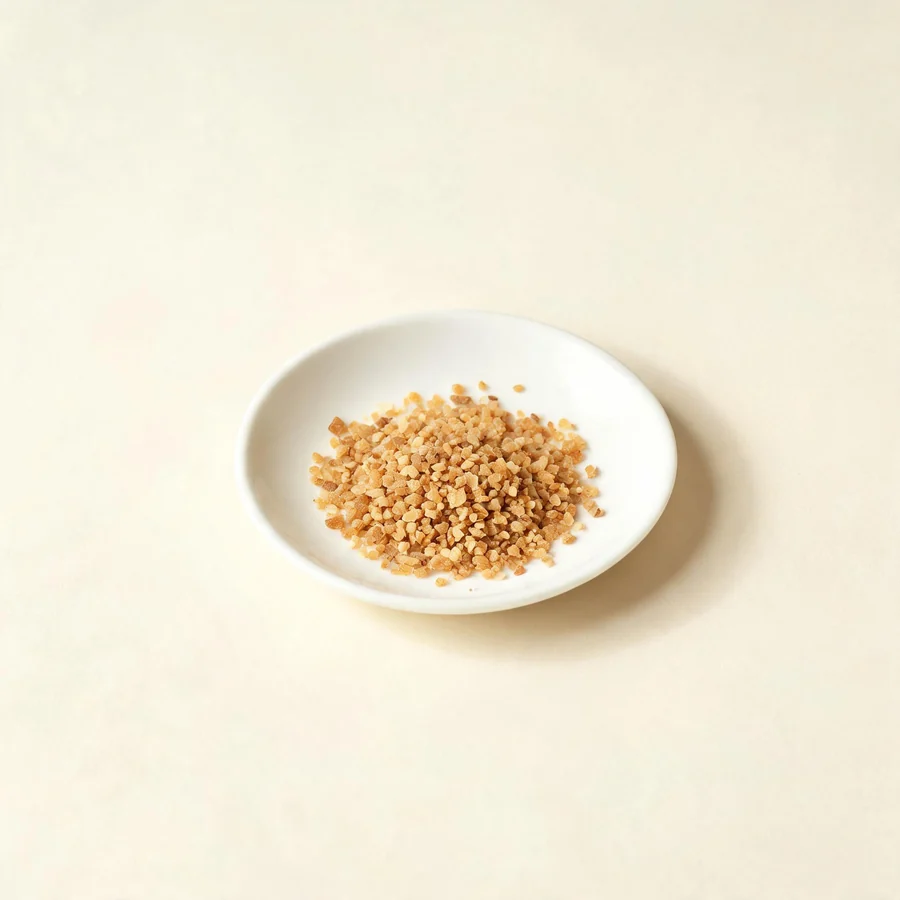
Skin profile
Where this herb sits in skin practice: the pattern it corrects, the skin signs it suits, and what it should not be used for.
She Xiang is used on the skin as a guide and a stasis-breaker, in trace amounts, for deep swellings and inactive chronic sores. It is not a surface herb for rash, it is excluded in pregnancy without exception, and the animal secretion is replaced by the synthetic material in all current practice.
Skin signs that suggest it
- A deep, hard, tender swelling that will not point, discharge or settle
- A chronic sore or ulcer that stays open, with a dusky or livid edge and little new tissue
- Fixed, boring pain in a swelling or an old scar, worse at night and on pressure
- A dull, dark or purplish cast to the face without surface inflammation
- A dusky tongue or purple sublingual veins in a person whose lesions are cold and unmoving
When it is not the right herb
Not for the ordinary hot, red, weeping rash that responds to cooling and drying herbs, and not for heat toxin with high fever, a full pulse and spreading redness, where a warm aromatic adds to the fire rather than clearing it. It is not for a depleted person with no stasis: where there is nothing blocked, a powerfully moving substance only scatters. It is absolutely excluded in pregnancy, on the skin as well as by mouth, and it is not a household remedy at any dose. The natural secretion is not an acceptable material.
What it does for skin
Skin-relevant actions only. Each one describes a mechanism in TCM terms and what it looks like on the skin.
Opens a blockage and carries a formula to the lesion
The classical description of She Xiang is not of a herb that acts where it sits but of one that travels. Its volatile compounds are said to enter tissue and cross barriers that ordinary decoctions do not, so a few hundredths of a gram added to a formula change where the rest of the formula arrives. In skin practice that is the whole rationale for using it at all: a hard, deep swelling or a cold, stagnant lesion is the case where the other herbs cannot reach the seat of the problem, and the aromatic is the guide rather than the treatment.
Moves congested Blood in the fine vessels
Where blood has stopped moving in the small vessels of the face, a scar or a swelling, the skin looks dusky, feels tense and hurts in one fixed place. She Xiang is described as reaching the fine collaterals, the vessels that ordinary blood-moving herbs reach poorly, and it is added in a small amount to formulas for stubborn fixed pain and for purple, congested lesions. The effect is put down to penetration rather than to heat, which is how a warming aromatic can sit in a cooling formula without the two pulling against each other.
Disperses toxic swelling and helps an abscess resolve or point
A deep swelling that is hard, painful and neither settles nor discharges is read as toxin and stagnant blood held together below the surface. She Xiang is included in the external and internal formulas that disperse such a mass, either so that it resolves or so that it comes to a head and drains. It is never the herb doing the main work: the toxin-clearing and blood-moving ingredients carry that load, and the musk is present to open the way. A spreading, hot, febrile infection needs medical care, not a plaster.
Promotes tissue regeneration in a chronic sore
In the external powders used for slow-healing sores, She Xiang is included for a repair action the tradition calls generating flesh: the wound is clean but flat, dusky and unmoving, and new tissue is not forming. Its job there is to wake the circulation at the wound edge, and it is used with herbs that also move blood and with others that astringe or nourish. The usual rule for any wound preparation applies: clean the lesion, exclude infection, and never seal a discharge under an occlusive dressing.
Skin conditions it is used for
Mapped to the condition pages on this site. The pattern column shows what the skin is doing when this herb is the right choice.
| Condition | Pattern | Why it suits | Typical setting |
|---|---|---|---|
| Skin abscess | Toxic swelling with stagnant Blood that will not resolve | A deep, hard, painful swelling that neither settles nor points is the picture in which musk appears, always inside a formula and always in a small amount. It is read as toxin and stagnant blood bound together below the surface, so the treatment has to move what is stuck and open a route out; the aromatic does the opening while the toxin-clearing herbs do the clearing. Nothing here replaces drainage: a tense, spreading or febrile abscess needs surgical or medical assessment, and a herb is at most an adjunct. | Xing Xiao Wan (醒消丸), with Ru Xiang, Mo Yao and Xiong Huang |
| Tissue necrosis | Blood stasis with cold, dusky and unmoving tissue | Where tissue has stopped being supplied, the surface is dusky, cold and numb at the edge and slow to granulate. Musk is used in external repair powders on that kind of chronic, clean but inactive sore, on the reasoning that it reopens the fine vessels at the wound margin and lets the rest of the powder act. The limit has to be stated plainly: necrosis means the blood supply has failed, it is a surgical problem, and no aromatic changes that. Use belongs to a wound service, not to home treatment. | Sheng Ji San style external powders, with Ru Xiang and Mo Yao |
| Boils | Early toxic swelling, hard and hot, before suppuration | In the early phase of a boil, before pus forms, the lesion is a hard tender nodule with a red edge, and the aim is to disperse it rather than to wait. Musk appears in the small pill formulas used for that stage, where its penetration is paired with strong toxin-clearing and blood-moving herbs. It is not the herb to reach for when the boil is already pointing, when fever is present, or when the lesion is on the face, where infection is dangerous. | Liu Shen Wan (六神丸), or with Lian Qiao and Jin Yin Hua |
| Dark face | Blood stasis in the fine facial vessels | The old record credits musk with lifting dark discolouration from the face, and later practice used it in tiny amounts in facial formulas whose aim was to move blood and restore the complexion. The reading is that stagnant blood in the fine facial vessels leaves a dull, dark or purplish cast, and that only something penetrating reaches vessels that small. It is a minor and largely historical indication, the animal material is not an option, and a facial pigment change should be assessed before it is treated as stasis. | A facial blood-moving formula with Bai Zhi and Dang Gui |
Combinations for skin
Herbs it is paired with when the skin, not an internal organ, is the target.
| Partner | Ratio | Why the pair is used |
|---|---|---|
| Ru Xiang | 0.03 to 0.1 g She Xiang with 3 to 6 g Ru Xiang | Frankincense moves blood and settles pain in tissue that is swollen and hard, and it is the standard partner for musk in preparations for deep masses. The division of labour is clear: frankincense does the moving and the healing, and the musk at a hundredth of a gram makes the tissue reachable. Xing Xiao Wan is built on the two together, with the aromatic present only as a guide. |
| Mo Yao | 0.03 to 0.1 g She Xiang with 3 to 6 g Mo Yao | Myrrh breaks stasis and promotes repair, and it is oilier and slower than frankincense, which suits a chronic sore as much as a fresh swelling. With musk it forms the second half of the classic pair used in external and internal formulas for trauma and for lesions that will not close. Adding a third blood mover instead of the musk does not reproduce the effect, because the problem is reach rather than force. |
| Niu Huang | A pinch of She Xiang with 0.3 to 0.5 g Niu Huang, in pill form | Cow bezoar clears heat and resolves toxin, and musk opens the way, so the two together cover a toxic swelling that is both hot and deeply stuck. The pairing belongs to the aromatic pill formulas rather than to everyday skin practice, and it is included because those formulas are the reason musk is still described in dermatological texts. Neither ingredient is a home medicine, and both are now supplied as substitutes or cultured material. |
| Huang Lian | 0.03 to 0.1 g She Xiang with 3 to 6 g Huang Lian | A hot, penetrating aromatic beside a bitter cold root looks contradictory and is not: the root clears the heat and toxin in the lesion while the musk moves the congested blood and opens the tissue. In a hot, hard swelling this lets the formula reach the centre without adding heat overall. The musk stays at a pinch, because its purpose is direction and not temperature. |
Formulas where it leads
- Xing Xiao Wan (醒消丸) - The classical pill for a hard, deep swelling that has not yet suppurated, built on frankincense, myrrh, realgar and musk. Its whole design assumes a mass that is stuck below the surface, which is exactly the situation in which an aromatic guide earns its place.
- Liu Shen Wan (六神丸) - A small, potent pill for toxic swelling and sore throat, containing musk, cow bezoar, borneol, pearl, toad venom and realgar. Skin use is limited to the early, hard stage of a boil or a localised toxic swelling, and it is not a treatment for a spreading infection or a fever.
- Sheng Ji San (生肌散) - The general name for the external powders that promote filling of a clean, chronic sore. Recipes vary and musk is a common but not universal ingredient; the powder is dusted thinly on a clean wound and is never packed into a cavity or sealed under a dressing.
Topical use
Musk appears on the skin in two forms only: as a trace ingredient in a warming plaster over a deep, cold swelling, and as a trace ingredient in the powders used on a clean, chronic sore. Both are prepared products with a fixed recipe, both use a few milligrams, and both depend on the lesion being assessed first. The aromatic is there to help the other ingredients penetrate rather than to act alone, and the pregnancy prohibition applies to the skin exactly as it does to the mouth.
| Preparation | How and when it is used |
|---|---|
| Trace ingredient in a warming plaster | A few milligrams are worked into a prepared plaster or ointment applied over a deep, hard, cold swelling on intact skin. The plaster stays on for a set period and is removed if the skin stings, and it is never used on broken skin, over a joint crease or on the face. |
| Dusting powder for a chronic sore | In a repair powder the musk is one of several finely ground ingredients dusted thinly over a clean, granulating wound. The wound is cleaned first, infection is excluded, and the powder is not packed into a cavity or covered with an occlusive dressing. |
| What is not done | Musk is not applied neat, not dissolved in oil at home, and not used on mucous membranes or near the eyes. It is not a remedy for an ordinary rash, and a strong compress of it is not a traditional preparation; the material is far too potent and too costly for that kind of use. |
Patch test and cautions
A patch test on normal skin is essential, because aromatic plasters are a recognised cause of contact dermatitis and some synthetic musks are themselves fragrance allergens. Do not apply to broken, ulcerated or infected skin except within a supervised wound preparation, keep it away from the eyes and genitals, and stop at once if burning, itching or spreading redness develops. Pregnancy excludes topical use as firmly as internal use, and the natural animal material should not be used at all.
Safety for skin use
What to check before recommending or using it, including the cautions that matter most for skin patients.
Do not use, or use with caution
- Pregnancy and breastfeeding. Musk stimulates uterine muscle in animal work and the classical record names it as a means of ending a pregnancy, so it is excluded by mouth and on the skin, with no lower dose that makes it acceptable.
- A hot, spreading infection with fever and a full forceful pulse. The herb is warm and moving, and the treatment there is cooling and toxin-clearing under medical care rather than an aromatic plaster.
- Deficiency with no obstruction: a thin, dry, depleted person with no stasis, no mass and nothing blocked. A strongly dispersing substance has nothing to move and scatters what little is there.
- Any unexplained bleeding, or current treatment with an anticoagulant, because the herb moves blood forcefully.
- The natural animal secretion in any form. It comes from protected species, the trade is banned, and the synthetic substitute is the material for current use.
Pregnancy and breastfeeding
Excluded completely, by mouth and on the skin, and not a matter of dose. Musk stimulates uterine muscle in animal work, the response grows with the amount given and with how far a pregnancy has advanced, and the classical record includes it among substances used to end a pregnancy or expel a retained placenta; the same pharmacology is why the ban is absolute. Breastfeeding follows the same logic: muscone is fat soluble, the material is active at minute doses, and there is no human data on transfer into milk, so a skin preparation is avoided while nursing as well.
Interactions
- Anticoagulants and antiplatelet medicines, including warfarin, heparin, aspirin and clopidogrel. Musk has shown antithrombotic and circulation-promoting activity in laboratory work, so an additive bleeding risk is plausible and clotting should be watched rather than assumed unaffected.
- Central nervous system medicines. Its action runs in two directions, rousing at a low dose and calming at a higher one, and animal work reports an influence on ketamine anaesthesia, so sedatives and anaesthetics deserve caution.
- Cardiovascular medicines. Animal work reports a pressor and cardiac-stimulating effect, so mixing the herb with blood pressure drugs, digoxin or rhythm-control drugs gives an unpredictable result.
- Uterine stimulants such as oxytocin, and any medicine used in pregnancy, because the uterine action is the governing risk. Formal human interaction studies are scarce, and most of this list is reasoned from pharmacology rather than observed.
Allergy and patch testing
Aromatic plasters and medicated ointments are a common cause of contact dermatitis, and the synthetic musks used in perfumery include recognised allergens, so a plaster containing musk can sensitise the skin it is meant to treat. Patch test on normal skin for 24 hours, keep the application to a small area, and stop if the skin becomes more irritated rather than calmer. A rash, swelling or breathlessness after use needs medical attention.
General safety references
General references for herbal hepatotoxicity and herb-drug interactions; they are not specific to this herb.
- Review article: Herbal hepatotoxicity - an update on traditional Chinese medicine preparations. Alimentary Pharmacology & Therapeutics, 2014. PMID: 24844799.
- Interactions between herbal medicines and prescribed drugs: an updated systematic review. Drugs, 2009. PMID: 19719333.
- Warfarin and food, herbal or dietary supplement interactions: a systematic review. British Journal of Clinical Pharmacology, 2021. PMID: 32478963.
Evidence
The classical record is quoted with its source. The modern note states the level of evidence plainly.
Classical record
盖麝香走窜,能通诸窍之不利,开经络之壅遏。若诸风、诸气、诸血、诸痛、惊痫、症瘕诸病,经络壅闭,孔窍不利者,安得不用为引导以开之、通之耶?非不可用也,但不可过耳。
Musk is mobile and penetrating: it opens every orifice that is blocked and frees every channel that is congested. For wind, for qi, for blood, for pain, for seizures and for masses, where the channels are closed and the orifices fail, how could it be left out as the guide that opens and clears the way? The objection is not to its use, but to using it to excess.
Ben Cao Gang Mu (Compendium of Materia Medica), Li Shizhen - The guide role and the warning about excess sit in one passage, and both matter on the skin: a trace amount is what the tradition intends, and more is not better.
疗中恶,心腹暴痛,胀急痞满,风毒,妇人产难,堕胎,去面黔,目中肤翳。
It is used for sudden malign attack, for violent pain in the chest and abdomen, for distension and fullness, for wind toxin, for difficult labour and for retention of a dead fetus; it also lifts dark discolouration from the face and clears a film from the eye.
Ming Yi Bie Lu (Supplement to the Classic of Materia Medica) - Two skin-relevant threads run through this entry: wind toxin, the term for a toxic swelling, and the facial discolouration. The obstetric uses recorded beside them are the origin of the absolute ban in pregnancy.
Modern evidence
Evidence status
- Muscone, the compound that carries most of the aroma, has been studied in laboratory and animal work for anti-inflammatory and circulation-promoting effects, including on the small vessels. The doses used there are far above the hundredths of a gram used clinically, and no trial has tested musk or muscone in a skin disease.
- The material raises a conservation problem rather than a clinical one. Every musk deer species appears on the CITES lists, several in Appendix I, and China protects the forest musk deer as a Class I species, with trade in natural musk banned for decades. Artificial musk, produced since 1994, contains synthetic muscone and is the material in more than 99 per cent of musk-containing patent medicines, so the traditional formulas can be made without the animal.
- The safety position rests on pharmacology rather than on human data: uterine stimulation is the documented animal effect behind the pregnancy ban, and the interaction list is inferred from cardiovascular and anticoagulant activity. Contact dermatitis to aromatic plasters is well recognised, but reports specific to musk are sparse.
PubMed records
Selected real PubMed records for this herb's species or its constituents, chosen by species name and title relevance. They are references for the non-TCM discussion above, not proof that the herb treats any skin condition.
- Chemical compositions and pharmacological activities of natural musk (Moschus) and artificial musk: A review.. Journal of ethnopharmacology, 2022. PMID: 34748869 (pharmacology or review record).
Dose and forms
Skin-practice dosing and the preparations that suit skin complaints.
| Form | Dose and notes |
|---|---|
| Powder or pill (internal) | 0.03 to 0.1 g of the prepared powder in a pill, or added to a decoction once it has been strained, then taken as a single dose. Boiling is avoided, since heat drives off the volatile fraction that does the work. |
| External trace use | A few milligrams in a prepared plaster or dusting powder, measured by the maker rather than by the patient. The quantity is too small to weigh at home, and a home measurement will be wrong in one direction or the other. |
| Duration | Single doses or a few days, inside a supervised formula. There is no long course: the indications are acute or local, and the pregnancy ban stands for the whole of any treatment. |
A few hundredths of a gram is the whole dose, and the usual mistake is to think that more must work faster. The material is dispensed as a powder or already made into a pill, added to a strained decoction at the end rather than boiled with the other herbs, and stored airtight in the dark, because the aroma is the action and it fades. The quantity is set by the formula and by the need for penetration, not by the severity of the lesion, and none of it applies to the natural secretion, which is not a material for current use.
Citations and further reading
Only real sources are listed: the classical materia medica passages quoted above, and the source works behind the botanical and safety statements.
- Ben Cao Gang Mu (Compendium of Materia Medica), Li Shizhen, 1578 - classical entry quoted above.
- Ming Yi Bie Lu (Supplement to the Classic of Materia Medica), Tao Hongjing, Southern and Northern Dynasties - classical entry quoted above.
- Convention on International Trade in Endangered Species of Wild Fauna and Flora (CITES), listing for Moschus species - source for the conservation statement.
- Pharmacopoeia of the People's Republic of China, Moschus monograph - source for the accepted source material, the dose range and the pregnancy prohibition.
- Modern evidence statement: based on laboratory and animal literature on muscone and on the substitution literature for artificial musk, summarised as a statement about the level of evidence rather than as a cited finding.
- Zoological description: literature on Moschus species, family Moschidae.
Educational reference for qualified practitioners. This page is not medical advice, and skin conditions should be diagnosed by a clinician before treatment.