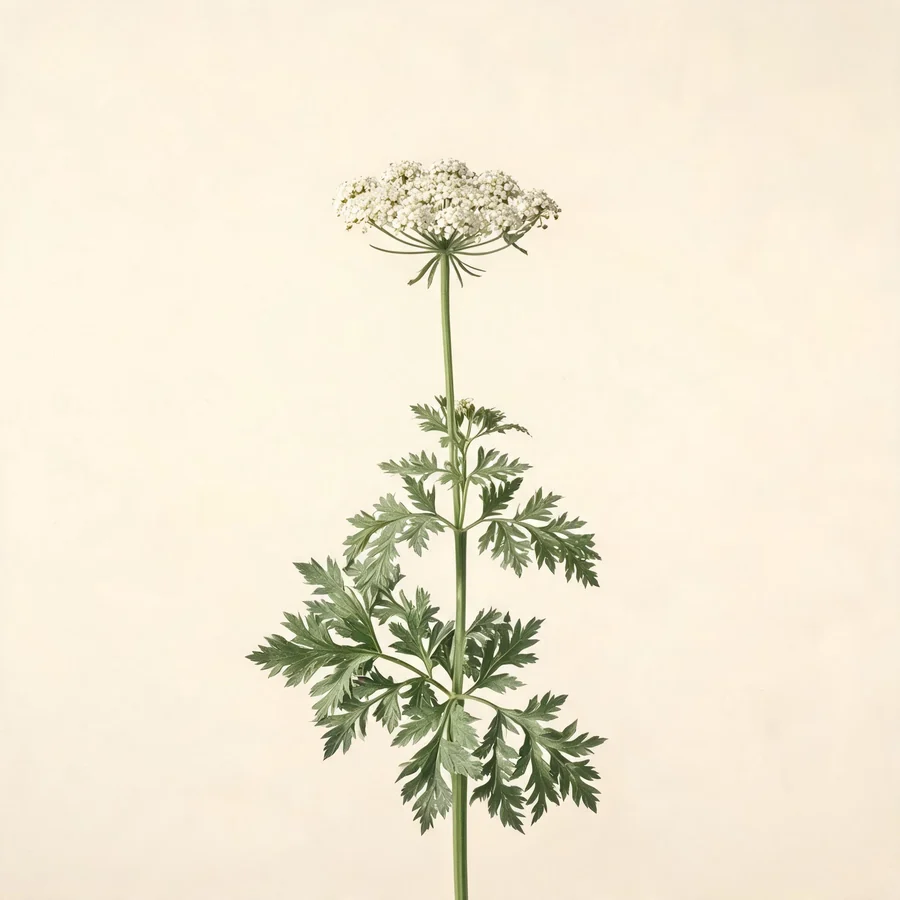
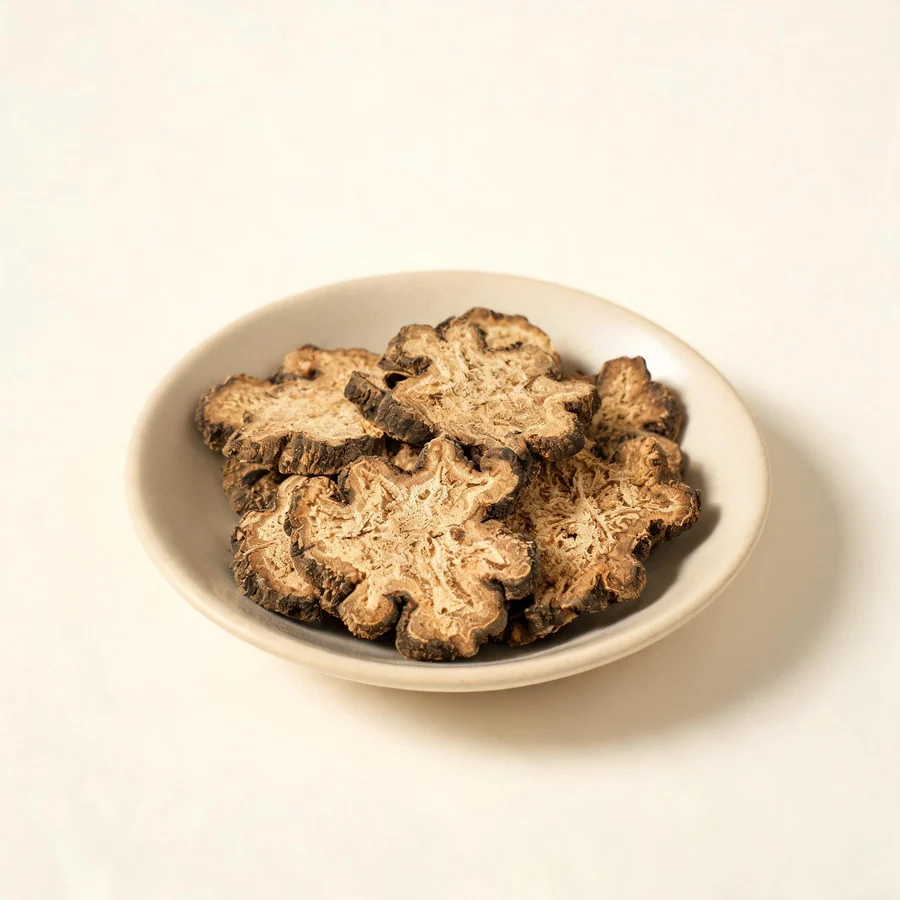
Skin profile
Where this herb sits in skin practice: the pattern it corrects, the skin signs it suits, and what it should not be used for.
Chuan Xiong is the mover rather than the clearer: it is chosen when the skin has lost colour, warmth and movement, and it is withdrawn when the skin is hot, red and active. It is at its most useful in the small dose that keeps a formula flowing.
Skin signs that suggest it
- Dusky, blue-tinged or purple patches that feel cool and ache in one fixed spot
- A bruise that stays dark and slow to fade, tender on pressure and cool to touch
- Cold, numb fingers and toes with purple nails, worse in winter and slow to rewarm
- Dark, mottled or muddy facial patches that worsen with stress and poor sleep
- Purple lips or a dusky complexion, with purple spots on the tongue and a choppy pulse
When it is not the right herb
Not for skin that is red, hot, swollen and weeping, and not for a spreading infection: warmth and movement add to a fire that needs cooling instead. Not for the flushing and throbbing of rising Liver Yang, where an ascending herb makes the face hotter rather than clearer. Not for dry, thin skin with night sweats and a red tongue that has little coat, because the rhizome is drying. It is not a treatment for a bruise that appeared without injury, for bleeding gums or for any unexplained bleeding, which need assessment rather than a blood-moving herb. Pregnancy is a firm exclusion.
What it does for skin
Skin-relevant actions only. Each one describes a mechanism in TCM terms and what it looks like on the skin.
Moves Blood and lifts stasis from the skin
The core skin action. Where Blood has pooled, the surface loses its colour and its ability to repair: a bruise lingers, a patch darkens, a scar stays raised and purple. The rhizome is said to set Blood and Qi in motion together, so it is chosen when the lesion is fixed, dusky and cool rather than red and spreading. It is an activator inside a formula, not a stand-alone treatment.
Warms the channels and drives cold from the limbs
Cold contracts the small vessels, and the tradition reads the result as Blood that cannot reach the surface. The sign is a finger or a toe that turns white, then blue, then red and painful, or a chilblain that recurs in the same place each winter. Pungent warmth opens those channels, and the herb is paired with warming, channel-reaching partners rather than used alone.
Reaches the head and face
Chuan Xiong is described as rising, and the old aphorism tied it to the head. In skin practice that quality is used for the face rather than for headache: dark patches, a dull muddy complexion, purple lips and a sluggish colour that improves when circulation improves. It is paired with Bai Zhi to direct the action to the face. Where the face is flushed and hot from rising Yang, the same ascending quality is a reason to leave it out.
Eases the pain of a stagnant lesion
A bruise, a chilblain or a thickened plaque that hurts in one place and hurts more on pressure is read as stagnant Blood, and moving it is expected to ease the pain as well as the colour. The relief is gradual and follows the change in colour. It is not an analgesic for inflammatory pain, and a lesion that is becoming more painful, hotter or larger needs a diagnosis rather than a stronger dose.
Skin conditions it is used for
Mapped to the condition pages on this site. The pattern column shows what the skin is doing when this herb is the right choice.
| Condition | Pattern | Why it suits | Typical setting |
|---|---|---|---|
| Bruising | Blood Stagnation: a fixed, dusky, tender bruise that fades slowly | A bruise is the clearest everyday picture of Blood that has left its path and pooled in the tissue. When the mark stays purple, feels cool and aches in one place, the tradition treats it as stasis that needs moving rather than as simple injury. Chuan Xiong is added to a blood-moving formula so the colour and the tenderness resolve together, and it is used only once the bleeding has stopped. | Tao Hong Si Wu Tang, or a modified Xue Fu Zhu Yu Tang |
| Chilblains | Cold in the channels with Blood Stagnation | Chilblains are read as cold that has congealed Blood in the small vessels of the extremities. The lesion is dusky, cold and painful, and it recurs where the circulation is weakest. The rhizome supplies warmth and movement at the same time, opening the channels so the pooled blood can leave, and it is used with warming partners in a formula rather than as a rub. | A modified Huang Qi Gui Zhi Wu Wu Tang with Chuan Xiong and Hong Hua |
| Melasma | Qi and Blood Stagnation in the fine vessels of the face | Melasma is described as stasis sitting in the fine vessels of the face, often after years of stress, poor sleep or irregular menstruation. The patches are brown or grey-brown, fixed, and they do not fade with ordinary skin care. Chuan Xiong moves the blood in those small vessels and is paired with herbs that nourish and cool, so the face is cleared without being dried. Sun protection remains essential and is not replaced by the formula. | Tao Hong Si Wu Tang |
| Purple face | Blood Stagnation with a dusky, fixed discolouration | A face that is dusky rather than red, with purple lips and a sluggish, mottled colour, is read as stasis in the vessels of the head. The herb reaches the head and moves the blood there, and it is used in formulas built for fixed stasis rather than for heat. The picture is different from rosacea, where the face is hot and flushing, and the two should not be treated with the same warming mover. | Xue Fu Zhu Yu Tang |
| Psoriasis | Blood Stagnation with Heat in a thickened plaque | Psoriasis is primarily a blood-level problem, and Chuan Xiong is not the herb that cools it. Its place is in the plaque that has become thick, dark red and fixed, where stasis has settled under the scale and cooling alone no longer shifts it. It is added in a small dose to a cooling, blood-moving formula so the plaque softens and the colour lightens, and it is withdrawn if the skin becomes hotter or more irritated. | A modified Xue Fu Zhu Yu Tang with Sheng Di Huang and Mu Dan Pi |
Combinations for skin
Herbs it is paired with when the skin, not an internal organ, is the target.
| Partner | Ratio | Why the pair is used |
|---|---|---|
| Dang Gui | About 2 parts Dang Gui to 1 part Chuan Xiong, as in Si Wu Tang | The classic arrangement of nourishing and moving. Dang Gui supplies the material that Blood is made from, and Chuan Xiong keeps it from sitting still. On the skin the pair suits a dry, dull, sallow complexion with poor healing and a tendency to dark circles, where nourishment alone would stagnate and movement alone would exhaust. The proportion matters: the mover is the smaller share. |
| Chi Shao | Equal weights, about 6 g of each | Two blood movers of opposite temperature, and the contrast is the point. Chuan Xiong is warm and activating, while Chi Shao is cool, moving the blood and clearing heat within it. Used together they suit stasis with no obvious thermal bias, and stasis that has started to produce heat, such as a purple-red fixed plaque or a bruise that feels warm. Neither is used in pregnancy without specialist advice. |
| Bai Zhi | Equal weights, about 6 g of each | Bai Zhi is the channel guide that takes the action to the face, and Chuan Xiong moves the blood once it arrives. The pair is used for dark facial patches, a dull complexion and a sluggish colour around the eyes and mouth, where the problem is congestion rather than heat. Both are aromatic and drying, so the course is kept short in a person with dry skin. |
| Huang Qi | 15 to 30 g Huang Qi with 3 to 6 g Chuan Xiong | Huang Qi supplies the Qi that pushes Blood, and Chuan Xiong makes sure the Blood moves once it is pushed. The pair is used for cold, pale, slow-healing skin, chronic ulcers with a dusky edge and tissue that has become inert, and it is the logic behind the warming formulas for the limbs. The rhizome stays at the low end of its range so the combination supports rather than disperses. |
Formulas where it leads
- Tao Hong Si Wu Tang (桃红四物汤) - The four-substance formula with peach kernel and safflower added, and the standard model for stasis on a blood-deficient base. In skin practice it is used for melasma, dark circles and a dull complexion, where the face needs both nourishment and movement. It is a short-course formula and is not given in pregnancy.
- Xue Fu Zhu Yu Tang (血府逐瘀汤) - The formula for fixed stasis in the upper body, with Chuan Xiong as one of its moving herbs. Skin uses are the dusky face, purple lips and dark fixed patches that come with chronic stress and poor sleep. It is a strong formula and belongs to a practitioner.
- Huang Qi Gui Zhi Wu Wu Tang (黄芪桂枝五物汤) - A warming formula for cold, numb and poorly nourished limbs, built on astragalus and cinnamon twig with blood-moving support. It is the setting in which Chuan Xiong is used for chilblains, cold ulcers and the dusky skin of poor peripheral circulation.
Safety for skin use
What to check before recommending or using it, including the cautions that matter most for skin patients.
Do not use, or use with caution
- Active bleeding, a bleeding disorder or unexplained bruises that appear without injury. A herb that moves Blood can make bleeding worse, and new bruising needs a medical cause excluded before any formula is given.
- Red, hot, weeping or spreading skin inflammation, including infected eczema, cellulitis and pustular eruptions. The rhizome is warm and moving, and it adds to a fire that needs cooling and, where infection is present, medical treatment.
- Yin deficiency with empty heat: dry thin skin, night sweats, hot palms, a parched mouth and a tongue that is red with almost no coating. The drying, warming quality spends fluid that is already short.
- Rising Liver Yang with a flushed, throbbing face, irritability and a wiry pulse. An ascending herb can push the colour and the pressure higher, and the face is the place where that shows first.
Pregnancy and breastfeeding
Avoid in pregnancy and while trying to conceive. The rhizome moves Blood strongly, and laboratory work on its alkaloid has shown uterine activity, so the theoretical risk of bleeding or disturbing an early pregnancy is taken seriously in ordinary practice. The classical obstetric exceptions were emergency decisions in specialist hands and are not a model for home use. Topical preparations are also best avoided on the abdomen and breasts. Breastfeeding: short courses only, under advice, because there are no modern safety data and the volatile oil may pass into milk.
Interactions
- Anticoagulants and antiplatelet medicines. Tetramethylpyrazine and ferulic acid have shown antiplatelet activity in laboratory work, so warfarin, heparin, aspirin and clopidogrel may bleed more than intended. Anyone on these should tell their prescriber before starting.
- Blood pressure medicines. In animal experiments the rhizome, and its main alkaloid separately, reduced blood pressure, so it may add to an antihypertensive effect and cause dizziness on standing, especially in an older person.
- Medicines handled by liver enzymes. Components have changed cytochrome activity in laboratory work, so the levels of drugs cleared by those pathways could in theory shift. The size of the effect at decoction doses is unknown.
Allergy and patch testing
Reactions to Ligusticum and to other members of the carrot family, including celery, fennel and coriander, make sensitivity more likely. Contact dermatitis from herbal creams and washes is well recognised, so any topical preparation is patch tested on a small area for 24 hours first. A rash, burning or swelling is a reason to stop rather than to reduce the dose.
General safety references
General references for herbal hepatotoxicity and herb-drug interactions; they are not specific to this herb.
- Review article: Herbal hepatotoxicity - an update on traditional Chinese medicine preparations. Alimentary Pharmacology & Therapeutics, 2014. PMID: 24844799.
- Interactions between herbal medicines and prescribed drugs: an updated systematic review. Drugs, 2009. PMID: 19719333.
- Warfarin and food, herbal or dietary supplement interactions: a systematic review. British Journal of Clinical Pharmacology, 2021. PMID: 32478963.
Evidence
The classical record is quoted with its source. The modern note states the level of evidence plainly.
Classical record
It governs wind in the head, headache and cold painful obstruction.
Shen Nong Ben Cao Jing (Divine Husbandman's Classic of Materia Medica), Han compilation - The oldest record is about the head and about cold pain, not about the skin. The skin uses on this page are an extension of the same moving action rather than a quotation from the classic.
芎藭,血中气药也。辛以散之,故气郁者宜之。
Xiong Qiong is a Qi herb within the Blood. Being acrid, it disperses, and that is why it suits those whose Qi is bound.
Ben Cao Gang Mu (Compendium of Materia Medica), Li Shizhen, 1578 - Li Shizhen names the idea that defines the herb, and it is the sentence that explains why a herb for pain is also used for a dusky, stagnant surface.
芎䓖,上行头目,下调经水,中开郁结,血中气药。味辛性阳,气善走窜而无阴凝粘滞之态。
Xiong Qiong goes up to the head and eyes, goes down to regulate the menses and in the middle opens what is bound: it is a Qi herb within the Blood. Acrid in taste and Yang in nature, its Qi moves and penetrates without any tendency to congeal or stick.
Ben Cao Hui Yan (Compendium of Materia Medica Explained), Ming dynasty - The three directions, up, down and middle, are why one rhizome is used for the face, the limbs and the deeper tissue at the same time.
Modern evidence
Evidence status
- Laboratory work on tetramethylpyrazine, ferulic acid and ligustilide reports vasodilatory, antiplatelet and anti-inflammatory activity in cells and animals. Some of this work concerns blood flow and inflammation pathways that are relevant to the skin, but the findings are experimental and do not show that the rhizome treats melasma, chilblains or psoriasis in people.
- No controlled clinical trial of Chuan Xiong alone in a skin condition was identified. It appears as one ingredient in multi-herb formulas used in Chinese practice for pigmentation and plaques, where the combination rather than the rhizome is the subject, so its own contribution cannot be separated from that of its partners.
- Regulatory status: the rhizome is an accepted article in the Chinese Pharmacopoeia. Quality is an issue because related Ligusticum species and other umbellifer herbs are sold under similar names, and the aroma that carries much of the action fades in old stock. What this page describes is traditional practice and the state of the evidence, not a claim of proven benefit.
PubMed records
Selected real PubMed records for this herb's species or its constituents, chosen by species name and title relevance. They are references for the non-TCM discussion above, not proof that the herb treats any skin condition.
- Ligusticum chuanxiong: a chemical, pharmacological and clinical review.. Frontiers in pharmacology, 2025. PMID: 40235541 (pharmacology or review record).
- Ligusticum chuanxiong Hort.: a review of its phytochemistry, pharmacology, and toxicology.. The Journal of pharmacy and pharmacology, 2024. PMID: 39180449 (safety record).
Dose and forms
Skin-practice dosing and the preparations that suit skin complaints.
| Form | Dose and notes |
|---|---|
| Decoction | 3 to 10 g of dried rhizome daily inside a formula. Three to five grams suits a supporting role, and six to ten grams is the working range for a fixed, dusky skin lesion. |
| Added late | Much of the moving action sits in the volatile oil, so the rhizome goes in for the last ten to fifteen minutes of simmering rather than for the whole hour. |
| Wine-processed form | Slices prepared with rice wine are the form chosen when the aim is to reach the face and move Blood in the head, and they are decocted in the usual way. |
| Course length | Two to four weeks for a bruise, a chilblain or a pigmented patch, with review. It is not continued indefinitely, because a warm, dispersing medicine gradually depletes the very Blood it has been moving. |
The dose stays small because the rhizome is potent and strongly moving. Excess produces the very head symptoms it is prescribed for: headache, dizziness and nausea, caused by an over-stimulated circulation. In animals, a very large dose of its alkaloid has suppressed the heart and lowered blood pressure. Three to ten grams daily is generally well borne. The wine-processed slices are chosen for facial and head work, while the raw form is the stronger mover.
Citations and further reading
Only real sources are listed: the classical materia medica passages quoted above, and the source works behind the botanical and safety statements.
- Shen Nong Ben Cao Jing (Divine Husbandman's Classic of Materia Medica), Han compilation - the head and cold-pain passage is quoted in translation above.
- Ben Cao Gang Mu (Compendium of Materia Medica), Li Shizhen, 1578 - the passage on the Qi herb within the Blood is quoted in the original above.
- Ben Cao Hui Yan (Compendium of Materia Medica Explained), Ming dynasty - the passage on the three directions is quoted in the original above.
- Chuan Xiong monograph, Pharmacopoeia of the People's Republic of China - accepted source, part, dose range and quality requirements.
- Modern evidence statement: based on published laboratory and animal work on tetramethylpyrazine, ferulic acid and ligustilide, presented as a statement about the level of evidence.
- Botanical description and identification: botanical literature on Ligusticum chuanxiong, Apiaceae, and on the Ligusticum species sold under similar names.
Educational reference for qualified practitioners. This page is not medical advice, and skin conditions should be diagnosed by a clinician before treatment.